

How to Reach Out to Someone Professionally (With Templates That Get Replies)
You've been staring at the blank email for twelve minutes. You type a sentence, delete it, type another one, wonder if "Dear" sounds too formal, switch to "Hey" and immediately feel too casual. Eventually you close the tab and tell yourself you'll do it tomorrow.
Tomorrow never comes.
Knowing how to reach out to someone professionally isn't about finding the perfect words. It's about following a system that respects the recipient's time and makes it easy for them to say yes. And if you can only fix one thing about your outreach, fix the length - nothing else comes close.
The Quick Checklist
Before you write a single word, nail these four rules:
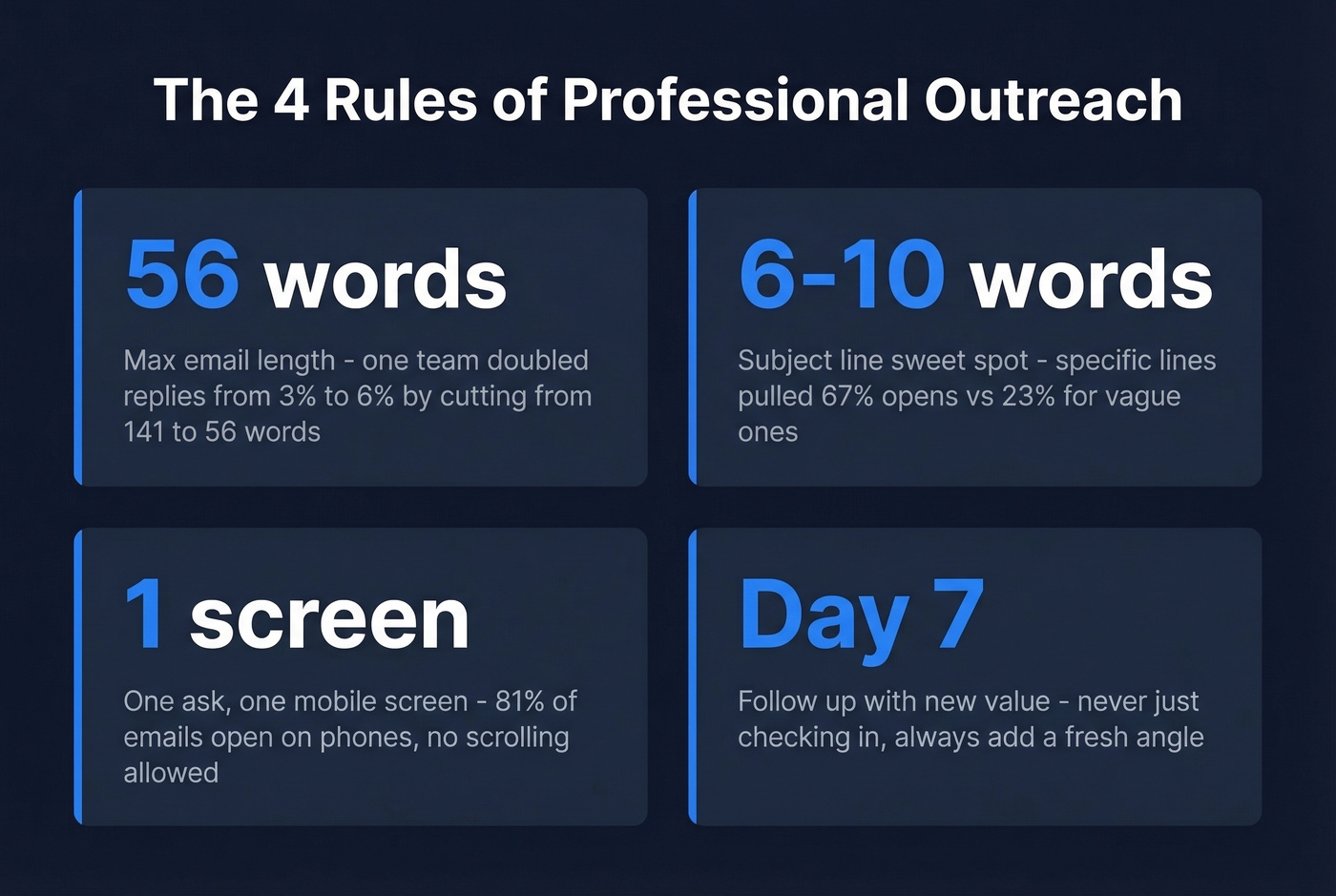
- Keep it under 56 words. One team doubled their reply rate from 3% to 6% just by cutting email length from 141 words to 56.
- Subject line: 6-10 words, specific to them. In one A/B test, a specific subject line pulled a 67% open rate versus 23% for a vaguer version.
- One ask, one mobile screen. 81% of emails are opened on phones. If they have to scroll, you've already lost.
- Follow up on Day 7 with new value - never "just checking in."
Why Email Beats Every Other Channel
Email is the superior channel for cold professional outreach. DMs on social platforms are too informal for most professional contexts and get buried in notification noise. Phone calls to strangers are intrusive. Professional networking platforms cap your message length, which forces you to be vague when specificity is exactly what gets replies.
Email gives you full control over formatting, length, and timing. It sits in a space the recipient has already designated for professional communication, and unlike a DM that disappears into a feed, an email stays in their inbox until they act on it.
That said, a connection request on a professional platform can warm up a cold email if you send it a day or two before. Think of it as a handshake before the conversation - not a replacement for it.
If you want a deeper system for sequencing, see our guide to a B2B cold email sequence.
Four Rules That Get Replies
Keep it short
Three short paragraphs. Under 56 words total. That's not a suggestion - it's the single biggest lever in outreach performance. We've watched reply rates collapse the moment emails cross that line, and the pattern holds across industries, seniority levels, and use cases. Long emails signal that you value your own thoughts more than the recipient's time.
If you need more examples, borrow from these emails that get responses.
Make the ask tiny
Busy people want to help, but you have to make it an "incredibly easy yes." Ask for a 15-minute call, a single email question, or a quick opinion. Never propose a specific time to a stranger - "How is 4pm Thursday?" to someone who doesn't know you reads as presumptuous, not efficient.
For more phrasing options, use this email wording to schedule a meeting guide.
Personalize with specifics
"Big fan of your work" is noise. "Your breakdown of retention metrics in last week's newsletter changed how I think about churn" is signal. Two minutes of research separates you from every generic pitch in their inbox.
If you want a framework, start with personalized outreach.
Send at the right time
Tuesday through Thursday, 8-11am in the recipient's timezone. One practitioner reported opens jumped 16% after shifting to this window. Mondays are inbox-clearing days. Fridays? Mentally checked out.
For a more data-heavy breakdown, see the best time to send cold emails.
Subject Lines That Get Opened
35% of recipients decide whether to open an email based on the subject line alone. That makes it the most important line you'll write.
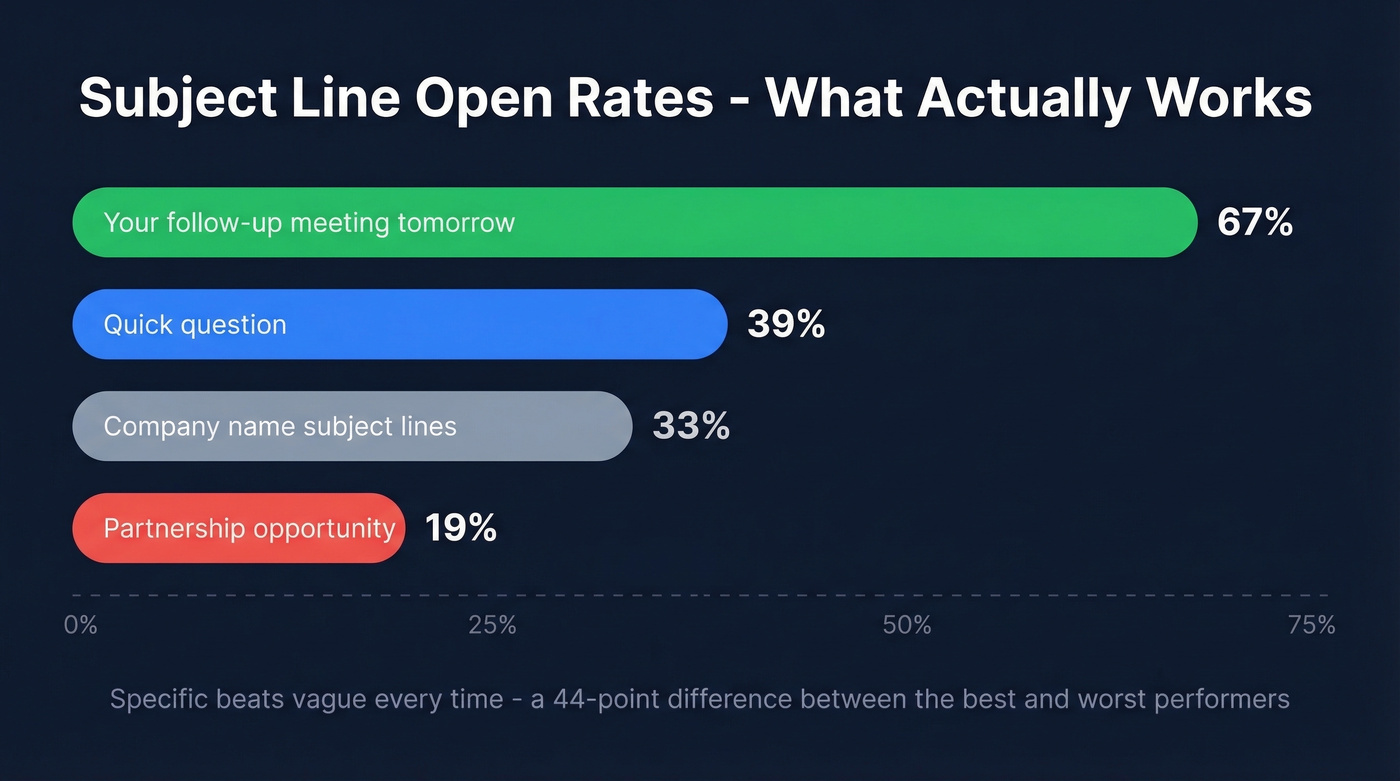
In one A/B test, "Your follow-up meeting tomorrow" pulled a 67% open rate versus 23% for the vague "Meeting tomorrow" - same email, same audience, a 44-point difference. A separate test found "Quick question" hit 39% opens, company-name subject lines landed at 33%, and "Partnership opportunity" scraped below 19%. The pattern is clear: specificity wins, vagueness loses.
The sweet spot is 6-10 words that reference something about them, not about you:
- "Loved your [specific piece] in [publication]"
- "Quick question about [their specialty]"
- "Request for 15-minute call about [topic]"
- "Reaching out via [mutual connection's name]"
- "[Their company] + [your topic] - quick thought"
If you want more options, swipe from these cold email subject line examples.

The perfect subject line won't matter if your email bounces. Prospeo's 98% email accuracy means your carefully crafted outreach actually lands in the inbox - not the void. Find verified professional emails for $0.01 each.
Stop perfecting emails that never arrive. Start with verified data.
Templates for Four Scenarios
Cold Outreach to Someone You Admire
Subject: Loved your [specific piece] - quick question
Hi [Name],
Your [specific work/talk/article] on [topic] really stuck with me - especially [specific detail]. I'm working on something similar and would love your perspective on [one focused question].
Happy to keep it to email if that's easier. Either way, thanks for putting that work out there.
[Your name]
Keep the appreciation genuine and brief. One specific reference beats three paragraphs of praise.
Informational Interview Request
Most informational interview requests fail because they're vague and long. Here's the difference between one that gets ignored and one that gets a reply.
The version that gets ignored:
Hi Sarah, I came across your profile and I'm really impressed by your career trajectory. I'm currently exploring options in the marketing space and would love to pick your brain about your experience. I think there's a lot I could learn from you. Would you be open to chatting sometime? Let me know what works!
That's 60 words of nothing. No specifics, no time boundary, no signal that you've done any homework.
The version that gets replies:
Subject: Request for 15-minute call about [industry/role]
Hi [Name],
I'm exploring [career path/industry] and your experience at [company] stands out - particularly [specific detail]. Would you be open to a 15-30 minute conversation? I've got 5-8 focused questions and I'm happy to work around your schedule.
Completely understand if the timing doesn't work. Thanks either way.
[Your name]
Let them pick the time and format. Mention that you've prepared questions - it signals you won't waste their time. Forbes' guidance aligns here: make the ask explicit, time-bounded, and low-friction.
Warm Introduction via Mutual Connection
A warm intro email has three structural jobs: name the connection, establish the context, and make one small ask.
Open with the connection. "[Mutual connection] suggested I reach out" - this is the entire reason the email gets read. Put it in the first sentence, not the second paragraph. Then establish shared context: "We were discussing [topic] and your name came up" tells them why the connection thought of them, which flatters without being sycophantic. Finally, give two options for the ask - "Would a quick email exchange work, or would you prefer a 10-minute call?" - because giving two options makes saying yes easier than saying no.
Subject: Reaching out via [mutual connection's name]
Hi [Name],
[Mutual connection] suggested I reach out - we were discussing [topic] and your name came up as someone who really knows this space. I'd love to ask you one question about [specific thing].
Would a quick email exchange work, or would you prefer a 10-minute call?
[Your name]
Follow-Up After No Response
Here's the thing: your first message's only job is to get a response. No links, no "book a call," no paragraphs. The follow-up's job is to add new value - a relevant article, a different angle, a lighter ask. Never repeat the same message with "just following up" tacked on.
Subject: Re: [original subject line]
Hi [Name],
Wanted to share [new relevant resource/insight/angle] that connects to what I mentioned last week. Thought it might be useful regardless.
If the timing isn't right, no worries at all - happy to reconnect down the road.
[Your name]
If you want more follow-up options, use these cold email follow-up templates.
The Follow-Up Cadence
Most silence isn't personal. The average cold email response rate is 5.1%, and most campaigns land between 1-5%. For context, Siege Media's outreach campaigns - among the best-documented in the industry - hit 81% open rates, 24% CTR, and a 13% reply rate. That's what "great" looks like, and even great means 87% of people don't reply.
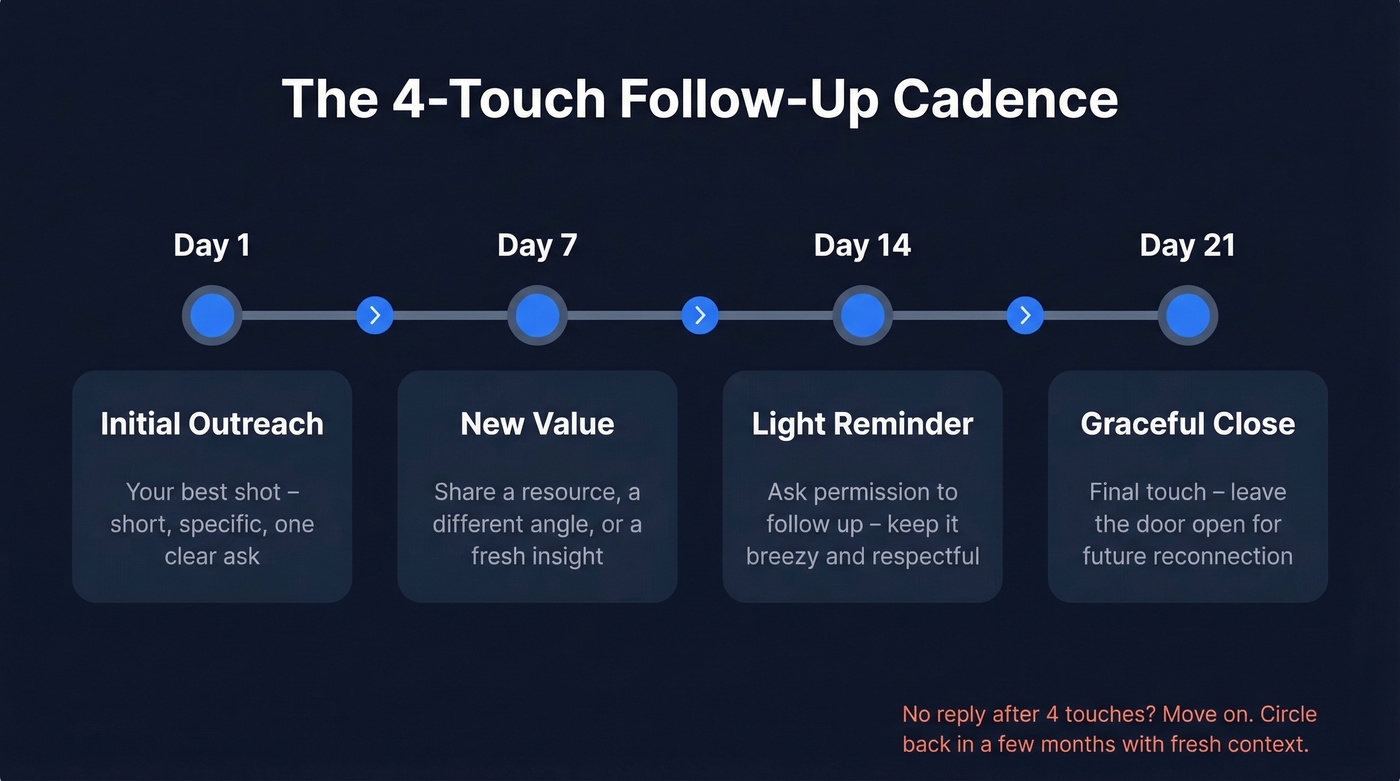
A structured cadence keeps you persistent without being annoying:
| Touch | Timing | What to Send |
|---|---|---|
| 1 | Day 1 | Initial outreach |
| 2 | Day 7 | New value or angle |
| 3 | Day 14 | Light reminder, ask permission |
| 4 | Day 21 | Graceful close |
If you need ready-to-send copy, grab these sales follow-up templates.
Each touch should feel like a different email, not a copy-paste with increasing desperation. If you don't hear back after four touches, move on. You can always circle back in a few months with fresh context.
Let's be honest about something the "networking is relationship-building" crowd gets wrong: your first email to a stranger is transactional. You're asking for something. Pretending otherwise - burying your ask in three paragraphs of forced rapport - is dishonest and wastes their time. Build the relationship after they reply.
Five Mistakes That Kill Replies
Sending to an unverified email
If you want to reduce bounces, start with an email deliverability guide and keep an eye on your email bounce rate.
Writing essays
If your email is over 56 words, cut it. Every word past that threshold is working against you. In our experience, the 56-word line isn't arbitrary - it's where attention drops off a cliff.
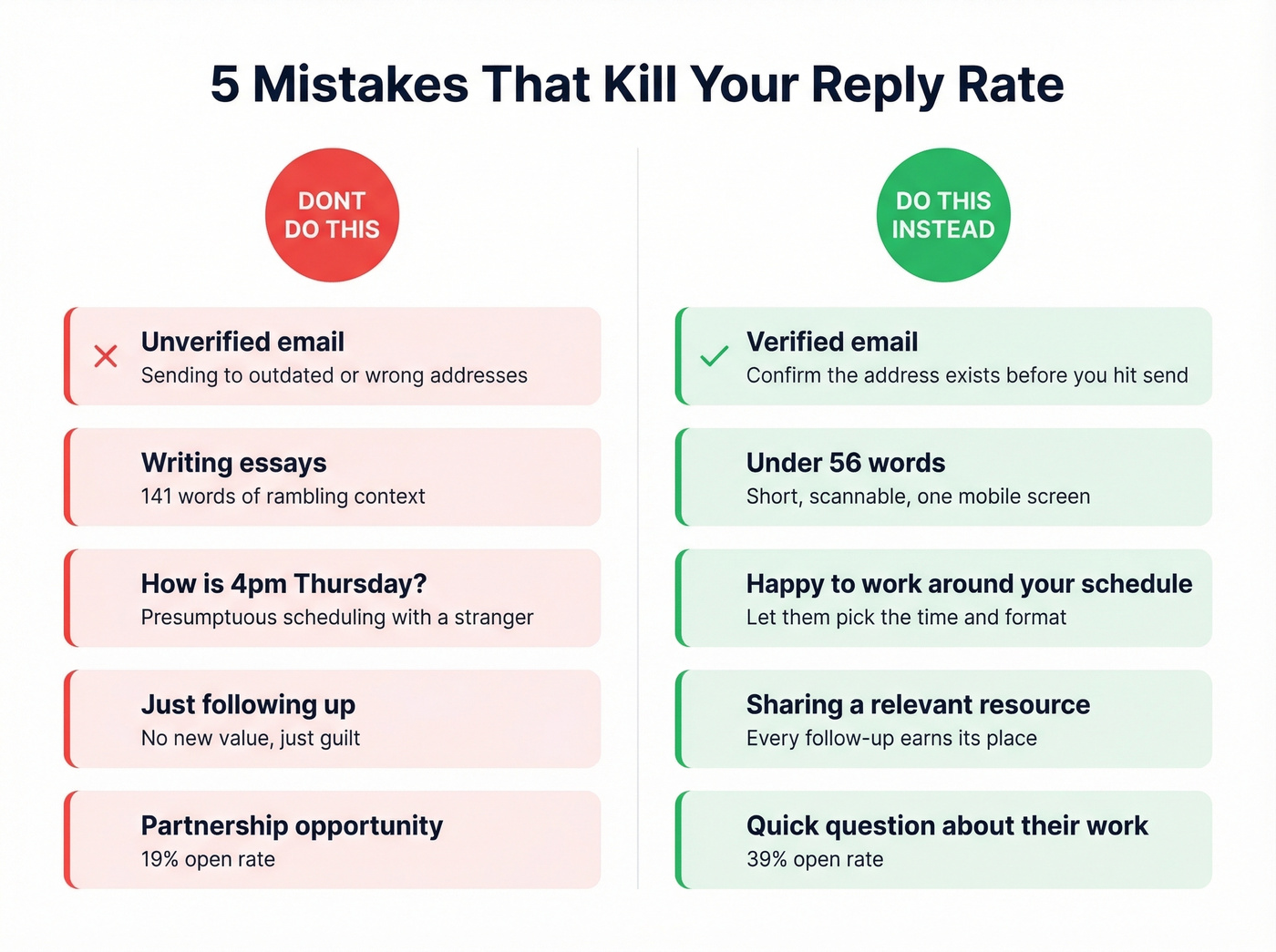
Presumptuous scheduling
"How is 4pm Thursday?" to a stranger is a fast way to get ignored. Offer flexibility: "Happy to work around your schedule" or "Would email work better?"
"Just following up"
Real talk: "just following up" is the outreach equivalent of "per my last email." Everyone hates it. If you don't have something new to share - a resource, a different angle, a lighter ask - don't follow up yet. Wait until you do.
If you’re tempted to write it anyway, use these alternatives for how to say just checking in professionally.
Generic subject lines
"Partnership opportunity" gets below 19% opens. "Quick question about [their actual work]" gets 39%. The data isn't ambiguous.
Make Sure Your Email Arrives
Even a perfect message is useless if your email bounces. Avoid ALL CAPS, spam-trigger words like "FREE" or "GUARANTEED," and keep your list clean by verifying addresses before you send. Keep paragraphs short and mobile-friendly - remember, 81% of emails are opened on phones.
If you're reaching out internationally, adjust your formality. Cultures like Japan, South Korea, and the Netherlands tend to favor directness and getting to the point, while Italy and much of Latin America expect relationship-building before any ask. A quick look at your recipient's cultural context can mean the difference between a reply and a delete.
Skip all of this if you're reaching out to someone you've already met in person - a warm "great meeting you at [event]" email doesn't need the same structure. Just be human, reference the conversation, and make your ask.
Don't have their email? Prospeo's Chrome extension finds verified contact info from any professional profile or company website in one click - 40,000+ users rely on it daily.
You just spent 10 minutes writing the perfect cold email. Don't waste it on an outdated address. Prospeo refreshes 300M+ contacts every 7 days - so the person you're reaching out to actually receives your message.
Great outreach deserves data that's less than a week old.
FAQ
How long should a professional outreach email be?
Under 56 words - three short paragraphs max. One team doubled their reply rate by cutting from 141 to 56 words. If it doesn't fit on one mobile screen without scrolling, it's too long.
How many times should I follow up?
Three to four times over 21 days, each adding new value - a relevant article, a different angle, or a lighter ask. Never send the same message twice. After four touches with no response, move on and circle back in a few months.
What's the best way to find someone's professional email?
Use a verified email finder like Prospeo - it covers 143M+ verified addresses at 98% accuracy. Sending to an unverified or guessed address risks bounces that hurt your domain reputation and tank deliverability for every future email you send.
When is the best time to send a networking email?
Tuesday through Thursday, 8-11am in the recipient's timezone. One practitioner reported a 16% jump in opens after shifting to this window. Avoid Mondays (inbox-clearing mode) and Fridays (mentally checked out).