

How to Write a Cold Email That Actually Gets Replies
You downloaded a "proven cold email template," swapped in your company name, and blasted 500 prospects. Open rate looked decent. Reply rate? Flatline. The consensus on r/coldemail is clear: once a template gets widely copied, it dies. Every inbox is drowning in the same "Hey [Name], noticed you [generic observation]..." opener, and prospects delete it on autopilot.
Here's the thing: if you're figuring out how to write a cold email for sales, templates aren't the answer - systems are. The Instantly 2026 benchmark report puts the average cold email reply rate at 3.43%. Top 10% of senders hit 10.7%+. The gap between those two numbers isn't copy talent. Let's build the system that closes it.
What You Need Before Anything Else
Before you spend an hour agonizing over word choice:
- Fix your infrastructure first. Verification, authentication, warm-up. Copy doesn't matter if emails bounce. (If you want the full checklist, use this email deliverability guide.)
- Write under 80 words using a framework (PAS is the easiest), not a copied template.
- Send 3-4 follow-ups spaced 2-4 days apart. 42% of replies come from follow-ups. (More detail: follow-up email reply rate.)
Before You Write a Word
Most guides on cold sales emails jump straight to subject lines. That's backwards. If your emails bounce or land in spam, the best copy in the world won't save you. We've seen teams rewrite their sequences five times before realizing the problem was never the words - it was the plumbing.
Verify Your List
Bad email addresses don't just waste sends - they torch your sender reputation. Every bounce tells Gmail and Outlook you're sloppy, and they start routing your emails to spam even for valid addresses. This is the single most overlooked step in cold outreach, and it's the one that matters most. (Benchmarks + fixes: email bounce rate.)
Prospeo's 5-step verification catches invalid addresses, spam traps, and catch-all domains before they do damage - 98% email accuracy with a free tier covering 75 emails per month, enough to test your first campaign. Stack Optimize built to $1M ARR keeping client deliverability above 94% with bounce rates under 3%. Meritt dropped their bounce rate from 35% to under 4%. (If you’re comparing tools, see Bouncer alternatives.)

Authenticate Your Domain
Gmail enforced SPF, DKIM, and DMARC for bulk senders as of February 2024. Outlook followed with high-volume enforcement in May 2025. If you haven't set these up, your emails are already getting filtered.
Quick checklist: one SPF record per hostname (stay under the 10 DNS lookup limit), DKIM with 2048-bit keys, and DMARC starting at p=none with reporting enabled. Move to quarantine or reject once alignment is clean. Send from a dedicated subdomain like outreach.yourdomain.com to protect your primary domain reputation, and use a custom tracking domain so you're not inheriting shared reputation from your email tool. (Related: DMARC alignment and tracking domain.)
Warm Up Your Inbox
Don't blast 200 emails from a fresh domain. Ramp gradually over four weeks: (Tooling options: unlimited email warmup.)
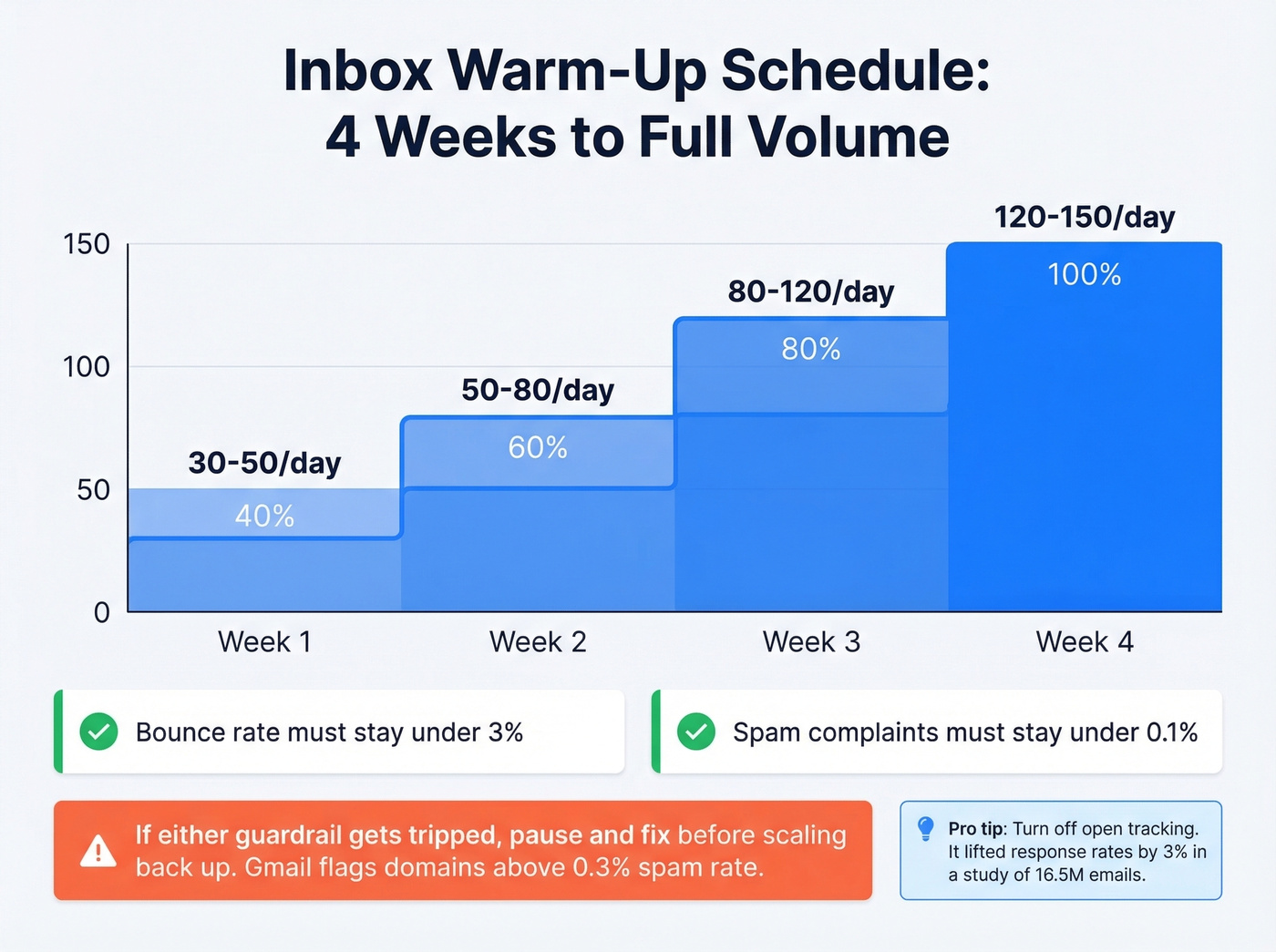
- Week 1: 30-50/day
- Week 2: 50-80/day
- Week 3: 80-120/day
- Week 4: 120-150/day (only if bounce stays under 3% and spam complaints under 0.1%)
If either guardrail gets tripped, pause and fix the issue before scaling back up. Gmail's Postmaster Tools flags domains that exceed a 0.3% spam rate, so aim well below that. Plain text emails, one link max, and skip the HTML templates entirely. (More: email velocity and email spam checker.)
A study of 16.5M cold emails found that turning off open tracking lifted response rates by 3%. Most senders obsess over open rates while the tracking pixel itself is hurting their inbox placement. Stop watching opens. Watch replies.
Anatomy of a Sales Cold Email
Subject Line
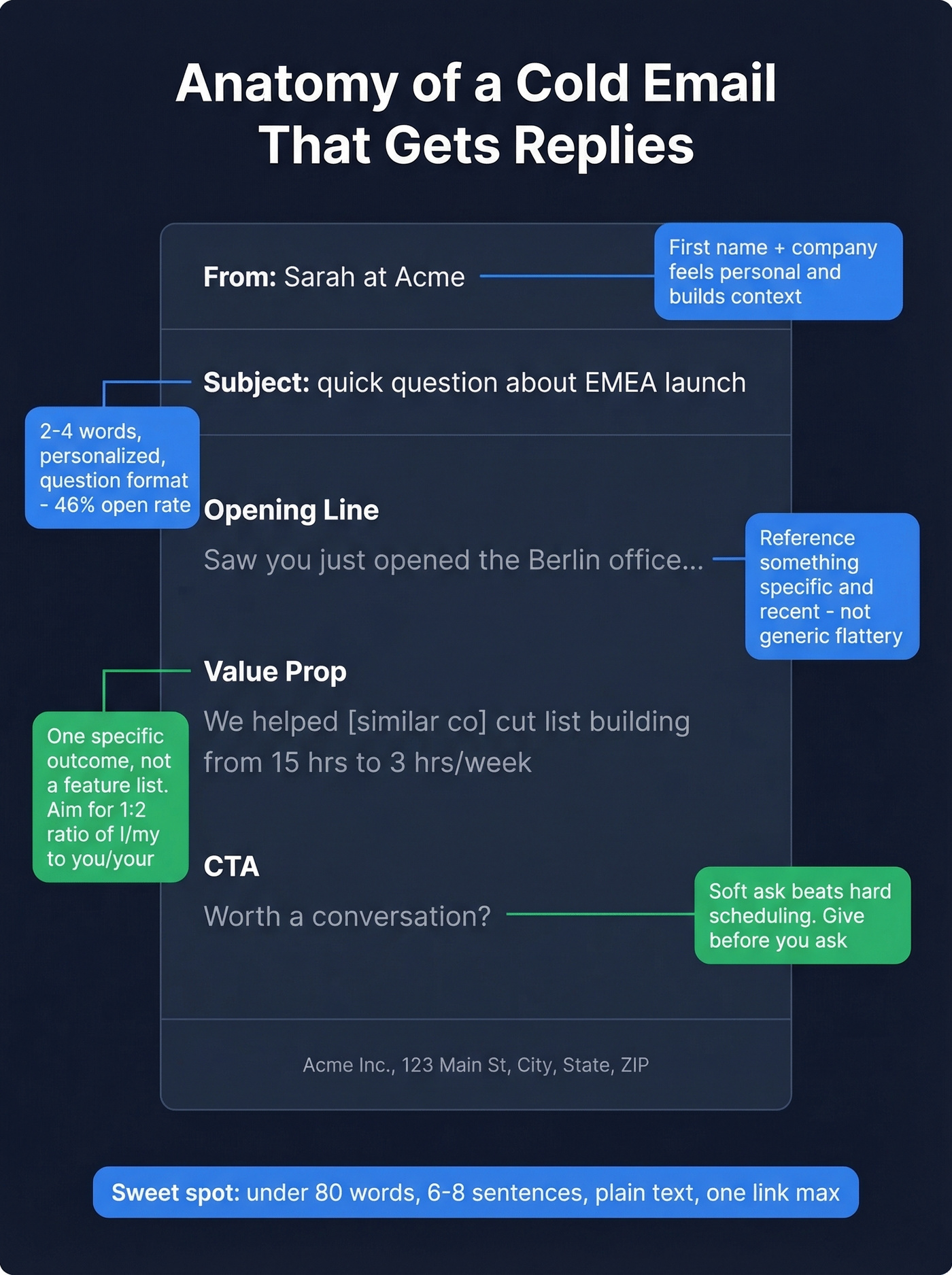
A Belkins study of 5.5M emails found that personalized subject lines pulled a 7% reply rate versus 3% without - a 133% lift. The sweet spot is 2-4 words, which hit a 46% open rate. Question-style formats performed best. Skip urgency words like "ASAP" or gimmicky greetings; they push opens below 36%. (Need ideas? See cold email subject line examples.)
Opening Line
"I read your blog post" is dead. Every SDR writes it, and nobody believes it.
Reference something specific and recent - a hiring signal, a product launch, a shift in their tech stack. The goal is to prove you did 30 seconds of research, not that you can Google their name. We've found that mentioning a concrete detail from the last two weeks gets the highest engagement, because it signals genuine attention rather than a mail merge field. (More tactics: personalized outreach.)
Sender Name
Don't overlook the "From" line. "Sarah at Acme" outperforms "Sarah Johnson" or "Acme Sales Team" because it feels personal while still establishing context. Test first name only versus first name + company for your audience.
Value Proposition
One specific outcome. Not a feature list, not your company's mission statement. "We helped [similar company] cut list-building from 15 hours to 3 hours per week" beats "Our platform uses AI-powered data enrichment to optimize your sales workflow" every time. (If you want to go deeper on structure, see email copywriting.)
A useful heuristic: aim for a 1:2 ratio of "I/my" to "you/your" in your email. If you're talking about yourself more than the prospect, rewrite.
CTA
Soft asks outperform hard scheduling. "Worth a conversation?" or "Interested?" beats "Book 30 minutes on my calendar Tuesday at 2pm." The r/copywriting consensus backs this up - low-friction offers like "I'll audit your top 3 landing pages and send a Loom" dramatically outperform meeting requests. Give before you ask. (More examples: email call to action.)

You just learned that bad data kills cold email campaigns before your copy even gets a chance. Prospeo's 5-step verification delivers 98% email accuracy - the same data Stack Optimize used to build a $1M agency with bounce rates under 3%.
Stop rewriting emails. Start verifying the addresses you're sending them to.
Frameworks That Replace Templates
Stop copying templates. Learn three frameworks and you'll never need one again.
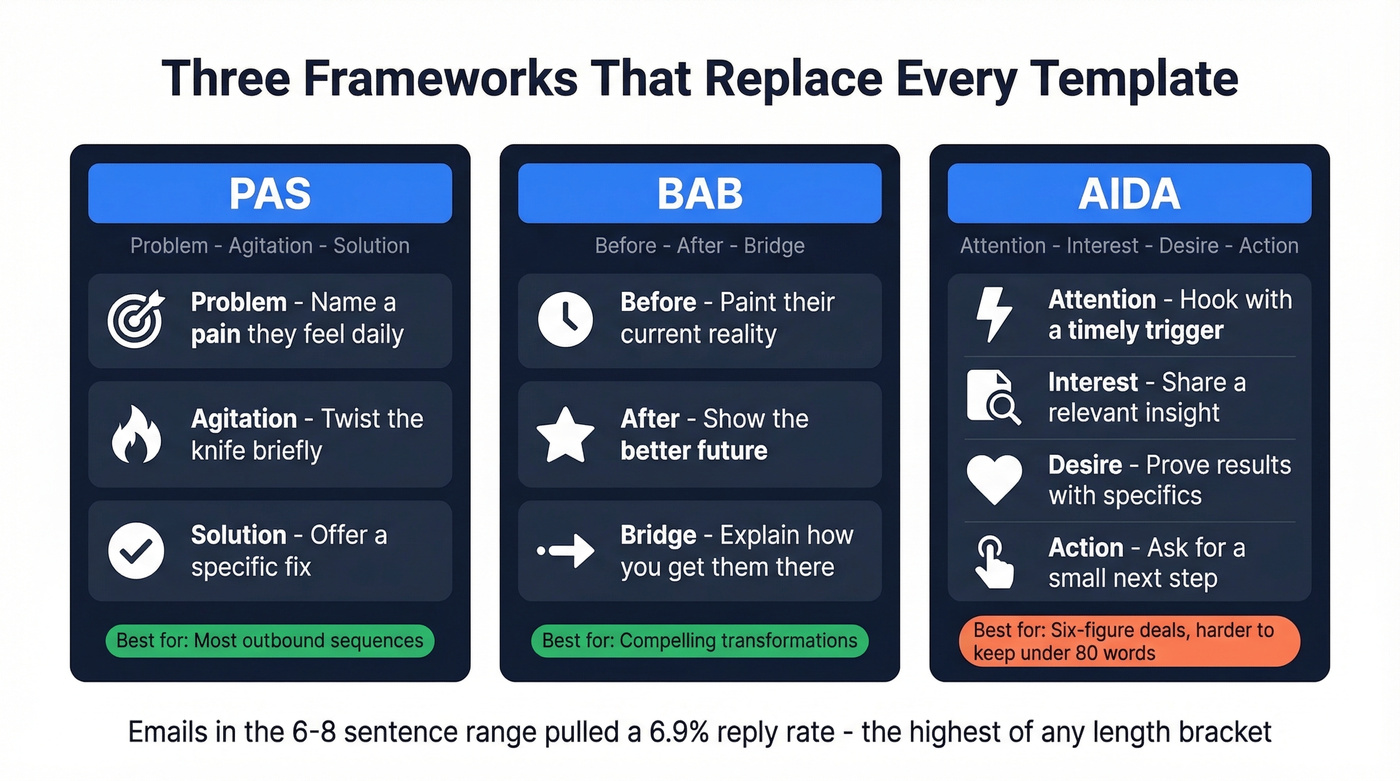
PAS (Problem - Agitation - Solution) is the workhorse. Name a problem, twist the knife briefly, offer a specific fix. Here's what it looks like at 47 words:
Building targeted prospect lists probably eats 10+ hours of your team's week. That's time your reps could spend actually selling. We cut that to under 2 hours for [similar company]. Worth a quick look?
BAB (Before - After - Bridge) works when the "after" is genuinely compelling:
Right now your reps spend Monday mornings building lists. Imagine they walked in to 50 verified contacts already in their CRM. That's what we set up for [similar company] - happy to show you how.
AIDA (Attention - Interest - Desire - Action) is harder to execute in under 80 words, but powerful for six-figure deals: (If you want the funnel view, see AIDA Sales Funnel.)
[Company] just expanded into EMEA - congrats. Most teams scaling internationally see reply rates drop 40% from bad contact data. We kept [similar company]'s reply rate above 8% through their APAC launch. Worth 10 minutes?
The data backs the "6-8 sentences, under 200 words" zone: emails in that range pulled a 6.9% reply rate, the highest of any length bracket. A/B test one variable at a time - subject line, opening line, or CTA. Run the variant on 20% of your list, then deploy the winner to the rest.
Follow-Up Strategy
58% of replies come from the first email. That means 42% come from follow-ups - you're leaving almost half your replies on the table if you send once and quit.
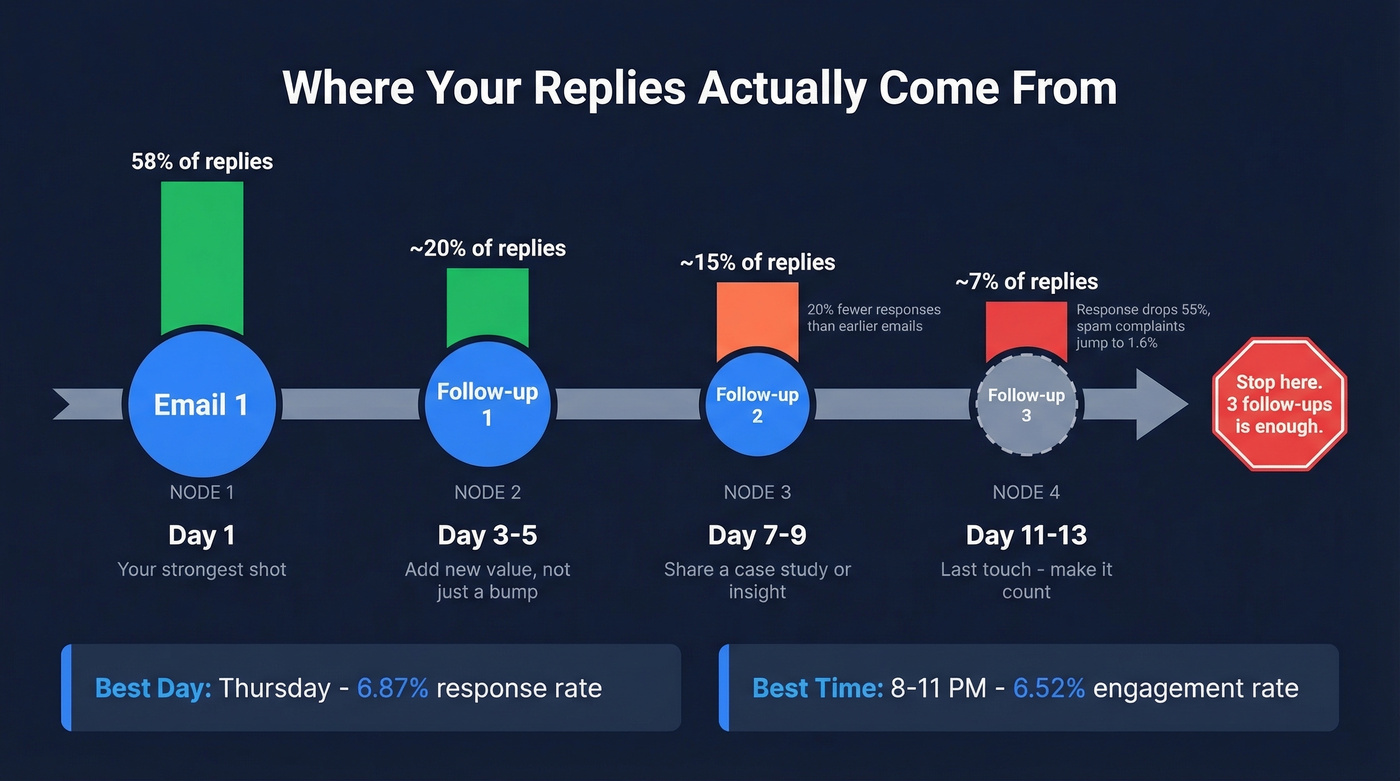
A practical sequence is 3-4 touchpoints spaced 2-4 business days apart. Each follow-up should add new value, not just "bumping this to the top of your inbox." The third follow-up brings 20% fewer responses than earlier emails, and by the fourth, response rates drop 55% while spam complaints climb from 0.5% to 1.6%. (If you need copy, use these cold email follow-up templates.)
Three follow-ups is enough for most sequences. After that, you're burning goodwill faster than you're generating replies.
Timing matters more than most people think. Thursday is the best day for replies at a 6.87% response rate, and the 8-11 PM window produces the highest engagement at 6.52%. If you want to lean into that pattern, schedule your sends so your emails land near the top of the inbox heading into Thursday morning. I've personally seen a 2x difference in reply rates just from shifting send times by a few hours - it's one of the easiest wins you'll find.
The frameworks above only work when they land in real inboxes. Prospeo gives you verified emails at $0.01 each, refreshed every 7 days - so your PAS and BAB sequences reach actual decision-makers, not dead addresses.
Meritt tripled their pipeline to $300K/week after fixing their data. Your turn.
Compliance in 60 Seconds
CAN-SPAM (US): Applies to all commercial email, including B2B. Penalties up to $53,088 per email. Include a valid physical address, provide a clear opt-out, and honor unsubscribes within 10 business days.
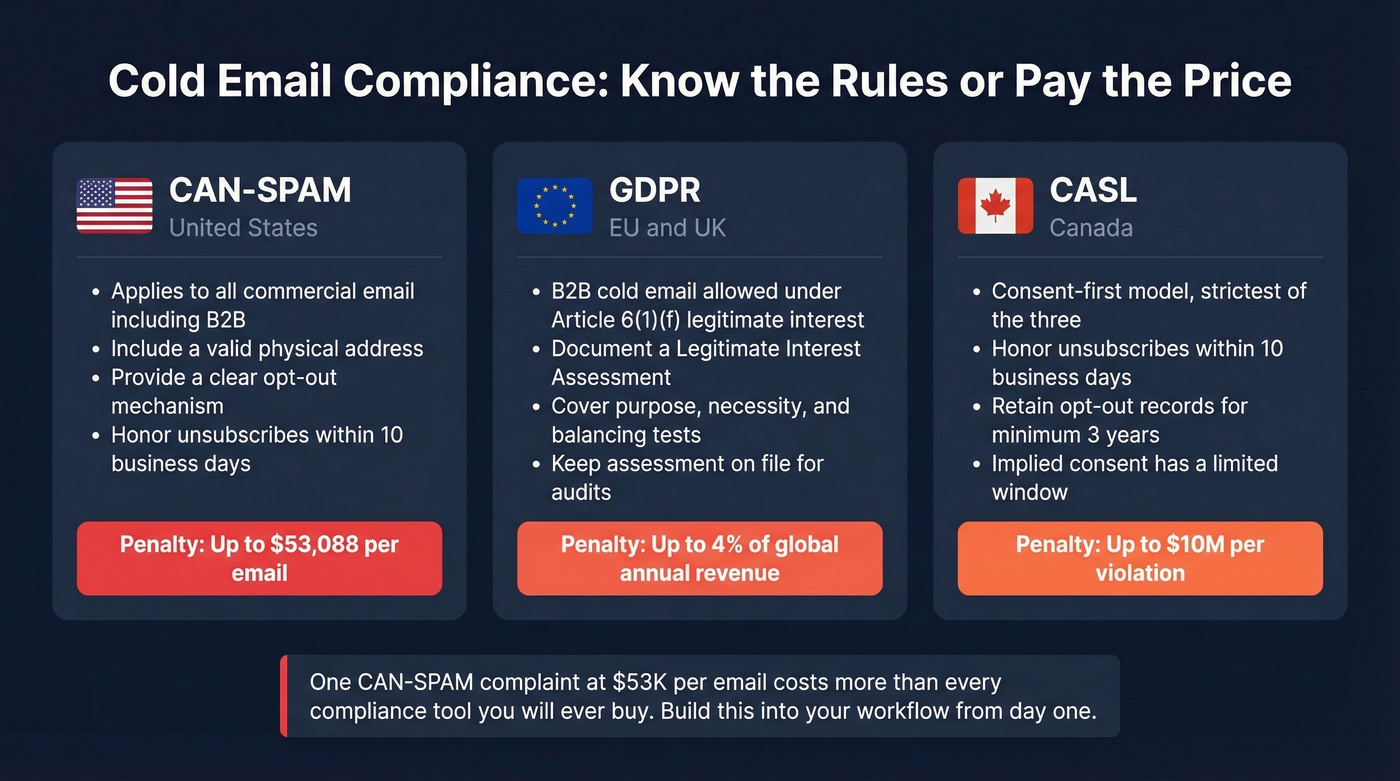
GDPR (EU/UK): B2B cold email is permissible under Article 6(1)(f) legitimate interest. Document a Legitimate Interest Assessment covering purpose, necessity, and balancing tests. Keep it on file.
CASL (Canada): Consent-first model. Honor unsubscribes within 10 business days and retain opt-out records for a minimum of 3 years.
One CAN-SPAM complaint at $53K per email will cost more than every compliance tool you'll ever buy. Build this into your workflow from day one - not after your first violation.
FAQ
What reply rate should I expect?
The average cold email reply rate is 3.43%, while top-performing senders hit 10.7%+. If you're below 2%, fix your deliverability setup - domain authentication, list verification, inbox warm-up - before rewriting any copy.
How long should a sales cold email be?
Under 80 words is a strong default for outbound prospecting. Research on 16.5M cold emails found 6-8 sentence messages pulled a 6.9% reply rate, the highest of any length bracket. Cut ruthlessly.
How do I keep cold emails out of spam?
Authenticate your domain (SPF, DKIM, DMARC), warm up your inbox over 4 weeks, verify every address before sending, and keep spam complaints under 0.1%. Send plain text with one link max. Verification tools that catch spam traps and catch-all domains before you send are non-negotiable - a single bad batch can tank months of reputation building.
What's the biggest cold email mistake?
Focusing on copy before infrastructure. No subject line trick will overcome poor deliverability. Verify your list, authenticate your domain, and warm up your inbox - then worry about the words. Teams that nail the plumbing first consistently land in the top 10% of senders.