

How to Write an Email Offering Services That Actually Gets Replies
Forget proposal letters. Formal pitches from strangers rarely get read. If you want to know how to write an email offering services that gets replies, the formula is simple: four sentences that prove you understand their problem. Do that and you'll outperform most of the service emails clogging inboxes right now.
Three Non-Negotiables
- Lead with the outcome, not the service
- Keep it under 80 words with a single CTA
- Verify the email address before you hit send
Why Most Service Emails Die in the Inbox
The average cold email reply rate is 3.43%. Top-quartile campaigns hit 5.5%; elite ones exceed 10%. The gap between average and elite usually comes down to one thing: you're describing your service instead of the outcome your prospect gets.
Compare these two versions:
Before (service-focused):
"We offer comprehensive SEO services including on-page optimization, link building, and technical audits for local businesses."
After (outcome-focused):
"Your top competitor ranks #1 for 'Denver plumber' and gets ~400 clicks/month you're missing. We can close that gap in under 90 days - or you don't pay. Worth a quick chat?"
The second version names a specific problem, quantifies the cost of inaction, and reverses the risk. A practitioner on r/coldemail nailed it: most cold emails fail because they describe the service instead of the outcome. That single shift is the difference between delete and reply.
The Five-Part Framework
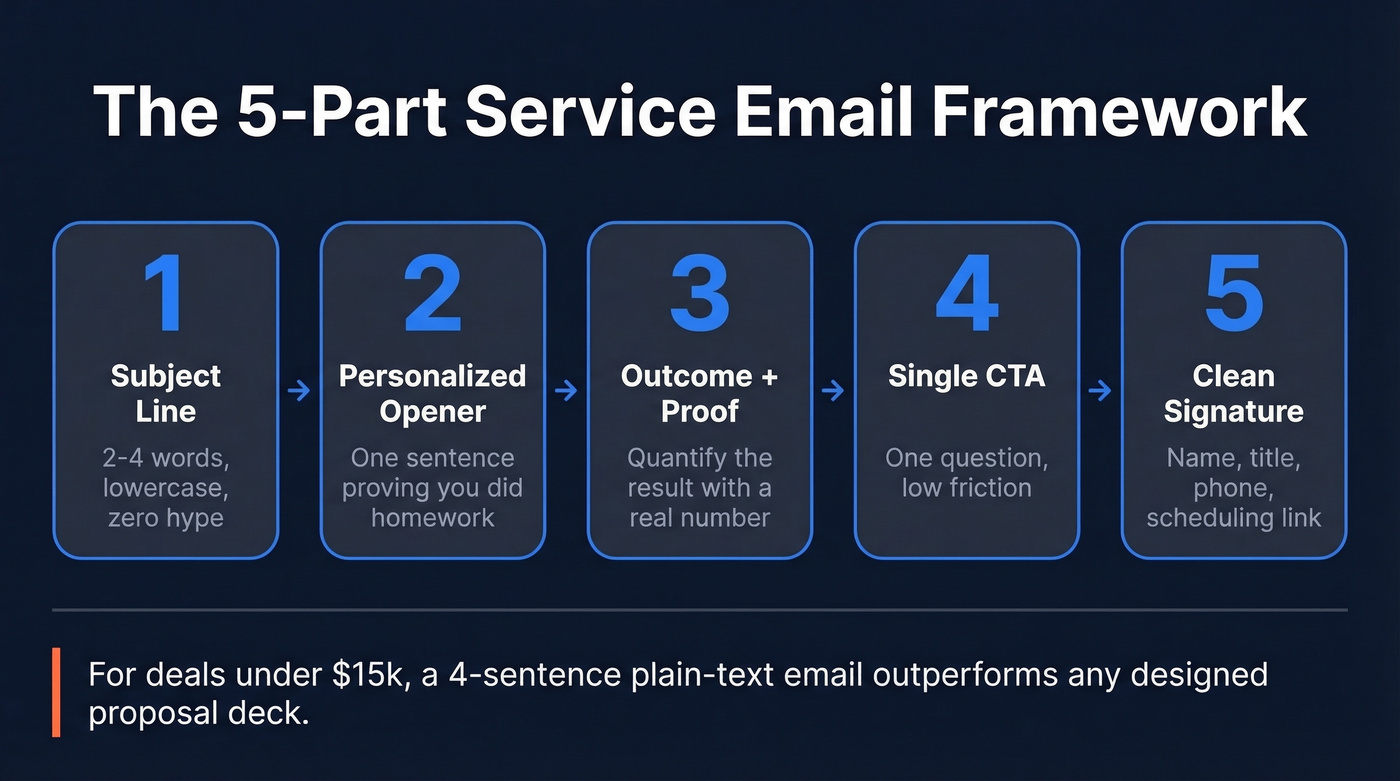
Most high-performing service emails follow five components. Miss one and the whole thing falls apart.
1. Subject Line
Two to four words, lowercase, zero hype. That's it. If you want more patterns, pull from proven subject lines that get opened.
2. Personalized Opener
One sentence proving you've done homework - reference their company, a recent hire, a competitor gap. Generic openers like "I hope this finds you well" get you deleted. (More on personalized outreach if you need a system.)
3. Outcome + Proof
Quantify the result. "We helped [similar company] increase demo bookings by 40% in 60 days" beats "we provide demand generation services" every time. If you don't have a case study yet, use an industry benchmark or a specific observation about their business that implies the gap. This is classic email copywriting: specificity beats adjectives.
4. Single CTA
One question, low friction. "Worth a 15-minute call this week?" Multiple CTAs split attention and hurt reply rates. If you want more options, see email wording to schedule a meeting.
5. Clean Signature
Name, title, company, phone, and a one-click scheduling link. Keep it tight. 81% of emails are opened on mobile - long signatures push the actual message off-screen.
Skip PDF attachments. Skip HTML formatting or embedded images. Plain text wins for cold outreach.
Here's the thing: for deals under $15k, a four-sentence plain-text email will outperform any designed proposal deck you've ever sent. We've seen it over and over - the teams that strip everything back are the ones booking meetings.
A/B test one variable per week: subject line, CTA phrasing, or send time. The campaigns that consistently beat 5.5% reply rates test relentlessly. (If you're building a full sequence, use a B2B cold email sequence structure.)
Subject Lines That Get Opened
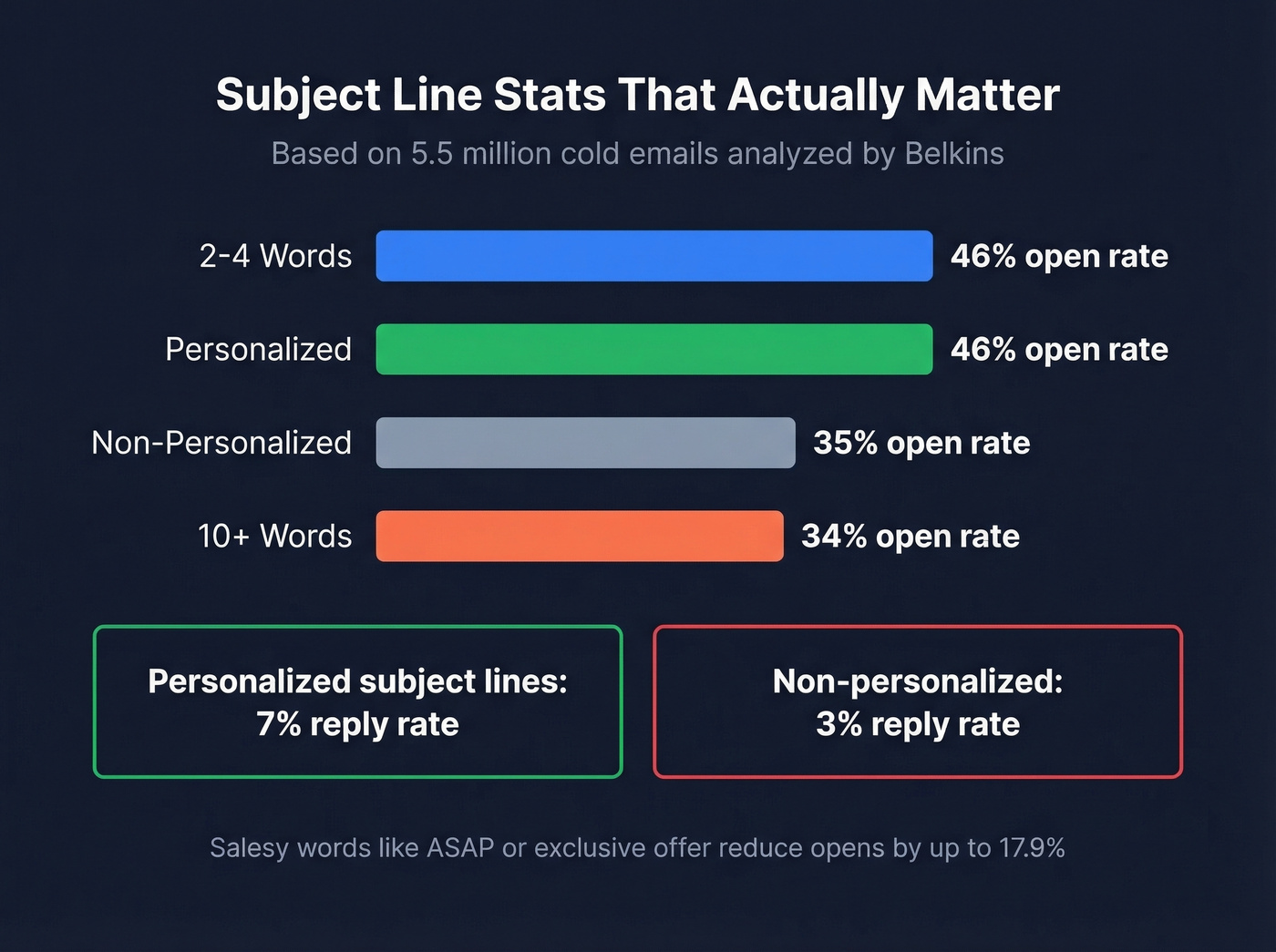
A Belkins study of 5.5 million emails found that length and personalization are two of the biggest levers:
| Subject Line Style | Open Rate |
|---|---|
| 2-4 words | 46% |
| Personalized | 46% |
| Non-personalized | 35% |
| 10+ words | 34% |
Personalized subject lines also doubled reply rates - 7% vs 3% without personalization. Salesy language like "ASAP," "exclusive offer," or "limited time" reduces open rates by up to 17.9% across large-scale cold email datasets. And an empty subject line boosts opens by 30% but cuts replies by 12% - gimmicks backfire.
Write subject lines that look like internal emails, not marketing campaigns. All lowercase, no punctuation tricks, no emojis. Good: "quick question," "denver seo," "{{firstName}} - idea." Bad: "Exclusive Offer Inside!" or "Let's Transform Your Marketing."

You just learned how to write a service email that gets replies. Now make sure it actually arrives. Prospeo verifies every email through a 5-step process - 98% accuracy, catch-all handling, spam-trap removal. One bounced email can torch your domain reputation. At $0.01 per verified address, there's no reason to risk it.
Don't let a perfect email bounce. Verify first.
Service Email Templates You Can Steal
Each template is under 80 words, outcome-focused, with a single CTA. Use them as a starting point, then customize the proof points for your niche.
Marketing agency:
Subject: {{company}} paid search
Hi {{firstName}}, I looked at {{company}}'s paid search - you're bidding on 12 keywords where {{competitor}} outranks you. We helped a similar {{industry}} brand cut CPA by 35% in 60 days by restructuring their campaign architecture. Would it make sense to show you what we'd change?
Consulting/strategy:
Hi {{firstName}}, {{company}} just raised Series B - congrats. Most post-Series B teams we work with find their sales process breaks between 15 and 30 reps. We helped {{similar company}} cut ramp time from 9 weeks to 4. Worth a 15-minute call to see if that's relevant?
Freelance creative:
Hi {{firstName}}, I write for {{notable client}} and {{notable client}}. Your product pages are strong, but your blog hasn't been updated since March - companies in {{industry}} that publish weekly see 2-3x more organic traffic within 6 months. Happy to send samples if you're exploring content.
Tech/SaaS services:
Hi {{firstName}}, I noticed {{company}} is running {{technology}} without {{integration}}. That usually means 5-10 hours/week of manual data entry. We built an integration for {{similar company}} that cut that to zero. Quick call to see if it fits?
Notice the pattern across all four: specific observation, quantified outcome, proof from a similar company, one question. No bullet lists of services. No "we're a full-service agency." Just the problem and the fix.
Follow-Up Sequence That Works
58% of replies come from the first email, but follow-ups contribute the other 42%. The sweet spot is 4-7 touchpoints:
If you want plug-and-play options, start with these cold email follow-up templates and adapt the proof points.
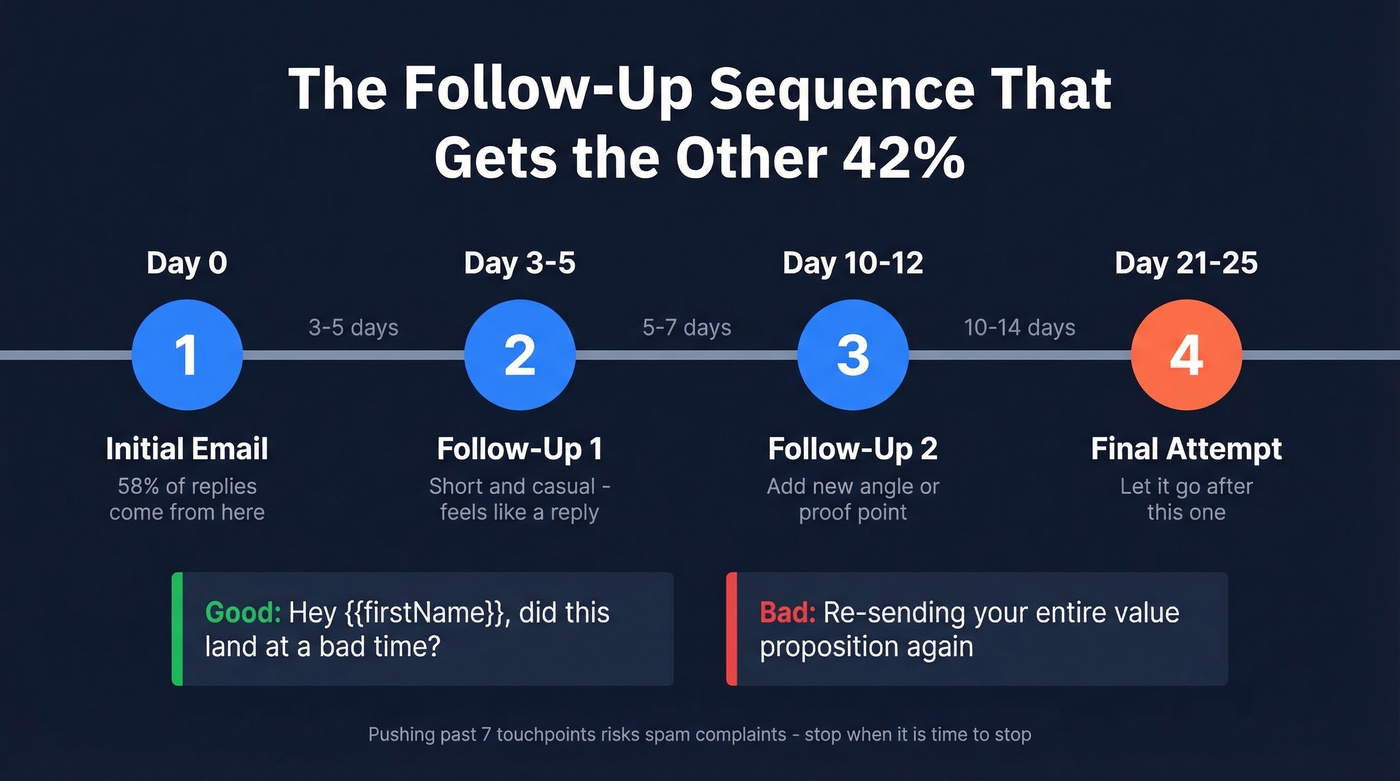
- Follow-up 1: 3-5 days after initial email
- Follow-up 2: 5-7 days later
- Final attempt: 10-14 days later
We've tested dozens of follow-up sequences, and the ones that feel like replies - short, casual, no re-pitching - consistently outperform formal follow-ups by about 30%. Think "Hey {{firstName}}, did this land at a bad time?" instead of re-sending your entire value proposition. If someone hasn't replied after your final attempt, let it go. Pushing past seven touchpoints annoys people and risks spam complaints.
Make Sure Your Email Arrives
A perfectly written email offering services is worthless if it bounces or lands in spam. If you're troubleshooting, this email deliverability guide breaks down the root causes.
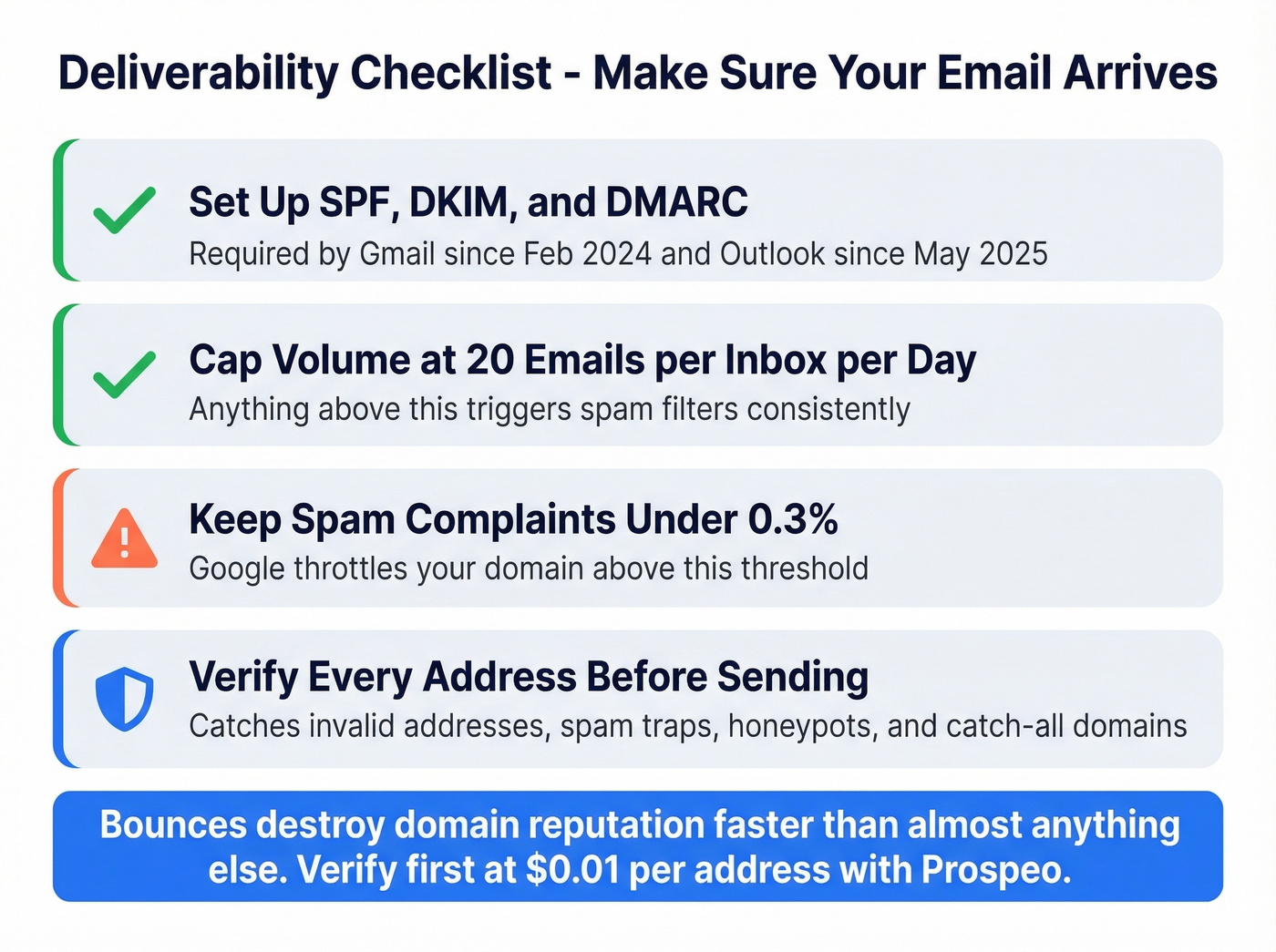
- Set up SPF, DKIM, and DMARC on your sending domain. Gmail has required this since February 2024, and Outlook enforced it for high-volume senders starting May 2025. (If you need examples, use these SPF record examples.)
- Cap volume at 20 emails per inbox per day. The consensus on r/coldemail is that anything above this triggers spam filters, and our own testing backs that up. For a deeper breakdown, see email velocity.
- Keep spam complaints under 0.3%. Google throttles your domain above that threshold. If you're trying to recover, follow this playbook to improve sender reputation.
- Verify every address before you send. Bounces destroy domain reputation faster than almost anything else. We run every list through Prospeo before launching a sequence - it catches invalid addresses, spam traps, honeypots, and catch-all domains with 98% accuracy. The free tier gives you 75 verifications per month, which is enough to test your first campaign without spending a dime. (Benchmarks and fixes: email bounce rate.)
Legal Requirements You Can't Skip
- CAN-SPAM (US): Include a valid physical address and an easy opt-out. Process opt-outs within 10 business days. Penalties run up to $53,088 per violation.
- GDPR (EU/UK): You need legitimate interest or explicit consent. Fines reach up to EUR 20M or 4% of global annual turnover.
- The key difference: The US uses an opt-out model - you can email until they say stop. The EU uses opt-in. If you're emailing prospects in Europe, know the distinction before you press send.
Let's be honest: most people skip this section. Don't. One complaint from a European prospect who didn't consent can cost you more than your entire outbound campaign generates in a year.
Those templates above need real contact data to work. Prospeo gives you verified emails and direct dials for 300M+ professionals - with 30+ filters to find exactly the decision-makers your service helps. Build a targeted list, verify every address, and send with confidence knowing your bounce rate stays under 4%.
Find the right inbox, then send the right message.
FAQ
How long should a service-offering email be?
Under 80 words - roughly four sentences. Include a personalized opener, one quantified outcome, a proof point, and a single low-friction CTA. Emails exceeding 125 words see reply rates drop by 15-20% in most benchmarks.
How many follow-ups should I send?
Four to seven touchpoints spaced 3-14 days apart. Follow-ups contribute 42% of total replies, so stopping after one email leaves nearly half your responses on the table.
How do I pitch services without sounding salesy?
Lead with the prospect's problem, not your credentials. Reference something specific about their business - a competitor gap, a recent funding round, a broken workflow - and tie your outcome to that. When you frame the email around their situation rather than your service list, it reads like a helpful note instead of a pitch.
How do I keep service emails out of spam?
Set up SPF, DKIM, and DMARC on your sending domain. Keep volume under 20 emails per inbox per day. Verify every address before sending - catching invalid addresses and spam traps before they hit your sender reputation is the single highest-ROI thing you can do for deliverability.