

How to Write Outreach Emails That Actually Get Replies
An agency owner we know spent $2K on a bulk email stack - PhantomBuster, Enrow, Instantly, the works. He closed two clients in two months. Then he switched to sending 120 handcrafted emails in a single month. Twenty-five replies. Five calls. Three clients closed.
Only 8.5% of outreach emails get a response, per a Backlinko study of 12 million messages. Most people blame their copy. But if you want to learn how to write outreach emails that actually work, the real problem starts earlier than the writing.
What You Need First
Three things matter, in this order:
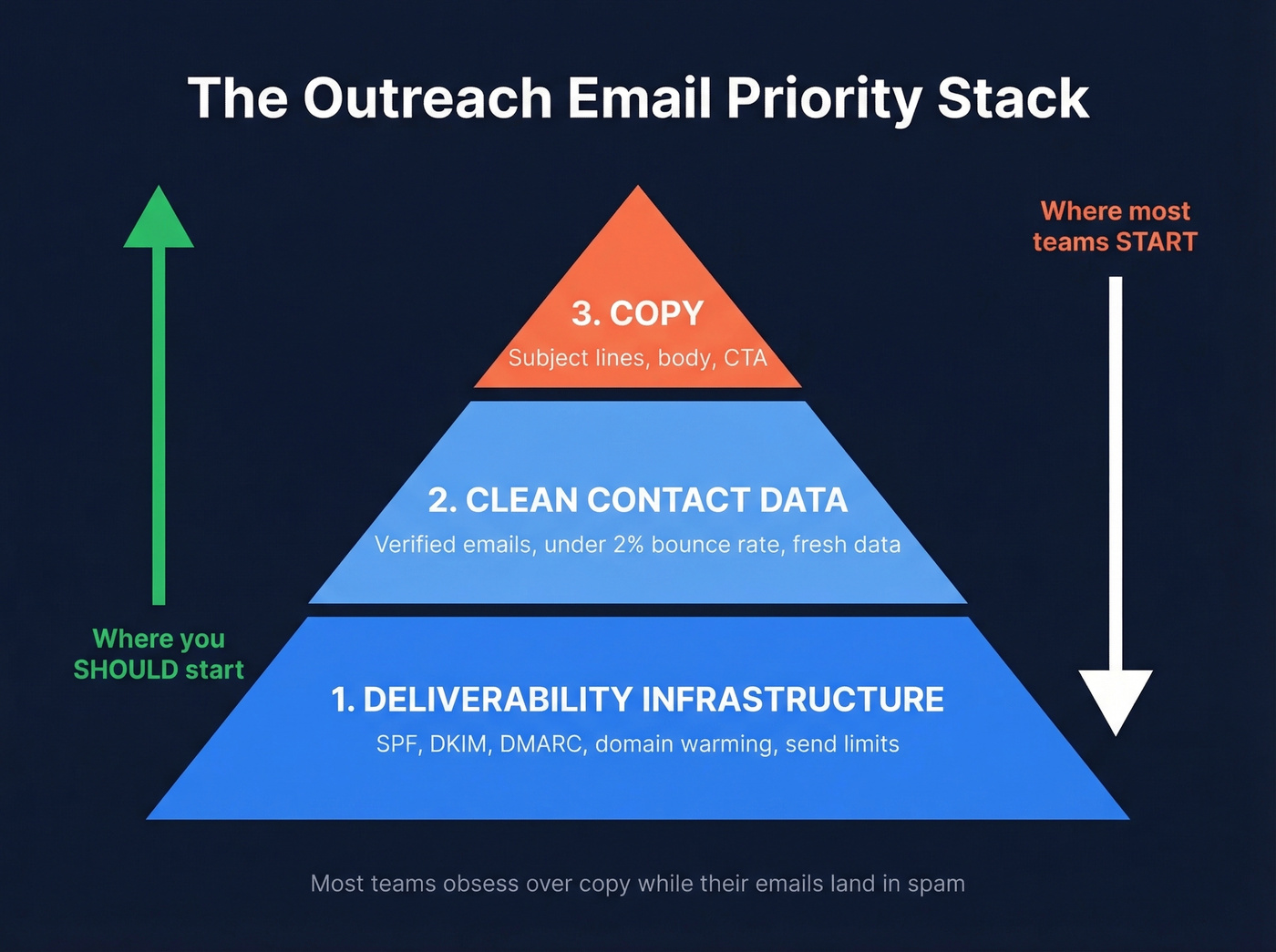
- Deliverability infrastructure - if your emails land in spam, nothing else matters
- Clean contact data - bounces destroy sender reputation
- Copy - subject line, body, CTA
Most teams start at #3 and wonder why their 5.8% average reply rate feels optimistic. Fix the foundation first. Resist the urge to jump straight to templates.
Subject Lines That Get Opened
Keep subject lines between 36 and 50 characters - long enough to be specific, short enough for mobile. Personalized subject lines lift response rates by 30.5%.
"Quick question!" isn't personalization. It's noise. Your subject line should tell the recipient why this email is for them, and you've got roughly 2.7 seconds to earn that attention - the opening line needs to justify the click. Avoid generic phrasing and false urgency.
Good: "Saw your Series B - hiring 12 AEs?" Good: "Your checkout flow is leaving money on the table" Bad: "Quick question about your business" Bad: "Touching base - let's connect!"
One underused signal: adding a social profile link to your signature. An Instagram link boosts replies by 23.4%, and a professional profile link adds 11.5%. It's proof you're a real person.
If you want more options beyond the examples above, pull from a swipe file of subject lines and test variations.
Write Shorter Than You Think
Six to eight sentences hit a 6.9% reply rate with a 42.67% open rate across 16.5M cold emails. But practitioners going shorter - 40 to 60 words total - consistently push better results in the field.
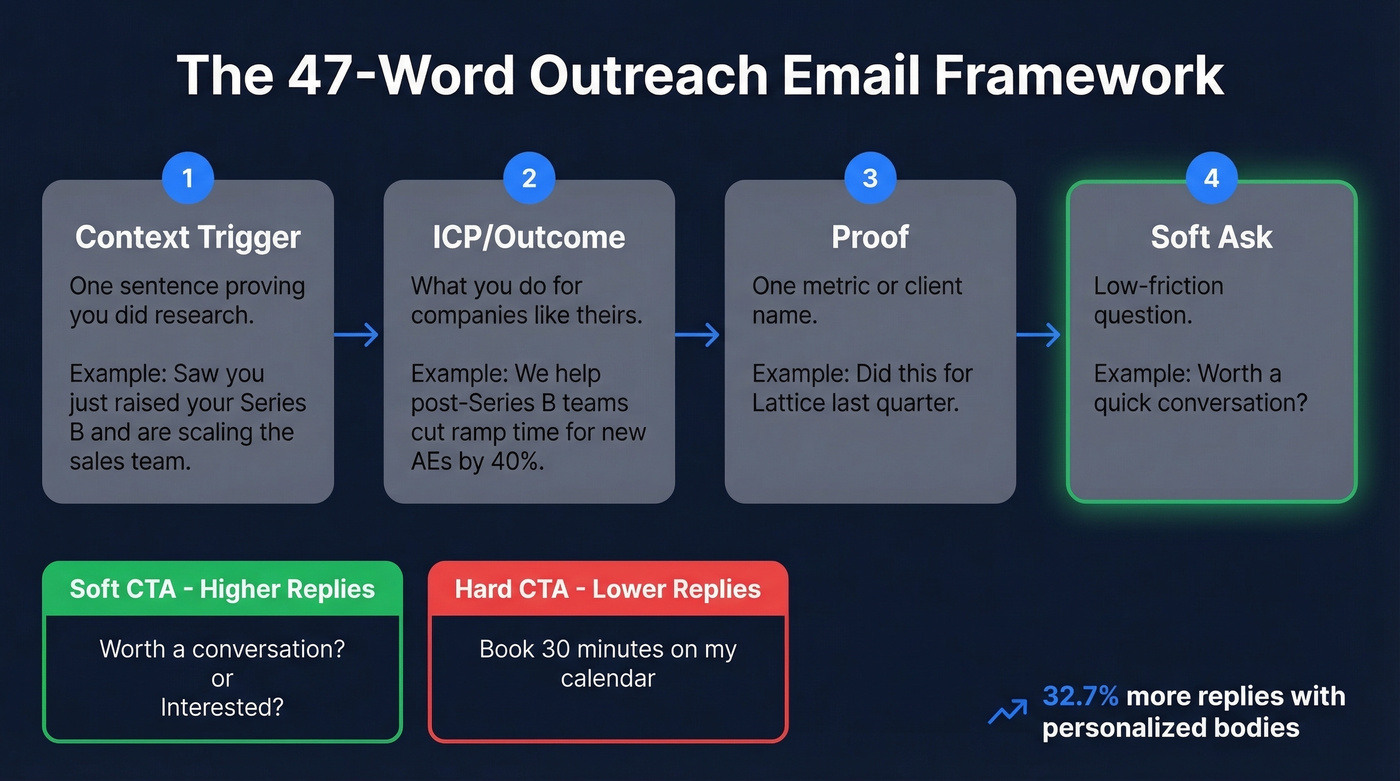
Here's a 47-word structure that works:
Context trigger (one sentence showing you did research) ICP/outcome (what you do for companies like theirs) Proof (one metric or client name) Soft ask ("Worth a conversation?" not "Book a 30-min demo")
Personalized email bodies generate 32.7% more responses than generic ones. Personalization doesn't mean writing a novel - it means one sentence that proves you're not a bot. And soft CTAs like "Interested?" outperform hard asks like "Book 30 minutes on my calendar" every time. Lower friction, higher replies.
If you’re tightening the ask, use a simple email call to action framework so the next step is obvious.
Personalization That Scales
You don't need 20 minutes per email. You need 2 to 5 minutes per prospect and a system.
The Woodpecker approach nails it: segment first, then personalize within segments. Group prospects by industry, role, or pain point. Write one template per segment. Add one custom line per email - a recent hire, a product launch, a competitor move. Writing a great prospect email is really about knowing your prospect well; the writing part follows naturally.
If you’re building segments from scratch, start with an ideal customer profile and score accounts before you write anything.
The "invisible offer" tactic is worth stealing. Build something specific for the prospect before you email them - a quick audit, a wireframe, a competitive teardown - then offer to share it. That's not a cold email. It's a gift with context.
Emailing multiple contacts at the same company boosts response rates by 93%. Combine multiple contacts with multiple attempts and that number jumps to 160%. But there's a ceiling: targeting 1 to 2 contacts per company yields a 7.8% reply rate, while 10+ contacts drops to 3.8%. We've found two to three stakeholders is the sweet spot - don't carpet-bomb the entire org chart.
If you want a more structured approach here, borrow from account-based selling so multi-threading doesn’t turn into spam.

You just learned that emailing 2-3 contacts per company boosts replies by 93%. But that only works if every email actually lands. Prospeo's 300M+ profiles with 98% verified accuracy and 7-day data refresh mean your carefully personalized outreach hits real inboxes - not spam folders.
Stop perfecting copy for emails that bounce. Fix the data first.
Follow-Ups: Less Is More
One follow-up is the default move. It generates 65.8% more replies than a single touch. But here's where the data gets interesting: one-email sequences actually had the highest reply rate at 8.4%. A third email can drop reply rates by 20%, and spam complaints climb from 0.5% on the first email to 1.6% by the fourth.
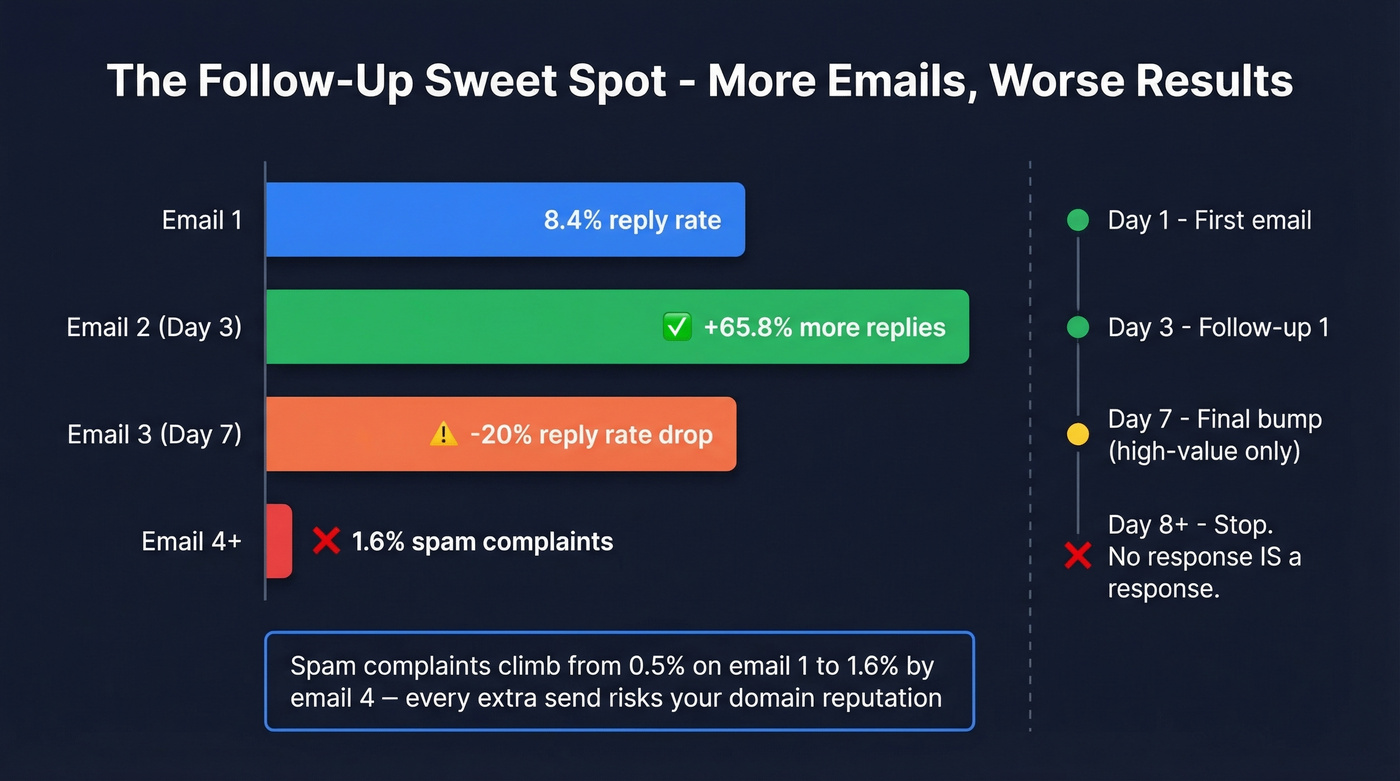
Every additional follow-up past two has diminishing returns and increasing risk.
Our recommendation: Day 1, Day 3, and if it's a high-value prospect, one last bump around Day 7. Then stop. No response is a response.
If you need wording that doesn’t sound like “just checking in,” keep a set of cold email follow-up templates ready.
Deliverability Comes First
This is the unsexy part that determines whether anything else matters. We've seen teams go from 3% reply rates to 8%+ just by fixing deliverability - before touching a single word of copy.
SPF, DKIM, and DMARC must be configured on every sending domain. Since May 2025, Microsoft enforces authentication for Outlook.com mailboxes sending 5,000+ messages per day. Miss any of these and you're landing in spam before a human ever sees your subject line.
If you want the full technical breakdown, follow an email deliverability guide and validate each record end-to-end.
Warm new domains slowly - 5 to 10 emails per day, ramping over 4 to 6 weeks. Keep spam complaints under 0.3% and bounces under 2%. Practitioners on r/coldemail recommend capping at 20 emails per inbox per day with max 3 inboxes per sending domain. Use a custom tracking domain, turn off open tracking, skip images, and space sends with "human-like" gaps of 9 to 14 minutes.
If you’re scaling volume, set hard rules around email velocity so you don’t burn domains.

Deliverability starts with clean data. If 5% of your list bounces, you've blown past the 2% threshold, your sender reputation takes a hit, and every subsequent email - even to valid addresses - is more likely to land in spam.
Clean Data Beats Clever Copy
Here's the thing: if your deal sizes are under $50K and you're spending more time crafting email copy than verifying your contact list, you have your priorities backwards.
A bounced email isn't just a missed opportunity. It's active damage to your domain reputation. Enough bounces and your perfectly crafted emails go straight to spam for everyone on your list. Stack Optimize, an outbound agency, built from $0 to $1M ARR by keeping client deliverability above 94% and bounces under 3% - zero domain flags across all their clients. That kind of discipline starts with data, not copywriting.
If you’re diagnosing list quality, start with email bounce rate benchmarks and fix the root causes before you send again.
Prospeo runs every email through a 5-step verification process with catch-all handling, spam-trap removal, and honeypot filtering, delivering 98% email accuracy. Data refreshes every 7 days - the industry average is 6 weeks. That gap matters because a "verified" email from last month can bounce today.
If you’re cleaning lists at scale, it also helps to understand spam trap removal so you don’t poison deliverability.
Stack Optimize built a $1M agency by keeping bounces under 3% across every client. Their secret wasn't better templates - it was Prospeo's 5-step email verification with catch-all handling, spam-trap removal, and honeypot filtering. At $0.01 per verified email, clean data costs less than a single bounced send costs your domain reputation.
Protect your sender reputation before you send another outreach email.
Timing Your Send
Backlinko's outreach data shows Wednesday as the best day and Saturday as the worst. Belkins' cold email dataset shows Thursday as the best by reply rate, hitting 6.87%. Evenings between 8 and 11 PM also show strong engagement, likely because inboxes are quieter.
If you want to go deeper on timing, use a dedicated best time to send cold emails playbook and test by segment.
In our experience, timing matters less than deliverability and data quality. But it's free optimization - no reason to leave it on the table.
Pre-Send Checklist
Before you hit send on any outreach campaign:
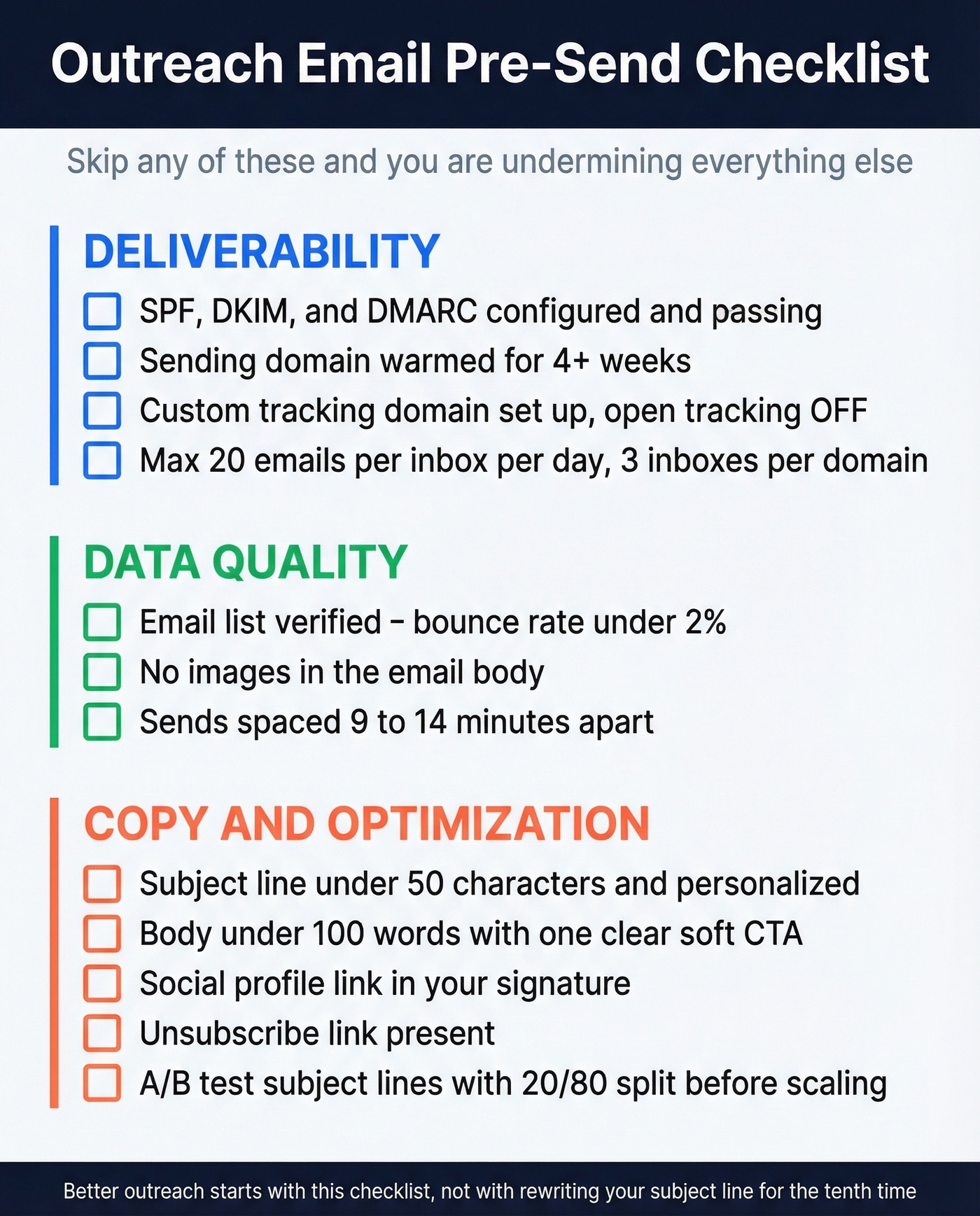
- SPF, DKIM, and DMARC configured and passing
- Sending domain warmed for 4+ weeks
- Email list verified (bounce rate under 2%)
- Subject line under 50 characters and personalized
- Body under 100 words with one clear soft CTA
- Social profile link in your signature
- Unsubscribe link present
- Custom tracking domain set up, open tracking off
- No images in the email body
- Max 20 emails per inbox per day, 3 inboxes per domain
- Sends spaced 9 to 14 minutes apart
- A/B test subject lines with a 20/80 split before scaling
Skip any of these and you're undermining everything else on the list. Better outreach emails start with this checklist, not with rewriting your subject line for the tenth time.
FAQ
How long should an outreach email be?
Aim for 40 to 100 words. Six to eight sentences hit the highest reply rate in studies of 16.5M+ emails. Anything longer than a short paragraph should be cut in half - brevity signals respect for the recipient's time.
How many follow-ups should I send?
One follow-up boosts replies by 65.8%, but a third email drops reply rates by 20% and spikes spam complaints to 1.6%. Stick to one or two follow-ups max, spaced at Day 3 and Day 7.
Why are my outreach emails going to spam?
Almost always a deliverability issue, not a copy problem. Missing SPF/DKIM/DMARC authentication, high bounce rates from unverified lists, or sending too many emails from an unwarmed domain are the top causes. Verifying your list before sending - keeping bounces under 2% - is the single fastest fix.
What's the biggest mistake in cold email outreach?
Obsessing over copy before fixing deliverability and data quality. The best-written email in the world won't generate replies if it lands in spam or bounces off an invalid address. Get your infrastructure right first, then refine your messaging.