

=== CURRENT ARTICLE (slug: hunter-mentality-in-sales) ===
The Hunter Mentality in Sales Is a System - Here's How It Actually Works
Your VP just announced the team needs to generate 40% of pipeline from outbound this quarter. Someone drops "hunter mentality" in the all-hands. You're wondering if you need to become a different person.
You don't - but you do need a different operating system. Consider that 84% of reps missed quota last year. The problem isn't effort. It's method.
The hunter mentality in sales isn't about aggression or cold-calling volume - it's a daily operating system built on targeting discipline, multichannel cadence, and verified data. If your company says "we need a hunter" but provides no pipeline support, that's a red flag, not a job description.
What the Sales Hunter Mindset Actually Means
You've read five articles telling you hunters are "fearless" and "self-motivated." None told you how many calls to make or what your reply rate should be.
This mindset isn't a personality type. It's a system for generating net-new pipeline through deliberate, repeatable outbound activity. The 1990s version - a battering ram who cold-calls 200 numbers and closes through sheer aggression - is dead. That archetype over-indexes on volume and mistakes noise for nuance.
A better frame comes from Reddit's r/sales community: hunting is "starting a business" - building relationships from zero. Farming is "growing a business" - expanding what already exists. Both require skill. The difference is where you point the effort, not how loud you are. With 80% of B2B sales interactions projected to happen through digital channels and 67% of reps not expecting to hit quota this year, the modern hunter is a multichannel operator with data discipline - not a phone warrior with a Rolodex.
Hunting vs Farming: The Real Differences
Most org charts force reps into two boxes. The reality is messier, and there's a third archetype most guides skip entirely.
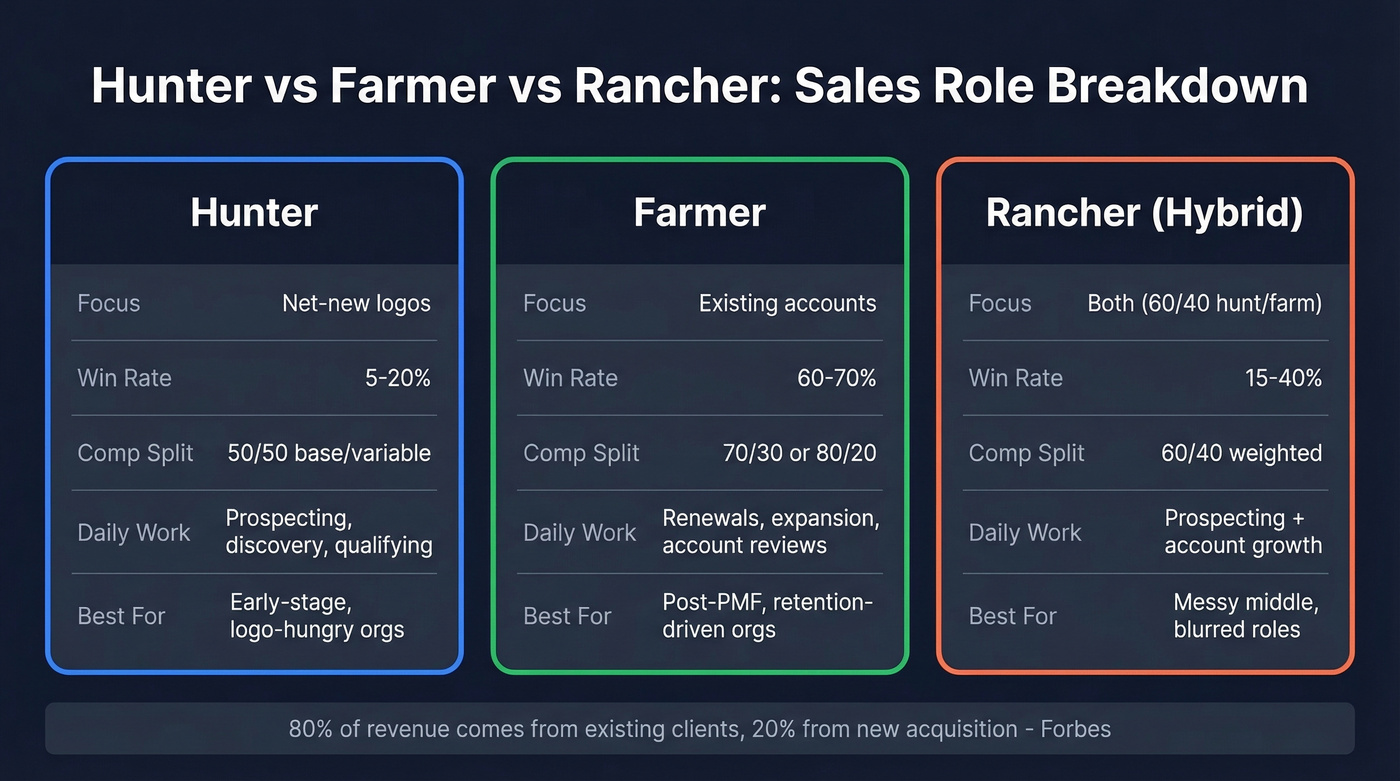
| Hunter | Farmer | Rancher (Hybrid) | |
|---|---|---|---|
| Focus | Net-new logos | Existing accounts | Both (60/40 hunt/farm) |
| Daily work | Prospecting, discovery, qualifying | Account reviews, renewals, expansion | Prospecting + account growth |
| Win rates | 5-20% on cold deals | 60-70% on existing accounts | 15-40% (weighted by mix) |
| Comp split | 50/50 base/variable | 70/30 or 80/20 | 60/40 with weighted incentives |
| Best stage | Early-stage, logo-hungry | Post-PMF, retention-driven | Messy middle, blurred roles |
Existing-client win rates run 60-70% while new-business closes at 5-20%. That's why Forbes cites the 80/20 rule - 80% of yearly revenue from existing clients, 20% from new acquisition. Understanding the hunting vs farming distinction isn't just academic. It determines how you staff, compensate, and measure your entire revenue org.
In our experience, the rancher hybrid is what most mid-market teams actually run. A rancher spends roughly 60% of their time hunting and 40% farming, with one practical model weighting 15% on new business and 8% on expansions. It's not elegant, but it reflects reality.
Seven Traits That Separate Real Hunters
You can't will yourself into being a hunter by reading adjectives. Here's what each trait looks like when it's working:
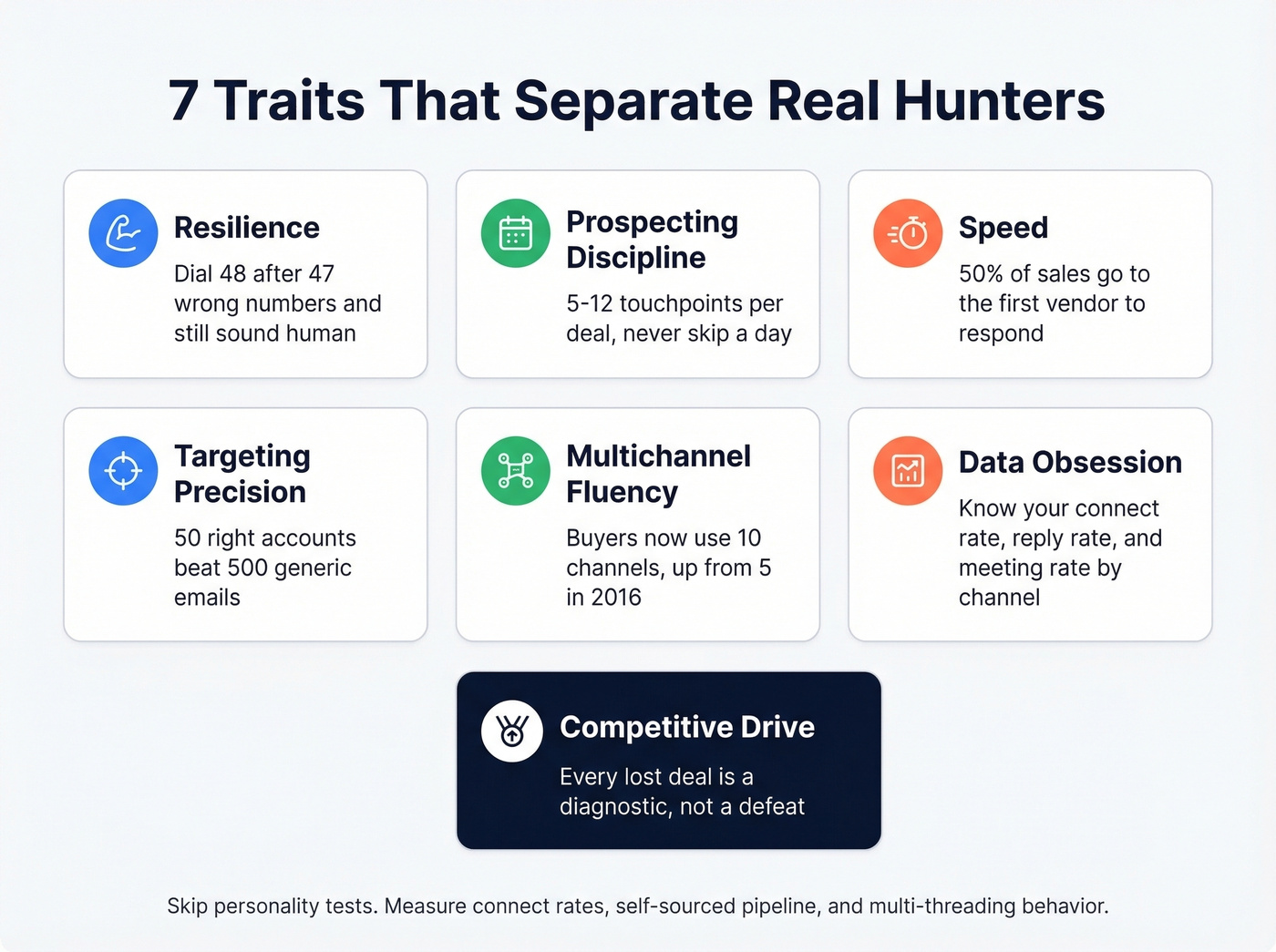
- Resilience isn't "staying positive." It's making your 48th dial after 47 wrong numbers and still sounding like a human when someone picks up. (If you want a systems view, see Resilience.)
- Prospecting discipline means running 5-12 touchpoints per deal across channels without skipping days. Most reps quit after three - and 89% of B2B buyers report a deal stalling in the past year, often because a seller dropped the thread.
- Speed matters more than you think. Up to 50% of sales go to the first vendor to respond. Waiting until Thursday to follow up on a Monday signal? You've already lost.
- Targeting precision is knowing which 50 accounts deserve your time this week, not spraying 500 generic emails and hoping. (This pairs well with account-based selling.)
- Multichannel fluency means you're comfortable moving between email, phone, video, and social in a single sequence. Buyers use an average of 10 interaction channels now, up from 5 in 2016.
- Data obsession separates productive hunters from busy ones. If you don't know your connect rate, reply rate, and meeting-booked rate by channel, you're guessing. (More on funnel metrics.)
- Competitive drive isn't about the leaderboard. It's about treating every lost deal as a diagnostic, not a defeat.
Skip the personality assessments if you're a manager trying to identify hunters on your team. Connect rates, self-sourced pipeline percentage, and multi-threading behavior tell you more than interview energy ever will.

You mapped 4-7 contacts per account. You built the multichannel cadence. Now 47 of your 50 dials hit wrong numbers. The hunter mentality breaks when your data does. Prospeo's 125M+ verified mobiles hit a 30% pickup rate - that's 3x the industry average. At $0.01 per email, your prospecting budget stretches further than your competitor's.
Stop losing deals to dead data. Arm your hunting system with contacts that connect.
The Hunter's Daily Playbook
Most "hunter mentality" advice stops at traits and never gives you the operating system. That's like telling someone to "think like a chef" without handing them a recipe.
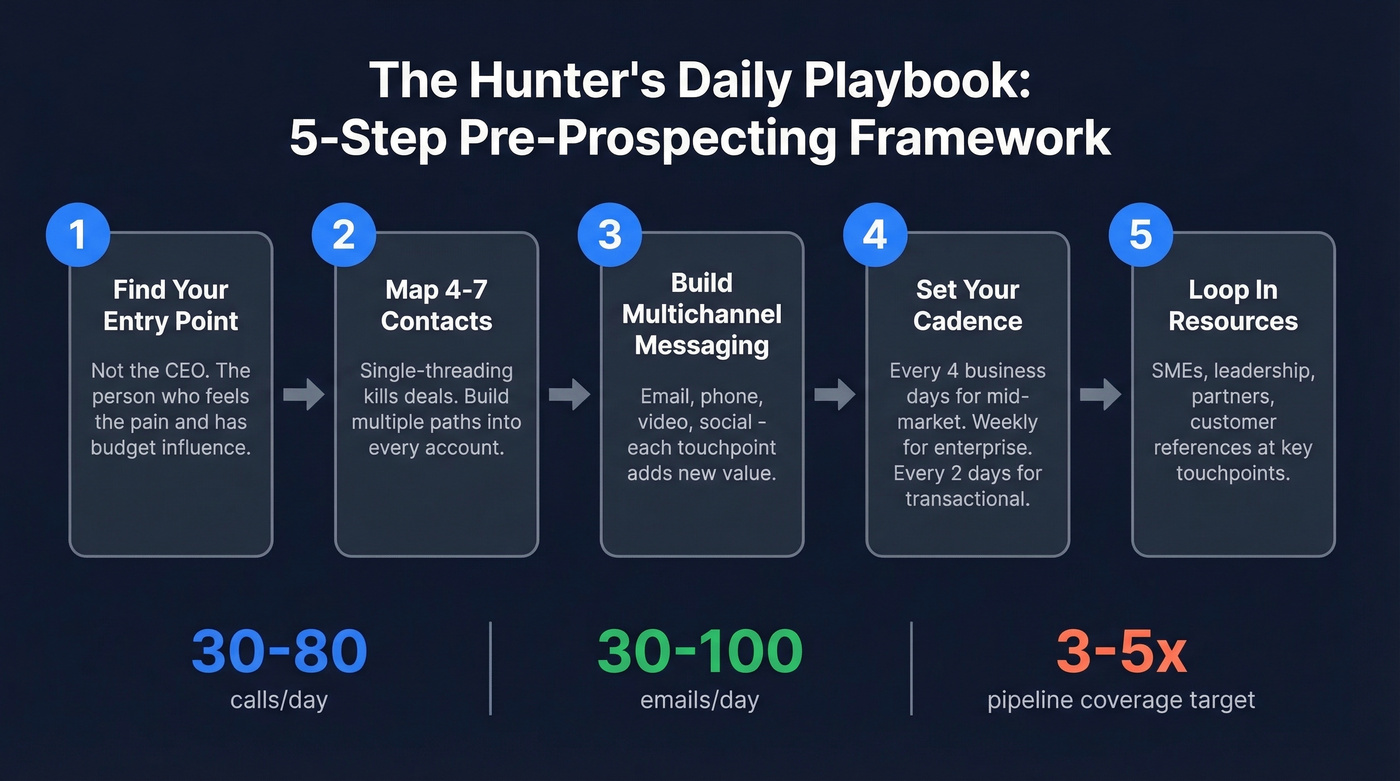
Mark Hunter's 5-step pre-prospecting framework is the best scaffolding we've found:
- Identify your best point of entry. Not the CEO. The person who feels the pain your product solves and has budget influence. (Use an ideal customer profile to keep this consistent.)
- Map 4-7 contacts per account. Single-threading kills deals. You need multiple paths into every target company.
- Build a messaging plan across channels. Email, phone, video, social - each touchpoint should add value, not repeat the last one. (If you need a starting point, use sales follow-up templates.)
- Set your cadence. Every four business days works for most mid-market sequences. Enterprise might stretch to weekly. Transactional can compress to every two days. (More sequence management guidance here.)
- Use your resources. SMEs, leadership, partners, customer references - loop them into key touchpoints in your sequences.

The activity benchmarks that matter: 30-80 calls per day depending on segment complexity, 30-100 emails per day, and a cold outbound funnel that converts at roughly 1-3% positive reply and 0.5-2% meeting booked per sequence. Pipeline coverage should sit at 3-5x quota. (Compare against broader sales pipeline benchmarks.)
Here's where academic research gets interesting. A 2022 study in the Journal of Business Research found an implicit trade-off between prospecting efficacy and conversion efficacy. More activity doesn't automatically mean more results. Experienced sellers can actually acquire fewer new customers without deliberate maintenance of their hunting habits. Volume without targeting precision burns you out and tanks your conversion rate.
When Your Mindset Problem Is Actually a Data Problem
You're 50 dials into your day and you've hit 3 voicemails and 47 wrong numbers. Your sales hunter mindset is starting to feel like a data quality problem.
That's because it is. A hunter who makes 100 calls on a garbage list is less effective than one who makes 30 calls on a verified, intent-qualified list. We've seen teams triple pipeline coverage just by fixing their data layer - before changing a single word of their pitch. Prospeo's B2B database covers 300M+ profiles with 98% email accuracy and 125M+ verified mobile numbers on a 7-day refresh cycle, which is the kind of foundation that makes the rest of this playbook actually work. Build your list right before you build your cadence. It's the single highest-leverage step. (If you're comparing vendors, start with data enrichment services.)
When "We Need a Hunter" Is a Red Flag
The phrase "we need a hunter" is the most abused line in sales hiring.
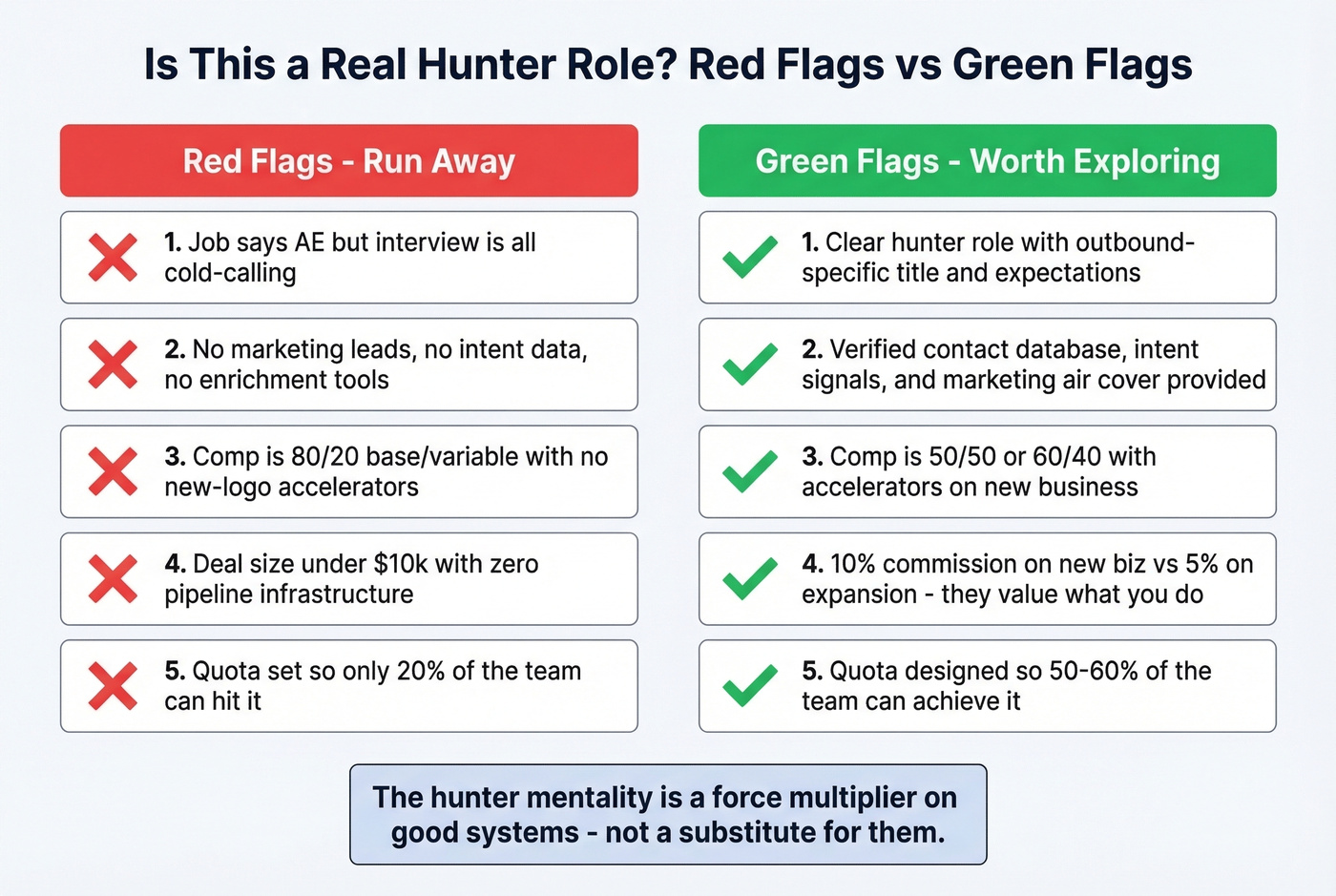
A rep on r/sales described a recruiter who pitched a role as territory AE/AM - then spent the entire interview grilling them on cold-calling tactics. The role was pure outbound BD work wearing an AE title. Marketing-sourced leads closed at 50-60% for that rep. Cold-generated leads closed at roughly 5%. They weren't going back to glorified appointment-setting. (If you're rebuilding outbound from scratch, see sales prospecting techniques.)
Companies that say "hunter mentality" in the job description but provide zero pipeline support - no marketing leads, no intent data, no enrichment tools - aren't looking for a hunter. They're looking for someone to do the work they haven't invested in building infrastructure for.
Compensation tells you what a company actually values. If they call you a hunter but pay you like a farmer - 80/20 base/variable with no accelerators on new logos - run. And if you're a consultative seller who thrives on complex, relationship-driven deals, there's nothing wrong with recognizing that pure hunting isn't your zone. That's not a weakness. It's a career-fit signal.
Here's the thing: if your deal size sits below $10k and your company demands a hunter mindset without providing a verified contact database, intent signals, or marketing air cover, they don't need a hunter. They need to invest in infrastructure. The hunter approach is a force multiplier on good systems - it's not a substitute for them.
Building a Hunter-Friendly Org
If you're a sales leader, the hunter mentality isn't something you hire for and hope works. It's something you build infrastructure around.
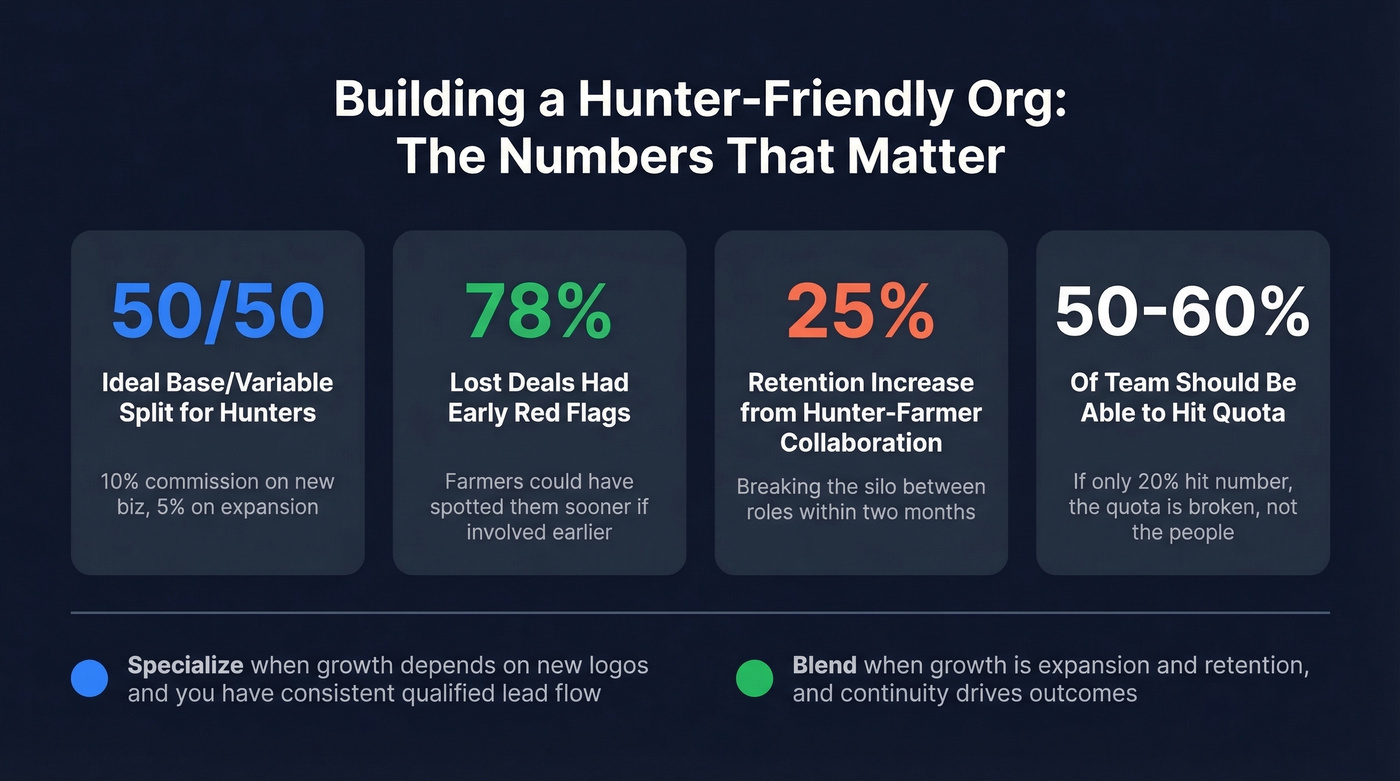
Comp design matters most. Hunter roles need aggressive pay mixes - 50/50 or 60/40 base/variable - with clear weighting toward new logos. A practical structure: 10% commission on new business versus 5% on expansion revenue. Set quotas so 50-60% of the team can achieve them. If only 20% of your hunters are hitting number, the quota is broken, not the people.
Handoff design is the silent killer. One CRM analysis found 78% of lost deals had red flags that farmers could have spotted earlier if they'd been involved sooner. Breaking the silo between hunters and farmers produced a 25% increase in customer retention within two months in one case study and a 15% jump in overall revenue in another. (Related: sales pipeline challenges.)
Academic research also shows marketing support and extrinsic rewards improve conversion efficacy more for experienced sellers - another reason infrastructure matters as much as individual skill. When to specialize vs. blend: specialize when growth depends on new logo acquisition and you've got consistent high-volume qualified lead flow. Blend when growth is primarily expansion and retention, and continuity drives outcomes. The new business vs account management split should be driven by your growth model, not by org chart tradition. Forcing hunters to farm or farmers to hunt is the fastest way to lose both.
When the Hunter Approach Doesn't Fit
Not every company needs hunters. Not every seller should be one.
If you're a post-PMF company where retention is the profit engine, the math is simple: customer acquisition commonly costs 5-25x more than retention. Pouring resources into net-new hunting when your churn rate is bleeding revenue is like filling a leaky bucket with a firehose. Enterprise sales cycles of 6-18 months also complicate the hunter model - continuity and relationship depth matter more than new-logo aggression when a single deal takes a year to close. (If you're diagnosing retention, start with churn analysis.)
The best orgs figure out which motion drives their growth and staff accordingly, rather than slapping a "hunter wanted" label on every open req.
The research is clear: volume without targeting precision tanks your conversion rate. Prospeo's 30+ search filters - buyer intent, technographics, job changes, headcount growth - let you identify the exact 50 accounts that deserve your time this week. Data refreshed every 7 days, not 6 weeks. That's how modern hunters build 3-5x pipeline coverage.
Target with precision. Prospect with confidence. Build pipeline that actually converts.
FAQ
What's the difference between a hunter and a farmer in sales?
Hunters focus on net-new logo acquisition through outbound prospecting - cold calls, cold emails, discovery meetings with strangers. Farmers grow revenue from existing accounts through renewals and expansion. Most modern orgs need both, or a hybrid "rancher" splitting time roughly 60/40. The core tension is that each motion requires different skills, metrics, and comp structures, and blending them carelessly leads to underperformance on both fronts.
Can you develop a hunter mentality, or is it innate?
It's operational, not genetic. Academic research shows prospecting has a measurable sweet spot - and experienced sellers can lose their edge without deliberate practice. Build the system first: targeting, cadence, multichannel sequences, data quality. The mindset follows the habits, not the other way around.
What tools do sales hunters need in 2026?
Three essentials: a verified contact database, a multichannel sequencer, and a CRM. Bad data kills hunter productivity before mindset ever matters. Prospeo covers the data layer with 98% email accuracy, 125M+ verified mobiles with a 30% pickup rate, and a 7-day refresh cycle. The free tier gives you 75 emails per month, and paid credits work out to about $0.01/email - enough to validate data quality against whatever you're using now.