

How to Improve Email Open Rate in 2026
Your open rate dropped again this quarter, and you're staring at a dashboard that makes no sense. The emails are "good." The list is "clean." But Office365 inbox placement is down 26.7 percentage points year-over-year, and reply rates that used to sit at 15-25% now feel like a win at 8-10%. Something structural changed, and tweaking subject lines isn't going to fix it on its own.
The Priority Stack
Most guides tell you to fix subject lines first. That's backwards.
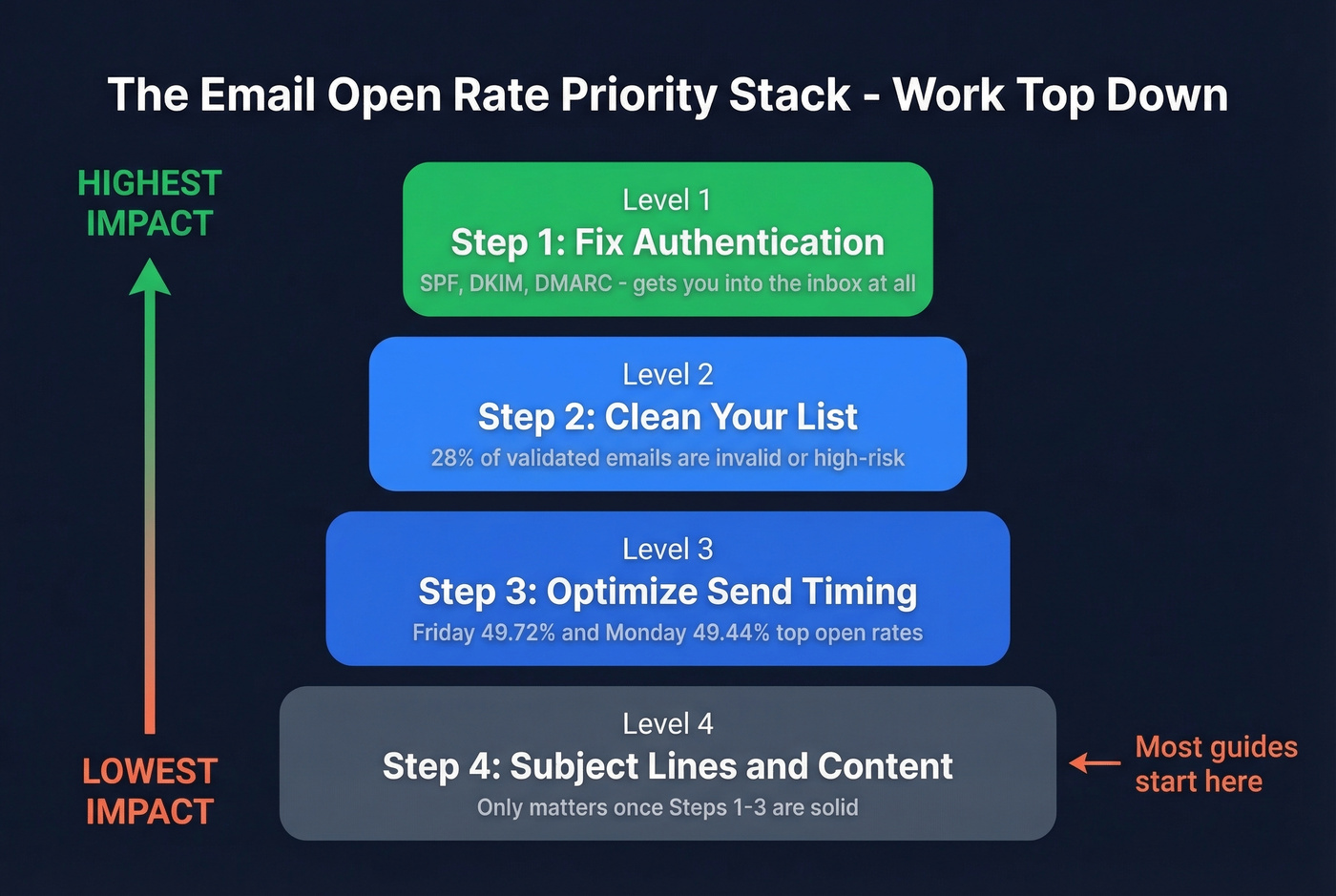
- Fix authentication - SPF, DKIM, DMARC enforcement
- Clean your list - a ZeroBounce analysis found 28% of validated emails were invalid or high-risk
- Optimize send timing - data from 2.1M+ campaigns says Friday and Monday win
- Then work on subject lines and content
If you only have 30 minutes, spend them on steps one and two. Everything else is optimization on top of a foundation that actually delivers mail.
Why Your Open Rate Is Lying
Apple Mail Privacy Protection accounts for 49% of email opens and inflates reported rates by 15-20 points. MPP preloads tracking pixels via Apple's proxy servers, firing the open event even when nobody reads the email. It also strips IP addresses, timestamps, and device data - so your geo and device reporting is partially fiction.
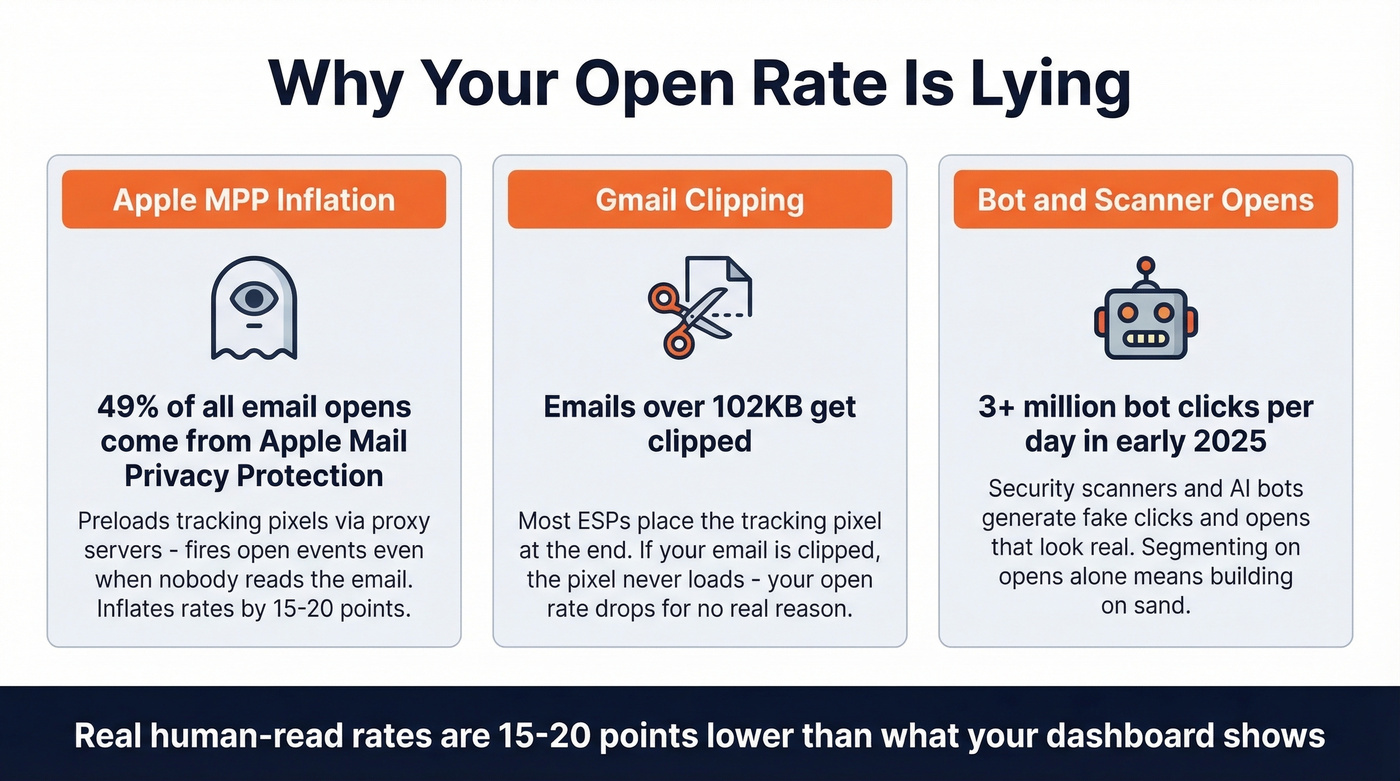
Gmail clips emails over 102KB, and most ESPs place the tracking pixel at the end of the message. If your email gets clipped, the pixel never loads, and your open rate drops for reasons that have nothing to do with engagement. GetResponse confirmed this in their analysis of 4.4B messages.
Then there's phantom engagement. Security scanners and AI bots generate clicks and opens that look real but aren't - bot clicks peaked at 3+ million per day in early 2025. If you're making segmentation decisions based on opens alone, you're building on sand.
2026 Open Rate Benchmarks
With the MPP caveat firmly in mind, here's where the major platforms landed:
| Platform | Avg Open Rate | Data Period |
|---|---|---|
| ActiveCampaign | 39.26% | 2025 campaigns |
| GetResponse | 39.64% | 4.4B messages, 2025 |
| Mailchimp | 35.63% | Most recent public update |
Industry breakdowns tell a more useful story:
| Industry | Open Rate |
|---|---|
| Media / Publishing | 43.16% |
| Non-profit | 42.68% |
| Healthcare | 41.48% |
| Software / SaaS | 36.20% |
| E-Commerce / Retail | 35.66% |
Geography matters too. Europe averages 43.25% open rates versus just 23.53% in North America. If you're a US-based SaaS company hitting 36%, you're actually outperforming your regional average, not underperforming. And remember - every number above is inflated by MPP. Real human-read rates are 15-20 points lower.
Work in the Right Order
Here's the thing: most "boost your open rate" articles lead with subject lines because they're easy to write about. Subject lines are the least impactful lever if your emails aren't reaching the inbox in the first place.
- Authentication - get into the inbox at all
- List quality - stop sending to dead addresses
- Deliverability hygiene - protect sender reputation
- Send timing - reach people when they're checking email
- Content and subject lines - earn the click once you're visible
Work top-down. Fixing number five while ignoring numbers one through three is like optimizing ad copy for a landing page that 404s.
Fix Your Infrastructure First
Only 7.6% of domains enforce DMARC with a quarantine or reject policy. That's a staggering gap. Google and Yahoo rolled out bulk-sender authentication requirements in February 2024, and Microsoft followed in May 2025 - making proper SPF/DKIM/DMARC table stakes for anyone sending at scale.
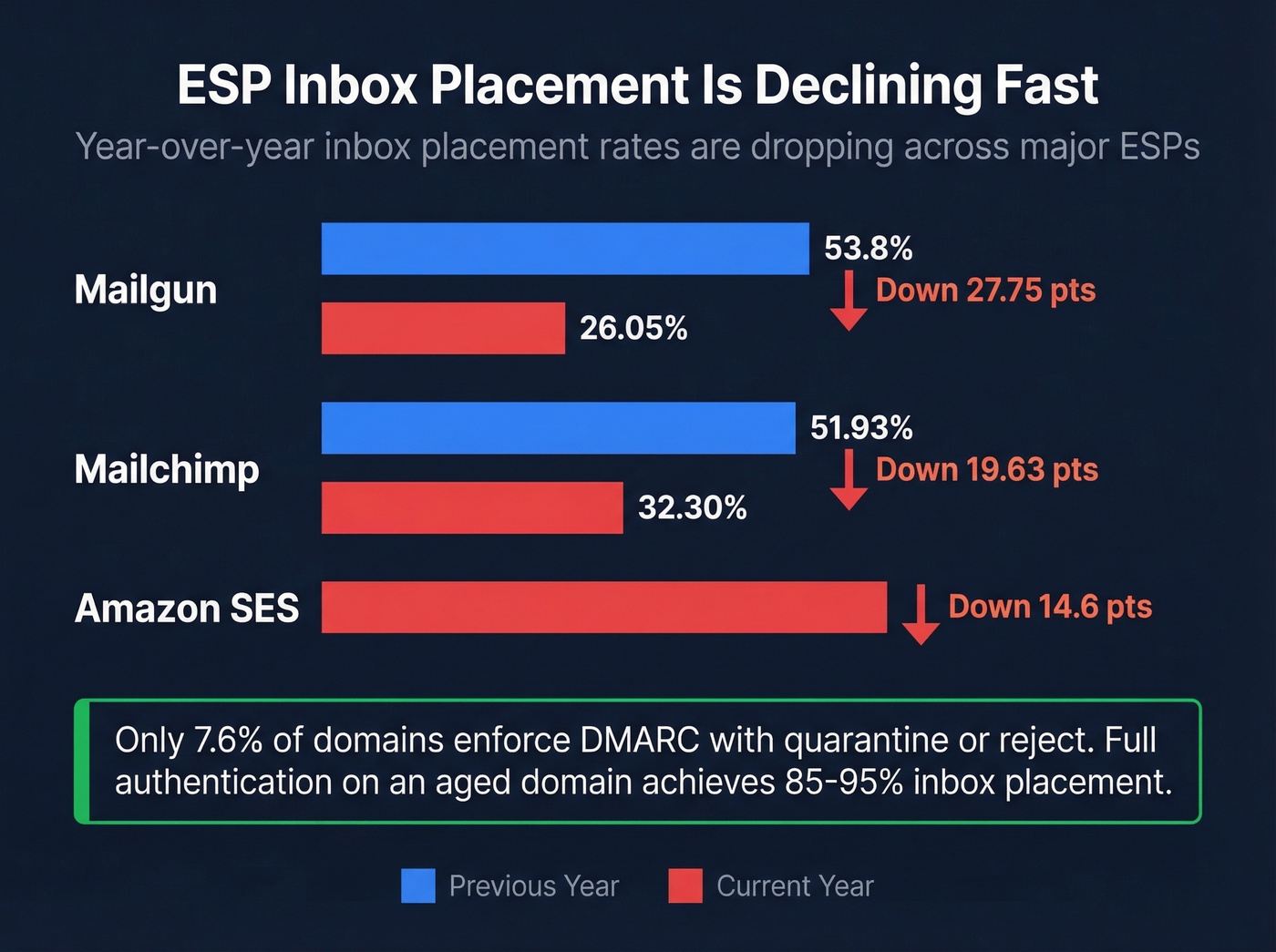
New domains face roughly a 30 percentage point penalty versus mature domains on inbox placement. Full authentication on an aged domain achieves 85-95% inbox placement. Without it, you're rolling dice.
ESP-level declines make this worse:
| ESP | Inbox Placement Change (YoY) |
|---|---|
| Mailgun | 53.80% to 26.05% |
| Mailchimp | 51.93% to 32.30% |
| Amazon SES | Down 14.6 points |
Your ESP's reputation is declining alongside yours, which means your own domain authentication matters more than ever. Verify SPF records cover all sending services, enable DKIM signing, set DMARC to at least p=quarantine, and warm new domains for 6-8 weeks before scaling volume. We've seen teams skip warm-up and wonder why they're landing in spam on day one. Getting authentication right is the single fastest way to improve email open rate across your entire program.
If you want a deeper playbook, start with an email deliverability audit and then validate your setup with a quick DKIM check.

Authentication gets you to the inbox. But sending to invalid addresses undoes all that work. Prospeo's 5-step verification catches spam traps, honeypots, and catch-all domains that basic tools miss - with 98% accuracy on a 7-day refresh cycle.
Stop optimizing subject lines on emails that never reach the inbox.
Clean Your List
Email lists decay roughly 22% per year. A ZeroBounce analysis of 10B+ email addresses found that 28% of validated emails in 2024 were invalid or high-risk. And yet 39% of senders rarely or never clean their lists.
If your bounce rate is above 5%, you're actively damaging your sender reputation. The target is under 2%. (If you need the specifics, see bounce rate benchmarks and how to improve sender reputation.)
One practitioner on r/Entrepreneur documented taking their bounce rate from 11% to under 2% through manual verification - and saw opens jump 16% as a direct result. That's the kind of lift most people chase through subject line hacks, when the real problem is dead addresses dragging down their sender score.
Prospeo's bulk verification catches the addresses that silently destroy deliverability - invalid addresses, catch-all domains, spam traps, and honeypots that basic verification misses. The 98% accuracy rate and 75 free monthly verifications make it easy to test before committing. If you're dealing with deliverability landmines, it's also worth having a plan for spam trap removal.
Email lists decay 22% per year, and every dead address tanks your sender reputation. Prospeo's bulk verification processes your entire list - flagging invalids, spam traps, and high-risk addresses - at $0.01 per email. No contracts, no sales calls.
Fix the foundation before you A/B test another subject line.
Optimize What People See
Once your infrastructure is solid and your list is clean, now subject lines matter.
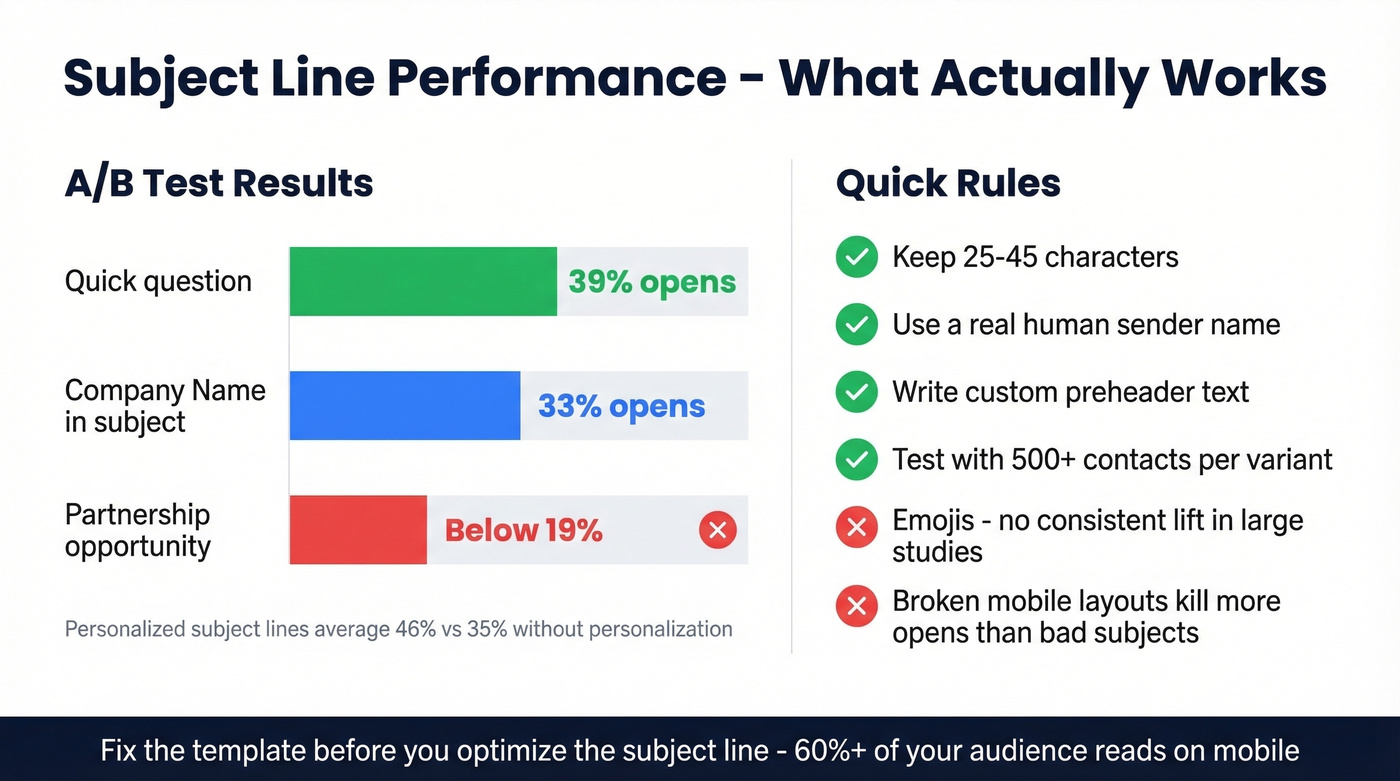
Personalized subject lines average 46% open rates versus 35% without personalization. In one practitioner's A/B test, "Quick question" pulled 39% opens, a company name in the subject hit 33%, and anything salesy like "Partnership opportunity" dropped below 19%. Keep subject lines between 25-45 characters - mobile clients truncate around 33-43 characters, and anything longer gets cut mid-thought.
Emojis? No large-scale study shows consistent lift. Test with 500+ contacts before going all-in. Don't ignore preheader text either - it's the second line of copy your recipient sees, and most senders leave it as default boilerplate. A recognizable human sender name outperforms "marketing@company.com" every time. If you need a swipe file, pull from these email subject line examples or go deeper on subject lines that get opened.
Let's be honest about something most people overlook: broken mobile layouts kill more opens than bad subject lines. If 60%+ of your audience reads on mobile and your email renders poorly, no amount of subject line wizardry will save you. Fix the template first.
Run A/B tests with at least 250 contacts per variant. Push toward 500+ for real confidence.
Send at the Right Time
A MailerLite study of 2.1M campaigns found Friday had the highest average open rate at 49.72%, followed by Monday at 49.44%. Opens peak between 8-11 AM local time on weekdays. That r/Entrepreneur practitioner who rebuilt their cold email system settled on Tuesday through Thursday, 8-11 AM in the recipient's timezone, and attributed a 16% open rate improvement to timing alone.
If you need a starting point, send Tuesday at 7 AM or 11 AM as your control. Your audience will differ - but "Tuesday morning" beats "whenever the campaign is ready" every single time. For cold outreach specifically, use this best time to send cold emails playbook.
Send Content Worth Opening
A practitioner on r/Emailmarketing maintains 40-70% open rates by centering every email on subscriber pain points rather than products. They send roughly 80% value and education, 20% promotional. That tracks with what we've seen across dozens of outbound campaigns.
Skip this advice if you're running pure transactional email - those have their own rules. But for marketing and outbound sequences, the pattern is clear: if your emails are consistently product-focused, your open rate will decay no matter how good your subject lines are. People learn what to expect from your sender name. Teach them something useful, and they'll keep opening. Pitch them constantly, and they'll hit the spam button. If you're building outbound sequences, this B2B cold email sequence guide helps you structure value-first messaging.
Your welcome email sets the tone. It gets disproportionately high engagement and trains recipients on whether your future emails are worth opening.
Measure What Actually Matters
Open rate is directional at best. Only 15% of email marketers still treat it as a primary success metric, and they're the ones making the worst decisions.
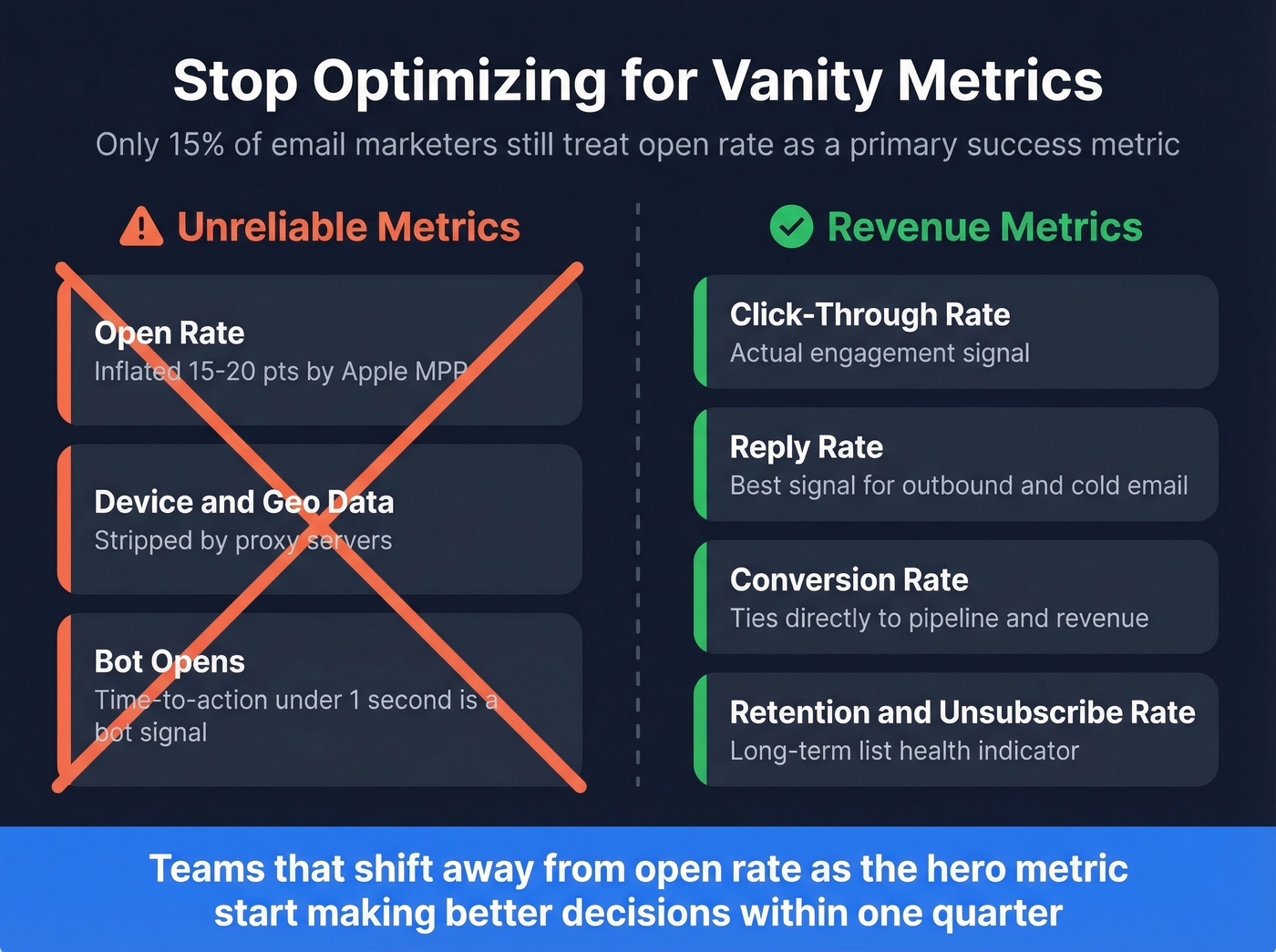
Shift your focus to clicks, replies, conversions, and retention - metrics that can't be faked by Apple's proxy servers or security bots. Watch for time-to-action under one second as a bot signal. If you want to standardize reporting, use a consistent click rate formula and track downstream outcomes like follow-up reply rate. In our experience, teams that move their reporting dashboards away from open rate as the hero metric start making dramatically better decisions within a single quarter, because they're finally optimizing for revenue instead of a vanity number.
FAQ
What's a good email open rate in 2026?
Across major platforms, the average sits between 35-40%. Non-profits and media publishers hit 42-43%, while e-commerce and SaaS hover around 35-36%. Apple MPP inflates these numbers by 15-20 points, so real human-read rates are significantly lower.
How often should I clean my email list?
Monthly is ideal; twice a year is the bare minimum. Lists decay roughly 22% annually as people change jobs and abandon addresses. Prospeo's bulk verification can process a full list in minutes with 98% accuracy - remove invalid addresses before they tank your sender reputation.
How can I boost open rates quickly?
Fix authentication (SPF, DKIM, DMARC) and clean your list. Those two steps alone address the structural reasons emails miss the inbox entirely. Subject line optimization only matters once you're actually landing in front of people - handle deliverability before you worry about copy.
Are open rates still a reliable metric?
Not on their own. Apple MPP inflates opens by 15-20 points, and bot scanners generate phantom engagement. Pair open rate tracking with click-through rate, reply rate, and conversion data to confirm genuine engagement is rising alongside the headline number.