

Industrial Lead Generation: A Data-Backed Playbook for 2026
A poster on r/AskMarketing shared a brutal number last year: 700 cold emails sent over two months for an industrial marketing agency. Zero replies. Not low replies - zero. The list was generic, the messaging was untargeted, and deliverability was shot. That's not a lead gen problem. That's a systems problem.
Industrial lead generation carries a unique set of challenges. Long buying cycles, technical buyers who hate being sold to, and contact databases that decay faster than anyone budgets for. We've put together this playbook with real CPL benchmarks, channel breakdowns, and a tool stack that doesn't require a six-figure contract to get started.
The Quick Version
Generating leads in the industrial sector in 2026 means combining inbound (SEO + technical content), targeted outbound (verified data + personalized sequences), and ABM for your top 50-200 accounts. The average manufacturing CPL is $391 - budget accordingly. Start by defining your ICP, fixing your contact data, and picking one channel to master before expanding.
How Industrial Buyers Actually Buy
The biggest mistake manufacturers make is assuming buyers are waiting to hear from them. They're not. 92% of B2B buyers start their evaluation with at least one vendor already in mind, and the winning vendor is on the Day One shortlist 95% of the time. If you're not on that shortlist before the RFQ drops, you're fighting for scraps.
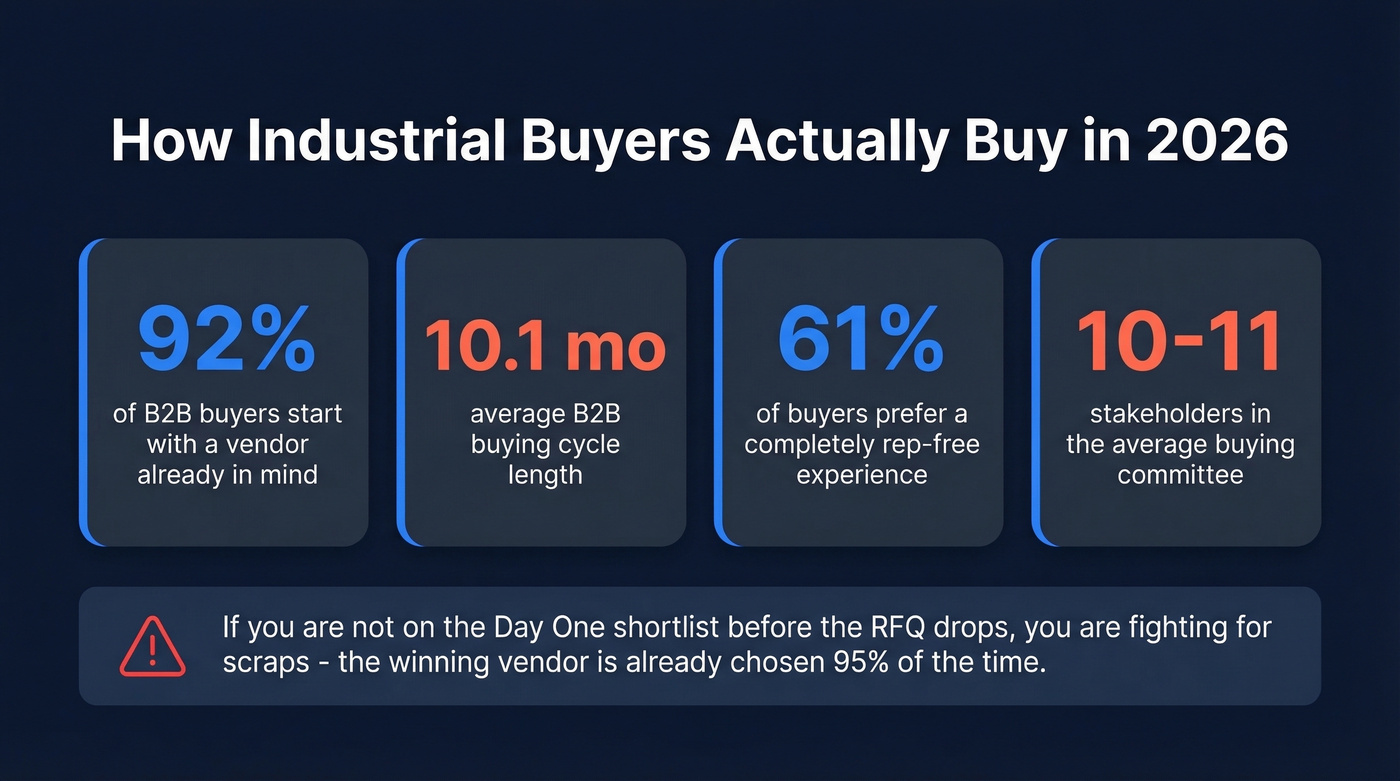
The average B2B buying cycle runs 10.1 months. For capital equipment or custom manufacturing, it's often longer. During that time, 97% of buyers check your website before engaging - but only 9% trust what they find there. That trust gap widens when 69% of B2B buyers report inconsistencies between what a company's website says and what sellers actually tell them. If your site says one thing and your sales team says another, you've already lost credibility.
61% of B2B buyers now prefer a completely rep-free buying experience. That doesn't mean outbound is dead - it means irrelevant outbound is dead. The same Gartner survey found 73% of buyers actively avoid suppliers who send irrelevant outreach, and with 10-11 stakeholders involved in enterprise buying committees, you can't just email the plant manager and hope for the best.
Here's the thing: most industrial companies don't have a lead gen problem. They have a visibility problem. By the time you hear about an RFQ, the winner was decided months ago. The entire game is about being known before the buying cycle starts.
Define Your ICP First
Remember those 700 cold emails that got zero replies? Broad targeting was the root cause. Before you spend anything on tools, channels, or content, nail your ICP.
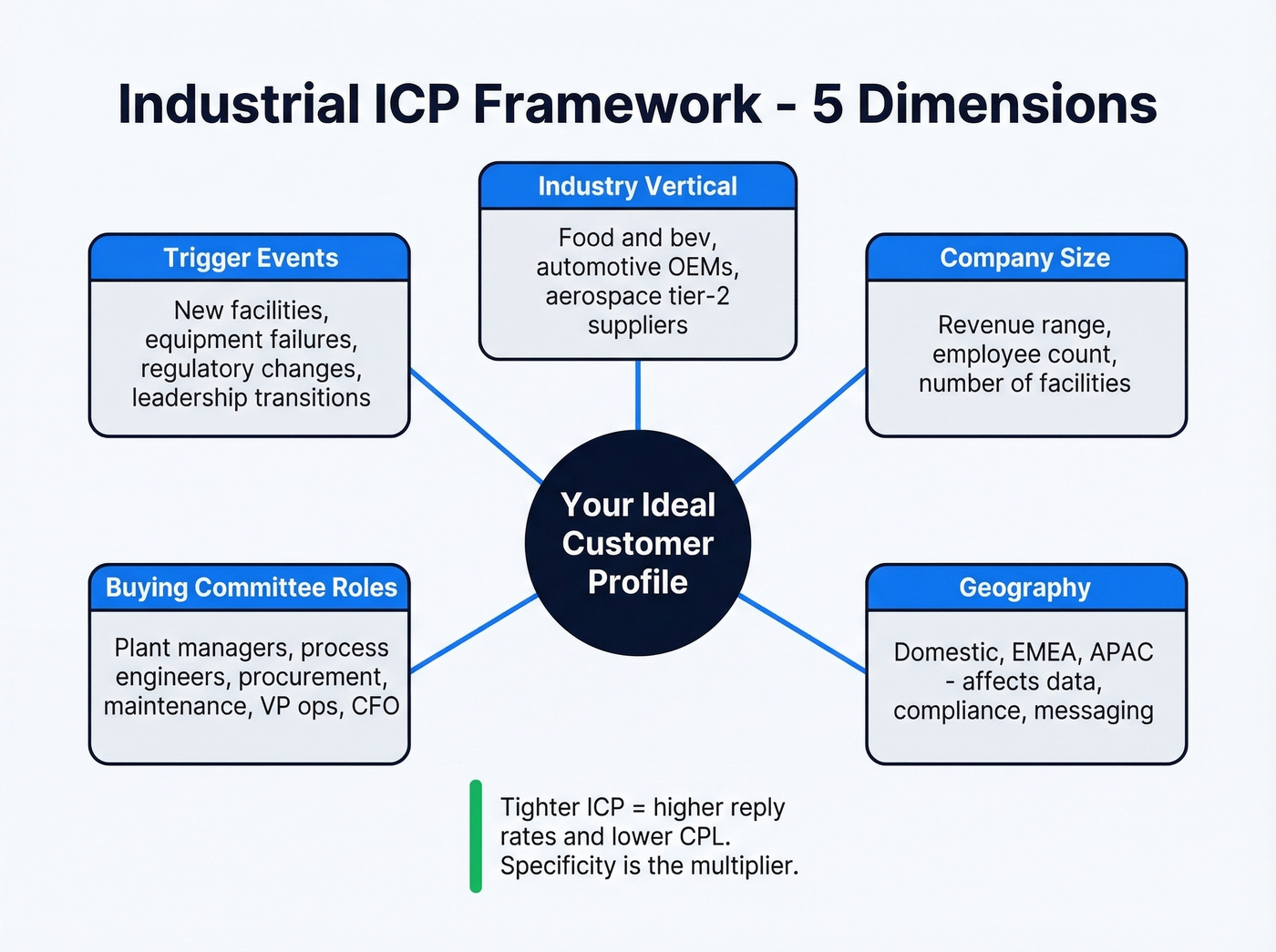
For manufacturers, a useful ICP framework covers five dimensions:
- Industry vertical - food & beverage processors, automotive OEMs, aerospace tier-2 suppliers. Each has different buying patterns and pain points.
- Company size - revenue range, employee count, number of facilities. A 50-person job shop buys differently than a 5,000-person OEM.
- Geography - domestic only, EMEA, APAC. This affects data availability, compliance, and messaging.
- Job roles in the buying committee - plant managers, process engineers, procurement leads, maintenance directors, VP of operations, CFO. That's six to ten people per account, and you need messaging for each.
- Trigger events - new facility openings, equipment failures, regulatory changes, leadership transitions. These create urgency.
The tighter your ICP, the higher your reply rates and the lower your CPL. We've seen teams cut their cost per qualified meeting in half just by narrowing from "all manufacturers over 100 employees" to "food & beverage processors with 3+ facilities running legacy PLCs." Specificity isn't a constraint - it's the multiplier.
Inbound, Outbound, and ABM
Inbound: SEO, Content, and Conversion
Manufacturing websites convert at 2.2% on average. Not great, but it means every visitor matters - and SEO is one of the cheapest ways to get them there at roughly $206 CPL, compared to $840 for trade shows and $463 for PPC.
The content that works for industrial buyers isn't fluffy thought leadership. It's technical depth. 80% of business decision-makers prefer getting company information from articles over ads. For a CNC shop, that means publishing tolerance guides, material comparison charts, and process selection frameworks - content that demonstrates expertise and shows up when engineers are researching solutions. Video walkthroughs of your facility and processes are increasingly effective too.
Email nurturing compounds the value of inbound leads. Mailchimp's Business & Finance category averages a 31.35% open rate and 2.78% click rate - a solid baseline for industrial nurture sequences. Nurtured leads produce roughly 20% more sales opportunities than non-nurtured ones. The playbook: capture with gated technical content, nurture with educational sequences, and hand off to sales when engagement signals spike.
Don't overlook industrial directories like Thomasnet. For manufacturers, being listed and optimized there is the equivalent of a strong Google Business Profile for local services - it's where procurement teams start their searches.
Outbound: Cold Email and Data Quality
Cold email at $225 CPL is one of the most cost-effective industrial channels. But it fails catastrophically when two things go wrong: bad targeting and stale data.
What gets replies: Hyper-specific outreach to a defined ICP, referencing a trigger event or pain point the recipient actually has. A cold email to a VP of Operations at a food processor mentioning their recent facility expansion and how your packaging line reduces changeover time by 40% - that earns a response.
What gets ignored: Blasting 700 generic emails from a list you bought at a trade show.
The data problem is the silent killer. Industry estimates put B2B database decay at roughly 30% per year - people change jobs, companies restructure, emails go stale. If you're running outbound on data that's even three months old, you're sending a meaningful percentage of emails to dead addresses. That tanks deliverability, which tanks everything.

This is where data freshness matters more than database size. Prospeo refreshes its entire 300M+ profile database every 7 days, compared to the 6-week industry average, and at 98% email accuracy you're not burning your domain on bounces. Snyk's outbound team saw this firsthand - bounce rates dropped from 35-40% to under 5%, and AE-sourced pipeline jumped 180%.
If your bounce rate is above 5%, fix your data before you touch your subject lines or copy. Data quality is the foundation everything else sits on. (If you need a deeper checklist, start with email bounce rate benchmarks and fixes.)
ABM for Manufacturers
ABM delivers the highest conversion rate of any B2B channel - 3.8% compared to 2.6% for SEO and 1.5% for PPC. For manufacturers selling high-value solutions to a finite number of potential customers, it's the natural fit.
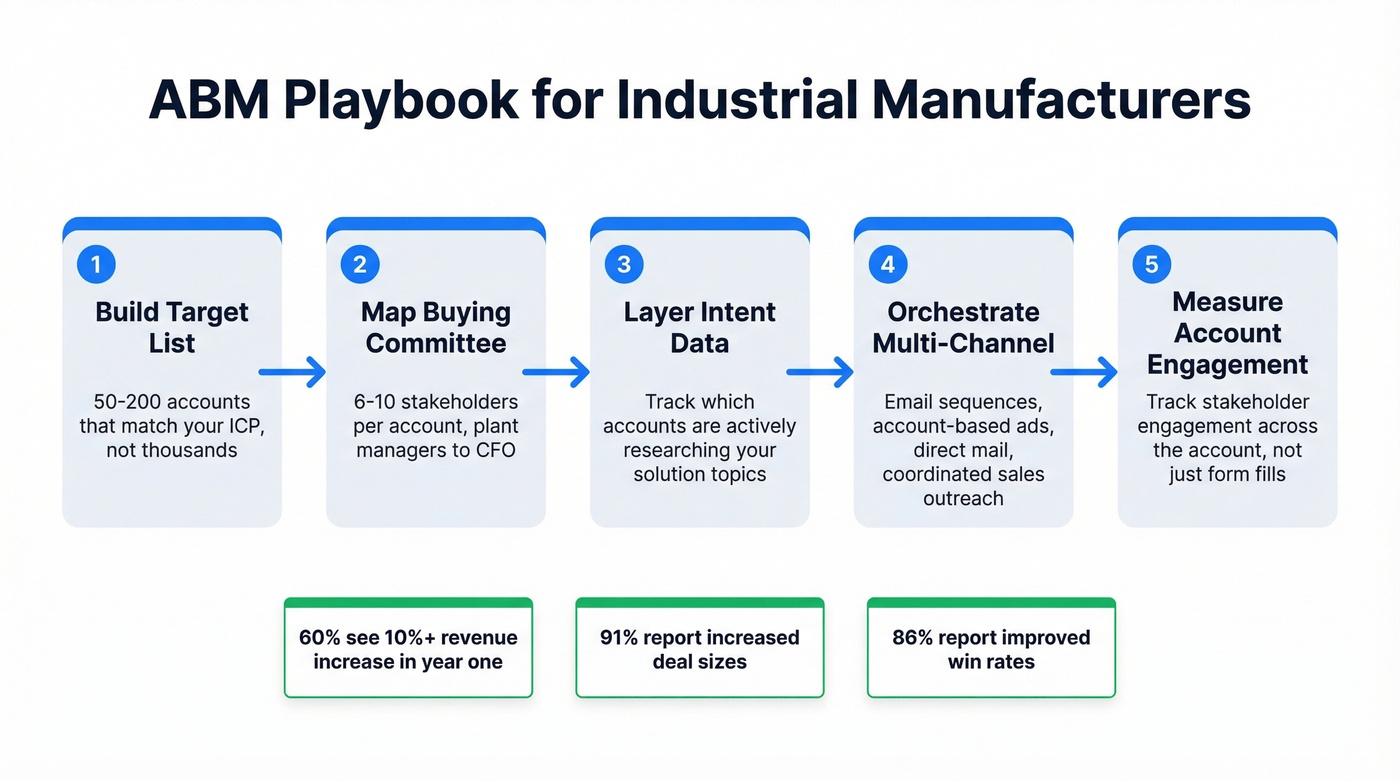
A practical ABM playbook for industrial companies:
- Build your target account list of 50-200 companies that match your ICP. Not thousands - dozens.
- Map the buying committee with 6-10 stakeholders per account. Plant managers, process engineers, procurement, maintenance, ops VP, CFO.
- Layer intent data to track which accounts are actively researching topics related to your solution.
- Orchestrate multi-channel touches combining personalized email sequences, account-based advertising, direct mail for high-value accounts, and coordinated sales outreach. (If you want a tighter process, use these account-based selling best practices.)
- Measure account engagement, not just leads. Track how many stakeholders at each account are engaging, not just whether you got one form fill.
The numbers back this up: 60% of companies using ABM report a 10%+ revenue increase in the first year, 91% see increased deal sizes, and 86% report improved win rates.

That 30% annual database decay hits industrial outbound hardest - long sales cycles mean your contacts go stale before deals close. Prospeo refreshes 300M+ profiles every 7 days at 98% email accuracy, so your outreach to plant managers and procurement leads actually lands.
Snyk dropped bounce rates from 35% to under 5%. Your industrial outbound deserves the same.
What It Actually Costs
Manufacturing is one of the most expensive B2B verticals for lead generation. The average CPL sits at $391 - roughly double the global B2B average of ~$198. Long sales cycles, technical complexity, and smaller addressable markets all drive costs up.
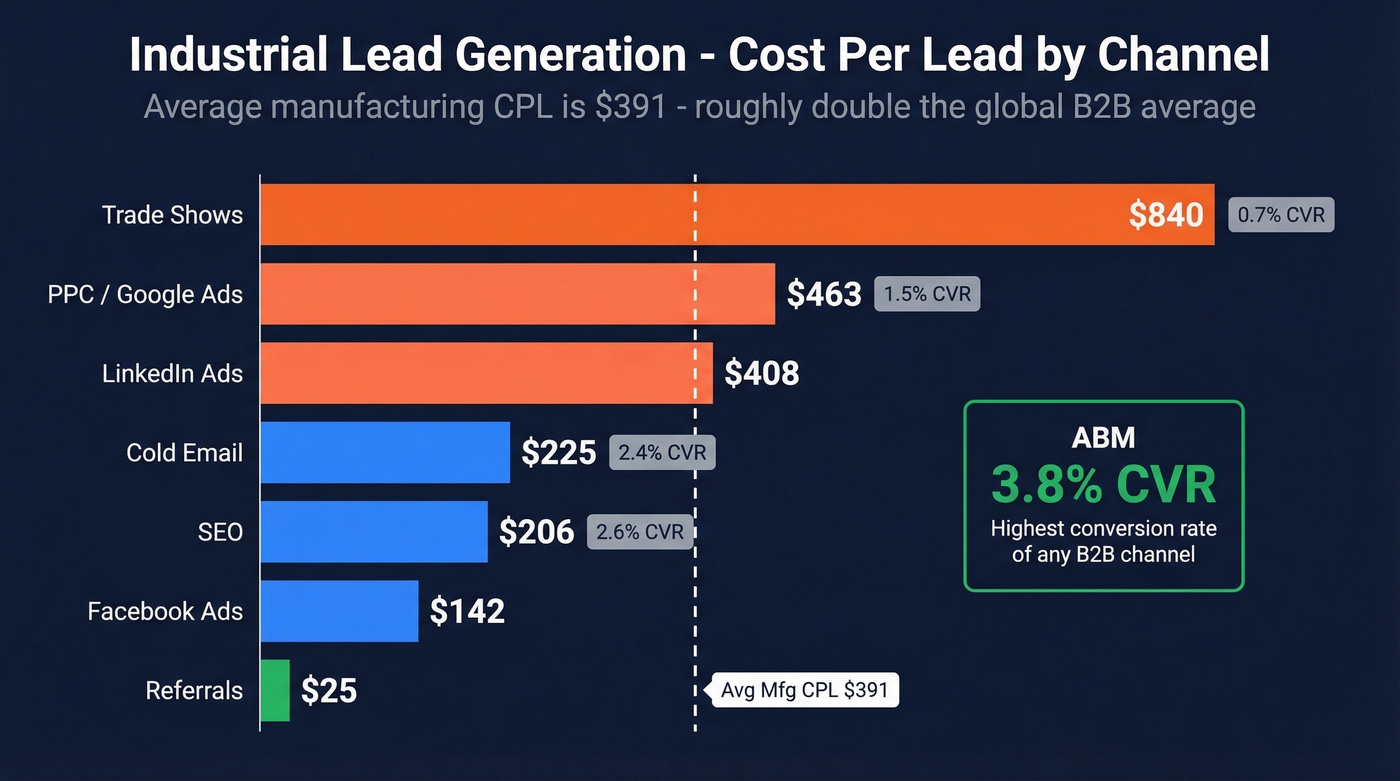
CPL varies significantly by channel:
| Channel | Avg CPL | Conversion Rate |
|---|---|---|
| Trade shows | $840 | 0.7% |
| PPC / Google Ads | $463 | 1.5% |
| LinkedIn ads | $408 | - |
| Cold email | $225 | 2.4% |
| SEO | $206 | 2.6% |
| Facebook ads | $142 | - |
| Referrals | $25 | - |
| ABM | - | 3.8% |
Google Ads benchmarks for Industrial Services are more encouraging than the broad PPC number suggests: search CPA of $79.28, search CVR of 3.37%, and search CPC of just $2.56. If you're running tight keyword targeting on high-intent industrial terms, paid search can outperform the category average significantly.
Company size matters too. Teams under 50 employees average $146 CPL, while enterprise organizations run closer to $429. The lesson: smaller companies can compete on efficiency, but they need to be ruthless about channel selection. You can't afford to spread $5K/month across five channels. Pick one or two, master them, then expand.
The Tool Stack for 2026
You don't need ten tools. You need three to five, chosen for your specific motion.
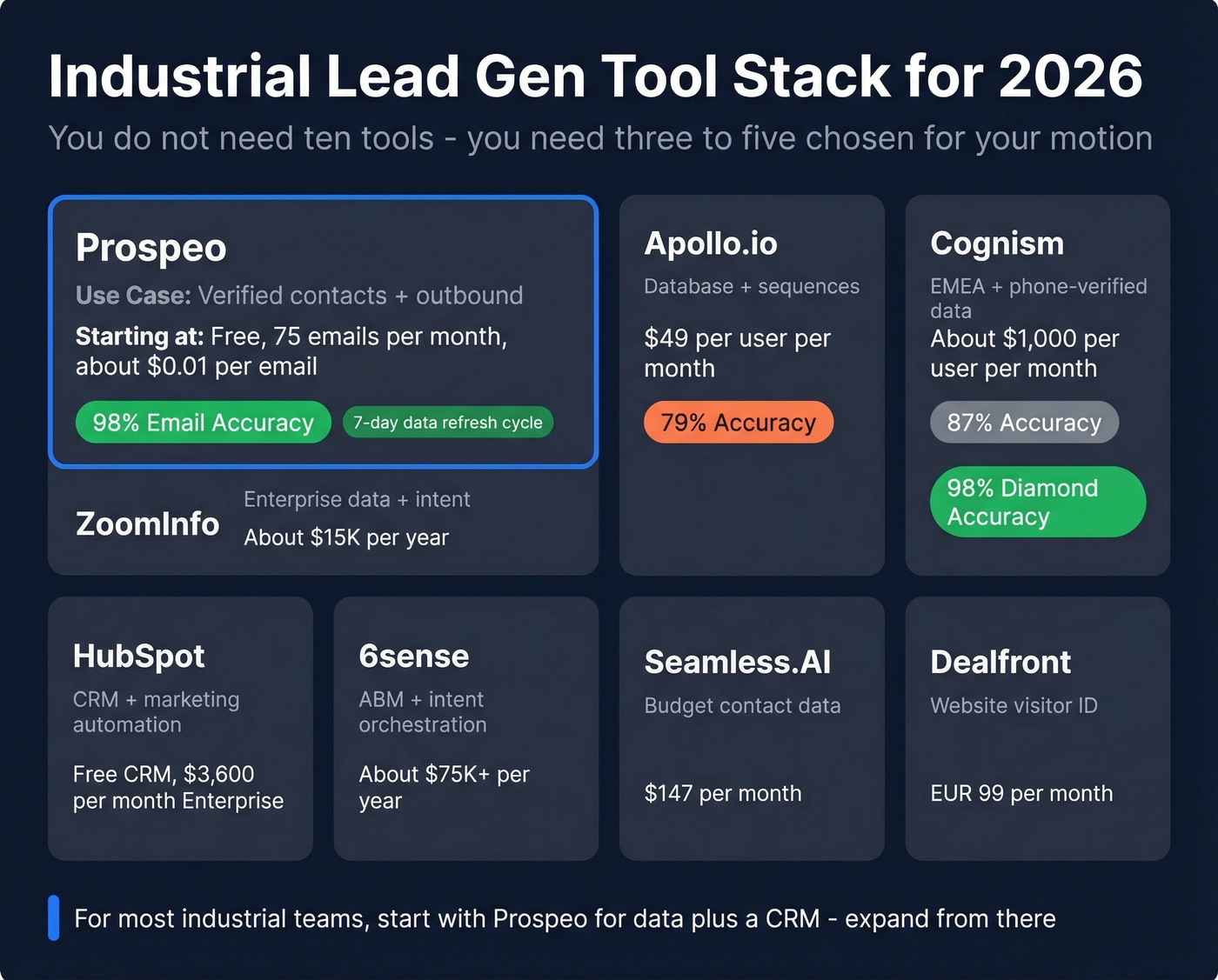
| Tool | Use Case | Starting Price | Email Accuracy |
|---|---|---|---|
| Prospeo | Verified contacts + outbound | Free (75 emails/mo); ~$0.01/email | 98% |
| Apollo.io | Database + sequences | $49/user/mo | 79% |
| ZoomInfo | Enterprise data + intent | ~$15K/yr | 87% |
| Cognism | EMEA + phone-verified data | ~$1,000/user/mo | 98% (Diamond) |
| HubSpot | CRM + marketing automation | Free CRM; $3,600/mo Ent. | N/A |
| 6sense | ABM + intent orchestration | ~$75K+/yr | N/A |
| Seamless.AI | Budget contact data | $147/mo | - |
| Dealfront | Website visitor ID | EUR99/mo | N/A |

Prospeo is the starting point for any industrial outbound motion. The database covers 300M+ professional profiles with 143M+ verified emails and 125M+ verified mobile numbers, and the entire dataset refreshes every 7 days. The 30+ search filters - buyer intent, technographics, job change, headcount growth - let you build precise prospect lists for specific roles at specific companies. Meritt tripled their pipeline from $100K to $300K/week after switching, with bounce rates dropping from 35% to under 4%. At roughly $0.01 per email with a free tier to start, there's no contract and no sales call required.
Apollo.io is the all-in-one option for SMB teams that want database, sequences, and a dialer in one platform. The database runs 275M contacts across 73M companies, and at $49-79/user/month, it's accessible. The tradeoff is email accuracy - at 79%, you'll see more bounces, which matters when you're emailing plant managers who get three cold emails a year and remember the bad ones. For teams with average deal sizes under $25K who want simplicity over precision, Apollo is a reasonable starting point. Just expect to supplement with a higher-accuracy source as you scale.
ZoomInfo is the enterprise default. Skip this if your team is under 20 reps or your annual data budget is under $20K - you'll pay for capabilities you won't use. The US database depth is unmatched, and the intent data and workflow tools are genuinely powerful for large sales orgs. But at $15K-30K/year and often much more with add-ons, it's overkill for most manufacturers under 100 employees.
Cognism fills a gap for teams selling into EMEA markets. Their Diamond Data feature provides phone-verified mobile numbers, and the accuracy on verified records is strong. At roughly $1,000/user/month, it's a premium investment - best suited for teams where direct dials into European manufacturing contacts justify the spend.
HubSpot handles the CRM and marketing automation layer. The free CRM is legitimately useful, and the marketing hub scales up to $3,600/month at the enterprise tier. For manufacturers running inbound + nurture sequences, it's the standard choice. (If you're comparing options, see examples of a CRM and what they’re best at.)
6sense is the ABM orchestration platform for companies with the budget to match. At $75K+/year, it's enterprise-only, but the intent data and account-level insights are best-in-class for identifying which target accounts are in-market right now.
Seamless.AI offers a budget-friendly contact database at $147-197/month. The database is large at 1.9B records claimed, but accuracy is inconsistent. Use it for initial research, not as your primary outbound source.
Dealfront (formerly Leadfeeder) identifies anonymous website visitors starting at EUR99/month. Useful as a signal layer - see which companies are visiting your site, then find the right contacts at those companies through a data provider.
At $391 average CPL in manufacturing, every wasted email burns budget. Prospeo's 30+ filters let you target by technographics, headcount growth, and buyer intent across 15,000 topics - so you reach food processors expanding facilities, not generic manufacturer lists.
Stop paying $391 per lead when verified emails cost $0.01 each.
Mistakes That Kill Results
Targeting too broad. "All manufacturers in the Midwest" isn't an ICP. Narrow by vertical, company size, buying triggers, and specific roles. The 700-emails-zero-replies story starts here every time. (Use an ideal customer profile template if you need structure.)
Running on stale data. B2B databases decay roughly 30% per year. If your last data purchase was six months ago, nearly a fifth of those contacts are wrong. Verify before you send. (A quick refresher on data enrichment services can help here.)
Slow follow-up. Conversion rates drop sharply with every hour of delay. If an inbound lead fills out a form at 10 AM and your rep calls back at 4 PM, you've likely lost them. Set response-time SLAs under 30 minutes. (If you need copy, use these sales follow-up templates.)
Measuring vanity metrics. MQLs without pipeline attribution are meaningless. Track CPL by channel, pipeline generated, and revenue closed - not form fills. (More on lead generation metrics that actually map to revenue.)
Going single-channel. Inbound builds long-term visibility. Outbound creates near-term pipeline. You need both. ABM bridges the gap for your highest-value accounts.
Weak landing pages. At 2.2% manufacturing CVR, every visitor counts. If your landing page is a generic "contact us" form with no specificity, you're leaking the traffic you paid to acquire.
No lead scoring or MQL/SQL definitions. Without clear criteria for when marketing hands off to sales, you'll either overwhelm reps with unqualified leads or let qualified ones go cold. In our experience, teams that skip this step waste 30-40% of their outbound effort on prospects who were never going to buy. (Set up a simple lead scoring model before scaling spend.)
Measuring What Matters
The metrics that matter for industrial lead generation aren't complicated, but most teams track the wrong ones.
| Stage | Benchmark Range |
|---|---|
| Visitor to Lead | ~2.2% |
| MQL to SQL | 10-30% |
| SQL to Closed Won | 15-30% |
The ranges are wide because they depend on your vertical, deal size, and sales cycle. A job shop quoting $50K projects closes at different rates than an OEM selling $2M capital equipment.
Track four KPIs relentlessly: CPL by channel so you know where to invest, pipeline velocity to see how fast deals move through stages, sales cycle length to confirm it's getting shorter, and win rate to ensure you're closing what you should. (If you want a tighter view, track pipeline health weekly.)
Your First 90 Days
Most industrial teams try to launch everything at once and end up doing nothing well. Let's break down a more realistic timeline.
Weeks 1-4: Define your ICP, clean your existing contact data, and set up your CRM with proper pipeline stages and lead scoring. Pick one outbound channel - cold email is the fastest to validate. (You can also adapt this into a rep-ready 30-60-90 day plan.)
Months 2-3: Launch your first outbound sequences to 200-500 contacts matching your tightest ICP. Simultaneously, publish 4-6 pieces of technical content targeting high-intent search terms. Measure reply rates, bounce rates, and CPL weekly.
Months 4-6: Double down on whatever channel is producing qualified conversations. Start your ABM motion for your top 50 accounts. Build nurture sequences for inbound leads that aren't sales-ready yet. By month six, you should have enough data to know your CPL by channel and where to invest next quarter.
For proof that this works at scale: Athena's case study with a plastic injection molder showed $2.7M in quoted business and $1.5M+ in revenue increase after implementing a structured inbound + outbound system. That's what "good" looks like - a repeatable process, not a one-off campaign.
FAQ
How long before industrial lead generation produces pipeline?
Outbound typically generates qualified conversations in 60-90 days; inbound and SEO compound meaningfully over 6-12 months. ABM sits in between at 3-6 months for named-account engagement. The average B2B buying cycle is 10.1 months, so plan expectations around that timeline.
Should manufacturers build in-house or hire an agency?
Start in-house with one channel you can own - usually outbound plus content. Agencies work best for specific capabilities you lack, like PPC management or ABM orchestration. Own the strategy internally; outsource the execution gaps.
What's a realistic monthly budget?
At $391 average CPL, budget $5K-15K/month to generate 12-40 qualified leads. Allocate roughly 40% to outbound data and tools, 30% to content and SEO, and 30% to paid channels. Adjust based on actual CPL by channel after 90 days of data.
Is cold email still effective for manufacturers?
Cold email at $225 CPL remains one of the most cost-effective channels. It fails with stale data and broad targeting - the difference between 0% and 5% reply rates is almost always data quality and ICP precision, not subject lines.
What tools do I need to start?
Three: a verified contact data platform (Prospeo's free tier gives you 75 emails/month), a CRM like HubSpot Free, and an email sending tool like Instantly or Smartlead. That's under $200/month total. Add intent data and ABM tools once you've validated your ICP and messaging with initial outbound results.