

Intent Data Marketing: What Works in 2026
91% of B2B marketers use intent data to prioritize accounts, but only 24% report exceptional ROI. One sales leader on r/sales put it bluntly: "90% of the 'intent triggers' we pay for are useless." Intent data marketing is a $4.49 billion industry in 2026 - and most of that spend gets wasted because teams can't bridge the gap between account-level signals and actual contacts fast enough.
Here's our take after watching dozens of teams try to operationalize this stuff: most don't need an enterprise intent platform. They need first-party signals, job-change alerts, and a way to find verified contact data for accounts showing buying behavior. If your annual budget sits below $50K, skip the enterprise platforms entirely.
What Is Intent Data?
Intent data captures digital behavior suggesting a company is actively researching a solution. First-party intent - website visits, pricing page views, content downloads - is high-accuracy but low-volume. Third-party intent aggregates signals across external publisher networks; Bombora's co-op covers roughly 5,000 sites, while Demandbase tracks bidstream metadata across about 3M sites. Third-party is broader but noisier, and the methodology feels like a black box to most buyers.
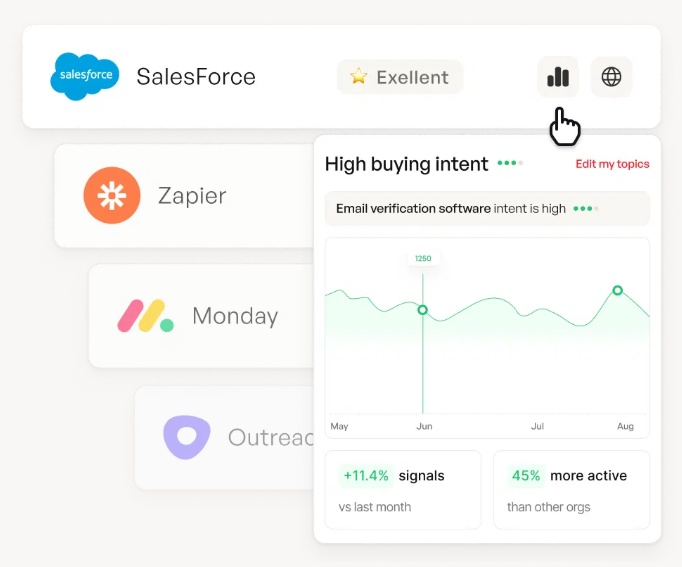
Here's the critical gap vendors gloss over: nearly all third-party buyer intent data is account-level, not contact-level. It tells you "Acme Corp is researching CRM software" but not who at Acme to call. That gap is where most intent investments die.
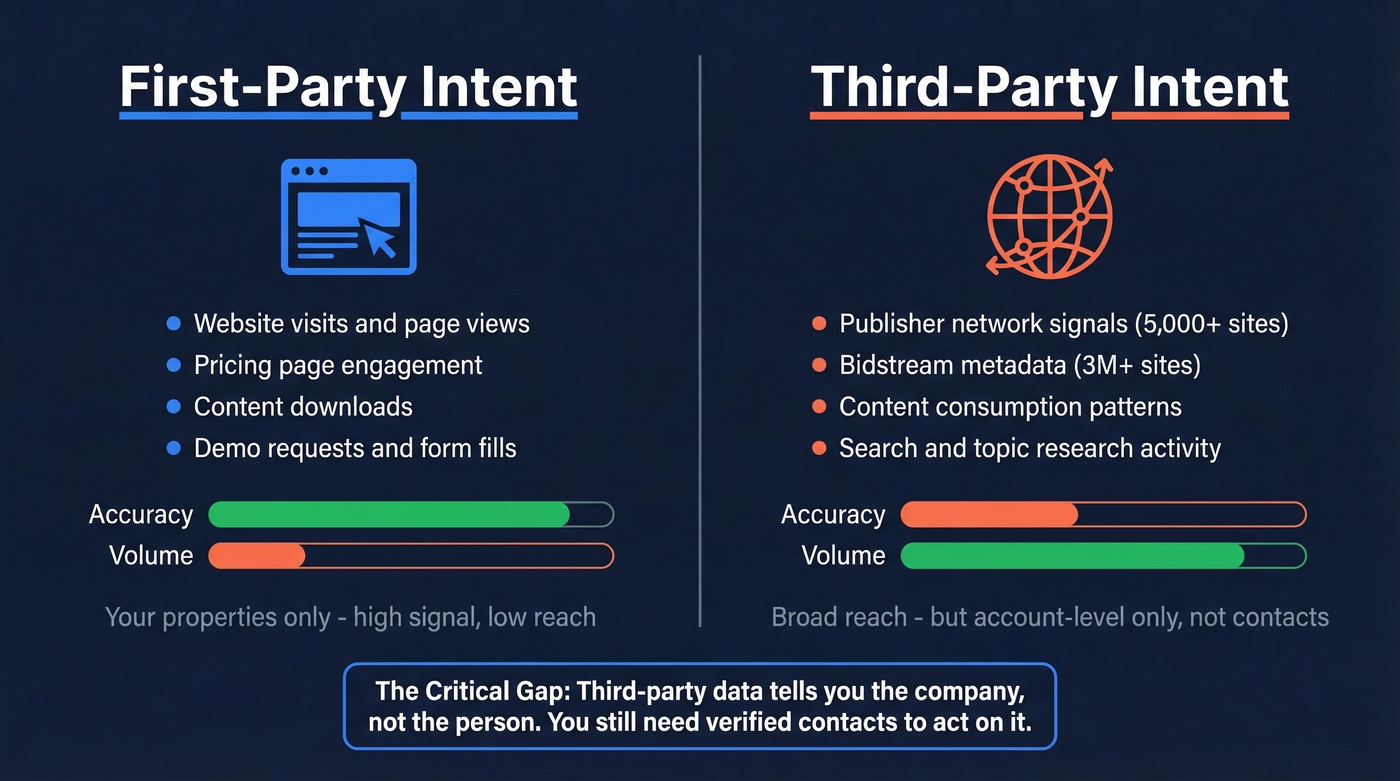
A pricing page visit is a buying signal. A blog read is barely a signal at all - rank accordingly.
How to Use Intent Signals for Pipeline
Intent data works when you pair it with speed and specificity. Five use cases that actually produce pipeline:
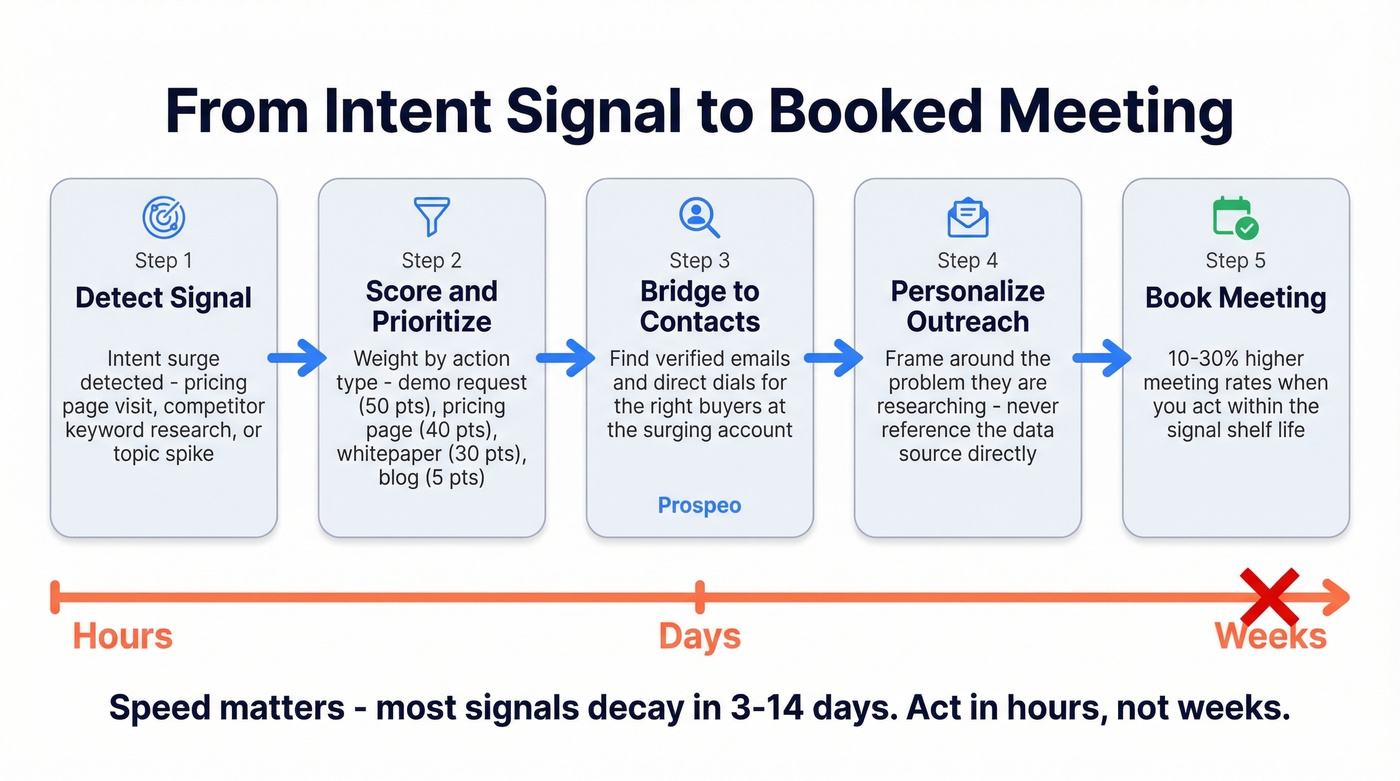
ABM account prioritization. Use intent surges to decide which accounts get ad spend and SDR attention this week - not this quarter. Teams layering intent-powered audience data into ABM programs typically see 10-30% higher meeting rates when they act within the signal's shelf life. (If you’re building the motion, start with account prioritization.)
Weighted lead scoring. Not every action deserves the same score. A solid baseline: demo request = 50 points, pricing page view = 40, whitepaper download = 30, blog subscription = 5. Build decay weighting in - most signals lose relevance within 3-14 days. We've seen teams run stale scores for months and wonder why reps ignore them. (More on building a model in lead scoring.)
Competitive displacement. When accounts surge on competitor keywords, route those signals to reps within hours. Not days. Hours. Speed-to-lead is everything here, and it's where signal-based targeting separates high-performing teams from everyone else. (This pairs well with a competitive intelligence strategy.)
Personalized outreach. Intent tells you what a company cares about right now. Use it to inform messaging - but never reference the data source. "We see you're researching X" feels invasive. "Here's how teams solving X typically approach it" lands better. (See personalized outreach for frameworks.)
Account-to-contact bridging. You know the company is in-market, but you don't have verified contact data for the right buyer. This is where most programs stall, and where pairing audience intent data with a verified leads database closes the gap. (If you need options, compare data enrichment services.)
What Intent Data Costs
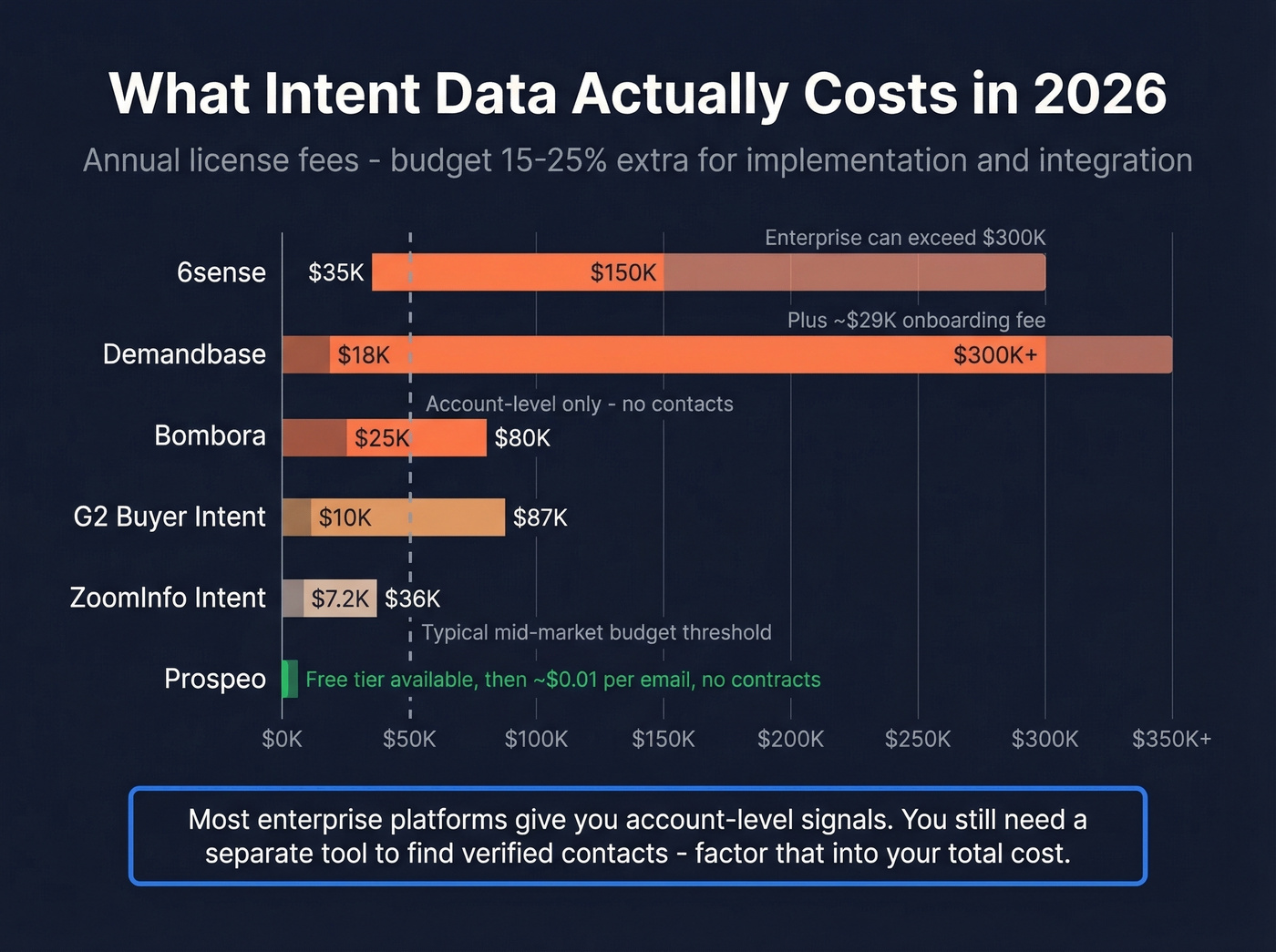
Vendors make pricing harder than it needs to be. Here's what you'll actually pay:
| Provider | Annual Cost | Notes |
|---|---|---|
| Bombora | $25K-$80K | Vendr median: ~$24,750 |
| Demandbase | $18K-$300K+ | ~$29K onboarding fee |
| 6sense | $35K-$150K+ | Enterprise can exceed $300K |
| ZoomInfo Intent | $7.2K-$36K | Mid-market add-on |
| G2 Buyer Intent | $10K-$87K+ | Add-on to G2 Seller |
| Prospeo | Free-~$0.01/email | Free tier: 75 emails + 100 Chrome extension credits/month, no contracts |
Budget 15-25% above the license fee for implementation, CRM integration, and optimization. A $40K Demandbase contract easily becomes $50K+ in year one when you factor in onboarding and extra seats at $1,200-$3,000/user/year. And buying Bombora directly gives you account-level data only - you'll still need a separate tool to find the actual people to contact. (If you’re pressure-testing ROI, use lead generation metrics.)

Intent data dies at the account level. Prospeo bridges the gap with 300M+ profiles, 143M+ verified emails at 98% accuracy, and Bombora intent signals across 15,000 topics - all in one platform. No $50K contracts. No stale data. Every record refreshed every 7 days.
Stop paying for signals you can't act on. Start reaching the actual buyer.
Five Mistakes That Kill ROI
Treating all signals as equal. This is the biggest ROI killer we see. A pricing page visit and a blog read aren't the same thing - weight by action type, not just recency, and revisit your scoring model quarterly. If you're scoring a whitepaper download the same as a demo request, your reps are chasing ghosts. (A practical way to define weights is to start from identifying buying signals.)
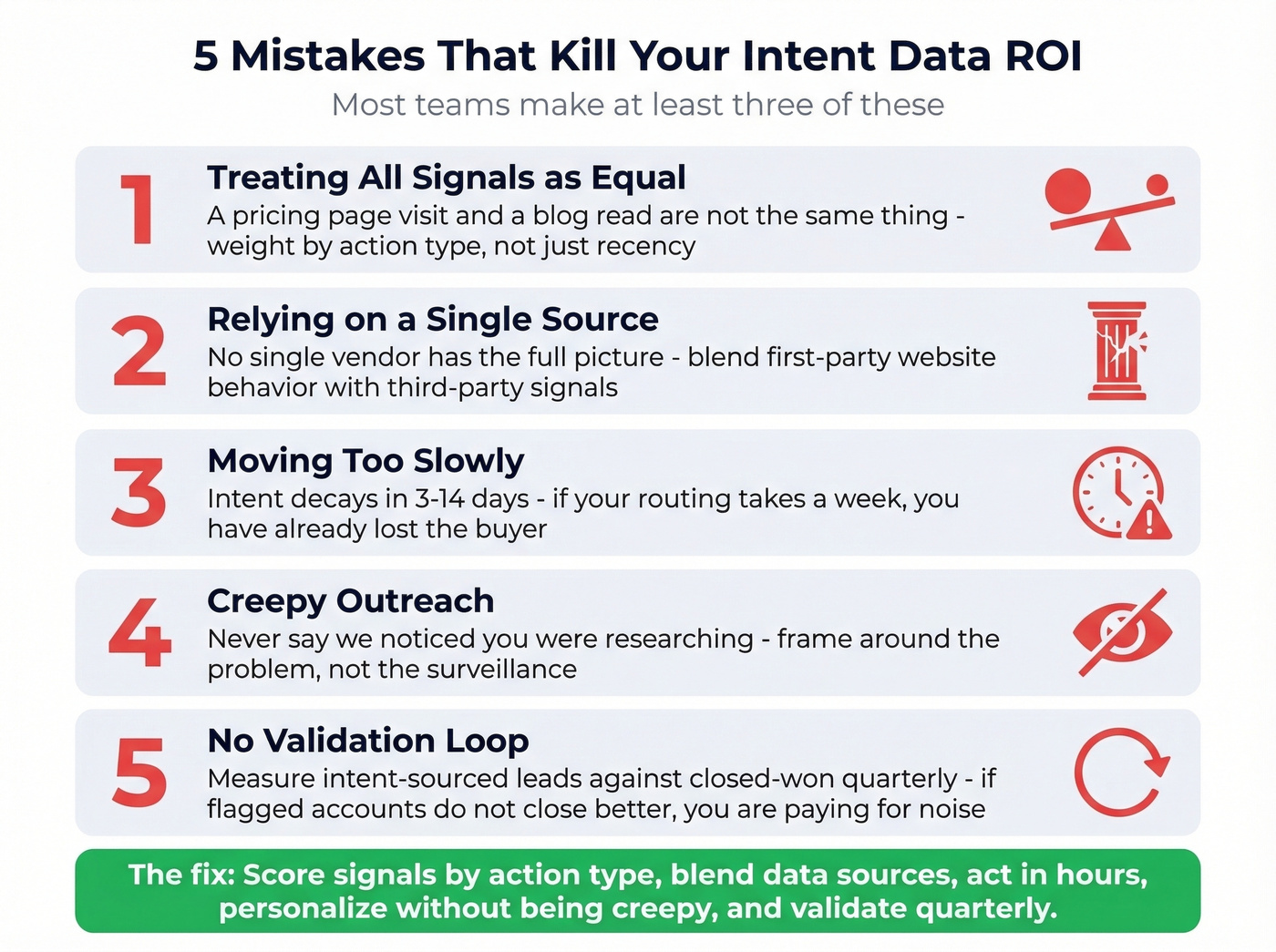
Relying on a single source. Teams that tested 6sense, ZoomInfo, and Bombora between 2021-2022 were mostly disappointed with the quality. Blend first-party website behavior with third-party signals. No single vendor has the full picture, and anyone who tells you otherwise is selling you something.
Moving too slowly. Intent has a shelf life. A pricing page visit is urgent - act within hours. A whitepaper download decays within days. If your routing takes a week, you've already lost. (If you need a system, map it as a lead generation workflow.)
Creepy outreach. "We noticed you were researching..." is a fast way to get blocked. Use intent to inform your messaging, but don't reference the data source. Ever. Frame around the problem, not the surveillance.
No validation loop. Measure intent-sourced leads against closed-won quarterly. If intent-flagged accounts don't close at a higher rate than non-flagged ones, you're paying for noise. Let's be honest - most teams skip this step and just keep renewing the contract because the dashboards look impressive.
Compliance and the Cookieless Shift
GDPR requires explicit consent for processing personal data - no pre-ticked boxes. CCPA mandates clear opt-out mechanisms. Cross-border transfers need Standard Contractual Clauses or adequacy decisions.
The bigger shift is technical. Safari and Firefox already block third-party cookies, and Chrome began restricting them in late 2025. First-party intent signals become more critical every quarter. If your strategy depends entirely on third-party signals, you're building on a foundation that's actively eroding - and the timeline for that erosion keeps accelerating.
Getting Started Without Enterprise Budgets
You don't need a $50K platform. Practitioners on r/sales consistently say they get more value from job-change alerts, funding signals, and direct website behavior than from generic third-party intent scores.
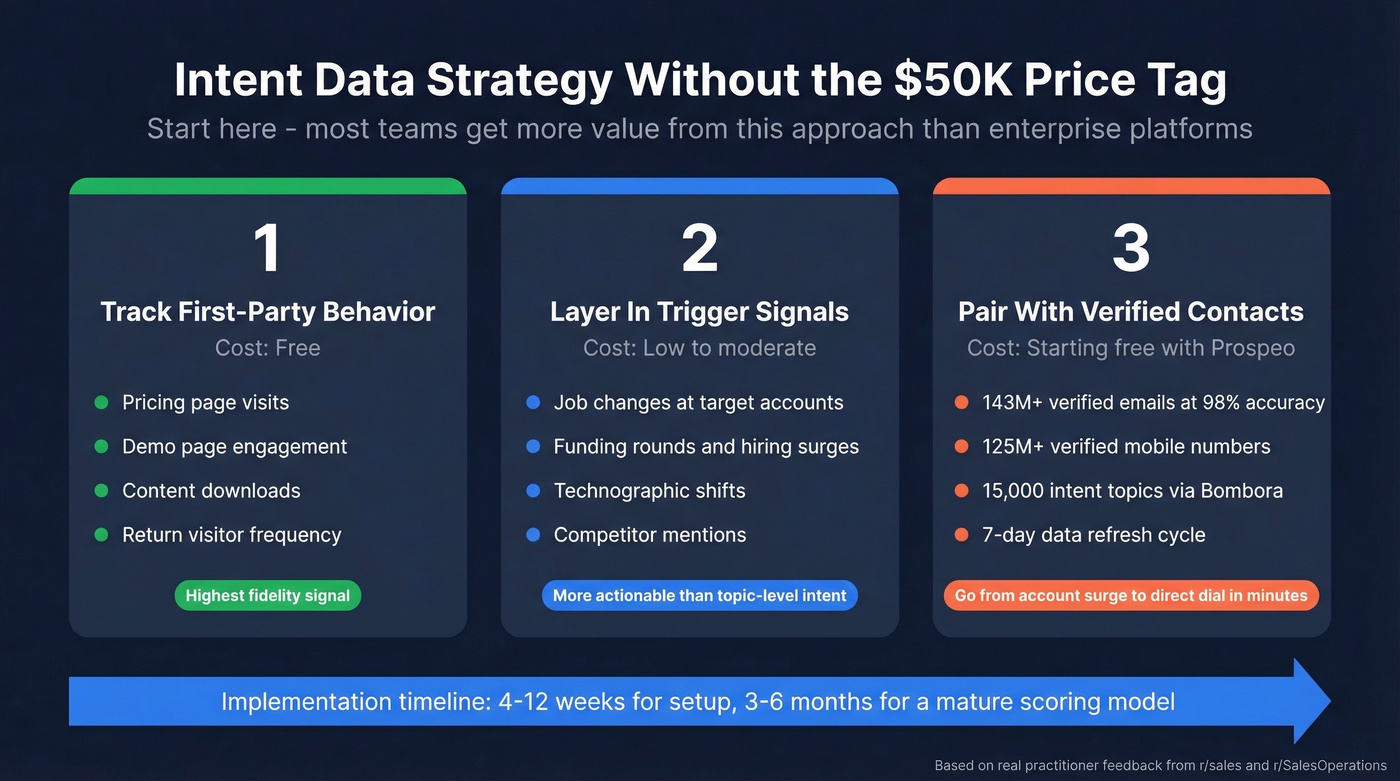
Track first-party website behavior first. Your analytics and CRM already capture pricing page visits and content engagement. This is your highest-fidelity signal and it's free. Start here before spending a dollar on third-party data. (If you’re standardizing fields, see lead status.)
Layer in trigger signals. Job changes, funding rounds, hiring surges, technographic shifts - these are more actionable than broad topic-level intent for most teams. A VP of Sales who just started at a new company and is hiring five SDRs? That's a signal worth acting on immediately. (Build a repeatable process with how to track sales triggers.)
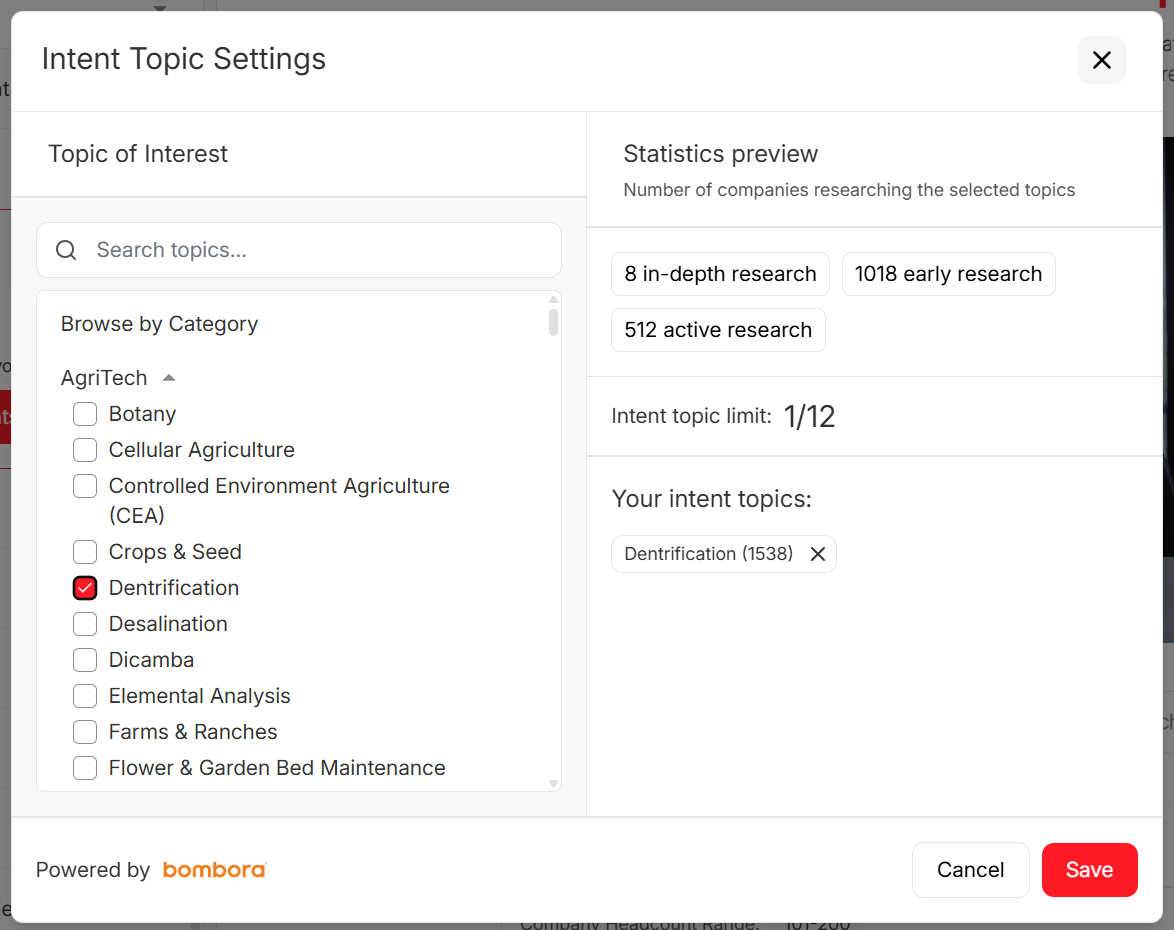
Pair signals with verified contact data so you can act fast. Prospeo tracks 15,000 intent topics layered on 143M+ verified emails and 125M+ verified mobiles, with 98% email accuracy and a 7-day data refresh cycle. You go from "Acme is surging" to a VP's direct dial in minutes - starting free, no contracts.
For proof that intent data marketing works when operationalized: 8x8's partner team used TechTarget Priority Engine to build $1.5M in monthly recurring revenue pipeline from intent-based initiatives. Expect 4-12 weeks for initial implementation and 3-6 months before your scoring model is mature enough to trust.
Most teams burn budget on enterprise intent platforms and still can't find verified contacts fast enough. Prospeo layers Bombora intent data with 30+ filters - job changes, funding, technographics, headcount growth - and returns verified emails and direct dials in seconds. At ~$0.01/email, you spend less on contacts than one month of your intent platform's onboarding fee.
Turn intent signals into booked meetings before the signal decays.
FAQ
What is intent based marketing?
Intent based marketing uses behavioral signals - content consumption, search activity, engagement patterns - to identify accounts actively researching a solution, then targets them with relevant messaging at the right time. It shifts spend from broad targeting to accounts already showing buying behavior, typically improving meeting rates by 10-30%.
What's the difference between first-party and third-party intent data?
First-party tracks behavior on your own properties like website visits and demo requests. Third-party aggregates signals across external publisher networks like Bombora's 5,000-site co-op. First-party is more accurate but lower volume; the most effective programs blend both sources.
How long do intent signals stay relevant?
Most decay within 3-14 days. A pricing page visit is urgent - act within hours. A whitepaper download loses value within a week. Build decay weighting into your scoring model so stale signals don't inflate lead scores and waste rep time.