

Is Cold Outreach Dead? Here's What the 2026 Data Actually Shows
Your reply rate dropped from 5% to under 1%, and you're wondering if the channel is cooked. It's not. But the version of cold outreach you ran in 2022 - blasting a purchased list from a single domain with zero verification - that's absolutely dead.
Cold outreach still works. The average cold email reply rate is 3.43%; elite senders hit 10%+. The gap between those numbers comes down to infrastructure and data quality, not the channel itself. Fix your data first, go multichannel second, and you'll stop asking whether the channel has a pulse.
The Short Answer
No. It's harder, more technical, and less forgiving of laziness than it was two years ago. That's a different thing entirely.
Instantly's analysis of billions of cold email interactions across thousands of active workspaces shows an average reply rate of 3.43%, with the top 10% clearing 10%+. If you're under 2%, the problem isn't cold email - it's how you're doing cold email.
Here's the thing most people miss: "cold outreach is dead" articles are written by companies selling you something that replaces it. "Cold outreach works great" articles come from companies selling cold email tools. The truth is boring - it works when done right, and "done right" in 2026 demands more infrastructure than it did three years ago.
Hot take: If your average deal size is under $1,000, you probably don't need outbound at all. Inbound or community-led growth will serve you better. Above that threshold, cold outreach remains one of the highest-ROI channels available.
2026 Benchmarks Across Channels
Outbound prospecting isn't just email anymore. The benchmarks vary wildly by channel:
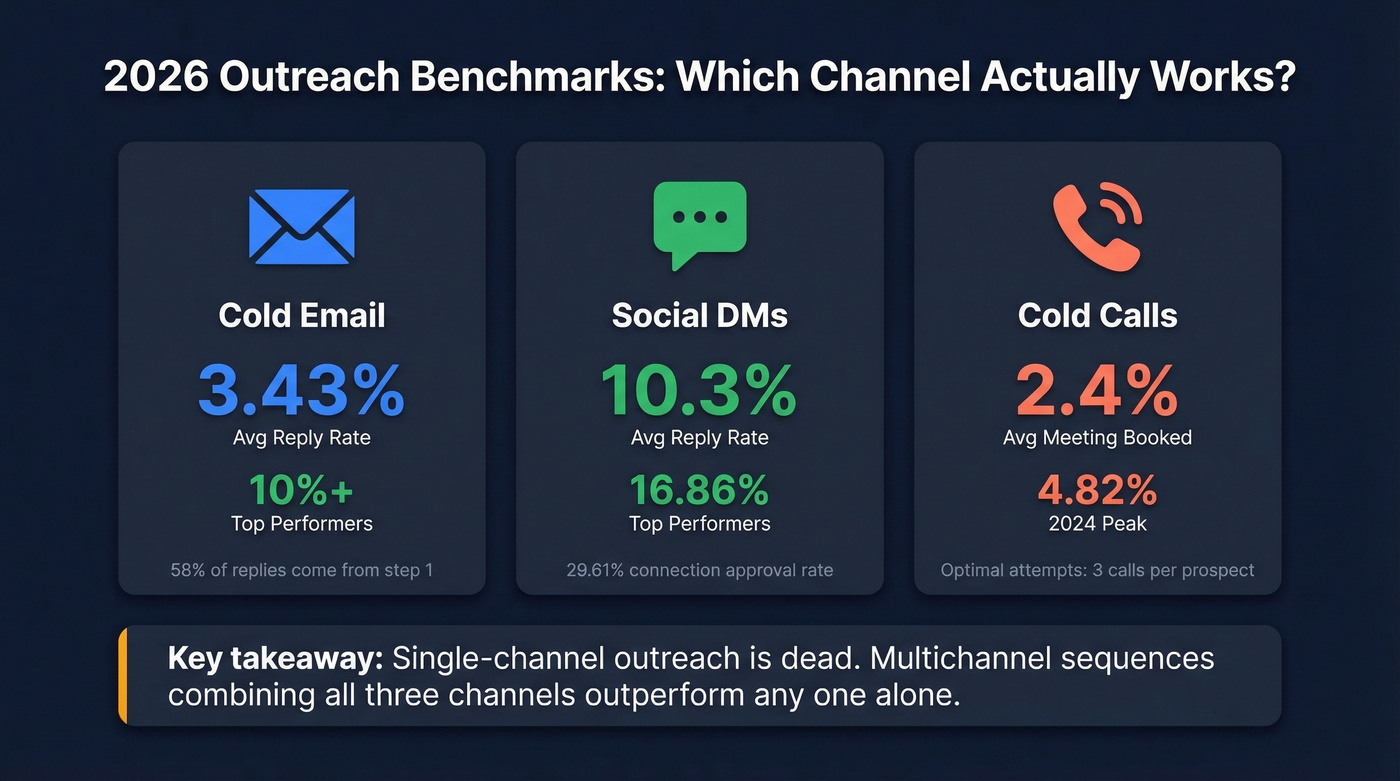
| Channel | Avg Response | Top Campaigns | Key Stat |
|---|---|---|---|
| Cold email | 3.43% reply | 10%+ reply | 58% of replies from step 1 |
| Social DMs | 10.3% reply | Up to 16.86% | 29.61% connection approval |
| Cold calls | ~2.4% meeting-booked | 4.82% (2024) | Optimal attempts: 3 |
Expandi's analysis of 70,130+ campaigns found social DMs pulling roughly 2x the response rate of cold email within the same dataset. One practitioner in r/b2b_sales ran a head-to-head test and reported 27% response via social selling vs. ~1% from cold email alone. Their conclusion wasn't "email is dead." It was "single-channel is dead."
Cold calling took the hardest hit. Cognism/WHAM puts 2024 meeting-booked success at 4.82%, and 2025 at almost half that. The optimum number of attempts is 3, which captures 93% of total conversations.
Why Deliverability Got Harder
Deliverability rules shifted dramatically starting in February 2024, when Google and Yahoo enforced new requirements for bulk senders: SPF, DKIM, and DMARC became mandatory for anyone sending 5,000+ messages per day. Gmail recommends staying below a 0.1% spam complaint rate, with a hard ceiling at 0.3%. Microsoft followed in early 2025, and Gmail escalated to SMTP-level rejection for non-compliant messages by late 2025.
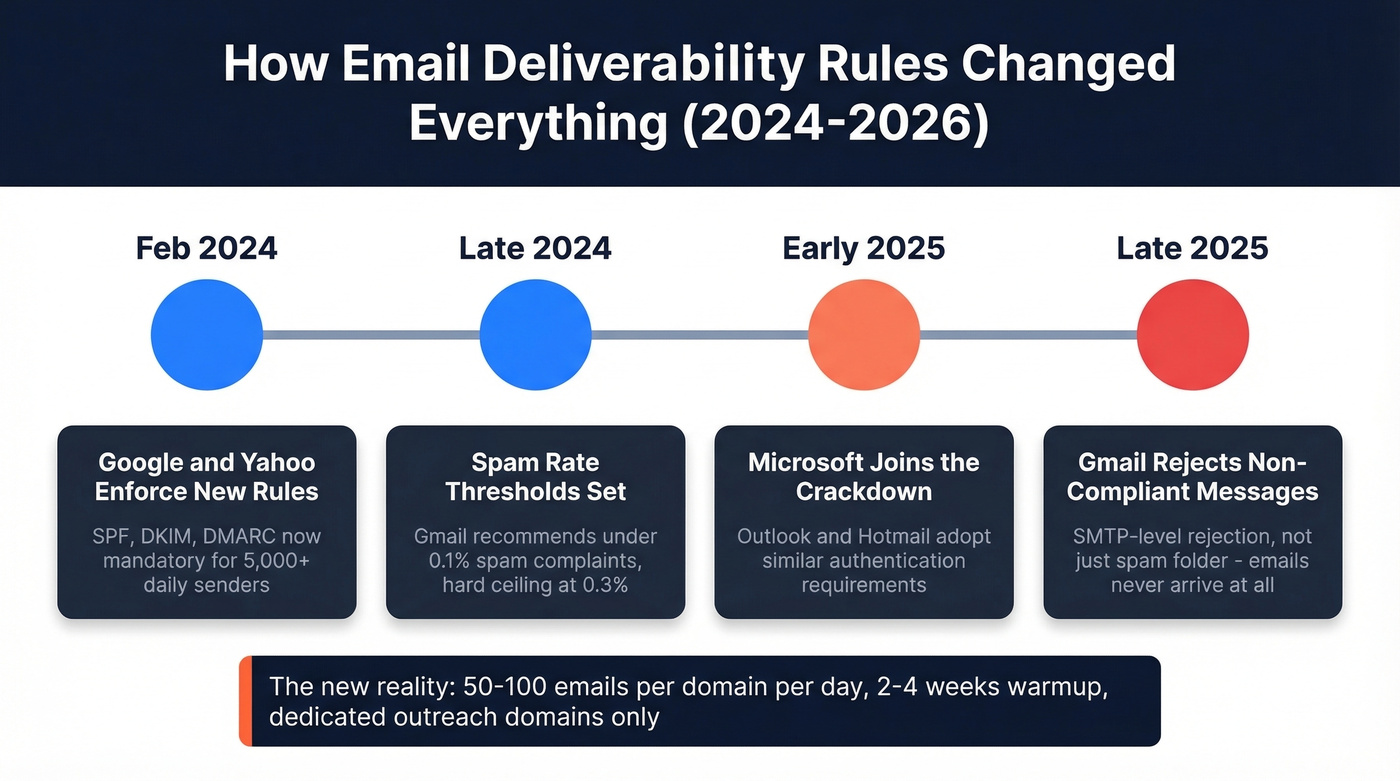
The practical impact was immediate. The consensus now sits at 50-100 emails per domain per day as a safe ceiling, with 2-4 weeks of warmup before you send a single cold email. Push volume too hard too fast and you'll get throttled. That's a fundamentally different operating model than "buy a list, blast 1,000/day." If you need a deeper breakdown, start with an email deliverability audit and a clear email velocity policy.

This article proves it: deliverability kills campaigns before your copy even gets read. Snyk cut bounce rates from 35% to under 5% with Prospeo's 143M+ verified emails on a 7-day refresh cycle. At $0.01 per email, fixing your data costs less than one bad campaign.
Stop rewriting copy when the real problem is your data.
The Hidden Killer: Bad Data
Most teams obsess over copy, subject lines, and send times while ignoring the thing that destroys campaigns before any of that matters. Bad data.
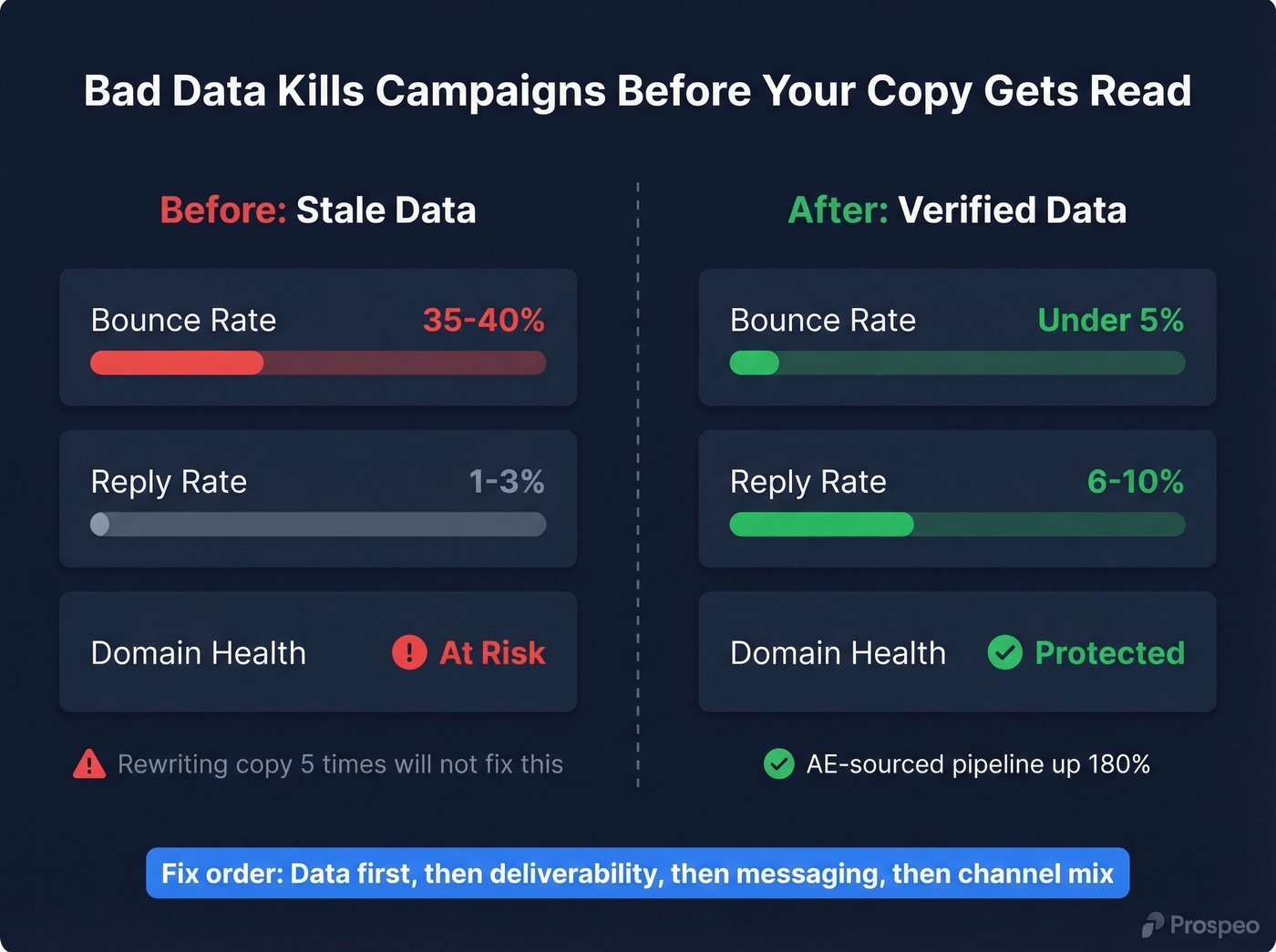
High bounce rates damage deliverability fast. One Reddit user documented their turnaround - bounce rate went from 11% to under 2%, and that single change was the biggest lever in lifting their reply rate from 3% to 6%. We've seen this pattern repeatedly. Teams rewrite their copy five times when the real problem is 15% of their emails are bouncing.
Look - data quality is the most underrated variable in outbound. Snyk saw this firsthand: bounce rates dropped from 35-40% to under 5% after switching to Prospeo, and AE-sourced pipeline jumped 180%. With 143M+ verified emails refreshed on a 7-day cycle and a 98% accuracy rate, the difference between stale data and fresh data is often the difference between a campaign that converts and one that tanks your domain. If you're evaluating vendors, compare data enrichment and email append options side-by-side.

The fix order is: data, deliverability, messaging, channel mix. Get that sequence wrong and nothing else matters. This is the single framework that separates teams thriving with outbound from teams declaring the channel dead.
What Modern Outreach Looks Like
Infrastructure Checklist
- Separate cold outreach domains from your main business domain
- Warm each domain for 2-4 weeks minimum
- Cap sends at 26-50 emails per day per domain
- Use plain-text, 1:1-looking emails - no HTML templates, no tracking pixels
- Monitor spam complaint rates daily, not weekly
Data and Personalization
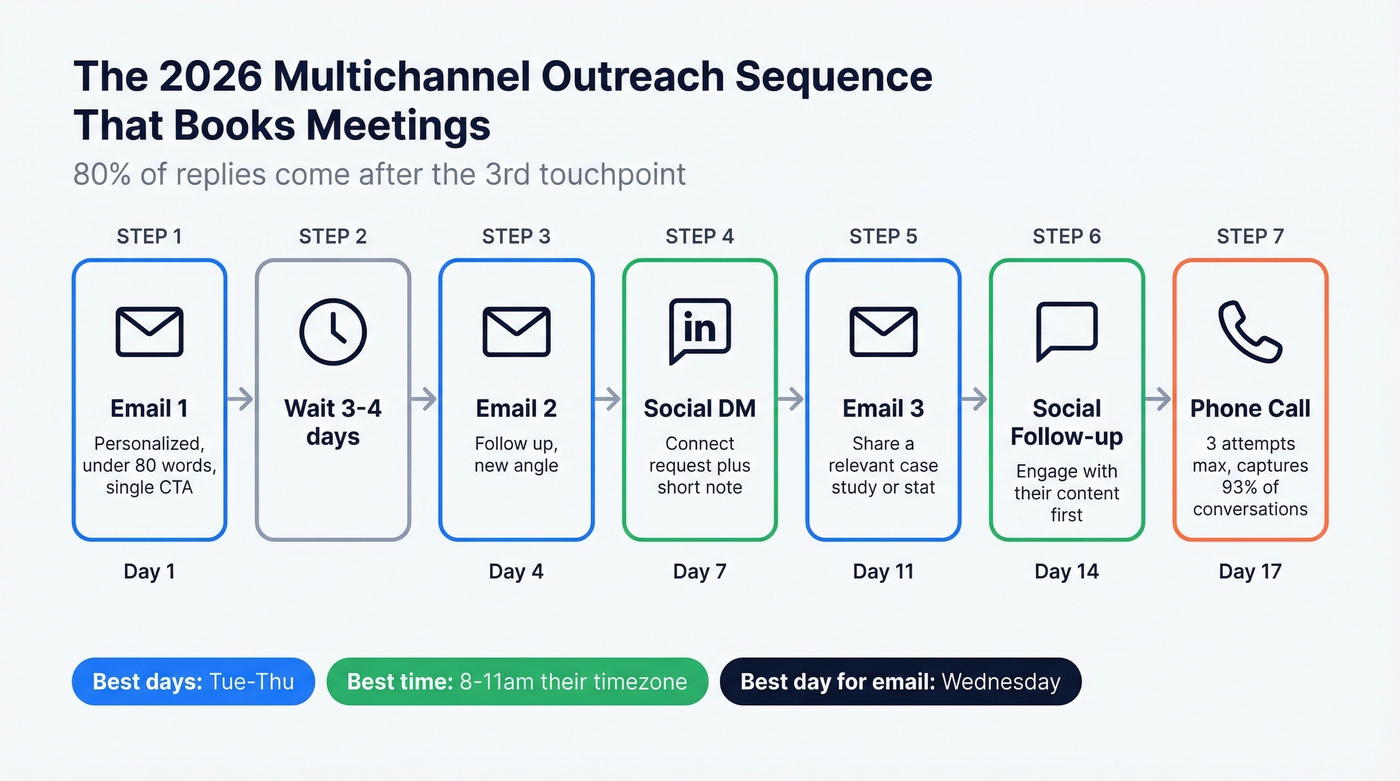
Best-performing campaigns keep emails under 80 words with a single, low-friction CTA. Personalization lifts reply rates from ~2% to 8-10% when done well, but manual research takes 10-15 minutes per lead. Enrichment platforms cut that to minutes by surfacing company signals, tech stack, and recent triggers automatically. To tighten execution, use a proven B2B cold email sequence and keep a library of cold email follow-up templates.
Multichannel Sequencing
Email, then social, then phone. Four to seven touchpoints, spaced 3-4 days apart. In one 2026 practitioner run, 80% of replies came after the 3rd touchpoint. Tuesday through Thursday, 8-11am in the recipient's timezone. In Instantly's weekday analysis, Wednesday shows the highest reply rates. If you're building this into a repeatable motion, treat it like sequence management, not a one-off campaign.
Signal-Based Targeting
Stop optimizing for volume. As Collin Stewart of Predictable Revenue put it: "Predictable Revenue was never meant to be about brute-force outreach - it was about focus." Intent data, job changes, and funding events tell you who's actually in-market. That shift - from spray-and-pray to signal-led - is the single biggest mindset change separating teams that are thriving from teams writing obituaries for the channel. This is also where a solid ideal customer profile and consistent lead scoring pay off.
The Math: Is It Worth It?
The economics still work. At the low end, you can run cold email for $36/month - a Woodpecker plan at $29, a domain at $1.25, and a mailbox at $6. A full infrastructure rebuild with multiple domains, verification, and enrichment runs closer to $420/month.
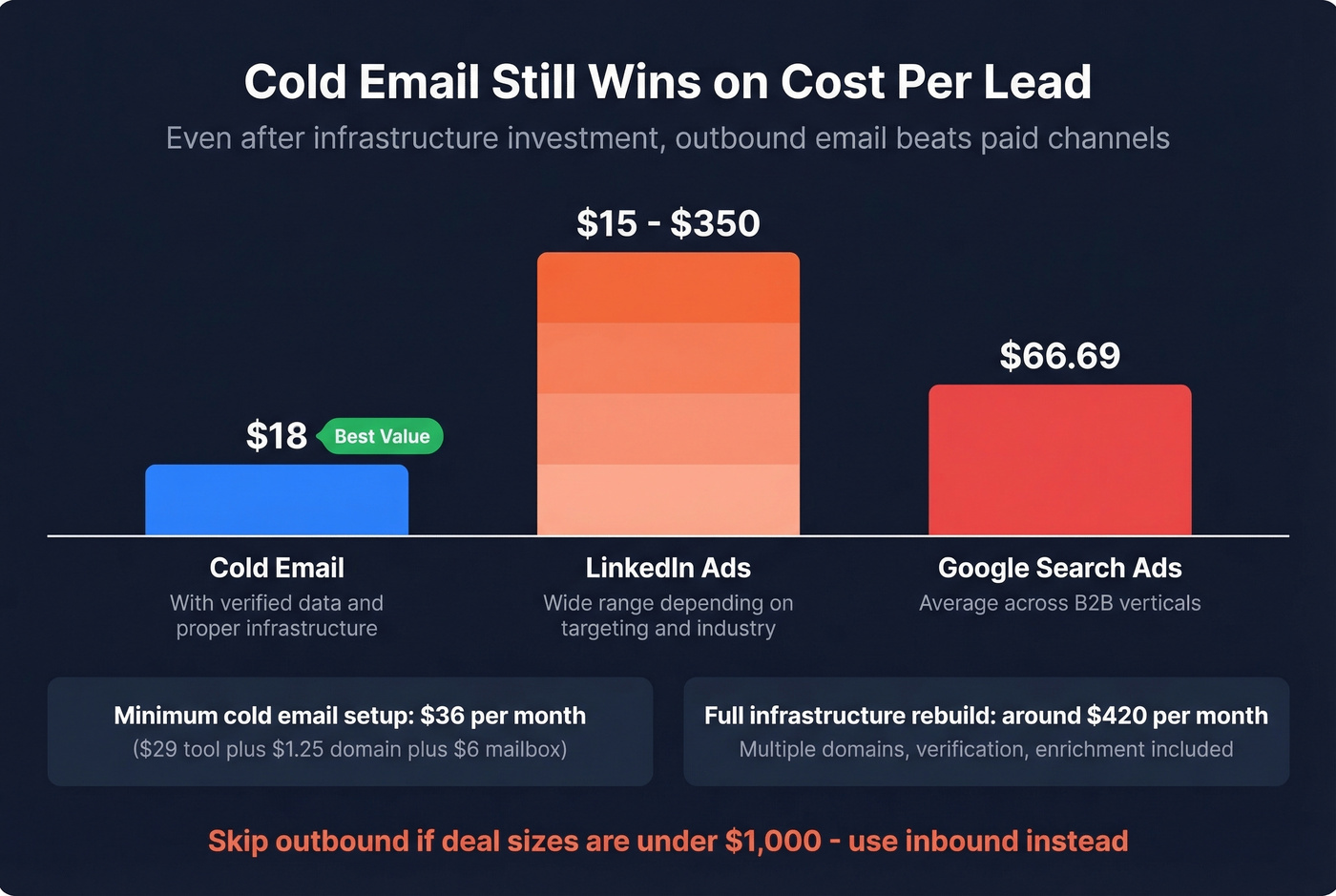
Using Woodpecker's benchmark assumptions, that can come out to around $18 per qualified lead at the low end. Compare that to LinkedIn ads at $15-$350 per lead, or Google search ads at $66.69 per lead. In our experience, cold email's cost-per-lead advantage remains significant even after the infrastructure investment - it's the one channel where spending more on data quality directly lowers your cost per lead. For more tactics that compound, see these sales prospecting techniques.
Skip outbound entirely if your deal sizes are under $1,000. For everyone else, outbound prospecting with clean data and multichannel sequencing is still one of the most efficient ways to build pipeline.
Only Dead If You Refuse to Adapt
Is cold outreach dead? Only the lazy version. The broader question people are really asking - is outbound dead as a go-to-market motion? - has the same answer.
Outbound sales isn't dead, but the low-effort, high-volume playbook that defined it for a decade is. The teams still generating pipeline in 2026 have rebuilt their approach around verified data, multichannel sequences, and signal-based targeting. The teams who haven't made those changes are the ones writing obituaries for the channel. Let's be honest - if you're still sending 500 unverified emails a day from your primary domain, you're not doing cold outreach. You're doing spam. If you want to modernize the stack, start with the right SDR tools and a clean outbound lead generation tools shortlist.
Signal-based targeting beats spray-and-pray every time. Prospeo combines 30+ filters - intent data, job changes, funding, tech stack - with 98% email accuracy so every touchpoint in your multichannel sequence reaches a real inbox. Teams using Prospeo book 35% more meetings than Apollo users.
Send fewer emails to better prospects and watch your reply rates climb.
FAQ
What's a good cold email reply rate in 2026?
The average across billions of interactions is 3.43%, with top performers hitting 10%+. If you're under 2%, fix your data quality and deliverability infrastructure before rewriting copy - those two variables account for most of the gap.
What's the best outreach channel right now?
Social DMs currently pull the highest response rates (~10.3% average), but no single channel wins alone. The teams getting the best results run multichannel sequences - email, social, and phone - across 4-7 touchpoints. Single-channel prospecting underperforms every time.
How many cold emails can I send daily without getting flagged?
Stay under 50-100 per domain per day, and never send from your primary business domain. Use dedicated domains, warm them for 2-4 weeks minimum, and keep spam complaint rates below Gmail's 0.1% threshold - exceeding the 0.3% hard ceiling triggers throttling fast.
What's a cost-effective way to fix bad outbound data?
Prospeo offers 75 free verified emails per month with 98% accuracy and a 7-day data refresh cycle. For teams running real campaigns, paid plans start at roughly $0.01 per email - significantly cheaper than enterprise providers while delivering higher accuracy on a weekly refresh.