

Just a Quick Reminder: How to Follow Up Without Sounding Pushy
You sent the proposal Monday. It's Thursday. Radio silence. You've drafted three versions of a follow-up, deleted all of them, and you're wondering whether "just a quick reminder" makes you sound like a passive-aggressive middle manager. Meanwhile, the average professional receives 121 emails daily - your message probably just got buried.
Let's fix this.
The Short Answer
"Just a quick reminder" is polite in most contexts. It only turns passive-aggressive after the second or third use in the same thread. Best timing for unanswered emails: send your first follow-up 2-3 days after your last message, Tuesday through Thursday between 9-11 AM. One follow-up lifts reply rates from 9% to 13%. If you want more plug-and-play options, use these follow-up templates to keep your cadence consistent.
If the phrase feels too direct, try "Wanted to follow up on this" or the stealth tactic: reply "thanks" to bump the thread without explicitly reminding.
Polite or Passive-Aggressive?
The phrase itself is neutral. Context is what tips it one way or the other.
When a vendor sends a quick reminder to a client about an overdue invoice, it reads as professional and restrained. When a manager sends it to a direct report for the third time about the same task, it reads as "I'm documenting this before I escalate." Same five words, completely different energy. Power dynamics matter here - peer-to-peer, it's fine; upward to your boss, it's fine and maybe even deferential; downward from boss to report, it can feel loaded, especially with repetition.
Stop agonizing over whether the phrase sounds rude. It doesn't. What sounds rude is not following up at all and letting the deal, the invoice, or the project die in someone's inbox.
Does Following Up Actually Work?
Yes, and it's not even close.
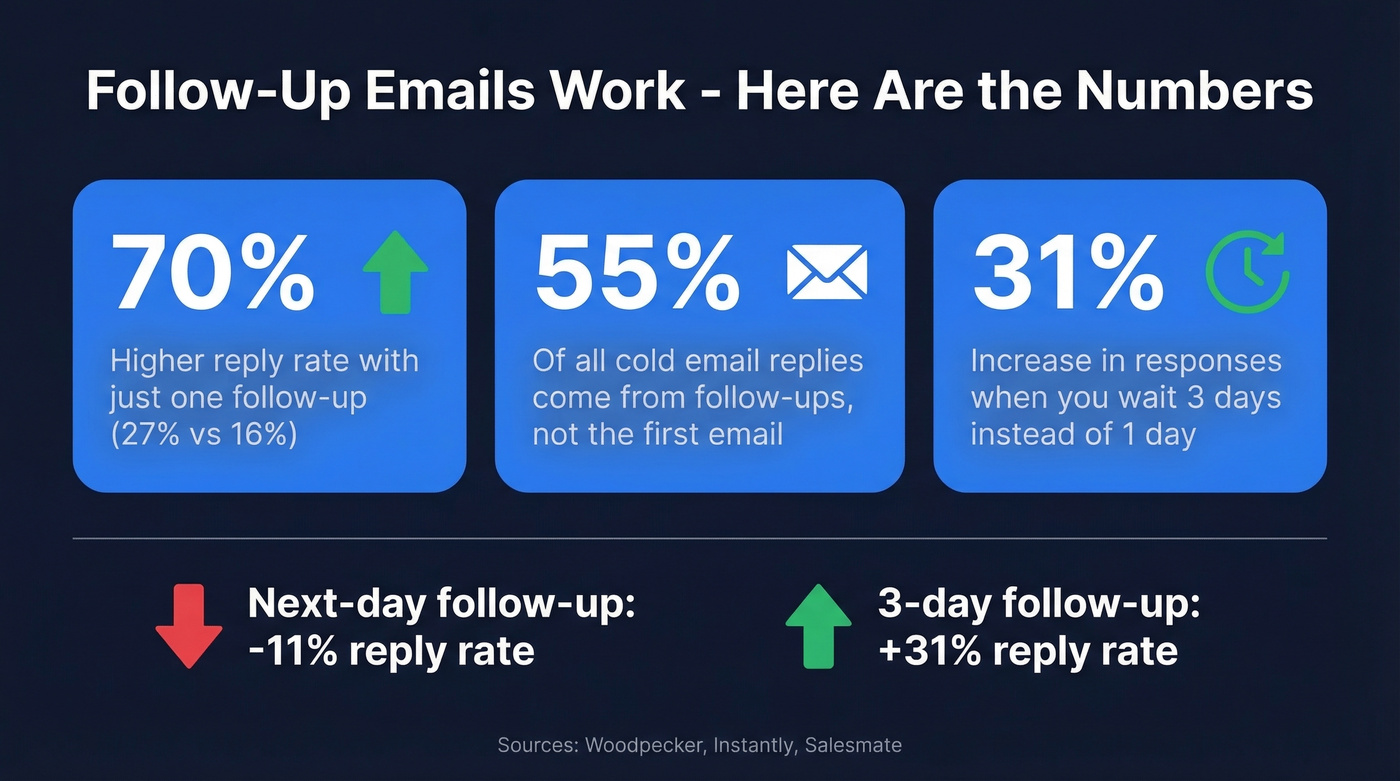
Woodpecker's platform data shows campaigns with at least one follow-up hit a 27% reply rate versus 16% for single-email sends - nearly 70% higher. Instantly reports that 55% of cold email replies come from follow-ups, not the initial message. Salesmate says 86% of responses are collected within 48 hours, which means the first follow-up matters most. If you’re trying to improve your follow-up email reply rate, this is the lever to pull first.
The sweet spot is 2-3 follow-ups. That's where you get most of the upside without dragging the thread into spammy territory.
Here's the thing most people get wrong: they obsess over the perfect phrasing when the real variable is timing. A mediocre follow-up sent on day three outperforms a beautifully crafted one sent the next morning. Next-day follow-ups actually reduce replies by 11%, while waiting three days produces a 31% increase in response likelihood. Patience pays.
When to Send Your Reminder
| Scenario | Wait Time | Notes |
|---|---|---|
| Upcoming meeting | 1-2 days before | Confirmation, not nagging |
| Payment/invoice | 1 day after due | Professional, not aggressive |
| Job application | 5-10 business days | 44% hear back within 2 weeks |
| Cold outreach | 2-3 days | Graduated: 2, 4, 7, 14 days |
| Proposal follow-up | 3-5 days | Enough time to review |
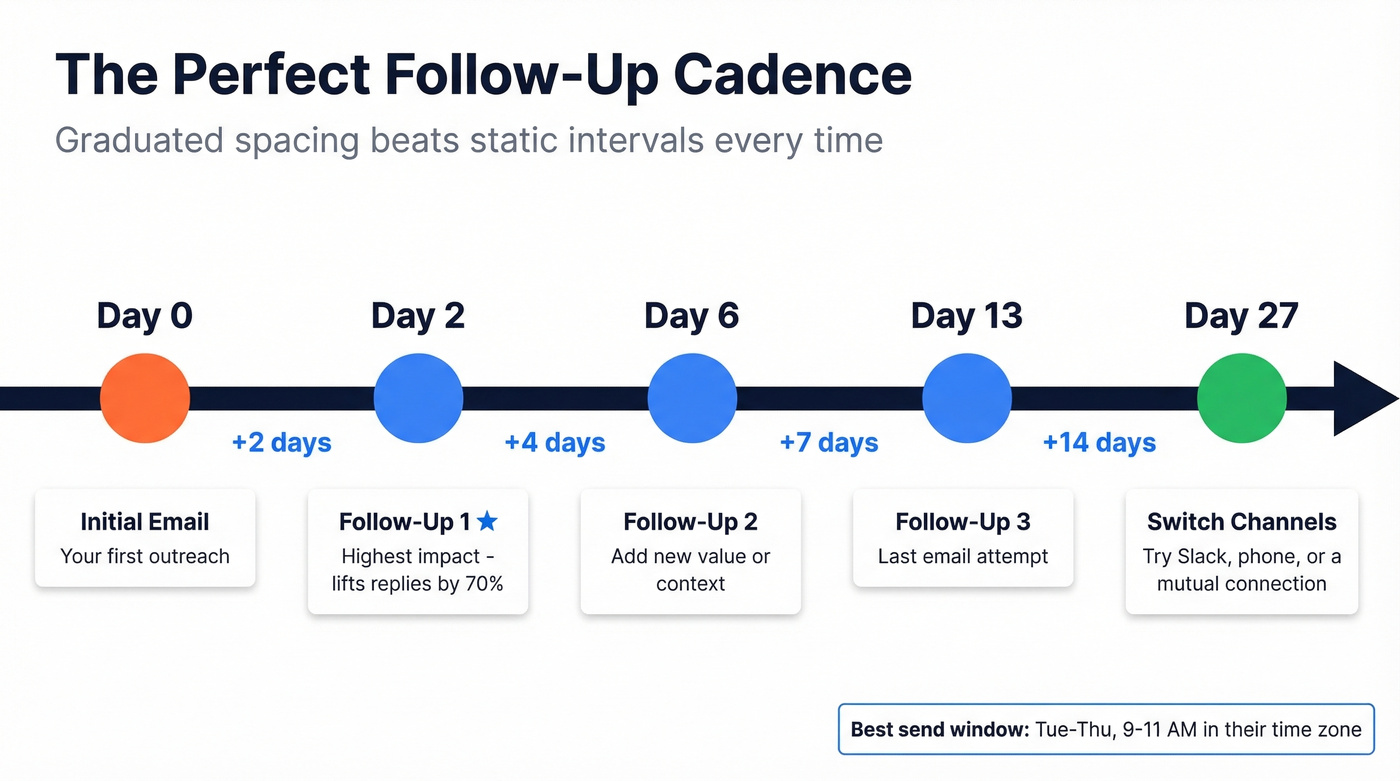
For multi-touch sequences, use graduated spacing rather than static intervals. A cadence of 2, 4, 7, then 14 days between messages mimics natural human follow-up patterns and avoids the "automated drip" feel. Best send window across the board: Tuesday through Thursday, 9-11 AM in the recipient's local time zone. If you’re building a full B2B cold email sequence, this spacing is a solid default.

Follow-up timing matters, but it's worthless if your email bounces. Prospeo's 98% email accuracy means your "just a quick reminder" actually lands in the inbox - not in a spam trap or dead address. 143M+ verified emails, refreshed every 7 days.
Stop crafting the perfect follow-up for an email address that doesn't exist.
Copy-Paste Reminder Templates
Each template follows the under-120-words best practice with one clear CTA and a soft deadline. If you want to tighten your copy further, these email copywriting principles help you stay short without sounding abrupt.
Meeting Reminder
Subject: Confirming our call Thursday at 2 PM
Hi [Name], just a quick reminder about our meeting Thursday at 2 PM [timezone]. Here's the agenda link: [link]. Let me know if the time still works or if we need to shift.
Payment or Invoice
Subject: Invoice #1042 - due yesterday
Hi [Name], wanted to flag that invoice #1042 was due [date]. If it's already been processed, ignore this. Otherwise, could you confirm payment by [date + 3 days]? Happy to resend the invoice if needed.
No-Response Follow-Up
Subject: Re: [Original subject line]
Hi [Name], bumping this up in case it got buried. The short version: [one-sentence summary of ask]. Would [specific date] work for a quick reply?
Job Application Follow-Up
Subject: Following up - [Role Title] application
Hi [Name], I applied for the [Role Title] position on [date] and wanted to follow up. I'm especially excited about [specific thing about the company]. Is there any additional information I can provide?
Proposal Follow-Up
Subject: Re: [Company] proposal - any questions?
Hi [Name], checking in on the proposal I sent [date]. Happy to walk through the pricing section or adjust scope if anything doesn't fit. Could we grab 15 minutes this week?
Polite Follow-Up Phrases That Work
| Phrase | Tone | Best For |
|---|---|---|
| Just a quick reminder | Neutral | General use |
| Wanted to follow up on this | Warm, casual | Peers, clients |
| I'd like to kindly remind you | Formal | Senior stakeholders |
| Circling back on this | Casual, direct | Internal teams |
| Friendly heads-up | Light, informal | Slack-era workplaces |
| Following up as promised | Professional | Post-meeting action items |
| Gentle nudge on the below | Soft, understated | Cross-cultural teams |
| Could you provide an update? | Direct, neutral | When you need an answer |
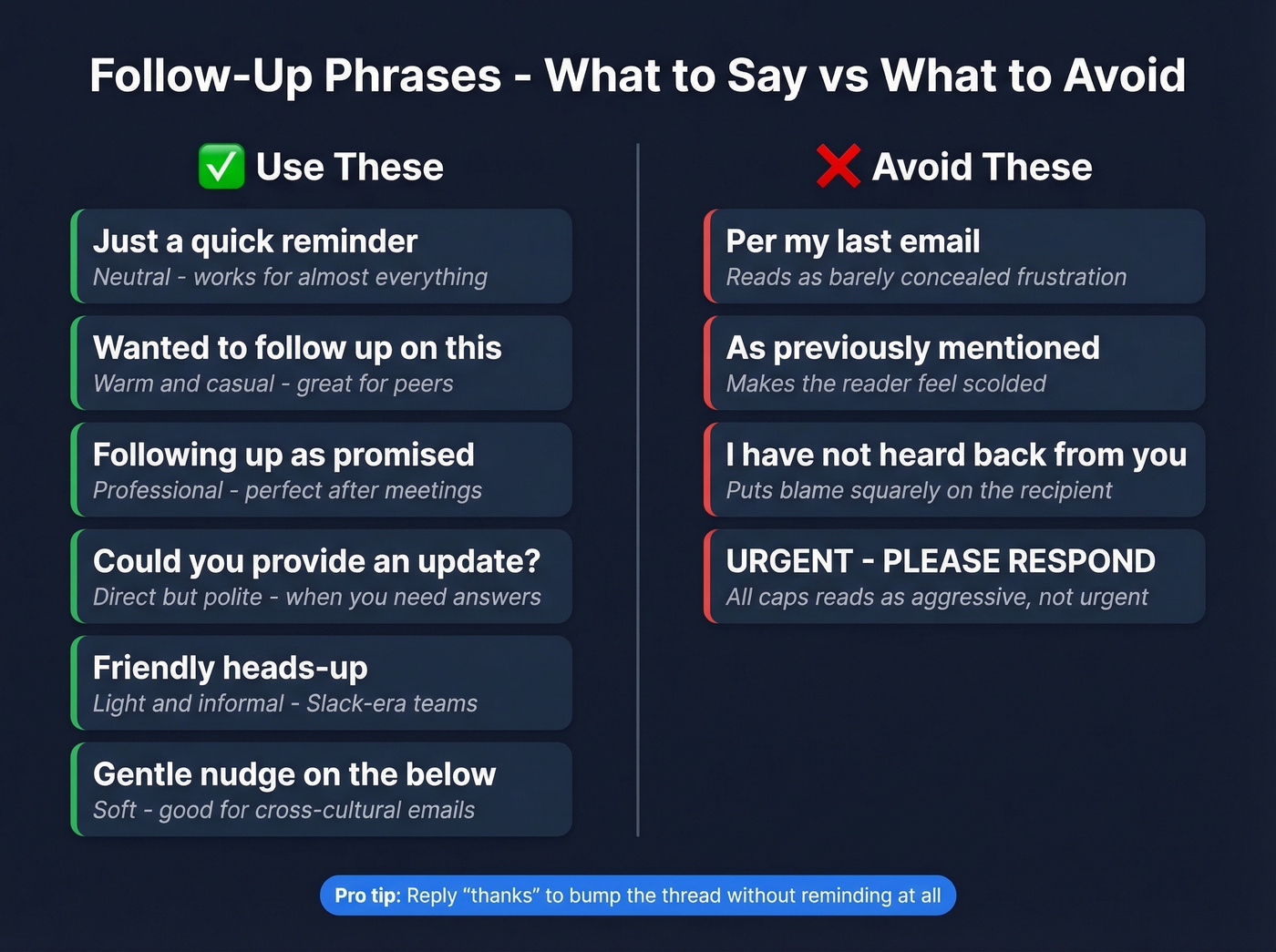
Choosing the right phrase depends on your relationship with the recipient and the formality of the conversation. When in doubt, lean warmer - "Wanted to follow up on this" almost never misfires. If you’re looking for more alternatives to “checking in,” see how to say just checking in professionally.
Now, the phrases to avoid. Skip "per my last email" and "as previously mentioned" - both read as barely concealed frustration and tend to make the reader defensive. "I haven't heard back from you" puts the blame squarely on the recipient and rarely gets a friendly response.
The best reminder doesn't look like a reminder at all. There's a stealth tactic from r/LifeProTips that we've used ourselves: after someone agrees to do something, wait a day or two, then reply "thanks" in the original thread. It bumps the conversation to the top of their inbox without explicitly saying "hey, you haven't done this yet." Socially safer, equally effective.
How It Lands in Different Cultures
"Just a quick reminder" is an Anglophone phrase, and it doesn't translate evenly.
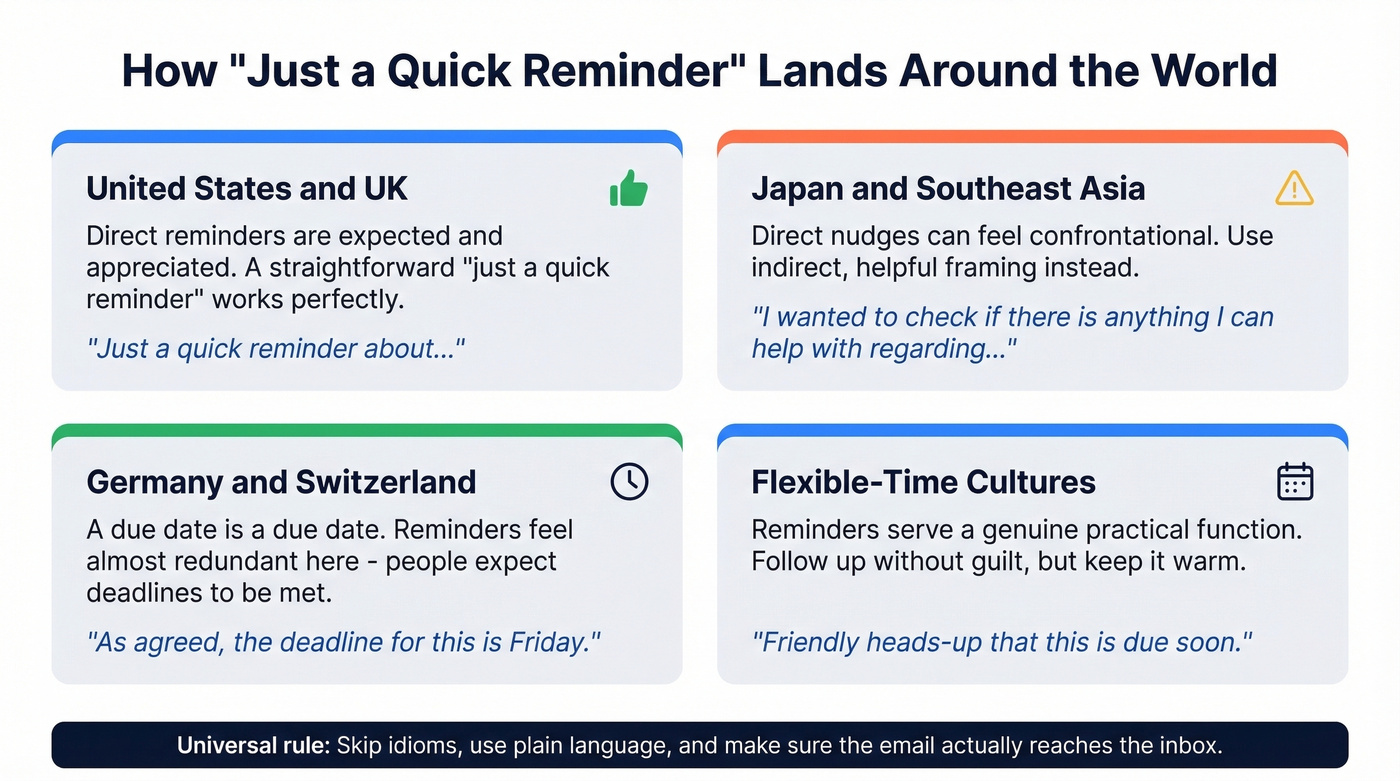
In the US, direct communication is the norm - a straightforward reminder is expected and appreciated. In Japan or Southeast Asia, the same directness can feel confrontational, and indirect phrasing lands better. Something like "I wanted to check if there's anything I can help with regarding..." goes further than a blunt nudge. In Germany and Switzerland, a due date is a due date - reminding someone feels almost redundant. In cultures with more flexible time norms, the reminder serves a genuine function.
In our experience, the biggest factor in cross-cultural follow-ups isn't word choice - it's whether the email actually reaches the inbox. If you're working across regions, skip idioms entirely. "Knock this out by Friday" means nothing to a non-native speaker. Plain language wins globally.
Best Practices Checklist
- Keep it under 120 words. Brevity signals respect for their time.
- Reply in the same thread so they have full context without searching.
- Include one clear CTA with a soft deadline ("Could you confirm by Thursday?"). (More examples: email call to action.)
- Use a specific subject line. "Quick reminder: proposal review by Friday" beats a vague subject every time. If you need ideas, borrow from these email subject line examples.
- Avoid ALL CAPS in subject lines - it reads as aggressive, not urgent.
- Avoid spam-trigger words in subject lines ("urgent," "act now," "free") - they can route your reminder straight to junk. A quick email spam checker pass can catch obvious issues.
- Send Tuesday through Thursday, 9-11 AM in the recipient's time zone.
- If three email reminders get no response, switch channels. A Slack message or phone call often breaks through.
One thing we see constantly with outbound teams: the follow-up phrasing is fine, but half the list is bouncing because the emails are stale. If your reminders consistently go unanswered, the problem isn't your wording - it's your data. Verify your contact list before sending sequences. Tools like Prospeo check emails in real time with 98% accuracy and flag catch-all domains, spam traps, and dead addresses before you hit send. If you’re troubleshooting deliverability, start with email bounce rate basics and then work through a full email deliverability guide.
55% of cold email replies come from follow-ups - but only if you're emailing real people. Prospeo's 5-step verification and catch-all handling keep your bounce rate under 4%, so every reminder you send protects your domain reputation.
Send follow-ups that land. Start with 75 free verified emails.
FAQ
Is "just a quick reminder" passive-aggressive?
Not inherently - it's neutral-to-polite in most professional contexts. It turns passive-aggressive only when used repeatedly in the same thread after someone has clearly ignored you. After two unanswered reminders, escalate directly or try a different channel like a phone call.
How many follow-ups should I send?
Two to three is the sweet spot. Woodpecker data shows diminishing returns after the third message. If three reminders get no response, try a phone call, a mutual connection, or a different stakeholder entirely.
Should I put "just a quick reminder" in the subject line?
It works, but a specific subject line performs better. "Quick reminder: proposal review by Friday" outperforms a generic subject because the recipient can prioritize without opening the email. Specificity drives 10-20% higher open rates.
What are the best professional follow-up phrases?
The safest options are "Wanted to follow up on this," "Following up as promised," and "Could you provide an update?" Each balances directness with courtesy. Use warmer phrasing for peers and slightly more formal language for senior stakeholders or first-time contacts.