

Land and Expand Strategy: 2026 Playbook, Benchmarks, and Why Most Companies Get It Wrong
Your best customer just renewed flat - again. Same seats, same tier, same ARR. Meanwhile, their headcount grew 40% and they rolled out two new departments that could use your product. You didn't lose the account. You just never expanded it.
That's the "land and leave" trap - the shadow failure mode of every land and expand strategy - and it's quietly killing growth at companies that think their expansion motion is working.
Here's the thing: for companies at $15M-$30M ARR, roughly 40% of growth comes from expansion, up from about 30% in early 2021. If you're not capturing that customer expansion revenue systematically, you're leaving almost half your growth on the table. Land and expand isn't a sales tactic. It's a business system that requires aligned pricing, comp plans, CS operations, and data infrastructure. If your NRR sits below 104%, your expand motion is broken. What follows: the benchmarks, the automations, and the failure modes to fix it.
What Is Land and Expand?
A land and expand strategy means intentionally selling a narrow-scope, lower-ACV deal first, then systematically growing that account over time through additional seats, usage, tiers, or products. Phase one optimizes for fast time-to-value and low friction. Phase two turns adoption into revenue.
The math makes it compelling. Selling to an existing customer converts at 60-70% versus 5-20% for new prospects. That's not a marginal difference - it's a fundamentally different economics engine. This approach works especially well in SaaS and subscription models where usage data creates natural expansion signals, and it's become the default playbook for product-led growth companies layering on sales-assisted motions.
Four Types of Account Expansion
Not all expansion looks the same. A strong customer expansion strategy requires different pricing mechanics and operational triggers depending on the path.
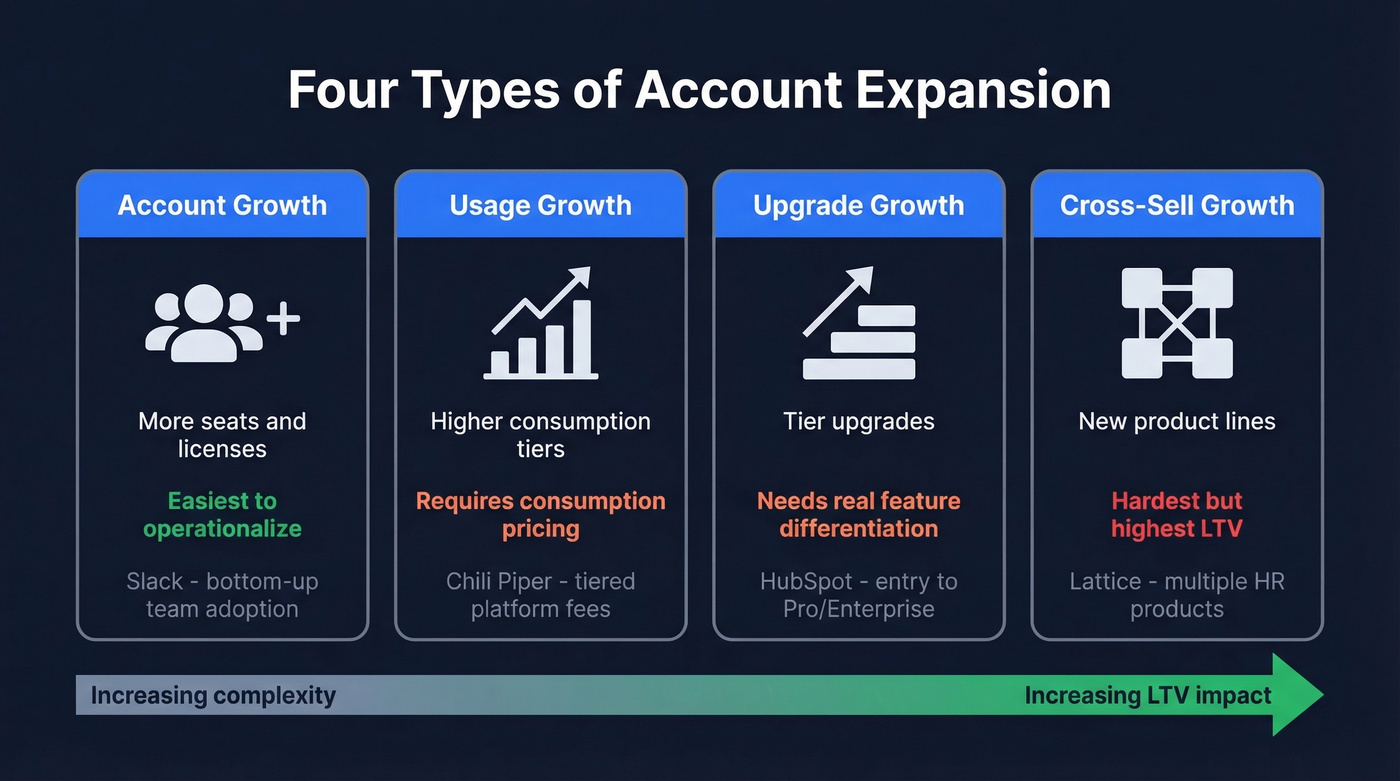
| Expansion Type | Mechanism | Example |
|---|---|---|
| Account growth | More seats/licenses | Slack: bottom-up team adoption |
| Usage growth | Higher consumption tiers | Chili Piper: tiered platform fee scaling with inbound lead volume |
| Upgrade growth | Tier upgrades | HubSpot: entry plans to Pro/Enterprise |
| Cross-sell growth | New product lines | Lattice: cross-sell into multiple HR products |
Account growth is the most common and easiest to operationalize - you're selling more of what they already use. Usage growth requires consumption-based pricing architecture. Upgrade growth depends on meaningful feature differentiation between tiers, not artificial gates that frustrate users. Cross-sell growth is the hardest to execute but produces the highest LTV when it works, because you're embedding deeper into the customer's workflow stack.
How to Land - The First 90 Days
The expand phase is won or lost during the land phase.
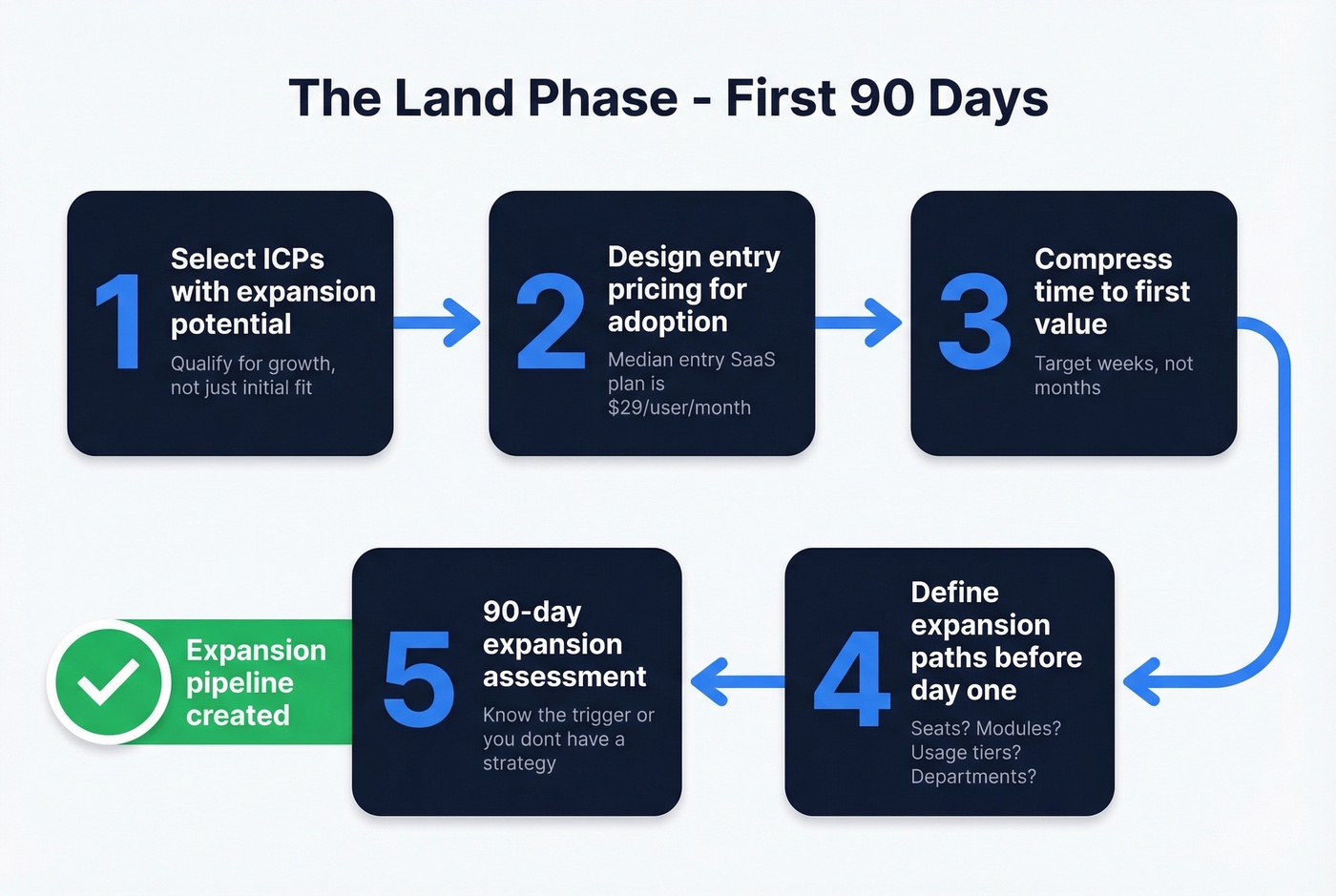
Select ICPs with expansion potential. Don't just qualify for initial fit - qualify for growth. A 50-person company with flat headcount is a worse land target than a 30-person company growing 40% YoY, even if the initial deal is smaller. (If you need a scoring rubric, use an ideal customer profile template.)
Design entry-point pricing for adoption, not revenue. The median entry-level SaaS plan sits at $29/user/month. If your entry point is $150/user/month, you're optimizing for initial ACV at the expense of expansion velocity. Lower the barrier. You'll make it back.
Compress time-to-first-value ruthlessly. One data platform reduced time-to-production from 9-12 months to roughly six weeks by scoping the initial deployment to a single use case. Track your "value cliff" - the point where incremental value plateaus - and trigger expansion conversations before customers hit it.
Define expansion paths before day one. Seats? Modules? Usage tiers? New departments? If your team can't articulate the specific growth levers for each account during onboarding, you don't have an expand strategy. You have a hope strategy.
Set a 90-day expansion assessment milestone. By day 90, you should know whether this account has expansion potential and what the trigger will be. We've seen teams who formalize this milestone generate materially more expansion pipeline than those who wait for the renewal conversation.
How to Expand - 5 Tactical Plays
This is where most implementations fall apart. The land happens. Then nothing. These are the plays that turn adoption into revenue.
Trigger-Based Upsells
When a customer hits about 80% of their usage limit or seat allocation, that's not a support ticket - it's a revenue signal. Build automation that auto-creates an expansion opportunity in your CRM and notifies the AE/CSM. The 80% usage trigger is one of the highest-leverage expansion automations you can build. Treat it the way marketing treats MQLs: route it, assign it, work it within 48 hours. (If you want a system for this, see how to track sales triggers.)
Champion Enablement
Your champion inside the account needs ammunition to sell internally. Build them ROI decks pre-loaded with their actual usage data, internal case studies from similar departments, and a one-pager they can forward to their VP. Champions don't fail because they don't want to expand - they fail because they can't articulate the business case to their boss.
Multi-Threading Into New Departments
This is where expansion gets real, and where most teams hit a data wall. You've been working with the marketing team for six months. Now you want to expand into sales ops. But you don't know the VP of Sales Ops, the RevOps lead, or the CRO's chief of staff.
Data quality tools earn their keep here. With Prospeo's 30+ search filters, you can narrow by company and department to find decision-makers in the target department without bounced emails slowing momentum - 98% email accuracy means you're reaching the right people on the first attempt. Best practice: add 2+ new contacts per account per quarter to prevent single-threading risk. (Related: firmographic filters and best contact management software.)

Renewal Mapping at 120 Days
Start the renewal conversation 120 days out, not 30. Joint AE+CS planning at the 120-day mark gives you time to run a QBR, build an ROI snapshot, and identify expansion opportunities before the renewal becomes a retention conversation. Companies that treat customer retention and expansion as a single, unified motion consistently outperform those that silo the two. (If you’re tightening your process, use a renewal rate framework.)
CS-Led QBRs
Quarterly business reviews should focus on outcomes and ROI, not feature walkthroughs. The QBR is your best expansion surface - it's a scheduled conversation where the customer is already thinking about value. Use it to present usage trends, quantify impact, and introduce the next expansion path. One CS leader on Reddit put it well: the QBR where you only demo features is the QBR where the customer mentally checks out. (Helpful: QBR questions to ask.)

Multi-threading into new departments is the highest-leverage expand play - but only if you can actually reach the right stakeholders. Prospeo gives you 30+ search filters to find decision-makers by company and department, with 98% email accuracy and data refreshed every 7 days. No bounced emails. No stale contacts killing your expansion momentum.
Stop single-threading accounts. Find every buyer in the building.
Pricing Architecture for Expansion
Your pricing model is either accelerating or blocking your expand motion.
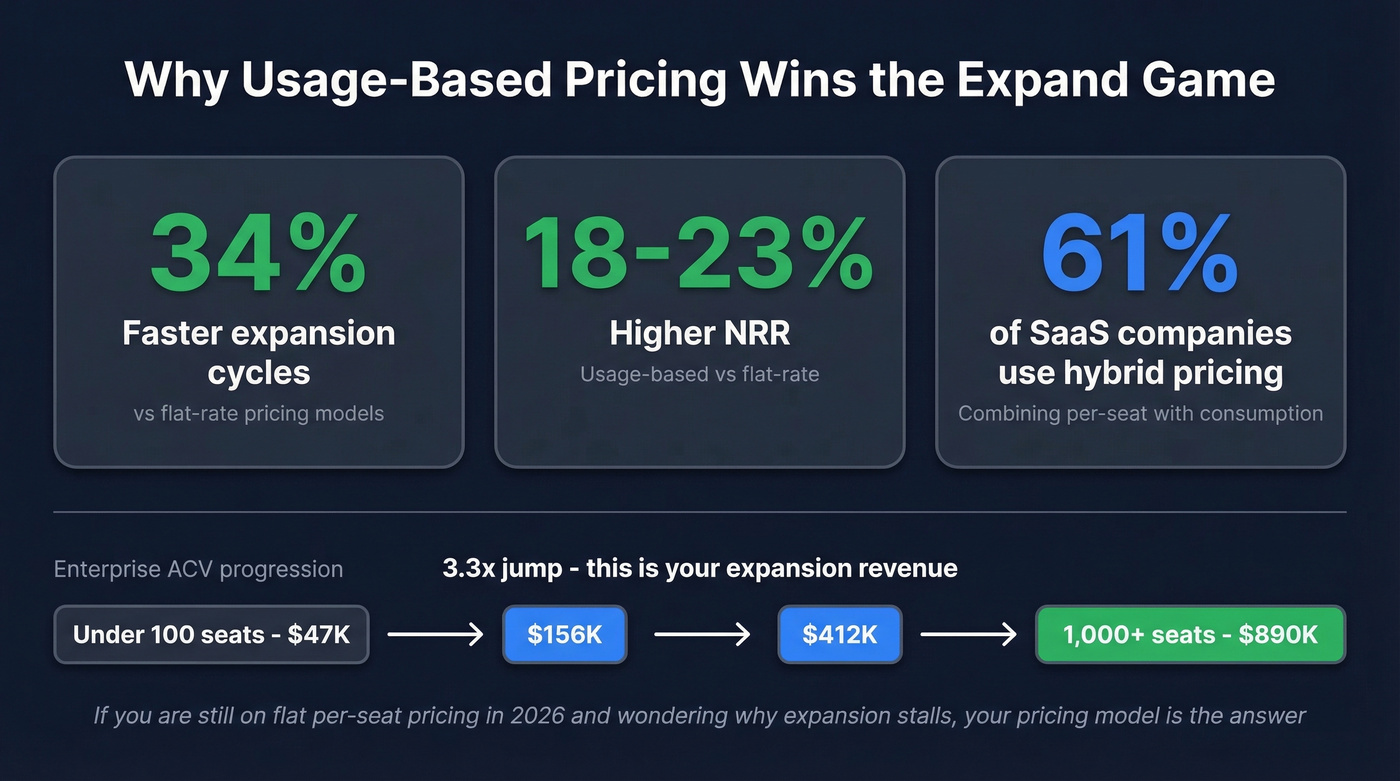
Usage-based pricing delivers 34% faster expansion cycles and 18-23% higher NRR compared to flat-rate models. That's not a rounding error. 43% of SaaS companies now use usage-based pricing, up 8 percentage points year-over-year, and 61% use hybrid models combining per-seat with consumption elements. I'd go further: if you're still on flat per-seat pricing in 2026 and wondering why expansion stalls, your pricing model is the answer.
Here's what enterprise ACVs look like by segment:
| Segment | Median ACV |
|---|---|
| <100 seats | $47,000 |
| 100-500 seats | $156,000 |
| 500-1,000 seats | $412,000 |
| 1,000+ seats | $890,000 |
The jump from sub-100 seats to 100-500 is a 3.3x increase. That's the expansion revenue sitting inside your existing accounts - if your pricing architecture lets customers grow into it naturally rather than hitting a wall that requires a procurement cycle.
NRR Benchmarks - What Good Looks Like
SaaS Capital's survey of 1,000+ private SaaS companies gives us the clearest NRR benchmarks available:
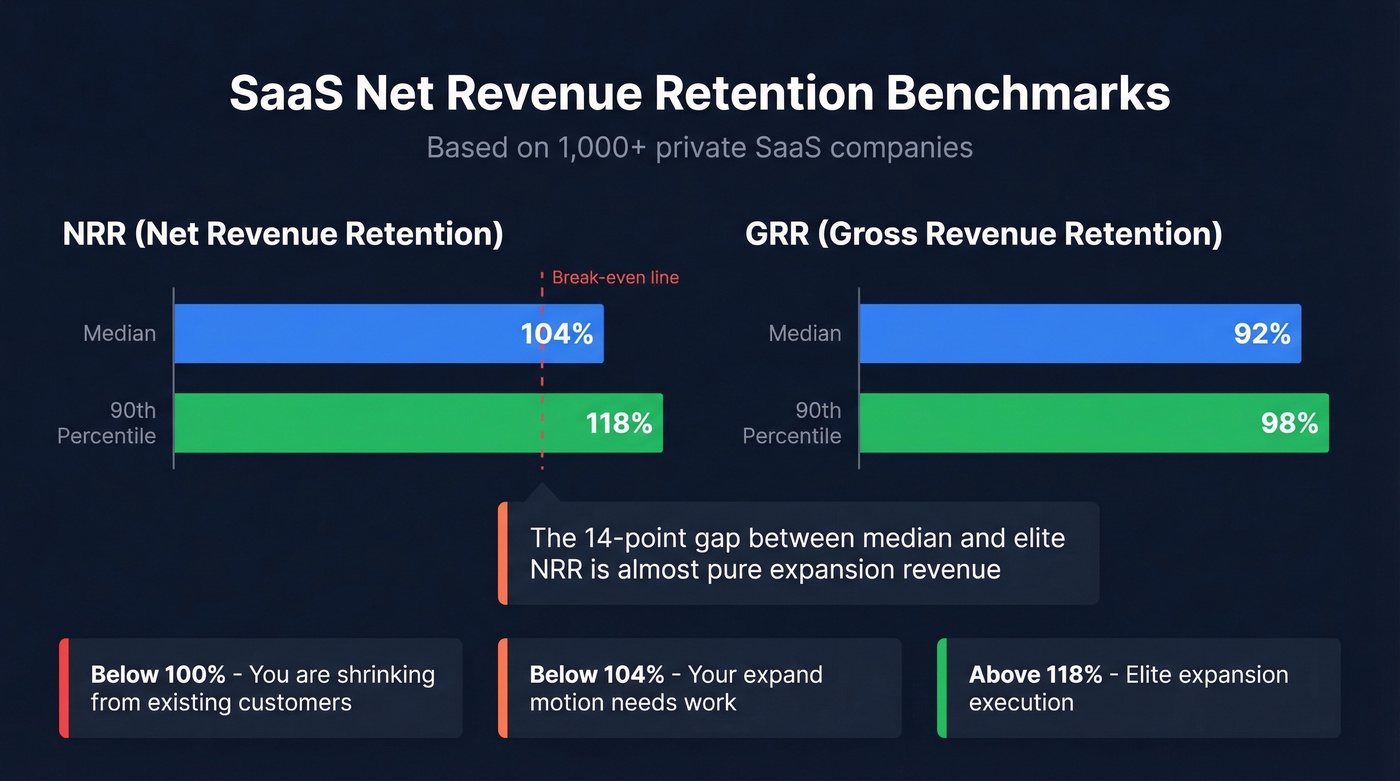
- Median NRR: 104%
- 90th percentile NRR: 118%
- Median GRR: 92%
- 90th percentile GRR: 98%
Below 104%, your expand motion needs work. Below 100%, you're shrinking from existing customers - full stop. The gap between median and elite represents 14 points of almost pure expansion revenue. (If you’re diagnosing leakage, start with churn analysis.)
Let's be honest about how most teams use this number: they obsess over NRR as a lagging indicator and ignore the leading ones. If you're tracking NRR but not tracking time-to-expand and expansion pipeline coverage, you're driving by looking in the rearview mirror. NRR tells you what happened. Expansion triggers tell you what's about to happen.
Why Land and Expand Fails
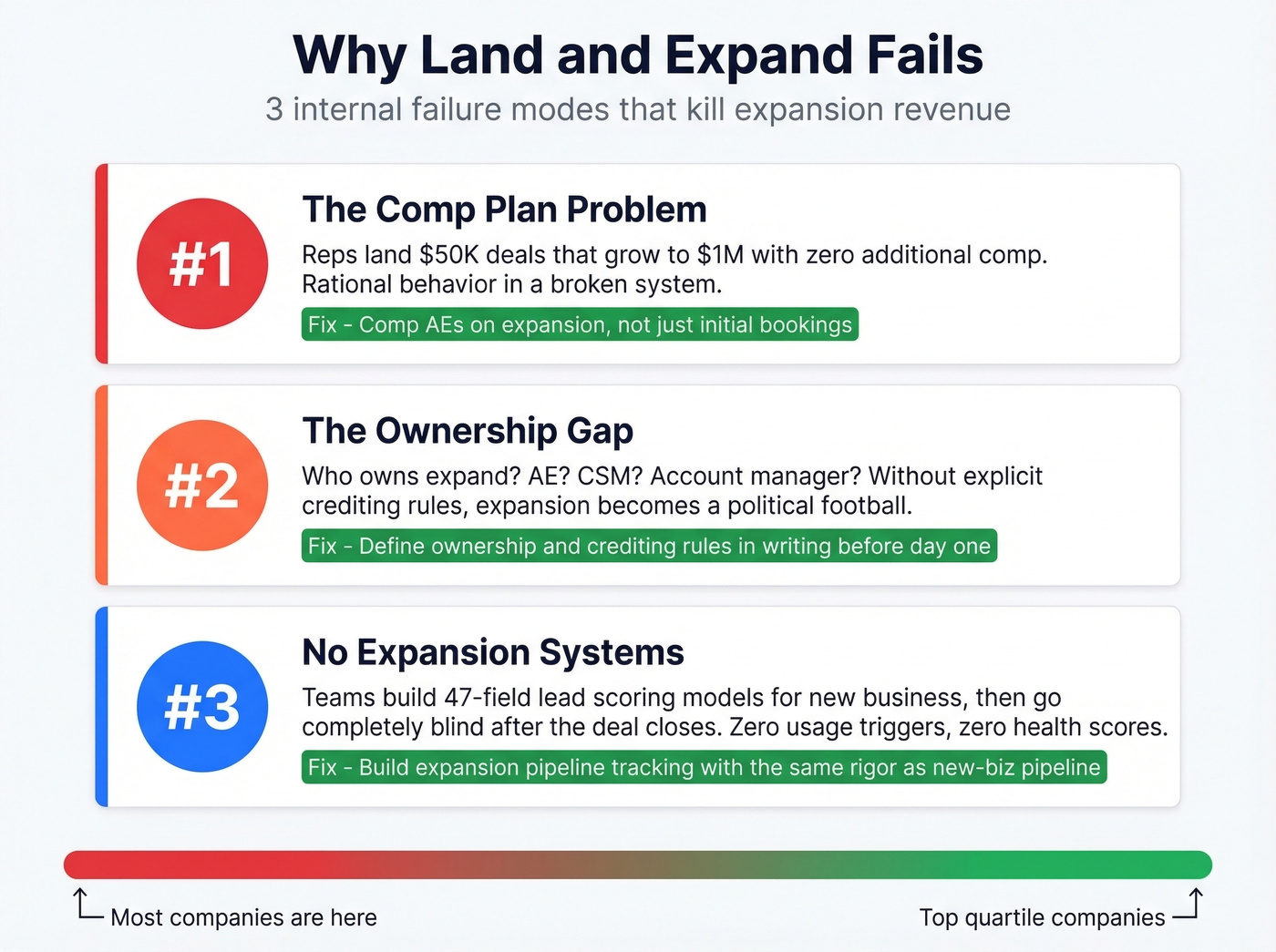
Most implementations don't fail because of product or market. They fail because of internal operations. Three failure modes dominate.
The Comp Plan Problem
This is the #1 killer, and it drives us crazy how often we see it. A rep on r/sales described landing a $50K deal that grew to $1M in expansion revenue - with zero additional comp beyond the initial booking. That's not an edge case. It's the norm at companies where commission structures reward initial bookings and ignore downstream growth.
If your AEs aren't compensated on expansion, they'll optimize for larger initial deals instead of fast lands. That's rational behavior in a broken system. We've seen companies double their NRR within 18 months just by fixing comp plans - no product changes, no new features, just aligning incentives. (If you’re rebuilding incentives, sales performance management is the operating layer.)
The Ownership Gap
Who owns the expand phase? AE? CSM? Account manager? The confusion on r/SaaSSales is representative - practitioners genuinely don't know whether expansion should be "registered" in the CRM to count, who gets credited, or at what rate CS gets comped versus the original AE. Without explicit crediting rules, expansion revenue becomes a political football instead of a growth engine. (This is where a strong RevOps manager function pays for itself.)
No Expansion Systems
Companies track new-business pipeline obsessively - stage progression, conversion rates, velocity metrics. Then the deal closes and they go blind. No usage triggers. No health score monitoring. No automated expansion signals. The same RevOps team that built a 47-field lead scoring model has zero automation for identifying when an existing customer is ready to expand. (If you’re standardizing, start with funnel metrics.)
This problem compounds at scale. ChartMogul's data shows top-quartile companies with 1,500 or fewer subscribers hit roughly 100% NRR, while those with 12,000+ typically land around 76%. Without a deliberate retention and growth strategy, expansion doesn't scale automatically.
5 Automations to Operationalize Expansion
You can implement all five of these within about 90 days. If you implement one thing, make it #4.
Onboarding checklist automation. Contract signed, auto-create onboarding tasks, assign CSM, set TTFV target date, schedule kickoff. No deals falling through the crack between sales and CS.
Health-score drop alert. Health score drops below 70, trigger risk playbook, notify CSM, escalate if no action within 48 hours. You can't expand accounts you're about to lose.
Renewal 120-day countdown. Renewal minus 120 days, assign QBR, auto-generate ROI snapshot from usage data, sync AE and CSM calendars.
Expansion trigger. Usage exceeds 80% of licenses or new business unit detected, auto-create CRM opportunity, notify AE/CSM, send champion enablement asset. This single automation turns passive account management into active expansion selling.
QBR prep workflow. Auto-pull adoption metrics, NRR trend, support ticket history, populate deck template. CSMs shouldn't spend 3 hours prepping a QBR. Data assembly should be automatic; the CSM's job is interpretation and strategy.
Your expansion pipeline dies when champion contacts go stale or you can't reach the VP in the next department over. Prospeo's 300M+ verified profiles and 125M+ mobile numbers mean your AEs and CSMs always have a direct line to new stakeholders - at $0.01 per email, not $1.
Land and expand requires fresh data. Prospeo refreshes yours every 7 days.
Land and Expand in a PLG World
Product-led growth has reframed this strategy for the modern buyer. McKinsey's analysis of 107 publicly listed B2B SaaS providers found that the highest-performing companies don't run pure PLG - they run product-led sales, a hybrid motion where self-serve adoption feeds sales-assisted expansion.
The operational model looks different from traditional approaches. Try-before-you-buy replaces the sales POC. Product usage analytics generate product-qualified accounts instead of MQLs. Cross-functional growth teams of 7-9 people - spanning product, sales, CS, and data - replace the siloed AE-to-CSM handoff.
But the core logic is identical: land small, prove value fast, expand systematically. PLG automates the land phase and gives you better data for the expand phase. The best PLG companies layer a customer expansion strategy on top of self-serve adoption, using product signals to time sales-assisted outreach precisely.
FAQ
What's the difference between land and expand and upselling?
Upselling is one tactic within the expand phase. Land and expand is a full go-to-market strategy encompassing pricing design, team structure, comp plans, and operational systems. You can upsell without this broader framework, but you can't run a systematic expand motion without coordinating upselling, cross-selling, and account growth under one strategy.
What NRR should a land-and-expand company target?
Median NRR for private SaaS is 104%. Top performers hit 118%+. Below 100% means you're shrinking from existing customers. Aim for 110%+ near-term and 118% as the elite benchmark.
How do you find new stakeholders when expanding into a different department?
Map the org chart of the target department - identify the budget holder, day-to-day operator, and technical evaluators. Then use a B2B data platform with department-level filters to pull verified contacts. Prospeo's 30+ search filters let you narrow by company, department, seniority, and headcount growth, with 98% email accuracy so you're reaching the right people on the first attempt.
How does a retention and expansion strategy differ from pure acquisition?
Acquisition brings new logos; retention and expansion grows revenue from customers you already have. Expansion deals close at 60-70% versus 5-20% for new prospects, cost less to win, and compound over time. Companies investing equally in both motions build more durable, capital-efficient growth than those relying on new-logo acquisition alone.