

Lead Generation Campaigns That Actually Work in 2026
You generated 500 leads last month. Marketing high-fived. Then sales worked the list and booked... four meetings. The average cold email reply rate sits around 2%, and 61% of marketers say generating quality leads is their biggest challenge. The problem isn't lead generation campaigns themselves - it's that most campaigns break after the lead is captured, not before.
Here's one stat that proves it: turning off open tracking in cold email doubles reply rates - 2.36% vs. 1.08% across 44 million emails. That alone should change how you run outbound.
The Short Version
Lead gen campaigns fail post-capture, not pre-capture. Three things move the needle: verified contact data as your foundation (bad emails silently destroy every channel), a lead scoring model so sales stops wasting time on tire-kickers, and intent-based nurture sequences instead of generic drips that get archived on sight.
What Is a Lead Generation Campaign?
A lead generation campaign isn't a tactic. It's a system. Running LinkedIn ads is a tactic. Sending cold emails is a tactic. A campaign connects those tactics into a coordinated sequence with a defined audience, a measurable goal, and a handoff mechanism that gets leads from marketing to sales without dropping them into a black hole.
The leads themselves exist on a spectrum. A raw lead is just a name and email - nothing more. An MQL (marketing qualified lead) has shown enough engagement through content downloads, pricing page visits, or email clicks to warrant sales attention. An SQL (sales qualified lead) has been vetted by a human and confirmed as a real opportunity. Your campaign needs to move people through that progression, not just dump names into a CRM.
Why Most Campaigns Fail
The consensus on r/sales and r/b2bmarketing is clear: the tools aren't the problem. The plumbing is.
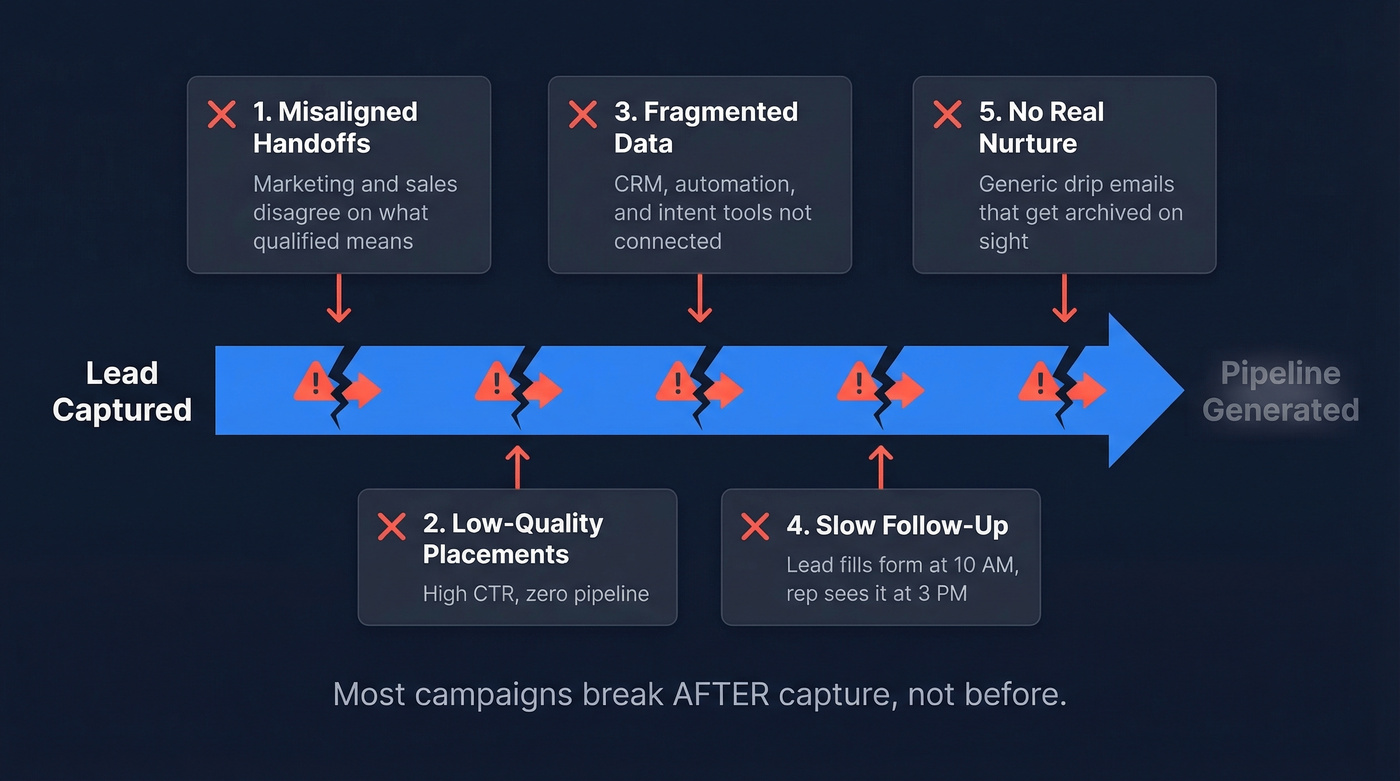
Misaligned marketing-to-sales handoffs. Marketing and sales don't agree on what "qualified" means. There's no shared lead definition, no SLA on follow-up timing, and reps cherry-pick the list instead of working it systematically. Fix: define MQL/SQL criteria together, set a follow-up SLA (within 4 hours, minimum), and track compliance weekly.
Low-quality placements inflating volume. High CTR, low intent. You're generating leads from content syndication networks or display placements where people click to dismiss, not to engage. Audit your lead sources quarterly. If a channel produces volume but zero pipeline, cut it.
Fragmented data and broken attribution. Your CRM, marketing automation, and intent tools aren't connected. Dashboards conflict. Nobody trusts the numbers, so nobody optimizes. Pick one source of truth - usually the CRM - and pipe everything into it.
Slow follow-up. A lead fills out a form at 10 AM, the routing rule sends it to a queue, and a rep sees it at 3 PM. By then, your competitor already had the conversation. Responding within minutes dramatically increases connect rates. Automate routing and trigger instant notifications.
No real nurture after capture. The lead downloads a whitepaper, gets three generic emails about your product, then goes cold. No intent-based sequencing, no behavioral triggers, and sales disengages after one failed call. Build nurture sequences tied to specific actions, not arbitrary timelines.
Steps to Build a Campaign That Produces Pipeline
Before you touch a single ad platform or email tool, you need a plan. This framework, adapted from Airtable's campaign planning model, applies whether you're running a $5k test or a $500k integrated campaign.
1. Clarify the goal. Are you generating net-new pipeline or accelerating existing deals? Demand gen and awareness campaigns have different KPIs, different channels, and different timelines. Pick one.
2. Identify and prioritize your audience. Role, seniority, industry, company size, and behavioral signals. The tighter your ICP, the lower your CPL and the higher your conversion rate. Broad targeting is how you burn budget.
3. Develop the central concept. Every campaign needs a narrative - a value proposition, proof points, and a reason to engage now. "We help companies do X" isn't a concept. "Companies using [approach] are seeing 40% faster deal cycles" is.
4. Define channels and tactics. Primary channel plus supporting channels. Gated vs. ungated content. Funnel paths from first touch to handoff. Map this out before you build anything.
5. Outline the timeline. Phase-based sequencing - launch, optimization, scale. Most B2B campaigns need several weeks before you have enough data to optimize meaningfully.
6. Build the measurement plan. Primary KPIs (pipeline generated, CPL, conversion rate) and secondary KPIs (engagement rate, speed-to-lead, MQL-to-SQL ratio). If you need a clean set of KPIs, start with funnel metrics.
7. Align stakeholders and finalize the brief. Owners, approvals, asset lists, and deadlines. Use AI to generate headline variants, draft ad copy, and stress-test messaging against ICP pain points - build this into the workflow from the start.
CPL Benchmarks by Industry
The 2026 CPL benchmarks from First Page Sage (data collected Jan 2022-Jun 2025) show massive variation. If you're benchmarking against a universal average, you're doing it wrong.
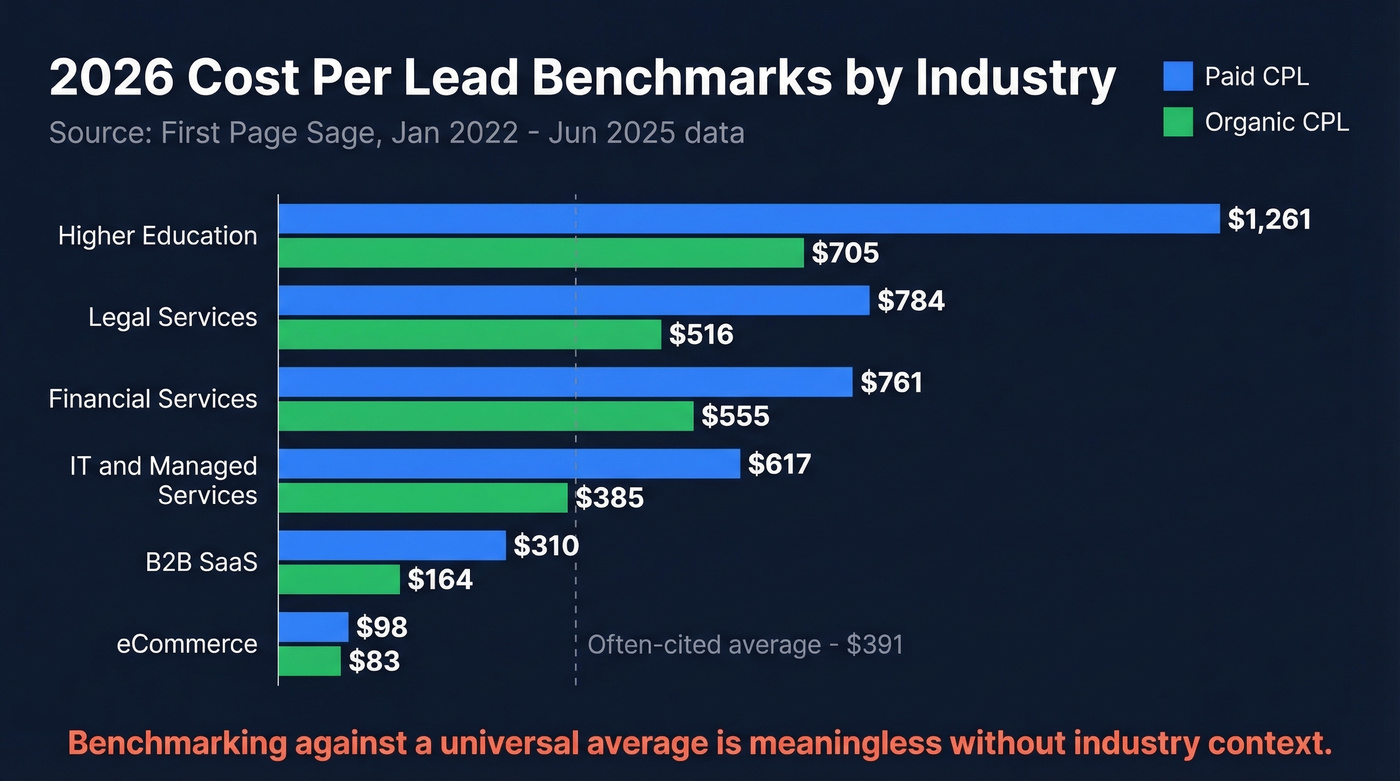
| Industry | Paid CPL | Organic CPL | Blended CPL |
|---|---|---|---|
| B2B SaaS | $310 | $164 | $237 |
| Financial Services | $761 | $555 | $653 |
| eCommerce | $98 | $83 | $91 |
| Legal Services | $784 | $516 | $649 |
| IT & Managed Services | $617 | $385 | $503 |
| Higher Education | $1,261 | $705 | $982 |
Two things jump out. Paid channels run higher than organic in every industry shown above. And the spread is enormous - eCommerce at $91 blended vs. Higher Education at $982. If someone tells you "the average CPL is $391," that number is meaningless without industry context.
Organic channels are cheaper per lead in most industries, but they take longer to build. Paid gets you volume now; organic compounds over time. The best campaigns run both.
Channel Playbook for 2026
Not all channels convert equally. Average conversion rates by channel: organic search at 5.0%, referral at 4.1%, email at 3.9%, and paid search at 3.6%.
Content & SEO
Organic search converts at 5.0% - the highest of any channel and the only one that compounds. A blog post ranking for a high-intent keyword generates leads for years without additional spend. Gate your highest-value assets (benchmarks, templates, calculators) and leave educational content open. The leads you capture from gated content are self-qualifying: they wanted the resource enough to trade their email for it.
Email & Cold Outreach
Cold email benchmarks paint a sobering picture: 27.7% average open rate, 5.1% response rate, 7.5% bounce rate, and a 0.2153% conversion rate. That conversion number means you need roughly 465 cold emails to generate one conversion. Volume matters, but so does precision.
If you're building sequences, use a proven B2B cold email sequence structure and keep deliverability front-and-center with an email deliverability guide.
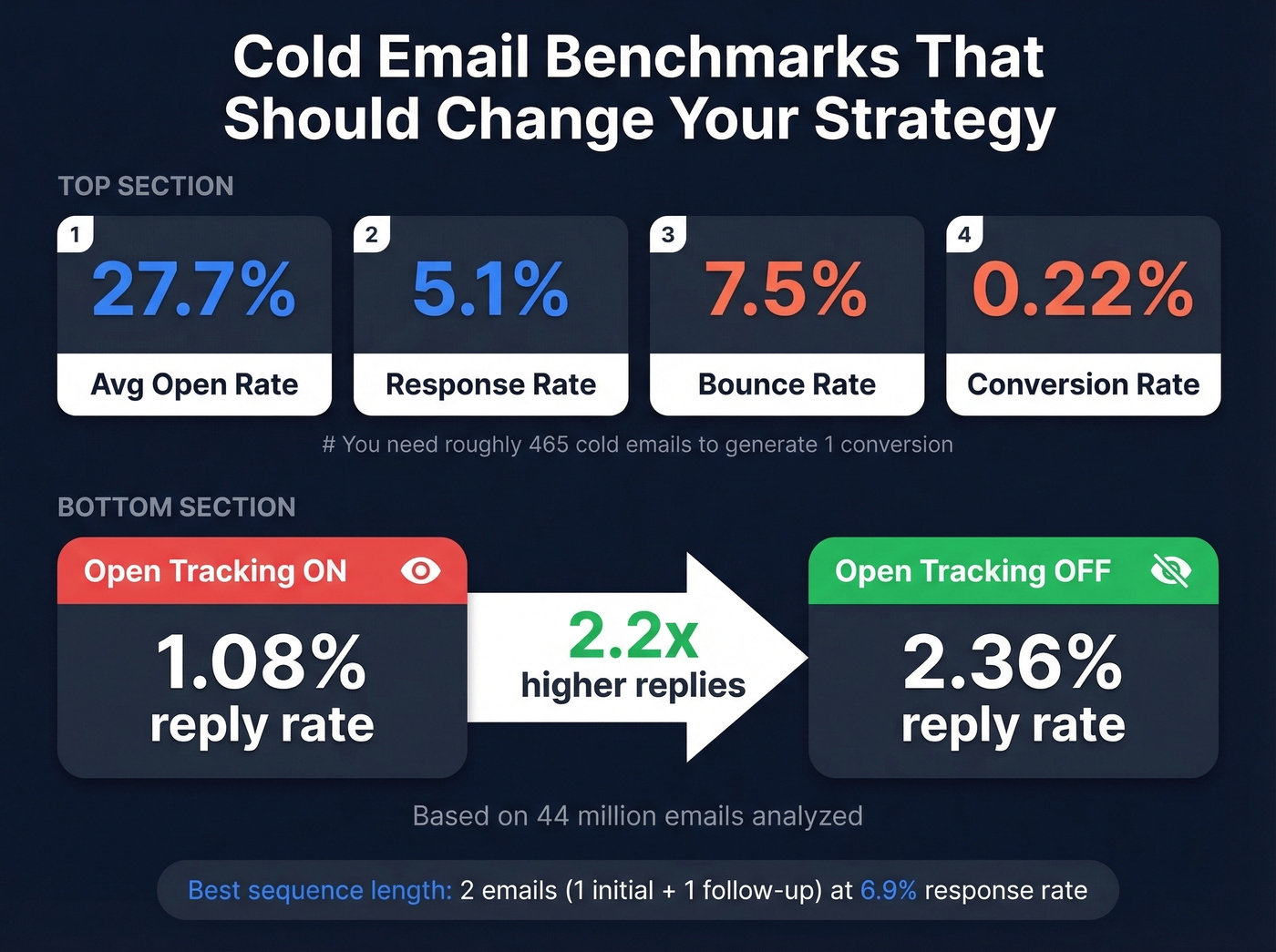
A 2-email sequence - one initial email plus one follow-up - drives the highest response rate at 6.9%. Adding more follow-ups actually dilutes performance. And here's the insight most teams miss: turning off open tracking doubles reply rates (2.36% vs. 1.08% across 44 million emails). Open tracking pixels trigger spam filters. If you're optimizing for replies, kill the pixel.
Paid Acquisition
Google Performance Max is quietly outperforming traditional Search campaigns for lead gen. Practitioners on r/PPC report PMax generating more leads than Search at roughly half the CPL. One user described getting 3x the lead volume after switching, though they noted a portion were low-quality - job seekers, existing customers, accidental clicks. You need downstream tracking to separate signal from noise.
LinkedIn Ads remain the default for B2B targeting - 89% of B2B marketers use the platform - but CPLs typically run $75-200+ per lead. That's 3-5x what you'd pay on Google for tighter targeting.
Events & Webinars
Don't sleep on events for complex B2B. A MarketingSherpa case study of an OEM equipment provider showed 300% ROI and 140 qualified leads from a single event campaign. People who show up to a 90-minute webinar or fly to a conference are already in-market. For products with deal sizes above $25k, events often produce the best pipeline-to-spend ratio of any channel.

Bad contact data is the silent killer of lead generation campaigns. Prospeo's 98% email accuracy and 7-day data refresh cycle mean your campaigns reach real buyers - not bounced inboxes that torch your domain reputation.
Stop feeding your campaigns dead data. Fix the foundation first.
Your Data Foundation
Every channel in your campaign - email, paid, content, events - feeds into the same downstream system. That system is only as good as the data flowing through it.
The average cold email bounce rate is 7.5%. Anything above 5% is a red flag that damages deliverability, which tanks performance across every future campaign. We've seen teams build beautiful nurture sequences, write compelling copy, nail their ICP targeting - and then watch it all fail because 12% of their list was invalid. Bad data is the silent killer.
Verification has to come first, before you launch anything. Prospeo's 5-step verification process catches invalid addresses, spam traps, and catch-all domains at 98% accuracy, with a 7-day refresh cycle that flags job changes before they become bounces. Snyk's 50-AE team cut bounce rates from 35-40% to under 5% and saw AE-sourced pipeline increase 180%. The free tier gives you 75 verified emails per month to test the workflow.
If you want to go deeper on list hygiene, start with email bounce rate benchmarks and fixes.
Lead Scoring Model You Can Copy
Not every lead deserves a sales call. A scoring model separates the signal from the noise so reps focus on prospects who are actually buying, not just browsing.
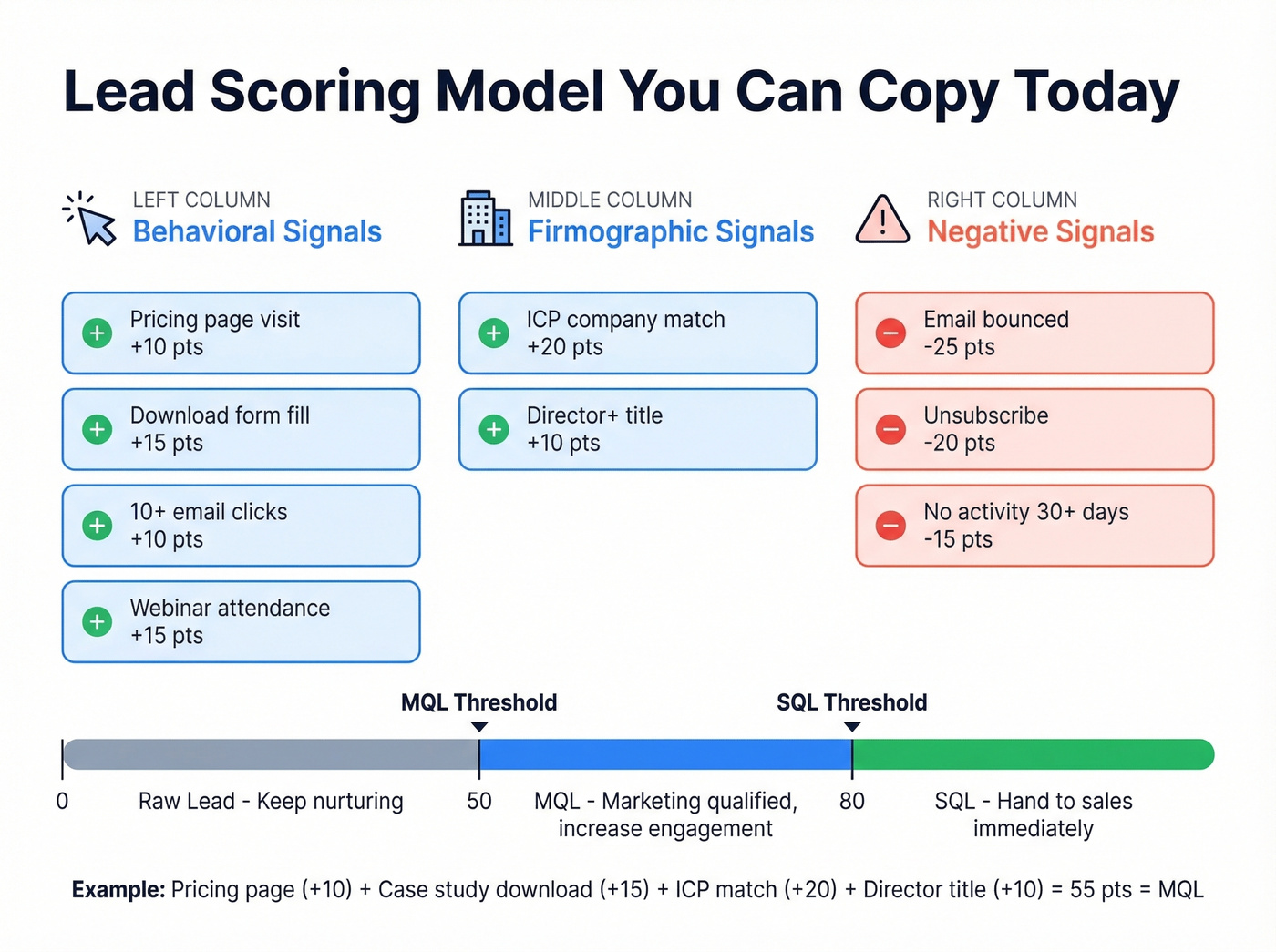
Here's a point-based model adapted from Belkins' HubSpot implementation that you can copy directly:
| Action / Signal | Points | Category |
|---|---|---|
| Pricing page visit | +10 | Behavioral |
| Download form fill | +15 | Behavioral |
| 10+ email clicks | +10 | Behavioral |
| Webinar attendance | +15 | Behavioral |
| ICP company match | +20 | Firmographic |
| Director+ title | +10 | Firmographic |
| Email bounced | -25 | Negative |
| Unsubscribe | -20 | Negative |
| No activity 30+ days | -15 | Negative |
Set your MQL threshold at roughly 50 points and your SQL threshold at 80. A prospect who visits your pricing page, downloads a case study, and matches your ICP hits 45 points - one more engagement and they're an MQL. A prospect who bounced and unsubscribed is at -45 and should be purged, not nurtured.
Deprioritize open rates as a scoring signal. Apple Mail's privacy changes mean open tracking is unreliable for a large chunk of your audience. Weight on-site behavior and direct engagement signals instead.
Nurture Sequences That Convert
Generic drip campaigns - "Hi [First Name], just checking in" sent on an arbitrary schedule - are the fastest way to train prospects to ignore you. Intent-based sequencing responds to what the prospect actually did, not what your calendar says.
Day 0 (trigger: content download). Send the asset immediately with one relevant follow-up resource. No pitch.
Day 3 (trigger: opened Day 0 email). Share a case study or benchmark related to the original download. Light CTA to book a call.
Day 8 (trigger: pricing page visit OR second content engagement). Direct outreach from a rep referencing the specific content they engaged with. This is your highest-intent moment - don't waste it on a template.
Day 15 (trigger: no response to Day 8). Final value-add email - a relevant industry stat, a competitive comparison, or a webinar invite. Then move to long-term nurture.
The key is behavioral triggers, not timelines. A prospect who hits your pricing page on Day 1 shouldn't wait until Day 8 for sales outreach. And verify every email before it enters your sequence - a single spam trap can torch your sender reputation for months.
If you need copy you can deploy fast, pull from these sales follow-up templates.
AI in Lead Gen - What Actually Works
Let's be honest: despite what vendors claim, autonomous AI agents aren't replacing SDRs in 2026. They're augmenting them. We've tested several "AI SDR" products, and the output still reads like... AI output. The sweet spot is AI handling research, enrichment, and first-draft personalization while humans handle the actual conversations.
The numbers behind AI-assisted selling are genuinely compelling, though. A BCG analysis cited by Outreach found that AI-leading companies achieve 1.7x revenue growth and 40% greater cost reductions than laggards. With sellers spending just 28% of their time actually selling - the rest goes to admin, research, and data entry - the automation opportunity is massive.
What's working in practice: AI-powered enrichment tools like Clay (starting around $149/month for individuals) and Trigify - both favorites on r/sales - automate the manual research that used to eat hours per prospect. They pull firmographic data, technographic signals, and trigger events into a single workflow. Ensemble AI, combining generative models for personalization with analytical models for scoring, is producing better lead scoring than either approach alone.
To build a repeatable enrichment workflow, see lead enrichment and data enrichment services.
Campaign Ideas That Produce Pipeline
Theory is nice. Let's look at campaigns that produced measurable results - and extract lead generation campaign ideas you can adapt.
SAP's "Inspire the Future" campaign remains the enterprise gold standard. While it ran in 2020, the integrated approach it demonstrates is more relevant than ever - especially now that AI tooling makes multi-channel orchestration accessible to smaller teams. The campaign spanned podcasts, video, social, and partner co-investment with Capgemini, generating EUR 924.4M in pipeline and EUR 266.15M in projected revenue. It drove 48% higher engagement than other SAP social campaigns, pulled 22,000+ podcast listeners, and 10,000+ YouTube views within 30 days. The lesson: integrated campaigns with a strong narrative outperform channel-specific tactics by an order of magnitude.
On the SMB side, MarketingSherpa case studies tell a different but equally useful story. A health IT data provider achieved 13.4% conversion to scheduled meetings and 15.9% of those meetings became customers - a 300% ROI. A commercial cleaning franchise hit 1,500% ROI on SEO and 200% ROI on PPC by treating lead gen as a system rather than disconnected tactics. The common thread across all of these: they measured pipeline and revenue, not just lead volume.
Attribution That Works
98% of marketers say attribution is crucial, but 70%+ fall short of their strategic goals. The gap between knowing attribution matters and actually doing it well is where most lead generation campaigns lose visibility.
| Model | Best For | Limitation |
|---|---|---|
| First-touch | Short sales cycles, single dominant channel | Ignores nurture impact |
| Multi-touch | Complex B2B with 6-8+ touchpoints | Requires clean data |
| Data-driven | High-volume orgs with mature analytics | Needs large datasets |
75% of companies already use multi-touch attribution, and for good reason - B2B sales cycles involve multiple touchpoints across weeks or months. First-touch works if you're selling a $50/month tool with a one-call close. For anything with a longer sales cycle, multi-touch is the only model that tells you which channels and content pieces actually influence pipeline.
The payoff is real: proper attribution across channels can deliver 15-30% efficiency gains by shifting budget from channels that generate vanity metrics to channels that generate revenue. That's not a marginal improvement - it's the difference between a campaign that breaks even and one that scales.
Skip the sophisticated attribution stack if your average deal size is under $10k. First-touch with UTM parameters and a clean CRM will get you 80% of the insight. Save multi-touch modeling for when you're spending enough that a 15% efficiency gain actually moves the needle.
If you're seeing leaks between stages, map the full lead generation workflow before you buy more tools.
You just read that slow follow-up and fragmented data kill pipeline. Prospeo gives you 300M+ verified profiles with 30+ filters - buyer intent, technographics, job changes - so your campaigns target in-market buyers from day one.
Build campaigns on intent signals, not guesswork. Free tier included.
FAQ
What's the average cost per lead in B2B?
Blended CPL varies dramatically by industry - $237 for B2B SaaS, $653 for Financial Services, $91 for eCommerce. Paid CPL runs higher than organic across every vertical. Always benchmark against your specific industry, not a universal average that blends wildly different markets together.
How many touchpoints to convert a B2B lead?
B2B sales cycles typically require 6-8+ touchpoints across multiple channels. A 2-email cold sequence drives the highest response rate at 6.9%, but complex deals need nurture sequences spanning weeks. Focus on intent-based timing rather than arbitrary follow-up schedules.
What's a good lead-to-customer conversion rate?
Organic search converts at roughly 5.0%, email at 3.9%, paid search at 3.6%. Strong B2B funnels hit around 13-15% of qualified leads converting to meetings, with 15-20% of meetings becoming customers. Measure conversion at each funnel stage, not just top-of-funnel volume.
How do I reduce bounce rates in outbound campaigns?
Verify every email before sending - the average cold email bounce rate is 7.5%, and anything above 5% damages deliverability. Bulk verification on a CSV takes minutes and prevents months of sender reputation damage. Tools like Prospeo catch invalid addresses, spam traps, and catch-all domains before they hit your sending infrastructure.
Should I use first-touch or multi-touch attribution?
Multi-touch for complex B2B sales - 75% of companies already use it. First-touch works for short cycles with one dominant channel. Data-driven attribution is ideal with high volume and clean CRM data, but most mid-market teams don't have enough data points to make it reliable.