

Lead Generation Digital Agency Guide for 2026
Your biggest client just churned. The retainer that covered payroll is gone, and your pipeline is empty. You've been so busy delivering for clients that you forgot to do the one thing you tell every client to do: generate leads for yourself.
Whether you run a lead generation digital agency or you're a digital agency that needs to generate its own leads, this is the playbook - with the math, the tactics, and the tool stack that actually work.
What You Need (Quick Version)
If you're struggling with lead gen, the answer is almost never "hire another agency." Fix your offer, fix your data, and run a disciplined outbound + inbound motion for 90 days before outsourcing anything.
- Lead with a low-commitment intro offer - a landing page audit, a lead list, an ad creative pack - not a 3-month retainer pitch
- Prioritize data quality over volume. A 500-contact list with verified emails outperforms a 5,000-contact scraped list every time.
- Spend 30 minutes researching each prospect before the call. This alone can completely change your close rate.
- Build sales assets like case studies, ROI calculators, and checklists, then embed them in outreach sequences
- Your website is your best salesperson. If it doesn't clearly say who you help and what you charge, nothing else matters.
- Track funnel math religiously: cost-per-meeting, lead-to-close rate, and revenue-per-client - know all three before scaling anything
Why Lead Gen Feels Harder in 2026
It's not your imagination. 80% of B2B sales interactions now happen in digital channels, which means every agency is competing for the same inbox, the same feed, the same search results. Buyers use an average of 10 interaction channels before making a decision - up from 5 in 2016. They're doing more research, talking to fewer vendors, and ghosting more calls.
The numbers are brutal. 84% of sales reps missed quota last year, and 67% don't expect to hit it this year. Most deals require 5-12 touchpoints before a prospect even books a call. If you're sending one cold email and wondering why nobody responds, that's your answer.
Paid ads cost more. Agencies that relied on referrals and word-of-mouth for years are discovering those channels don't scale when you need them to. The good news: agencies that build a real demand generation engine - outbound plus inbound, with clean data and a clear offer - are booking more meetings than ever. The bar is higher, but most of your competitors still aren't clearing it.
What Stopped Working (and What Replaced It)
Dead: Generic lead magnets. The "Download our Ultimate Guide to Digital Marketing" PDF doesn't convert anymore. Buyers have seen a thousand of them. What works instead: specific, outcome-oriented content. A case study showing how you took a SaaS company from $40K to $180K in monthly pipeline. A teardown of a real campaign with actual numbers.
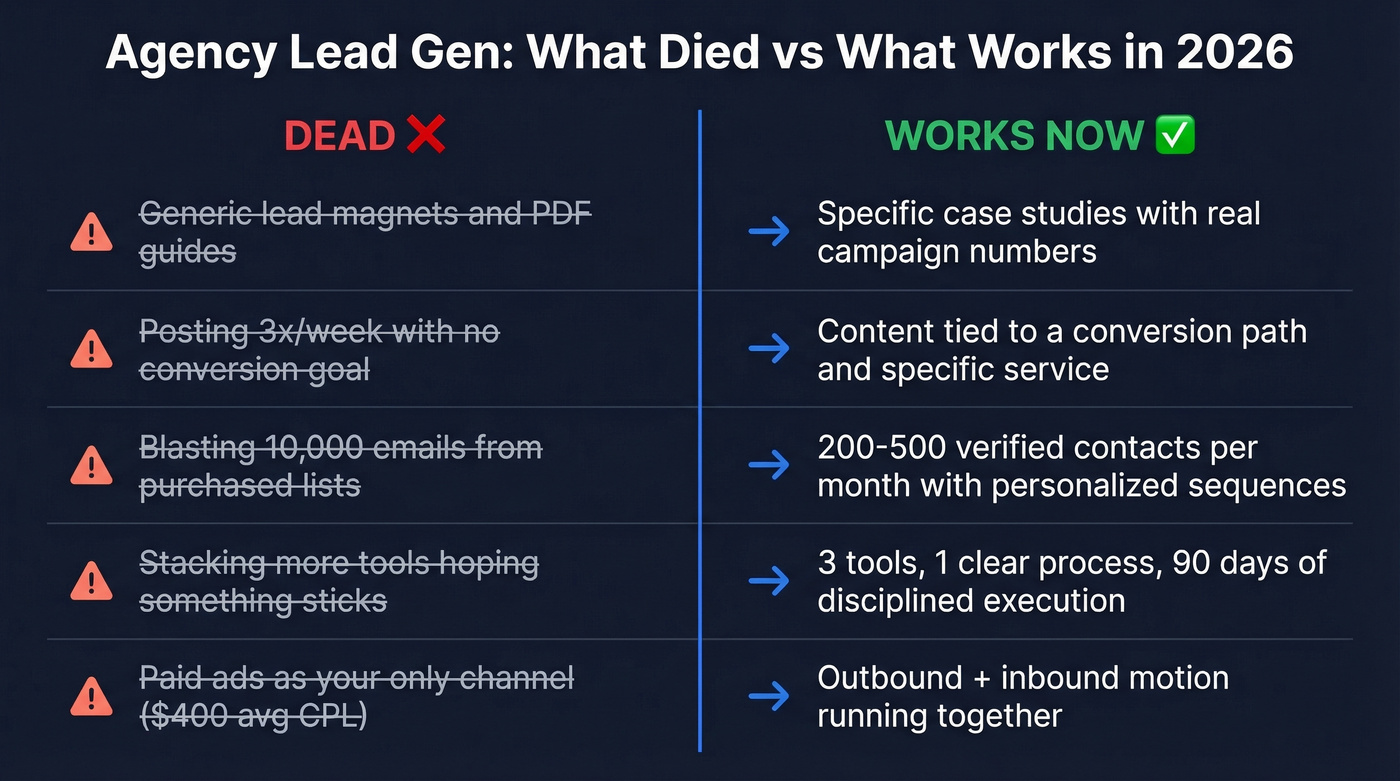
Dead: Posting constantly without a goal. Three posts a week about "the power of storytelling" isn't lead gen. It's content theater. What works instead: content tied to a conversion path, where every post either builds authority for a specific service or drives traffic to a page that captures buyer intent.
Dead: Cold, disconnected automation. Blasting 10,000 emails from a purchased list with a generic template. What works instead: targeted sequences to 200-500 verified contacts per month with personalized messaging and embedded sales assets. (If you need a structure, start with a B2B cold email sequence and iterate weekly.)
Dead: Adding more tools instead of fixing strategy. In our experience, the agencies with the most tools are often the ones booking the fewest meetings. Three tools, one clear process, and disciplined execution for 90 days beats a bloated tech stack every time.
Dead: Paid ads as your only channel. B2B cost-per-lead roughly doubled between 2017 and 2023 - from about $200 to $400 on average. If you're spending $5K/month on Google Ads with no outbound motion backing it up, you're leaving pipeline on the table.
Outbound Playbook: From 1 to 23 Calls/Month
Cold email still works for agencies. But the gap between doing it well and doing it badly is enormous. If you want a broader menu of approaches beyond email, use these sales prospecting techniques as your baseline.
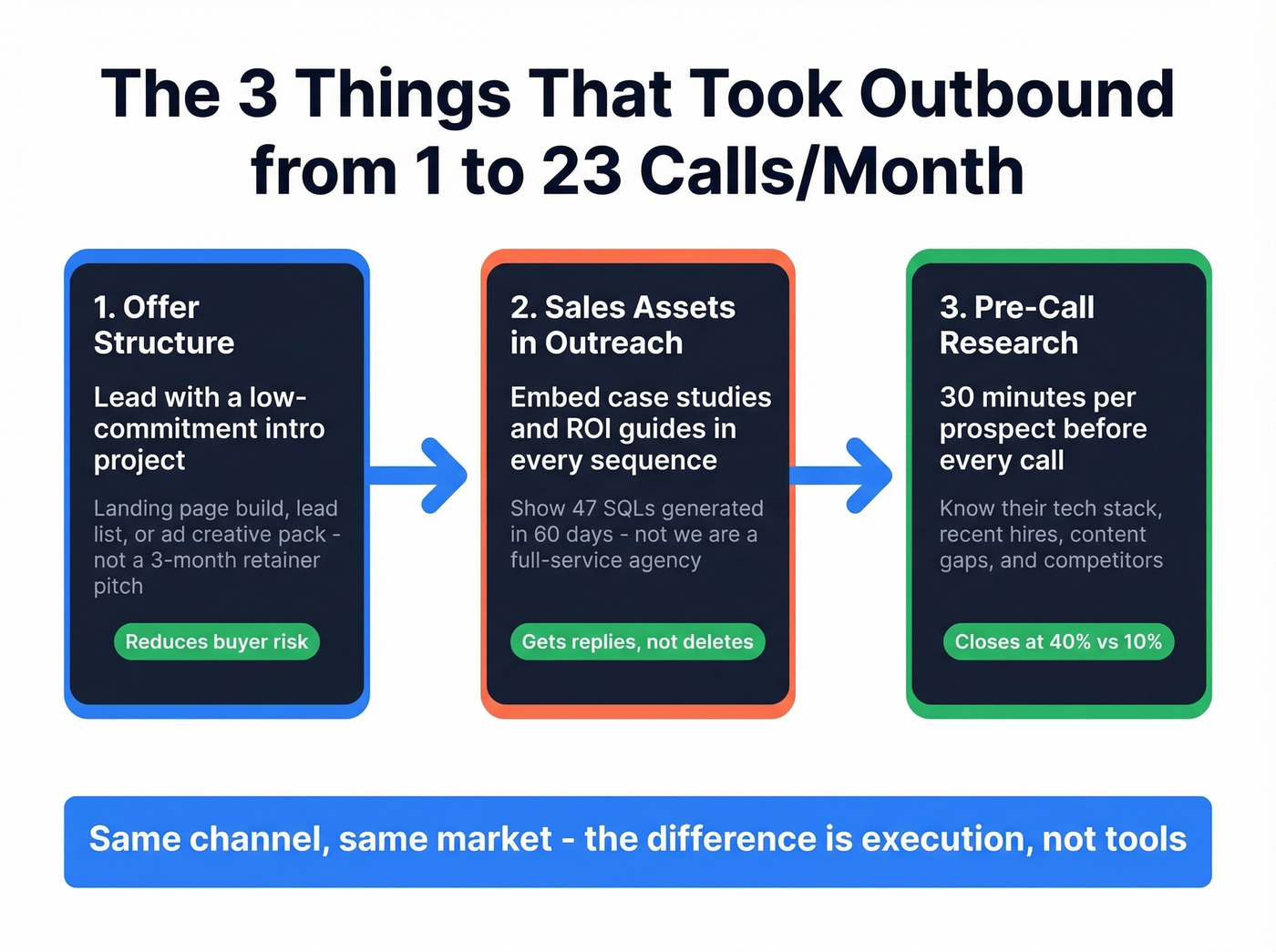
One practitioner on r/Entrepreneur documented running outbound for four different agencies - outcomes ranged from 1 call per month to 23 calls per month in a competitive niche. Same channel. Wildly different results. The difference came down to three things.
Offer Structure
The best-performing agency didn't lead with a retainer pitch. They offered a low-commitment intro project - a landing page build, a lead list, an ad creative pack - priced to reduce risk for the buyer. Once the prospect saw results, the upsell to a monthly retainer happened naturally.
The worst-performing agency pitched "Sign a 3-month contract with no guarantees." Reduce the buyer's risk first, earn the retainer second. This principle holds whether you're a solo SMMA consultant or a 50-person shop.
Sales Assets Inside Outreach
The agencies booking meetings weren't just sending cold emails asking for calls. They embedded case studies, ROI guides, and checklists directly into their sequences. A cold email that says "here's how we generated 47 SQLs for a B2B SaaS company in 60 days - full breakdown attached" gets replies. A cold email that says "we're a full-service digital agency, let's hop on a call" gets deleted.
Build 3-5 sales assets before you send a single cold email. Case studies with specific numbers perform best. (For follow-ups, keep a swipe file of sales follow-up templates so you don't wing it.)
Pre-Call Research That Closes
The agency booking 23 calls per month spent roughly 30 minutes researching each prospect before the call. They knew the prospect's tech stack, recent hires, content gaps, and competitive landscape. The conversation felt natural because it was informed.
The agency with a ~10% close rate ran a long slide deck with little company-specific research. The prospect could tell they were getting a canned pitch.
Thirty minutes of research per prospect sounds expensive. But if you're booking 20 calls a month and closing 8 of them at $3K/month retainers, that research time pays for itself many times over. Skip the deck. Know their business. Ask questions you already know the answers to.
Inbound That Still Converts
Outbound fills the pipeline fast. Inbound fills it consistently. You need both, but inbound requires patience - expect 3-6 months before it generates steady meetings.
Your website is the foundation. If your homepage doesn't clearly communicate who you serve, what you do, and roughly what it costs within 10 seconds, every other marketing effort is leaking value. Nearly 61% of marketers say improving lead quality is their top challenge - and most of that starts with a website that attracts the wrong people.
Add a "Who We're NOT a Fit For" section. This is one of the highest-converting positioning moves an agency can make. "We don't work with companies under $1M in revenue" or "We're not the right fit if you need a one-off logo design" filters out tire-kickers and signals confidence to real buyers.
Publish case studies with before/after numbers. Not "we helped a client grow." Instead: "We took Company X from 12 MQLs per month to 47 SQLs in 90 days. Here's the exact campaign structure." Specificity builds trust faster than any testimonial.
Be transparent about pricing. Publish ballpark ranges on your site. You'll lose some leads who can't afford you - that's the point. The leads who remain are pre-qualified and close faster.
Add an AI chatbot for lead capture. In 2026, a well-configured chatbot on your services pages qualifies visitors 24/7, routes high-intent prospects to your calendar, and captures contact info from visitors who aren't ready to fill out a form. It won't replace your sales team, but it'll catch leads that would otherwise bounce.
Partnerships and referral programs remain a high-converting channel for most agencies - but they don't scale predictably, which is why you need outbound and inbound running alongside them.
For agencies targeting enterprise accounts, account-based marketing adds another layer. Instead of casting a wide net, ABM focuses your content, ads, and outreach on a defined list of target accounts. It's resource-intensive but produces the highest deal sizes when executed well. If you're doing this seriously, borrow from account-based selling best practices to align targeting and messaging.

The article says it: a 500-contact list with verified emails outperforms a 5,000-contact scraped list every time. Prospeo delivers 98% email accuracy with 30+ filters - buyer intent, technographics, headcount growth - so your agency sends targeted sequences to the right prospects, not spam to strangers. Stack Optimize built a $1M agency on Prospeo data with under 3% bounce rates and zero domain flags.
Stop burning your domain on bad data. Start with 75 free verified emails.
Funnel Math - Know Your Numbers
You can't scale what you don't measure. Before spending another dollar on lead gen, calculate how many leads you actually need to hit your revenue target. If you want a clean list of what to track, start with these funnel metrics.
Here are stage-by-stage conversion benchmarks for industries most relevant to agency buyers:
| Industry | Lead-to-MQL | MQL-to-SQL | SQL-to-Opp | SQL-to-Closed |
|---|---|---|---|---|
| B2B SaaS | 39% | 38% | 42% | 37% |
| IT & Managed Services | 19% | 38% | 41% | 46% |
| Software Dev | 28% | 39% | 60% | 59% |
The average B2B close rate sits around 29%, with sales cycles running 1-3 months for most agency-sized deals. Let's work backward from a revenue goal.
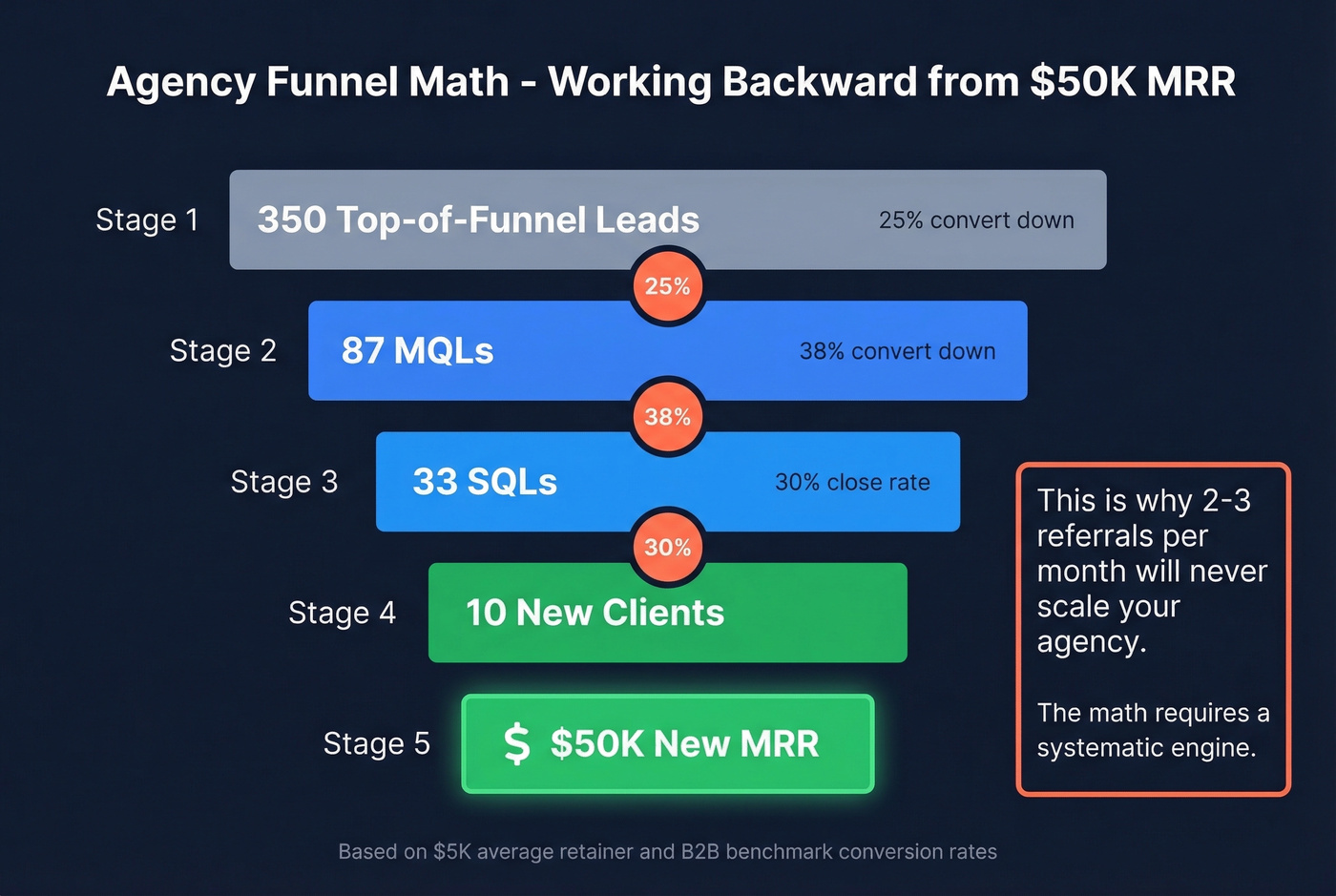
Say you need $50K in new monthly recurring revenue, and your average retainer is $5K/month. That's 10 new clients. At a 30% close rate from qualified opportunities, you need ~33 SQLs. If your MQL-to-SQL conversion is 38%, you need ~87 MQLs. And if your lead-to-MQL rate is 25%, you need roughly 350 top-of-funnel leads per month.
Those numbers are supposed to feel high. This is why agencies that rely on 2-3 referrals a month plateau - the math doesn't support growth without a systematic engine. It's also why B2B lead generation companies exist: they help fill the gap when your internal team can't produce that volume alone. (If you want more benchmarks, see the average B2B lead conversion rate.)
Tools Every Digital Agency Needs
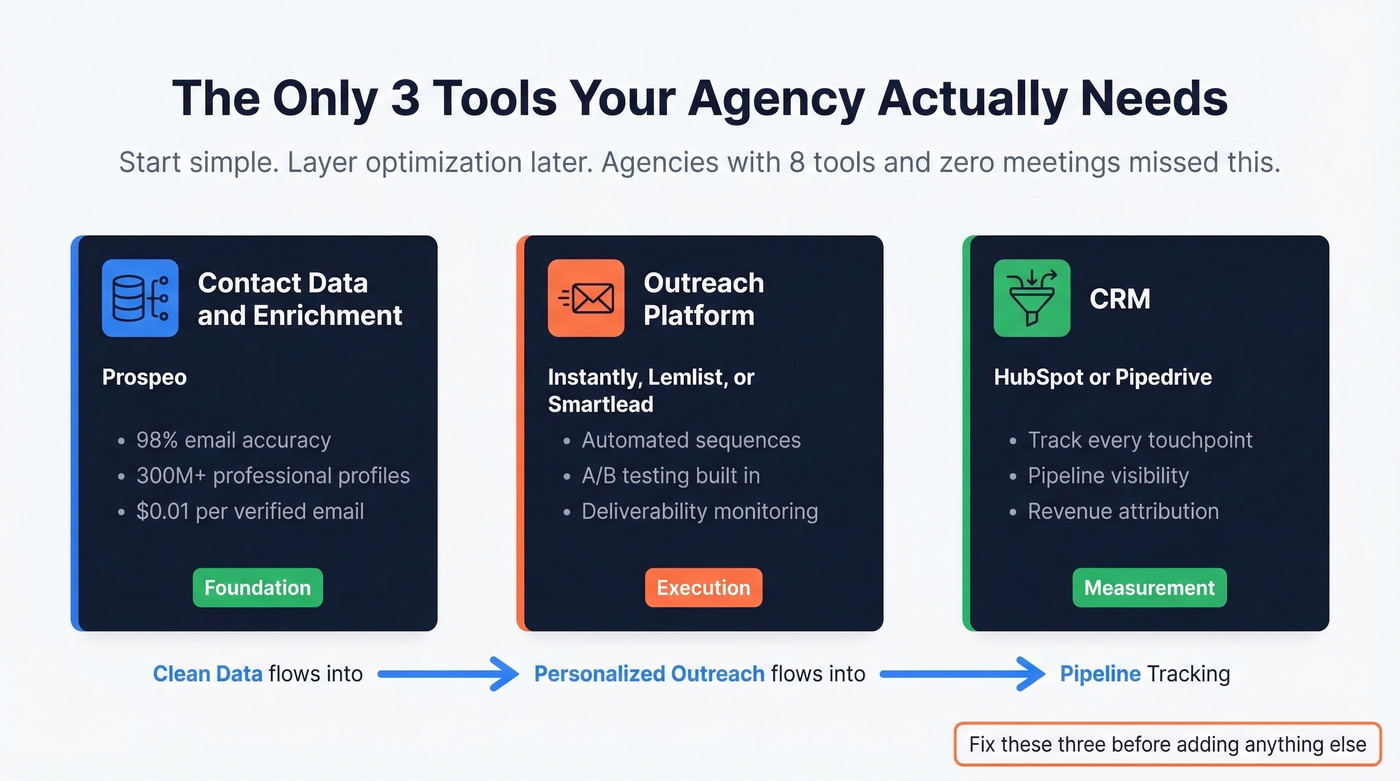
You need three things: a data source, an outreach platform, and a CRM. Everything else is optimization. We've seen agencies running eight tools and booking zero meetings because they never nailed the fundamentals. Start simple, then layer. If you're comparing options, this list of outbound lead generation tools is a good starting point.
Contact Data and Enrichment
Prospeo is the starting point for agencies that care about deliverability. When you're running campaigns for multiple clients, one bad data provider can torch your sending domains - and your clients' domains - in a week. The database covers 300M+ professional profiles with 98% email accuracy and a 7-day data refresh cycle, where the industry average is six weeks. At roughly $0.01 per email with a free tier of 75 verified emails per month, it's built for agencies that need to scale without enterprise contracts. Stack Optimize built from $0 to $1M ARR using Prospeo as their primary data source, maintaining 94%+ deliverability and under 3% bounce rates across all agency clients - zero domain flags. The Chrome extension with 40,000+ users lets you prospect from any website or CRM, and native integrations with Instantly, Lemlist, Smartlead, and HubSpot mean your data flows directly into your outreach stack without manual exports.

Apollo is a strong free starting point if you're bootstrapping. The free plan includes 10,000 export credits per month, and the database covers 275M+ contacts. Paid plans run $49/user/month for Basic to $79/user/month for Professional. The tradeoff: Apollo's email accuracy is around 79% compared to Prospeo's 98%. If you're using Apollo, verify your lists through a separate tool before sending - a high bounce rate will destroy your sender reputation. (More on that in our email deliverability guide.)
ZoomInfo is enterprise-grade and enterprise-priced. Contracts start around $15K-$25K/year for small teams and scale well past $100K for larger orgs. For most agencies under $5M in revenue, it's overkill. Skip it unless you need intent data and workflow tools at scale.
Lusha works for quick lookups at $49/user/month. Solid for grabbing a phone number or email on the fly, but it's not a primary data source for outbound campaigns.
Outreach and Engagement
Instantly is a strong budget cold email tool for agencies, starting at $30/month. Simple multi-sender outbound without a ton of complexity.
Lemlist adds multi-channel sequences with strong personalization - custom images, video thumbnails, and social steps. Steeper learning curve than Instantly, but more flexibility for agencies that want to go beyond email.
Smartlead is an Instantly alternative that's popular for managing replies across multiple sending accounts.
CRM
HubSpot Free CRM is where most agencies should start. Contact management, deal tracking, and basic reporting - all free. You'll outgrow it eventually, but it's the right foundation. If you're evaluating options, compare against other contact management software before you commit.
Salesforce is the enterprise standard. Only worth the investment if you need advanced reporting, custom objects, or complex workflow automation.
| Tool | Category | Starting Price | Database Size | Best For |
|---|---|---|---|---|
| Prospeo | Contact Data | Free (75/mo) / ~$0.01/email | 300M+ profiles | Agencies scaling outbound |
| Apollo | Contact Data | Free / $49/user/mo | 275M+ contacts | Bootstrapping teams |
| ZoomInfo | Contact Data | ~$15K/year | 300M+ profiles | Enterprise orgs |
| Lusha | Contact Data | $49/user/mo | Not public | Quick lookups |
| Instantly | Cold Email | $30/mo | N/A | Budget multi-sender outbound |
| HubSpot | CRM | Free | N/A | Agencies getting started |
You're spending 30 minutes researching each prospect before the call. Prospeo's enrichment returns 50+ data points per contact - tech stack, funding, department headcount, job changes - so that research takes minutes, not half an hour. At $0.01 per email, your 200-500 monthly outreach list costs less than a single lunch meeting.
Research faster, book more calls, close at 40%. Your competitors won't catch up.
What Lead Generation Actually Costs
Whether you're building in-house or hiring an external agency, here's what the market looks like.
| Service Type | Monthly Cost |
|---|---|
| Cold email outreach | $2,000-$8,000 |
| LinkedIn lead gen | $3,000-$10,000 |
| Multi-channel outbound | $5,000-$15,000+ |
| Enterprise programs | $15,000-$40,000+ |
Cost-per-meeting varies dramatically by the segment you're targeting:
| Segment | Cost/Meeting |
|---|---|
| SMB | $150-$500 |
| Mid-market | $300-$900 |
| Enterprise | $800-$2,500+ |
And if you're running paid channels alongside outbound:
| Channel | Average CPL |
|---|---|
| SEO | ~$31 |
| Google Ads | ~$87 |
| LinkedIn Ads | $60-$150 |
| Content Marketing | ~$92 |
| Overall B2B avg | $200-$400 |
Here's the thing: if your average deal size is under $10K, you probably don't need a $15K/month outsourced provider. Run outbound yourself with a $200/month tool stack and reinvest the savings into better sales assets. Agencies charging $10K+ per month for lead gen are built for businesses selling six-figure deals, not $3K retainers.
Pricing models break into four buckets. Retainer with a fixed monthly fee is the most common and typically the best value if the agency is competent. Pay-per-appointment runs $50-$250 per qualified lead. Performance-based models charge on results but expect higher per-lead costs. Hybrid structures combine a base retainer with a performance bonus.
The DIY vs. outsource decision is simple. Run your own outbound for 90 days first. If you can book meetings at a reasonable CPL with good tools and disciplined execution, scale in-house. If you can't after 90 days of real effort, outsource what's already showing traction - never outsource a broken process. An agency can't fix a bad offer or unclear ICP. That's your job.
For teams running paid ads alongside outbound, target high-intent pain-point keywords, not vanity terms. Fix the post-click journey: fast landing pages, a single offer per page, and a simple form. Exclude job seekers, students, and countries you don't serve.
How to Hire a B2B Lead Generation Agency
If you do decide to outsource, ask these questions before signing anything:
- How do you define "qualified"? If they can't give you a specific answer tied to your ICP, walk away. (Use an ideal customer profile template so you can pressure-test their definition.)
- Do you report booked meetings or held meetings? A "booked" meeting that no-shows isn't a result. Insist on held-meeting reporting.
- What's your tech stack and data source? If they can't name their tools, they're probably using scraped lists.
- Does your stack integrate with our CRM? Data that doesn't flow into your system creates manual work and reporting gaps.
- Which funnel stages do you cover? Some agencies only generate top-of-funnel leads. Others handle qualification and appointment setting. Know what you're buying.
- What does the first 4-6 weeks look like? Most agencies need a ramp period for list building, copy testing, and domain warmup. Anyone promising results in week one is lying.
For context, Belkins - one of the more visible agencies in the space - charges an estimated $5,000-$14,800+/month with a typical 3-6 month minimum engagement. Their Trustpilot sits at 3.2/5 with mixed reviews: some clients praise their lead research and appointment setting, while others report pressure tactics and underwhelming results. That variance is typical of the industry.
Red flags to watch for:
- Won't publish pricing ranges
- Guarantees specific lead counts without understanding your ICP
- Reports "booked" meetings without distinguishing held vs. no-show
- Requires 6+ month contracts before delivering any results
- Can't name their tech stack or data sources
Mistakes That Kill Agency Lead Gen
1. Unclear ICP. "We help businesses grow" isn't a target market. Agency owners on Reddit consistently cite unclear ICP as the #1 reason outbound fails. Define your ideal client by industry, company size, tech stack, and buying triggers. Update this quarterly with real data from your closed-won deals.
2. Single-channel dependence. Cold email alone plateaus. Social alone plateaus. SEO alone takes months. The strongest agencies run at least two channels simultaneously - typically outbound email plus content or SEO.
3. No lead scoring. Not every lead deserves the same attention. Build a simple scoring model based on company size, budget signals, and engagement level. Route high-scores to sales immediately; nurture the rest. (If you need a framework, start with lead scoring.)
4. Ignoring analytics. If you don't know your reply rate, meeting-booked rate, and cost-per-meeting by channel, you're flying blind. Set up weekly reporting from day one.
5. No nurturing sequences. Most prospects aren't ready to buy today. The agencies that build 30/60/90-day nurture sequences capture revenue that single-touch outreach misses entirely.
6. Sales and marketing misalignment. If your SDR team defines "qualified" differently than your account executives, you'll book meetings that go nowhere. Document shared definitions and review them monthly.
7. Compliance blind spots. If you're running outbound in the US, know your TCPA obligations for cold calling and texting. Targeting EU prospects? GDPR applies to your lead lists - you need a lawful basis for processing. Ignoring compliance doesn't just risk fines; it erodes trust with the exact buyers you're trying to reach.
8. Bad contact data. This one kills everything downstream. A 15% bounce rate doesn't just waste emails - it damages your sender reputation and tanks deliverability for every future campaign. Verify contact data before launching. A bounce rate under 5% should be your baseline, not a stretch goal. (If you're troubleshooting, start with email bounce rate.)
FAQ
How much does a lead generation digital agency charge?
Most agencies charge $2,000-$15,000/month depending on channels and target segment. Enterprise programs run $15,000-$40,000+. Cost-per-meeting ranges from $150 for SMB targets to $2,500+ for enterprise accounts.
Should I build lead gen in-house or outsource?
Run your own outbound for 90 days first using a verified data platform and cold email tool. If you can book meetings at a reasonable cost, scale in-house. Outsource only after you've proven the motion works and need to accelerate volume beyond your team's capacity.
What's a good conversion rate for B2B leads?
Lead-to-MQL conversion runs 19-39% depending on industry. MQL-to-SQL is typically 38-39%. SQL-to-Closed ranges from 37-59%. Use these benchmarks to reverse-engineer how many top-of-funnel leads your agency actually needs each month.
What's the best free tool for agency prospecting?
Prospeo's free tier includes 75 verified emails per month at 98% accuracy - enough to test outbound without risking your sender reputation. Apollo offers 10,000 export credits free but at ~79% accuracy, so verify lists separately before sending campaigns.
How long before outbound produces meetings?
Expect 4-8 weeks for initial meetings, accounting for domain warmup and copy iteration. Inbound channels like SEO and content take 3-6 months for consistent pipeline. Anyone promising qualified meetings in under two weeks is overselling.
The playbook for any lead generation digital agency is straightforward: fix your offer, get clean data, run outbound and inbound simultaneously for 90 days, and measure everything. Most agencies never get past step one because they keep looking for a shortcut. There isn't one. But the agencies that commit to the process - even imperfectly - end up with a pipeline their competitors would kill for. Start this week.