

Lead Generation for Startups: The 2026 Founder's Playbook
You're running cold email campaigns at a 2% reply rate, LinkedIn connection requests are getting ignored, and your ad spend is evaporating into impressions that don't convert. Lead generation at a startup is brutal - 91% of B2B marketers call it their top priority, but the playbook that worked in 2022 is broken. Here's what actually works in 2026, with real numbers behind every recommendation.
What You Need (Quick Version)
- Start with intent-filtered cold email. Lowest effort-to-result ratio for a founder without a sales team.
- Systematize referrals immediately. They cost $25/lead vs $408 on LinkedIn ads. If you're spending on paid channels before building a referral engine, you're lighting money on fire.
Inbound or Outbound First?
Both, but not equally. Hybrid teams see 2x faster revenue growth compared to teams that go all-in on one channel. But startups don't have the luxury of doing everything at once.
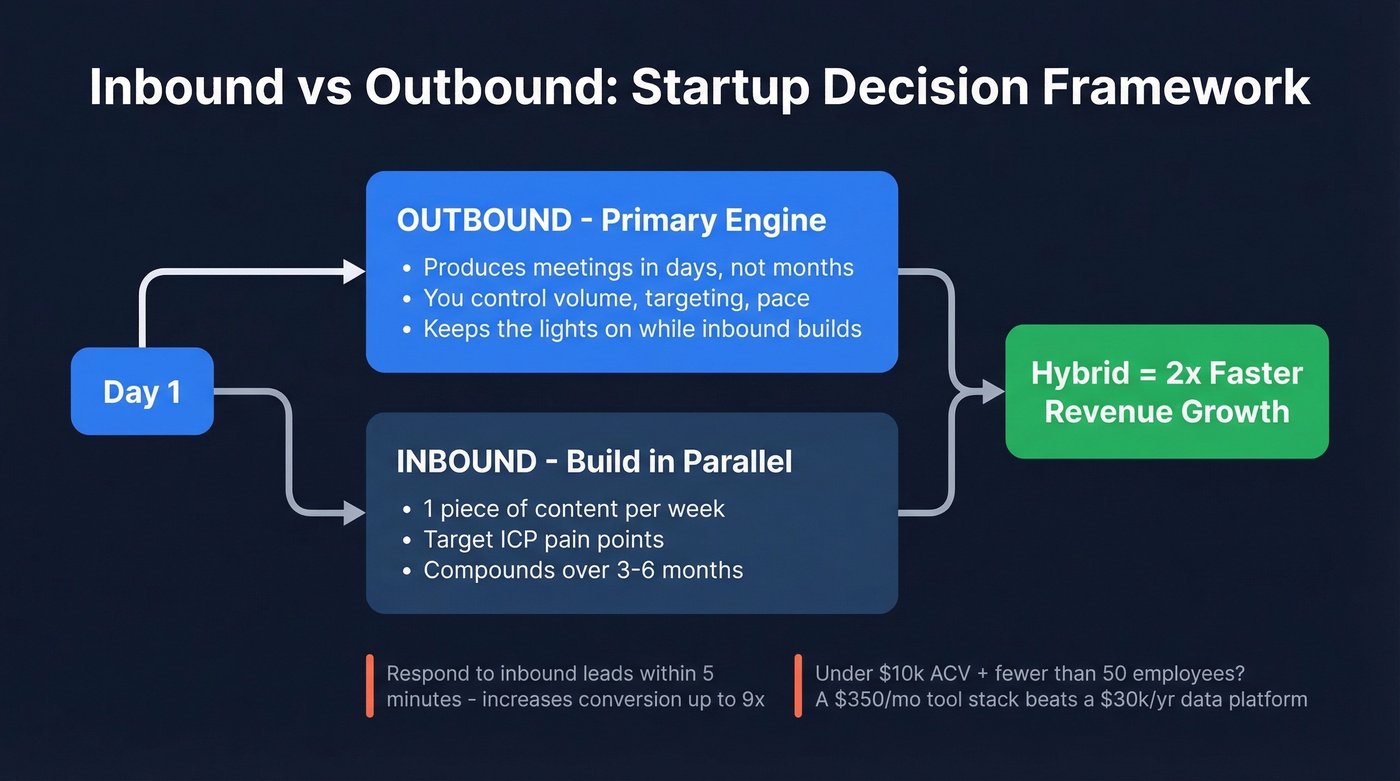
Start outbound. It produces meetings in days, not months. You control the volume, the targeting, and the pace. Inbound leads can cost up to 60% less over time, but SEO and content take 3-6 months to compound - and you need pipeline now.
Here's the decision framework: run outbound as your primary engine from day one while publishing one piece of content per week targeting your ICP's pain points. When inbound starts generating leads, respond within five minutes - that alone increases conversion chances up to 9x. The inbound flywheel will eventually reduce your outbound dependency, but outbound keeps the lights on while you build it.
If your average deal size is under $10k and you have fewer than 50 employees, you probably don't need a $30k/year data platform or a two-person SDR team. A solo founder with the right $350/month stack will outperform both until you hit product-market fit. This is especially true for bootstrapped SaaS lead generation, where every dollar of spend needs to tie directly to pipeline.
Six Strategies That Actually Work
1. Intent-Based Outbound
The shift from "who could buy" to "who's ready to buy" is the single biggest unlock in modern lead gen. Instead of blasting a list of 10,000 VPs, you're targeting the 200 who are actively showing buying signals.
The signal checklist: job changes in your buyer persona, companies hiring for roles in your category, recent funding rounds, leadership changes, and engagement with competitor or complementary content. Each of these signals tells you someone's world just changed - and change creates budget. One practitioner estimated 70% of phone numbers in large databases are wrong, which is another reason to prioritize verified, intent-filtered lists over bulk data.
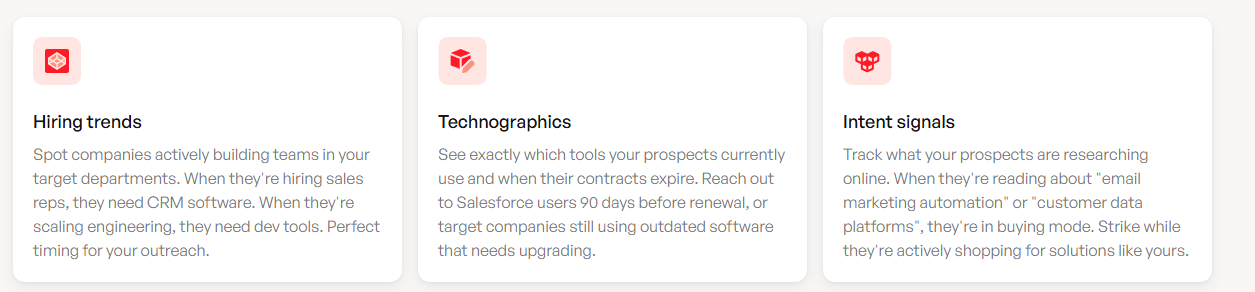
Layer buyer intent with job role and company growth signals to build lists of accounts that are actually in-market. That's the difference between cold outreach and warm outreach at cold email prices.
2. Cold Email
Benchmarks you should know: 15-25% open rates, 1-5% reply rates, 0.2-2% conversion rates. Those ranges are wide because list quality and message relevance determine everything.
Before you send a single email, verify your list. This isn't optional - it's step zero. One bad campaign with a 15% bounce rate can torch your domain reputation for months. At ~$0.01/email, verification is the cheapest insurance you'll ever buy. (If you want to go deeper on bounce thresholds and fixes, see email bounce rate.)
For the message itself, the consensus on r/Entrepreneur is that clarity beats cleverness. The CCQ framework from SalesBread works well: open with a genuine Compliment, establish Commonality with the prospect's situation, then close with a Question that's easy to answer. "Can I send you a 2-minute video?" converts better than "Let's schedule a 30-minute demo." When A/B testing subject lines or CTAs, use at least 50 contacts per variant before drawing conclusions (more ideas: cold email subject line examples).
3. LinkedIn Outreach
LinkedIn converts visitors to leads at 2.74% - roughly 3.5x Facebook's rate of 0.77%. Lead Gen Forms hit ~13% conversion, which crushes the ~2.35% landing page benchmark.
Sales Navigator runs ~$99/month. Test at least three segments in your first month to learn which ICP slice responds best. The mistake most founders make is treating LinkedIn as a broadcasting channel instead of a conversation channel. Connection requests with a personalized note and a genuine question outperform pitch-first messages every time. (For more tactics, see sales prospecting techniques.)
4. Content + SEO
This is the long game, and it's the one channel where patience pays compound interest. SEO CPL averages $206, but the range is massive - $14 to $397 - because compound returns reward consistency. Any lead generation startup with 6+ months of runway and a founder who can write should invest here early. (Related: what is B2B content marketing.)
The play: publish problem-aware content that your ICP is already searching for. Don't write about your product. Write about the problem your product solves. The leads come to you.
5. Partnerships & Co-Marketing
You're borrowing someone else's audience instead of building your own from scratch. A SalesBread case study showed a partnership campaign generating 88 leads in 7 weeks for MDxBlocks - roughly 12 qualified leads per week with zero ad spend.
Use this if you have a complementary, non-competing product in your space and a founder who's comfortable co-creating content or running joint webinars. Skip this if you don't have a clear partner fit or you're too early to have a compelling co-marketing asset.
6. Referrals
At $25 per lead, referrals are the cheapest source by a massive margin - roughly 9x cheaper than cold email and about 16x cheaper than LinkedIn ads. That's not a typo.
The problem isn't that referrals don't work. It's that founders treat them as accidental instead of systematic. Build a referral ask into your post-sale workflow. Ask every happy customer for two introductions. Track referral sources in your CRM. In our experience running these numbers across dozens of startup campaigns, referrals consistently deliver the highest-quality pipeline alongside the lowest cost. This isn't a "nice to have" - it's the highest-ROI channel you'll ever run.

The article says it: verify your list before you send a single email. Prospeo's 98% email accuracy and 7-day data refresh mean your startup outbound hits real inboxes, not spam traps. At ~$0.01/email, list verification costs less than a single wasted impression.
Stop torching your domain. Start with data that actually connects.
What a Lead Actually Costs
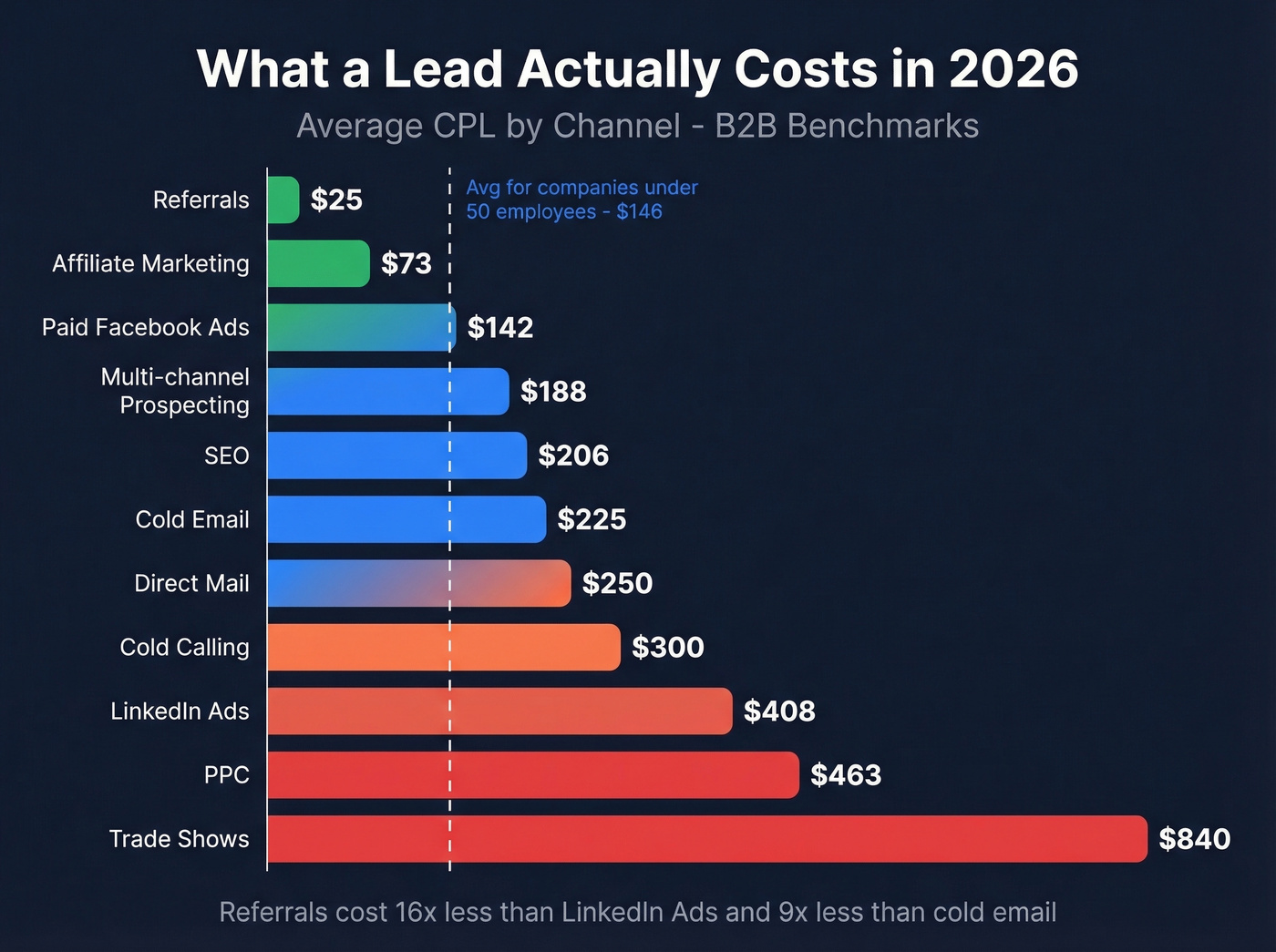
The average B2B CPL sits at $84 across all channels, but that number hides enormous variance. Here's the breakdown from Sopro's CPL benchmarks:
| Channel | Avg CPL | Low | High |
|---|---|---|---|
| Referrals | $25 | - | - |
| Affiliate marketing | $73 | $54 | $92 |
| Paid Facebook ads | $142 | $102 | $182 |
| Multi-channel prospecting | $188 | $80 | $296 |
| SEO | $206 | $14 | $397 |
| Cold email | $225 | $150 | $300 |
| Direct mail | $250 | - | - |
| Cold calling | $300 | - | - |
| LinkedIn ads | $408 | $15 | $800+ |
| PPC | $463 | $175 | $751 |
| Trade shows | $840 | $180 | $1,500+ |
Businesses under 50 employees typically pay $146 per lead. That's your baseline. If you're spending significantly more, your targeting needs work - not your budget.
Build vs Buy: The Real Cost Math
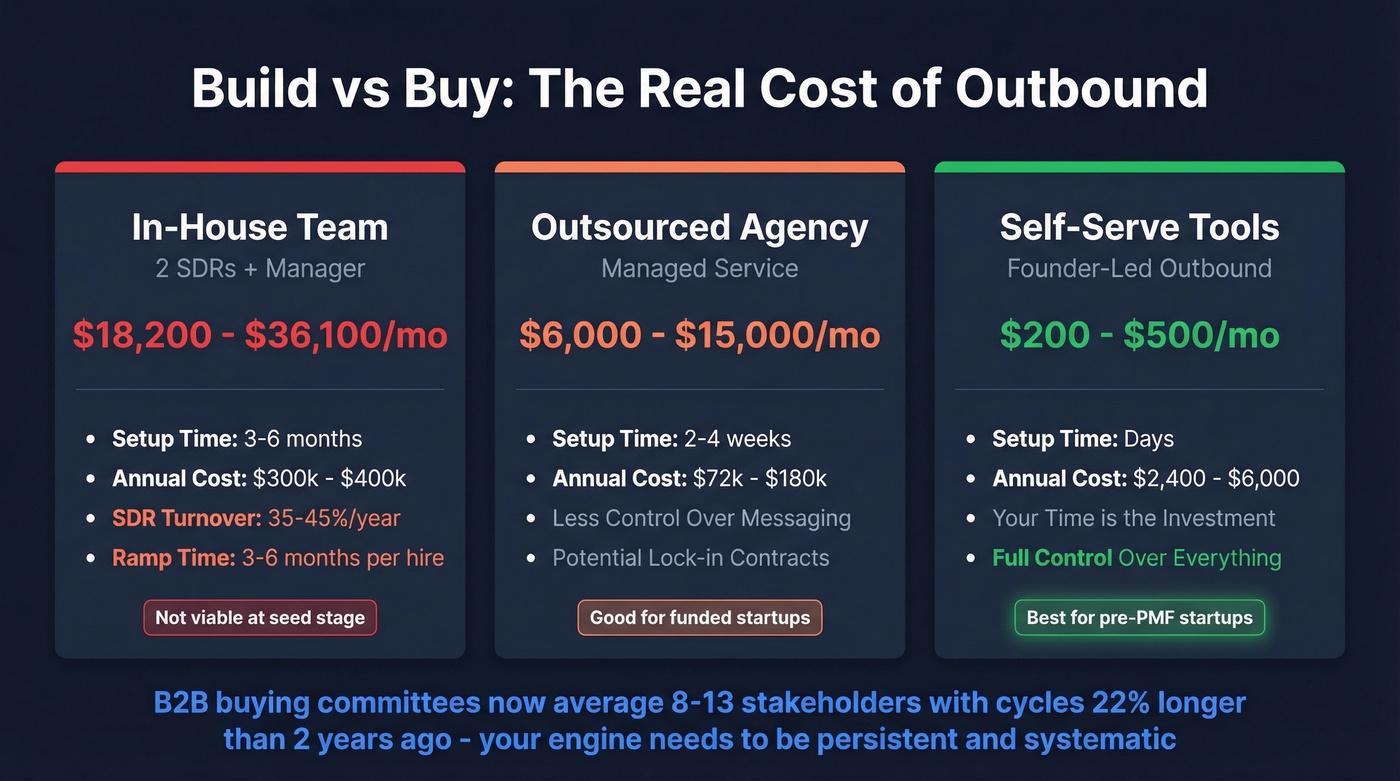
Most founders underestimate what an in-house outbound team actually costs.
| Model | Monthly Cost | Setup Time | Hidden Costs |
|---|---|---|---|
| In-house (2 SDRs + mgr) | $18,200-$36,100 | 3-6 months | 35-45% turnover, recruiting, benefits |
| Outsourced agency | $6,000-$15,000 | 2-4 weeks | Less control, lock-in |
| Self-serve tools | $200-$500 | Days | Your time, learning curve |
An in-house team of 2 SDRs plus a manager runs $300k-$400k/year all-in. That's before you factor in 35-45% annual SDR turnover and 3-6 month ramp times. For a seed-stage startup, that math doesn't work.
B2B buying committees now average 8-13 stakeholders with cycles 22% longer than two years ago. That complexity means your outbound engine needs to be persistent and systematic - whether you build it in-house or run it yourself with tools. (If you need a system for triggers, see identifying buying signals.)
The $350/Month Startup Stack
You need three core tools: a data layer, a sending layer, and a CRM. Everything else is an optional upgrade you can add later when revenue justifies it.
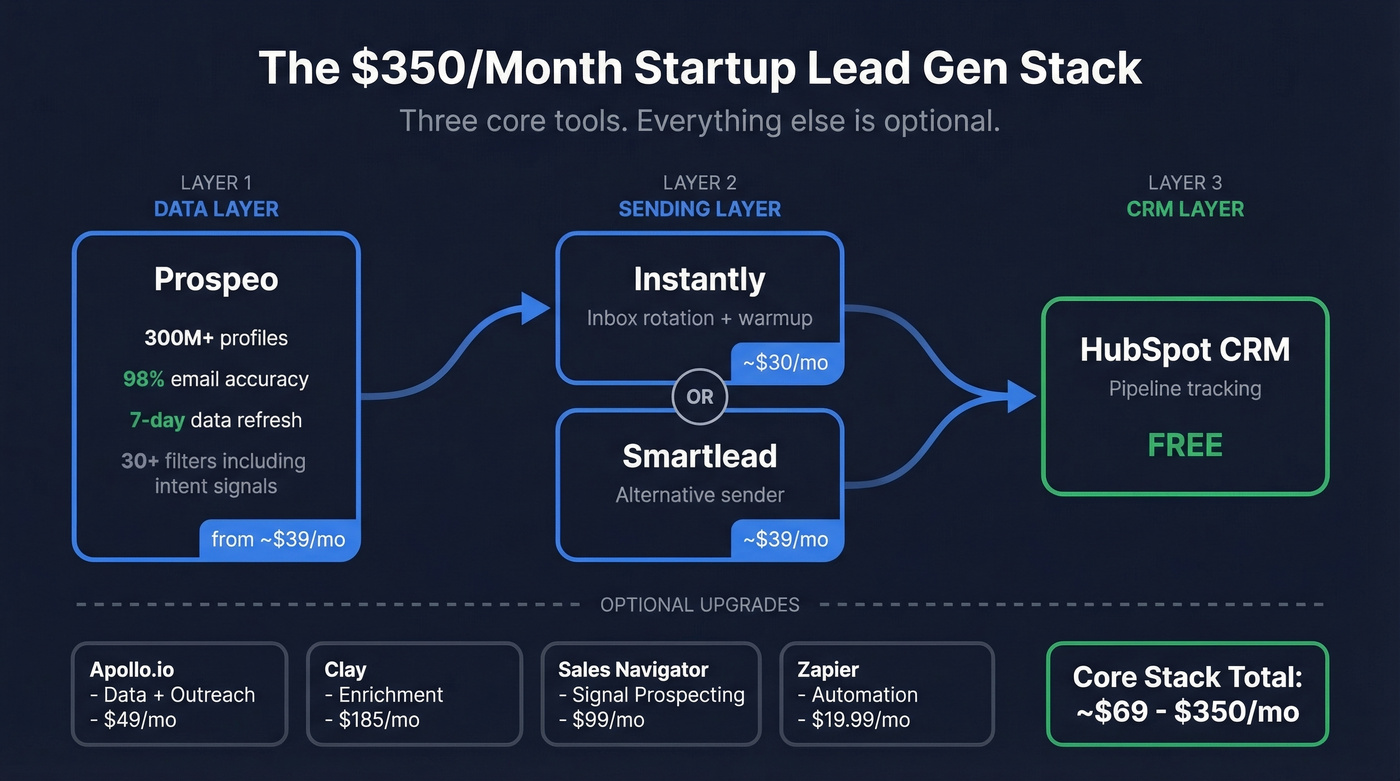
Core three:
| Tool | Function | Starting Price | Free Tier |
|---|---|---|---|
| Instantly | Cold email sending | ~$30/mo | No |
| HubSpot CRM | Pipeline tracking | Free | Yes |
Optional upgrades:
| Tool | Function | Starting Price | Free Tier |
|---|---|---|---|
| Apollo.io | Data + outreach | $49/user/mo | 50 AI credits |
| Smartlead | Cold email (alt) | ~$39/mo | No |
| Clay | Enrichment | $185/mo | 100 data credits |
| Sales Navigator | Signal prospecting | ~$99/mo | No |
| Zapier | Automation | $19.99/mo | Yes |
Data & Verification
Prospeo covers 300M+ professional profiles with 98% email accuracy and a 7-day data refresh cycle - the industry average is six weeks. That freshness gap matters more than most founders realize. Stale data means bounced emails, and bounced emails mean domain reputation damage you can't afford. (More on deliverability fundamentals: email deliverability guide.)

The search interface gives you 30+ filters including buyer intent, technographics, job changes, funding rounds, and headcount growth. Build a list of 500 prospects in minutes, export verified contacts, and push them straight to Instantly or Smartlead via native integrations. Stack Optimize built from $0 to $1M ARR using this exact stack, keeping client deliverability above 94% and bounce rates under 3% with zero domain flags. (If you’re layering sources, see data enrichment services.)
By comparison, Apollo's 79% email accuracy means roughly 1 in 5 contacts has a bad or unverified email - a domain reputation risk founders can't afford at scale. Apollo credits also expire each billing cycle, so unused data spend is lost.
Outreach: Instantly + Smartlead
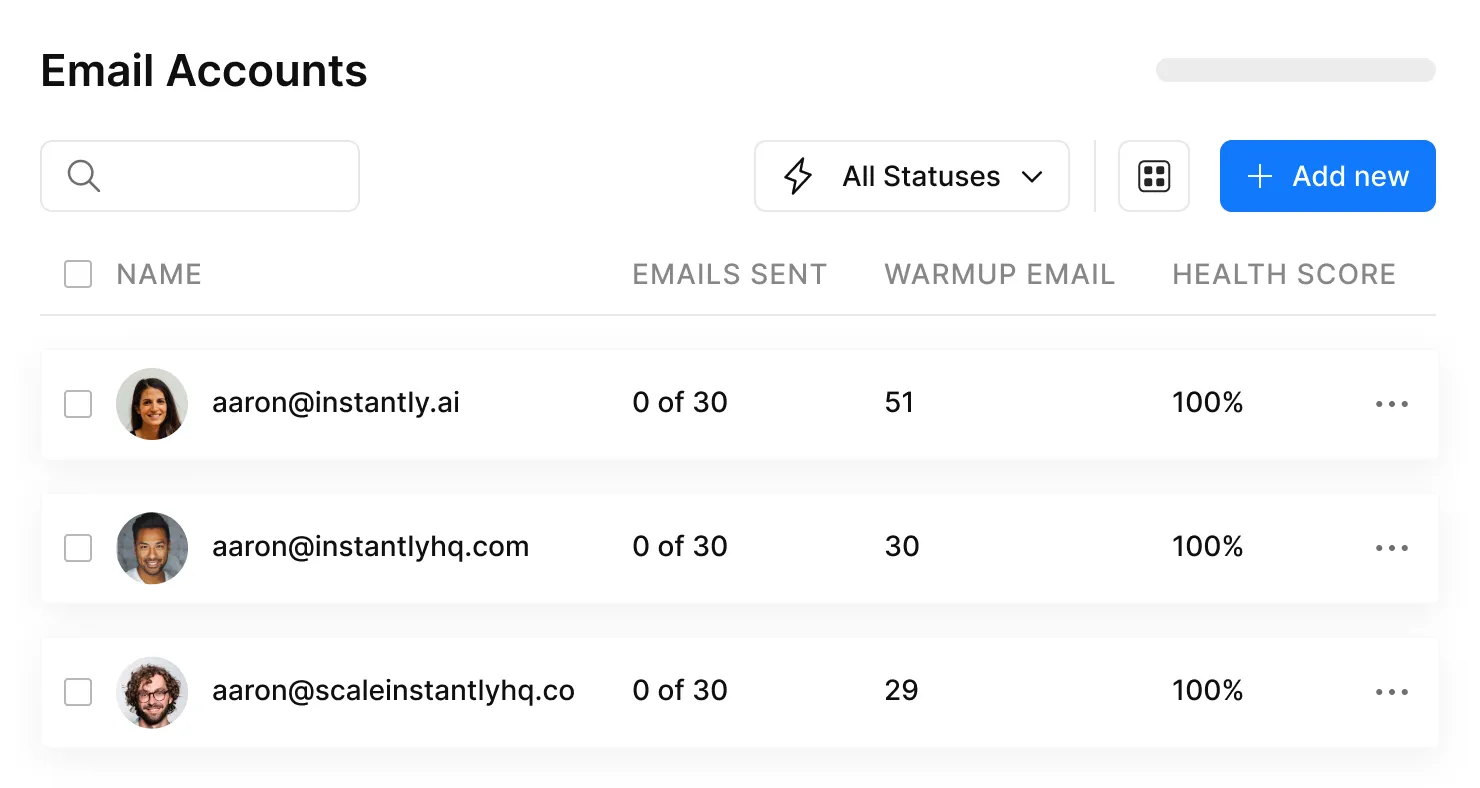
Instantly handles inbox rotation, warmup, and campaign management for ~$30-$97/month depending on volume. It's the default sending tool for most early-stage outbound operations, and the integration with your data layer is native - no Zapier required. (For safe scaling, see email velocity.)
Smartlead is the alternative at ~$39-$94/month. Similar feature set, slightly different UX. We've seen teams split between the two based on personal preference more than feature gaps. Pick whichever UI you prefer and move on.
CRM: HubSpot
HubSpot's free CRM is sufficient for early-stage pipeline tracking. You don't need Salesforce until you have a sales team that needs Salesforce. (If you’re comparing options, see examples of a CRM.)
Enrichment & Automation
Clay's pricing includes separate data credits and actions. The Launch plan at $185/month gives you 2,500 data credits - enough for enrichment workflows that layer multiple data sources on top of your prospect lists. The Growth plan at $495/month serves teams needing more capacity, and the free tier gives you 100 data credits and 500 actions to test. (Related workflow: Clay list building.)
Zapier connects everything else. Free plan handles basic automations; paid plans from $19.99/month unlock multi-step workflows.
Intent-based outbound is the #1 unlock for startups - but only if your data connects you to real buyers. Prospeo layers buyer intent across 15,000 topics with 30+ filters like funding, headcount growth, and job changes so you target the 200 who are ready, not the 10,000 who aren't.
Build intent-filtered lists in minutes, not hours. No sales call needed.
Mistakes That Kill Startup Lead Gen
Buying pre-built lists. Generic purchased lists destroy your domain reputation. 80% of leads never convert - that's a targeting problem, not a volume problem. Founders on r/b2bmarketing consistently report that big databases deliver outdated contacts and overused lists, which is why intent-filtered prospecting has taken over. Build lists based on signals, not size. (If you’re unsure on compliance, see Is It Illegal to Buy Email Lists?.)
Stopping after one follow-up. 80% of sales require 5+ follow-ups, but 48% of reps stop after one touch. With buying committees averaging 8-13 stakeholders and cycles running 22% longer than two years ago, persistence isn't aggressive - it's necessary. If you're a solo founder, automate your follow-up sequences so persistence doesn't depend on your memory. (Templates: cold email follow-up templates.)
Spreading across too many channels. Master one channel before adding another. A founder running cold email, LinkedIn outreach, content marketing, and paid ads simultaneously will do all four poorly. Pick cold email, get it working, then layer.
Skipping verification. Here's the thing: sending 1,000 unverified emails feels productive. Getting your domain blacklisted two weeks later does not. Verify every list before every send. No exceptions.
FAQ
How long does lead generation take for a startup?
Cold email campaigns can generate meetings within 1-2 weeks if your list is verified and your ICP is tight. Inbound channels like SEO typically take 3-6 months to compound. Start outbound for immediate pipeline, build inbound in parallel for long-term cost reduction.
What's a realistic CPL for an early-stage startup?
Businesses under 50 employees average $146 per lead across channels. Cold email runs ~$225, referrals ~$25, and LinkedIn ads ~$408. Intent-filtered lists can cut these numbers by 30-50% because you're only paying to reach accounts already in-market.
Can I generate leads without an SDR team?
Yes. A solo founder with Prospeo for verified data, Instantly for sending, and HubSpot's free CRM can run a complete outbound operation for $200-$350/month. The bottleneck isn't headcount - it's list quality and follow-up discipline. Systematize both and you won't need to hire until volume demands it.
How is B2B lead generation for startups different from enterprise?
Enterprise teams absorb the cost of large SDR orgs, $30k/year data platforms, and 6-month sales cycles. A lead generation startup demands leaner infrastructure, faster iteration, and tighter feedback loops between founder and prospect. You're optimizing for speed-to-learning, not coverage - which is why a $350/month tool stack often outperforms a six-figure sales org at the early stage.