

The Data-Driven Lead Generation Strategy Guide for 2026
92% of B2B buyers already have a vendor in mind before they start evaluating options. 95% of the time, the winner was on the buyer's "Day One shortlist." If your lead generation strategy is just about capturing demand that already exists, you're fighting over 5% of the market - and you're probably losing.
The Short Version
If you only take three things from this guide:
- Invest in SEO, client referrals, and cold email. SEO converts leads to MQLs at 41%, client referrals convert at 56%, and cold email gives you the most direct control over volume and targeting.
- Know your numbers. Organic CPL runs 40-50% lower than paid across industries. Most teams don't track this, and they bleed budget on the wrong channels.
- Fix your data before you fix your tactics. Every strategy downstream - sequences, ABM, nurture - breaks when contact data is stale or wrong. A verification layer with 98% email accuracy and a 7-day refresh cycle keeps your outbound from starting with a handicap.
Why Most Lead Gen Strategies Fail
The problem isn't usually the tactics. It's the assumptions.
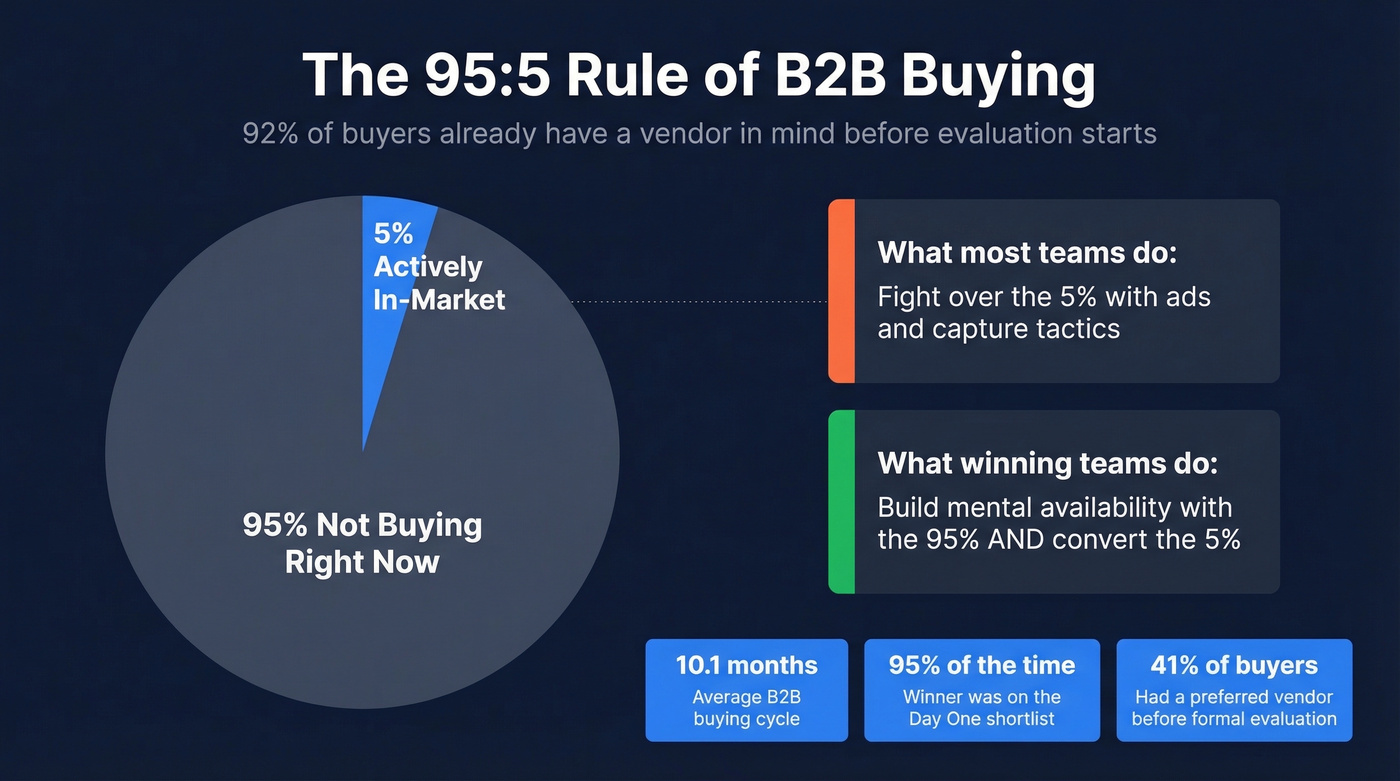
Most teams build their approach around a fantasy: that there's a large pool of buyers actively looking for their solution, and the job is to capture that attention. The data says otherwise. 92% of buyers start with at least one vendor in mind, and 41% have a preferred vendor before formal evaluation even begins. The winning vendor is on the buyer's shortlist from Day One - 95% of the time.
This is the 95:5 rule. At any given moment, roughly 95% of your ideal customers aren't buying. They're not in-market, not Googling solutions, not clicking your ads. Only about 5% are actively evaluating.
The average B2B buying cycle runs 10.1 months from first signal to closed deal. Demand generation - being remembered when buyers eventually enter the market - matters as much as lead capture. The strongest approaches do both: they build mental availability with the 95% while efficiently converting the 5%. If you're only doing the latter, you're leaving the majority of your future pipeline to chance.
Benchmarks Nobody Else Gives You
Most lead gen guides tell you to "try content marketing" or "invest in PPC" without giving you the conversion data to compare them. Here's what the numbers actually show.
Cost Per Lead by Industry
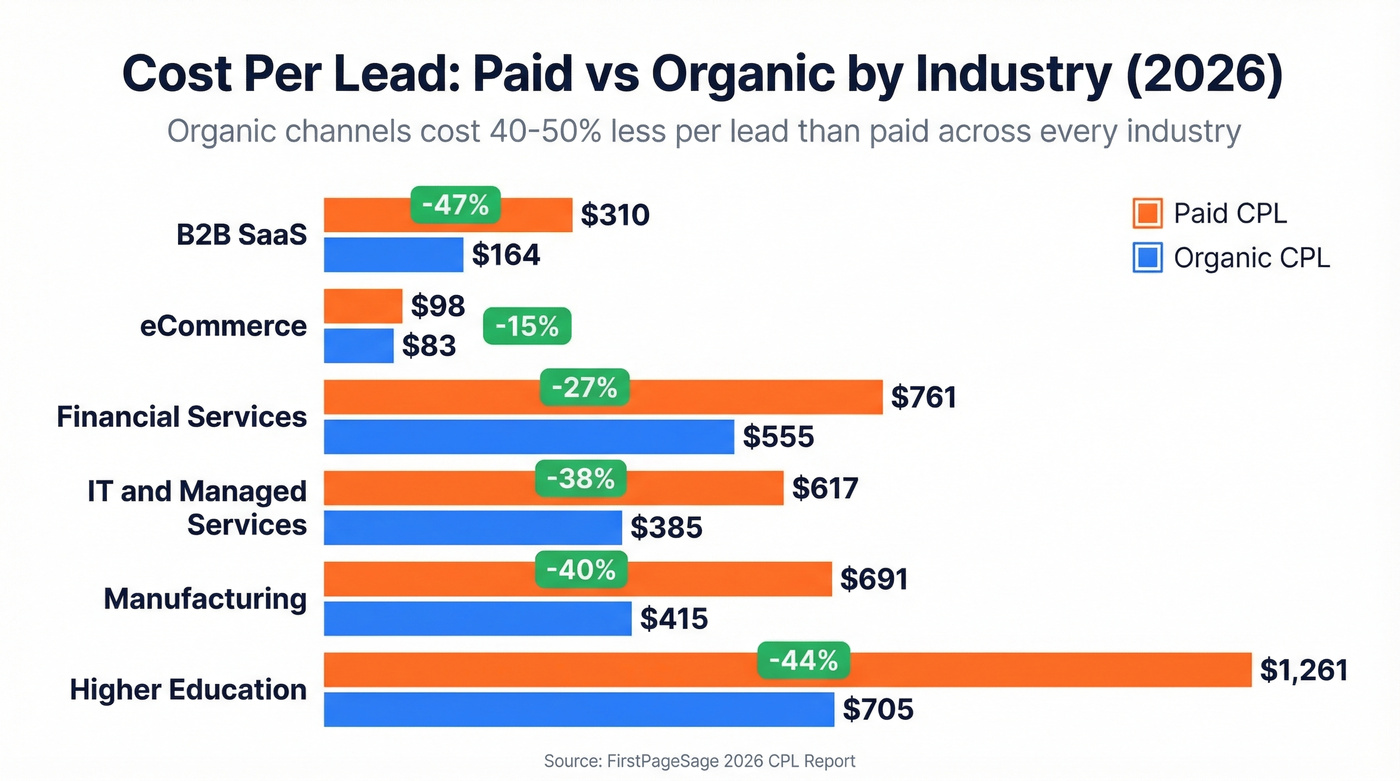
These figures come from the FirstPageSage 2026 CPL report, covering thousands of campaigns across industries.
| Industry | Paid CPL | Organic CPL | Blended |
|---|---|---|---|
| B2B SaaS | $310 | $164 | $237 |
| eCommerce | $98 | $83 | $91 |
| Financial Services | $761 | $555 | $653 |
| IT & Managed Services | $617 | $385 | $503 |
| Manufacturing | $691 | $415 | $553 |
| Higher Education | $1,261 | $705 | $982 |
The pattern holds across industries: organic channels cost 40-50% less per lead than paid. The gap widens downstream - organic leads convert better through the funnel because they self-selected with higher intent.
Full-Funnel Conversion Rates
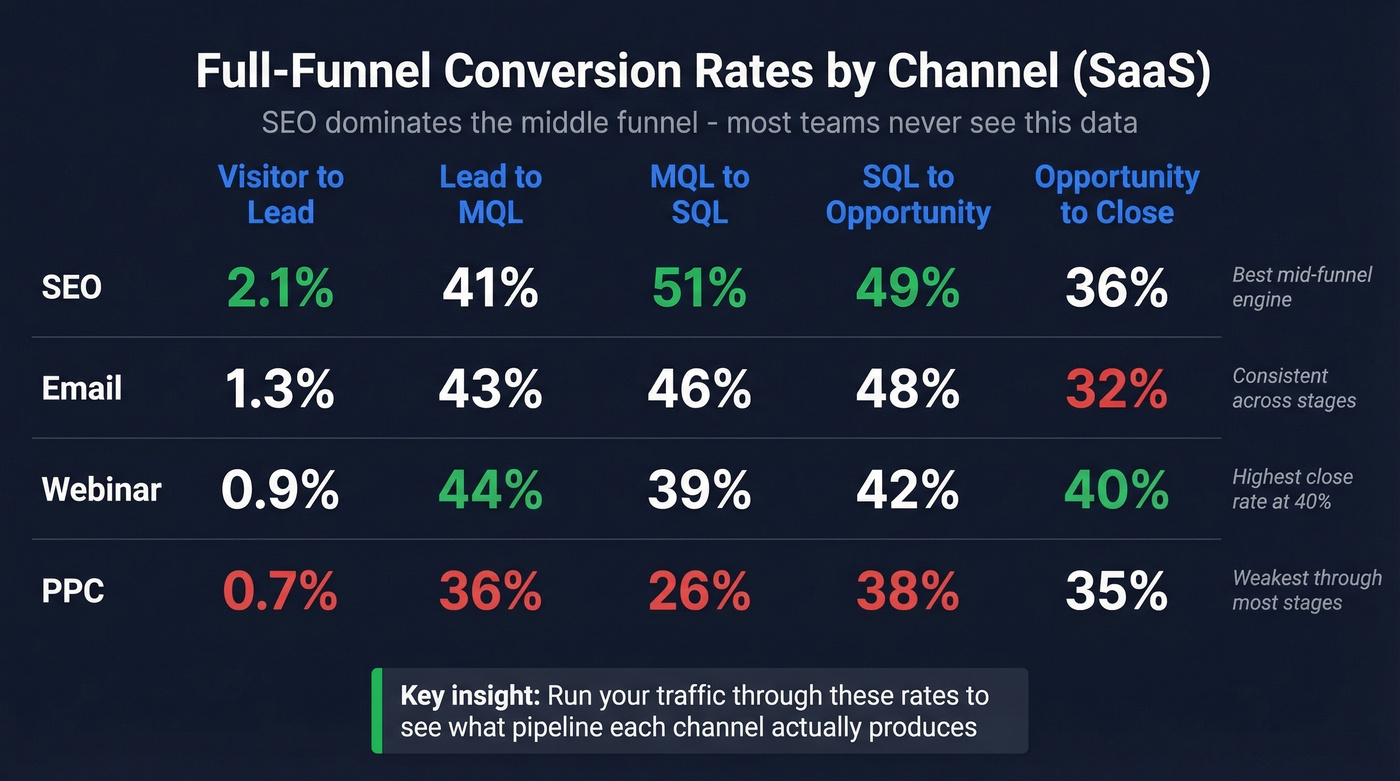
This is where it gets interesting. A lead is worthless if it doesn't convert. Here's how SaaS channels perform across the full funnel:
| Channel | Visitor-Lead | Lead-MQL | MQL-SQL | SQL-Opp | Opp-Close |
|---|---|---|---|---|---|
| SEO | 2.1% | 41% | 51% | 49% | 36% |
| 1.3% | 43% | 46% | 48% | 32% | |
| Webinar | 0.9% | 44% | 39% | 42% | 40% |
| PPC | 0.7% | 36% | 26% | 38% | 35% |
Look at the Opp-Close column. Webinars have the highest close rate at 40%, despite the lowest visitor-to-lead conversion. PPC is the weakest through most of the funnel, and it only looks competitive at close rate. SEO dominates the middle - 41% Lead-MQL and 51% MQL-SQL - which is why it compounds so aggressively over time.
Take your monthly traffic by channel, multiply through these rates, and see what pipeline each channel actually produces. Most teams are shocked at how much their "best" channel underperforms when you run the full math.
Lead-MQL rates by source tell a similar story: client referrals convert at 56%, executive events at 54%, SEO at 41%, email marketing at 38%, and PPC at 29%. Referrals aren't just "nice to have." They're the highest-converting source you have.
Define Your ICP (Properly)
An ICP isn't a one-paragraph description of your ideal customer. It's a ranked, segmented model that tells your team exactly who to pursue and in what order.
The most useful framework we've seen is competency mapping. Break your total addressable market into sub-segments, then rank each one across three dimensions: ease of selling (short cycle, clear pain, accessible buyers), strategic fit (alignment with your product roadmap and strengths), and growth potential (expanding market, increasing budgets). The segments that score highest across all three are where you focus first.
Within each segment, map the buying committee. Cap it at five key players - going beyond that creates analysis paralysis. For a mid-market SaaS deal, that's typically the end user, their manager, a technical evaluator, a budget holder, and a procurement or legal gatekeeper. Each persona needs different messaging. The end user cares about daily workflow impact. The budget holder cares about ROI and risk. If you're sending the same email to both, you're wasting at least one of those touches.

You just saw the data: every funnel stage breaks when contact information is stale. Prospeo's 7-day refresh cycle and 98% email accuracy mean your sequences, ABM plays, and nurture campaigns start on solid ground - not a 6-week-old guess.
Fix your data layer first. Everything else compounds from there.
Build Your Funnel
68% of companies haven't identified their funnel, which means they haven't mapped their ICP at the level described above either. Doing this work puts you ahead of two-thirds of your competitors before you send a single email.
Lead Types That Matter
Not all leads are equal, and using the right labels keeps marketing and sales aligned.
An MQL has engaged with your content or campaigns enough to signal interest - downloaded a whitepaper, attended a webinar, visited pricing pages multiple times. An SQL has been vetted by sales and confirmed as a real opportunity. A PQL has used your product through a free trial or freemium tier and hit usage thresholds that predict conversion. A Service Qualified Lead has told your support or success team they want to buy more.
50% of qualified leads aren't ready to purchase at first contact. That's not a failure - it's the reality of a 10.1-month buying cycle. Your funnel needs to account for nurture, not just capture. Expected MQL-to-Close rates vary by company stage: early-stage SaaS sees 1-2%, growth-stage 2-4%, scale-stage 3-5%, and enterprise 4-7%.
On the capture side, don't overlook form optimization. Conditional logic that shows relevant fields based on earlier answers, exit-intent triggers, and multi-step forms consistently outperform static forms. Small friction reductions compound across thousands of visits.
Lead Scoring Basics
Scoring combines two signal types: engagement signals like content downloads, page visits, email replies, and webinar attendance, alongside fit signals such as job title, company size, industry, and tech stack. Assign point values to each - a VP visiting your pricing page three times is worth more than an intern downloading a generic ebook.
If you want a deeper breakdown, use a dedicated lead scoring model that marketing and sales can both audit.
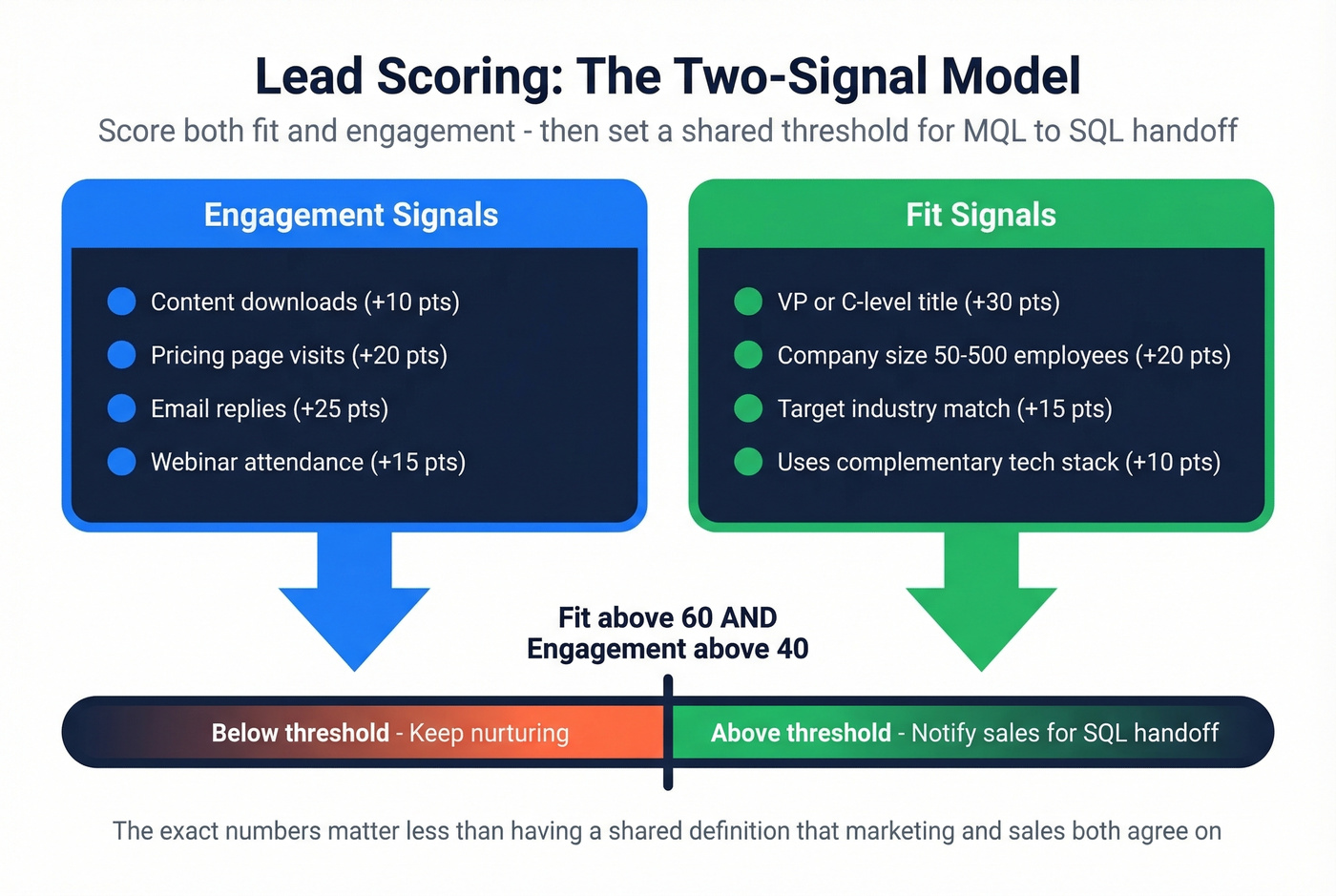
Set a clear threshold for MQL-to-SQL handoff. Something like: fit score above 60 AND engagement score above 40 triggers a sales notification. The exact numbers matter less than having a shared definition that both marketing and sales agree on. Without it, leads disappear into a black hole between teams.
12 Tactics That Generate Leads in 2026
SEO & Content Marketing
SEO converts visitors to leads at 2.1% and leads to MQLs at 41% - the strongest mid-funnel performance of any major channel in the benchmark table. Organic CPL runs 40-50% lower than paid across industries. The tradeoff is time: SEO compounds, but it takes 6-12 months to build momentum. Treat it as infrastructure, not a campaign. Every piece of content that ranks is a lead gen asset that works while you sleep.
If you're building this channel seriously, treat B2B content marketing as a system (not a posting schedule).
In 2026, optimize for AI search engines too. Structure content for featured snippets and direct answers that LLMs can surface. If your content doesn't answer questions concisely, you'll struggle for visibility in ChatGPT, Perplexity, and Google's AI Overviews - even if you rank well in traditional results.
Cold Email
61% of decision makers prefer email outreach over cold calls. But 71% of recipients ignore cold emails due to lack of relevance - and 20% say they've never received a relevant one. The channel works, but only if you nail targeting and deliverability.
If you're building sequences from scratch, start with a proven B2B cold email sequence structure.
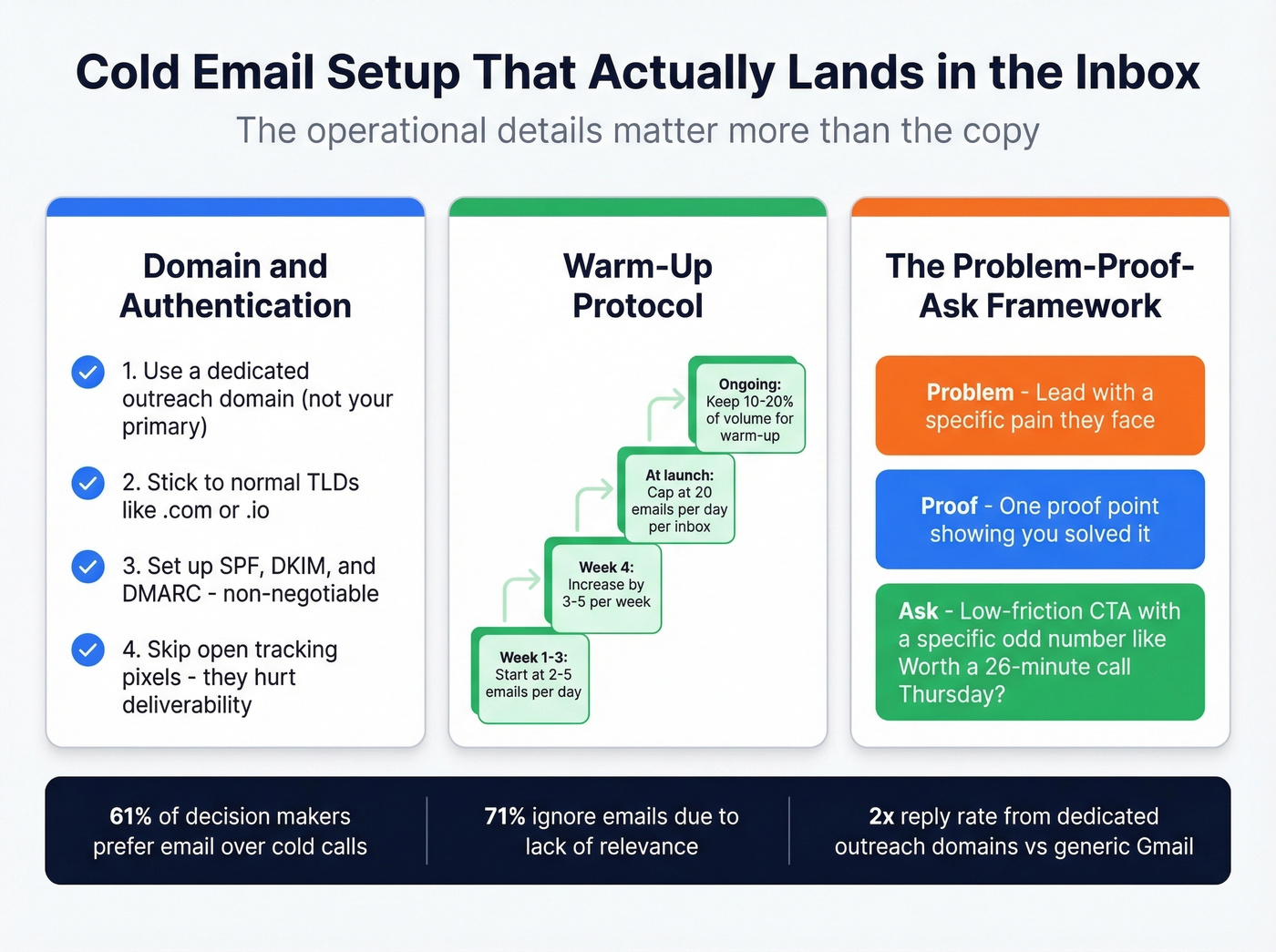
The operational details matter more than the copy. Limit sending to about 20 emails per day per inbox, use no more than 3 inboxes per sending domain, and scale horizontally by adding domains. Warm up each inbox for at least three weeks, starting at 2-5 emails per day and increasing by 3-5 per week. Keep warm-up active after launch - allocate 10-20% of daily volume to engagement maintenance.
Use a dedicated outreach domain, not your primary one. Dedicated outreach domains get roughly 2x the reply rate of generic Gmail addresses. Stick to normal TLDs like .com or .io. Authenticate everything: SPF, DKIM, and DMARC are non-negotiable. Skip open tracking; tracking pixels hurt deliverability and the data isn't worth the risk. (If you need the technical checklist, follow an email deliverability guide.)
Here's a framework that works: Problem, Proof, Ask. Lead with a specific pain the prospect faces, drop one proof point showing you've solved it, and close with a low-friction ask. Example subject line: "Cutting [Company]'s bounce rate in half." The body: two sentences on the problem, one sentence of proof, one specific ask like "Worth a 26-minute call Thursday?" Using a specific odd number in the CTA lifts response rates 10-15% - pattern interrupts work. This kind of outbound sequence consistently outperforms generic templates because it's built around relevance, not volume.
If you want more options, pull from these email subject line examples and adapt them to your ICP.
The consensus on r/sales about tools like Apollo is that the data is "populated by other users" and the platform isn't verifying it independently. Apollo is powerful for sequences, but run every list through external verification before you send.

Referrals & Word-of-Mouth
Client referrals convert leads to MQLs at 56% - the highest of any channel. Yet most teams treat referrals as something that happens organically. Build a formal referral program: ask for introductions after successful outcomes, create incentive structures, and make it easy for happy customers to refer. Don't leave your best-converting channel to chance.
Intent Data & Signal-Based Prospecting
If 95% of buyers are out-of-market at any given time, intent data helps you find the 5% who aren't.
Job changes, funding rounds, headcount growth, technology adoption, and content consumption patterns all signal buying intent. Most competing guides don't even mention this channel, which is surprising given how much it changes outbound efficiency. Instead of blasting 10,000 contacts, you're targeting the 500 showing active signals. Strategic lead generation means focusing resources on accounts that are actually ready to buy. (To operationalize this, use a framework for identifying buying signals.)
Paid Ads
PPC converts visitors to leads at just 0.7%, with a Lead-MQL rate of 36% - the weakest full-funnel performance of the major channels. Only about 6% of keywords actually convert. Paid works for short-term demand capture and retargeting, but it's the most expensive channel per qualified lead. Use it to supplement organic, not as your foundation.
ABM / Account-Based Plays
Account-based marketing flips the funnel: instead of generating leads and qualifying them, you pick accounts first and multi-thread into their buying committees. Map 3-5 decision-makers per target account and coordinate outreach across email, ads, and direct mail. Combine ABM with intent data for timing - reaching the right account at the wrong time is almost as wasteful as reaching the wrong account entirely.
If you're building this motion, follow account-based selling best practices to avoid the common traps.
Webinars & Events
Webinars convert visitors to leads at just 0.9%, but their Opp-Close rate is 40% - the highest of any channel in the SaaS data. The leads are fewer but dramatically better. Executive events convert leads to MQLs at 54%. If your sales cycle is long and your deal size justifies the effort, events punch above their weight.
Social Selling
Skip this if your buyers don't spend time on social platforms or your average deal size is under $5K - the ROI on social selling scales with contract value. For everyone else: build presence where your buyers research. Share insights, not pitches. Comment on industry discussions. The goal isn't to generate leads directly - it's to warm up cold outreach by being visible before you reach out. A cold email from someone the prospect recognizes gets opened at a fundamentally different rate.
Community Building
This is the long play, and it's not for everyone. Create the space where your ICP gathers - a Slack community, a newsletter, a regular meetup. Communities convert slowly, but they build the brand preference that puts you on the Day One shortlist. Remember: 92% of buyers start with a vendor in mind. Communities are how you become that vendor.
One Prospeo customer, Founder Led Sales, grew their community from 47 to 1,000 members in six months and landed five paid sponsors at $3,500/month - proof that community compounds into revenue, not just goodwill.
Video & YouTube
Underused in B2B and underrated. Short-form video is one of the highest-ROI content formats, yet most B2B teams still don't publish consistently on YouTube. The production bar is lower than most teams think - repurpose webinar recordings, create product walkthroughs, and publish thought leadership clips. Educational video content builds trust at scale and compounds like SEO.
Free Tools & PLG
Product-led growth lets the product qualify leads for you. Freemium-to-paid conversion averages about 3.4%, while free trial-to-paid runs 18-29% depending on category. The leads that convert from product usage are among the highest quality you'll get - they've already experienced the value.
Here's the thing: if your average contract value is below $10K, PLG should be your primary channel, not outbound. The math on outbound at low ACVs rarely works once you factor in rep time, tooling costs, and data spend.
If you're building top-of-funnel with utilities, start with these free lead generation tools.
Partnerships & Co-Marketing
Shared audiences mean shared CPL. Joint webinars, co-authored content, and integration partnerships let you reach your ICP through a trusted intermediary. The key is finding partners with overlapping audiences but non-competing products. One tactic we've seen work well: co-host a webinar with a partner, gate the recording, and split the leads by ICP fit. Both sides get qualified contacts at half the cost.
Build Your Lead Gen Tool Stack
Your stack needs five layers, and most teams overcomplicate at least three of them.
| Layer | Tool | Starting Price | Best For |
|---|---|---|---|
| Data + Verification | Apollo | Free / paid from ~$49/mo | Sequences + automation |
| Data + Verification | ZoomInfo | $15-40K/year | Enterprise teams |
| Intent | Bombora | $25-40K/year | Standalone intent data |
| Enrichment | Clay | ~$149/mo | Workflow orchestration |
| Outreach | Instantly | ~$30/mo | Cold email at scale |
| Outreach | Smartlead | ~$39/mo | Multi-inbox rotation |
| Outreach | Lemlist | ~$59/mo | Multi-channel sequences |
| CRM | HubSpot | Free / paid from ~$20/mo/seat | SMB and mid-market |
| CRM | Salesforce | ~$25/user/mo entry | Enterprise |
| Integration | Zapier | Free / $19.99/mo | Connecting everything |

Apollo is powerful for sequences and has a generous free tier, but its contact data is user-populated - accuracy varies and you should verify externally before sending. ZoomInfo is the enterprise default at $15-40K per year, but most teams under 50 reps are paying for modules they'll never activate.
If you're comparing providers, start with the best B2B company data sources for your segment.
For enrichment and orchestration, Clay has become the favorite on r/sales for building multi-step workflows that pull data from multiple sources. Outreach tools like Instantly, Smartlead, and Lemlist handle the sending setup - pick based on your volume needs and whether you need multi-channel or email-only.
If you're evaluating vendors, use this shortlist of data enrichment services to sanity-check pricing and coverage.
For CRM, HubSpot's free tier is genuinely good for teams under 10 reps. Salesforce makes sense when you need custom objects, complex reporting, or enterprise-grade permissions.
Why Your Lead Generation Strategy Isn't Working
If you've built a plan and it's underperforming, the problem is almost always one of these five system failures. We've seen each of them tank otherwise solid programs.
Misaligned handoffs. Marketing and sales don't share a definition of "qualified." MQLs get tossed over the wall with no context, sales ignores them, and both teams blame each other. The fix is a shared MQL/SQL definition with specific scoring criteria and an SLA for follow-up timing. (If you need copy you can deploy fast, use these handoff email templates.)
Low-quality placements. Your ads get great CTR but the leads never convert downstream. This happens when you optimize for volume metrics instead of pipeline metrics. Measure every channel through to SQL and opportunity, not just to lead capture.
Fragmented data. Your CRM says one thing, your automation platform says another, and your intent tool lives in a separate tab nobody checks. Snyk cut bounce rates from 35-40% to under 5% and saw AE-sourced pipeline increase 180% after switching to weekly-refreshed verified data. The tool matters less than the principle: verify everything before it enters your pipeline.
Slow activation. Manual lead routing means competitors engage first. Every hour between form fill and sales follow-up drops conversion rates. Automate routing rules in your CRM and set alerts for high-intent signals.
No real nurture. Generic drip sequences don't count. If 50% of qualified leads aren't ready at first contact, you need intent-based follow-up that adapts to behavior - not a seven-email sequence that sends regardless of engagement. Even the best tactics fall apart without a nurture layer that responds to what prospects actually do.
FAQ
What makes a lead generation strategy effective?
It combines channel selection, ICP targeting, outreach workflows, and full-funnel measurement into a repeatable system. The best ones balance demand capture (the 5% in-market) with demand generation (the 95% who aren't buying yet), using benchmarks like the 41% SEO lead-MQL rate to allocate budget.
How much does B2B lead generation cost?
B2B SaaS averages $237 per lead blended - $310 paid, $164 organic. Financial services runs $653 blended. Organic channels cost 40-50% less than paid across every industry tracked. Shift budget toward organic-heavy mixes to lower blended CPL over time.
What's the highest-converting lead gen channel?
Client referrals convert at 56% lead-MQL - the highest of any source. SEO follows at 41%, then email marketing at 38%. The strongest programs layer all three rather than relying on a single channel, using cold email for volume control and referrals for quality.
What tools do I need to start generating leads?
Start with five layers: data sourcing and verification (Prospeo's free tier gives you 75 verified emails/month plus 100 extension credits), outreach sequencing (Instantly or Smartlead from ~$30/mo), CRM (HubSpot free), enrichment (Clay), and analytics. Data quality is the foundation - every other layer depends on it.
Building an ICP is step one. Reaching the right buyers is step two. Prospeo gives you 30+ filters - buyer intent, technographics, job changes, headcount growth - across 300M+ profiles so your lead gen strategy targets the 5% who are actually in-market.
Stop sending cold emails to people who will never buy.