

The Practitioner's Guide to Lead Nurturing Marketing Automation
You spent three weeks building a 12-step nurture sequence. Open rates: 8%. Bounce rate: 22%. The workflow isn't broken - your data is. That's the dirty secret behind most failed nurture programs, and it's why 79% of marketing leads never convert into sales.
Every lead nurturing marketing automation guide gives you the same advice: segment your list, personalize your content, map to the buyer journey. That advice is correct. It's also useless if a third of your list is dead emails. The real problem isn't strategy - it's plumbing. The global marketing automation market is projected to grow from $7.4B to $16.2B by 2034, and most of that spend will be wasted on workflows running against dirty data.
What You Need (Quick Version)
Before we get into frameworks and templates, here's the minimum viable stack:
- A CRM with built-in automation - HubSpot or ActiveCampaign handles this for most teams without tool sprawl.
- A lead scoring model with real thresholds - not a vanity leaderboard. Template below.
- Verified contact data - because nurturing dead emails burns budget and sender reputation.
Three tools. Everything else is optimization.
What Is Automated Lead Nurturing?
Lead nurturing marketing automation uses behavioral triggers - not just timers - to move prospects through your funnel with the right content at the right moment. It's not the same as a drip campaign, which fires emails on a fixed schedule regardless of what the prospect does.
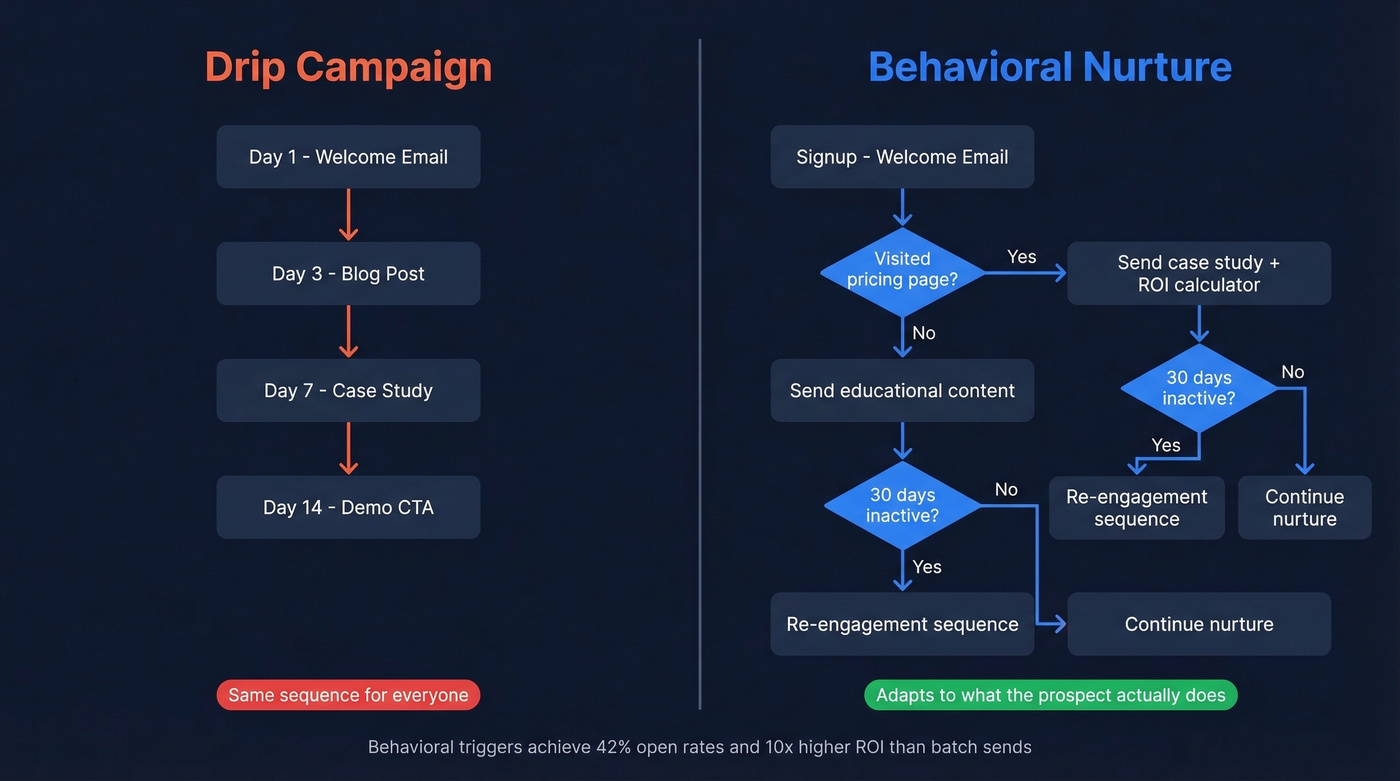
The distinction matters. A drip campaign sends Email 3 on Day 7 whether the prospect visited your pricing page or quietly unsubscribed from your newsletter. Behavioral nurturing adapts: a pricing page visit triggers a case study email, while inactivity triggers a re-engagement sequence. B2B buyers now engage across 10 channels before purchase, up from 5 in 2016. Your nurture program needs to meet them there.
Why Nurture Automation Works
Companies that excel at nurturing generate 50% more sales-ready leads at 33% lower cost. Nurtured leads make 47% larger purchases and produce a 20% increase in sales opportunities versus non-nurtured leads. Behavioral triggers alone achieve 42% open rates and 10x higher ROI than batch-and-blast sends, while stage-targeted content drives 72% higher conversion rates compared to generic messaging.
None of those numbers mean anything if your list is full of invalid addresses. A 42% open rate on a clean list of 5,000 beats a 12% open rate on a dirty list of 20,000 - in pipeline generated, in sender reputation preserved, and in time your team doesn't waste chasing ghosts.
How to Build a Nurture Program That Converts
Lead Scoring Template
Here's the thing: lead scoring without negative scoring is a vanity leaderboard. Every competitor who downloads your whitepaper gets +10 points, and suddenly your "MQL" list is 40% noise. We've seen this kill pipeline at companies that should know better. Here's a scoring model you can copy into HubSpot or ActiveCampaign today:
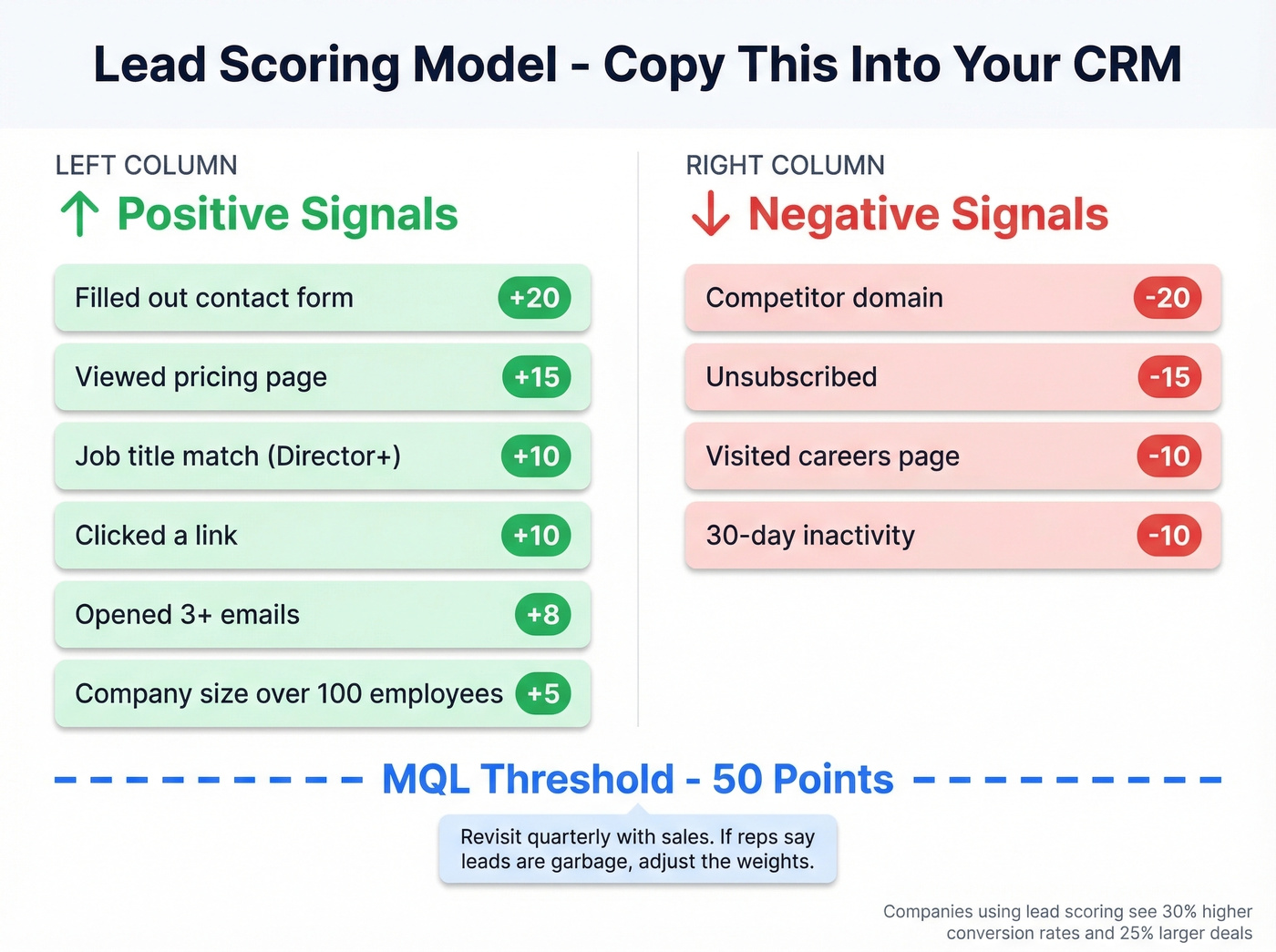
| Action / Attribute | Points |
|---|---|
| Job title match (Director+) | +10 |
| Company size >100 employees | +5 |
| Opened 3+ emails | +8 |
| Clicked a link | +10 |
| Viewed pricing page | +15 |
| Filled out contact form | +20 |
| Unsubscribed | -15 |
| Visited careers page | -10 |
| Competitor domain | -20 |
| 30-day inactivity | -10 |
Set your MQL threshold at 50 points. Revisit it quarterly with sales - if reps say the leads are garbage, lower the threshold or adjust the weights. Companies using lead scoring report up to 30% higher conversion rates and 25% larger deal sizes. To score accurately, you need complete firmographic data - job title, company size, tech stack, funding - not just an email address and a first name. (If you need a tighter definition of fit, use an ideal customer profile rubric alongside scoring.)
Nurture Sequence Cadences
Welcome series: 3-7 emails over 7-14 days. The first email fires within 5-10 minutes of signup - not the next morning, not "when the batch runs." Speed matters here.
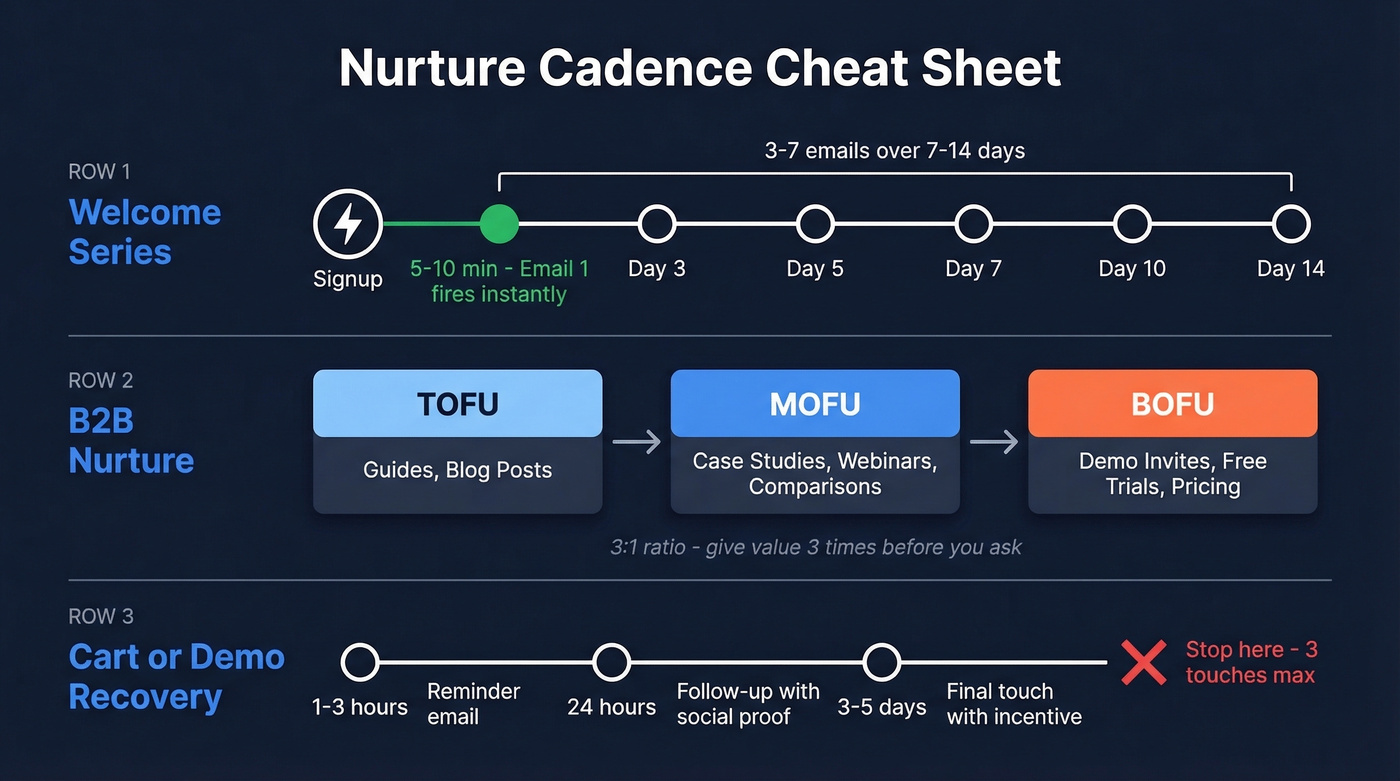
B2B nurture: Map content to funnel stage. TOFU gets guides and blog posts. MOFU gets case studies, webinars, and comparisons. BOFU gets demo invites, free trials, and pricing. Follow the 3:1 give-to-get ratio - deliver value three times before you ask for anything. Use progressive profiling at each conversion point: ask for 1-2 new data points per form fill instead of gating everything behind a 10-field form. You'll get higher conversion rates and richer data over time.
Cart/demo recovery: Email 1 at 1-3 hours. Email 2 at 24 hours. Email 3 at 3-5 days with an incentive. Three touches. Don't push past that without a compelling reason.
Goal-Setting Before You Build
Vague goals produce vague results. Before you configure a single workflow, set concrete before/after targets:
- Reduce sales cycle from 90 to 60 days
- Increase demo requests from 50 to 100/month
- Improve nurture email open rate from 15% to 25%
Use these optimization thresholds as guardrails: 35% open rate means your segmentation and content are strong. Below 20% means something's fundamentally off - check your data quality, subject lines, and send timing before tweaking the content itself. (If you're diagnosing deliverability, start with an email deliverability audit.)

Your lead scoring model is useless if half your list is dead emails. Prospeo's 5-step verification delivers 98% email accuracy on a 7-day refresh cycle - so every nurture workflow runs against contacts that actually exist. Snyk cut bounce rates from 35% to under 5% and grew pipeline 180%.
Fix the data under your workflows. Everything else follows.
The Data Problem Nobody Talks About
Every nurture guide focuses on workflows, content, and timing. Almost none address the foundation those workflows run on: your contact data.
We audited a client's 15,000-contact nurture list last quarter and found 4,200 invalid emails - addresses that had been accumulating bounce signals for months. Their automation platform dutifully sent every sequence, every trigger, every follow-up to addresses that would never open anything. They blamed the content. They rewrote subject lines. They adjusted send times. Nothing moved. The workflow was never the problem - the data was rotten from day one.
Snyk's team lived this exact scenario: bounce rates sat at 35-40% across their 50-person AE team. After switching to verified contact data from Prospeo, bounce rates dropped below 5%, and AE-sourced pipeline jumped 180%. The workflow didn't change. The data underneath it did. Prospeo's 5-step verification process - including catch-all handling, spam-trap removal, and honeypot filtering - runs on a 7-day refresh cycle, compared to the 6-week industry average. That freshness gap is why nurture sequences built on verified data consistently maintain deliverability above 95%. (If you're seeing persistent bounces, benchmark against a proper email bounce rate breakdown.)

Your automation platform handles the workflows. Verified data makes those workflows actually deliver.
Nurture sequences need more than an email and a first name. Prospeo enriches every contact with 50+ data points - job title, company size, tech stack, funding - so your lead scoring actually works and your segmentation hits the right people. 92% match rate, $0.01 per email, no contracts.
Score leads accurately when you have the full picture.
Mistakes That Kill Pipeline
1. Missing the golden window. Leads contacted within 5 minutes are 100x more likely to qualify. If your first nurture email fires "within 24 hours," you've already lost the moment. Configure instant triggers - not batch sends.
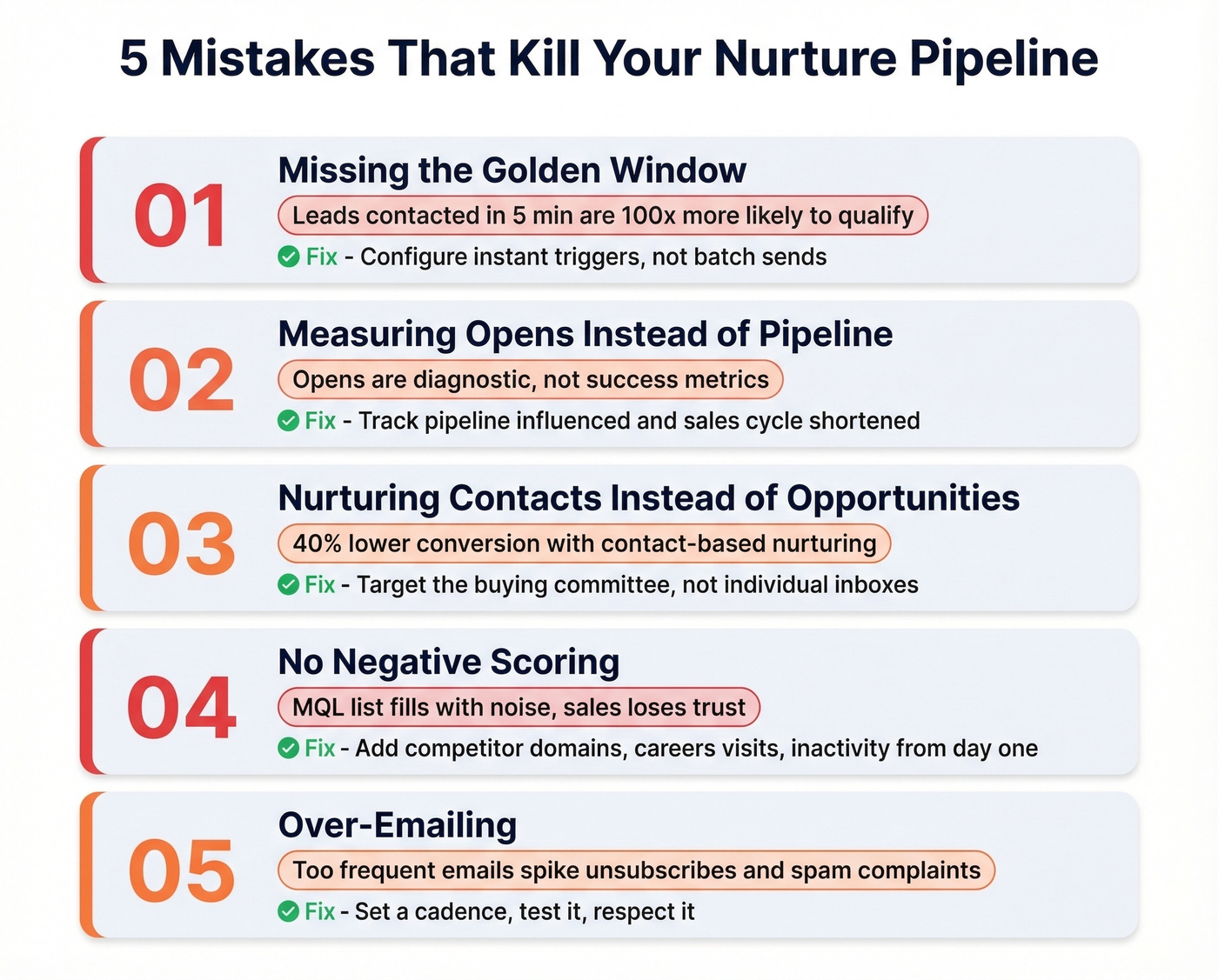
2. Measuring opens instead of pipeline. Open rates are a diagnostic metric, not a success metric. Track pipeline influenced, dormant accounts reactivated, and sales cycle shortened. If your nurture program doesn't move revenue numbers, it's a newsletter with extra steps. (For a cleaner measurement model, align on funnel metrics with sales.)
3. Nurturing contacts instead of opportunities. This one kills enterprise deals. 68% of qualified opportunities stall because teams nurture individual contacts instead of the buying committee. Contact-based nurturing yields 40% lower conversion rates and 30% longer sales cycles than opportunity-focused engagement. The consensus on r/Emailmarketing is that effective nurturing targets buying committees, not individual inboxes. If you're selling to accounts with 6-10 stakeholders, single-threaded nurture is a liability. (This is where account-based selling principles help.)
4. No negative scoring. Without negative signals - careers page visits, competitor domains, 30-day inactivity - your MQL list fills with noise. Sales loses trust. The feedback loop breaks. Add negative scoring from day one.
5. Over-emailing. Emailing every other day risks unsubscribes and spam complaints. Set an acceptable cadence, test it, and respect it.
Best Automation Tools for Nurturing
When evaluating tools, weigh five factors: cost relative to your list size, feature depth for your use case, native integrations with your existing stack, ease of setup, and vendor support quality.
| Tool | Category | Best For | Starting Price | Key Strength |
|---|---|---|---|---|
| HubSpot | Automation | Mid-market teams | From $15/user/mo | All-in-one CRM + automation |
| Prospeo | Data quality | Any nurture team | Free tier; ~$0.01/email | 98% email accuracy, 7-day refresh |
| ActiveCampaign | Automation | SMBs / lean teams | ~$15/mo | Best-value full automation |
| Salesforce | Enterprise CRM | Large orgs | From $25/user/mo | Multi-BU orchestration |
| Marketo (Adobe) | Enterprise automation | Enterprise marketing | ~$1,000+/mo | Advanced scoring + ABM |
| Zoho | Budget automation | Budget teams | ~$14/mo | Affordable workflow builder |
| Keap | CRM + automation | Small biz | ~$249/mo | Single-login CRM + automation |
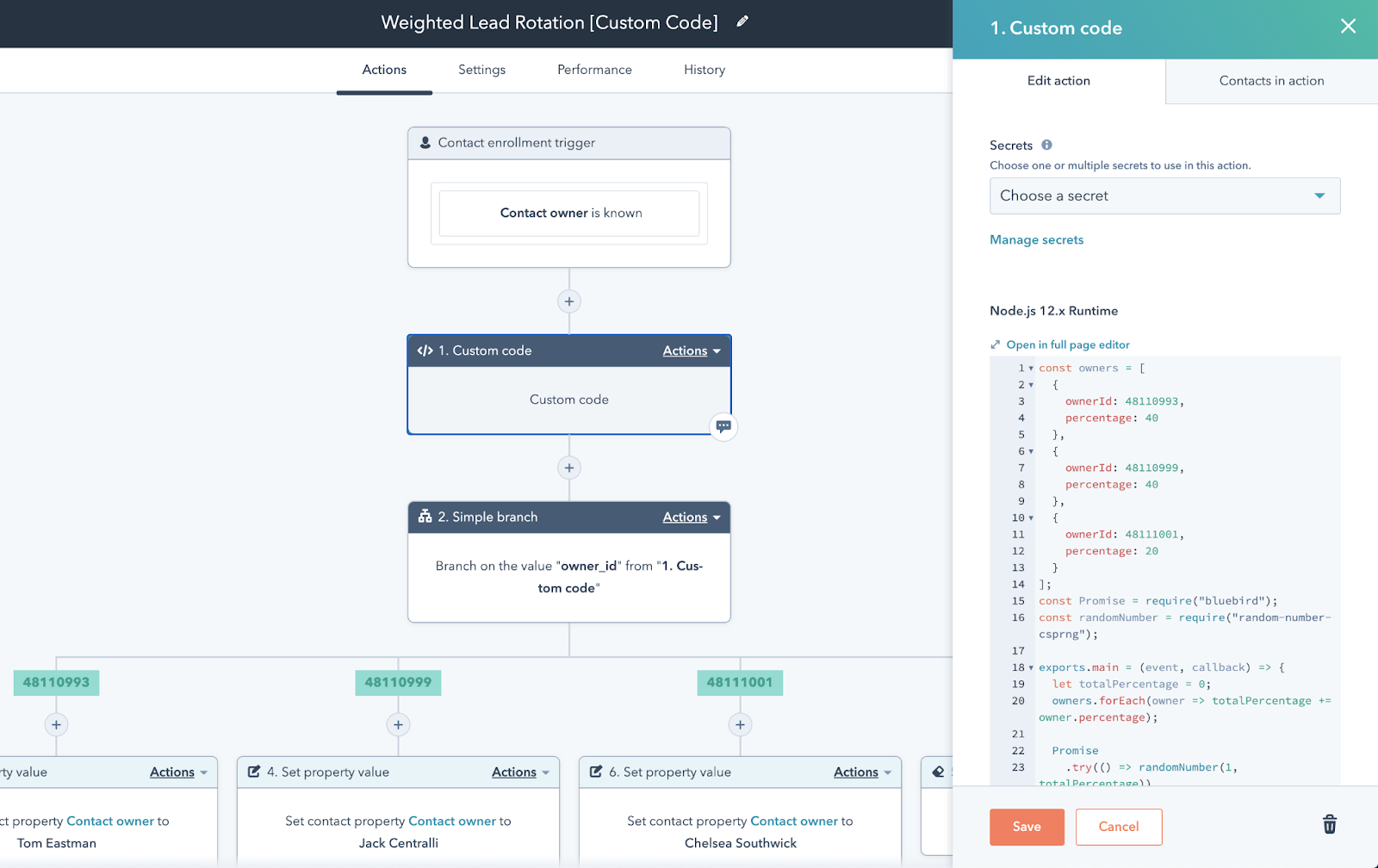
HubSpot is the default for mid-market teams, and for good reason. The CRM, automation, and reporting live in one place, which eliminates the integration headaches that plague multi-tool stacks. Starter from $15/user/month gets you in the door; Professional from $90/user/month unlocks the workflow builder most teams actually need. The consensus on r/MarketingAutomation is that HubSpot + Zapier covers 80% of use cases without the complexity of enterprise platforms.
Prospeo sits in a different category - it's the data layer that makes every other tool on this list perform better. With 300M+ professional profiles, 143M+ verified emails, and a proprietary email-finding infrastructure that doesn't rely on third-party providers, it solves the data quality problem that silently kills most nurture programs. Native integrations with HubSpot, Salesforce, Smartlead, Instantly, and Lemlist mean enriched contacts flow directly into your automation workflows. (If you're comparing vendors, start with data enrichment services.)
ActiveCampaign delivers more than its price suggests. At ~$15/mo, you get behavioral automation, lead scoring, and email sequences that rival platforms costing 5x more. If you don't need a full CRM and just want the automation engine, it's the best value in the category.
Let's be honest about enterprise tools: if your average deal size is under $15k, you almost certainly don't need Salesforce Marketing Cloud or Marketo. HubSpot Professional or ActiveCampaign will do everything you need at a fraction of the cost and complexity. The enterprise platforms earn their price tag only when you're orchestrating nurture across multiple business units with distinct scoring models and handoff rules. Skip them if that doesn't describe your org.
Zoho's workflow builder handles basic nurture sequences at a fraction of HubSpot's cost - a solid starting point for teams with simple funnels. Keap bundles CRM and automation for teams that want one login, not three, though the ~$249/mo entry point is steep for what you get.
AI vs Manual Nurturing
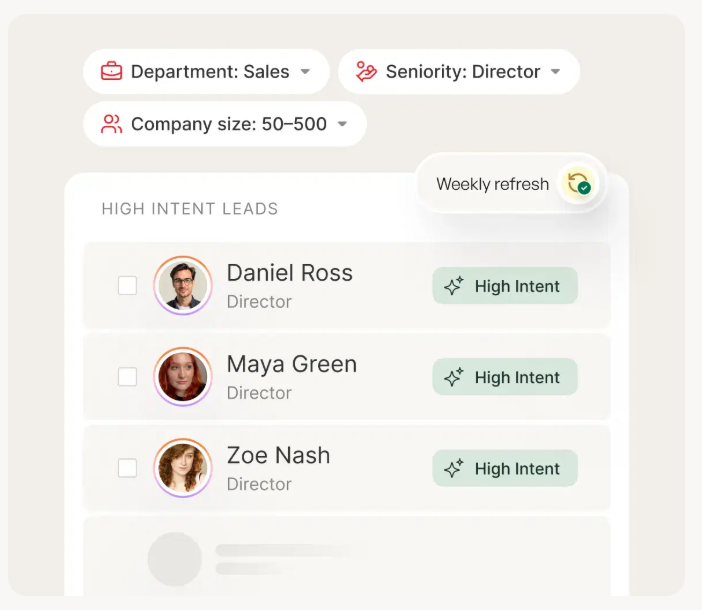
AI isn't a buzzword in nurture automation anymore - it's the execution layer. AI hyper-personalized campaigns achieve 15-25% reply rates versus 1-5% for standard outbound. Intent-based routing within 5 minutes raises qualification likelihood 21x.
The bigger shift is behavioral. Buyers now complete up to 69% of their journey anonymously before talking to sales. By the time they fill out a form, they've already made half the decision. AI-driven enrichment - now used by 75% of businesses - fills the gap by identifying intent signals before the hand-raise, driving a 30% revenue increase for teams that deploy it well. Teams that combine intent data with behavioral scoring see the highest lift: leads scoring high on both signals convert at rates that make the old whitepaper-to-call model look slow. (To operationalize this, build an intent based segmentation layer.)
Manual nurturing still has a role for high-value accounts where a personal touch matters, but for everything else, automated nurturing outperforms hand-crafted sequences in speed, consistency, and scale.
Measuring What Matters
Track these: pipeline influenced (revenue touched by nurture), dormant accounts reactivated, sales cycle shortened in days, and revenue attributed to nurture sequences.
Ignore these as primary KPIs: open rates (diagnostic only), list size (vanity), and email volume sent (activity doesn't equal impact).
Well-segmented nurture emails hit 36-42% open rates. CTR for nurture emails averages ~8%. If you're below a 20% open rate, don't optimize subject lines - audit your data quality and segmentation first. The industry average open rate sits at 23.44%, so anything above 35% means your targeting is working. (If you do need to iterate on copy, pull from proven email subject line examples.)
FAQ
What's the difference between nurture automation and drip campaigns?
Drip campaigns send on a fixed schedule regardless of behavior. Nurture automation is behavior-driven - triggers fire based on downloads, page visits, and scoring thresholds, adapting the path in real time. Nurturing reacts; drips just send.
How many emails should a nurture sequence have?
Welcome series: 3-7 emails over 7-14 days. B2B nurture: 5-12 touches over 30-90 days depending on sales cycle length. Cart recovery: 3 emails over 5 days. Match cadence to deal complexity - longer cycles need more touches spaced further apart.
What's a good open rate for nurture emails?
Industry average is 23.44%. Well-segmented nurture emails hit 36-42%. Below 20% signals a data quality or segmentation problem - bounces and stale addresses drag averages down and damage sender reputation.
Do I need a separate tool for lead scoring?
No. HubSpot, ActiveCampaign, and Marketo all include native lead scoring. The bigger gap is usually data quality - scoring models are only as accurate as the firmographic and behavioral data feeding them. Pair your automation platform with a verified data source for complete contact records.