

The B2B Marketing Funnel With Actual Numbers
Your CMO just asked for a funnel report. You pull up the dashboard, stare at TOFU/MOFU/BOFU labels that haven't changed since 2019, and realize you can't explain where deals are dying. Your B2B marketing funnel looks clean on a slide. In practice, it's a mess of dark social, committee politics, and buyers who've already made up their minds before they fill out your demo form.
This isn't another TOFU/MOFU/BOFU rehash. We're covering what B2B teams actually deal with in 2026 - real conversion benchmarks, funnel math you can steal, and the mistakes quietly killing your pipeline.
The linear funnel is a useful mental model but a terrible operating system. About 70% of the buyer journey is invisible to you, and only 3-5% of your TAM is in-market right now. Your job isn't to "nurture" people through stages they don't follow. It's to be on the Day One shortlist. The benchmarks, math, and channel framework below will help you build a funnel that actually converts.
What Is a B2B Marketing Funnel?
A B2B marketing funnel maps how companies move from first hearing about you to signing a contract. Awareness at the top, consideration in the middle, decision at the bottom. You know the shape.
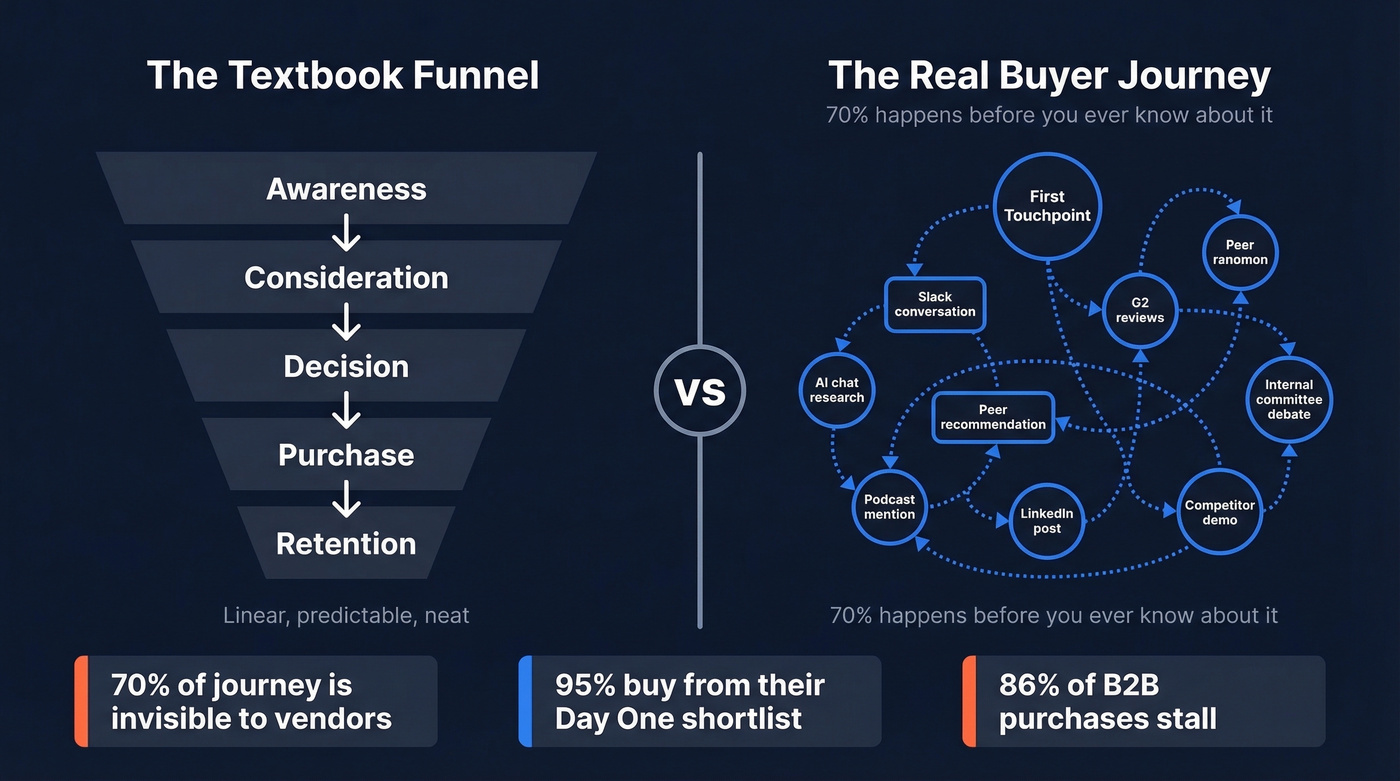
Here's why the textbook version is incomplete: it assumes a linear path. Real B2B buying doesn't work that way. Buyers loop back, skip stages, and do most of their research in channels you can't track.
Roughly 70% of the B2B buyer journey happens before a buyer ever contacts a vendor. In 95% of cases, buyers purchase from one of the four vendors on their Day One shortlist - a shortlist that gets formed in Slack channels, peer conversations, and AI chat sessions, not in your nurture sequence.
The buying committee makes it worse. The average B2B purchase involves about 13 people, and 74% of those teams experience what Gartner calls "unhealthy conflict" during the process. Buyers spend only ~17% of their total buying time with potential suppliers. If they're evaluating three vendors, you're getting about 5-6% of their calendar. And 61% of B2B buyers now prefer to buy without talking to a sales rep at all.
The kicker: 86% of B2B purchases stall. Not because the funnel broke, but because the committee couldn't reach consensus. Your funnel model needs to account for that reality.
The Buying Committee You're Selling To
Those 13 people aren't interchangeable. They play distinct roles, and your funnel content needs to address each one:
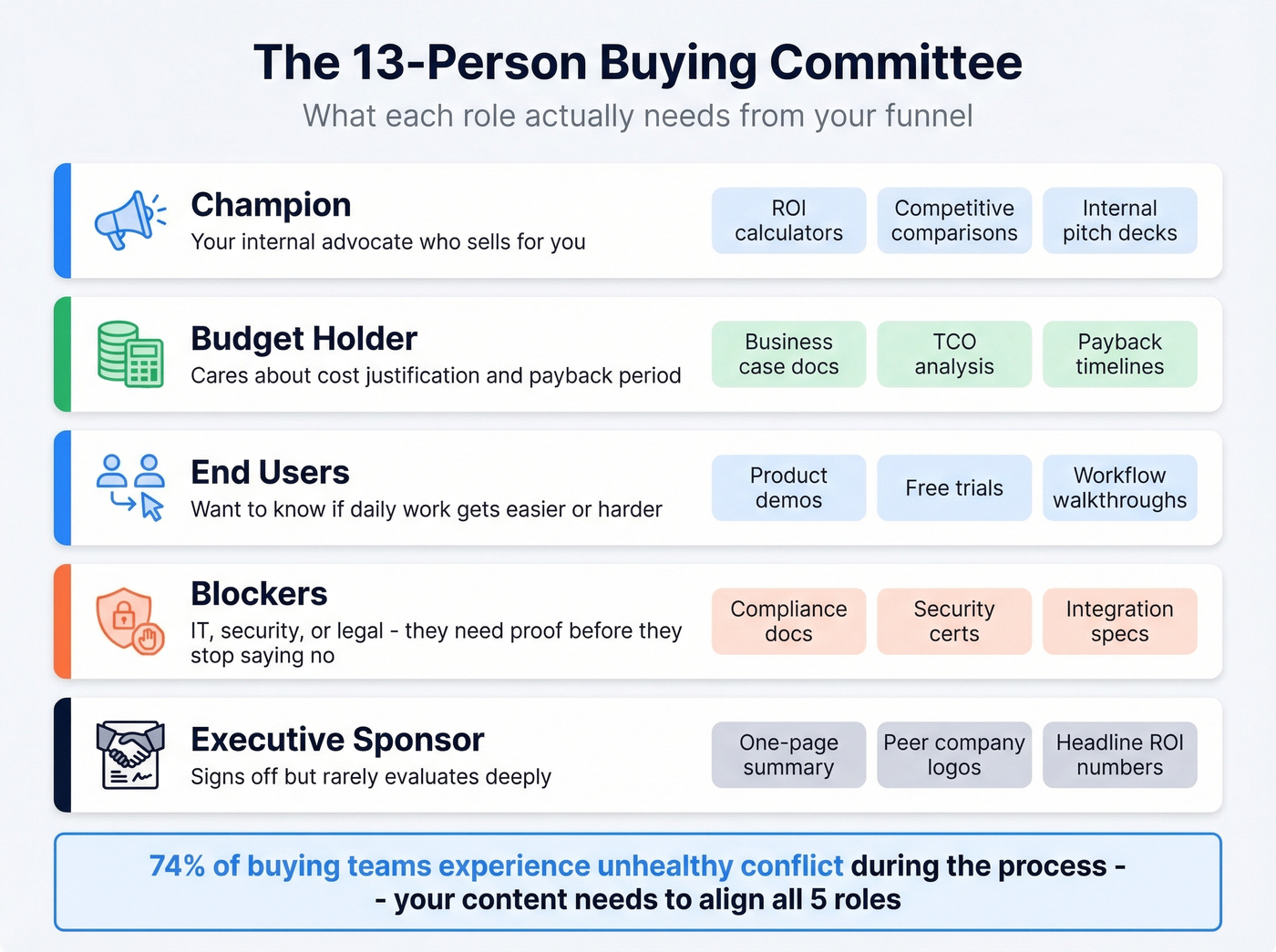
- Champion - your internal advocate. They need ammunition: ROI calculators, competitive comparisons, and internal pitch decks they can forward. (If you want a tighter definition, see internal champion.)
- Budget holder - cares about cost justification and payback period. Send them the business case, not the feature tour.
- End users - want to know if the tool will make their daily work easier or harder. Product demos and free trials win here.
- Blockers - often from IT, security, or legal. They need compliance docs, security certifications, and integration specs before they'll stop saying no.
- Executive sponsor - signs off but rarely evaluates deeply. A one-page summary with peer company logos and headline ROI numbers is what moves them.
Every piece of mid-funnel and bottom-funnel content should target at least one of these roles. If your case studies only speak to champions, you're leaving the other 12 people unconvinced - and that's how deals stall.
Funnel Stages With Real Benchmarks
The stages themselves are straightforward: Visitor, Lead, MQL, SQL, Opportunity, Closed Won. What matters is knowing what "good" looks like at each transition, because that's where you diagnose leakage. (For more examples, compare against these sales funnel examples.)
Conversion Benchmarks by Industry
These benchmarks come from First Page Sage's analysis of internal and anonymized client data gathered between 2017-2025. They represent lead-stage onward conversion rates, not visitor-to-lead rates.
| Industry | Lead→MQL | MQL→SQL | SQL→Opp | SQL→Closed |
|---|---|---|---|---|
| B2B SaaS | 39% | 38% | 42% | 37% |
| Cybersecurity | 24% | 40% | 43% | 46% |
| IT & Managed Services | 19% | 38% | 41% | 46% |
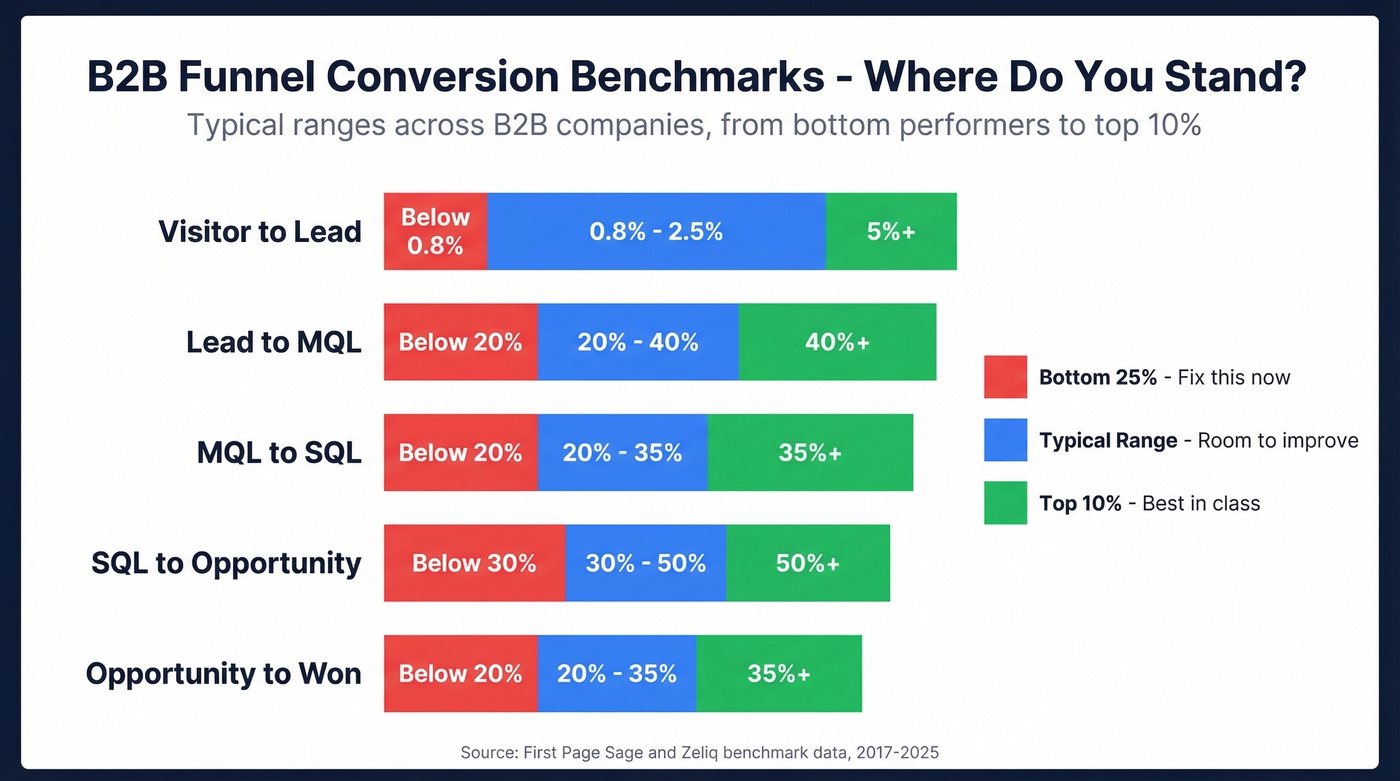
For broader orientation, Zeliq's benchmark ranges give you the bands most B2B companies fall within:
| Stage | Bottom 25% | Typical Range | Top 10% |
|---|---|---|---|
| Visitor→Lead | Below 0.8% | 0.8-2.5% | 5%+ |
| Lead→MQL | Below 20% | 20-40% | 40%+ |
| MQL→SQL | Below 20% | 20-35% | 35%+ |
| SQL→Opp | Below 30% | 30-50% | 50%+ |
| Opp→Won | Below 20% | 20-35% | 35%+ |
Channel matters at the top. Google Ads typically converts visitors to leads at 3-5%, while LinkedIn campaigns run 1.8-3.2%. If you're below those floors, the problem is targeting or landing page quality, not the funnel structure. (More context: what's a good conversion rate.)
How Long Each Stage Takes
Time-to-convert is where enterprise and SMB funnels diverge sharply. MQL-to-SQL progression typically takes 8-15 days regardless of deal size - that's mostly about sales follow-up speed. But opportunity-to-close is where the gap opens up. (Related: average sales cycle.)
| Segment | Opp→Close | Full Cycle |
|---|---|---|
| SMB | 30-45 days | 45-75 days |
| Mid-Market | 60-90 days | 90-120 days |
| Enterprise | ~120 days | 150-200+ days |
If your enterprise deals are closing in 45 days, you're either selling something very transactional or your pipeline definitions are off. If SMB deals are dragging past 60 days, something's broken in your qualification or pricing.
How to Build a B2B Funnel That Converts
The Simple Channel Framework
A useful piece of advice on r/Entrepreneur comes from a practitioner who reported building $40M+ in pipeline using this exact framework. It's dead simple: pick one channel per category and go deep.
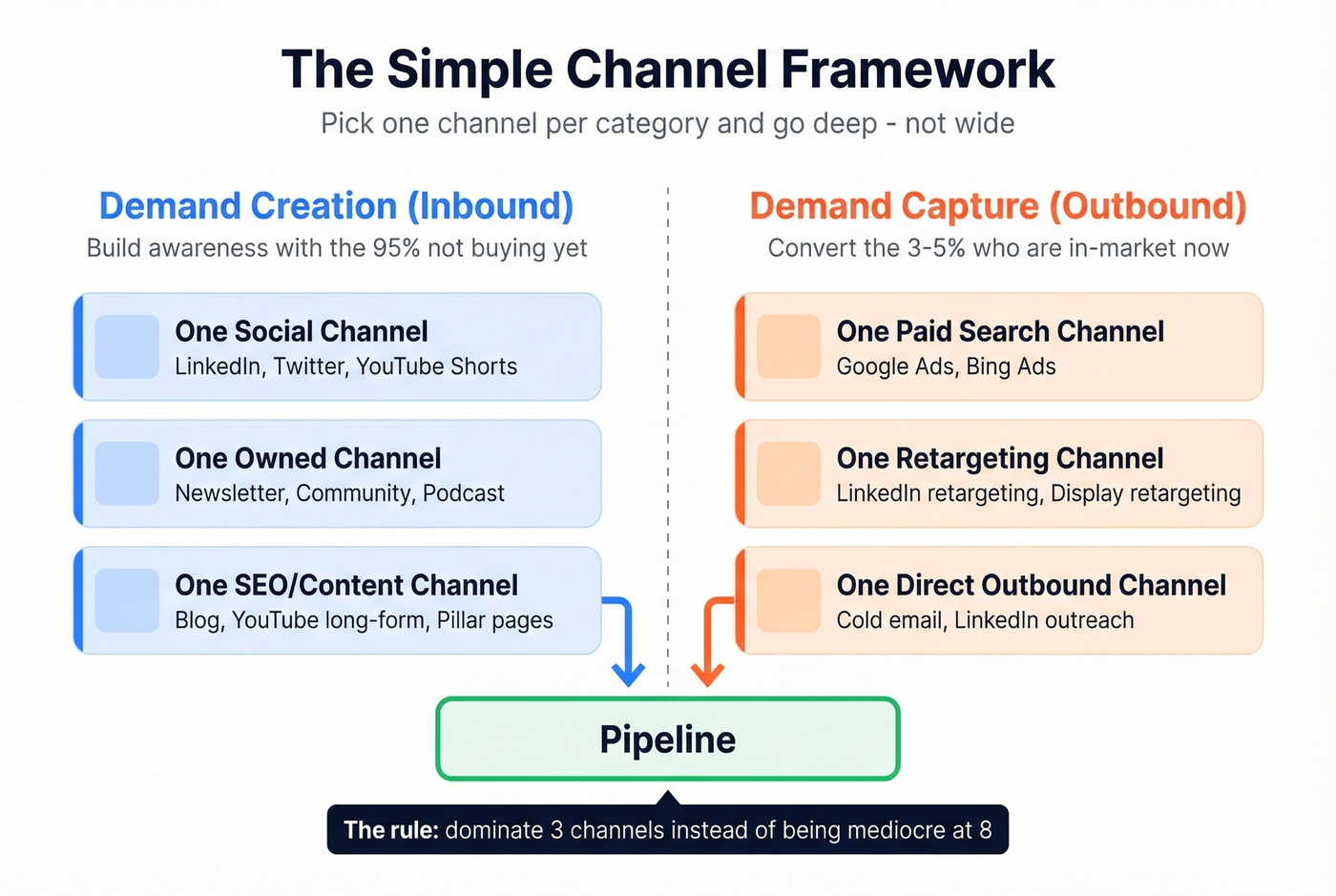
Inbound side: one social channel, one owned channel like a newsletter, and one SEO/content channel such as a blog or YouTube. That's your demand creation engine. (If you want to go deeper on TOFU strategy, see top of funnel.)
Outbound side: one paid search channel, one retargeting channel, and one direct outbound channel. That's your demand capture engine. (If you're building the outbound motion, start with outbound lead generation tools.)
Most teams fail because they spread thin across eight channels instead of dominating three. A focused system that both generates and captures demand will outperform a scattered one every time.
Content Mapping by Stage
The channel framework tells you where to show up. Content mapping tells you what to say when you get there.
At the top of the funnel, ungated education wins: original research, trend reports, and short-form video that earns attention without asking for anything in return. In the middle, shift to proof and specificity - case studies, product comparisons, and ROI calculators that help your champion build the internal business case. At the bottom, remove friction: live demos, free trials, implementation timelines, and security documentation that satisfies the blockers on the buying committee.
Here's the thing: a gated ebook that generates 500 "leads" who never respond to sales isn't a funnel. It's a vanity metric factory. Front-loading gated content at the top of funnel is one of the most common and most expensive mistakes we see.
Demand Gen vs. Lead Gen
Only 3-5% of your total addressable market is in-market at any given time. That stat, from the B2B Institute and Ehrenberg-Bass research, changes how you should think about budget allocation.
Lead gen captures the 3-5% who are ready to buy now. Demand gen builds awareness and preference with the other 95% so you're on their shortlist when they do enter the market. Most B2B teams over-invest in capture and under-invest in creation. If your marketing budget is 80% lead gen and 20% demand gen, you've got it backwards. (More on this split: digital marketing demand generation.)
Let's be honest: if your average deal size is under $15k, you probably don't need a complex multi-stage funnel at all. A strong brand presence, one killer demo flow, and clean outbound data will outperform a seven-stage nurture sequence with 14 email touches. Skip the complexity unless you have the volume to justify it.
Data Quality: The Silent Funnel Killer
Your funnel is only as good as the data feeding it. We've seen teams build beautiful multi-touch sequences, nail their ICP targeting, and craft perfect messaging - then watch it all collapse because 35% of their outbound emails bounced. (If you're cleaning lists, start with data hygiene vs data quality.)
Bad data doesn't just waste sends. It tanks your domain reputation, which drags down deliverability for every email you send afterward, including the ones going to real prospects. This is especially true as B2B outbound increasingly relies on automated sequences where a single deliverability hit cascades across thousands of touches.

Prospeo addresses this at the data layer with 98% email accuracy across 143M+ verified emails, a 7-day data refresh cycle when the industry average is six weeks, and intent data tracking 15,000 topics so you can spot which accounts are actually in-market. Snyk's team of 50 AEs saw their bounce rate drop from 35-40% to under 5% after switching, with AE-sourced pipeline up 180% and 200+ new opportunities per month.

Your funnel leaks when you target the wrong people. Prospeo's 30+ search filters - including buyer intent, technographics, and headcount growth - let you fill your TOFU with prospects who actually match your ICP. With 300M+ profiles and 98% email accuracy, your MQL→SQL conversion rate stops being a guessing game.
Stop feeding bad data into a good funnel. Fix the top and everything downstream improves.
86% of B2B purchases stall because the buying committee can't reach consensus. You need to reach all 13 decision-makers - champions, budget holders, blockers - with verified contact data. Prospeo gives you direct emails at 98% accuracy and 125M+ verified mobile numbers so you can multi-thread every deal in your pipeline.
Reach the full buying committee, not just the champion who filled out your form.
What to Measure at Each Stage
KPIs by Funnel Stage
Not every metric matters at every stage. Here's a framework adapted from Userpilot's KPI model that maps cleanly to B2B SaaS:

| Stage | Primary KPIs | Secondary KPIs |
|---|---|---|
| Awareness | Ad clicks, blog views, SEO rankings | Share of voice, branded search volume |
| Consideration | Pricing page clicks, case study views, demos requested | Time on site, return visits |
| Conversion | MQL→SQL rate, trial→paid rate | Sales cycle length, win rate |
| Retention | User retention rate, NRR | Support tickets, feature adoption |
The mistake most teams make is measuring awareness metrics like impressions and traffic, then jumping straight to conversion metrics like closed-won, without tracking the middle. If you don't know your pricing page click rate or case study engagement, you're flying blind on consideration-stage health.
The Right Attribution Model
First-touch attribution gives all credit to the blog post that generated the lead. Last-touch gives all credit to the demo that closed the deal. Both are wrong for B2B, where the average deal involves dozens of touchpoints across months.
The right default for most B2B companies is W-shaped attribution: 30% credit to first touch, 30% to the opportunity-creation moment, 30% to the closing touch, and 10% spread across everything else. It captures the three moments that actually matter without pretending the middle doesn't exist. Graduate to algorithmic attribution once you have 12+ months of clean data and enough volume to train a model.
Funnel Math in 60 Seconds
Let's run the numbers with median benchmarks. Start with 10,000 monthly website visitors:
- 10,000 visitors x 2% conversion = 200 leads
- 200 leads x 30% qualification = 60 MQLs
- 60 MQLs x 30% acceptance = 18 SQLs
- 18 SQLs x 40% progression = 7 opportunities
- 7 opportunities x 28% close rate = ~2 closed-won deals
That's a ~0.02% visitor-to-customer rate. Looks brutal, but it's normal for B2B.
The question isn't whether the numbers are small - it's which transition is underperforming relative to benchmarks. In our experience, the MQL-to-SQL transition is where most funnels hemorrhage. If yours is running at 15% when the benchmark is 30%, that's your bottleneck. Fix that one stage and you double your pipeline without touching traffic. (To diagnose stage-by-stage, use this sales funnel optimization playbook.)
The Dark Funnel Problem
Here's where most funnel models fall apart completely. That 70% of the buyer journey happening before vendor contact? It's happening in places you can't track: peer conversations, private Slack communities, podcast mentions, and increasingly, AI chat tools.
60% of B2B buyers now use ChatGPT or Gemini to research vendors and summarize content. Forrester found 89% of B2B buyers adopted generative AI for self-guided information gathering. Your carefully gated whitepaper? A buyer can ask an AI to summarize the key points without ever touching your landing page.
This doesn't mean funnels are useless. It means your job isn't to move buyers through stages - it's to be on the shortlist when they start. That requires consistent brand presence in the channels where dark funnel activity happens, plus intent data to catch signals when buyers do start researching your category.
The 95% Day One shortlist stat is the most important number in this entire article. If you're not on it, your B2B marketing funnel doesn't matter.
One thing you can do today: Add a "how did you hear about us?" free-text field to your demo form. It's imperfect, but it's the cheapest dark funnel signal you'll get - and the answers will surprise you.
Five Funnel Mistakes That Kill Conversion
1. Building around your org chart instead of the buyer journey. Marketing owns TOFU, sales owns BOFU, and nobody owns the messy middle where deals actually die. One agency reported that rebuilding a client's digital journey around the buyer - not the org chart - increased contact form submissions 650% year over year. The funnel should map to how buyers buy, not how your departments are structured.
2. Too many steps. The consensus on r/b2bmarketing is clear: 3-4 steps max. Every additional step is another place for prospects to drop off. If your funnel has seven stages with sub-stages, you've built a bureaucracy, not a pipeline.
3. Ignoring the dark funnel. If you only measure what's visible in your analytics, you're optimizing for about 30% of the buyer journey. Self-reported attribution is imperfect but far more useful than pretending dark social doesn't exist.
4. Volume obsession over quality. "We generated 500 MQLs this month" means nothing if none of them convert. And if your contact data is bad, you're not even reaching real prospects - GreyScout's team saw bounce rates drop from 38% to under 4% and pipeline increase 140% after cleaning up their data source.
5. No shared definitions between marketing and sales. If marketing's MQL is "downloaded an ebook" and sales expects "ready for a demo," you'll have a permanent trust gap. Sit in a room together, agree on definitions, write them down, and revisit quarterly.
B2B vs. B2C Funnels
The biggest practical difference isn't the shape - it's the committee. In B2C, you convert an individual. In B2B, your champion has to sell internally after you sell to them. (More detail: B2B sales vs B2C sales.)
| Dimension | B2B | B2C |
|---|---|---|
| Cycle Length | 30-120+ days | Minutes to days |
| Stakeholders | ~13 avg | 1-2 |
| Decision Driver | ROI, committee consensus | Emotion, price |
| Content Needs | Case studies, ROI calcs, demos | Reviews, social proof, promos |
| Deal Size | $5K-$500K+ | $10-$500 |
This is why B2B content strategy can't just be "write good blog posts." You need internal-facing assets - the one-pager your champion can email to their CFO, the security questionnaire that satisfies the CISO, the implementation timeline that calms the project manager. The sale doesn't end when your champion says yes. It ends when the committee does.
FAQ
What's the difference between a B2B marketing funnel and a sales funnel?
A marketing funnel covers awareness through MQL handoff - everything from first touch to the point where a lead is qualified enough for sales. A sales funnel picks up at SQL and runs through closed-won. In practice, the best B2B teams in 2026 merge them into a single revenue funnel with shared definitions and KPIs, because the handoff gap is where most deals die.
How long is a typical B2B sales cycle?
SMB deals close in 30-45 days, mid-market runs 60-90 days, and enterprise averages ~120 days from opportunity to close. MQL-to-SQL progression typically takes 8-15 days regardless of deal size, meaning the variability is almost entirely in the sales stages, not the marketing qualification phase.
How do I fix high lead volume but low conversion?
Start with definitions - if marketing and sales define "qualified" differently, volume is meaningless. Then check data quality: if 30%+ of outbound emails bounce, your mid-funnel is broken before content even matters. Finally, run the funnel math to find your specific bottleneck. A 5-percentage-point improvement at the right transition can double pipeline output.