

Miller Heiman Conceptual Selling: The Practitioner's Field Guide
You're prepping for a meeting with the VP of Operations tomorrow. You've got a deck, a demo environment, and a vague sense of what they care about. But eight other people are on this deal - and you've only talked to two of them. That gap between what you know and what you need to know is exactly what Miller Heiman Conceptual Selling was built to close.
Buying committees now average 6 to 10 people, and 77% of B2B buyers describe their purchase process as complex. A framework for running stakeholder conversations isn't optional. It's infrastructure.
What Is Conceptual Selling?
Conceptual Selling was developed by Robert B. Miller and Stephen E. Heiman and introduced in the 1980s, then published as a book in 1987 (the paperback edition commonly lists a 1989 publication date). Today, the training is owned by Korn Ferry. The core principle is deceptively simple: sell the buyer's concept of success, not your product.
Every stakeholder in a deal carries a mental picture of what a good outcome looks like. The VP of Ops wants fewer bottlenecks. The CFO wants cost predictability. The IT lead wants zero integration headaches. Conceptual Selling forces you to uncover each person's version of success before you pitch anything - and that reordering of the conversation changes everything about how the deal unfolds.
Strategic Selling vs. Conceptual Selling
These two get conflated constantly. They're complementary, not interchangeable. Strategic Selling helps you design the play; Conceptual Selling helps you execute it.
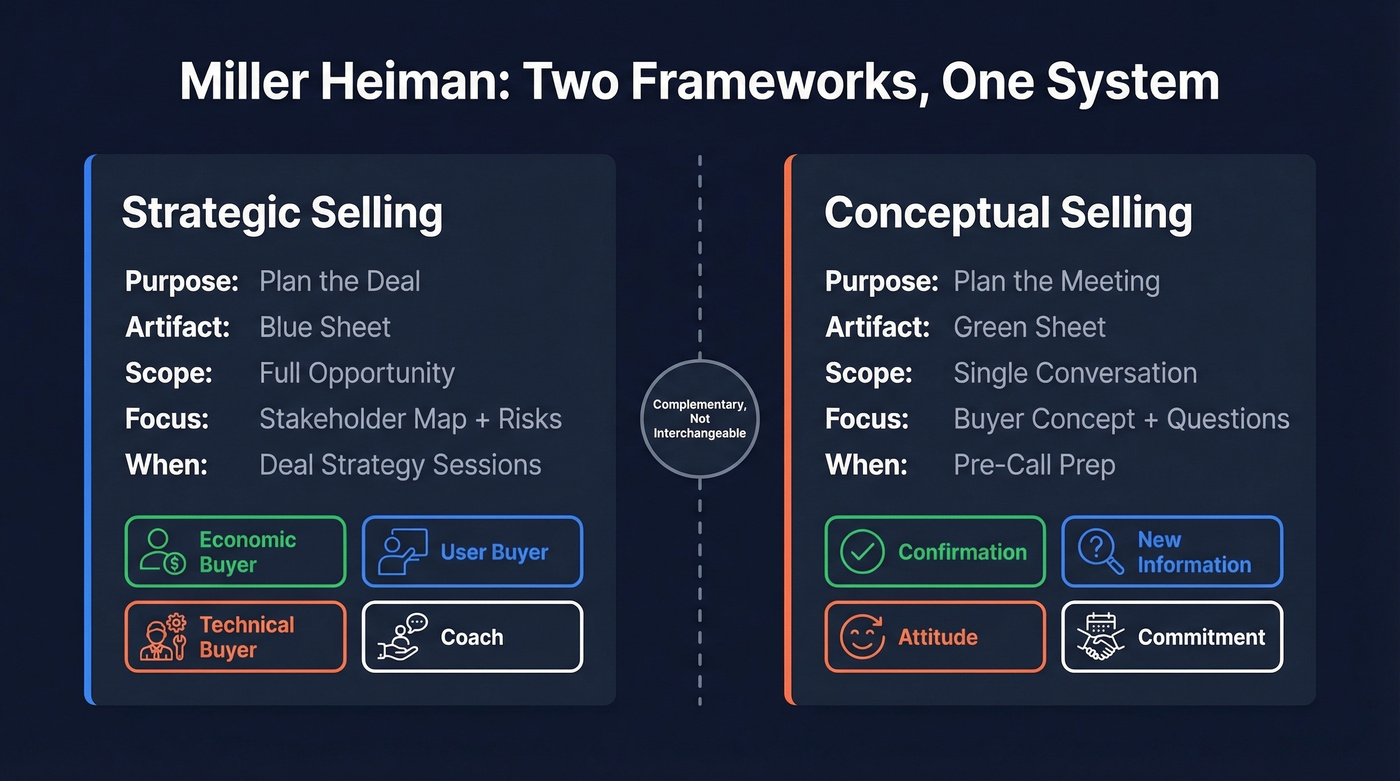
| Strategic Selling | Conceptual Selling | |
|---|---|---|
| Purpose | Plan the deal | Plan the meeting |
| Artifact | Blue Sheet | Green Sheet |
| Scope | Full opportunity | Single conversation |
| Focus | Stakeholder map + risks | Buyer concept + questions |
| When | Deal strategy sessions | Pre-call prep |
The Blue Sheet maps your entire opportunity and defines four buying roles:
- Economic Buyer - holds budget authority and final approval
- User Buyer - the people who'll use your product daily
- Technical Buyer - IT, security, legal; they can't say yes but can absolutely say no
- Coach - your internal champion; you don't assign them, you earn them
The methodology only works if you can actually reach every stakeholder on the Blue Sheet. That's where a tool like Prospeo comes in - 300M+ professional profiles with 98% email accuracy means you can multi-thread into the buying committee instead of hoping your single contact forwards your email.
If you're building a repeatable multi-threading motion, it helps to standardize your sales prospecting techniques and keep clean records in contact management software.
The Green Sheet - Planning Each Meeting
You can buy the books and still not get the actual Green Sheet template. On r/sales, practitioners regularly gripe that the templates are locked behind a ~$2,600, 3-day workshop. Here's a reconstructed version based on the framework's published principles.
Reconstructed Green Sheet Template
1. Buyer's Concept
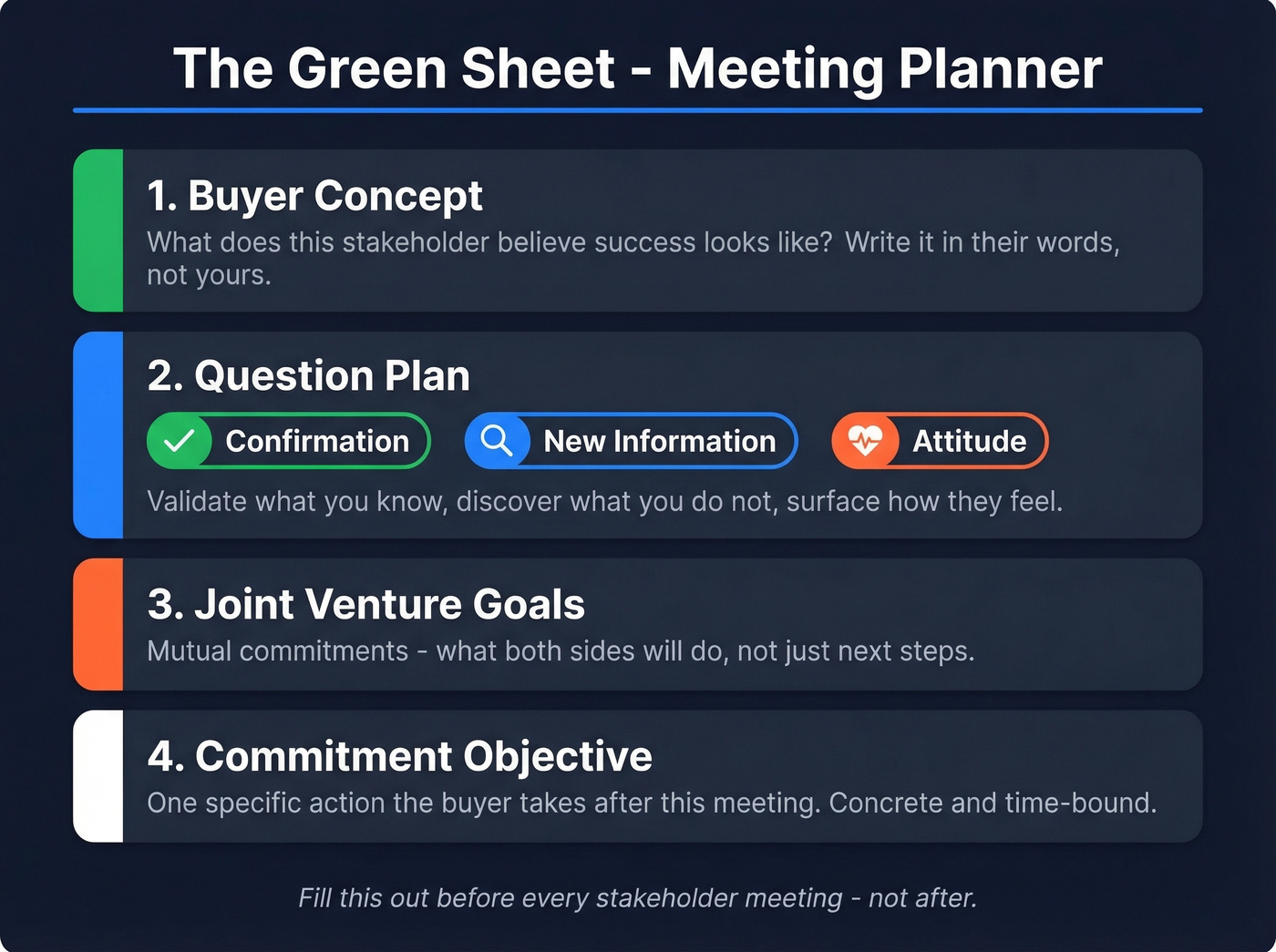
What does this specific stakeholder believe success looks like? Write it in their words, not yours. If you don't know yet, that's your first discovery objective. (If you want a deeper library of prompts, see our guide to discovery questions.)
2. Question Plan (by type)
Confirmation Questions validate what you think you know. They show preparation and build credibility.
- "You mentioned your current vendor's SLA is 99.5% - is that still accurate?"
- "Last time we spoke, the rollout target was Q3. Is that timeline holding?"
New Information Questions are your primary discovery mechanism. They uncover what you don't know.
- "Walk me through what happens after a deal closes - who's involved in implementation?"
- "What does success look like 12 months from now if this project goes perfectly?"
Attitude Questions surface feelings, concerns, and political dynamics that factual questions miss. In our experience, this is where deals are won or lost - they expose the internal politics no one volunteers.
- "How do you feel about the timeline your team proposed?"
- "What's your level of confidence that the budget will get approved?"
3. Joint Venture Goals
What will both sides commit to by the end of this meeting? Not just "next steps" - mutual commitments. You'll provide a technical deep-dive; they'll introduce you to the Economic Buyer.
4. Commitment Objective
The single, specific action you want the buyer to take after this meeting. Not "move the deal forward" - something concrete like "schedule a pilot kickoff with IT by Friday."
The Data Behind the Framework
Conceptual Selling tells you to ask more and talk less. Research across millions of sales calls proves it works.
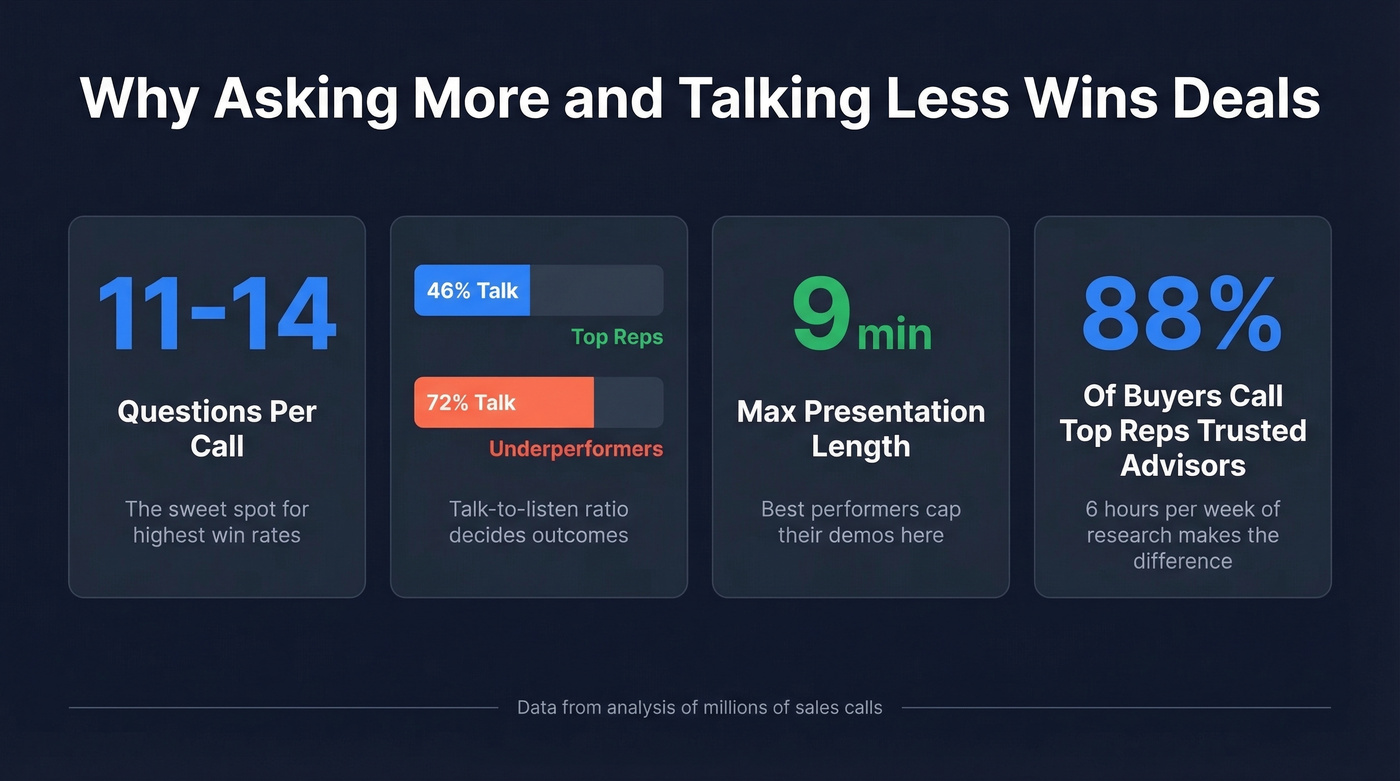
The sweet spot for discovery calls is 11-14 questions - that's the range correlated with the highest win rates. Top-performing reps maintain a 46:54 talk-to-listen ratio, meaning they talk less than half the time. Average reps? 68:32. Underperformers hit 72:28 - essentially giving monologues while the buyer mentally checks out.
Here's the thing: best-performing reps cap their presentations at 9 minutes or less and spend roughly 6 hours per week researching prospects before calls. That research time isn't overhead. It's what makes the questions sharp enough to surface real buyer concepts instead of rehearsed objections. The payoff: 88% of buyers describe the salespeople they buy from as "trusted advisors."
If you're trying to tighten discovery-to-close, a structured discovery call script and a clear set of steps to close a sale can make the Green Sheet easier to operationalize.

Conceptual Selling only works when you can reach every stakeholder on the Blue Sheet. Prospeo gives you 300M+ professional profiles with 98% email accuracy and 125M+ verified mobile numbers - so you can multi-thread into the Economic Buyer, User Buyer, and Technical Buyer without waiting for a single-threaded intro.
Stop hoping your contact forwards your email. Reach the full buying committee directly.
When to Use What
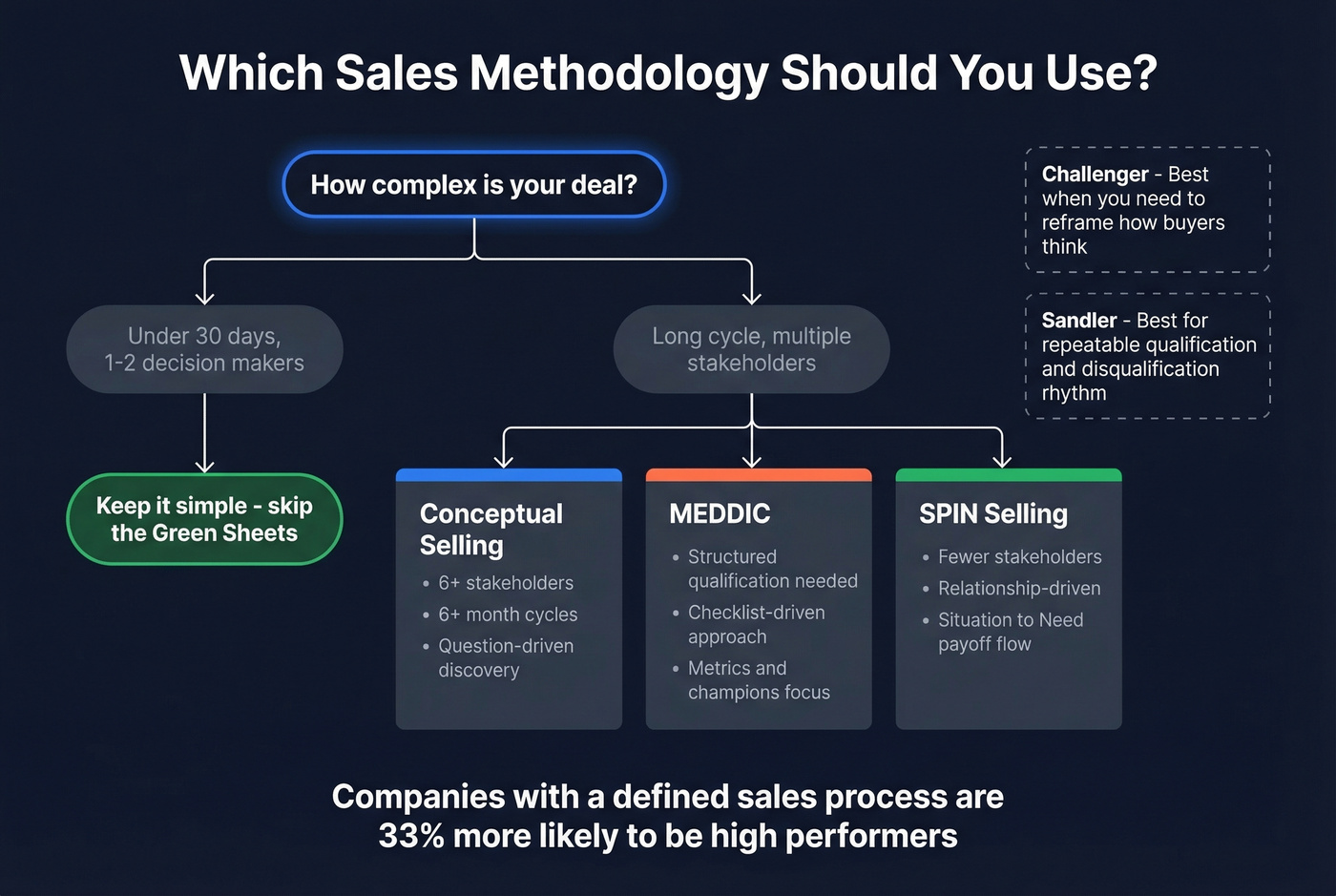
I'll be blunt: the specific methodology matters less than actually committing to one. Companies with a defined sales process are 33% more likely to be high performers and see 18% more revenue growth than those winging it. Pick a framework and run it.
That said, pick the right one:
| Methodology | Best For | Core Mechanism |
|---|---|---|
| Conceptual Selling | 6+ stakeholders, 6+ month cycles | Question-driven discovery |
| MEDDIC | Structured qualification | Checklist qualification |
| SPIN Selling | Fewer stakeholders, relationship-driven | Situation-Problem-Implication-Need |
Challenger works well when you need to reframe how buyers think about a problem - you're teaching, not just discovering. Sandler is strong for teams that want a repeatable qualification and disqualification rhythm. For deals under 30 days with one or two decision-makers, don't overcomplicate it with Green Sheets.
If you're formalizing how your team runs pipeline, this is also where sales process optimization and sales execution start to matter more than the label on the methodology.
Where the Methodology Breaks Down
Let's be honest - most orgs implement Blue Sheets and Green Sheets as compliance exercises. Reps fill them out because managers check. The methodology becomes paperwork, not skill-building. We've seen teams adopt the Blue Sheet as a checkbox exercise and wonder why win rates don't move. As one practitioner put it: garbage in, garbage out.
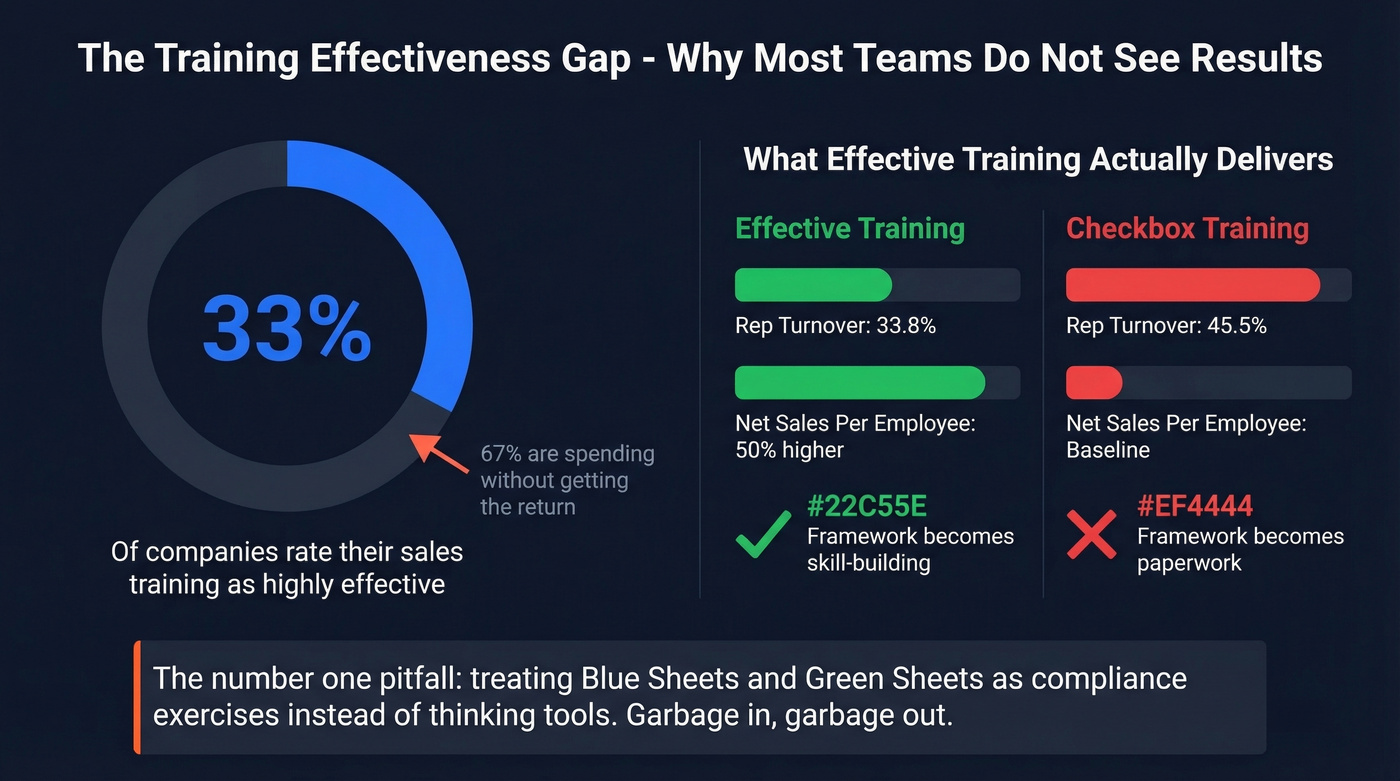
Only 33% of companies rate their sales training as highly effective. The ones that do see meaningfully lower turnover - 33.8% vs. 45.5% - and 50% higher net sales per employee. That gap tells you how many organizations spend on training without getting the return.
Skip the full framework if your deal cycle is two weeks and involves one decision-maker. A Green Sheet for every call in that scenario is a waste of time. The methodology was built for enterprise complexity - don't force it where it doesn't fit.
If you're seeing "paperwork without outcomes," it's often a sales pipeline challenges problem as much as a training problem.
Understanding the Sales Funnel Stages
One piece of the Miller Heiman ecosystem that often gets overlooked is the sales funnel. It breaks opportunities into distinct stages - from initial contact through close - each with specific criteria a deal must meet before advancing. Unlike a generic pipeline, these stages map to buyer behavior rather than seller activity. A deal doesn't move forward because you sent a proposal; it moves forward because the buyer demonstrated a qualifying action.
This is where the Blue Sheet and Green Sheet connect to pipeline management. Each funnel stage has corresponding questions and commitments that tell you whether you're genuinely progressing or just busy. Teams that align their CRM stages to this funnel report more accurate forecasting because the criteria are buyer-verified, not rep-estimated.
If you want a more detailed breakdown of stage logic and metrics, start with funnel metrics and a practical B2B sales funnel template.
What It Costs
Korn Ferry offers onsite and digital formats but doesn't publish pricing. Practitioners report paying around $2,600 per person for a 3-day workshop - that's where you get the official Green Sheet template and the full professional selling skills curriculum.
If you want the framework without the workshop price tag, the books are cheap. The classic "Conceptual Selling" paperback runs about $12.52 new, with used copies from $1.36. The books teach the principles and question types; you just won't get the official templates. The reconstructed Green Sheet above should get you 80% of the way there.
Those 6 hours per week top reps spend researching prospects? Cut that to minutes. Prospeo's 30+ search filters - including job changes, department headcount, and buyer intent across 15,000 topics - surface the exact stakeholders and signals you need to fill Green Sheets with real intelligence, not guesswork.
Turn pre-call research from overhead into a competitive weapon at $0.01 per lead.
What's the difference between the Blue Sheet and the Green Sheet?
The Blue Sheet maps your overall deal strategy - who's involved, what they care about, what could derail the deal. The Green Sheet plans a single meeting - what questions to ask, what concept to uncover, what commitment to secure. Think campaign plan vs. mission brief.
Is Conceptual Selling still relevant for remote selling in 2026?
Yes. The framework structures conversations, not venues. Question types, buyer concept mapping, and joint venture goals work identically on video calls. You just need sharper contact data since you can't rely on in-person introductions to reach new stakeholders.
Can I learn the framework without Korn Ferry training?
You can learn the core principles from the books by Robert Miller and Stephen Heiman - they cover question types and buyer concept mapping thoroughly. You won't get the official Green Sheet, but the reconstructed template above is a practical substitute. For teams wanting the full experience, Korn Ferry's workshop adds facilitated practice and proprietary templates.
Why do people spell Miller Heiman so many different ways?
You'll see Miller Heiman, Miller Hyman, Miller Heimen, and Miller Heimann across forums and search results. They all refer to the same methodology founded by Robert B. Miller and Stephen E. Heiman. The correct spelling is Miller Heiman - now operating under Korn Ferry after a series of acquisitions.