

Nice Meeting You Email: Templates That Get Replies in 2026
You're back at the hotel after a networking event, shoes off, laptop open, staring at a blank compose window. You need to send a nice meeting you email to the three people who actually mattered tonight - but what do you say beyond "hey, great to meet you"?
Here's the thing: a recruiter on r/BigLawRecruiting shared that after one evening event, by 10:30 AM the next morning, the hiring team had already emailed attorneys asking who stood out. Attendees who hadn't sent a follow-up were literally forgotten - attorneys couldn't recall their names. The follow-up isn't a courtesy. It's the whole game.
What You Need (Quick Version)
Before you scroll to templates, nail these three rules:
- Grammar: "Nice to meet you" is a greeting. "It was nice meeting you" is a farewell or follow-up. In a follow-up email, you've already met - use past tense.
- Timing: Write the email immediately after the meeting. Schedule-send it for 9 AM the next business day. (If you want the data-backed timing breakdown, see best time to send cold emails.)
- Structure: Personal reference from the conversation + one specific piece of value + one clear CTA. That's it. (More examples: sales meeting follow-up email.)
If you just want copy-paste templates, jump to the templates section.
"Nice to Meet You" vs. "Nice Meeting You"
The distinction is simple. "Nice to meet you" is what you say when you're introduced - it's a greeting. "It was nice meeting you" is what you say when parting or following up - it's a reflection on time spent together.
For virtual introductions, "nice to meet you" still works fine. Don't use "e-meet." Here are cleaner alternatives depending on your tone:
- Formal: "It was a pleasure meeting you"
- Warm: "Really enjoyed our conversation"
- Casual: "Great connecting with you"
- Virtual: "Glad we got the chance to meet"
- Post-conference: "Great to finally put a face to the name"
Any of these beats "e-meet." All of them work.
When to Send Your Follow-Up
Intent decays in hours, not days. The Default.com team frames it well: the conversion window after a meeting is measured in hours, and every day you wait cuts your chances of a reply. Remember that BigLaw example? The recruiter was making decisions by 10:30 AM. If your email arrived that afternoon, you were already behind. (If you're building a repeatable process, use these sales follow-up templates.)
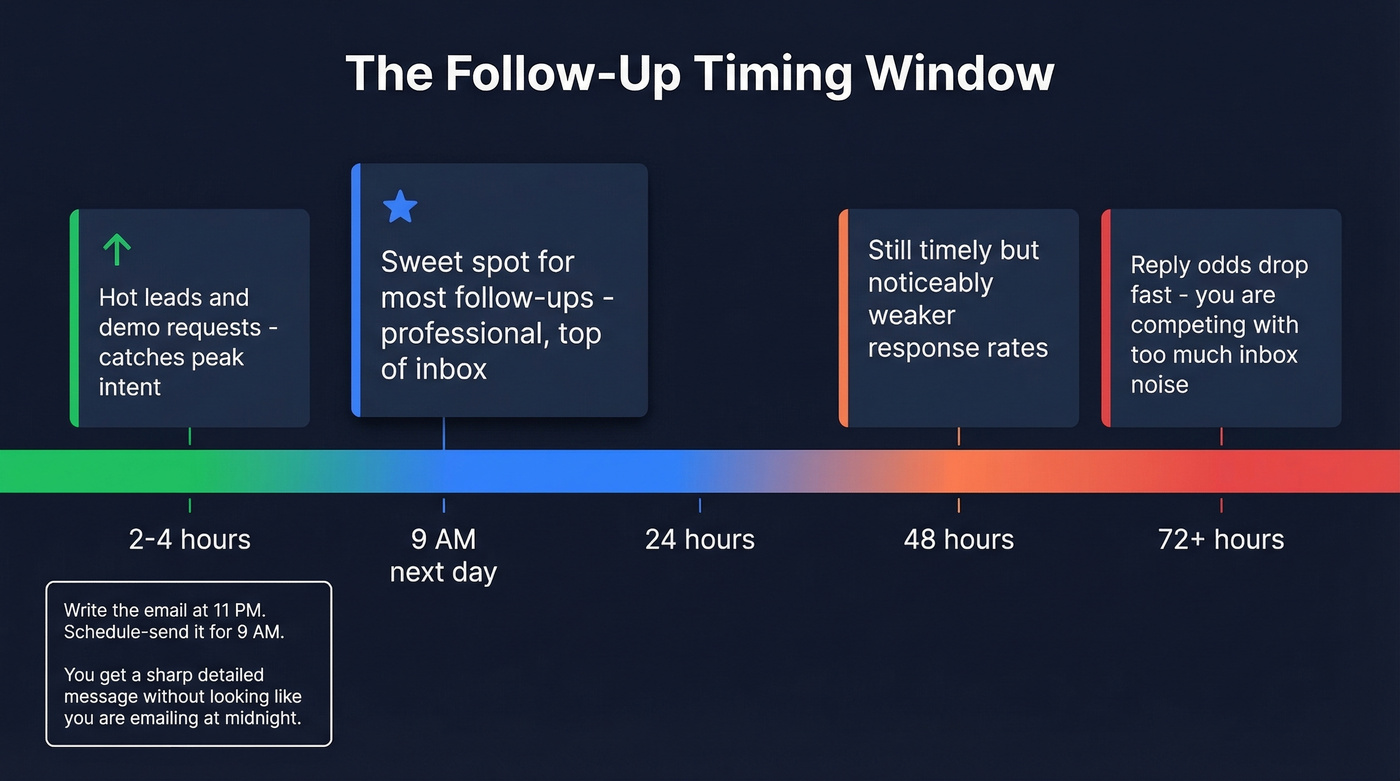
Write the email while the conversation is still fresh - even if it's 11 PM at the hotel. Then schedule-send it for 9 AM the next business day. You get the benefit of a sharp, detailed message without looking like you're emailing at midnight.
| Timing | Best For | Why It Works |
|---|---|---|
| Same day (2-4 hrs) | Hot leads, demo requests | Catches peak intent |
| Next morning (9 AM) | Most follow-ups | Professional, top of inbox |
| Within 48 hours | Lower-priority contacts | Still timely, but weaker |
After 48 hours, reply odds drop fast. Don't wait.
Anatomy of the Perfect Follow-Up
Every strong post-meeting email has six parts:
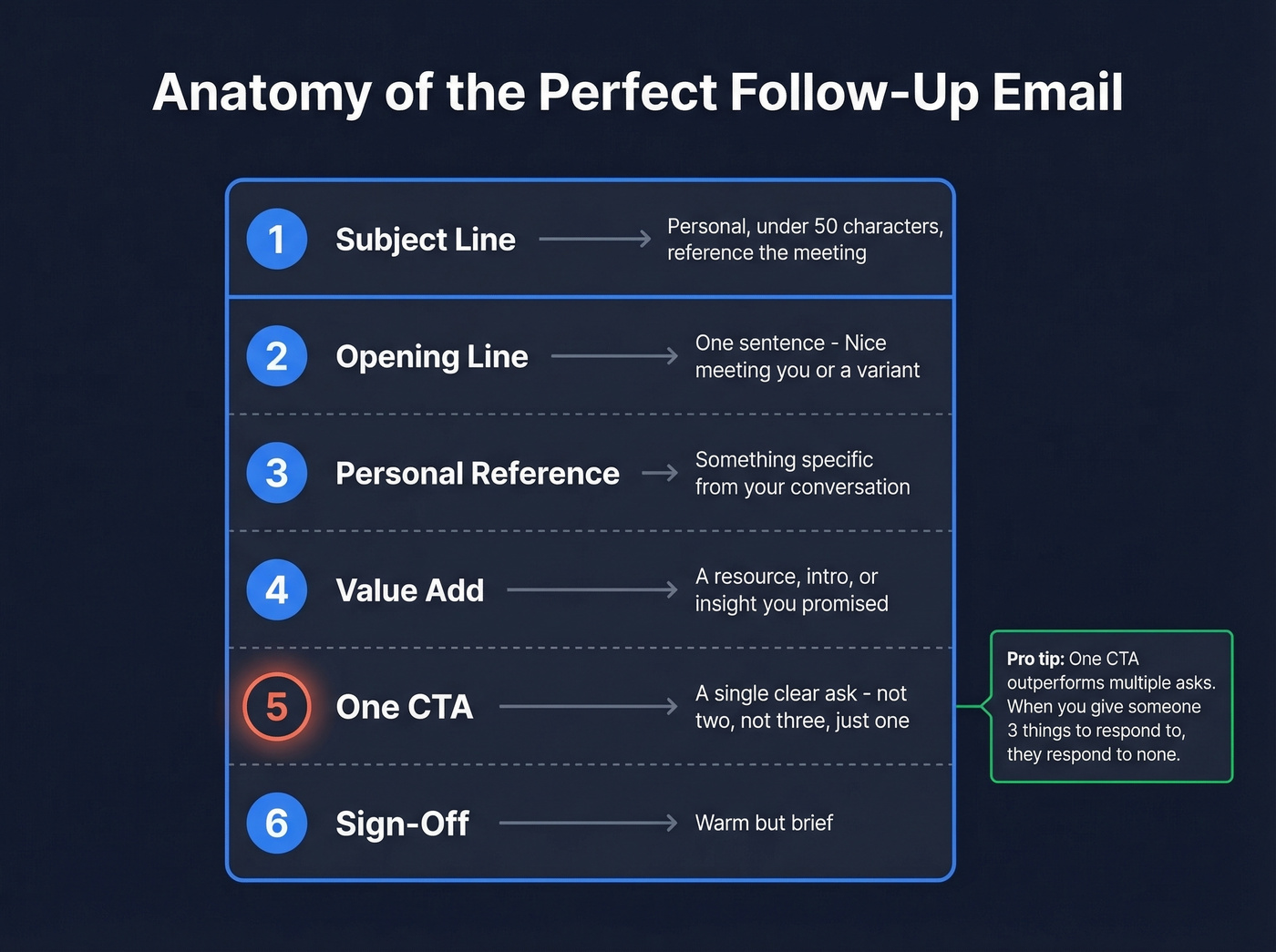
- Subject line - Personal, under 50 characters, references the meeting
- Opening line - "Nice meeting you" or a variant (one sentence)
- Personal reference - Something specific from your conversation
- Value add - A resource, intro, or insight you promised
- One CTA - A single, clear ask
- Sign-off - Warm but brief
The single-CTA rule matters more than people think. One CTA outperforms multiple asks - when you give someone three things to respond to, they respond to none. And don't skip the appreciation. Research from the Workhuman Research Institute found that when workers feel appreciated, they're 47% more likely to agree leaders cared about building a human workplace. A real "thank you" isn't filler. It's strategy. (If you want to sharpen the ask, see email call to action.)
Let's be honest, though: if the relationship is purely social or the ask is tiny, you don't need all six parts. A three-sentence email with a personal reference and a CTA will outperform a polished five-paragraph essay every time. Brevity signals confidence. (More on writing tight messages: emails that get responses.)

Your follow-up template is only as good as the email address it lands on. Prospeo's 98% verified emails mean your "nice meeting you" actually reaches the inbox - not a bounce notification. Find anyone's professional email from 300M+ profiles.
Stop crafting the perfect follow-up for an address that bounces.
Subject Line Examples
Keep subject lines to 5-7 words and under 50 characters. Anything longer gets truncated on mobile. Avoid spam triggers like "free," "reminder," or all caps. (For more options, browse these email subject line examples.)
| Scenario | Subject Line |
|---|---|
| Networking event | Great meeting you at [Event] |
| Job interview | Thanks for your time, [Name] |
| Sales meeting | Following up on [Topic] |
| Conference | [Event] - loved your take on [X] |
| Virtual call | Good connecting today |
| Investor meeting | Next steps from our chat |
| Client onboarding | Excited to get started |
| Casual intro | [Mutual contact] intro follow-up |
| Referral-based | [Name] suggested I reach out |
Personalization is the difference between "opened" and "archived." Use their name, the event, or a topic you discussed. (If you're doing this at scale, see personalized outreach.)
Follow-Up Email Templates
Each template below is 3-4 sentences. Replace the [bracketed fields] with your details.
Networking Event
Networking events create strong "I should respond" social pressure - so keep it short, specific, and easy to answer.
Subject: Great meeting you at [Event]
Hi [Name], it was great meeting you at [Event] last night. Your point about [detail] stuck with me - I found [this article/resource] that ties into what we discussed. Would you be up for a coffee or quick call next week? Best, [Your name]
Job Interview
Subject: Thanks for your time, [Name]
Hi [Name], thank you for meeting with me today about the [Role] position. Learning about [specific project or team detail] reinforced my excitement about [Company]. I'd love to continue the conversation and am happy to provide any additional information. Looking forward to hearing from you, [Your name]
Why this works: It references something specific from the interview and reinforces fit without rambling.
Sales Meeting or Demo
Subject: Following up on [Topic]
Hi [Name], nice meeting you earlier today. I wanted to recap the key point we landed on: [specific pain point they mentioned]. I've attached [resource/case study] that addresses exactly that. Does [specific date] work for a 20-minute follow-up? [Your name]
Conference or Trade Show
Skip this template if you didn't actually attend their talk or have a real conversation. A generic "great connecting at [Conference]" with zero specifics is worse than not emailing at all.
Subject: [Event] - loved your take on [X]
Hi [Name], your perspective on [topic from their talk or conversation] was one of the highlights of [Conference] for me. I put together [resource/link] that builds on what you shared. Would love to stay in touch - are you open to a quick call in the next couple of weeks? [Your name]
Virtual or Video Call
Subject: Good connecting today
Hi [Name], really glad we got the chance to meet today. I took a note on [specific thing they mentioned] - here's [resource or link] I mentioned during our call. Let me know if [specific next step] makes sense as a follow-up. Talk soon, [Your name]
Investor or Partner Meeting
Subject: Next steps from our chat
Hi [Name], I appreciated your candor about [specific feedback or question they raised]. I've attached [deck/data/resource] that addresses [their concern]. Does [date range] work to dig deeper with [you/your team]? [Your name]
Client Onboarding
Subject: Excited to get started
Hi [Name], great meeting you and the team today. Key next steps from our kickoff: [1-2 bullet points]. I'll have [deliverable] ready by [date] - don't hesitate to reach out with questions in the meantime. [Your name]
Casual Introduction
The shortest template here, and intentionally so. Casual intros die when you overthink them.
Subject: [Mutual contact] intro follow-up
Hi [Name], nice to meet you - [Mutual contact] speaks highly of you. Would a 15-minute call sometime next week work? I'd love to learn more about [their work/project]. [Your name]
What If They Don't Reply?
Don't panic. A 2024 Belkins analysis of 16.5 million cold emails found that the highest reply rate - 8.4% - came from a single email. Performance drops with each additional follow-up, and sending 4+ emails triples spam complaint risk. (If you need a clean nudge, use a polite chaser email.)
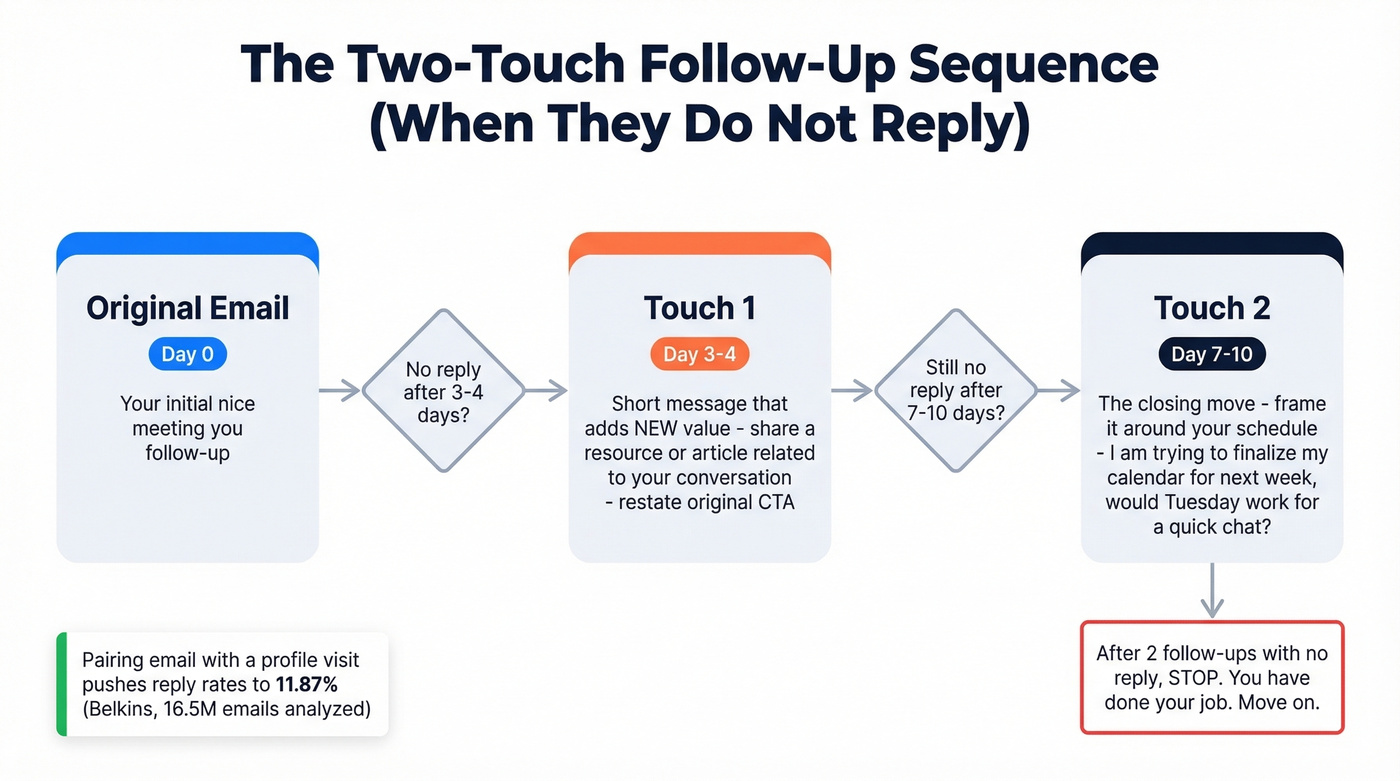
If email alone doesn't work, pairing it with outreach on professional networks can push reply rates to 11.87% based on the same Belkins data for a "message + profile visit" combo.
We've found this two-touch sequence works without being pushy:
Touch 1 (Day 3-4): Short, adds new value. "Hi [Name], wanted to share [new resource/article] related to what we discussed at [Event]. Let me know if [original CTA] still makes sense."
Touch 2 (Day 7-10): The closing move. A tactic from r/sales that works well - frame it around your schedule: "I'm trying to finalize my calendar for next week - would [date] work for a quick chat?" It gives them a concrete reason to respond without sounding desperate.
After two follow-ups with no reply, stop. You've done your job. Move on.
Common Mistakes to Avoid
We've seen follow-ups that were perfectly written but arrived three days late - they never got replies. Nobody ignores a follow-up because the greeting was slightly generic. They ignore it because it arrived too late or said nothing useful. (If you're building a system, see importance of follow-up in sales.)
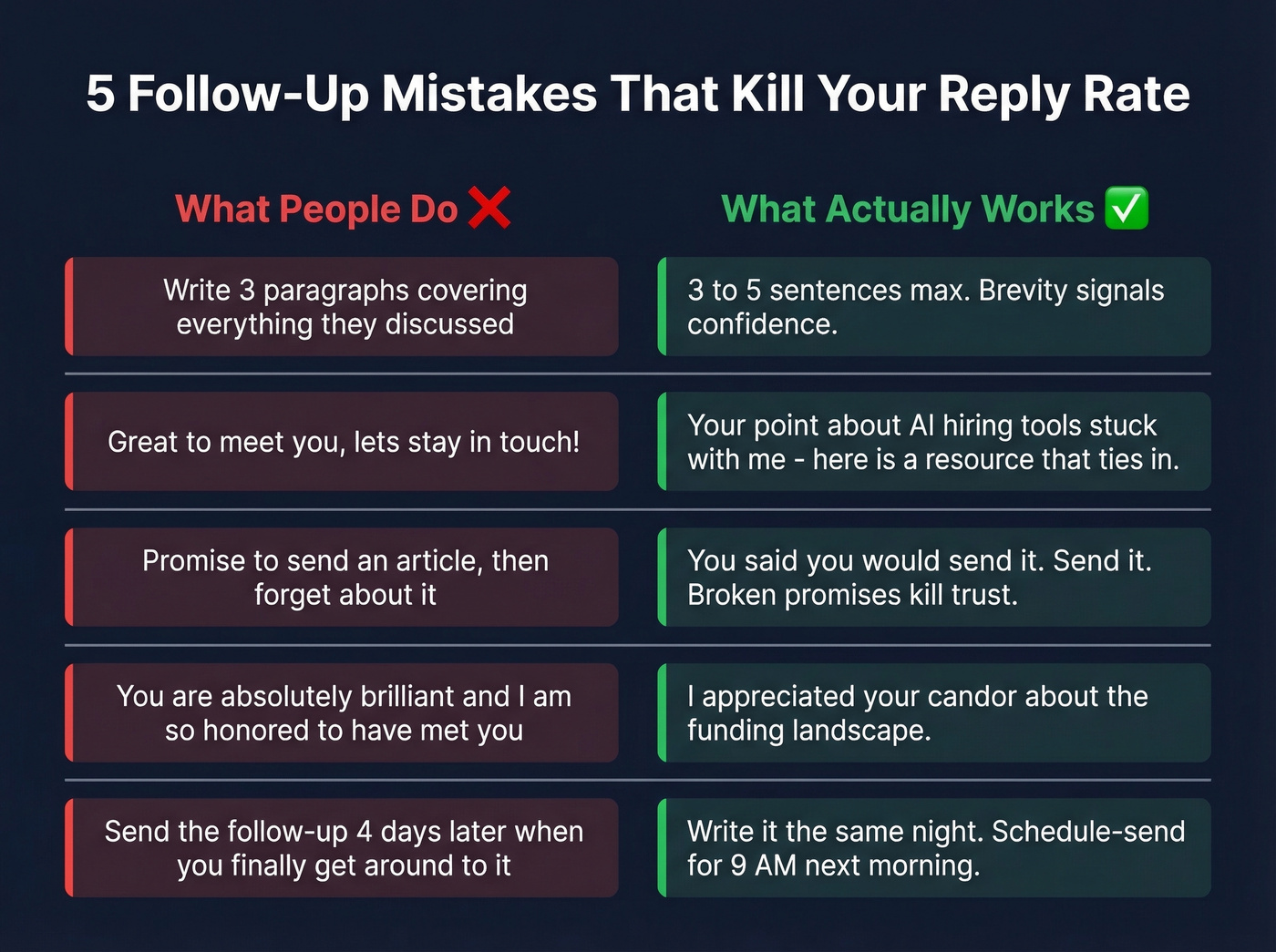
Look, the mistakes are always the same:
- Too long - Long, unfocused emails overwhelm recipients. Three to five sentences. That's the ceiling.
- Too generic - "Great to meet you, let's stay in touch" with zero specifics is a dead end
- Broken promises - You said you'd send that article. Send the article.
- Excessive flattery - "You're absolutely brilliant and I'm so honored" reads as insincere
- Waiting too long - After 48 hours, your email is competing with a lot more inbox noise
Verify the Address Before You Send
You wrote the perfect email. Now make sure it actually arrives.
Business cards get smudged. Verbal introductions don't come with spelled-out email addresses. And guessing someone's email format - firstname@company.com vs. f.lastname@company.com - increases the odds of a bounce. A bounce doesn't just waste the email. It looks like you never followed up at all, which is arguably worse than a bad follow-up. (If you're troubleshooting, see email bounce rate.)
Prospeo's email finder pulls verified addresses from 300M+ professional profiles and checks them in real time at 98% accuracy. The free tier gives you 75 lookups a month - more than enough for post-event follow-ups. It's the last step before you hit send, and it's the one most people skip. (Related: name to email.)

Met someone great but only grabbed a name and company? Prospeo turns that into a verified email, direct dial, and 50+ data points - so your follow-up hits the right inbox within that critical 24-hour window.
Turn a handshake into a verified contact in seconds.
FAQ
Can you say "nice to meet you" in an email after meeting virtually?
Yes - "nice to meet you" works for any first interaction, whether it's a video call, phone call, or in person. The phrase has evolved past requiring physical presence. Skip "e-meet" or "virtually meet" and just say it naturally.
How long should a follow-up email be?
Three to five sentences is the sweet spot. That's enough to reference the conversation, add one piece of value, and include a single clear CTA. Anything longer reads like a memo, not a follow-up, and reply rates drop accordingly.
Should you connect on social media too?
Yes, but send the email first - that's the high-signal move. Then connect on professional networks with a brief note referencing your conversation. Belkins data shows combining email with a profile visit pushed reply rates to 11.87%, compared to 8.4% for email alone.
How do you find someone's email if you only have their name?
Use an email finder tool with your contact's name and company domain. Prospeo searches 300M+ professional profiles and returns verified addresses at 98% accuracy - the free tier includes 75 lookups per month, which covers most post-event follow-up needs.