

How to Run Outbound ABM That Actually Generates Pipeline
One RevOps lead shared on Reddit that their outbound ABM program generated $51M in pipeline with 84% conversion from engagement to opportunity - across 28 enterprise logos. The secret wasn't a six-figure platform. It was coordinated follow-up on verified data.
And yes, we've seen "best-in-class" databases create a mess in Salesforce with duplicates and bad merges, while cheaper tools sometimes produce better phone connect rates. This approach lives or dies on data quality and sales follow-up, not platform features.
What Outbound ABM Actually Is
Outbound ABM isn't "outbound with a smaller list." It's a coordinated motion where marketing and sales jointly target specific accounts with personalized, multi-channel outreach - email, calls, direct mail, ads - all aimed at a defined buying committee. You start with the accounts you want and work backward to the contacts and messages that will open doors.
You're researching 20-50 target accounts, not blasting 1,000 leads. Every account gets a tailored approach based on who's in the buying group, what signals they're throwing off, and where they sit in their buying journey. 70% of the B2B buying journey happens anonymously, so your outreach has to surface the conversation before a prospect ever fills out a form.
Is This Strategy Right for You?
- Deal size: $50K+ ACV. Below $20K, per-account research cost doesn't justify the return.
- Sales cycle: 3-6+ months. Short cycles don't give ABM enough runway.
- Stakeholders: 3+ people in the buying decision.
- Rep bandwidth: Reps need time for account research, not just dial volume.
- Sales-marketing alignment: If sales won't work the accounts marketing warms up, ABM fails.
Check four or more? Keep reading. Otherwise, you'll get better ROI from programmatic outbound.
The Outbound ABM Playbook
Define Your High-Velocity ICP
Start with the cohort that converts to revenue fastest - measured by deal size, win rate, and cycle length. Pull your last 12 months of closed-won deals and look for patterns: industry, company size, tech stack, growth stage. This isn't your TAM. It's the 20-50 accounts most likely to close in the next 6 months.
If you need a tighter definition, use an ICP scoring rubric so sales and marketing tier accounts the same way.
Tier Your Accounts
Not every account gets the same treatment. Use a 3-tier model:
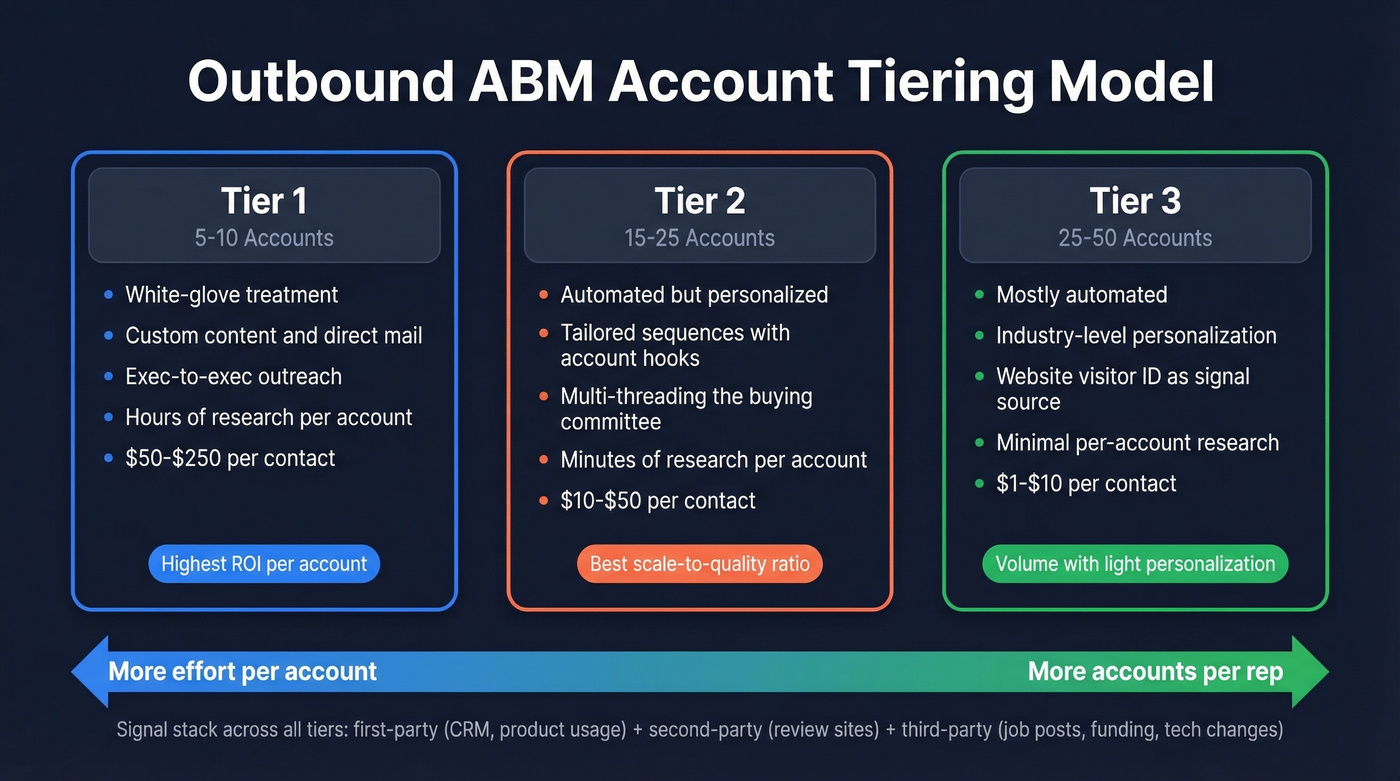
Tier 1 (5-10 accounts): White-glove. Custom content, direct mail, exec-to-exec outreach. Budget $50-$250 per contact. Direct mail alone pulls 80-90% open rates and 3-5% response rates - nothing else in your channel mix comes close.
Tier 2 (15-25 accounts): Automated but personalized. Tailored sequences with account-specific hooks. You're still multi-threading into the buying committee, but the research per account drops from hours to minutes.
Tier 3 (25-50 accounts): Mostly automated. Industry-level personalization, plus website visitor identification tools as a first-party signal source.
Stack signals across all tiers: first-party (CRM activity, product usage), second-party (review site engagement), and third-party (job postings, funding rounds, tech changes). If you want a cleaner way to operationalize this, build an intent-based segmentation model before you write sequences.
Map the Buying Committee
For each account, map decision makers, champions, and end users. A typical enterprise deal involves 6-10 people. You need verified contact data for all of them - not just the VP who signs.
Here's the thing: bad data kills account-based outbound before your messaging even matters. Snyk's team was running 35-40% bounce rates before switching providers - a third of their sequences hitting dead ends. After moving to Prospeo, bounces dropped under 5% and AE-sourced pipeline jumped 180%. The platform covers 300M+ professional profiles with 98% email accuracy on a 7-day refresh cycle, and you can search by 30+ filters including buyer intent, technographics, and job changes to find every member of the buying committee.
If you're comparing sources, start with a shortlist of sales prospecting databases and validate coverage by role + region, not just total record count.

Stack Intent Signals
Don't mention intent data directly to prospects - use it for timing. Layer 3-8 intent signals over a 90-day trend to segment accounts into hot, warm, and cold. A prospect researching your category on third-party sites while their company posts a relevant job opening? That's a Tier 1 signal stack.
Contact-level ABM drives up to 74% more booked meetings and 118% more pipeline conversion than account-level targeting alone. The difference is knowing who at the account is active, not just that the account is surging.
To make this repeatable, set up a lightweight process for identifying buying signals and scoring them consistently.
Build Multi-Channel Sequences
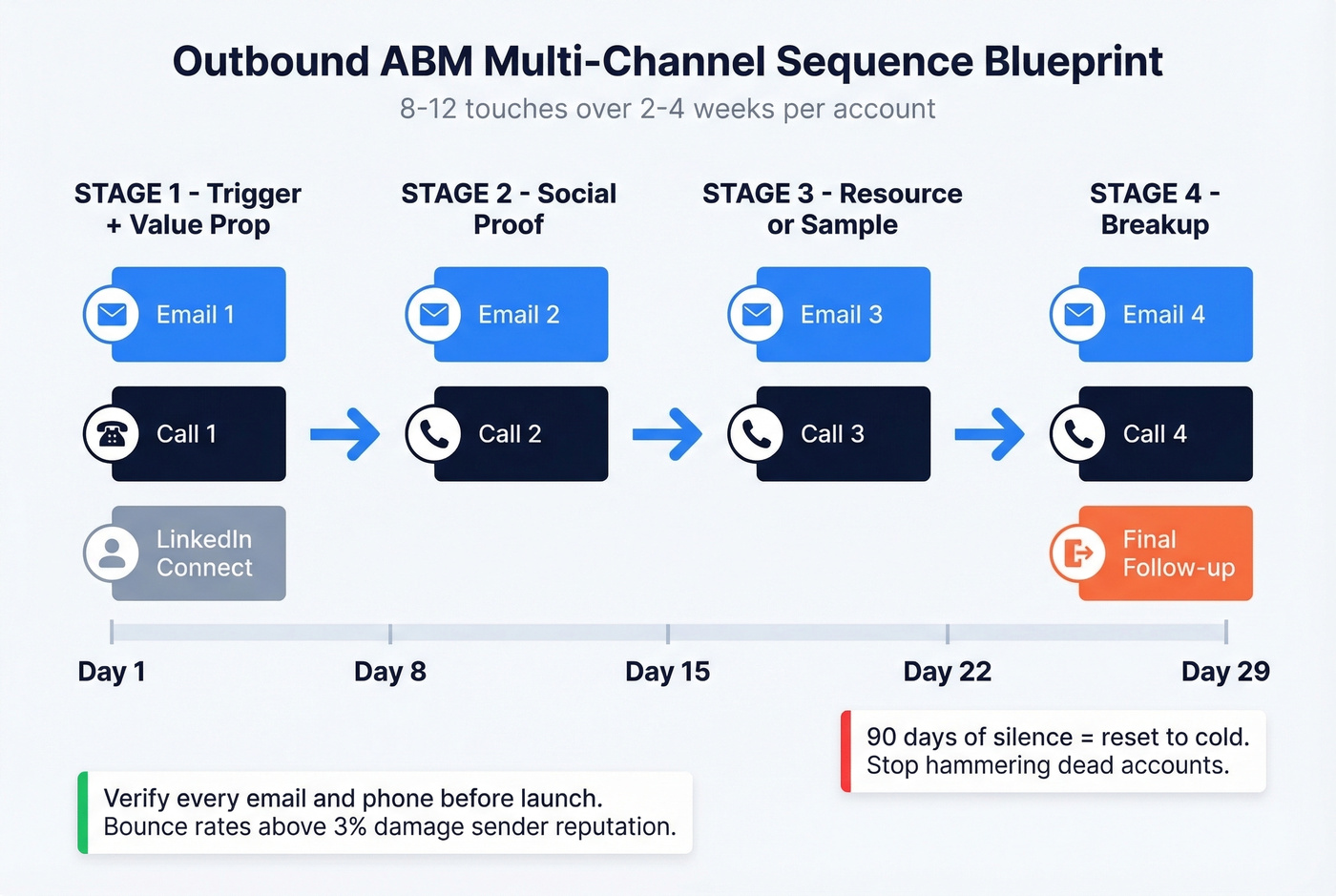
Plan 8-12 touches over 2-4 weeks per account. Mix email, phone, and social. Structure emails around four messages: trigger + value prop, social proof, resource or product sample, and breakup. Personalization via trigger events like a promotion, expansion, or funding round beats generic "I noticed your company..." openers every time.
If you need copy patterns that don't sound templated, pull from these sales follow-up templates and adapt them to each tier.
One agency running a 4-channel framework generated $7.83M in pipeline and $1.52M closed-won - proof that channel diversity compounds.
Verify every email and phone before launch. Hard bounce rates above 3% damage sender reputation, and once your domain's flagged, recovery takes weeks. If deliverability is already shaky, follow an email deliverability guide and tighten your email reputation tools before scaling volume.
Sample 30-Day Sequence
| Day | Channel | Action |
|---|---|---|
| 1 | Social + Email | Connect request + Email #1 (trigger + value prop) |
| 2 | Phone | Call #1 |
| 8 | Email #2 (social proof) | |
| 9 | Phone | Call #2 |
| 15 | Email #3 (resource/sample) | |
| 16 | Phone | Call #3 |
| 22 | Email #4 (breakup) | |
| 23 | Phone | Call #4 |
| 29 | Final follow-up |
After 90 days of inactivity, reset the account to cold. Don't keep hammering dead leads.
If you're rolling this out to a new team, a simple 30-60-90 day plan keeps research, sequencing, and follow-up from slipping.

Your outbound ABM sequence hits 6-10 stakeholders per account. One bad email tanks your sender reputation and kills the entire account play. Prospeo delivers 98% email accuracy on a 7-day refresh cycle with 30+ filters - including buyer intent, technographics, and job changes - so you can map the full buying committee without bouncing a single message.
Stop losing Tier 1 accounts to bad data. Verify every contact before you send.
What It Actually Costs in 2026
| Category | Tool Examples | Typical Annual Cost |
|---|---|---|
| Intent Data | Bombora, 6sense, Demandbase | Bombora ~$24,750 / 6sense ~$58,310 |
| Contact Data (lean) | Prospeo | $0-$2,000/yr |
| Contact Data (enterprise) | ZoomInfo, Apollo | $15K-$40K+ / Free-~$1,200 per user |
| Engagement | Salesloft, Outreach, Lemlist | $3K-$25K/yr |
| CRM | Salesforce, HubSpot | ~$300-$3,600/yr per user |
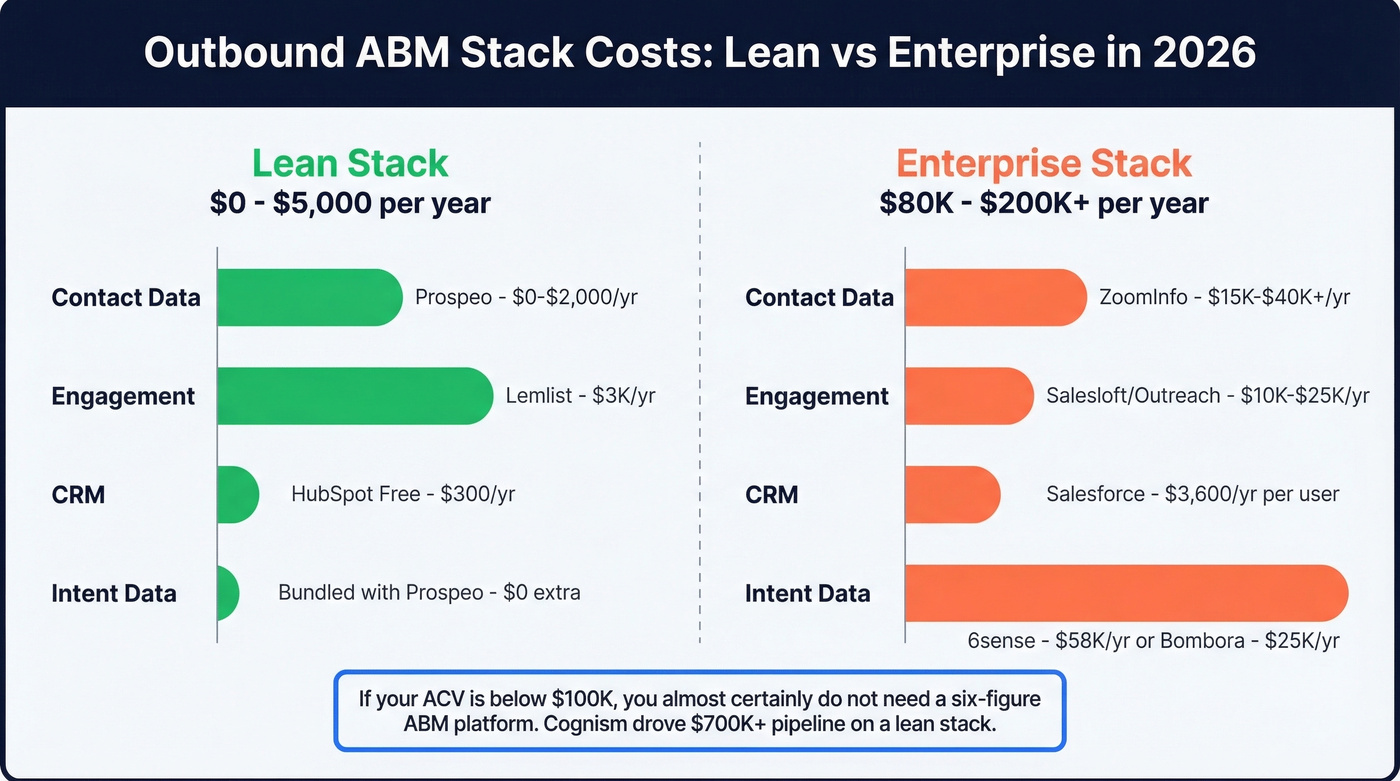
Lean stack total: ~$0-$5,000/yr. Enterprise stack: $80K-$200K+/yr.
Let's be honest: if your average contract value sits below $100K, you almost certainly don't need a six-figure ABM platform. Cognism's marketing team drove $700K+ pipeline using a lean stack. Prospeo bundles intent data tracking 15,000 Bombora topics, so you can layer buyer signals without a separate $25K+ intent contract. That alone changes the math for teams running outbound ABM on a real budget.
If you're cleaning and standardizing records across tools, consider a dedicated data enrichment service so your CRM doesn't become the bottleneck.
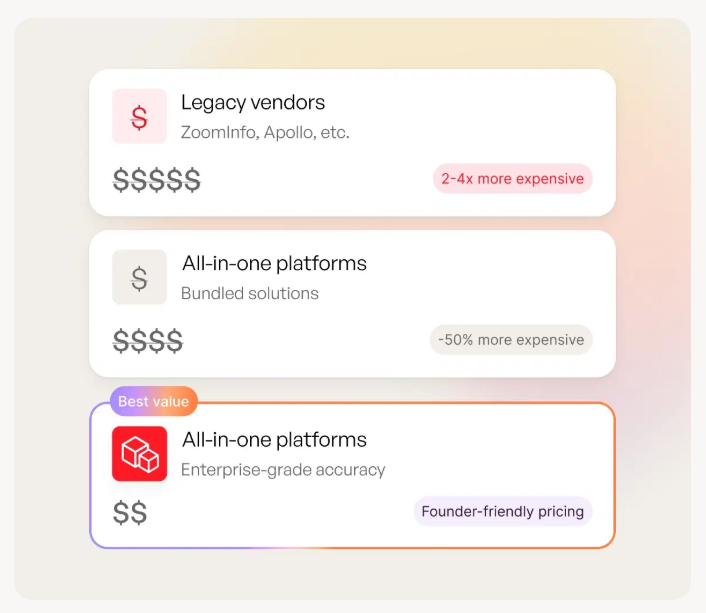
You don't need a $200K ABM stack to run pipeline-generating outbound. Prospeo bundles 15,000 Bombora intent topics, 300M+ profiles, and 125M+ verified mobiles at roughly $0.01/email - no annual contracts, no sales calls. Layer intent signals on your tiered account list and reach decision-makers who are actually in-market.
Enterprise ABM data without the enterprise price tag. 75 free emails to prove it.
Why ABM Outbound Campaigns Fail
Sales doesn't work the accounts. This is the number one killer. Marketing warms and qualifies accounts, then reps ignore half the list. One practitioner reported sales only worked 50% of target accounts - meaning half the ABM budget evaporated. Shared pipeline KPIs and weekly alignment meetings fix this, but only if leadership enforces them. We've watched this pattern repeat at three different companies we've worked with, and the fix is always the same: make ABM pipeline a joint number, not a marketing number.
If you want the sales-side operating system, borrow from account-based selling best practices so reps know exactly what "working an account" means.
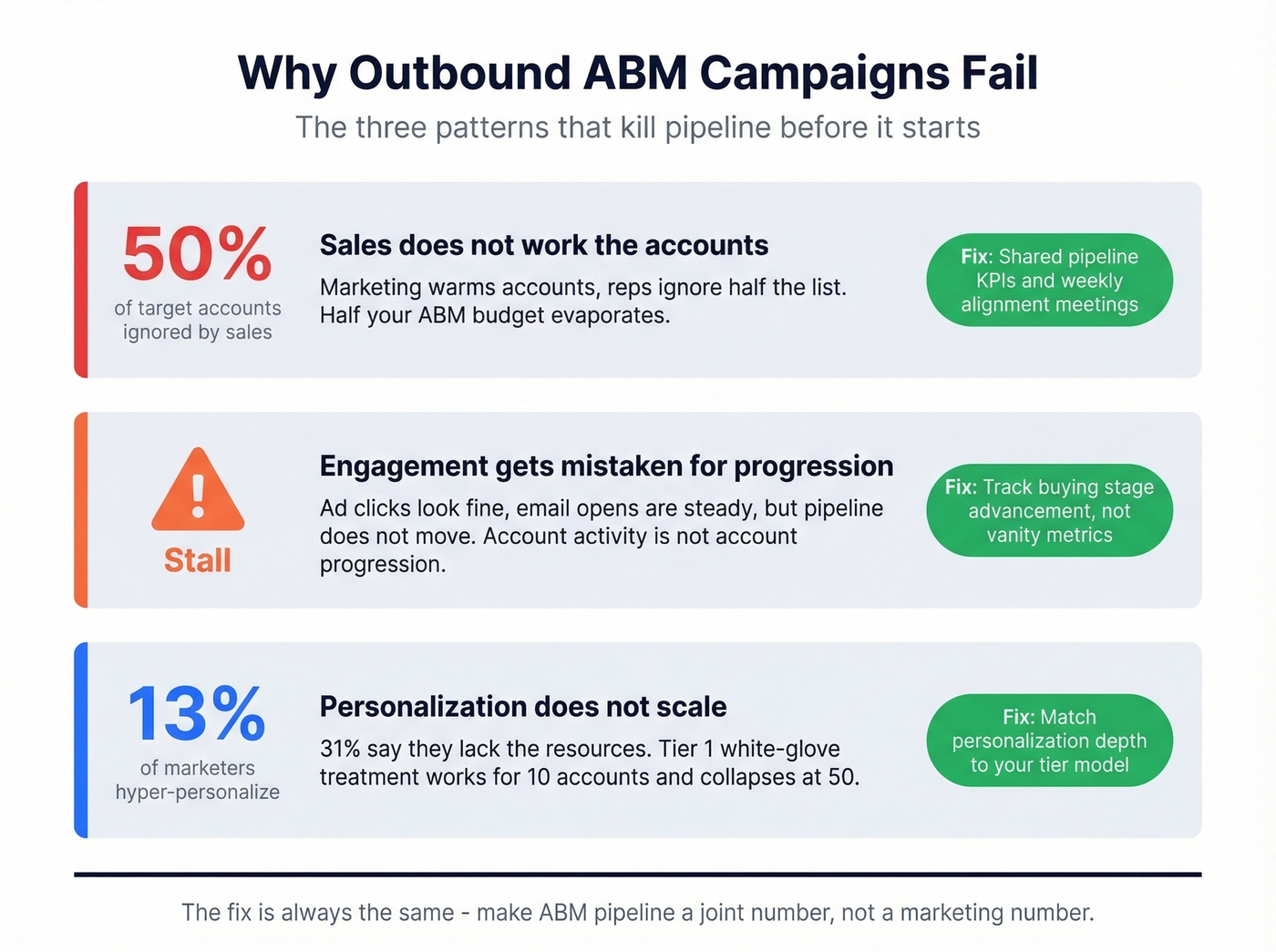
Engagement gets mistaken for progression. ABM often stalls quietly. Ad clicks look fine, email opens are steady, but pipeline doesn't move. Account activity isn't account progression. We've seen teams run ABM for six months with "great engagement" and zero closed revenue because nobody tracked whether accounts were advancing through buying stages.
Personalization doesn't scale. Tier 1 white-glove treatment works for 10 accounts and collapses at 50. Only 13% of marketers hyper-personalize, and 31% say they lack the resources. That's fine - tier your effort to match your tier model. Skip hyper-personalization for Tier 3 entirely and focus your creative energy where deal sizes justify it.
How to Measure Your Strategy
Stop measuring open rates. Track account progression through AIDA stages - Unaware, Attention, Interest, Desire, Action - instead of traditional MQL/SQL handoffs.
If you need a clean definition of each stage (and what to measure), use the AIDA stages as your reporting backbone.
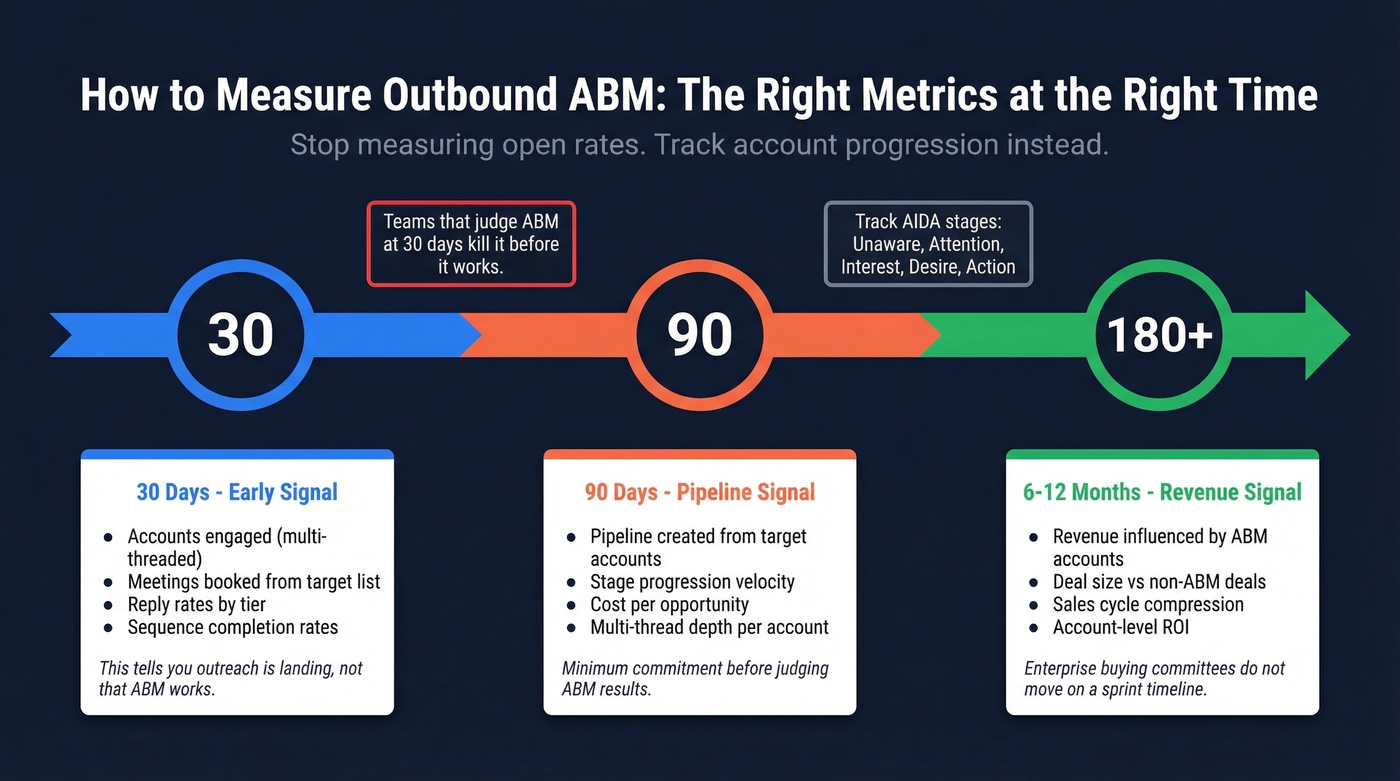
30 days: Accounts engaged (multi-threaded), meetings booked, reply rates. This is your signal that outreach is landing, not your signal that ABM "works."
90 days: Pipeline created from target accounts, stage progression, cost per opportunity.
6-12 months: Revenue influenced, deal size vs. non-ABM deals, sales cycle compression. Teams that judge ABM at 30 days kill it before it works. Commit to 90 days minimum - enterprise buying committees don't move on a sprint timeline.
Compliance in 60 Seconds
US (CAN-SPAM): No prior consent needed for B2B. Include a physical address, honest subject lines, and working unsubscribe. Fines run $53,088 per email.
EU (GDPR): Cold email requires a lawful basis - typically legitimate interest with a documented balancing test. Opt-out and data subject rights are mandatory.
Canada (CASL): Requires express or implied consent before sending. Penalties run into millions of CAD.
FAQ
How many accounts should I target?
Twenty to fifty. More than 100 and you're running programmatic outbound - personalization depth won't hold. Fewer than 10 and you're doing enterprise sales with a different name.
What's the minimum deal size?
$50K+ ACV makes outbound ABM worthwhile. Below that threshold, per-account research and multi-threading costs erode margins fast. Run volume-based sequences instead and reserve account-level plays for your largest prospects.
How long before it produces pipeline?
Ninety days minimum for meaningful signal. Six to twelve months for reliable revenue attribution. Teams that evaluate after one month almost always kill it prematurely - enterprise buying committees don't move on a 30-day clock.
Do I need a paid intent data platform?
Not necessarily. Stack free signals - job postings, funding news, website visits - for 80% of the value. Some platforms bundle intent data into their contact database, which saves you a separate five-figure contract. The consensus on r/sales is that most teams overspend on intent before they've even nailed their ICP and outreach cadence.
What's the biggest reason these programs fail?
Sales doesn't work the accounts. Shared pipeline KPIs and weekly alignment meetings are the fix. Without them, you're burning budget on accounts nobody follows up on - and half your target list goes untouched.