

Outbound Emails: What Works in 2026 (and What Doesn't)
A 27.7% average open rate sounds decent until you realize 17% of cold emails never reach the inbox at all. Outbound emails aren't dead - lazy outbound is. The teams still booking meetings in 2026 get three things right before writing a single word: clean data, authenticated infrastructure, and tight targeting.
Here's the short version. Verify every email before it hits a sequence. Authenticate your sending domain. Target cohorts of 50 or fewer contacts with signal-based messaging. Do those three things and you're ahead of most sales teams we talk to.
What Is Outbound Email?
Outbound email is any cold or warm message sent to prospects who haven't asked to hear from you. It's how you start conversations and build pipeline with people who don't know you exist yet, as opposed to inbound, where the prospect comes to you first.
The tradeoff against inbound is straightforward. Outbound leads cost $200-$500 each vs. $75-$150 for inbound, but outbound delivers results in 4-8 weeks and generates 50% larger deal sizes on average. If you're selling to a defined ICP and can't wait six months for SEO to compound, cold email is the fastest path to pipeline.
2026 Benchmarks Worth Knowing
| Metric | 2026 Average | Top Performers |
|---|---|---|
| Open rate | 27.7% | 40-60% |
| Reply rate | 3.43% | 15-25% |
| Conversion rate | 0.2-2% | ~3-5% |
| Replies from follow-ups | 42% | - |
| Reps who never follow up | 48% | - |
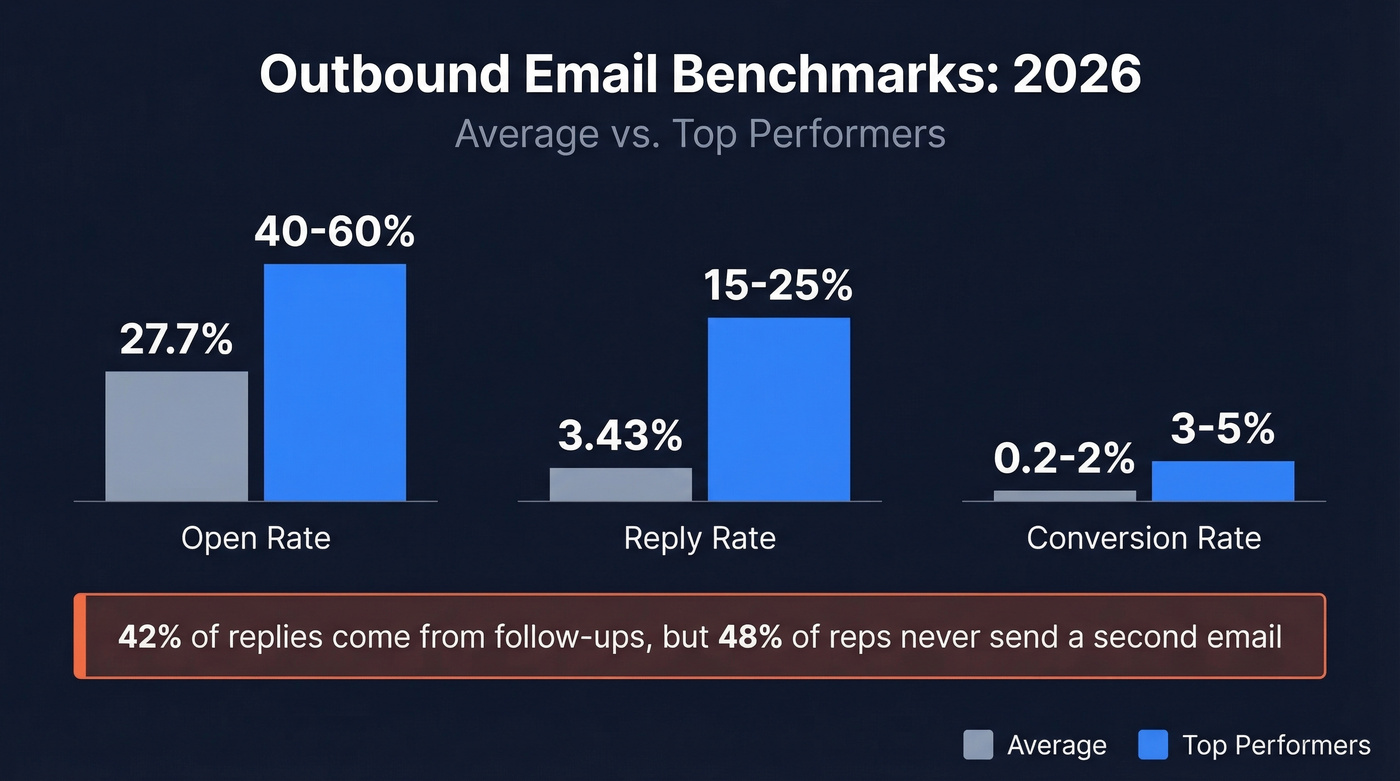
The hook you use matters more than most people think. [Timeline-based hooks average a 10.01% reply rate](https://thedigitalbloom.com/learn/cold-outbound-reply-rate-benchmarks/) vs. 4.39% for problem-based hooks - and the gap widens at the meeting stage, where timeline hooks convert at 2.34% vs. 0.69%. "We noticed you just raised a Series B" beats "Are you struggling with pipeline?" every time.
In our experience, the hook-type decision drives more variance than any other other single copy choice. We've run campaigns where switching from a pain-point opener to a trigger-event opener doubled reply rates overnight, with identical lists and identical offers.
How to Build an Outbound Campaign
Most campaigns fail before the first email sends. The sequence matters less than the setup.
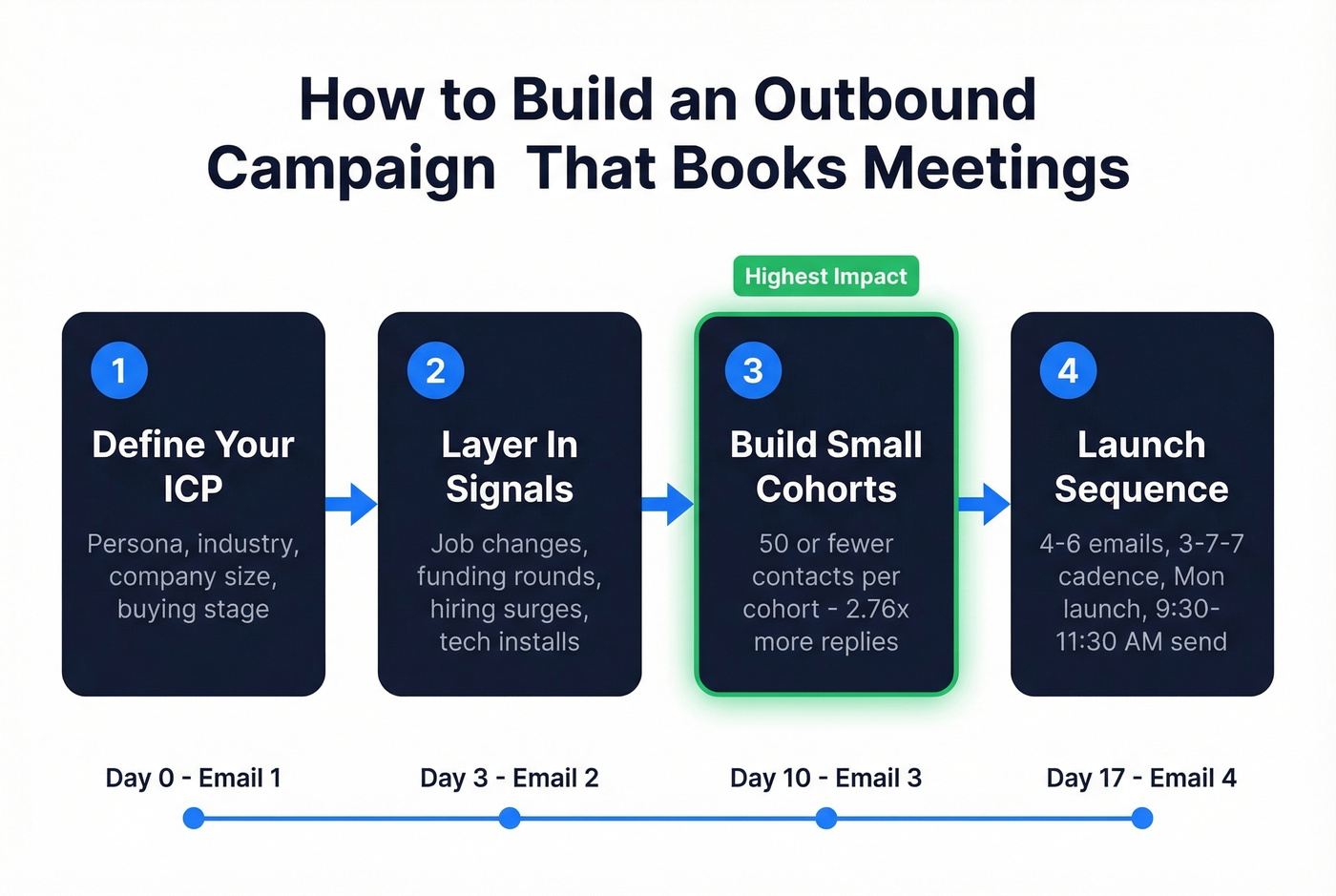
1. Define your ICP tightly. Segment by persona, industry, company size, and buying stage. Broad lists waste credits and burn domains. Use an Ideal Customer Profile scorecard so reps don’t “wing it.”
2. Layer in signals. Job changes, funding rounds, hiring surges, tech installs. Signal-based outbound isn't optional anymore - it's the baseline. If you need a system, start with identifying buying signals.
3. Build small cohorts. Cohorts of 50 contacts or fewer increase reply rates 2.76x compared to bulk blasts. This is the single highest-leverage structural change you can make to a campaign, and it's the one most teams skip because it feels slower.
5. Build your sequence. 4-6 emails, spaced on a 3-7-7 cadence (Day 0, Day 3, Day 10, Day 17). This length sees up to 50% higher reply rates than single-touch sends. Launch on Monday; schedule follow-ups for Wednesday. Best send window: 9:30-11:30 AM in the recipient's local time (more data in our guide on the best time to send cold emails).
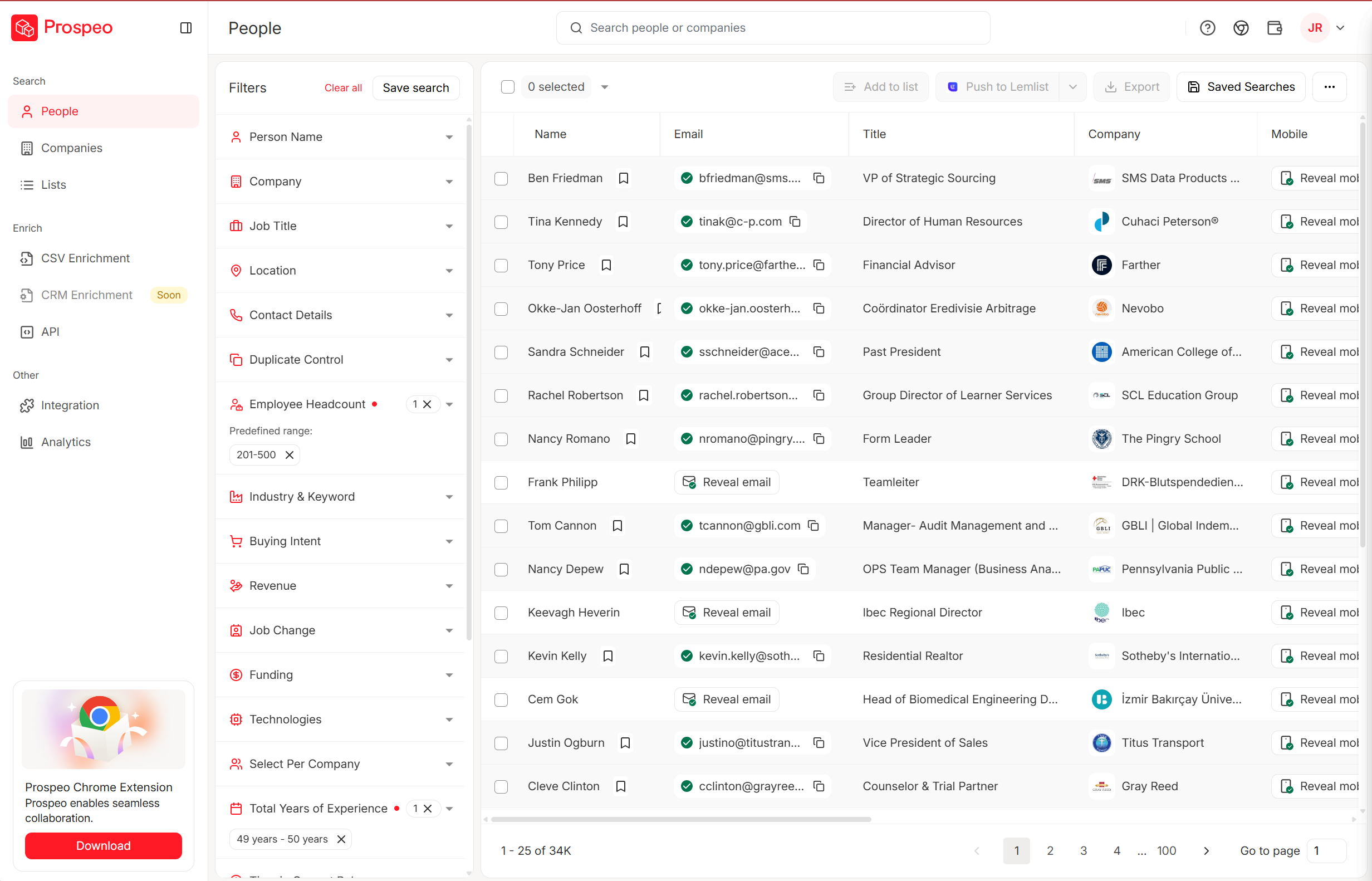

You just read that bounces above 3% destroy sender reputation. Prospeo's 5-step verification and 7-day data refresh keep your bounce rate under control - 98% email accuracy means your outbound campaigns hit real inboxes, not spam folders.
Stop burning domains on stale data. Verify before you send.
Deliverability Infrastructure
None of your copy matters if emails land in spam. Let's break this down.
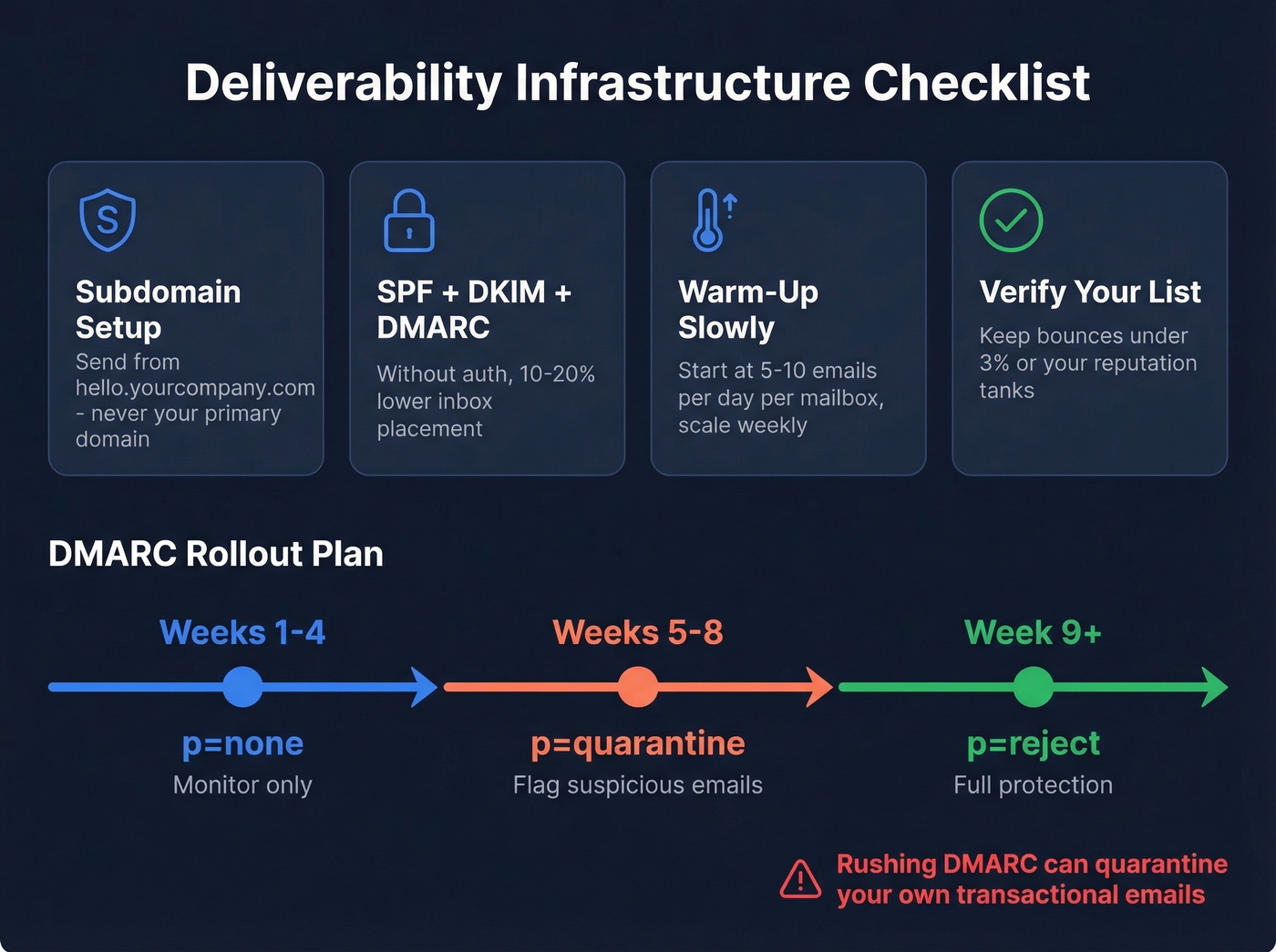
Use a subdomain. Send from hello.yourcompany.com, never your primary domain. One spam complaint wave and your entire company email reputation is toast. (If you’re unsure how to set this up, see tracking domain basics.)
Set up SPF, DKIM, and DMARC. Emails without proper authentication see 10-20% lower inbox placement. Watch the SPF 10-lookup limit - exceeding it breaks SPF entirely. For a deeper walkthrough, use our email deliverability guide.
Roll out DMARC gradually. Weeks 1-4: p=none. Weeks 5-8: p=quarantine. Week 9+: p=reject. Rushing this is how you accidentally quarantine your own transactional emails. (More on DMARC alignment if you’re troubleshooting.)
Warm up slowly. Start at 5-10 emails per day per mailbox and scale weekly. Keep an eye on email velocity so you don’t spike volume too fast.
Keep bounces under 3%. If you're above that, your list is the problem - not your copy. Stale data wrecks sender reputation faster than bad messaging ever will. Use email bounce rate benchmarks to diagnose what’s happening.
Small cohorts with signal-based targeting drive 2.76x more replies. Prospeo's 30+ filters - buyer intent, job changes, funding rounds, tech installs - let you build those tight 50-contact lists in minutes, not hours. Every email verified at 98% accuracy for $0.01 each.
Build signal-rich outbound lists that actually convert to meetings.
Writing Emails That Get Replies
The 3-7-7 cadence captures 93% of replies by Day 10. Your first three touches do almost all the heavy lifting.
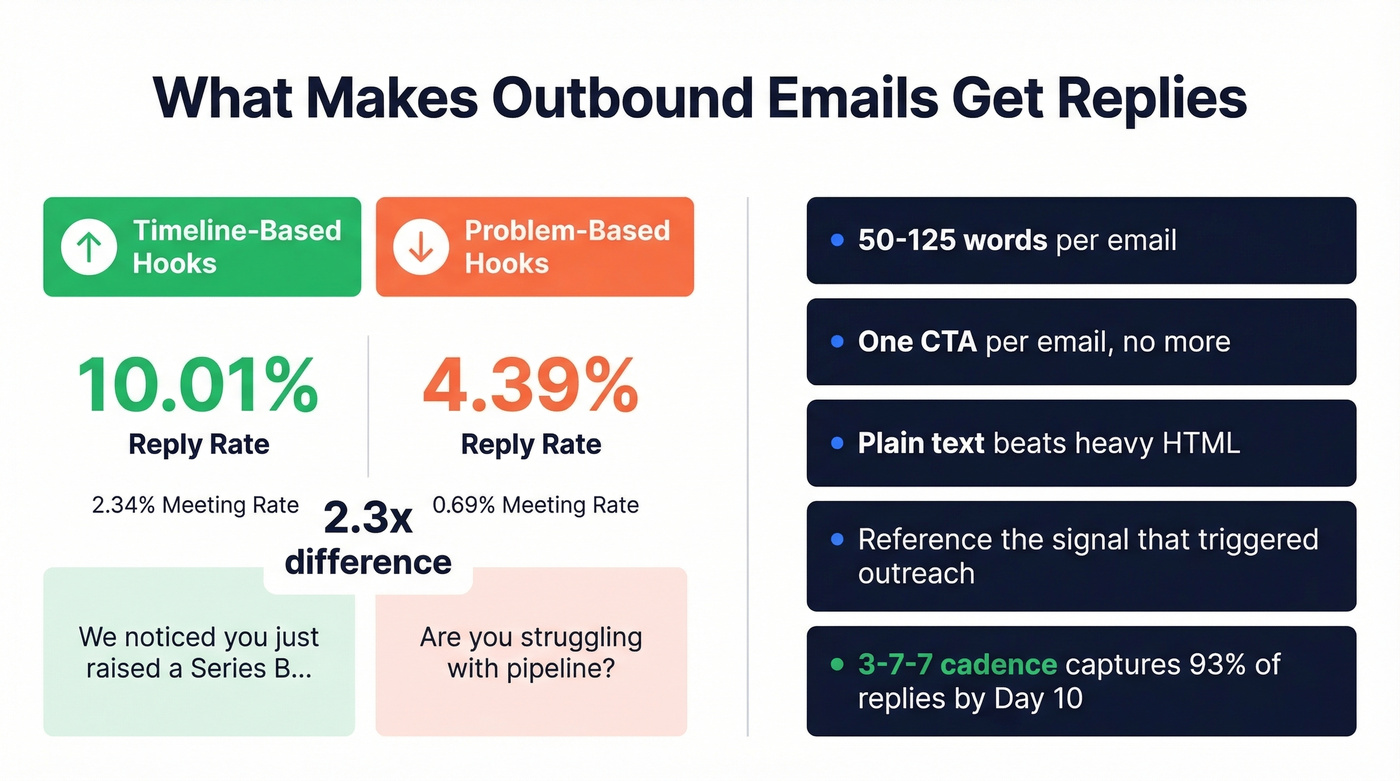
Keep emails between 50 and 125 words. One CTA per email. A common tip on r/coldemail is clear subject lines that "tell, don't sell" (steal ideas from these cold email subject line examples). Personalize beyond first name - reference the signal that triggered the outreach. And remember, 42% of replies come from follow-ups, yet 48% of reps never send a second email. The math is obvious.
Here's my hot take: if you're closing deals under $10k, you don't need a 12-step multichannel sequence. Three tight emails with a timeline-based hook will outperform the elaborate playbook every time. The same four bottlenecks show up over and over - deliverability, irrelevant messaging, bad ICP definition, and boring asks - and none of those are solved by adding more steps. If you want plug-and-play copy, use these cold email follow-up templates.
Early adopters of personalized video outreach report up to 7x higher click-through rates vs. static text. Worth testing if your deal size justifies the production time, but skip this if your average contract value is under $25k - the ROI on video production just doesn't pencil out at that level. (If you do test it, see Loom video cold email tactics.)
Best Tools for Sending
The fully loaded SDR stack can exceed $1,000/user/month-the-definitive-guide-to-ai-outreach-tools-for-sales-teams). Keep it lean. If you’re rebuilding your stack, start with a ranked list of SDR tools.
| Tool | Best For | Starting Price | Key Strength |
|---|---|---|---|
| Instantly | Solo/SMB volume | ~$37/mo | Easy setup, lead DB |
| Smartlead | Agencies, 100K+ | ~$32/mo | Inbox rotation |
| Lemlist | Personalization | $79/user/mo | Dynamic content |
| Woodpecker | Small teams | $24/mo | Simple UI |
| Saleshandy | Budget-friendly | $36/mo | Unified inbox |
For teams sending under 50K emails/month, Instantly is the simplest starting point. Agencies running 100K+ should look at Smartlead for inbox rotation. When personalization is the priority and you've got the budget, Lemlist earns its premium. All five integrate natively with Prospeo, so verified contacts flow straight into sequences without CSV exports or manual imports.
Compliance Essentials
Laws apply based on where your recipient sits, not where you send from.
| Regulation | Consent Model | Unsubscribe Window | Max Penalty |
|---|---|---|---|
| CAN-SPAM | Opt-out | 10 business days | $53,088/email |
| GDPR | Explicit opt-in | Without delay | EUR 20M or 4% revenue |
| CASL | Opt-in | 10 business days | $10M CAD |
Every cold message needs a valid physical address and a working unsubscribe link. No exceptions. If you’re unsure about list sourcing, read Is It Illegal to Buy Email Lists?.
Mistakes That Kill Campaigns
We've seen teams burn through domains in weeks by ignoring the basics:
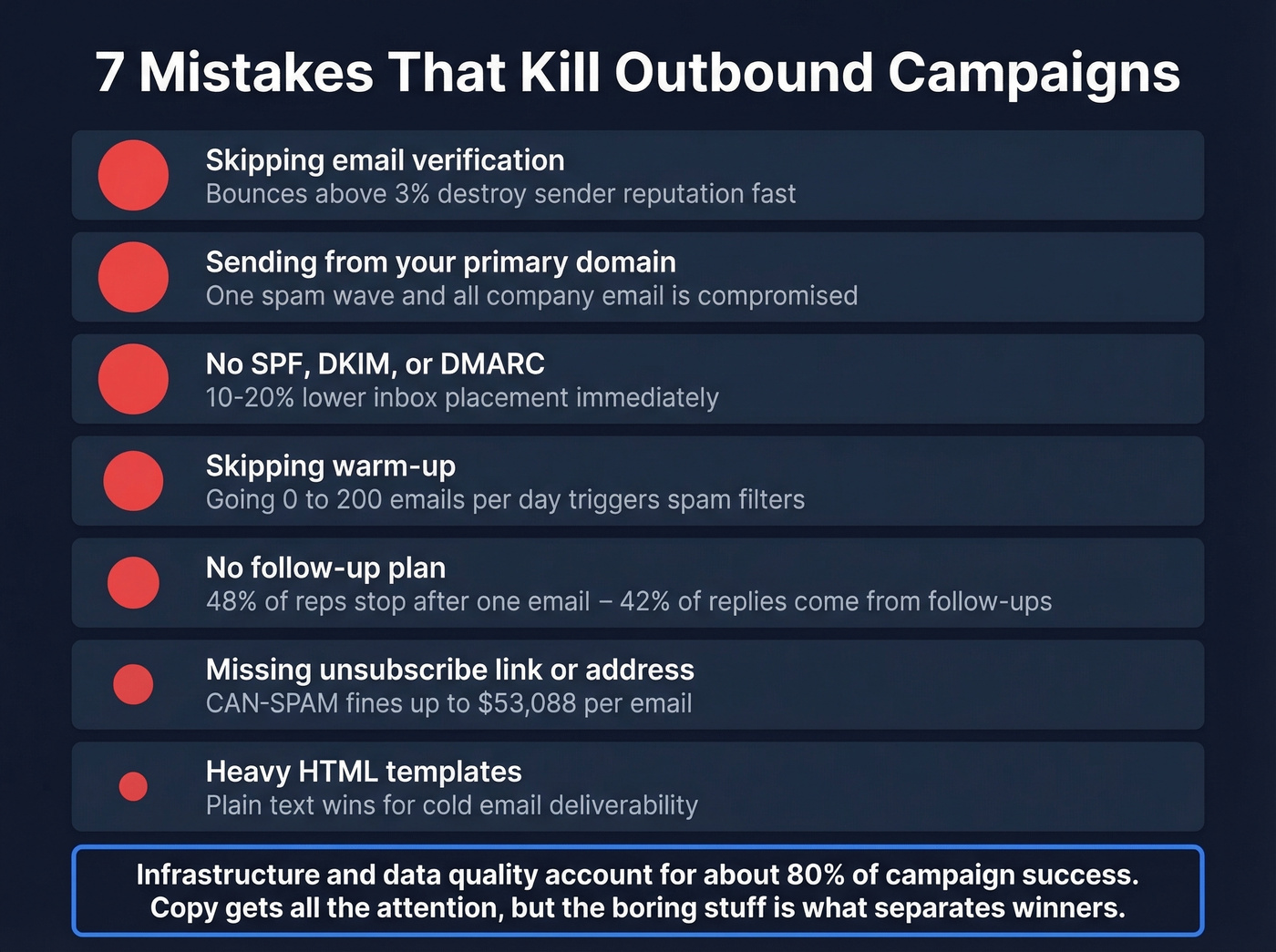
- Skipping warm-up - going from 0 to 200 emails/day overnight
- Sending from your primary domain
- Not verifying your list before launch
- No follow-up plan (48% of reps stop after one email)
- Missing unsubscribe link or physical address
- Skipping SPF/DKIM/DMARC authentication
- Heavy HTML - plain text wins for cold email
Look, if there's one thing to take away from this entire article, it's that infrastructure and data quality account for about 80% of campaign success. Copy gets all the attention, but the boring stuff is what separates teams booking 20 meetings a month from teams wondering why nobody replies.
FAQ
How many follow-ups should I send?
Send 4-6 emails per sequence. 42% of replies come from follow-ups, and the 3-7-7 cadence captures 93% of replies by Day 10. After that, diminishing returns kick in hard.
What's a good reply rate for cold outbound?
The 2026 average is 3.43%. Top performers hit 15-25% by combining signal-based targeting with small cohorts of 50 or fewer contacts. Below 2%, audit data quality and deliverability before rewriting copy.
How do I keep outbound emails out of spam?
Authenticate your domain with SPF, DKIM, and DMARC, use a dedicated subdomain, warm up gradually starting at 5-10 sends/day, and keep bounces under 3%. Verify every address before sending - a 5-step verification process that removes spam traps and honeypots makes a massive difference here.
What's the cheapest way to verify emails at scale?
Several tools offer verification at roughly $0.01 per email. Prospeo hits 98% accuracy with catch-all handling included, and the free tier gives you 75 verified emails per month - enough to test a first campaign without spending anything.