

Outbound Lead Generation Strategies: The 2026 Operational Playbook
Your team sent 10,000 cold emails last month. Reply rate: 0.8%. The SDRs blame the copy. Marketing blames the list. The VP of Sales blames everyone. Here's what actually happened: 2,300 of those emails bounced, your domain reputation is cratered, and half the phone numbers in your CRM belong to people who changed jobs eight months ago.
Most outbound lead generation strategies fail because of infrastructure, not messaging. Let's fix the foundation first, then talk tactics.
What You Need Before Anything Else
Skip the subject line debates. Get these three pillars right:
- Deliverability foundation. SPF, DKIM, DMARC configured. Secondary sending domains warmed up. Bounce rate under 2%. If you skip this, nothing else matters.
- Verified data. 98% verified emails and confirmed mobile numbers on a weekly refresh cycle - that's the baseline, not a nice-to-have.
- Short multichannel cadences. 4-5 touches across email, phone, and social. Not 9-step sequences that annoy prospects and tank your sender reputation.
The Foundation Nobody Talks About
Most outbound advice jumps straight to tactics without addressing why campaigns break before a single prospect reads a word. The foundation is boring. It's also where 80% of outbound marketing lead generation failures start.
Email Deliverability Requirements
Google and Yahoo enforce bulk sender rules that went into effect in 2025, with Microsoft applying similar requirements for Outlook.com. If you're sending more than a few hundred emails a day, these aren't optional:
- SPF, DKIM, and DMARC must be configured on every sending domain. No exceptions.
- RFC 8058 one-click unsubscribe (List-Unsubscribe + List-Unsubscribe-Post headers) is required.
- Spam complaints must stay under 0.3%. Bounce rates must stay under 2%.
Miss any of these and your emails land in spam - or don't get delivered at all. We've seen teams lose months of pipeline because they skipped DMARC setup on a new domain. Google's bulk sender guidelines are the reference document.
Infrastructure Math
Never send outbound from your primary domain. Buy secondary domains - variations of your brand - and plan your infrastructure around these numbers:
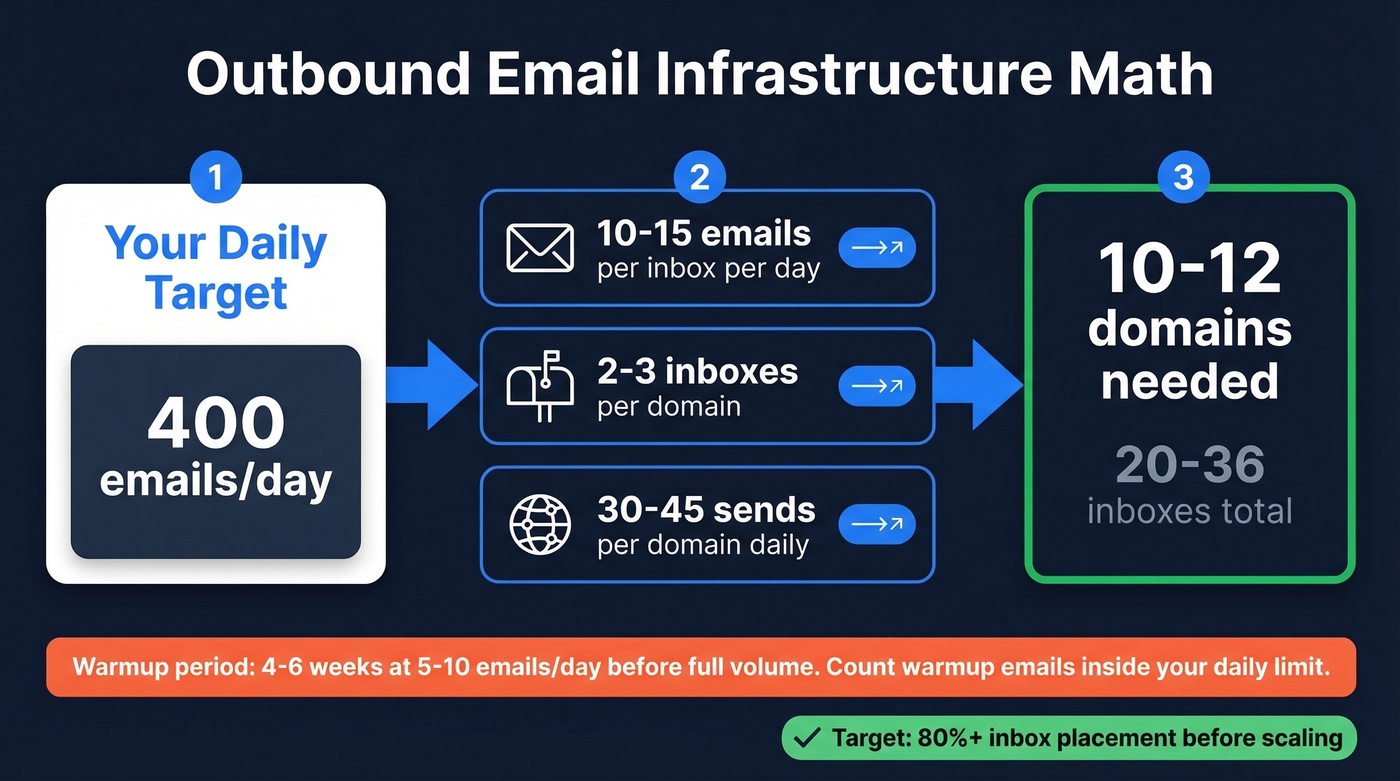
- 2-3 inboxes per domain
- 10-15 emails per inbox per day
- Roughly 30-45 sends per domain daily
Want to send 400 emails a day? You need around 10-12 domains. Each domain needs a warmup ramp starting at 5-10 emails per day, scaling gradually over 4-6 weeks before you push volume. During active campaigns, count warmup emails inside your daily limit - if your cap is 30/day per inbox, that's 25 outreach plus 5 warmup. Don't scale until seed tests show 80%+ inbox placement.
This math isn't glamorous, but it's the difference between 80%+ inbox placement and landing in spam.
Data Quality Is the Silent Killer
B2B contact data decays at roughly 2.1% per month - that's 22.5% annually, and some estimates run as high as 70% depending on industry. Reps lose 27.3% of their selling time chasing contacts who've moved on.
If your bounce rate crosses 2%, email providers start throttling your domain. Bad data doesn't just waste time - it actively destroys your ability to reach anyone. Your data provider matters more than your sequencing tool.
Meritt, an outbound agency, saw their bounce rate drop from 35% to under 4% after switching to Prospeo's verified data, and their pipeline tripled from $100K to $300K per week. That's not a copywriting improvement. That's a data quality improvement.

7 Techniques That Work in 2026
Cold Email
The average cold email reply rate is 3.43%. Top-quartile campaigns hit 5.5%, and elite operators exceed 10%. For B2B SaaS specifically, expect reply rates of 1-3% average and 4-8% top quartile, with meeting booked rates of 0.3-0.8% average and 1-2% top quartile. Below 1%? The problem isn't your copy - it's deliverability or targeting.
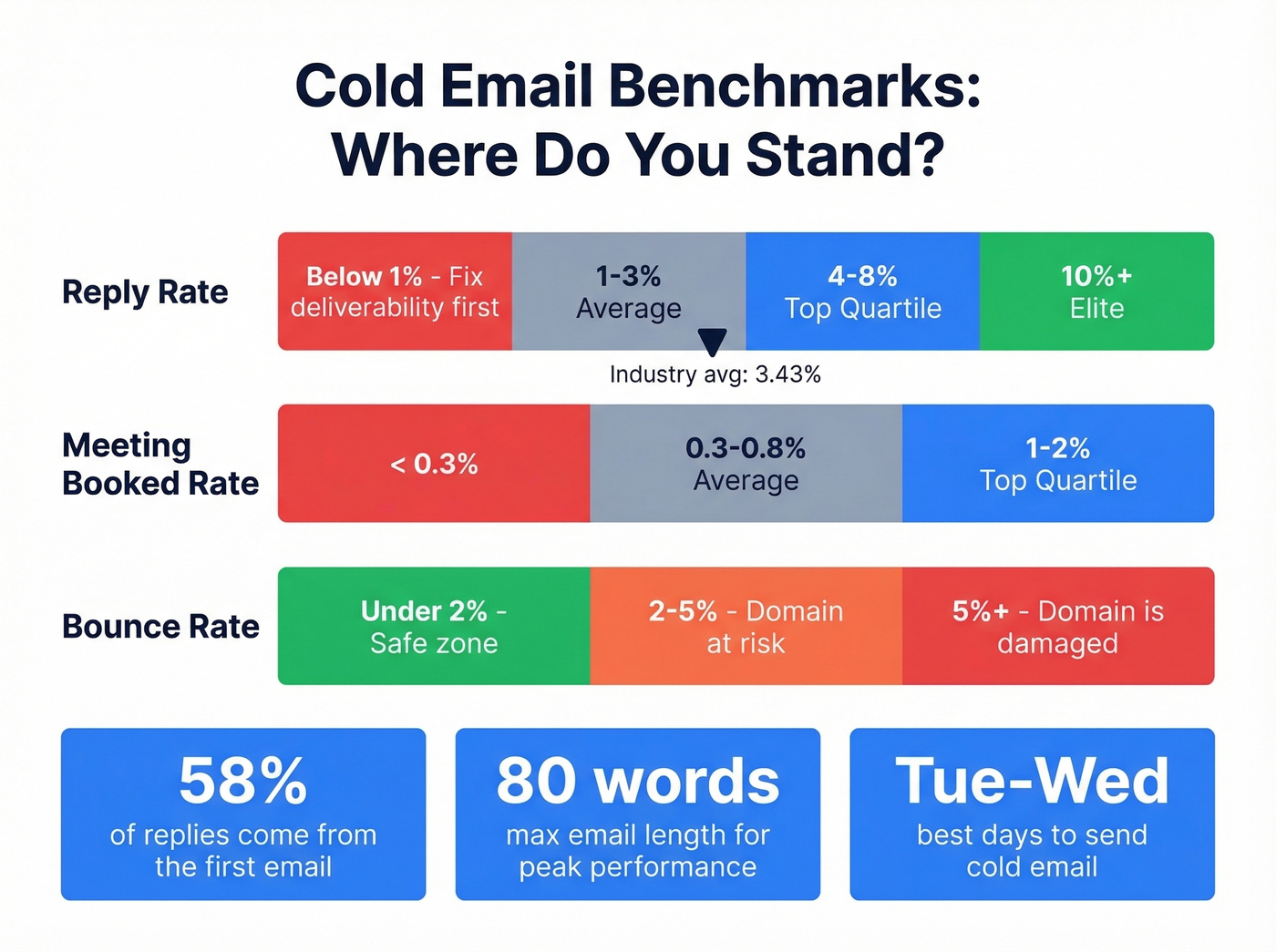
58% of all replies come from the first email. Follow-ups contribute the remaining 42%, but with sharply diminishing returns after touch 3 or 4. One agency owner running six-figure campaigns put it bluntly: "3-4 emails max. 7-9 step sequences underperform." Keep emails under 80 words, send Tuesday through Wednesday for peak engagement, and A/B test subject lines weekly.
If your reply rate is stuck below 1% after three emails, stop rewriting copy. Check your domain reputation, verify your list, and confirm your infrastructure math. The problem is upstream.
If you need a tighter system for touch 2-4, use proven sales follow-up templates instead of improvising.
Cold Calling
Cold calling is the most expensive outbound channel per touch - 209 calls per appointment, 7.5 hours of dialing time per meeting booked. 80% of calls go to voicemail. When you do connect, successful calls average 5:50 in duration versus 3:14 for calls that go nowhere.
The math changes dramatically with verified mobile numbers. Most teams work with unverified lists and see 5-10% connect rates. Verified mobiles flip the equation entirely: fewer dials, more conversations, more pipeline. For direct sales prospecting, nothing beats a live conversation with a decision-maker.
If you're building a repeatable calling motion, a dedicated cold calling system matters as much as scripts.
Here's the thing: if your average deal size is under $10K, cold calling probably isn't worth the cost. The CPL math ($300/lead) only works when deal sizes justify the rep time. For lower-ACV products, put that budget into email infrastructure and multichannel sequences instead.
Social Selling
Social selling works best as a supporting channel, not a standalone strategy. Send a connection request that references your prior email outreach, engage with the prospect's content for a few days, then follow up with a warm message.
A cold connection request with a pitch gets ignored. A connection request that says "saw my email might've gotten buried - wanted to connect here too" feels natural. This is a multiplier on your email and phone efforts, not a replacement.
Multichannel Sequences
Multichannel outreach - combining email, phone, and social - increases response rates by 30-50% compared to single-channel campaigns. Hybrid inbound+outbound approaches reduce lead costs by 31% according to Forrester research.
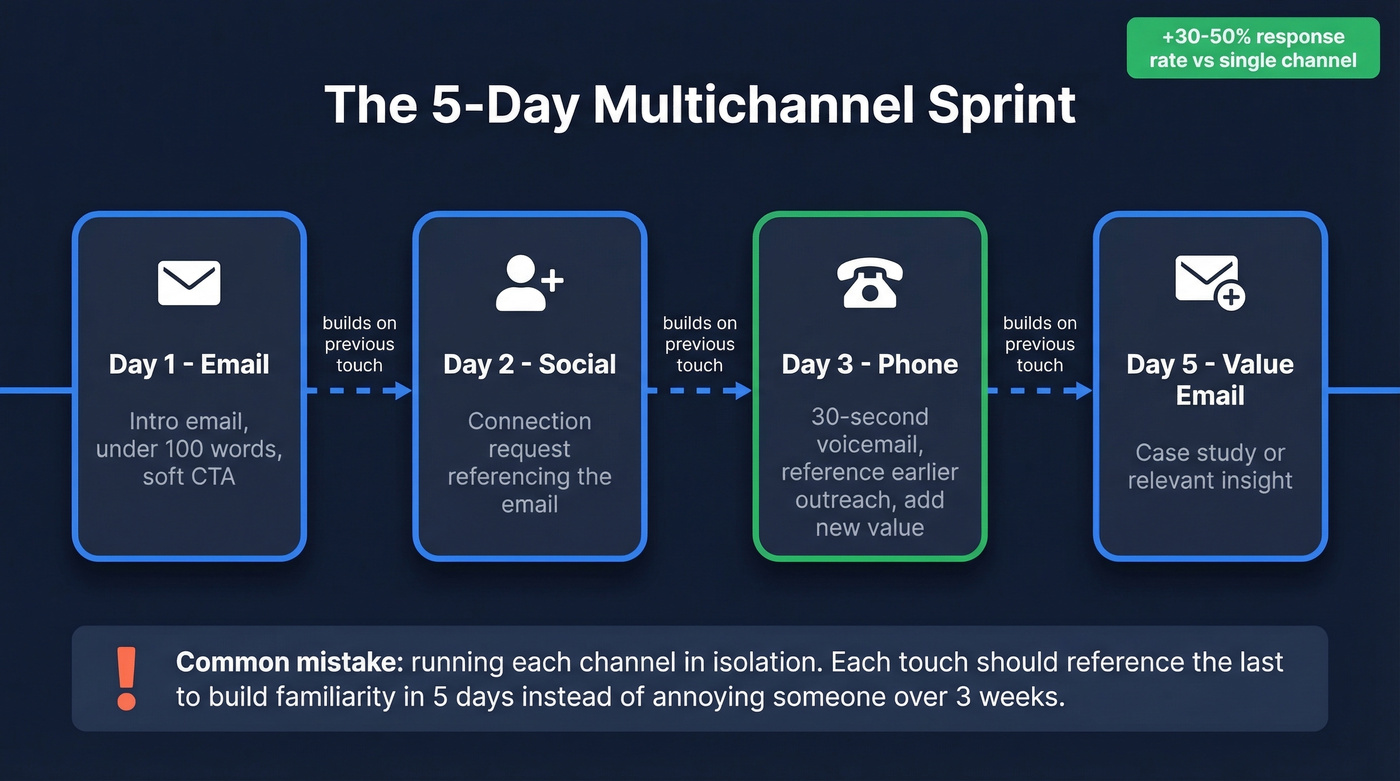
The mistake most teams make is running each channel in isolation. Your SDRs send emails in one tool, make calls from another, and do social outreach manually. The sequence should be orchestrated: email on Day 1, connection request on Day 2, call on Day 3, value email on Day 5. Each touch references the last. That's how you build familiarity in a 5-day window instead of annoying someone over 3 weeks.
If you want more options beyond the two cadences below, see these sales prospecting techniques and adapt them to your ICP.
Account-Based Outbound
For enterprise and high-ACV deals, spray-and-pray outbound doesn't work. Account-based outbound means selecting 50-200 target accounts, mapping 3-5 stakeholders per account, and running coordinated sequences across the buying committee. A SaaS company targeting 100 accounts with 3 stakeholders each creates 300 contacts to sequence - manageable volume with high precision.
Layer intent data to prioritize accounts showing active buying signals. Combine intent signals with multi-threaded outreach - reaching the VP of Engineering, the CTO, and the Director of Security simultaneously - and you're booking C-suite meetings instead of getting ignored by gatekeepers. We've found that multi-threading into three or more contacts per account roughly doubles the meeting-booked rate compared to single-threading, especially when you can time outreach to intent spikes.
To operationalize this, borrow the structure from account-based selling best practices.
Referral-Based Outbound
| Channel | Avg CPL |
|---|---|
| Referrals | $25 |
| Cold email | $225 |
| Cold calling | $300 |
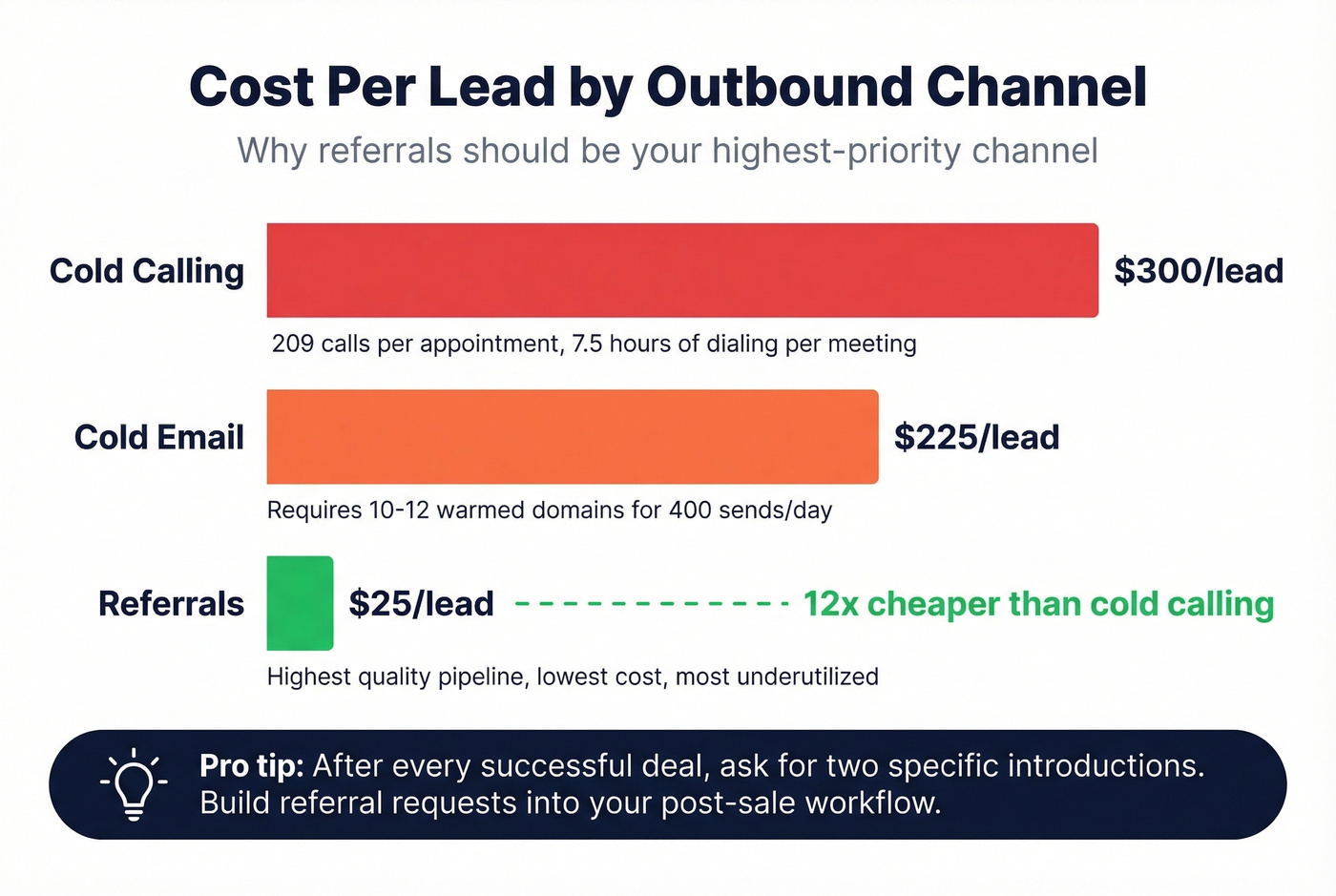
Referrals have the lowest cost per lead of any channel, but most teams treat them as passive - waiting for happy customers to volunteer introductions. Systematize it instead. After every successful deal, ask for two specific introductions. Build referral requests into your post-sale workflow.
The teams that treat referrals as a proactive prospecting channel consistently generate their highest-quality pipeline. Skip this if your product has a long implementation cycle and customers aren't seeing value yet - asking for referrals before the customer is happy backfires fast.
Video Prospecting
When a prospect has ignored your first two emails, a 30-60 second personalized Loom or Vidyard video in the third touch stands out. Embed the video thumbnail as a GIF in the email - clickthrough rates on video thumbnails run 2-3x higher than text links.
Keep it short, reference something specific about their company, and include a clear ask. A webcam recording with their website pulled up behind you is more authentic than a polished marketing video. Don't over-produce it.
If you want a repeatable format, use a dedicated Loom video cold email workflow.

You just read the infrastructure math: 2% bounce ceiling, verified contacts, weekly refresh. Prospeo delivers 98% email accuracy with a 7-day data refresh cycle - not the 6-week industry average that lets 22.5% of your list decay. Meritt cut their bounce rate from 35% to under 4% and tripled pipeline to $300K/week.
Stop burning domains on bad data. Start with verified contacts at $0.01 each.
Day-by-Day Cadence Templates
Cadence 1: The 5-Day Sprint
- Day 1 - Intro email, under 100 words, soft CTA ("worth a conversation?")
- Day 2 - Connection request referencing the email
- Day 3 - Phone call + 30-second voicemail referencing earlier outreach and adding new value
- Day 5 - Value email with a relevant case study or insight
Cadence 2: The 10-Day Build
- Day 1 - Connection request (no pitch - just connect)
- Day 2 - Personalized cold email referencing something specific about their business
- Day 4 - Follow-up email with a helpful resource (benchmark, report, framework)
- Day 7 - Phone call or voicemail
- Day 10 - Social message referencing their recent activity or content
Both cadences are starting points. The consensus among practitioners running high-volume outbound - and threads on r/sales back this up consistently - is that shorter, tighter sequences outperform long drip campaigns. Three to four emails inside a broader 4-7 touchpoint multichannel cadence is where performance usually peaks. If you're not getting replies by touch 4, the problem isn't persistence. It's targeting or deliverability.
If you need a scoring model to tighten targeting, start with an ideal customer profile before you touch copy.
The Outbound Sales Tech Stack
The 4-Layer Stack
Your outbound stack has four jobs. Don't let any single tool try to do all four.
| Layer | Job | Tools | Starting Price |
|---|---|---|---|
| Data & Signals | Find, verify, enrich | Prospeo, Apollo, Clay | Free-$134/mo |
| Execution | Send sequences | Smartlead, Instantly, Salesloft, Outreach | $30-$150/user/mo |
| CRM | System of record | HubSpot, Salesforce | Free-$25/user/mo |
| Social Prospecting | Network outreach | Sales Navigator, HeyReach | ~$80-$100/mo |
If you're evaluating options, compare your shortlist against these outbound lead generation tools so you don't overbuy.
AI in Outbound - What's Real
AI tools are genuinely useful for enrichment, personalization at scale, and lead prioritization. Clay ($134/mo) handles waterfall enrichment. Apollo ($49/user/mo) combines data with sending. Smartlead ($39/mo) automates high-volume email. Salesloft and Outreach handle enterprise-grade sequencing in the $75-$150/user/mo range.
Let's be honest about what we've watched happen: teams spend $3K/month on AI personalization while sending from a domain with a 15% bounce rate. The AI writes beautiful emails that land in spam. Fix the plumbing first. AI amplifies whatever you already have - good infrastructure or bad.
If you're using AI to scale outreach, align it with a real AI cold email outreach process (and keep deliverability non-negotiable).
What Outbound Actually Costs
Outbound is mid-range on a cost-per-lead basis, and significantly cheaper than most inbound channels.
| Channel | Avg CPL |
|---|---|
| Referrals | $25 |
| Affiliate | $73 |
| Multi-channel prospecting | $188 |
| SEO | $206 |
| Cold email | $225 |
| Cold calling | $300 |
| LinkedIn ads | $408 |
| PPC | $463 |
| Events | $840 |
Industry matters too. B2B SaaS averages $188/lead, while financial services runs $461, IT/managed services hits $501, and legal services reaches $650. Company size shifts the math: businesses under 50 employees typically pay $146/lead, while enterprise organizations average $429/lead.
The takeaway for budget conversations: outbound isn't cheap, but it's controllable. You know exactly what you're spending per touch, per meeting, per opportunity. That predictability is worth a lot when the board wants pipeline forecasts.
If you want to pressure-test your numbers, track the right lead generation metrics instead of vanity stats.
Mistakes That Kill Outbound Campaigns
Five failure modes we see repeatedly:
Skipping SPF/DKIM/DMARC. Without proper authentication, your emails don't reach inboxes. Period.
Using open and click tracking pixels. Tracking pixels trigger spam filters. Our own testing confirms it, and the practitioner consensus is clear: turn them off for cold outbound. Measure replies, not opens. (If you need the technical why, see email tracking pixels.)
Running 7-9 step sequences. Shorter sequences of 3-4 emails consistently outperform longer ones. If you haven't gotten a reply by email 4, more emails won't help.
Sending from your primary domain. One deliverability hit on your main domain affects every email your company sends - marketing, support, invoicing. Always use secondary domains.
Trusting platform-reported metrics. Apollo's built-in analytics have been flagged by practitioners for inflating engagement numbers, and its Twilio-based VoIP dialer numbers frequently get flagged as spam by recipients. Verify deliverability independently with seed tests and third-party tools like GlockApps or Mail Tester.
Even the best outbound lead generation strategies fall apart when the infrastructure underneath them is broken. Audit your foundation quarterly.
If you're troubleshooting bounces specifically, use this email bounce rate guide to map codes to fixes.
Cold calling 209 times per appointment only works with real phone numbers. Prospeo's 125M+ verified mobiles deliver a 30% pickup rate - triple what teams see with unverified lists. Pair that with 300M+ profiles and 30+ filters including buyer intent and job change signals to build lists that actually convert across every channel.
Build multichannel sequences on data that connects you to real decision-makers.
FAQ
What's the difference between inbound and outbound lead generation?
Inbound attracts prospects through content, SEO, and ads. Outbound means reaching out directly via cold email, cold calling, and social selling. Most successful B2B teams run both - hybrid approaches reduce cost per lead by 31% compared to running either channel alone.
How many emails should a cold sequence include?
Three to four. 58% of replies come from the first email, and practitioners running six-figure campaigns consistently report diminishing returns beyond step four. If you're below 1% reply rate after three sends, fix deliverability or targeting - not sequence length.
What's a good cold email reply rate in 2026?
The average is 3.43%, top-quartile campaigns hit 5.5%, and elite operators exceed 10%. B2B SaaS narrows to 1-3% average and 4-8% top quartile. Below 1%, check your deliverability setup and data quality before rewriting copy.
What tools do you need for outbound prospecting?
Four layers: a data provider, a sequencing tool like Smartlead or Instantly, a CRM, and a social prospecting tool. A lean stack runs $200-$600/month for most small teams. Don't over-buy until your infrastructure and data quality are solid.
How much does outbound lead generation cost per lead?
Multi-channel prospecting averages $188 per lead, cold email about $225, and cold calling roughly $300. The biggest variable is data quality - bad data inflates CPL by wasting rep time and destroying domain reputation. Companies under 50 employees typically pay $146/lead; enterprise averages $429/lead.