

Outbound Sales: The Practitioner's Playbook for 2026
You pull the monthly report. Reply rates dropped 40% quarter-over-quarter. The team blames messaging - "we need better subject lines," someone says in the Slack thread. But the real problem is in the bounce log: 30% of your emails never reached a human inbox, and your sending domain just got flagged.
The 2019 outbound sales playbook didn't just stop working. It started actively hurting the teams still running it.
Reply rates that averaged 6.8% in 2023 dropped to 5.8% in 2024, and current benchmarks put the average at 3.43%. Buyers now use roughly 10 interaction channels on average, up from 5 in 2016, and spend just 17% of their buying time meeting with suppliers. Gmail tightened complaint thresholds. Microsoft tightened sending rules. The infrastructure that used to tolerate sloppy outbound no longer does.
84% of reps missed quota last year. That's not a messaging problem - it's a structural one. Teams are running high-volume playbooks into an environment that punishes volume and rewards precision.
What Separates the Teams That Book Meetings
Outbound isn't dead, but the version most teams are running might as well be. Three things separate the teams booking meetings from the ones burning through SDR headcount:
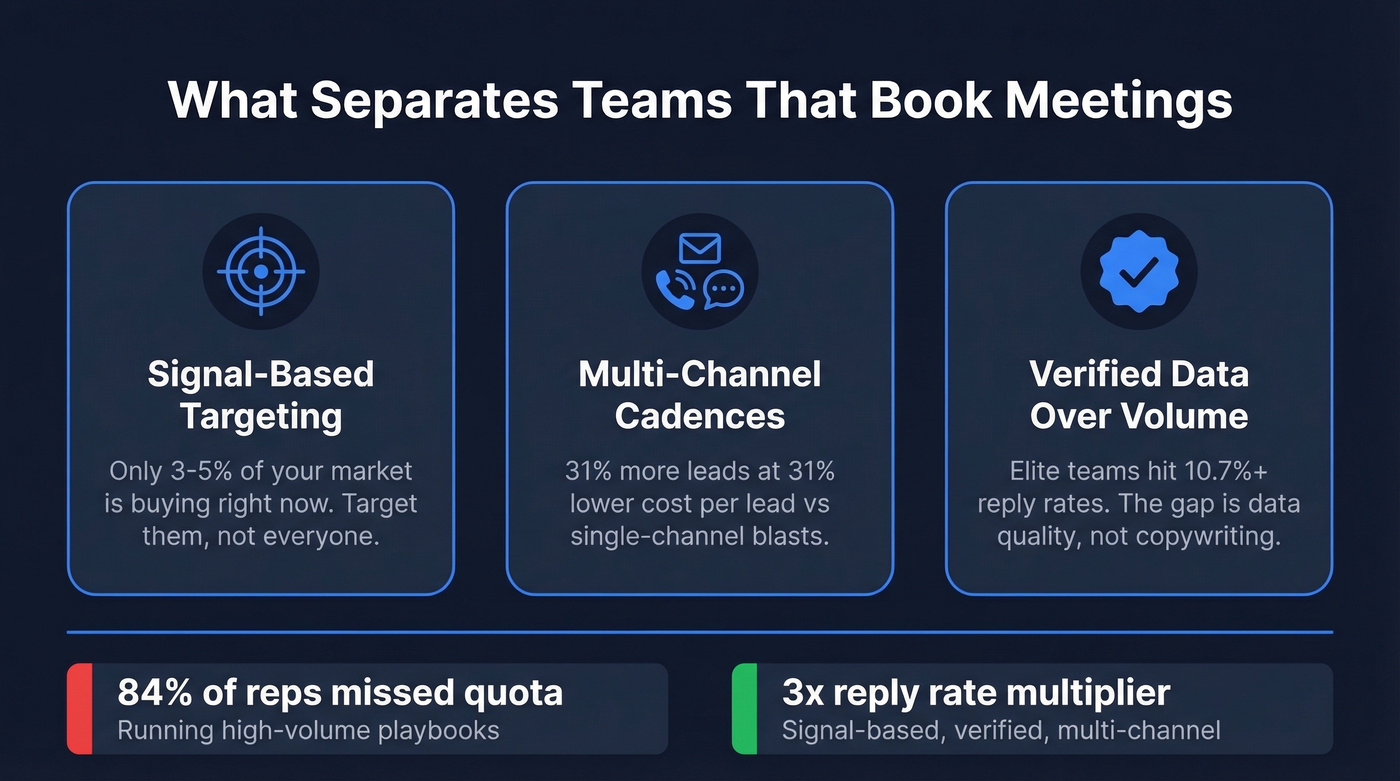
Signal-based targeting over spray-and-pray. Only 3-5% of your market is buying right now. Blasting your entire TAM means most of your emails are irrelevant by definition.
Multi-channel cadences over single-channel blasts. Multi-channel campaigns generate 31% more leads at 31% lower cost per lead than single-channel, with 40%+ better engagement overall.
Verified data over volume. Top-quartile teams hit 5.5% reply rates. Elite teams reach 10.7%+. The difference isn't copywriting talent - it's data quality and targeting.
What Is Outbound Sales?
Outbound sales is seller-initiated outreach. You identify prospects, you contact them, you create the conversation. The prospect didn't raise their hand - you reached out because they fit your ideal customer profile and you believe you can help. Any sales activity where the seller makes the first move rather than responding to inbound demand falls under this umbrella.
SDRs and BDRs handle prospecting and qualification: building lists, sending sequences, booking meetings. AEs take the qualified meeting, run discovery, and close. Some orgs blur these lines, but the handoff from "book the meeting" to "close the deal" is the fundamental division.
80% of high-performing sales teams still rely on outbound. 43% run a hybrid model where the same function handles both inbound and outbound. Proactive prospecting isn't optional for teams that want predictable pipeline - it's how you control your own revenue trajectory instead of waiting for marketing to deliver leads.
Outbound vs. Inbound
The comparison isn't "which is better" - it's "which do you need right now." Teams that integrate both see up to 38% higher revenue growth.
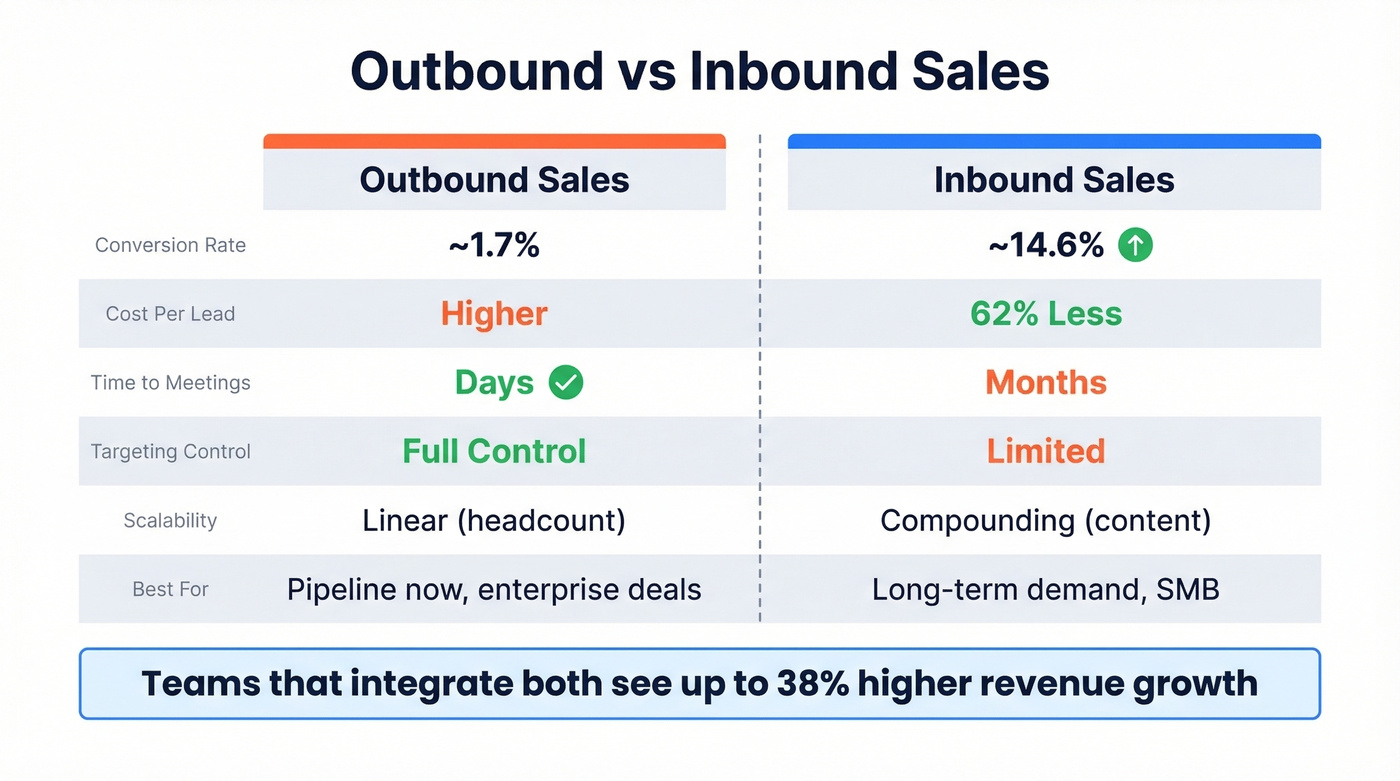
| Dimension | Outbound | Inbound |
|---|---|---|
| Conversion rate | ~1.7% | ~14.6% |
| Cost per lead | Higher | 62% less |
| Time to meetings | Days | Months |
| Targeting control | Full | Limited |
| Scalability | Linear (headcount) | Compounding (content) |
| Best for | Pipeline now, enterprise | Long-term demand, SMB |
Inbound converts at about 8.6x the rate and costs significantly less per lead. But inbound takes months to build and you can't control who shows up. Outbound lets you pick your targets and generate meetings within days. For enterprise deals with long sales cycles and multiple stakeholders, seller-initiated outreach is often the only path to the right people at the right time.
2026 Benchmarks That Matter
Numbers matter because they set expectations. If your team thinks a 2% reply rate means the messaging is broken, they'll waste weeks rewriting emails when the real issue is list quality or deliverability.
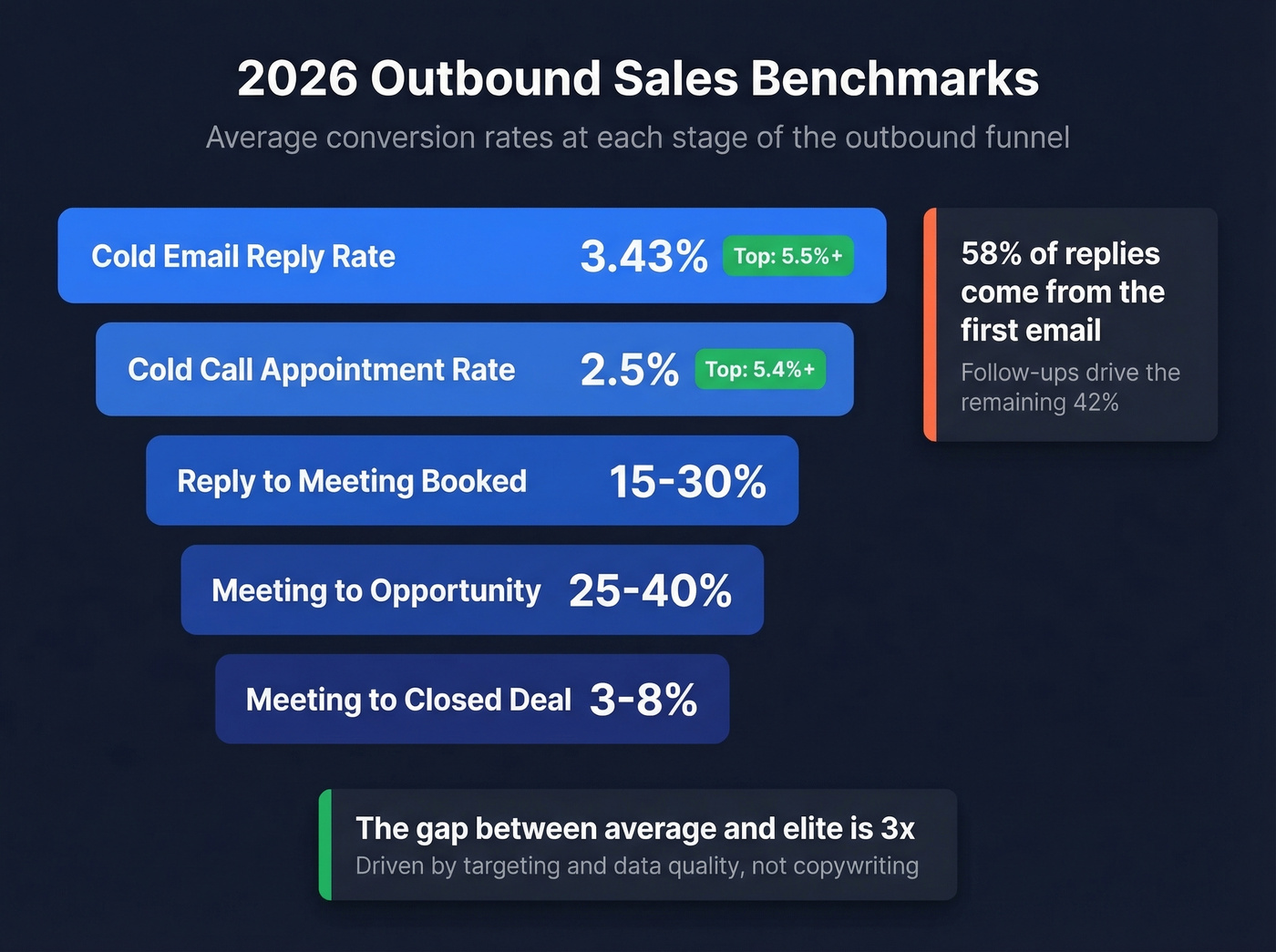
| Metric | Average | Top Quartile |
|---|---|---|
| Cold email reply rate | 3.43% | 5.5%+ |
| Cold call appointment rate | 2.5% | 5.4%+ |
| Meeting book rate | 1.5-4% of sequences | - |
| Reply to meeting | 15-30% | - |
| Meeting to opp | 25-40% | - |
| Meeting to closed deal | 3-8% | - |
58% of replies come from the first email. Follow-ups drive the remaining 42%, but the first touch does the heavy lifting. If your first email isn't strong, no amount of "just bumping this up" will save the sequence.
The gap between average and elite is a 3x multiplier. That gap comes from tighter ICP targeting, verified contact data, and relevance-based personalization - not better copywriting.
Here's the thing: most teams don't have a messaging problem. They have a targeting problem wearing a messaging costume. Fix the list before you rewrite a single subject line.
The Outbound Sales Process
Most deals require 5-12 touchpoints across multiple channels. The process below isn't linear - you'll loop between steps - but the sequence matters because each step depends on the one before it.
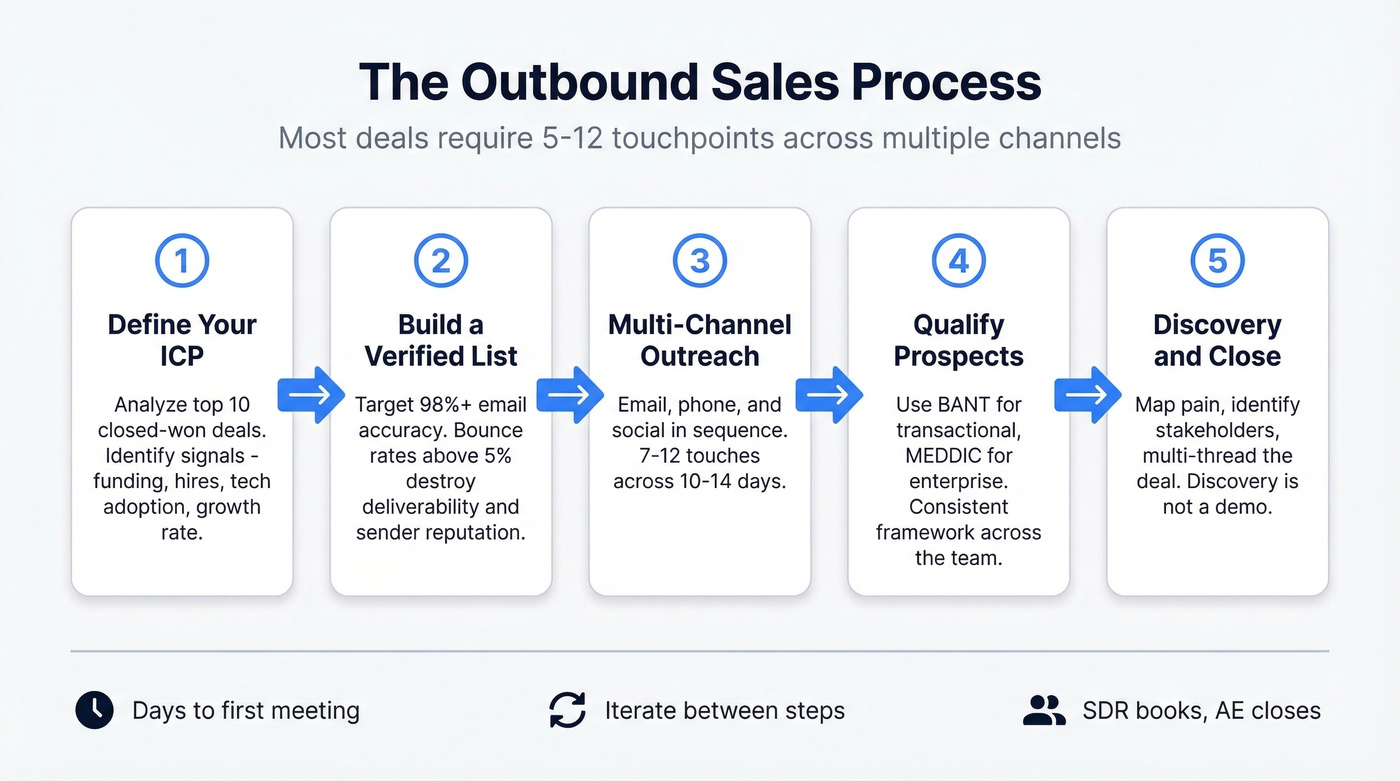
Define Your ICP
Your ICP isn't "companies with 50-500 employees in SaaS." That's a TAM definition, not a targeting framework. A real ICP includes signal-based criteria: recent funding rounds, VP-level hires in your target department, headcount growth above 20%, specific technology adoption.
Start with your best 10 closed-won deals. What did those companies have in common beyond industry and size? What was happening at those companies when they bought? That pattern is your ICP.
If you need a starting point, use an ICP template and scoring rubric.
Build a Verified List
This is where most outbound breaks down. We've seen teams spend weeks perfecting email copy while sending to lists with 25-30% bounce rates. Doesn't matter how good your subject line is if a third of your emails never arrive.
Prospeo's database covers 300M+ professional profiles with 98% email accuracy, verified through a 5-step process including catch-all handling, spam-trap removal, and honeypot filtering. Data refreshes every 7 days - the industry average is 6 weeks. You can filter by 30+ criteria including buyer intent, technographics, job changes, and headcount growth to build lists that match your signal-based ICP. Snyk's team of 50 AEs went from a 35-40% bounce rate to under 5%, generating 200+ new opportunities per month.

Launch Multi-Channel Outreach
Email, phone, and social - in sequence, not in isolation. The specific cadence template is in the channels section below, but the principle is simple: meet prospects where they are, and don't rely on a single channel to carry the conversation.
If you want more options beyond the baseline cadence, see these sales prospecting techniques.
Qualify Prospects
Once a prospect responds, you need a framework to determine fit. BANT (Budget, Authority, Need, Timeline) works for transactional sales. MEDDIC (Metrics, Economic Buyer, Decision Criteria, Decision Process, Identify Pain, Champion) is better for complex enterprise deals. Pick one, train your team on it, use it consistently.
For a deeper breakdown, use MEDDIC and keep a bank of MEDDIC discovery questions.
Run Discovery and Close
Discovery isn't a demo. It's a consultative conversation where you map the prospect's pain, identify stakeholders, and understand their decision process. The best discovery calls end with the prospect saying "yes, that's exactly our problem" - not with you walking through a slide deck.
For enterprise deals, multi-threading is non-negotiable. If you're single-threaded to one champion, you're one reorg away from a dead deal. Map the buying committee early and manage the timeline aggressively.
If your team needs a consistent closing framework, use these steps to close a sale.

You just read that 84% of reps missed quota - and the root cause is structural, not messaging. Prospeo's 300M+ profiles with 98% email accuracy, 30+ signal-based filters, and 7-day data refresh give your outbound the precision targeting this article describes. Snyk's 50 AEs dropped bounce rates from 35% to under 5% and generated 200+ opportunities per month.
Stop rewriting subject lines. Start fixing your list.
Channels and Tactics
Cold Email
What works: short emails under 125 words, a specific reason for reaching out tied to the prospect's situation, and a low-friction CTA. 60% of B2B decision-makers prefer email as the initial contact method.
What's dead: "I noticed your company is growing" openers, {first_name} as your only personalization token, and anything that reads like a template. Personalization means demonstrating you understand the prospect's specific context - their tech stack, a recent hire, a challenge specific to their role. We've tested dozens of opening lines across client campaigns, and the ones that reference a concrete signal outperform generic flattery by 2-3x every time.
If you’re rebuilding your library, pull from these cold email subject line examples and emails that get responses.
Cold Calling
Script-based cold calling outperforms unstructured approaches by 42%, and 69% of buyers accept cold calls from new providers. 57% of C-level execs actually prefer phone as an initial contact method.
The framework that consistently books meetings:
- Intro - Your name, company, one sentence max
- Permission-based hook - "How have you been?" shows 6.6x higher meeting odds than "Did I catch you at a bad time?"
- Personalized reason - Why you're calling them, not just anyone
- Value statement - One sentence on what you help companies like theirs achieve
- Discovery question - Open-ended, gets them talking
60% of cold calls hit "I'm not interested." Don't argue. Say: "Totally fair - quick question though: how are you currently handling [specific problem]?" You're not overcoming objections. You're opening a conversation.
If your reps struggle with pushback, train on cold call rejection.
Social Selling
Send a connection request before or alongside your first email. Don't pitch in the request. Engage with their content first if they're active. The goal is name recognition - when your email lands, they've already seen your face.
The Multi-Channel Cadence
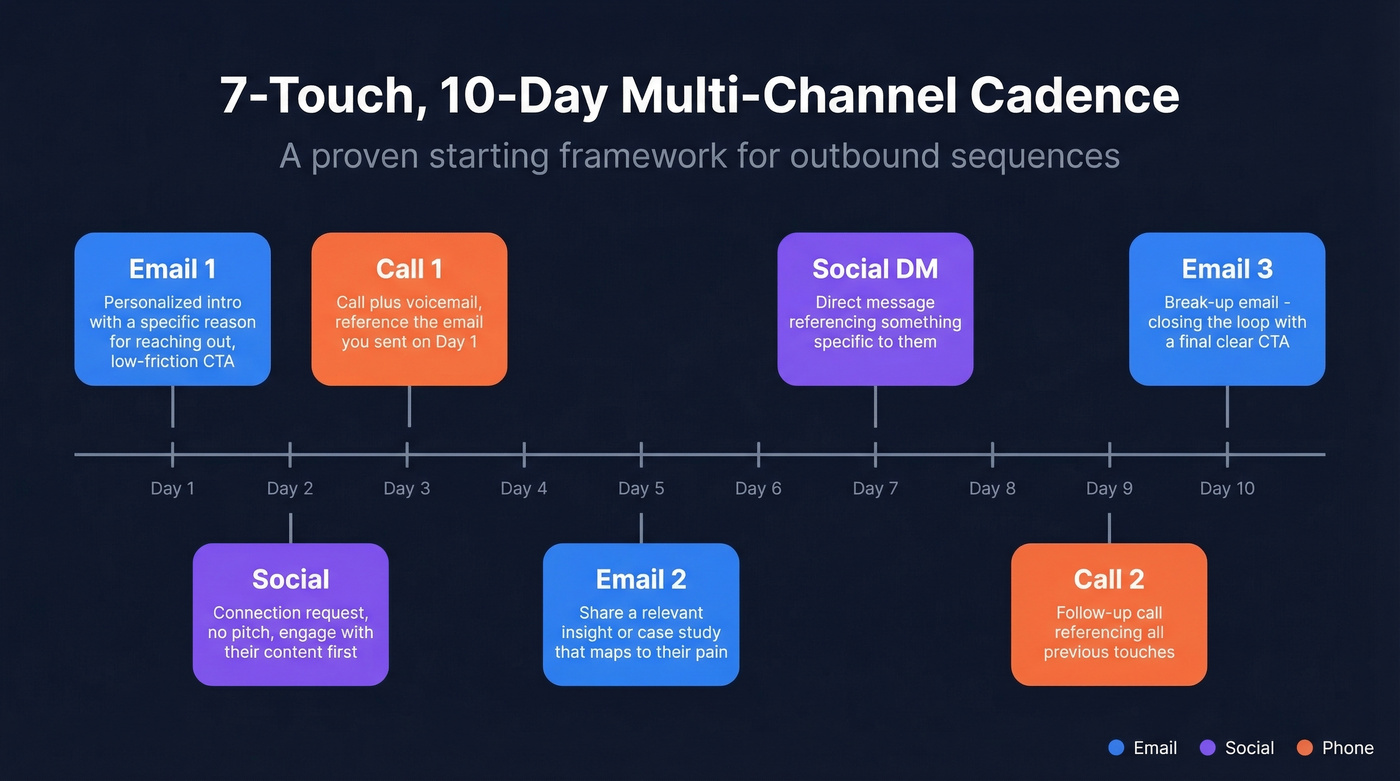
Here's a copy-paste 7-touch, 10-day cadence that works as a starting framework:
| Day | Channel | Action |
|---|---|---|
| 1 | Intro email - personalized reason + low-friction CTA | |
| 2 | Social | Connection request (no pitch) |
| 3 | Phone | Call + voicemail referencing the email |
| 5 | Value email - relevant insight or case study | |
| 7 | Social | Direct message on something specific |
| 9 | Phone | Follow-up call referencing previous touches |
| 10 | Break-up email - "closing the loop" with a final CTA |
For cold leads, 10-15 days with multiple touches per week is the sweet spot. Longer nurture cycles of 30-60 days work for enterprise accounts where timing matters more than urgency.
To tighten your follow-up copy, use these sales follow-up templates.
Deliverability Rules
You've read 10 articles that say "personalize your outreach." None of them told you that your emails aren't landing in the inbox. Deliverability is the boring part that everything else depends on.
Never cold email from your main corporate domain. Buy dedicated sending domains and use those exclusively for outbound. If a sending domain gets flagged, your corporate email keeps working.
Safe daily sending limits:
| Provider | Safe Limit | Technical Max |
|---|---|---|
| Google Workspace | 100-150/day | 2,000/day |
| Microsoft 365 | 100-150/day | 10,000 recipients |
| GoDaddy | 50-75/day | 250 recipients |
Warm-up ramp for new domains:
| Week | Daily Volume |
|---|---|
| 1 | 10-20 |
| 2 | 20-40 |
| 3 | 40-60 |
| 4 | 60-80 |
Full maturation takes 2-4+ weeks minimum. Rushing this is the number one way teams destroy a domain before they send a single real campaign.
Bounce rate above 3-5% signals list quality problems and damages your sender reputation. Spam complaint rate above 0.1% can trigger filtering. The consensus on r/b2bmarketing is that even teams with proper SPF/DKIM/DMARC setup struggle to maintain 90%+ inbox placement when their underlying data is stale.
If you need a deeper diagnostic, use this email deliverability guide and track email bounce rate benchmarks.
Scale with domains, not volume. Five domains sending 100 emails/day each is dramatically safer than one domain sending 500/day. Every serious outbound team runs this multi-domain strategy. Skip this if you're only sending 50-100 emails a day total - one well-warmed domain is fine at that volume.
The gap between a 3.43% average reply rate and 10.7% elite performance isn't copywriting - it's data quality and signal-based targeting. Prospeo lets you filter by buyer intent, technographics, job changes, and headcount growth across 300M+ profiles, all refreshed every 7 days. At $0.01 per email, it's 90% cheaper than ZoomInfo with higher accuracy.
Teams using Prospeo book 26% more meetings than ZoomInfo users.
Signal-Based Prospecting
Let's be honest about what most outbound looks like today: broad ICP blasts producing trash reply rates. The threads on r/SaaS are full of teams wondering why their 5,000-email campaigns generate 12 replies. The alternative is signal-based prospecting - stacking buying signals to identify the 3-5% of your market that's actively buying and another 7% that's open to a conversation.
The signals that matter most: recent funding rounds (budget and growth pressure), VP-level hires in your target department (new leaders buy new tools), headcount surges above 20% (scaling pain is real), and specific technology adoption that creates a use case for your product.
If you want a repeatable system, build a scoring model around identifying buying signals.
Consider two teams. Team A emails 1,000 random ICP-fit contacts - maybe 30-50 are in a buying window. Team B emails 200 signal-qualified contacts - 40-60 are. Smaller list, higher hit rate, better deliverability, more meetings. I call this "The 3-5% Rule": stop trying to convince the 95% who aren't buying and focus your energy on finding the ones who are.
AI and Automation
Sales teams spend only 29% of their time actually selling. AI is recovering some of that - roughly 4.5 hours per week per rep, with 10-20% boosts in sales ROI for teams that adopt it properly.
Automate lead scoring, contact enrichment, CRM data entry, sequence drafting, meeting scheduling, and follow-up reminders. Tools like Outreach's Research Agent or Clay's waterfall enrichment handle the research grunt work so reps can focus on conversations.
If you’re evaluating your stack, start with these SDR tools.
Keep these human: discovery conversations, objection handling, relationship building, and strategic account planning. AI won't replace the SDR. It'll make each one 20-30% more productive by eliminating the busywork that eats their selling time.
Mistakes That Kill Pipeline
These are the patterns we see repeatedly in teams with declining outbound performance:
- Wrong accounts - zero buying signals despite ICP fit on paper
- No segmentation - treating your entire ICP as one audience
- Ignoring persona differences - same email to a VP of Engineering and a CFO
- Generic messaging - "I noticed your company is growing" isn't personalization
- Single-channel reliance - email-only outbound leaves 31% of potential leads on the table
- Volume over fit - 500 emails/day to a loose list instead of 100 to a tight one
- Stale data - contacts change jobs every 2-3 years; your list decays faster than you think
- Pitching too early - leading with your product before earning the right to the conversation
If three or more of these describe your current operation, fix the list before you fix the messaging. Seriously. We've watched teams rewrite their entire sequence library when the real culprit was a list that hadn't been refreshed in six months.
Funnel Math: Data Quality as a Multiplier
Two scenarios show where data quality makes the biggest difference.
With average data (80% accuracy): 1,000 emails sent, 800 delivered, 200 bounce, domain reputation damaged, 27 replies at 3.43%, 4-8 meetings, 1-3 opps, maybe a closed deal.
With verified data (98% accuracy): 1,000 emails sent, 980 delivered, clean reputation, 34 replies at 3.43%, 5-10 meetings, 1-4 opps, and a real shot at closing. At top-quartile reply rates of 5.5%, those same 1,000 verified emails produce 54 replies, 8-16 meetings, and 2-6 qualified opportunities.
The 18-point accuracy gap doesn't just mean fewer bounces. It means better deliverability on every email that goes out, higher inbox placement, and more replies per send. That's the difference between an SDR who hits quota and one who doesn't.
Stack Optimize built from $0 to $1M ARR running client deliverability at 94%+, bounce under 3%, with zero domain flags across all clients. Clean data isn't a nice-to-have. It's the multiplier that makes everything else work.
FAQ
Is outbound sales dead in 2026?
No. The spray-and-pray model is dead, but signal-based, multi-channel outbound with verified data produces stronger results than ever. 80% of high-performing teams still rely on proactive prospecting as a core pipeline driver.
What's a good cold email reply rate?
Average is 3.43%. Top-quartile teams hit 5.5%, and elite teams running tight ICP targeting with verified data reach 10.7%+. If you're below 3%, look at data quality and deliverability before rewriting your emails.
How many touches before giving up?
Most deals require 5-12 touchpoints across multiple channels. A 7-touch, 10-day cadence is a strong starting framework. Don't give up after two emails - 42% of replies come from follow-ups.
How do I keep my domain from getting flagged?
Never cold email from your main corporate domain. Use dedicated sending domains, warm them up over 2-4 weeks, and keep bounce rates under 3%. Verified data with a short refresh cycle is the single biggest factor in maintaining clean sender reputation at scale.
What tools do I need for outbound?
Three to four: a CRM like Salesforce or HubSpot, a sequencer like Outreach, Salesloft, or Instantly, and a verified data source like Prospeo for emails and direct dials. Add a parallel dialer like Orum if cold calling is a core channel.