

Outbound Sales Advice That Actually Builds Pipeline
A RevOps lead we know ran a 10,000-contact cold email campaign last quarter. Gorgeous copy. Tight ICP. Reply rate? 1.8%. The problem wasn't the messaging - 14% of those emails bounced, torching the domain's sender reputation before the first follow-up even fired. That's the dirty secret of outbound right now: most teams are debugging their copy when they should be debugging their data. The outbound sales advice that actually matters starts with infrastructure, not inspiration.
80% of high-performing teams still rely on outbound as a primary pipeline channel. It works. But the gap between teams averaging a 2% reply rate and those hitting 10%+ isn't talent or hustle - it's system design.
The Checklist
Before you read another word, here's what separates functional outbound from expensive noise:
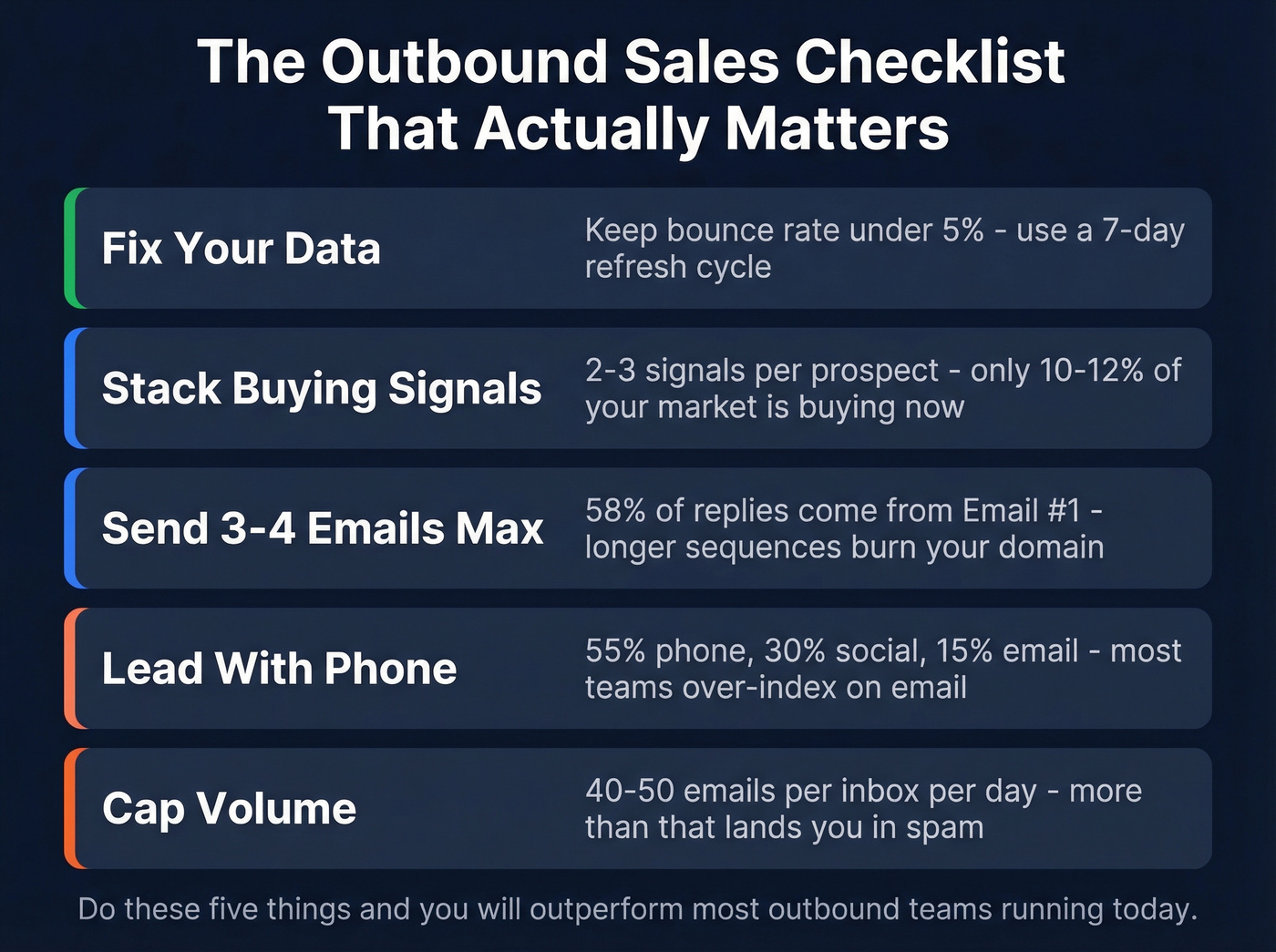
- Fix your data. If your bounce rate is above 5%, nothing else matters. Use a verified source with a 7-day refresh cycle so your emails actually land. (If you need a baseline, start with email bounce rate benchmarks and fixes.)
- Use buying signals. Stack 2-3 signals (funding, new VP hired, competitor churned) before you reach out. Only around 10-12% of your market is buying or open at any given time. Find them. (More on identifying buying signals.)
- Send 3-4 emails max. 58% of replies come from Email #1. After email four, you're hurting your domain more than helping your pipeline. If you want examples, use these sales follow-up templates.
- Lead with phone. The recommended channel mix is 55% phone, 30% social, 15% email. Most teams over-index on email by a wide margin. If you’re rebuilding the motion, start with a cold calling system.
- Cap volume. 40-50 emails per inbox per day. More than that and you're begging for spam folder placement. (See email velocity limits.)
Do those five things and you'll outperform most outbound teams running today.
Benchmarks That Actually Matter
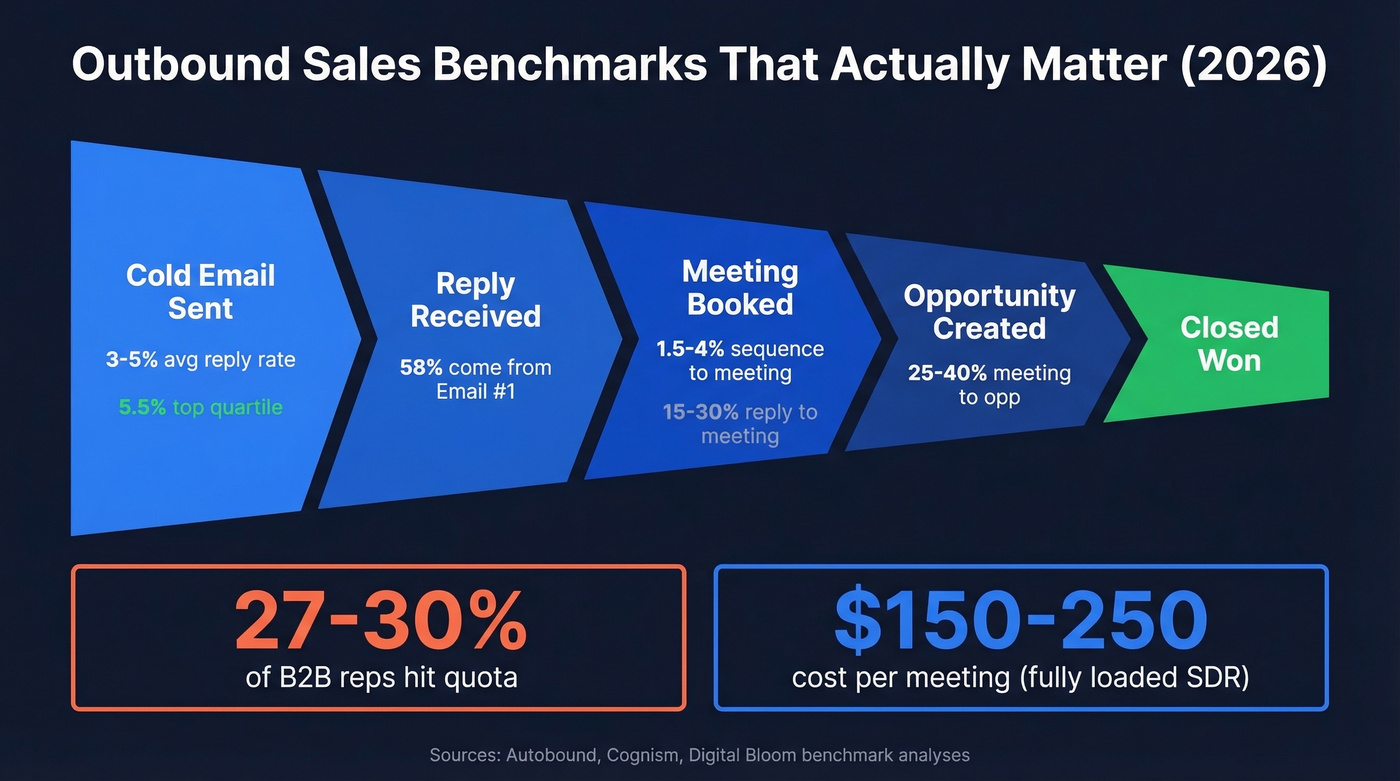
You can't fix what you can't measure. Here's where the industry actually sits, aggregated from Autobound's analysis of Instantly benchmarks, Cognism's outbound report, and several practitioner analyses:
| Metric | Benchmark Range |
|---|---|
| Cold email reply rate | 3-5% average, 5.5% top quartile, 10%+ elite |
| Replies from Email #1 | 58% of all replies |
| Sequence to meeting | 1.5-4% |
| Reply to meeting | 15-30% |
| Meeting to opportunity | 25-40% |
| Reps hitting quota | 27-30% |
Only 27-30% of B2B reps hit quota. That's not a "reps are lazy" problem. It's a systems problem - bad targeting, bad data, bad sequencing, or all three compounding at once.
Here's a number worth knowing: A fully loaded SDR costs $70-90K per year. At 8-10 meetings per month, that's roughly $150-250 per meeting. Know your cost-per-meeting. It's the denominator that makes every optimization decision rational.
If your reply rate is below 1%, the issue is almost certainly deliverability, not copy. Between 1-3%, it's likely targeting. Above 3%, you're in the game and optimizing copy and cadence will move the needle. Know which problem you're solving before you start tweaking subject lines.
Five Mistakes Killing Your Pipeline
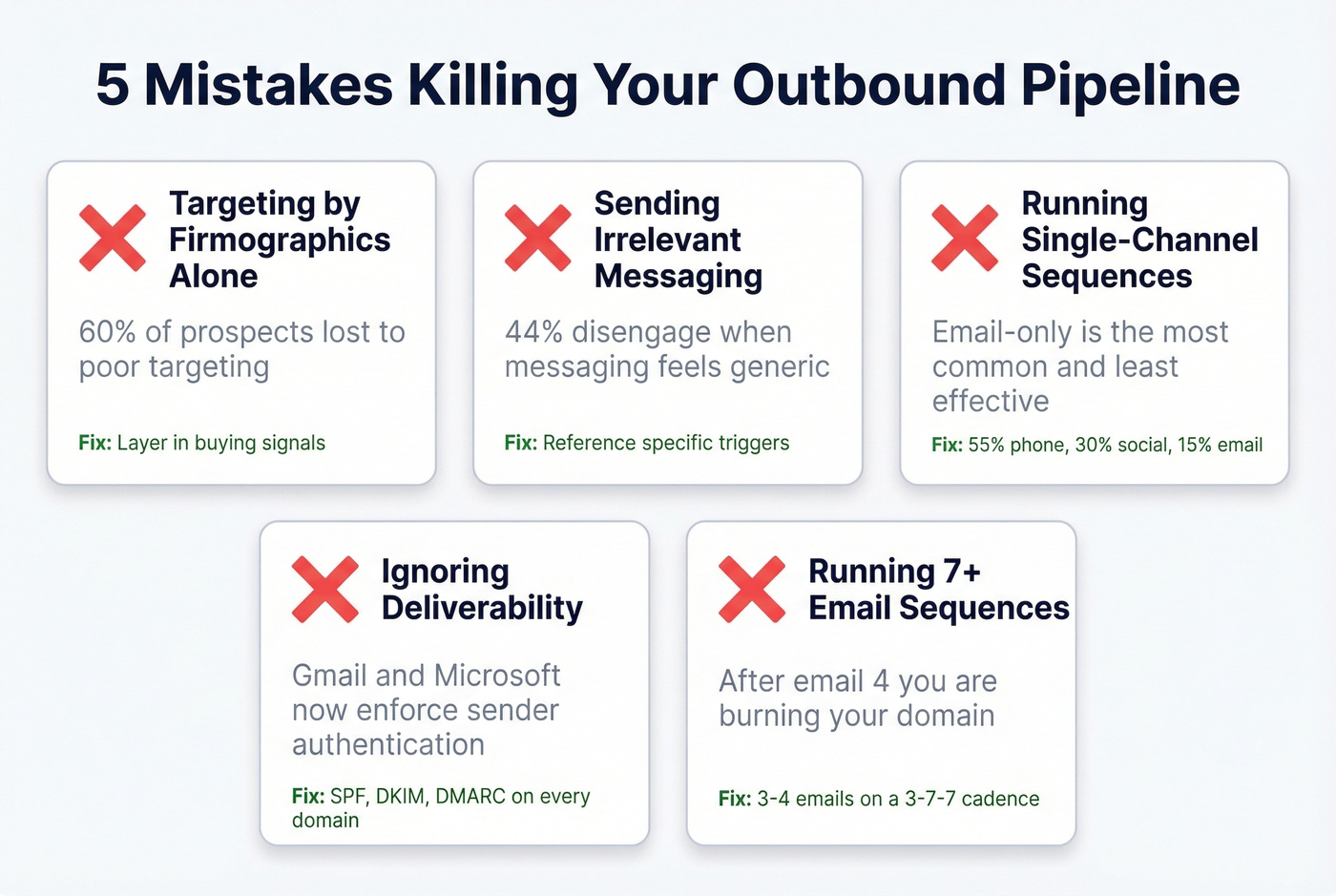
Targeting by firmographics alone
60% of prospects are lost due to poor targeting. Firmographics - industry, headcount, revenue - get you a universe, not a list. If you're blasting every Series B SaaS company with 50-200 employees, you're competing with every other SDR who built the same filter in Apollo. Layer in signals. (If you need a framework, use an ideal customer profile template.)
Sending irrelevant messaging
44% of prospects disengage when messaging feels irrelevant. "I noticed your company is growing" isn't personalization. Referencing a specific trigger - a job posting, a tech stack change, a funding round - is. Less poetry, more receipts. If you want to tighten the craft, start with email copywriting.
Running single-channel sequences
Email-only outbound is the most common setup and the least effective. Cognism's outbound report recommends 55% phone, 30% social, 15% email. If your entire motion is email sequences, you're leaving the highest-converting channel on the table.
Ignoring deliverability until it's too late
SPF, DKIM, DMARC, warmup ramps, bounce thresholds - none of this is optional anymore. Gmail enforced bulk sender rules in February 2024. Microsoft introduced similar sender requirements in May 2025. If you haven't set up authentication and custom tracking domains, your emails are hitting spam before a human ever sees them.
Running 7+ email sequences
After email four, you're not persistent - you're spam. Best-performing sequences run 3-4 emails on a 3-7-7 cadence. Longer sequences burn domain reputation and train mailbox providers to filter you out.
Signal-Based Prospecting: How to Stand Out
Only 3-5% of your total addressable market is actively buying at any given time. Another ~7% is open to a conversation. That means roughly 10-12% of your list is worth contacting right now - the other 88-90% isn't a "no," it's a "not yet."
Signal-based prospecting flips the model. Instead of blasting your entire ICP and hoping for timing luck, you watch for indicators that an account is entering a buying window:
- Funding raised - new budget, new initiatives, new hires incoming
- New VP of Sales or CRO hired - they'll rebuild the stack within 90 days
- Job postings for SDRs/AEs - they're scaling outbound and need tools
- Competitor removed from tech stack - displacement opportunity
- Headcount growth spike - operational pain points multiply
Here's the thing: in a lot of teams, reps spend 6+ hours per week on account research across 5+ sources. Signal-based targeting cuts that to minutes by surfacing the accounts that matter. The consensus on r/SaaS is don't act on one signal - stack multiples. A company that just raised a Series B and hired a new VP Sales and posted three SDR roles is a fundamentally different prospect than one that just raised money.
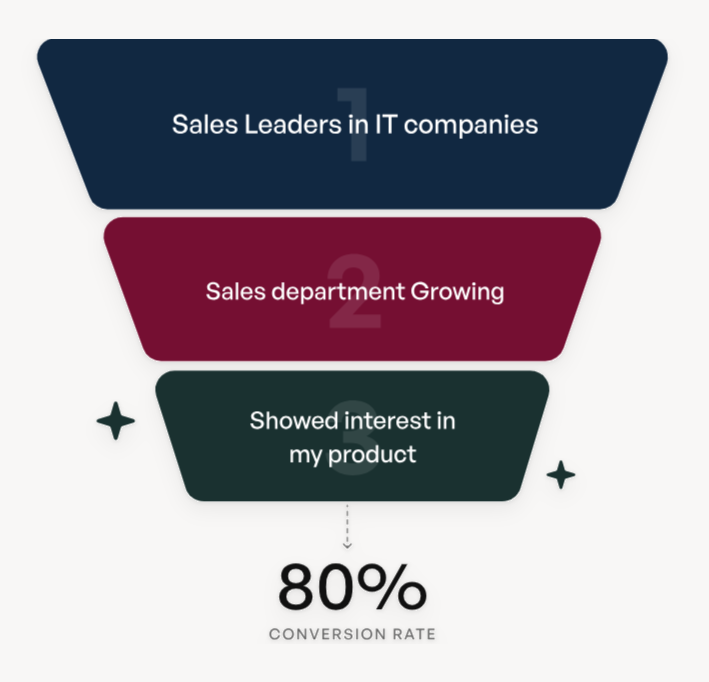
To operationalize signal stacking, you need a data source that combines intent signals with firmographic and technographic filters. Prospeo's intent data tracks 15,000 topics via Bombora, which you can layer with job change alerts, headcount growth filters, and technographic signals. Stack those with your ICP filters and you're building a hit list, not a spray list.

You just read that 14% bounce rates torch sender reputation before follow-ups even fire. Prospeo's 5-step verification delivers 98% email accuracy with a 7-day refresh cycle - so your sequences land in inboxes, not spam folders. At $0.01 per email, fixing your data costs less than one bounced campaign.
Stop debugging your copy when the real problem is your data.
The Cold Email Playbook
These aren't opinions - they're patterns backed by data from Digital Bloom's benchmark analysis and practitioner testing across hundreds of campaigns.
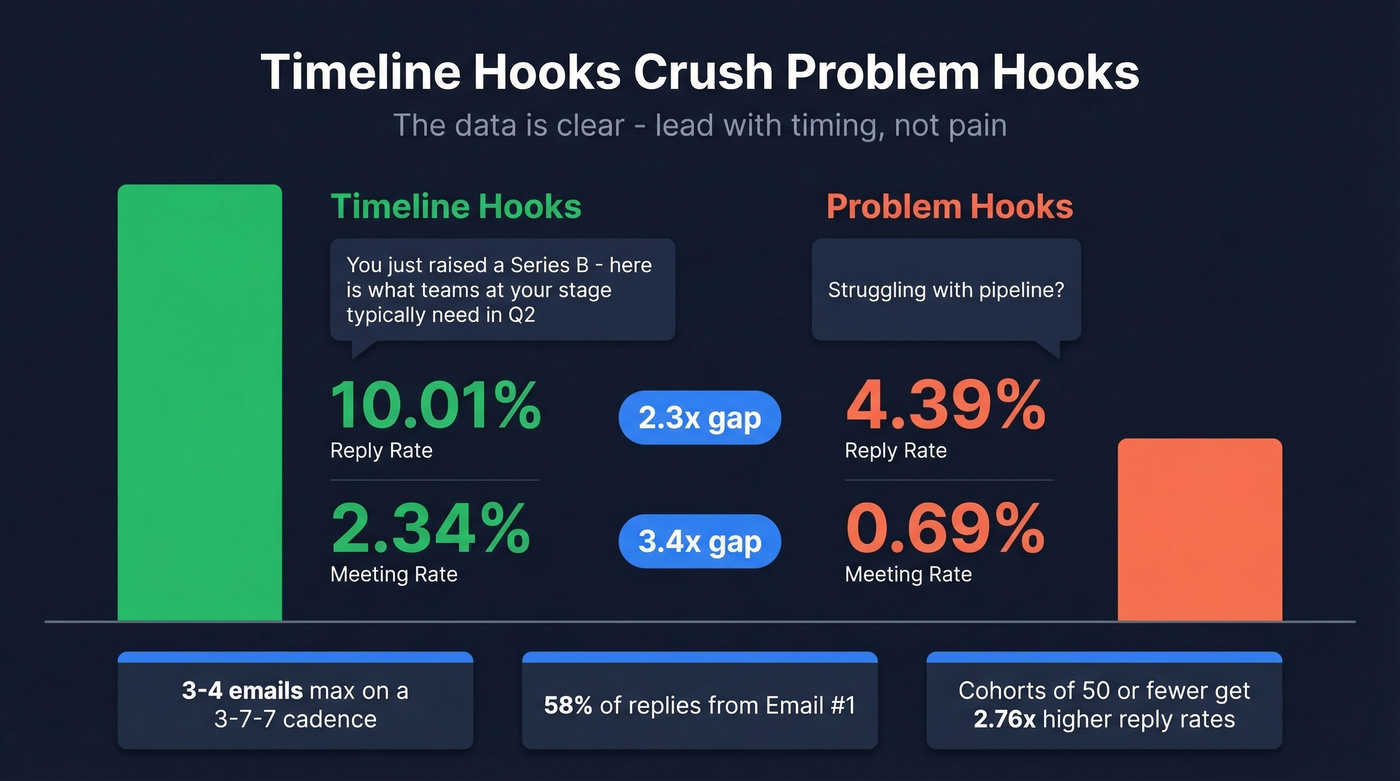
Sequence structure: 3-4 emails, 3-7-7 cadence. Day 0 is your pitch. Day 3 is a follow-up with a new angle. Day 10 is a final touch with a different CTA. This cadence captures 93% of replies by Day 10. (If you want a full build, see B2B cold email sequence.)
Email #1 does the heavy lifting. 58% of all replies come from the first email. If your opener doesn't work, adding more follow-ups won't save it. Spend 80% of your optimization time on Email #1.
Timeline hooks crush problem hooks. Timeline-based hooks ("You just raised a Series B - here's what teams at your stage typically need in Q2") average a 10.01% reply rate. Problem-based hooks ("Struggling with pipeline?") average 4.39%. That's a 2.3x gap. The meeting-rate gap is even wider: 2.34% for timeline hooks vs 0.69% for problem hooks - a 3.4x difference. Lead with timing, not pain.
Keep cohorts small. Sequences targeting cohorts of 50 contacts or fewer see 2.76x higher reply rates than broad blasts. Smaller cohorts force better targeting and more relevant copy.
Volume caps matter. 40-50 emails per inbox per day. Go higher and you'll trigger spam filters. If you need more volume, add inboxes - don't push existing ones past their limits.
Test offers, not subject lines. The consensus on r/b2bmarketing is clear: the biggest lever is what you're offering (save time vs. make money vs. reduce risk), not how you phrase the subject line. Test the angle first, then optimize the wrapper. (If you still need a library, use these cold email subject line examples.)
The Cold Calling Playbook
Phone is the most underutilized channel in outbound. Most teams run a channel mix that's 80%+ email. That's backwards.
SDRs using verified contact data see a 13.3% answered rate on cold calls - roughly 1 in 8 dials reaching a human. Not great in isolation, but when you're calling someone who just showed three buying signals and received your first email two days ago, the conversation quality is far higher than a cold email reply.
Script 1: Time-boxed permission opener
"Hi [Name], this is [You] from [Company]. I know I'm calling out of the blue - can I borrow just three minutes? I'll be quick, and if it's not relevant, I'll hang up. Does that sound fair?"
This works because it acknowledges the interruption and gives the prospect control. Most people say yes to three minutes.
Script 2: "I don't have time" callback
"Totally understand - you're busy. When's a better time for a quick 5-minute call this week? I'll send a calendar invite so it doesn't slip."
Don't argue. Don't pitch harder. Just get the callback scheduled. The goal of a cold call isn't to close - it's to set a meeting.
Script 3: Gatekeeper transfer
"Hi, I'm trying to reach [Name] - could you transfer me or share their direct extension? I'll be brief."
Keep it simple. Don't pitch the gatekeeper. They're not your buyer.
Track answered rate and call-to-meeting conversion, not just dials. A rep making 80 dials with a 13% answer rate and 20% call-to-meeting rate books ~2 meetings per day. That math is hard to beat with email alone.
Email Deliverability
This is the foundation nobody talks about until their domain is burned.
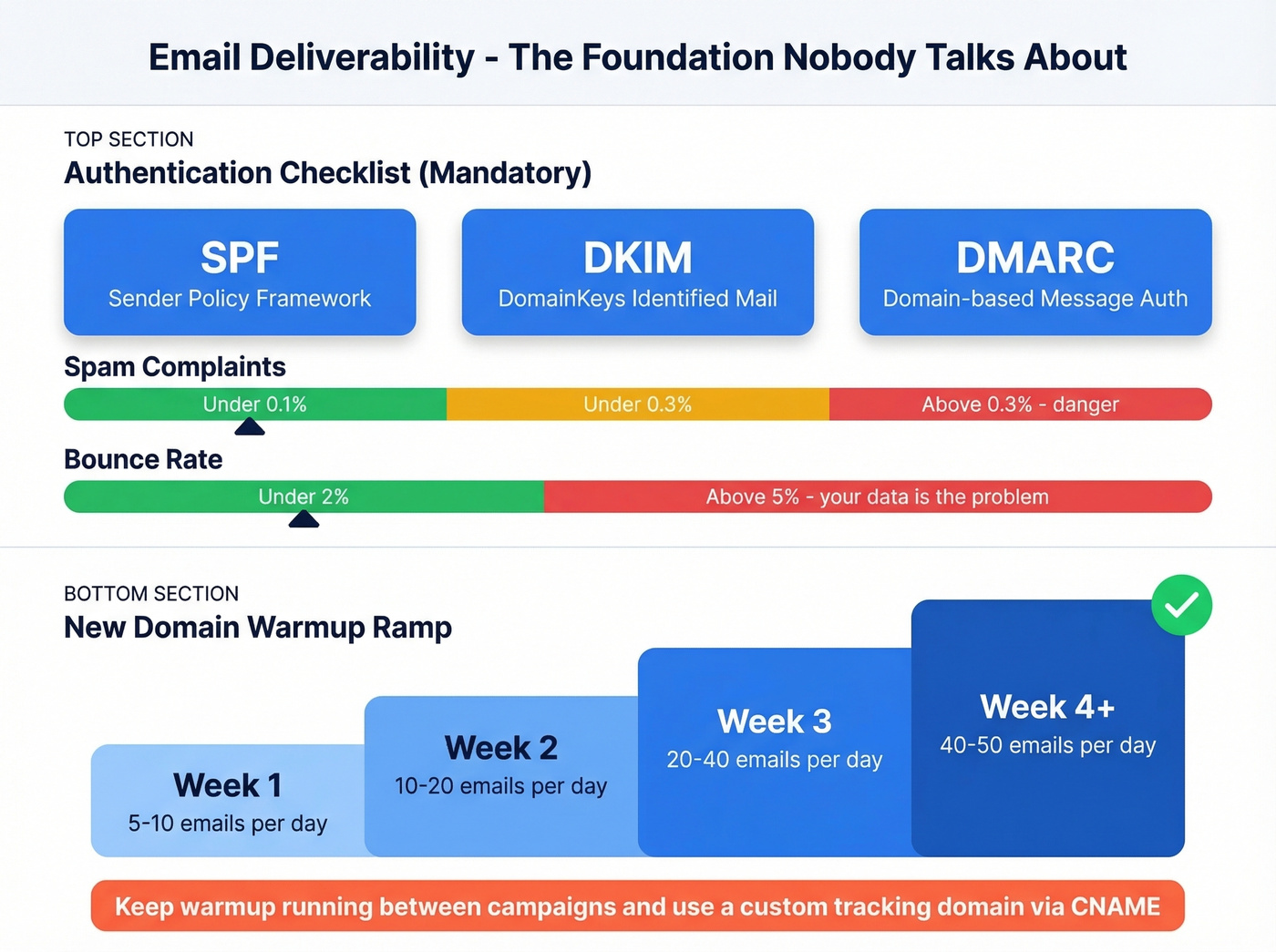
Authentication is mandatory. Every sending domain needs SPF, DKIM, and DMARC configured. Gmail enforced this for bulk senders starting February 2024, and Microsoft followed with similar requirements in May 2025. If you haven't set these up, do it today - not next sprint. (If you want the full foundation, use this email deliverability guide.)
Thresholds that matter:
- Spam complaints: under 0.3% (ideally under 0.1%)
- Bounce rate: under 2%
- One-click unsubscribe headers required for bulk sends
Warmup ramp for new domains:
| Week | Daily send volume |
|---|---|
| Week 1 | 5-10 emails/day |
| Week 2 | 10-20 emails/day |
| Week 3 | 20-40 emails/day |
| Week 4+ | 40-50 emails/day |
Per Instantly's deliverability guide, keep warmup running between campaigns and use a custom tracking domain via CNAME to isolate your sender reputation.
Bad data is the #1 deliverability killer. If your bounce rate is above 5%, the problem isn't your warmup schedule - it's your data source. We've seen this firsthand: Snyk's team cut their bounce rate from 35-40% to under 5% after switching to a provider with 5-step verification and a 7-day data refresh cycle, and their AE-sourced pipeline jumped 180%.
Building Your Outbound Stack
You need four categories of tools. Here's what we'd recommend at each layer.
Data Provider
This is where your outbound lives or dies. Your data provider determines bounce rates, connect rates, and whether your emails reach humans or spam folders.
Prospeo covers 300M+ professional profiles with 98% email accuracy and 125M+ verified mobile numbers. The 7-day data refresh cycle means you're not emailing someone who left the company six weeks ago - which is what happens with providers refreshing on the industry-standard 6-week cycle. Pricing runs ~$0.01 per email, credit-based, with no annual contracts. There's a free tier (75 emails + 100 Chrome extension credits per month) so you can test before committing anything. For context, Meritt tripled their pipeline from $100K to $300K per week using this data, and Stack Optimize built to $1M ARR while maintaining 94%+ deliverability across all clients.

Other data providers worth knowing about: Apollo.io ($49-149/user/month) has a large database but lower email accuracy around 79%, which means higher bounce rates and more domain risk. ZoomInfo ($15-40K/year) is the enterprise incumbent with deep firmographic data, but at roughly $1/lead with mandatory annual contracts, it's 90x more expensive per verified contact. Skip ZoomInfo if your deal sizes are under $10K - the ROI math doesn't work.
Sequencer
Instantly (~$30-100/mo) is the best option for SMBs and agencies running multi-inbox setups. Built-in warmup, simple UI, and it scales cleanly. Outreach ($100-140/user/mo) is enterprise-grade - powerful but expensive. A 25-person team runs $40-80K per year. Salesloft ($75-125/user/mo) is a strong alternative if you're already in that ecosystem. (If you’re comparing categories, start with outbound lead generation tools.)
CRM
HubSpot's free tier handles contact management, deal tracking, and basic reporting. It's genuinely free and genuinely useful for teams under 10 reps. Salesforce is the move once you need custom objects and advanced reporting, but that's a $25-165/user/month commitment plus implementation costs. If you’re still deciding, see examples of a CRM.
Dialer
If you're running the 55/30/15 channel mix, you need a proper dialer. Orum and Nooks are the current leaders for parallel dialing at $100-200/user/month. Worth it if phone is a primary channel.
Signal stacking only works if your data platform combines intent, technographics, and job changes in one place. Prospeo tracks 15,000 intent topics via Bombora, layers in headcount growth and tech stack filters, and gives you 125M+ verified mobile numbers - because the best channel mix is 55% phone, not 100% email.
Build signal-stacked lists with direct dials in a single search.
Think Like a System, Not a Sequence
Let's be honest: if your deal sizes are under $10K, you probably don't need ZoomInfo-level data or enterprise sequencing tools. A $99/month data provider, Instantly, and HubSpot's free CRM will outperform a $50K/year stack that nobody on your team fully uses. The best outbound system is the one your reps actually work every day.
Collin Stewart from Predictable Revenue put it well: the Predictable Revenue model "was never meant to be brute-force outreach - it was about focus." Somewhere along the way, teams turned outbound into a volume game and forgot the focus part.
The best outbound teams we've studied treat their motion as an intelligence system. Every call, every reply, every "not now" is data. Replace "Closed Lost" in your CRM with "Closed Lost - Nurture" and maintain a separate nurture pipeline view. That prospect who said no in January will have a new budget in July. Recycle your TAM every six months with fresh angles, and the companies that build this feedback loop - signals in, outreach out, learnings back - are the ones consistently hitting that top-quartile 5.5% reply rate while everyone else is stuck at 2%.
Outbound isn't dying. Lazy outbound is dying. Build the system, fix the data, respect the signals, and the pipeline follows.
FAQ
What's a good cold email reply rate in 2026?
Average sits at 3-5%. Top-quartile teams hit 5.5%, and elite performers reach 10%+ with tight ICP targeting and timeline-based hooks. Below 1% signals a deliverability problem, not a copy problem.
How many emails should a cold outreach sequence have?
Three to four emails maximum. 58% of replies come from Email #1, so later follow-ups have sharply diminishing returns. Use a 3-7-7 cadence: send on Day 0, Day 3, and Day 10.
Is cold calling still effective?
Yes - SDRs using verified contact data see a 13.3% answered rate. The recommended activity mix is 55% phone, 30% social, 15% email. Phone is the most underrated outbound channel because most teams ignore it entirely.
What tools do I need for outbound prospecting?
Four categories: a data provider for verified emails and direct dials, a sequencer like Instantly or Lemlist, a CRM (HubSpot free works), and a dialer for phone-heavy motions. Total cost for an SMB stack: under $200/month.
How do I improve results quickly?
Start with deliverability - fix SPF/DKIM/DMARC authentication, verify your contact data, and cap send volume at 40-50 emails per inbox per day. Then layer in buying signals so you're reaching the 10-12% of your market that's actually open to a conversation. These two fixes move the needle faster than rewriting copy ever will.