

The Outbound Sales Process That Actually Books Meetings
It's Thursday. Pipeline review is Monday. Marketing's inbound leads won't close this quarter, and your CRO is already asking what's in the forecast. This is the moment outbound earns its keep - the lever where you control the pace, the targets, and the volume.
Outreach found that 80% of high-performing teams rely on outbound as a key part of their revenue strategy, and 43% run hybrid models blending inbound and outbound within the same function. Outbound isn't a fallback. It's the engine. But most teams run it wrong - blasting unverified lists through unwarmed domains and wondering why reply rates sit in the low single digits. Data quality is a top bottleneck, yet teams keep throwing money at copy tweaks and sequencer upgrades instead.
Let's break down every step of the outbound sales process so you can fix what's actually broken.
What You Need (Quick Version)
Three things separate teams booking 15+ meetings a week from those booking two:
- Verified data that won't torch your domain. Aim for 98%+ verified emails before a single message goes out.
- A multi-channel cadence with day-by-day structure. Not "send some emails and hope." A specific sequence across email, phone, and social.
- Email infrastructure set up before a single message sends. SPF, DKIM, DMARC, warm-up ramps, inbox rotation. Non-negotiable.
The 7-Step Framework
1. Define Your ICP
Skip this step and everything downstream breaks. Your ICP isn't "mid-market SaaS companies." It's a documented profile specific enough that a new SDR can build a list without asking you a single question.
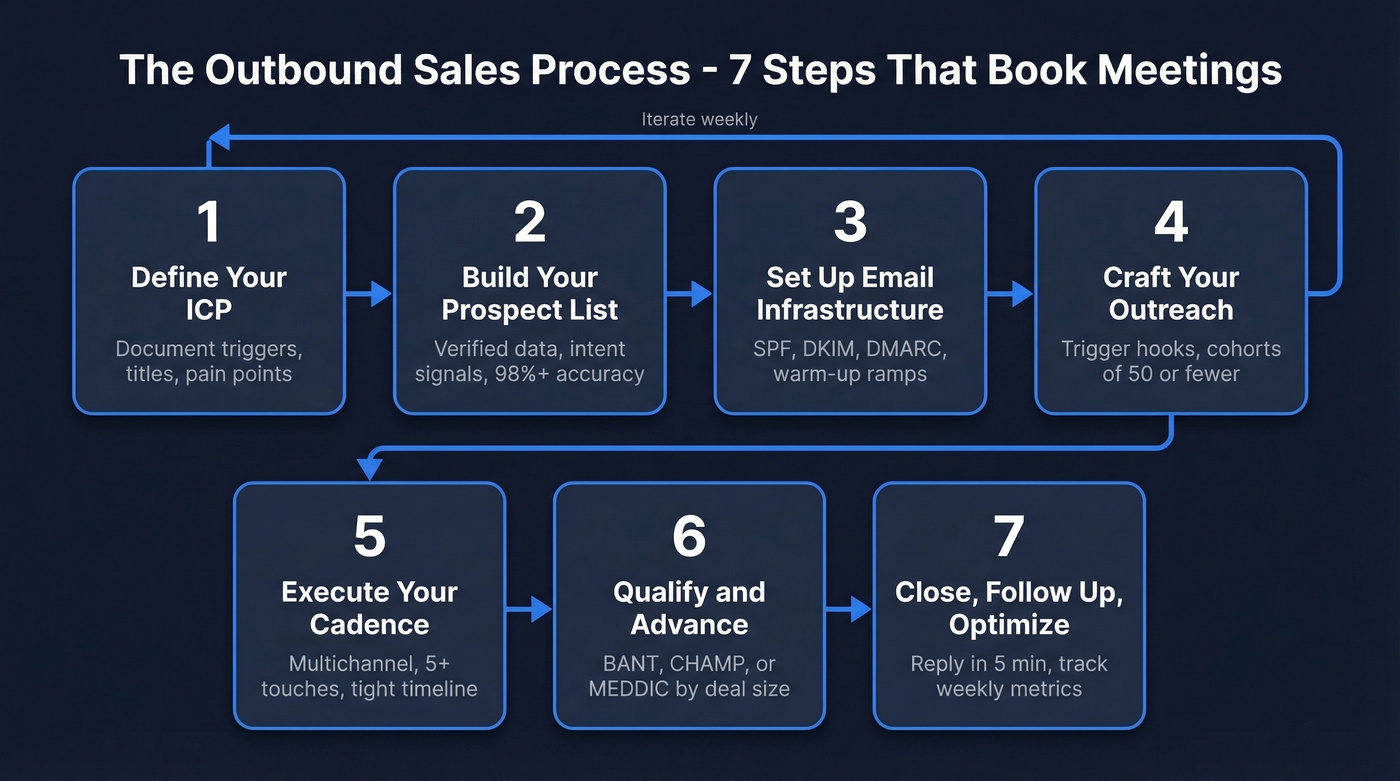
Here's what to document:
- Company profile: Industry verticals, employee count range, geography, revenue band
- Decision-maker details: Titles and functions (VP Sales, Head of RevOps), reporting structure, day-to-day challenges
- Buying triggers: Recent funding rounds, M&A activity, product launches, regulatory changes, leadership hires
- Pain points and goals: What keeps them up at night, what they're measured on
- Preferred channels: Email, phone, social, events - and when each works best
Buying triggers are the most underrated element. A company that just raised a Series B and posted three SDR roles is a fundamentally different prospect than one that's been flat for two years. Build your list around signals, not just firmographics. In our experience, getting this foundation right is the single most impactful thing you can do for your outbound results - more than any subject line test or cadence tweak.
2. Build Your Prospect List
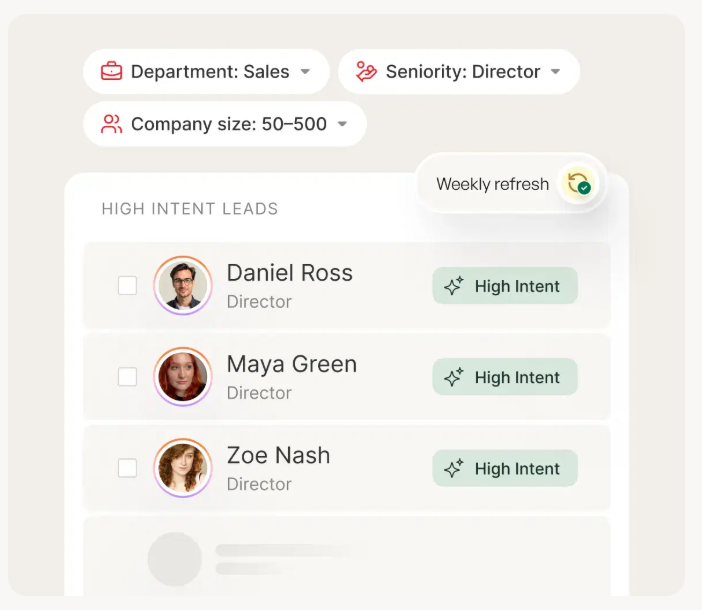
Here's the thing: data quality is the biggest variable in your entire outbound motion. Bad data doesn't just mean bounced emails - it means burned sender domains, tanked deliverability, and sequences that never reach a human inbox. We've seen teams spend months optimizing copy and cadence timing while sitting on a list with double-digit bounce rates. That's not an outbound problem. That's a data problem.
Prospeo covers 300M+ professional profiles with 98% email accuracy and a 7-day refresh cycle. The industry average refresh is six weeks - most providers serve you data that's already stale by the time you load it into your sequencer. Layer in intent data across 15,000 Bombora topics, and you're building a list of people actively researching solutions like yours. Meritt switched to Prospeo and watched their bounce rate drop from 35% to under 4% while pipeline tripled from $100K to $300K per week. Snyk saw similar results: bounce rates fell from 35-40% to under 5%, AE-sourced pipeline jumped 180%, and the team now generates 200+ new opportunities monthly.

Use this if: You want verified data with intent signals and no annual contract. Skip this if: You already have a provider delivering under 3% bounce rates consistently.
3. Set Up Email Infrastructure
If your process doesn't include infrastructure setup, you don't have a process. You have a spam operation.
Three authentication protocols are non-negotiable: SPF, DKIM, DMARC. Set them up before sending a single cold email. Then follow this warm-up ramp for every new inbox:
| Week | Daily Volume | Notes |
|---|---|---|
| 1-2 | 5-10/day | Warm replies only |
| 3-4 | 15-20/day | Mix warm + cold |
| 5-6 | 30-40/day | Monitor bounce/spam |
| 7+ | 50/day max | 25 warm / 25 cold |
Never exceed 50 emails per day from a single inbox. For higher volume, rotate across multiple domains and inboxes. Monitor three thresholds religiously: bounce rate under 2%, spam complaints under 0.1%, reply rate above 5%. Avoid open-rate tracking pixels entirely for cold email - they reduce deliverability and the data is unreliable anyway. If you need a tighter system for protecting deliverability at scale, use an email reputation management checklist.
4. Craft Your Outreach
Every guide tells you to "personalize at scale" without explaining how when you've got 500 prospects and one SDR. Two levers actually move the needle: hook type and cohort size.
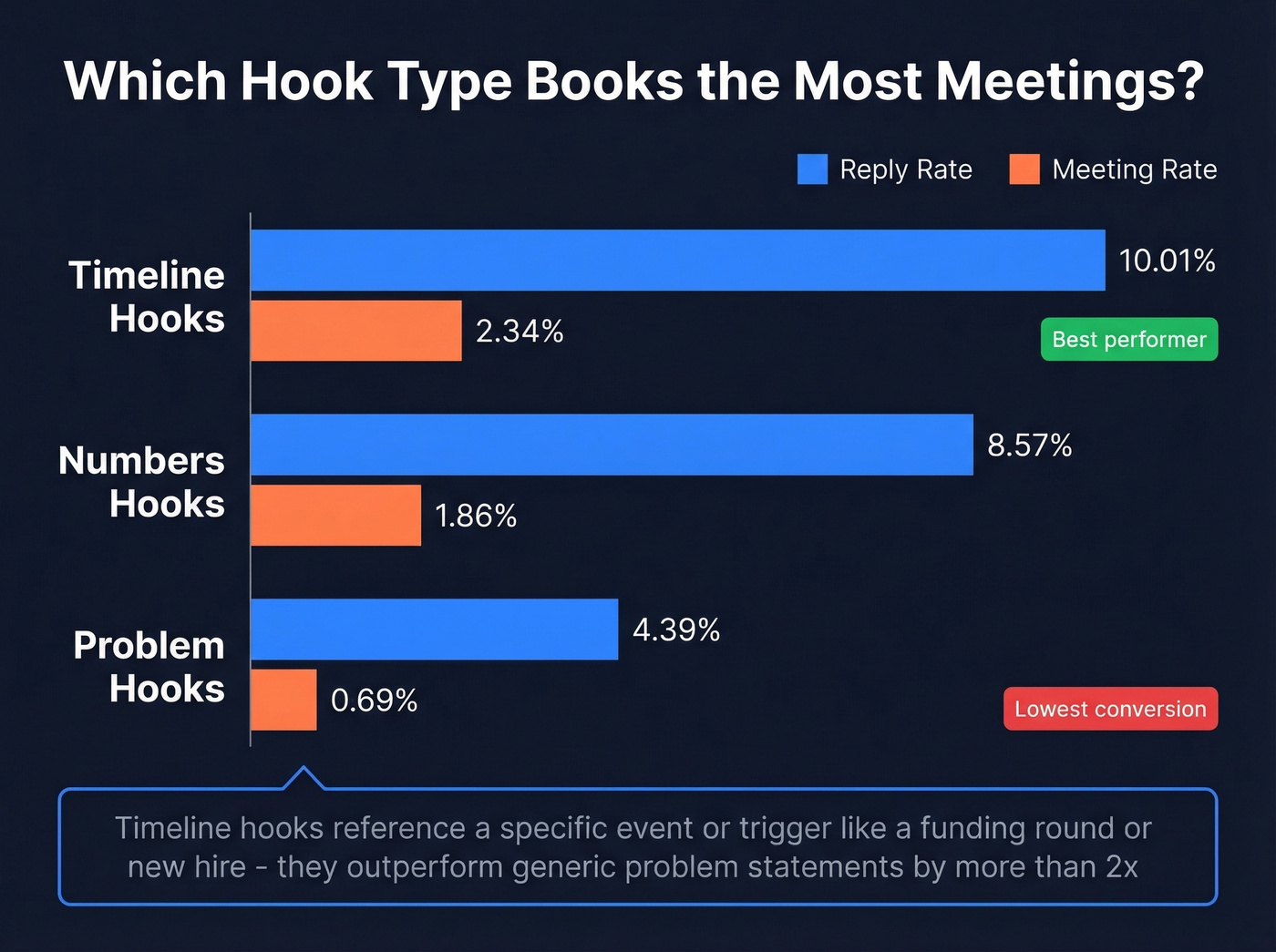
Recent hook performance data tells a clear story:
| Hook Type | Reply Rate | Meeting Rate |
|---|---|---|
| Timeline | 10.01% | 2.34% |
| Numbers | 8.57% | 1.86% |
| Problem | 4.39% | 0.69% |
Timeline hooks - referencing a specific event or trigger ("Saw you just closed your Series B...") - outperform generic problem statements by more than 2x. This is why buying triggers in your ICP matter so much. They give you the raw material for hooks that actually land. (If you want more examples, steal from these cold email triggers.)
The other lever is cohort size. Segmenting your outreach into cohorts of 50 contacts or fewer increases reply rates by 2.76x. Smaller batches force tighter targeting and more relevant messaging. The consensus on r/sales is pretty consistent here: the teams getting the best results aren't sending more emails - they're sending fewer, better ones. If your messaging still feels generic, follow a personalization in outbound sales framework.
5. Execute Your Cadence
Single-channel outreach is costing you meetings. Multichannel sequences drive 40%+ higher response rates than email-only campaigns. Yet 48% of reps still stop after a single touch, while 80% of sales require five or more follow-ups.
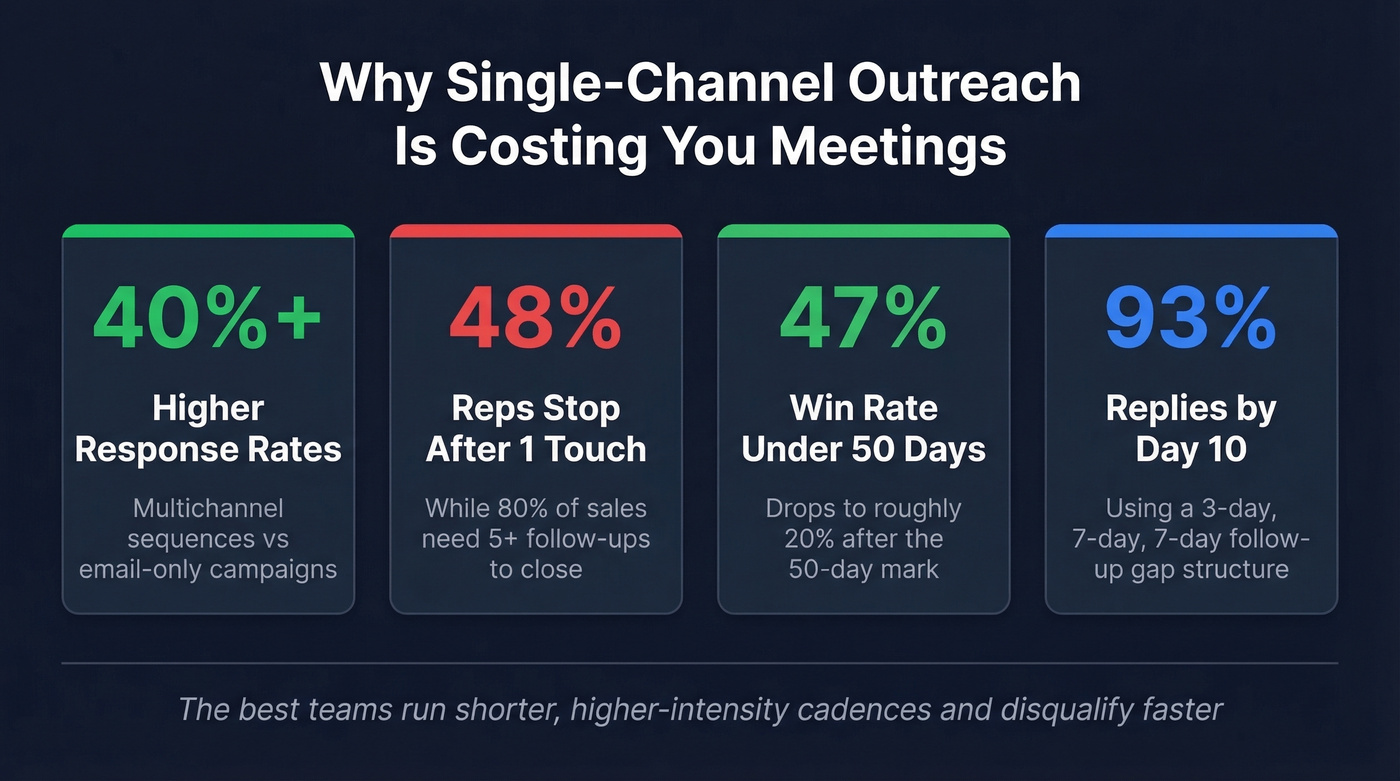
Here's what most teams miss: more touches don't automatically mean more pipeline. Opportunities closed within 50 days win at 47%, but after 50 days, win rates drop to roughly 20% or lower. The goal isn't to grind through a 90-day cadence. It's to run a shorter, higher-intensity sequence that creates enough engagement to qualify or disqualify within that window. See the 7-Touch Baseline Cadence below for the exact day-by-day breakdown. For more options, pull from these sales cadence templates.
6. Qualify and Advance
Not every reply is a qualified opportunity. With sales cycles stretching 1-2 quarters and involving multiple stakeholders, the framework you use should match your deal complexity.
BANT works for SMBs with shorter cycles and single decision-makers. CHAMP fits mid-market where challenges drive urgency more than budget. MEDDIC is built for enterprise deals with multiple stakeholders and six-figure contracts. If you're running enterprise deals, use a dedicated MEDDIC sales methodology breakdown.
Skip all three if you're overcomplicating a transactional sale. For deals under five figures with a single buyer, two questions are enough: "Do you have this problem? Do you have budget?"
7. Close, Follow Up, Optimize
Speed matters. Responding to inbound replies within 5 minutes increases conversion by up to 9x. When a prospect responds to your cold outreach, treat it like an inbound lead and get back to them immediately.
The 50-day cliff applies here too. If a deal hasn't progressed meaningfully within that window, the odds shift dramatically against you. Don't let deals linger - advance them or disqualify them and reallocate your time to fresh pipeline.
Track three metrics weekly: reply-to-meeting conversion, meeting-to-opportunity conversion, and average days to close. These numbers tell you exactly where your process is leaking. If you want a cleaner KPI set, track outbound sales metrics alongside pipeline.
Outbound Cadence Templates
7-Touch Baseline (10 Business Days)
This sequence typically generates 18-25% reply rates for SaaS teams when paired with verified data and tight ICP targeting.
| Day | Channel | Action |
|---|---|---|
| 1 | Trigger-based first touch | |
| 1 | Phone | Call + voicemail |
| 2 | Follow-up (different angle) | |
| 4 | Phone | Call + voicemail |
| 6 | Video | Personalized video message |
| 8 | Value-add (case study/stat) | |
| 10 | Breakup / exit email |
The breakup email on Day 10 isn't a gimmick - it creates urgency and often generates the highest reply rate of any touch in the sequence. Keep it short: "Looks like the timing isn't right. I'll close the loop on my end, but if [problem] comes back up, here's where to find me."
Intent-Triggered Burst (5 Touches, 7 Days)
When a prospect shows active intent - researching your category, visiting your pricing page, or triggering a Bombora topic signal - compress the timeline. First touch within 24 hours of the signal. Intent-triggered outreach drives a 2-3x lift in response rates compared to cold sequences.
| Day | Channel | Action |
|---|---|---|
| 1 | Reference the signal directly | |
| 2 | Phone | Call (mention the signal) |
| 4 | Different angle + social proof | |
| 6 | Social | Connect + brief message |
| 7 | Phone/Email | Final touch |
2026 Cadence Benchmarks
For calibration:
- ~21 attempts per contact across 8 calls, 8 emails, and 5 social touches
- Average cadence length: 53 days (though shorter is better given the 50-day cliff)
- 90% of BDRs multithread, reaching ~9 people per account
- A follow-up cadence with 3-day, 7-day, and 7-day gaps (Day 0 → Day 3 → Day 10 → Day 17) captures 93% of replies by Day 10
21 attempts and 53 days is the average, not the target. The best teams we've worked with run tighter, more intense cadences and disqualify faster. Grinding through two months of follow-ups on mediocre data isn't persistence - it's waste.

Bad data is the #1 reason outbound cadences fail. Prospeo gives you 300M+ profiles with 98% email accuracy, intent signals across 15,000 topics, and a 7-day refresh cycle - so every prospect in your sequence is real, reachable, and in-market.
Stop optimizing copy on top of broken data. Fix the foundation.
Benchmarks - What Good Looks Like
| Metric | Average | Top Quartile |
|---|---|---|
| Cold email reply rate | 3-5% | 15-25% |
| Cold call connect rate | 5-10% | 12-15% |
| Reply-to-meeting rate | 15-25% | 30-40% |
| Win rate (within 50 days) | 47% | 47% |
| Win rate (after 50 days) | ~20% or lower | ~20% or lower |
| Cost per meeting (SMB) | $200-$500 | $150-$300 |
| Recommended cadence length | 53 days (avg) | 21-30 days |
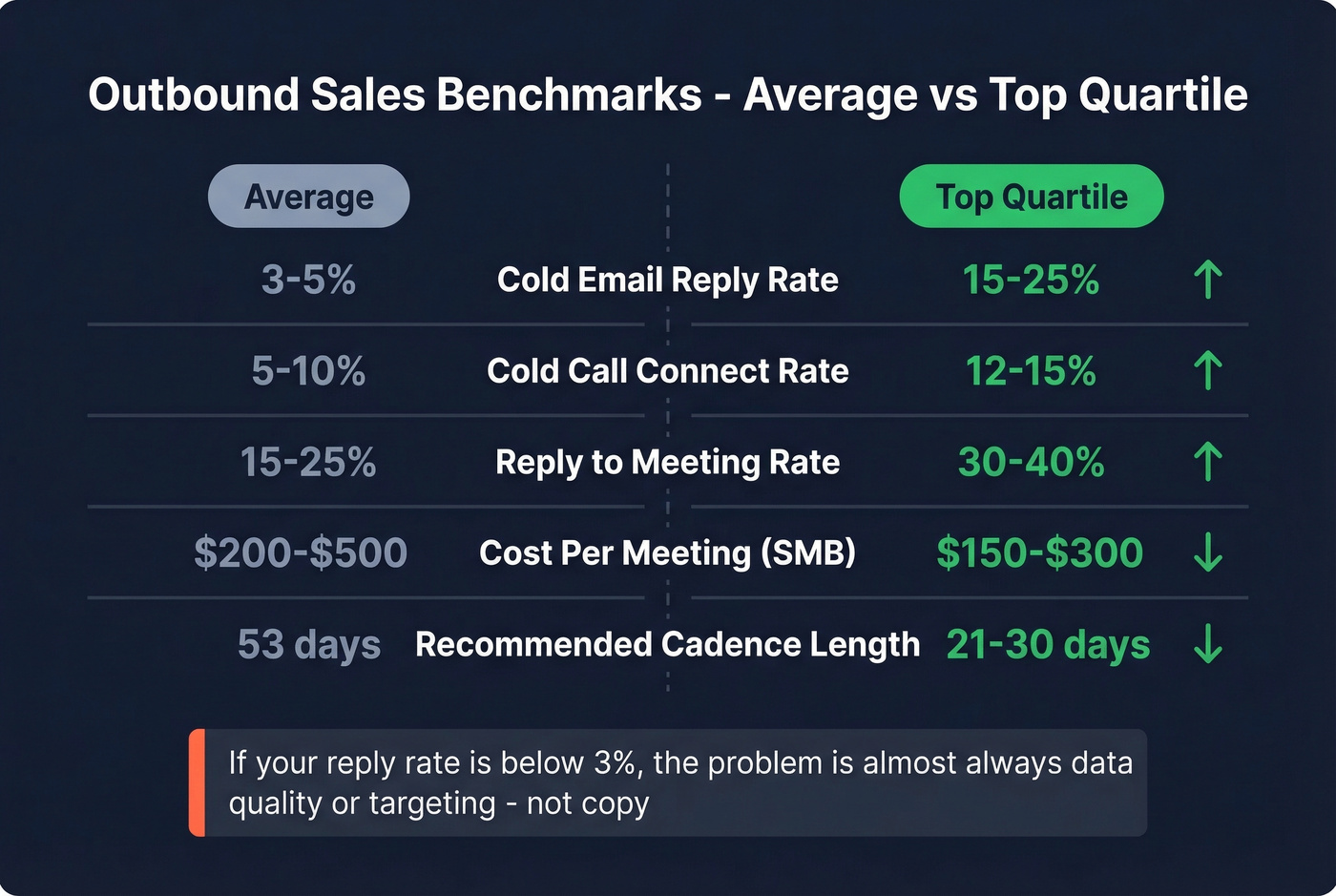
If your reply rate is below 3%, the problem is almost always data quality or targeting - not copy. Between 3-5% but meetings aren't converting? Your qualification step is broken. 55% of sales leaders who lack a defined process report lost revenue. Use these benchmarks to find where yours is leaking. If you suspect targeting is the issue, tighten your sales targeting before rewriting sequences.
I'll say something that'll annoy the "always be following up" crowd: if your average deal size is under $10K, you probably don't need a 53-day cadence or 21 touches. Run a tight 10-day sequence, disqualify fast, and move on. The teams obsessing over "optimal touch count" are usually the ones avoiding the harder work of fixing their targeting.
Pipeline velocity formula: (# of qualified opportunities x average deal size x win rate) / average sales cycle in days. Track this weekly. It's the single number that tells you whether your outbound engine is actually improving or just getting busier. If you want to operationalize it, build a simple pipeline tracker.
The Outbound Tool Stack
You don't need ten tools. You need five categories covered, and you can start with two.
| Category | Recommended | Cost Range |
|---|---|---|
| Data Provider | Prospeo ($0.01/email), Apollo ($49-$99/user/mo), ZoomInfo ($15K-$40K+/yr), Cognism ($1K-$3K/mo) | $0-$40K+/yr |
| Email Verification | Prospeo (built-in) | Included |
| Sequencer | Smartlead, Instantly, Lemlist, Outreach, Salesloft | $30-$300/user/mo |
| Dialer | Orum, Outreach, Salesloft | $100-$300/user/mo |
| CRM | HubSpot (free tier available), Salesforce ($25-$300/user/mo) | $0-$300/user/mo |
A full enterprise stack runs $500-$2,000 per month per rep. Or start with a free data tier and a $30/month sequencer like Smartlead or Instantly. The expensive mistake isn't picking the wrong sequencer - it's paying $15K-$40K/year for a data provider and still getting 20%+ bounce rates. Data is the foundation. Get that right first, then layer on execution tools. If you're evaluating providers, compare options in best B2B email list providers.
Meritt tripled pipeline from $100K to $300K/week. Snyk generated 200+ new opportunities monthly. Both started by replacing stale data with Prospeo's verified contacts - bounce rates dropped from 35%+ to under 5% overnight.
Run your 7-step outbound process on data that actually connects.
Five Mistakes That Kill Outbound
1. Dirty data, burned domains. Sending to unverified lists is the fastest way to land in spam. One bad campaign with a 15%+ bounce rate can tank your domain reputation for months. Verify every email before it enters a sequence. Use a proper business email validation workflow, not guesswork.
2. Stopping after one touch. 48% of reps give up after a single attempt while 80% of sales require five or more follow-ups. Half your team is quitting before the game starts.
3. Running email-only sequences. Multichannel outreach drives 40%+ higher response rates than email alone. If your "cadence" is three emails and a breakup, add calls and social touches. If you need a full playbook, follow a multi-channel outreach sequence.
4. Skipping warm-up and authentication. No SPF, DKIM, or DMARC means you're sending from an unverified domain. No warm-up ramp means you're spiking volume from a cold inbox. Either one gets you flagged. Both together guarantee it.
5. Generic messaging at scale. Blasting the same template to 5,000 contacts isn't outbound - it's spam with a CRM. Segment into cohorts of 50 or fewer, vary your hooks, and reference specific triggers. The 2.76x reply rate lift from smaller cohorts is the natural result of actually being relevant. Tight segmentation, verified data, and multichannel cadences are what separate pipeline builders from spam senders.
FAQ
What's the difference between outbound and inbound sales?
Outbound is rep-initiated - cold email, cold calls, and social outreach to prospects who haven't raised their hand. Inbound is prospect-initiated through content, ads, or referrals. Companies running hybrid models combining both see 2x faster revenue growth than those relying on a single channel.
How many touches does an outbound cadence need?
2026 data shows roughly 21 attempts per contact across calls, emails, and social touches. A 7-touch baseline cadence over 10 business days is a strong starting point for most teams before optimizing based on reply data.
What's a good cold email reply rate?
Average B2B cold email reply rates sit at 3-5%. Top-quartile teams hit 15-25% by combining tighter ICP targeting, verified data, and multichannel sequencing. Below 3%, fix your data before touching copy.
How much does outbound cost per meeting?
For SMB-focused teams, expect $200-$500 per meeting booked when factoring in SDR compensation, tools, and data costs. Enterprise deals run higher per meeting but yield significantly larger contract values. Starting with a free data tier and a $30/month sequencer keeps initial costs under $50/month.
What tools do I need to start?
Three non-negotiables: a verified data provider with a free tier to test, a sequencing platform at $30-$150/month, and a CRM. Dialers, intent platforms, and conversation intelligence are optional until you've validated your process and need to scale. HubSpot's free CRM is a solid starting point if you don't have one yet.
The outbound sales process isn't complicated. It's just unforgiving when you skip steps. Nail your data, run a tight multichannel cadence, disqualify fast, and let the benchmarks tell you where to optimize next.