

4 Outreach Sequence Templates You Can Steal Today
55 subject lines isn't a sequence - it's a swipe file. What actually moves pipeline is a day-by-day plan with timing, channel mix, and copy frameworks sized to your deal. Here are four complete outreach sequence templates plus the deliverability guardrails that keep them landing in inboxes.
Jump to your template:
- Founder-led / SMB → Lean 3-Email Sequence
- Mid-market B2B → 8-Touch Multi-Channel Blueprint
- Enterprise → Long-Play Sequence
- Dead leads → Re-Engagement Sequence
Benchmarks Before You Build
Calibrate before you write a single email. These numbers come from an analysis of 500+ SaaS sequences on Reddit and 2026 benchmark data from Instantly:
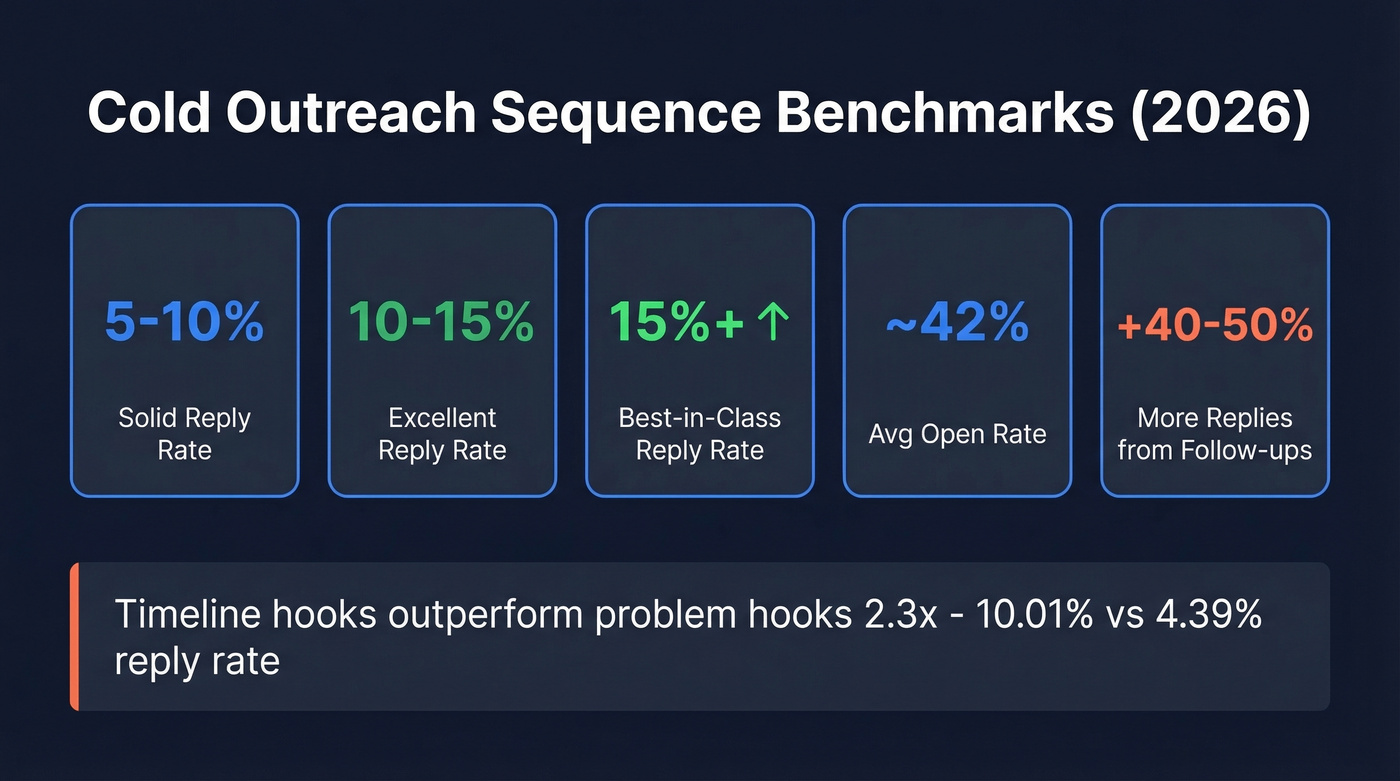
| Metric | Range |
|---|---|
| Reply rate (solid) | 5-10% |
| Reply rate (excellent) | 10-15% |
| Reply rate (best-in-class) | 15%+ |
| Avg open rate | ~42% |
| Follow-up lift | +40-50% more replies |
In our experience, teams hitting 10%+ reply rates run tight lists under 500 contacts with trigger-based personalization (see Personalized Outreach). And here's a stat worth internalizing: timeline-based hooks outperform problem hooks 2.3x - 10.01% vs 4.39% reply rate. "Your contract renews in 6 weeks" beats "Struggling with X?" every time.
4 Sales Outreach Sequences You Can Copy Today
67.88% Open Rate From 3 Emails
This structure pulled that number on 344 recipients in a real logistics campaign - written in the founder's voice, short, zero marketing fluff. Best for SMB and founder-led sales targeting tight lists.
| Day | Channel | Framework | Guidance |
|---|---|---|---|
| 1 | CPPC | Context → Problem → Projection → Soft CTA | |
| 4 | PAIB | Problem → Agitation → Implication → Benefit | |
| 8 | PAS | Problem → Agitation → Solution + offer |
Space emails 3-5 days apart. The consensus from practitioners on r/LeadGeneration is blunt: short, real, founder-voice emails beat polished, over-produced templates almost every time (more ideas in our Cold Email Follow-Up Templates).
The 8-Touch Multi-Channel Blueprint
This is the workhorse for mid-market B2B. The 8-touch, 12-day framework from Sybill mixes email, phone, and social while respecting the 50% Rule - no more than half your touches are email.
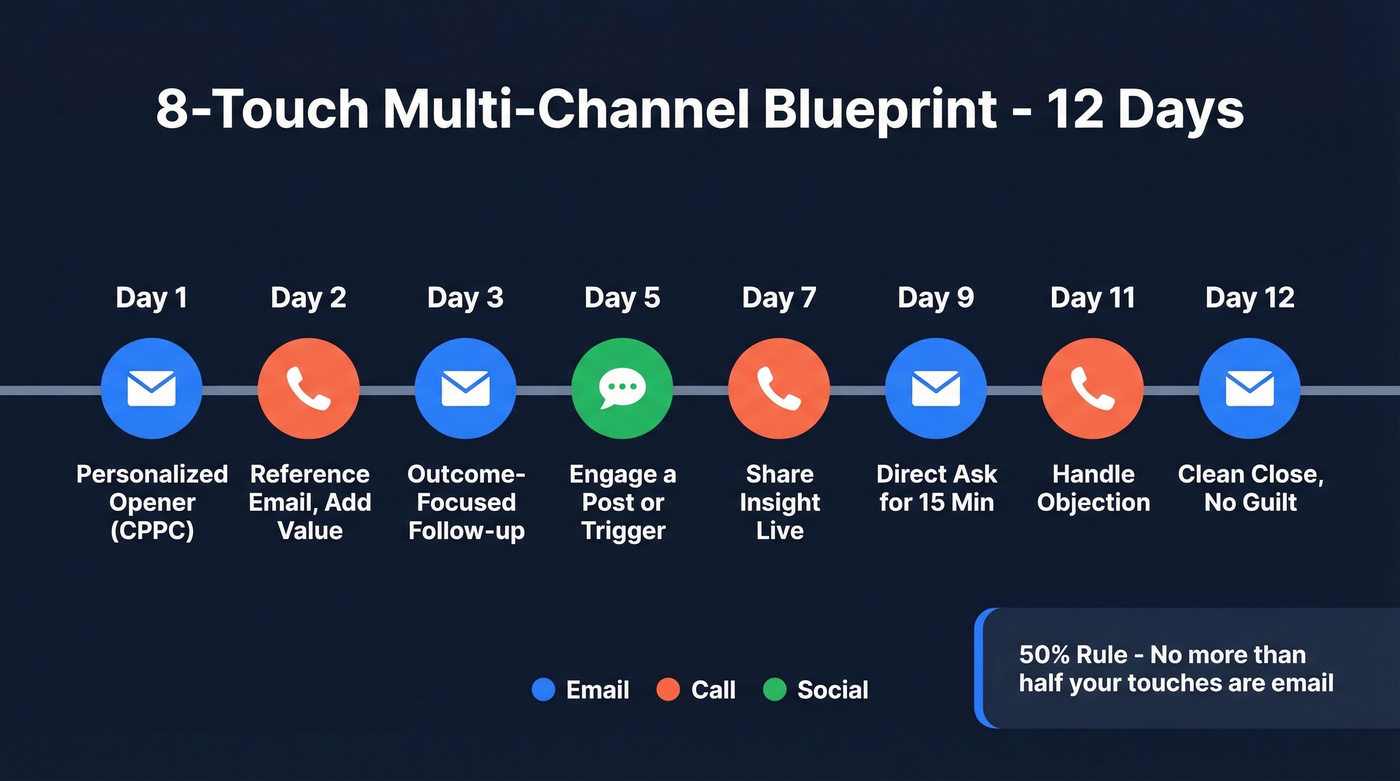
| Day | Channel | Action |
|---|---|---|
| 1 | Personalized opener (CPPC) | |
| 2 | Call | Reference email, add value |
| 3 | Outcome-focused follow-up | |
| 5 | Social | Engage a post or reference a trigger |
| 7 | Call | Share an asset or insight live (follow up if needed) |
| 9 | Direct ask for 15 minutes | |
| 11 | Call | Handle the likely objection |
| 12 | Clean close - last touch, no guilt |
The Day 5 social touch only works if it's tied to a real signal - a job change, a funding round, a post they wrote. Generic "great post!" engagement is worse than skipping the step entirely. No signal? Replace it with a second call attempt (use a simple lead scoring model to decide who gets the extra effort).
We've found this is the multi-channel cadence most teams should start with before customizing for their market. It's structured enough to be repeatable but flexible enough to swap channels based on what your prospects actually respond to (especially if you're running a sales engagement platform).
The Enterprise Long-Play
Your champion went dark. The CFO hasn't been looped in. Nobody's booking a demo after two emails. Complex deals need 10-18 touches over 30-60+ days using a Widening Gap cadence (for deeper enterprise motion, see Enterprise B2B Sales).
Touches 1-4 (Days 1-8): Email, call, email, social - tight spacing to establish presence.
Touches 5-8 (Days 12-25): Asset touch, call, stakeholder reference, social. You're building a case across the buying committee now, not just pinging one person.
Touches 9-12+ (Days 30-60): Spaced check-ins with fresh value each time. Cap email steps at 5-9 total. The widening gaps prevent velocity filters and mirror how enterprise buyers actually decide - slowly, with internal consensus-building between your touches.
The Re-Engagement Sequence
For prospects who went dark after initial interest. Three touches, seven days.
- Day 1 - Check-in. Reference the last conversation. Ask one question. No pitch.
- Day 4 - New value. Share something that's changed - a feature, a case study, a market shift.
- Day 7 - Breakup. "Should I close this out?" This consistently gets the highest reply rate in any sequence. People respond to the fear of losing an option.
Question CTAs win here. "Is this still a priority for Q3?" beats "Let me know if you'd like to reconnect." (If you need more options, borrow from these sales follow-up templates.)

Every template above assumes your emails actually reach inboxes. Prospeo's 5-step verification keeps bounce rates under 2% - catching spam traps, honeypots, and catch-all domains before they torch your sender reputation. At $0.01 per verified email, clean data costs less than one bounced sequence.
Stop writing sequences on top of broken data.
Sequence Architecture Checklist
We've tested these rules across dozens of campaigns. Treat them as non-negotiable:
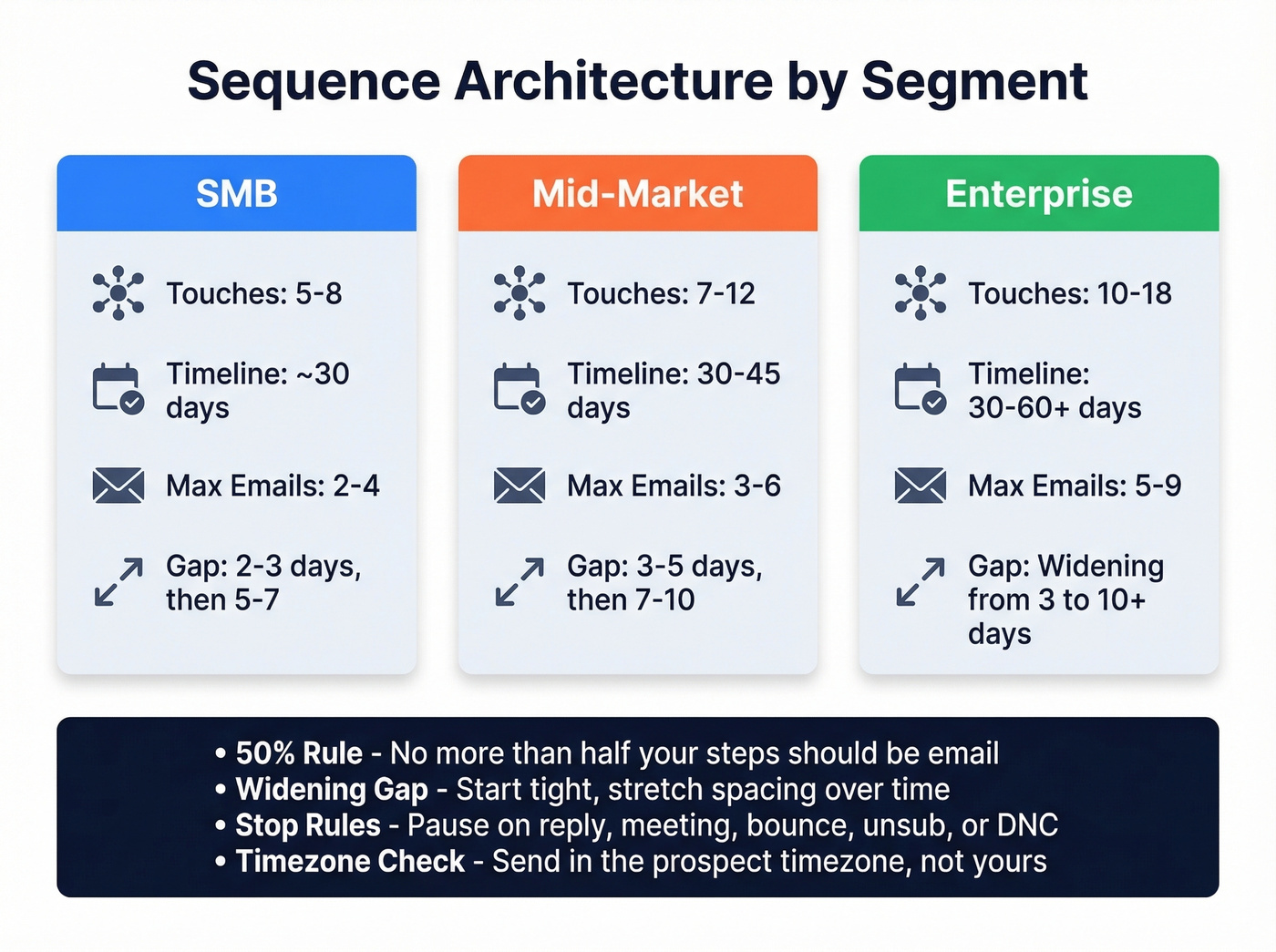
- 50% Rule: No more than half your steps should be email.
- Widening Gap: Start at 2-3 days, stretch to 5-7, then 10+ for later touches.
- Stop rules: Pause on reply, meeting booked, hard bounce, unsubscribe, or DNC flag.
- Timezone: Many tools schedule on sender timezone. A 9 AM send from your office hits at 6 AM in theirs. Check this before launch (more on safe pacing in Email Velocity).
| Segment | Touches | Timeline | Max emails |
|---|---|---|---|
| SMB | 5-8 | ~30 days | 2-4 |
| Mid-market | 7-12 | 30-45 days | 3-6 |
| Enterprise | 10-18 | 30-60+ days | 5-9 |
Deliverability Non-Negotiables
None of this matters if your emails hit spam. Here's the baseline, drawn from bulk-sender requirements and Outreach's deliverability guidelines (full breakdown: Email Deliverability Guide):
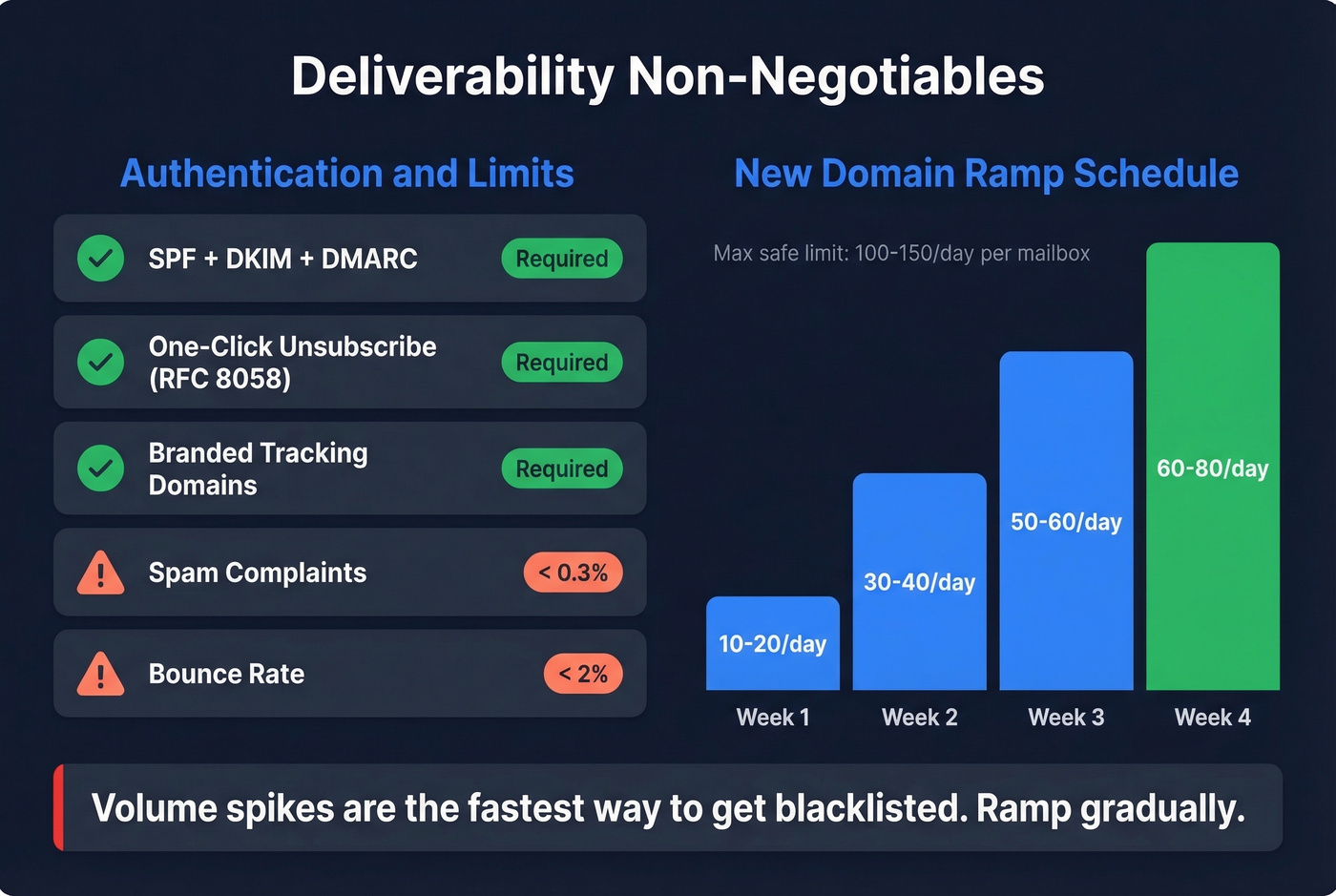
| Rule | Threshold |
|---|---|
| SPF + DKIM + DMARC | Required |
| Spam complaints | < 0.3% |
| Bounce rate | < 2% |
| One-click unsubscribe | Required (RFC 8058) |
| Tracking domains | Branded, not shared |
Safe daily limits: Google Workspace and Microsoft 365 top out at 100-150/day. New domains should ramp: 10-20/day in Week 1, scaling to 60-80 by Week 4. Volume spikes are the fastest way to get blacklisted (see How to Improve Sender Reputation).
Verify every email before sending. Prospeo's 5-step verification handles catch-all domains, spam traps, and honeypots automatically - the stuff that silently tanks your sender reputation even when your copy is perfect (use an AI email checker to catch issues before you hit send).
Data Makes or Breaks the Sequence
Look, roughly 40% of emails from unverified lists never reach an inbox. Bad data creates bounces, bounces damage your domain, and a damaged domain means every future sequence starts in a hole you didn't need to dig.

Real results tell the story better than theory: Stack Optimize runs bounce rates under 3% with zero domain flags across all clients using Prospeo's verified data. Meritt dropped from a 35% bounce rate to under 4% (if you're cleaning lists at scale, compare data enrichment services too).
If your bounce rate is above 5%, stop writing new sequences. Fix your data first. The best outreach sequence templates in the world can't outrun a burned domain.
Multi-channel sequences need more than emails - they need direct dials that actually connect. Prospeo delivers 125M+ verified mobile numbers with a 30% pickup rate, so your Day 2 and Day 7 call steps land with real decision-makers instead of voicemail graveyards.
Build sequences with contacts that pick up the phone.
FAQ
How many emails should a cold outreach sequence include?
Three to five for SMB deals, five to nine for enterprise. Follow the 50% Rule - no more than half your total touches should be email. Fill the rest with calls, social engagement, and asset shares.
What's the best time to send cold emails?
Mid-morning, 9-11 AM in the prospect's timezone, tends to produce the highest open rates. But timing to a trigger - a job change, a funding round, a new hire - consistently beats timing to a clock.
Do follow-up sequences actually improve reply rates?
Structured follow-up sequences add 40-50% more replies compared to single-touch sends. The key is widening the gap between touches and leading with fresh value each time - not just resending the same ask.
How do I keep outreach emails out of spam?
Authenticate with SPF, DKIM, and DMARC. Keep bounces under 2% by verifying emails before sending. Ramp volume gradually and stay under 150 emails per mailbox per day. Skip this step and even a great sequence won't reach anyone.