

Permissionless Value Proposition: The 2026 Guide
Cold email response rates dropped from 8.5% in 2019 to roughly 5% in 2025. Meanwhile, 54% of sales teams already use AI to write outbound - which means your prospects' inboxes are flooded with AI-generated mediocrity that all sounds the same. The permissionless value proposition is the framework that cuts through that noise, and it's the only outbound approach we've seen consistently beat the averages.
Jordan Crawford coined the PVP and later taught it through Cannonball GTM. His framework has been scattered across Substack posts, podcast appearances, and LinkedIn threads. This guide consolidates it into something you can actually execute on.

What Is a PVP?
A PVP is a data-driven outbound message so valuable the prospect would pay to receive it. The word "permissionless" is the key - you're delivering uniquely valuable business intelligence before anyone asked for it.
"I saw you went to Duke" is decoration. A PVP delivers something the prospect didn't know about their own business. In Crawford's HVAC example, the message quantified a specific replacement opportunity at $568,000 - complete with equipment details, timeline, and revenue impact. The prospect could act on that information whether they bought the product or not.
That's the litmus test. If your email is independently useful without your product, you've got a PVP. If it's just a clever first line stapled to a demo request, you don't.
7 Rules That Define the Framework
Not every "personalized" email qualifies. The framework sets seven criteria:
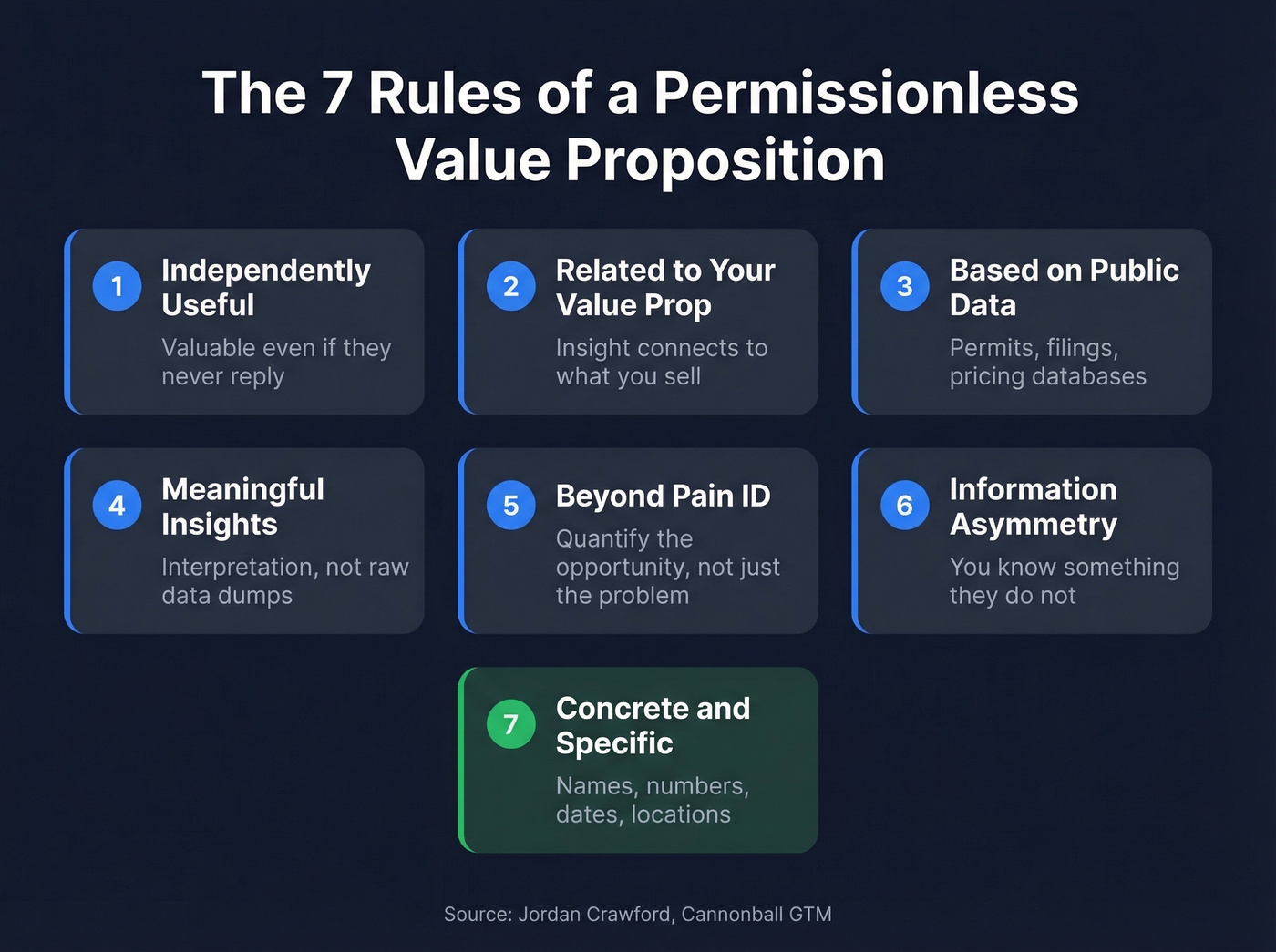
- Independently useful - the prospect gains value even if they never reply.
- Related to your value prop - the insight connects to what you sell.
- Based on public data - permits, filings, pricing databases, regulatory records.
- Translates into meaningful insights - raw data isn't a PVP. The interpretation is.
- Goes beyond pain identification - don't name the problem. Quantify the opportunity.
- Creates information asymmetry - you know something the prospect doesn't.
- Concrete and specific - names, numbers, dates, locations.
Even Crawford's team hits about a 30% success rate on the first try. This isn't magic. It's a skill that improves with reps.
Why PVP Outperforms Generic Outbound
Timeline-based hooks - messages tied to a specific event or data point - average a 10.01% reply rate versus 4.39% for generic problem hooks. That's a 2.3x gap. Meeting rates are even more dramatic: 2.34% versus 0.69%.
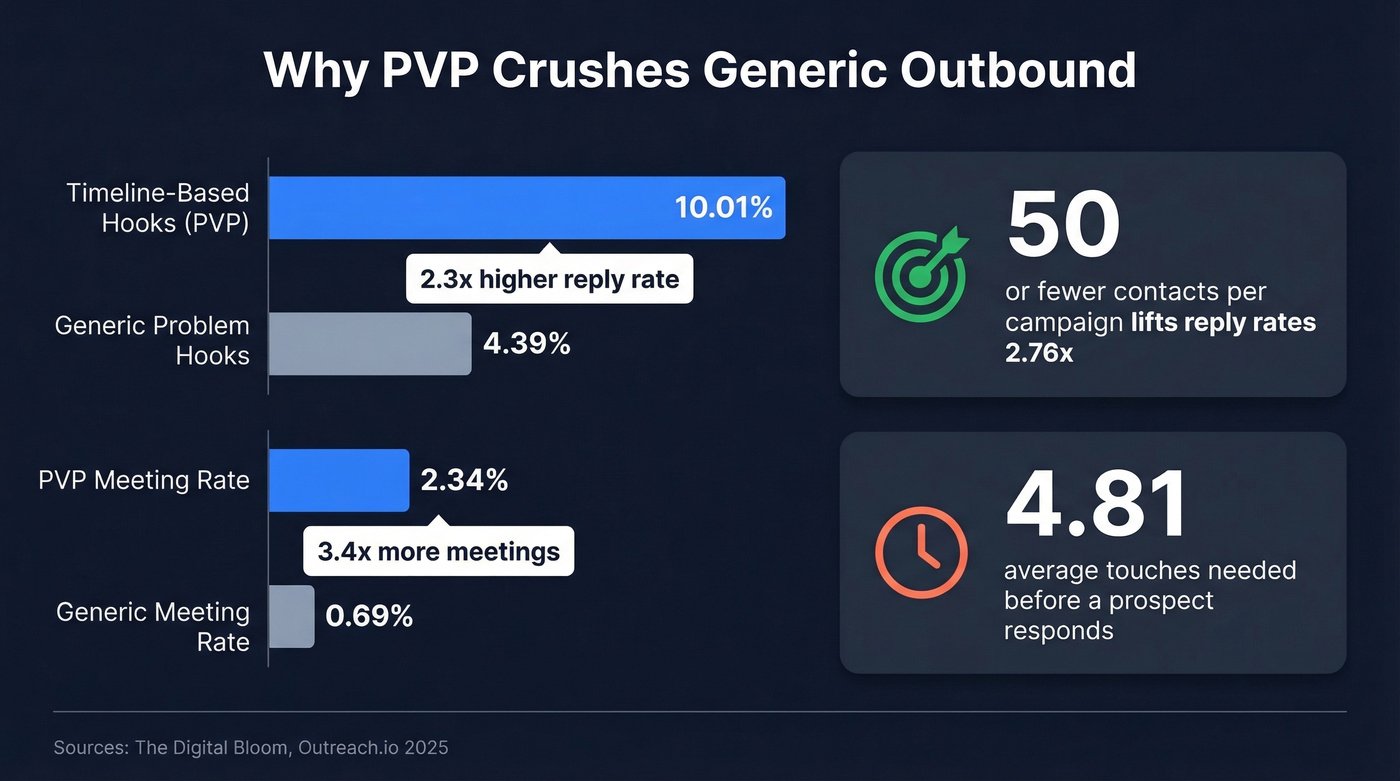
Micro-cohorts matter too. Campaigns targeting 50 contacts or fewer lift reply rates 2.76x. And with the average prospect needing 4.81 touches before responding, your first message has to earn the right to send a second one. A PVP does that because it leads with value, not a pitch.
Here's the thing most teams miss: they don't have a messaging problem. They have a list problem. PVP forces you to fix the list first, and the message practically writes itself.
If you want more frameworks that pair well with PVP, start with sales prospecting techniques and account-based selling.
How to Build a PVP: The FIND Framework
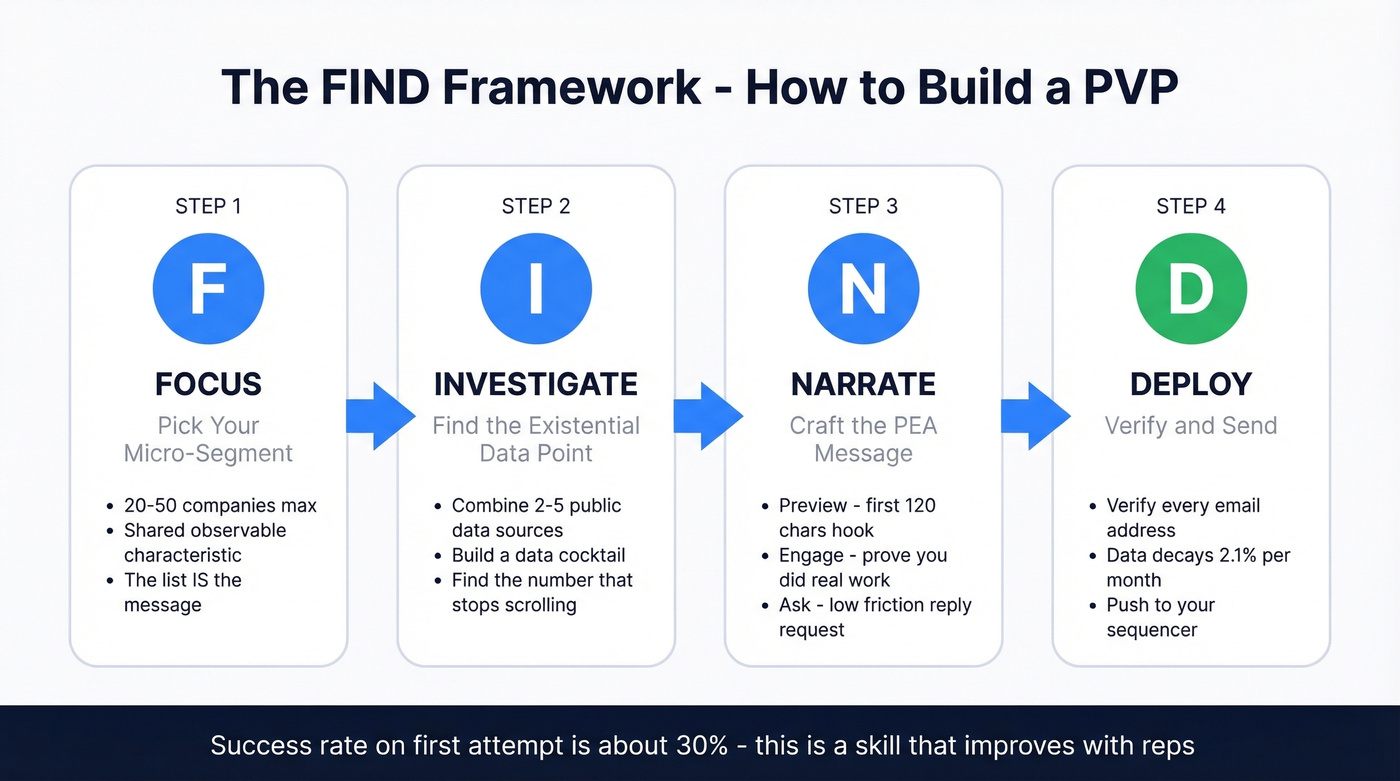
Crawford's core philosophy: "Process over prompts." You can't prompt-engineer your way to a great PVP. You need a repeatable research process. The FIND framework - Focus, Investigate, Narrate, Deploy - is that process. Three tools to start: an AI research model, a data enrichment platform, and a sending tool.
Focus - Pick Your Micro-Segment
"The list is the message." Don't start with a 10,000-contact export. Start with 20-50 companies sharing a specific, observable characteristic: a regulatory deadline, a technology gap, a market shift hitting their vertical right now. We've found that the tighter the segment, the easier every subsequent step becomes - your research gets faster, your insight gets sharper, and your message practically assembles itself.
This is also where a clean ideal customer profile and strong firmographic filters do most of the heavy lifting.
Investigate - Find the Existential Data Point
This is where the framework gets its power. You're looking for the existential data point - the metric that turns your product from nice-to-have into must-have.
Take Texada's equipment rental case. Moving from 60% to 80% utilization can shift profit margin from around 20% to 36%. A single piece of heavy equipment can represent +$650K in annual revenue with minimal added costs. That's the kind of number that makes a prospect stop scrolling.
Use ChatGPT or Claude to combine 2-5 public data sources into a "data cocktail." One data point is forgettable. Three woven together are compelling. DOT permits, building permits via Shovels.ai, contractor licensing databases, pricing indices - every industry has public data if you look hard enough.
If you want to go deeper on turning raw signals into outreach angles, see how to track sales triggers.
Narrate - Craft the PEA Message
The PEA framework structures your outreach:
- Preview - your first ~120 characters must hook. That's all that shows in a mobile notification.
- Engage - share enough of the insight to prove you've done real work. Specific numbers, not vague claims.
- Ask - a low-friction reply request. Not "book a 30-minute demo." More like "want me to send the full analysis?"
For more help tightening the actual copy, use these cold email subject line examples and emails that get responses.
Deploy - Verify and Send
A brilliant insight sent to a dead email is wasted research. B2B contact data decays at ~2.1% per month - roughly a quarter of your list goes stale every year. Verify every address before deploying. Prospeo's 5-step verification process catches bad addresses at 98% accuracy before they tank your sender reputation, and you can push verified contacts directly to your sequencer via native integrations with Instantly, Smartlead, or Lemlist.
If you're troubleshooting bounces and inboxing, start with email bounce rate and email deliverability.

PVP campaigns live or die on micro-segments. Prospeo's 30+ filters - buyer intent, technographics, headcount growth, funding - let you build the hyper-targeted 20-50 company lists the FIND framework demands. Then verify every email at 98% accuracy for $0.01 each.
Build the list that writes the message for you.
Real PVP Examples Across Industries
| Industry | Public Data Source | PVP Insight | Prospect Value |
|---|---|---|---|
| Equipment Rental (Texada) | DOT permits + permit filings | Fleet utilization below ~60% (existential threshold) | $45K-$180K revenue opportunity |
| Dental (Overjet) | CDC data + geo targeting | City-level diabetes signal tied to dental risk and revenue | Clinical + revenue AI case |
| Construction | Material price indices | Concrete +22% in 45 days; 3 alt suppliers | Cost avoidance, timeline protection |
| Restaurants | Liquor license auctions | License = +37% avg ticket; auction $15K below market | ROI-backed expansion decision |
Let's be honest about the two objections that always come up in outbound communities: "It's too much work to scale" and "the personalization feels creepy." Both are fair. This approach isn't for every team - it's for teams where deal sizes justify 30 minutes of research per prospect. If your average contract value is under ~$5-10K, batch-and-blast probably wins on ROI. Skip PVP and focus on volume. Above that threshold, PVP dominates.
PVP for Horizontal SaaS
Horizontal SaaS has a unique challenge here. When your product serves every industry, you can't build the deep, vertical-specific insights that give these campaigns their power.
The workaround is the Inverse Value Prop - show evidence of pain from not having your solution. Sell email verification? Find prospects whose domains are sitting on spam blacklists. Sell an integration platform? Surface data sync delays costing them revenue. You're flipping the approach: instead of showing opportunity, you're showing the cost of inaction. I once watched a team close a six-figure deal because they showed a prospect their domain was on three blacklists - the prospect had no idea, and the urgency was immediate.
The PVP Tool Stack
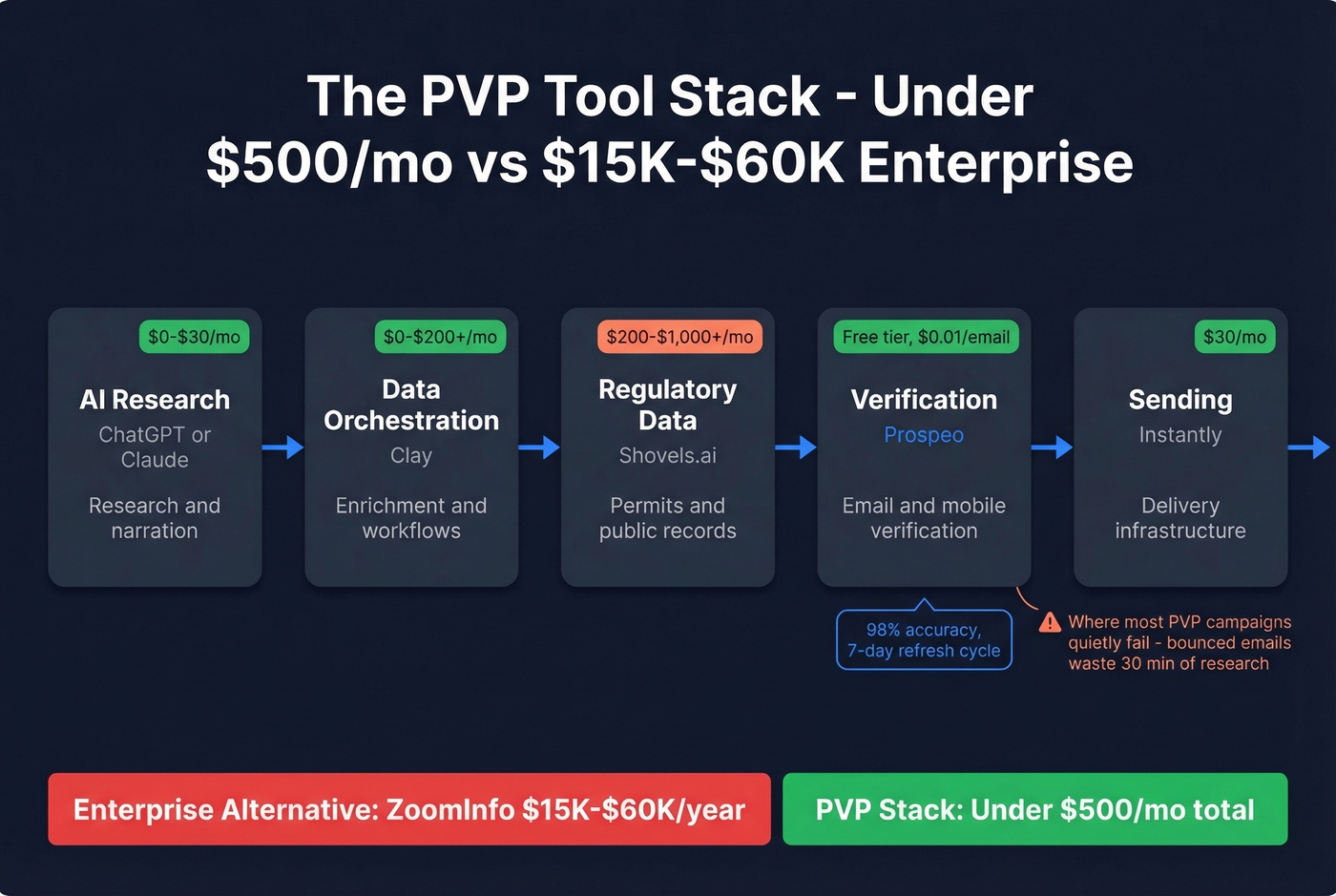
Compare enterprise tools like ZoomInfo at $15K-$60K/year, and the PVP stack looks like a bargain.
| Tool | Role | Cost |
|---|---|---|
| ChatGPT / Claude | AI research + narration | ~$0-$30/mo |
| Clay | Data orchestration + enrichment | ~$0-$200+/mo depending on usage |
| Shovels.ai | Permit + regulatory data | ~$200-$1,000+/mo depending on volume |
| Prospeo | Email/mobile verification + lead database | Free tier available; ~$0.01/email paid |
| Instantly | Sending infrastructure | ~$30/mo |
If you're evaluating options across the stack, these roundups help: SDR tools and outbound lead generation tools.
The verification layer is where most PVP campaigns quietly fail. You've spent 30 minutes researching a prospect, crafted a genuinely valuable insight, and then the email bounces because the address was stale. Prospeo's 7-day data refresh cycle - versus the 6-week industry average - means you're working with current records, not stale exports. Teams like Meritt saw bounce rates drop from 35% to under 4% after switching their verification layer.
You just spent hours crafting a $568K insight. Don't bounce it off a dead inbox. Prospeo's 5-step verification catches bad addresses before they torch your sender reputation, and pushes verified contacts straight to Instantly, Smartlead, or Lemlist.
Protect every PVP you deploy - verify before you send.
Common PVP Mistakes
Captain Obvious. Telling a restaurant owner food costs are rising isn't a PVP. Telling them concrete in their county is up 22% with three cheaper suppliers is.
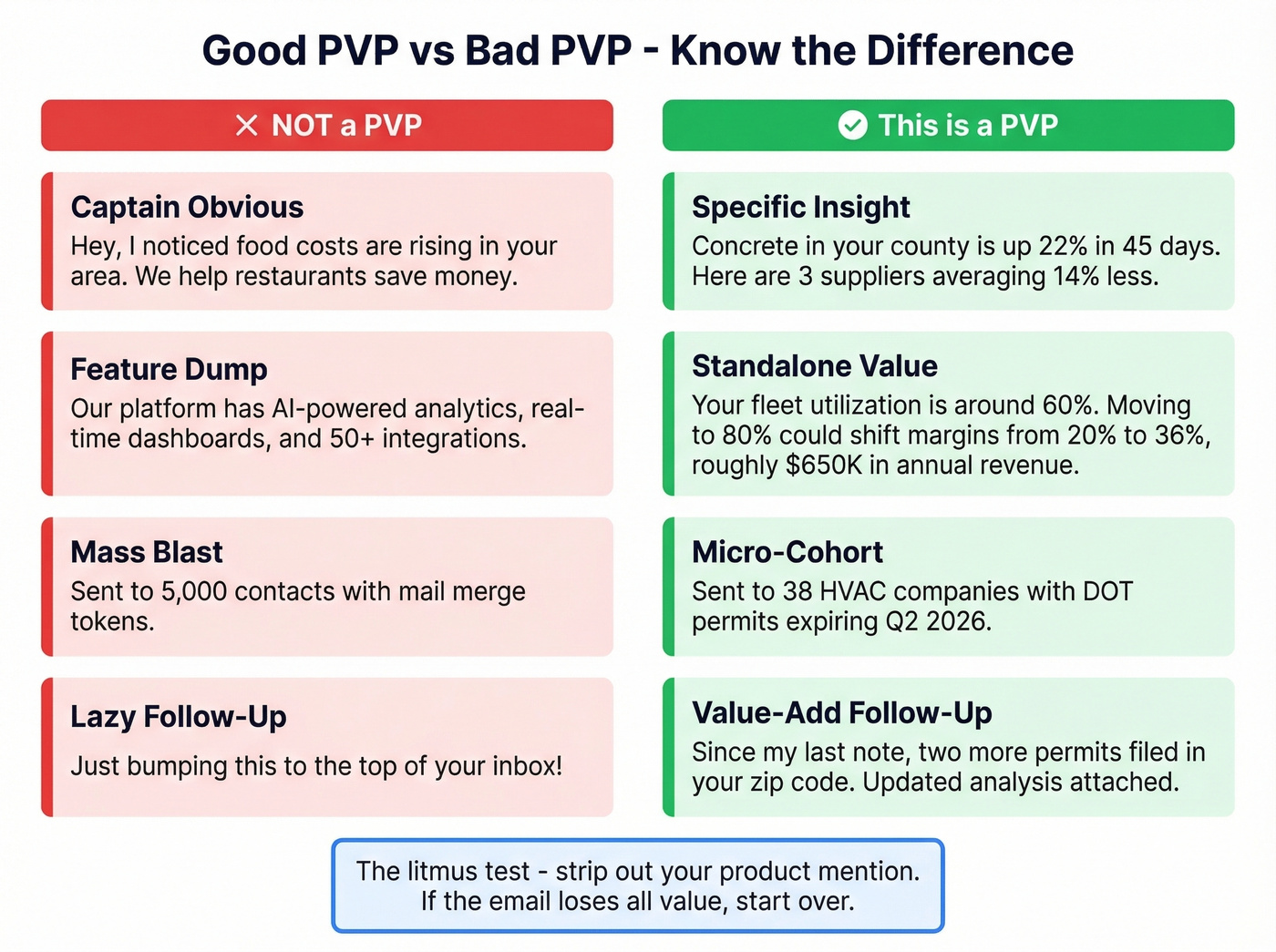
Making it about your features. The prospect should be able to act on your insight without buying anything. If you strip out your product mention and the email loses all value, start over.
Skipping segmentation. A PVP sent to 5,000 contacts isn't a PVP. It's a mail merge with better copy.
Ignoring follow-up cadence. With 4.81 touches needed on average, plan a 3-7-7 day follow-up sequence that adds new data each time. Don't just "bump" the original email - that's lazy and your prospect knows it.
FAQ
Does PVP work for small teams?
Yes - PVP actually favors small teams. Micro-cohorts of 50 contacts or fewer lift reply rates 2.76x. One person with ChatGPT, a public data source, and a verified contact list can run a full campaign. We've seen solo founders outperform 10-person SDR teams this way because they're willing to do the research that larger teams won't.
What if there's no public data for my industry?
Every industry has public data - permits, filings, job postings, pricing databases, court records. If you truly can't find external data, use the Inverse Value Prop approach: show evidence of pain from not having your solution instead.
How is PVP different from regular personalization?
Standard personalization decorates a generic pitch with surface-level details. A permissionless value proposition delivers business intelligence the prospect didn't have - specific numbers and dollar amounts that change how they see their own business. The prospect can act on the insight whether they buy from you or not.
How long does it take to build one?
Expect 20-30 minutes per prospect for your first few campaigns. With practice and templated research workflows in tools like Clay, experienced teams get that down to 10-15 minutes. At a $25K+ ACV, even 30 minutes per prospect is a bargain compared to the cost of ignored cold emails.