

The 7-Step Personal Selling Process - With Real Numbers, Scripts, and Frameworks
Nearly 70% of prospects ignore emails they perceive as automated. Meanwhile, only 13% of buyers believe a sales rep can actually understand their needs. That's the paradox of modern selling: automation annoys people, but most human-led selling isn't much better.
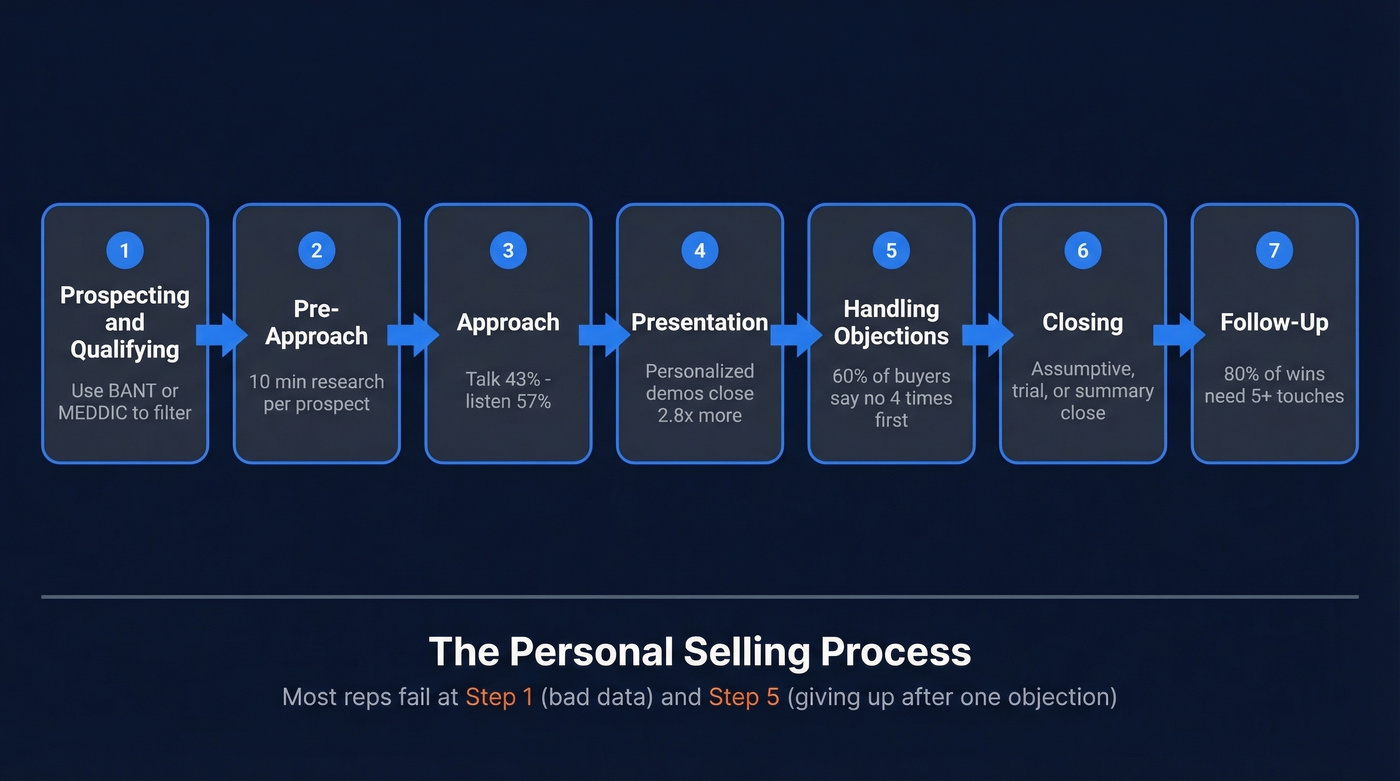
The personal selling process - done right, with real data behind each step - is how you close that gap. Here's the short version: it's seven steps, prospecting through follow-up. Most reps fail at step 1 (bad data wastes every step that follows) and step 5 (first objection = give up). We're going to walk through the benchmarks, scripts, and frameworks to actually execute each step, not just name them.
Why Personal Selling Still Wins
Personal selling costs more per contact. That's not a secret, and pretending otherwise wastes your time. But the conversion math tells a different story.
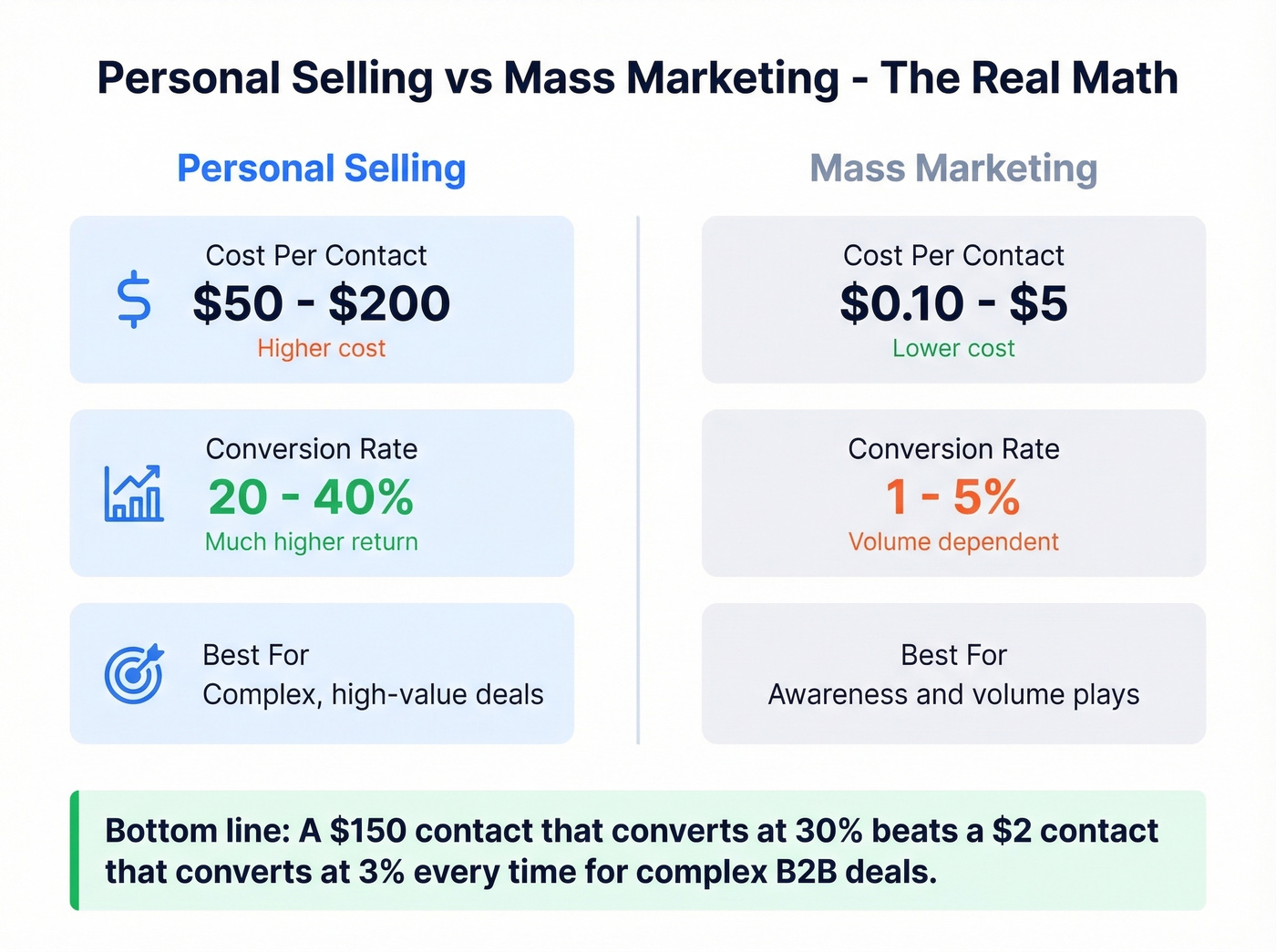
| Metric | Personal Selling | Mass Marketing |
|---|---|---|
| Cost per contact | $50-200 | $0.10-5 |
| Conversion rate | 20-40% | 1-5% |
| Best for | Complex, high-value | Awareness, volume |
A $150 cost-per-contact looks expensive until you realize it converts at 20-40%. Mass marketing's $2 cost-per-contact looks cheap until you need 10x the volume to match the same pipeline. For complex B2B deals, high-ticket services, pharma, financial services, and luxury retail, the math strongly favors one-to-one selling.
The deeper reason is trust. When 57% of the buying journey is done before a prospect talks to sales, the human interaction that remains carries disproportionate weight. Buyers have already read the comparison posts and watched the demos. What they need from you is someone who listens, diagnoses, and solves - not someone who recites a feature list. That's exactly when personal selling earns its cost: when the buyer's decision hinges on trust, complexity, and customization rather than price alone.
What Is Personal Selling?
Personal selling is one-to-one, consultative, direct communication between a seller and a buyer - whether in person, over video, on the phone, or through targeted email. It's the opposite of broadcast marketing. You're talking to one person about their specific problem.
Three types show up across industries:
- Order takers process inbound demand - think retail counters or inbound SDRs fielding demo requests.
- Order creators generate demand by educating buyers. A pharma rep walking a physician through clinical trial data for a new drug is the classic example.
- Order getters hunt net-new business through outbound prospecting - the SaaS AE cold-calling into a target account list.
One distinction worth knowing: Sales Force Automation tools help you acquire customers through the selling process, while CRM systems help you manage and retain them after the sale. Most teams conflate the two, but understanding the difference sharpens how you tool up for each step (and which examples of a CRM actually fit your motion).
As a form of promotional communication, personal selling sits alongside advertising, PR, and direct marketing - but it's the only promotional tool that allows real-time, two-way dialogue. That's its superpower and its cost driver.
The 7 Steps of Personal Selling
Most guides name the steps and move on. Each step below includes what to do, a benchmark or script, and the mistake that kills deals at that stage.
Step 1 - Prospecting and Qualifying
You've spent 45 minutes on a demo with someone who has no budget, no authority, and no timeline. We've all been there. That's a prospecting and qualifying failure, and it's the most expensive mistake in the entire process.
Prospecting means building a pipeline of potential buyers. Qualifying means filtering that pipeline to people who can actually buy. Two frameworks dominate:
- BANT - Budget, Authority, Need, Timeline. Simple, fast, works for SMB and mid-market.
- MEDDIC - Metrics, Economic Buyer, Decision Criteria, Decision Process, Identify Pain, Champion. Heavier, built for enterprise deals where committees make decisions (useful to pair with MEDDIC sales qualification when deal size grows).
Since 57% of the buying journey happens before a prospect ever talks to you, unqualified outreach means you're chasing people who've already decided - just not in your favor. And here's a stat that should change how you think about qualification: on deals over $50K, multithreading - engaging multiple stakeholders - boosts win rates by 130%. Map the org chart early.

Bad data is the silent killer here. Every bounced email and wrong number poisons every step that follows. Prospeo gives you 300M+ professional profiles with 98% email accuracy and a 7-day refresh cycle, plus 30+ search filters including buyer intent, technographics, and job changes - so your list is half-qualified before you pick up the phone (more ideas in these sales prospecting techniques).
Step 2 - Pre-Approach
This is the research step most reps skip entirely - and it shows. As Morgan Ingram puts it, personal selling is relevance (problems you solve without research) plus personalization (research on the specific company and prospect). You can't personalize what you haven't studied.
Your pre-approach checklist:
- Company triggers - recent funding, acquisitions, leadership changes, layoffs (see a practical system for how to track sales triggers)
- Tech stack - what they're already using and what they might replace
- Org chart - who reports to whom, who influences the decision
- Recent content - what the prospect has published, shared, or commented on
Here's the thing: when buyers are already more than halfway through their journey before they talk to you, showing up unprepared is the fastest way to get dismissed. Ten minutes of research per prospect pays for itself in every conversation that follows.
Step 3 - Approach
Top closers talk 43% of the time versus 65% for average reps. That single stat should reshape how you think about your first real interaction with a prospect.
The practitioner mantra on r/sales is consistent: "Have conversations, not presentations." A soft approach works best - ask questions, listen, resist the urge to pitch in the first 60 seconds. Non-verbal cues matter too. Body language, seating position, and even clothing choices signal confidence and approachability before you say a word.
The deal-killer is talking too much. New reps feel pressure to demonstrate expertise, so they dump features and value props before they've even understood the problem. Flip the ratio. Ask two questions for every statement you make. The prospect will tell you exactly how to sell to them if you let them talk (a deeper breakdown: sales communication).
Step 4 - Presentation
Several presentation formats work depending on the situation:
| Format | When It Works |
|---|---|
| Consultative | Complex deals requiring collaborative problem-solving |
| Need-satisfaction | Surface the need, then show how you solve it |
| Adaptive | Adjust based on the buyer's personality and signals |
| AIDA | Structured persuasion through Attention, Interest, Desire, Action - best for shorter cycles |
The principle that separates great presenters from average ones: lead with outcomes, not features. A study of 1,200 B2B sales cycles found that personalized demos closed at 2.8x the rate of generic presentations. That's not a marginal improvement - it's the difference between a 15% close rate and a 42% close rate.
What goes wrong: feature-dumping. You've built a beautiful product and you want to show all of it. Don't. Connect every capability to the prospect's stated pain. If they didn't mention it as a problem, it doesn't belong in your presentation (use this product demo checklist to keep it tight).
Step 5 - Handling Objections
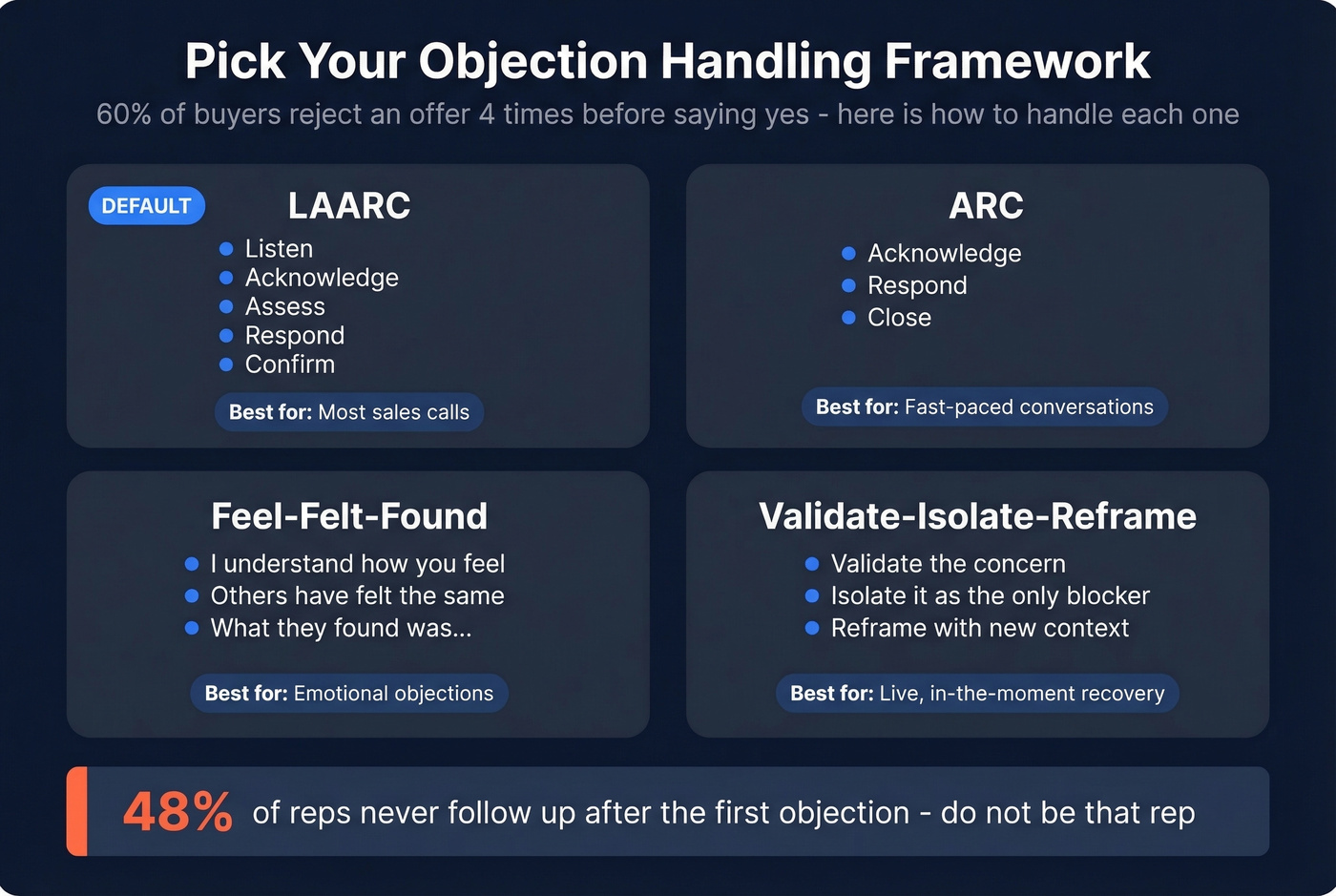
60% of buyers reject an offer four times before saying yes. And yet 48% of reps never follow up after the first objection. That gap is where deals go to die.
Objections aren't rejection - they're buying signals. A prospect who objects is engaged. A prospect who says "looks great, we'll be in touch" is the one you should worry about.
The default framework is LAARC: Listen, Acknowledge, Assess, Respond, Confirm. For faster moments, try Validate, Isolate, Reframe.
| Framework | When to Use | Strength |
|---|---|---|
| LAARC | Default for most calls | Structured, complete |
| ARC | Fast-paced conversations | Speed |
| Feel-Felt-Found | Emotional objections | Empathy-driven |
| Validate-Isolate-Reframe | Live, in-the-moment | Quick recovery |
The 70/30 rule applies here more than anywhere: the prospect talks 70%, you talk 30%. When objections hit, average reps speed up to 188 words per minute from a baseline of 173. Top performers keep their pace steady and let the silence work (if this is a recurring issue, use a system to reduce sales objection rate).
A concrete script for the most common objection - "I don't have time":
"Totally fair. Can I get 30 seconds? If what I share isn't relevant, I'll hang up - does that sound fair?"
Then deliver your sharpest value prop in two sentences. No preamble, no throat-clearing. The mistake that kills deals here is treating objections as the end of the conversation instead of the beginning of the real one.
Step 6 - Closing
New reps on Reddit consistently describe closing as "awkward and cringe" - the discomfort of "pushing people to open their wallets." Let's reframe that. Closing isn't pressure. It's confirming that the next step makes sense for both sides.
Three techniques that work without feeling pushy:
- Assumptive close - "Should we start with the 10-seat plan or the 25?" Assumes the decision is made, focuses on details.
- Trial close - "If we could solve the data quality issue you mentioned, would that be enough to move forward?" Tests readiness without forcing commitment.
- Summary close - "So we've covered the integration timeline, the pricing, and the onboarding support. What else do you need to make a decision?" Recaps value, invites remaining objections.
If you've done steps 1-5 well, closing is just the natural next sentence. Say it. Waiting for the prospect to close themselves is a fantasy - they won't (more closing mechanics in steps to close a sale).
Step 7 - Follow-Up
"Let me think about it." Every rep has heard this. Most interpret it as "no." It's not - it's "not yet."
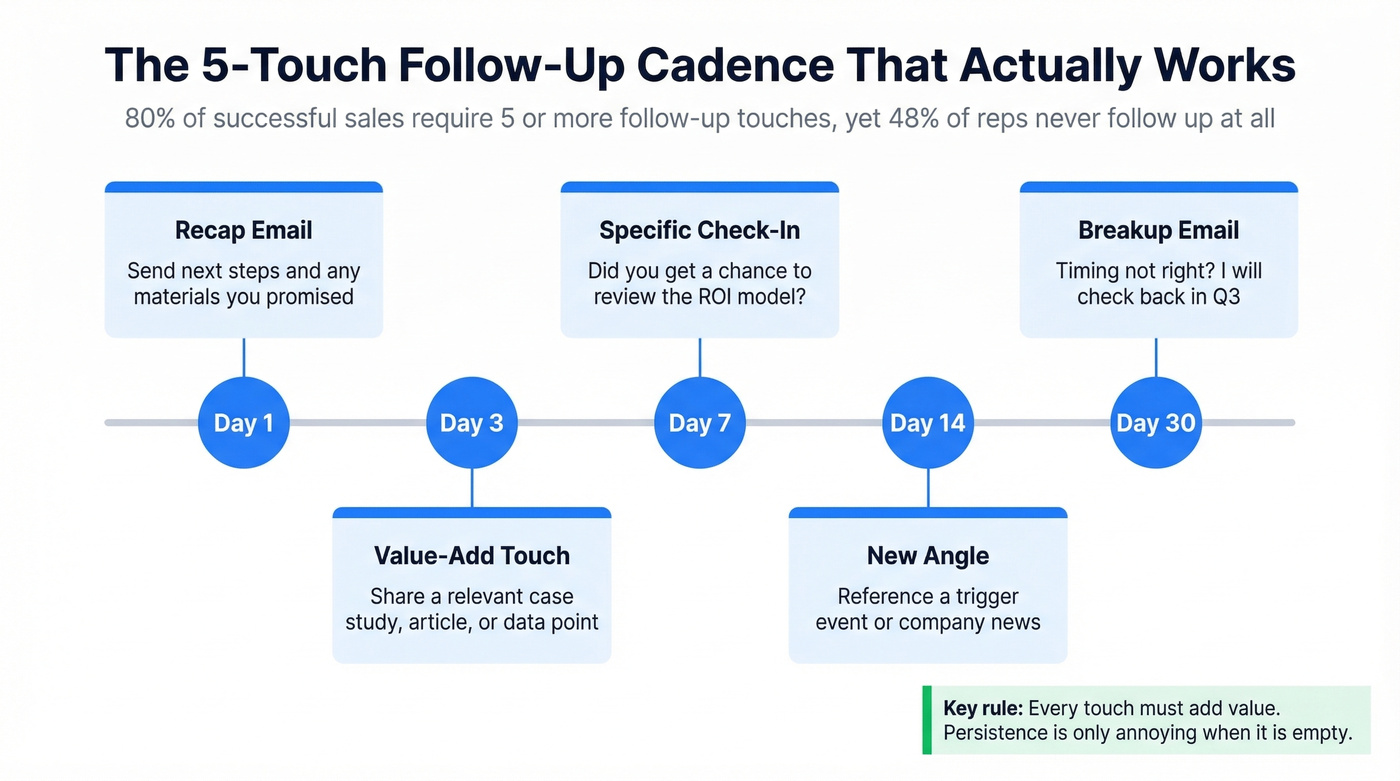
80% of successful sales require five or more follow-up touches. Yet 48% of reps never follow up at all. The math is brutal: half of all salespeople abandon deals that statistically need five more contacts to close.
This cadence works:
- Day 1 - recap email with next steps and any materials promised
- Day 3 - value-add touchpoint: relevant case study, article, or data point
- Day 7 - check-in with a specific question ("Did you get a chance to review the ROI model?")
- Day 14 - new angle or trigger event ("Saw your company just announced X - here's how that connects")
- Day 30 - breakup email ("Seems like timing isn't right. I'll check back in Q3 - unless you want to revisit sooner?")
Persistence isn't annoying when each touch adds value. It's only annoying when you send "just checking in" five times (use these sales follow-up templates to avoid that trap).

Bad data kills personal selling at Step 1. Every bounced email and wrong number wastes the research, approach, and presentation that follow. Prospeo's 300M+ profiles with 98% email accuracy and 30+ filters - including buyer intent and job changes - mean your list is half-qualified before you pick up the phone.
Stop wasting demos on unqualified prospects with bad contact data.
Methodologies Mapped to the 7 Steps
The seven steps are the skeleton. Methodologies are the muscle.
| Methodology | Evidence / Origin | Strongest Steps | Best For |
|---|---|---|---|
| SPIN | 35,000+ calls, 20+ countries | Discovery, presentation | Complex, consultative |
| Challenger | 6,000 reps, 90 companies | Discovery, strategy, presentation | Insight-led selling |
| MEDDIC | Enterprise qualification | Qualifying, pre-approach | Enterprise, committee buys |
| Sandler | Behavioral psychology roots | Approach, qualifying | SMB, lower complexity |
No single methodology covers every step. SPIN goes deepest in discovery and presentation but doesn't address qualification rigorously. Challenger teaches reps to lead with insight but benefits from pairing with MEDDIC for qualification discipline. MEDDIC is purpose-built to prevent wasted demos on unqualified deals - teams often adopt it when they outgrow BANT.
In our experience, most teams end up blending two methodologies - and that's fine. Use MEDDIC for enterprise deals with buying committees, BANT for SMB velocity sales, SPIN when discovery is the bottleneck, and Sandler for shorter cycles where rapport matters more than process.
Skip the heavy methodology entirely if your average deal size is under $10K. BANT plus genuine curiosity will outperform a poorly executed MEDDIC every time. Process is only valuable when it's actually followed.
Building a Strategy That Scales
The seven steps give you a repeatable framework, but a personal selling strategy requires decisions about where and how to deploy that framework across your team. Not every deal deserves the same level of human investment.
Start by segmenting your pipeline into tiers. High-value, complex deals get the full seven-step treatment with deep research and multi-threaded engagement. Mid-market deals can compress steps 2 and 3 into a single research-and-reach session. Transactional deals - where one-to-one selling is least cost-effective - get routed to self-serve or inside sales with lighter touch. The goal isn't to apply the same process everywhere; it's to match the intensity of your process to the complexity and value of the opportunity.
We worked with an outbound agency last year that was running the same 7-step playbook for $5K deals and $150K deals. Their reps were burned out, and their close rate was mediocre across the board. Once they tiered their pipeline and reserved full-depth research for accounts above $50K, close rates on those deals jumped 40% - and reps had time to actually work them (a good companion framework: sales process optimization).
How AI Changes Each Step in 2026
The AI sales tools market hit $3B and is growing at roughly 13% annually. 56% of sales professionals now use AI daily, up from 24% in 2023. Sellers who effectively partner with AI are 3.7x more likely to meet quota.
But here's the nuance: 61% of B2B buyers say they prefer a rep-free buying experience. That doesn't mean they don't want human interaction - it means they don't want bad human interaction. AI amplifies consultative selling; it doesn't replace it.
Reps spend only 28-30% of their time actually selling. AI reclaims the rest:
- Prospecting - AI-powered databases surface in-market buyers using intent signals and technographic filters, cutting list-building from hours to minutes
- Pre-approach - AI research tools synthesize company news, financial data, and org charts into pre-call briefs automatically
- Approach and presentation - Conversation intelligence analyzes talk ratios, sentiment, and objection patterns in real time
- Objection handling - AI predicts likely objections based on deal stage, persona, and historical patterns
- Follow-up - Sequencing tools optimize timing, channel, and messaging based on engagement signals (see AI sales follow-up for what’s actually working)
Real talk: the reps who treat AI as a replacement for preparation will lose. The reps who use it to prepare faster and engage deeper will dominate. I've seen this play out across dozens of teams - the tool doesn't matter nearly as much as the intent behind it.
Multithreading boosts win rates by 130% on deals over $50K. But you can't multithread without verified contacts across the org chart. Prospeo gives you 125M+ verified mobiles with a 30% pickup rate and direct emails for every stakeholder - refreshed every 7 days.
Reach every decision-maker in the account, not just the gatekeeper.
Benchmarks by Industry
Know your baseline before you try to improve it. These SQL-to-Closed Won conversion rates give you a realistic target:
| Industry | SQL to Closed Won |
|---|---|
| B2B SaaS | 37% |
| Cybersecurity | 46% |
| Financial Services | 53% |
| Real Estate | 53% |
| Pharmaceutical | 64% |
| Higher Education | 66% |
Data from FirstPageSage benchmarks collected through 2025.
If your team's close rate is significantly below your industry benchmark, the problem is almost always in steps 1-3 - bad prospects, no research, weak approach - rather than steps 5-6. Fix the top of the process first.
Measuring Whether Your Process Works
Benchmarks are useless without tracking. Five metrics tell you if your personal selling process is healthy: close rate (are you converting?), average deal size (are you selling to the right accounts?), sales cycle length (are you efficient?), customer acquisition cost (are you profitable?), and customer retention rate (did you sell honestly?).
If close rate is strong but retention is weak, your presentation is overpromising. If cycle length is ballooning, your qualification step needs work. Every metric points back to a specific step in the process - that's what makes the seven-step framework useful as a diagnostic tool, not just a sales playbook (tie it to pipeline health so you can spot issues early).
FAQ
What is the personal selling process?
It's a seven-step framework - prospecting, pre-approach, approach, presentation, handling objections, closing, and follow-up - used for complex or high-value sales where trust and consultative dialogue drive the decision rather than volume-based marketing.
How many steps are in the process?
Seven steps make up the standard model: prospecting and qualifying, pre-approach, approach, presentation, handling objections, closing, and follow-up. Some frameworks condense this to five or six stages, but the seven-step structure is the most widely adopted across B2B and high-value B2C industries.
What's the difference between personal selling and direct selling?
Personal selling is a strategy - one-to-one, consultative communication aimed at solving a buyer's specific needs. Direct selling is a distribution model - selling outside a fixed retail location, like door-to-door or network marketing. All direct selling involves personal selling, but not all personal selling is direct.
When is personal selling least effective?
For low-cost, high-volume commodity markets - grocery staples, fast-moving consumer goods, or digital products sold through self-serve checkout. When the product is simple and the price is low, mass marketing and automated funnels are far more cost-effective than one-to-one conversations.
What tools improve prospecting accuracy?
A verified B2B data platform like Prospeo for contact data, a CRM like HubSpot or Salesforce for pipeline management, and conversation intelligence tools like Gong for coaching. The data layer matters most - every subsequent step depends on reaching the right person with correct contact information.