

Pipeline Leads: The Operator's Playbook for 2026
It's Monday morning. You open the CRM and see 180 leads in the pipeline. Feels good - until you realize 40% have wrong phone numbers, 25% changed jobs last quarter, and a third never responded to a single touchpoint. Your real pipeline isn't 180. It's maybe 70.
Here's the thing: your pipeline leads aren't "200 contacts." They're however many have verified contact data and meet your qualification criteria. Everything else is noise that distorts your forecast and wastes rep time.
Track three metrics weekly: stage conversion rate to see where leads stall, pipeline velocity to measure how fast revenue moves through, and pipeline coverage ratio to know whether you have enough to hit quota. Stop adding more leads. Start verifying the ones you have. A smaller pipeline of reachable, qualified contacts outperforms a bloated one every single time.
What Are Pipeline Leads?
A pipeline lead is a contact who's entered your sales process but hasn't yet qualified as a deal opportunity. They've raised a hand somehow - downloaded something, replied to an email, attended a webinar - but they haven't cleared the bar for your sales team to actively work them.
The confusion starts because "pipeline" means different things to different teams. Marketing talks about a lead pipeline: suspects moving through MQL to SQL. Sales talks about a deal pipeline: qualified opportunities moving toward closed-won. They're two views of the same funnel, where marketing owns the top, sales owns the bottom, and the handoff point is qualification.
This differs from raw lead generation. Lead gen chases volume at the top of funnel; pipeline management ties every contact to revenue progression through defined stages. A lead becomes an opportunity when you've confirmed a real possibility of working a deal. Until then, it's tracked, nurtured, scored - but not in your forecast.
Why They Matter More in 2026
The numbers paint an ugly picture. 84% of sales reps missed quota last year. Buying committees now average 7 people for mid-sized firms, and 80% of B2B sales interactions happen through digital channels.
Meanwhile, 63% of sales managers admit their organization does a poor job managing pipeline. Companies that actively optimize pipeline management grow revenue 28% faster than those that don't. The gap between teams who treat their sales lead pipeline as a living system and those who treat it as a CRM dump is widening fast.
Lead Pipeline Stages and Exit Criteria
Every lead should sit in a defined stage with clear criteria for advancing. Buyers interact with 10-12 pieces of content before purchasing, so your pipeline stages need to account for that journey.
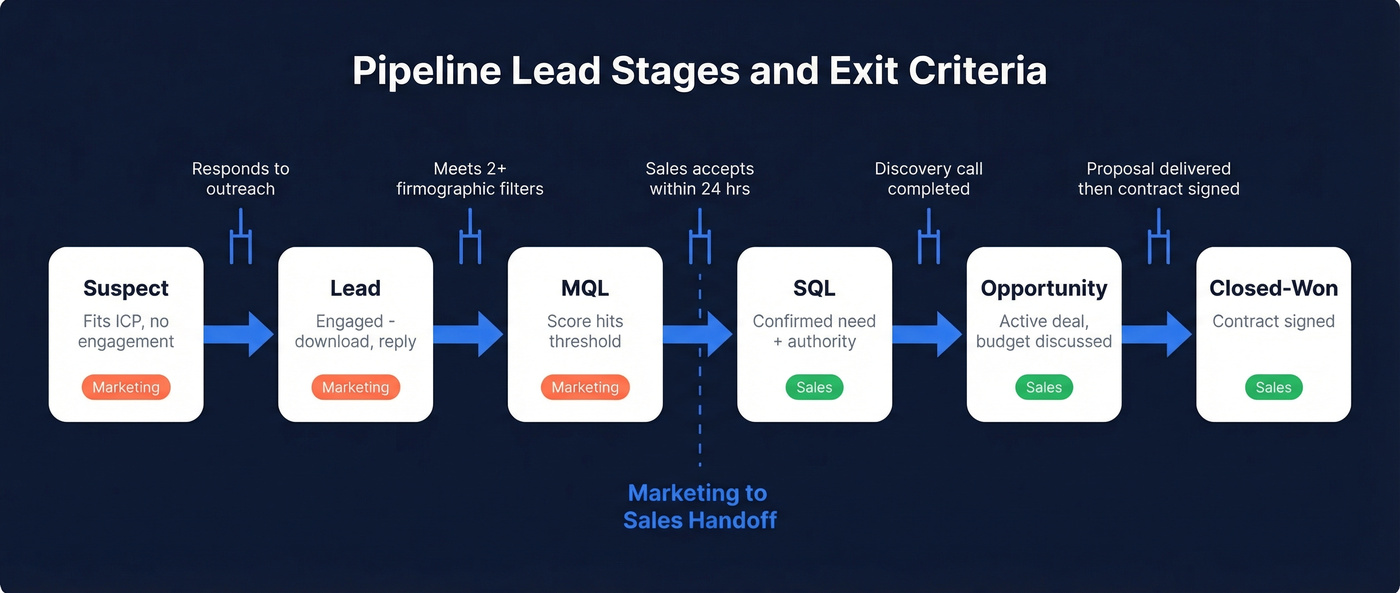
| Stage | Definition | Exit Criteria | Owner |
|---|---|---|---|
| Suspect | Fits ICP, no engagement | Responds to outreach | Marketing |
| Lead | Engaged (download, reply) | Meets 2+ firmographic filters | Marketing |
| MQL | Score hits threshold | Sales accepts within 24-hr SLA | Marketing |
| SQL | Confirmed need + authority | Discovery call completed | Sales |
| Opportunity | Active deal, budget discussed | Proposal delivered | Sales |
| Closed-Won | Contract signed | Revenue booked | Sales |
Think of exit criteria as gates. A lead doesn't advance because a rep feels optimistic - it advances because it cleared a specific, documented bar. Without these gates, contacts pile up in stages they should've left weeks ago, and your forecast becomes fiction. We've watched teams shave two full weeks off their average cycle just by enforcing stage gates in weekly pipeline reviews instead of letting reps self-promote deals based on vibes.
Conversion Benchmarks by Stage
Here are the latest SaaS stage-conversion benchmarks for 2026 planning:
| Stage Transition | SMB / Mid-Market | Enterprise |
|---|---|---|
| Lead to MQL | 41% | ~35% |
| MQL to SQL | 39% | 31% |
| SQL to Opportunity | 42% | 36% |
| Opportunity to Close | 39% | 31% |
| Overall Lead to Customer | ~2.7% | ~1.2% |
If your numbers fall significantly below these, the problem is usually in one of two places: qualification criteria are too loose, letting junk through, or follow-up cadence is too slow, letting good leads go cold. Either way, the sales qualified leads pipeline suffers.
How to Qualify Pipeline Leads
Let's be honest: most teams overcomplicate qualification. Pick a framework that matches your deal complexity and enforce it ruthlessly.
BANT works for deals under $10K where budget is the gating factor. CHAMP flips the script - lead with the challenge, figure out money later - which maps better to how mid-market buyers actually think. MEDDIC is heavy machinery for enterprise deals north of $50K; don't deploy it for deals that close in two weeks.
Regardless of framework, every SQL needs three things confirmed: a real need, the right person, and some urgency. If any of those are missing, the lead stays in nurture. In our experience, teams cut their SQL-to-close cycle by weeks just by enforcing that simple three-part gate instead of letting reps promote leads on gut feel. Once sales accepts a lead, it enters the sales accepted pipeline and becomes the rep's responsibility to progress or disqualify - no limbo allowed.

Your pipeline velocity formula is only as good as the data feeding it. If 40% of your leads have wrong numbers or outdated emails, you're forecasting fiction. Prospeo refreshes every record on a 7-day cycle - not the 6-week industry average - so your pipeline reflects reality, not last quarter's org chart.
Stop inflating your pipeline with dead contacts. Start with 98% accurate data.
Scoring and Prioritization
Lead scoring assigns a number based on two dimensions - fit and engagement - then combines them into a prioritization matrix.
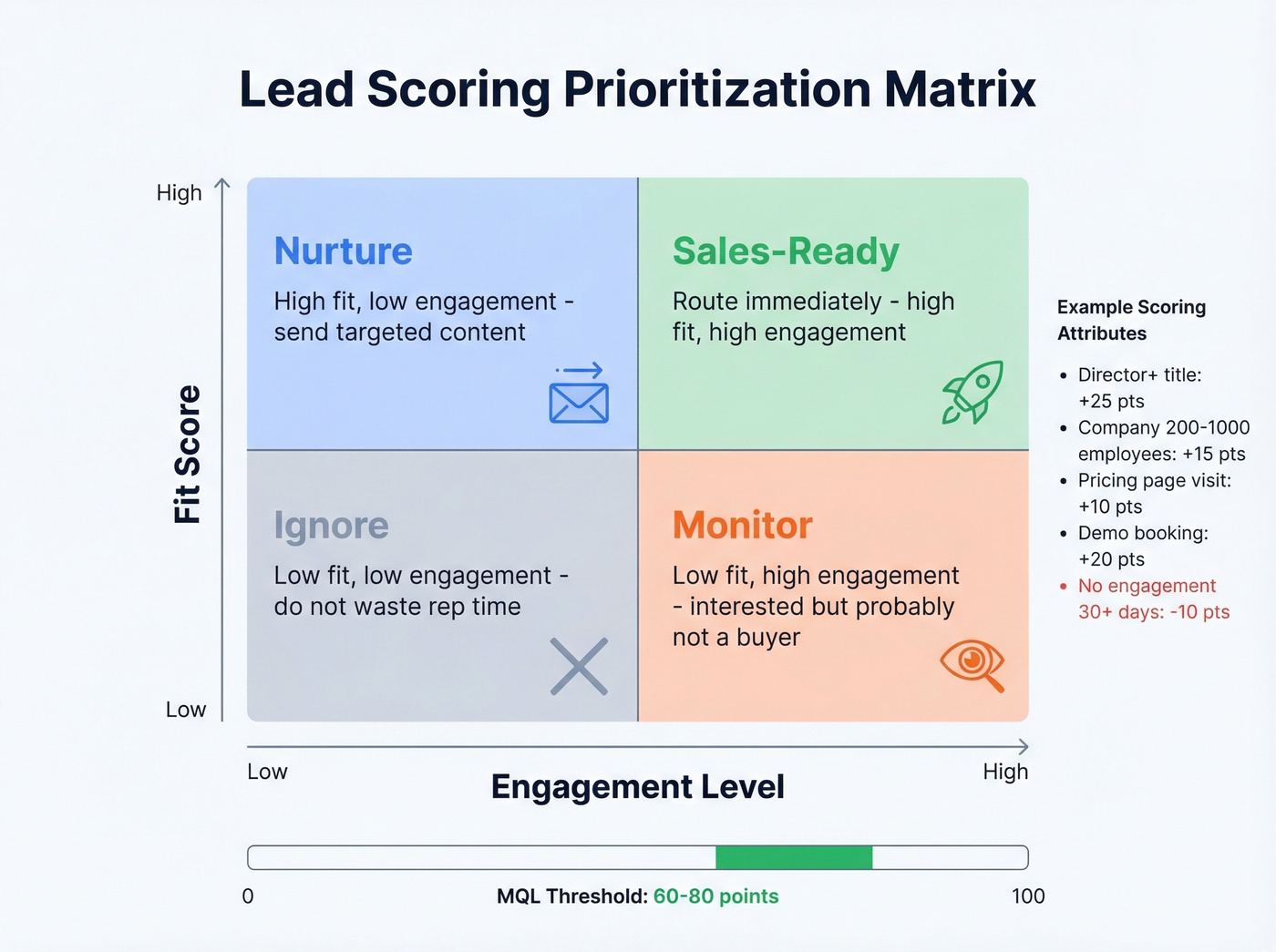
High fit + high engagement = sales-ready, route immediately. High fit + low engagement = nurture with targeted content. Low fit + high engagement = interesting but probably not a buyer. Low fit and low engagement? Ignore.
| Attribute | Points |
|---|---|
| Director-level or above | +25 |
| Company size 200-1,000 employees | +15 |
| Pricing page visit | +10 |
| Demo booking | +20 |
| No engagement in 30+ days | -10 |
Set your MQL threshold at 60-80 points. Negative scoring is the most underused lever in pipeline management - a lead who downloaded a whitepaper eight months ago and hasn't opened an email since shouldn't sit at 40 points forever. Decay keeps your pipeline honest. Recalibrate weights quarterly, because what signaled intent six months ago might be noise today. If you want a deeper framework, use a dedicated lead scoring model and keep it consistent across teams.
Pipeline Velocity: The Revenue Formula
Pipeline velocity tells you how much revenue moves through your pipeline per day:
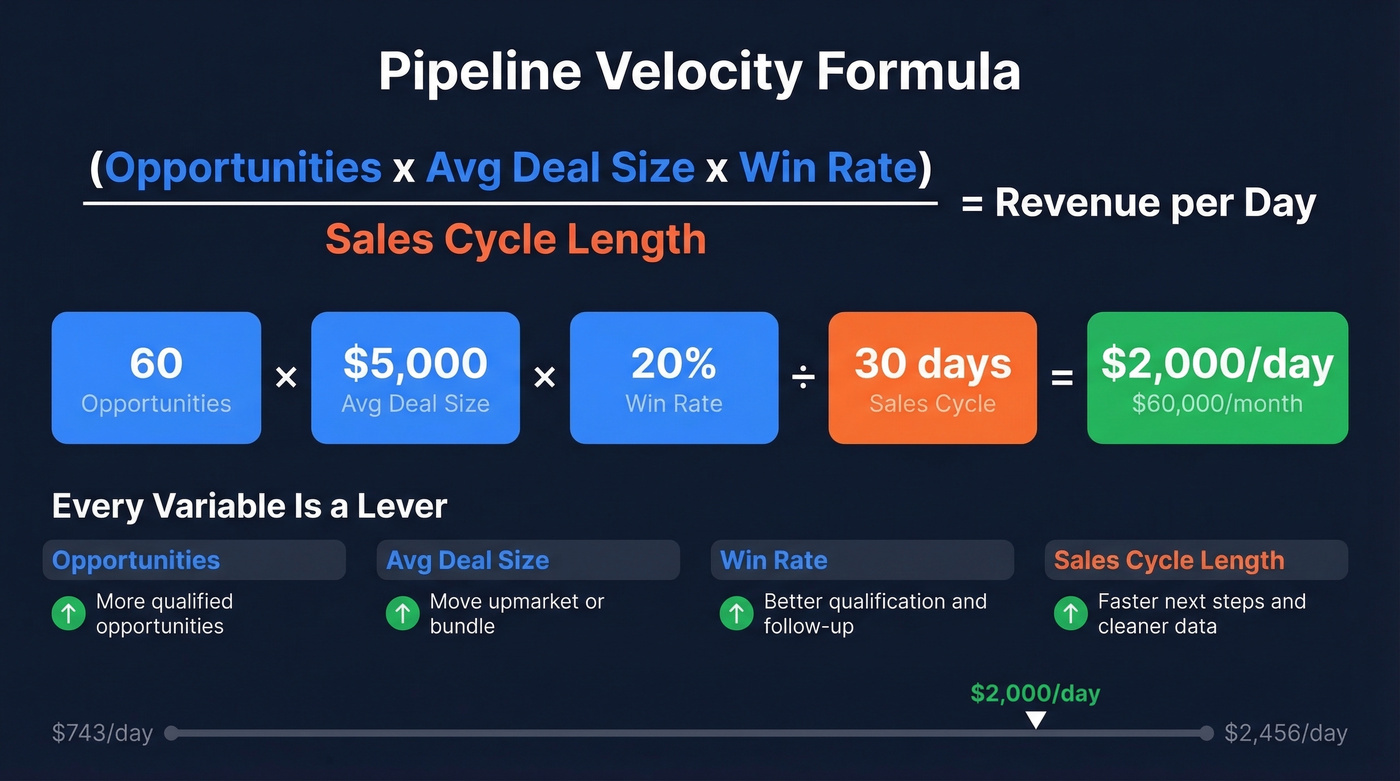
(Opportunities x Avg Deal Size x Win Rate) / Sales Cycle Length (days)
Worked example: 60 opportunities x $5,000 deal x 20% win rate / 30-day cycle = $2,000/day, or roughly $60,000/month. Benchmark range across industries runs $743-$2,456/day.
Every variable is a lever. Here's what "normal" looks like for SaaS cycles by deal size:
| ACV Range | Typical Cycle |
|---|---|
| Under $2K | ~14 days |
| Under $5K | ~30 days |
| Under $25K | ~90 days |
| Under $100K | 90-180 days |
| Over $100K | 3-9 months |
We've run this formula with dozens of teams, and the cycle-length lever almost always has the biggest impact. If your cycle is double these benchmarks, that's your bottleneck - not lead volume. A team we worked with last year cut their average cycle from 62 days to 38 by adding a mandatory "next step confirmed" field to every deal update, which forced reps to either move deals forward or admit they were stalled.
If your average deal is under $8K, you don't need more leads. You need faster qualification and cleaner data. Buying another database won't fix a conversion problem. If you're seeing recurring bottlenecks, start with the most common sales pipeline challenges and fix them systematically.
How Many Leads Do You Need?
Work backward from quota. $2M target / $5,000 average deal = 400 closed deals. At a 20% win rate, that's 2,000 opportunities. At a 42% SQL-to-opportunity conversion, you need ~4,760 SQLs. At a 39% MQL-to-SQL rate, you need ~12,200 MQLs at the top.
The standard rule of thumb is 3-4x coverage for mature inbound motions and 4-6x for outbound or enterprise cycles. If your quota is $500K this quarter, you need $1.5-3M in pipeline value to feel confident. For more context on what "good" looks like, compare against current sales pipeline benchmarks.
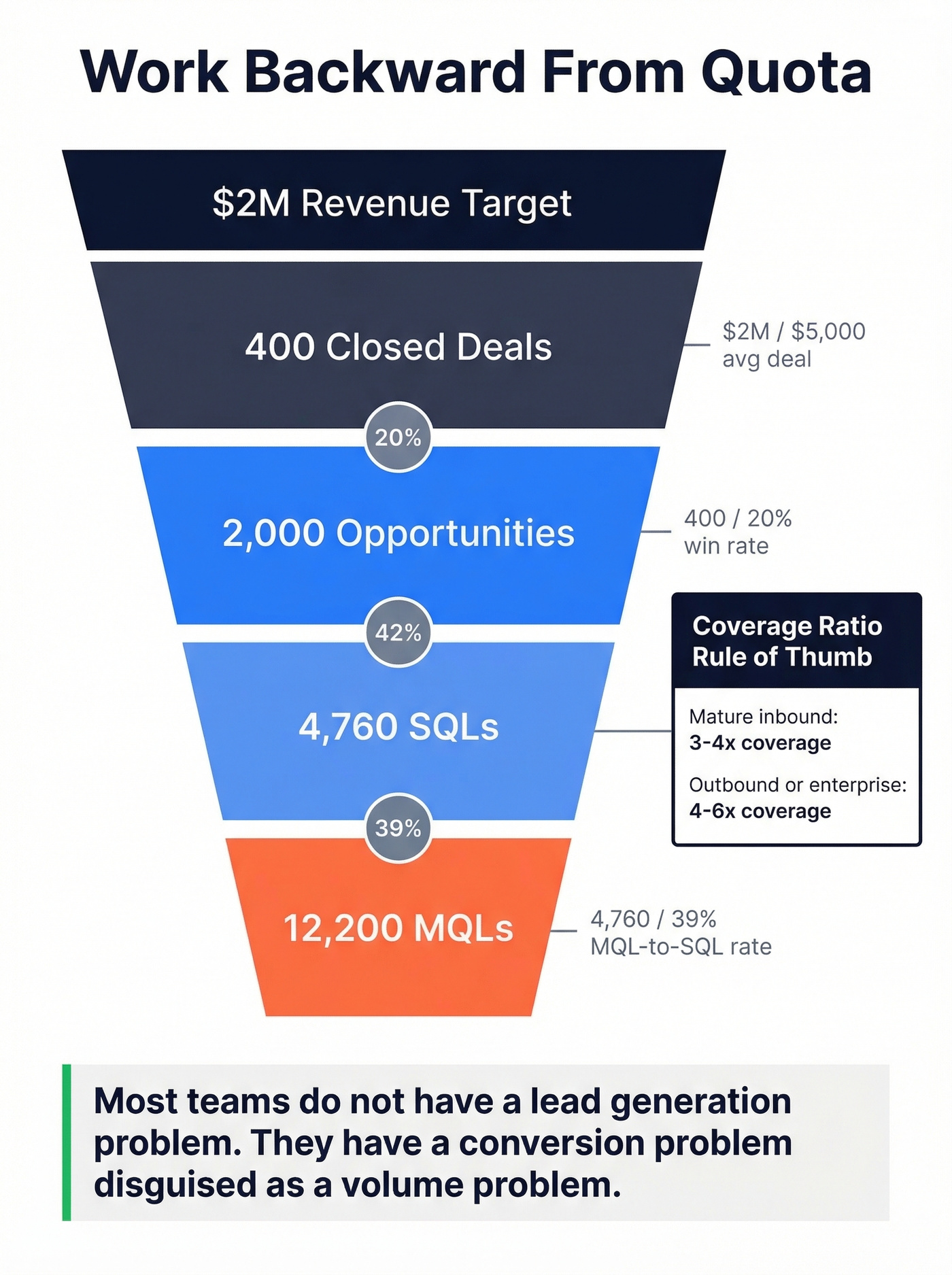
Most teams don't have a lead generation problem. They have a conversion problem disguised as a volume problem. Before you buy another database, audit your existing pipeline against the benchmarks above. If you need a tighter measurement layer, track funnel metrics alongside pipeline stages.
Building a Warm Leads Pipeline
Not all pipeline leads are created equal. A warm leads pipeline - contacts who've already engaged with your brand through content, events, or referrals - converts at dramatically higher rates than cold outreach alone.
Prioritize re-engaging past demo no-shows, webinar attendees, and inbound inquiries before scaling cold prospecting. The best-performing teams blend warm and cold sources to keep new contacts entering the pipeline every week, which prevents the feast-or-famine cycle that tanks quarterly numbers. Skip this approach if your brand awareness is near zero in your target market; in that case, cold outbound is your only realistic starting point, and warm pipeline building comes later. To keep outreach consistent, borrow proven sales prospecting techniques that fit your motion.
Five Mistakes That Kill Forecasts
1. Inconsistent prospecting. Pipeline is a lagging indicator. Skip prospecting this week, feel it in six weeks. The teams that hit quota prospect daily regardless of how full the current pipeline looks.
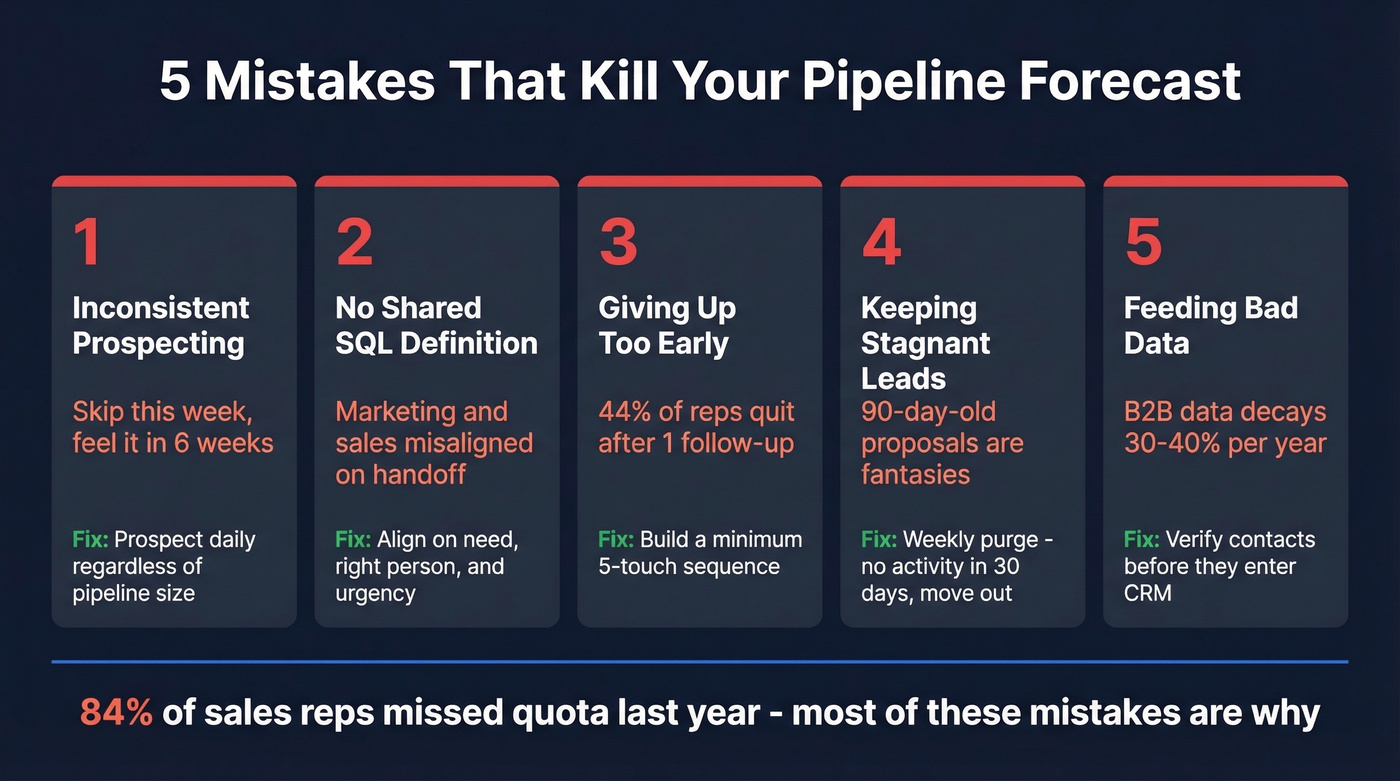
2. No shared SQL definition. If marketing thinks an SQL is "downloaded two whitepapers" and sales thinks it's "ready to buy this month," every handoff creates friction. Align on need, right person, and urgency - then document it where both teams can see it. A clean handoff also depends on a clear ideal customer profile so both teams qualify against the same target.
3. Giving up too early. It takes 8+ touches to close a deal, yet 44% of salespeople give up after one follow-up. Build a minimum 5-touch sequence before marking any lead unresponsive. The consensus on r/sales is that most reps quit right before the deal would've moved - and the data backs that up. If you need a starting point, use these sales follow-up templates to standardize your sequences.
4. Keeping stagnant leads. That deal sitting in "proposal sent" for 90 days isn't a deal - it's a fantasy. Run a weekly purge: no activity in 30 days, move to nurture or close. This is frustrating because reps get emotionally attached to deals they've invested time in, but dead weight in your pipeline is actively harmful to forecasting. A simple weekly pipeline health check makes this easier to enforce.
5. Feeding pipeline with bad data. B2B contact data decays 30-40% annually. A pipeline with 200 leads and 30% bad data is actually 140 leads, and your reps are wasting hours chasing ghosts. Tools like Prospeo verify emails and phone numbers before they enter your CRM - with 98% email accuracy and a 7-day data refresh cycle, your pipeline reflects contacts who are actually reachable. If you're evaluating vendors, start with a shortlist of data enrichment services.
Tools for Managing Pipeline Leads
CRM: Salesforce (~$25-$165/user/mo depending on edition), HubSpot (free tier, paid plans starting around $20-$50/user/mo and scaling by seat), Pipedrive (~$14-$99/user/mo). If you're comparing options, see more examples of a CRM with real pricing.
Data and verification: Prospeo (free tier, paid from ~$0.01/email, no contracts) includes 300M+ professional profiles, real-time email and mobile verification, 30+ search filters, a 7-day refresh cycle, and intent data across 15,000 topics powered by Bombora. Apollo (free tier, paid from ~$49/user/mo) combines prospecting with sequencing. For a broader vendor landscape, review the top sales prospecting databases.
Analytics: Your CRM's native reporting handles most pipeline tracking. For teams that need deeper velocity analysis and forecast modeling, dedicated tools like Forecastio can fill the gap. If you're shopping categories, start with sales forecasting solutions.
You just built a scoring model and stage gates - now make sure every SQL has a reachable contact behind it. Prospeo's 300M+ profiles with verified emails and 125M+ direct dials mean your reps spend time selling, not hunting for working phone numbers. Teams using Prospeo book 26% more meetings than ZoomInfo users.
Qualification means nothing if the lead's email bounces. Fix that at $0.01 per contact.
FAQ
Lead pipeline vs. sales pipeline?
A lead pipeline tracks suspects through qualification - from first touch through MQL to SQL. A sales pipeline tracks qualified opportunities through deal stages toward closed-won. Marketing owns the lead pipeline, sales owns the deal pipeline, and the handoff happens at the SQL gate.
How often should you clean pipeline leads?
Weekly, minimum. Remove contacts with no activity in 30+ days, verify contact data quarterly, and enforce stage exit criteria at every review. Teams that run disciplined weekly purges see 15-25% improvement in forecast accuracy within one quarter.
What's a healthy pipeline coverage ratio?
For mature inbound motions, aim for 3-4x your quota in pipeline value. Outbound-heavy or enterprise teams need 4-6x. If your quota is $500K and your pipeline sits below $1.5M, you're undercovered and at serious risk of missing the number.
When should you disqualify a pipeline lead?
Disqualify when any of the three SQL requirements - real need, right person, urgency - can't be confirmed after your full outreach sequence. Also disqualify if contact data is unverifiable, the company doesn't match your ICP on firmographic criteria, or the lead has gone completely dark for 30+ days despite multiple touches. Better to lose a lead than to let it pollute your forecast.