

Predictable Revenue Book: What Still Works and What to Modernize in 2026
Everyone quotes the "$100 million" headline from the predictable revenue book. Almost nobody implements the actual framework correctly. That disconnect - between the book's fame and its proper application - is why teams keep building broken outbound machines fifteen years after publication.
We've handed this book to dozens of founders over the years, always with the same caveat: the organizational design is timeless, but the email tactics need updating. Here's a complete summary covering what's inside, what holds up, and what needs a 2026 refresh.
Quick Verdict: 7/10
Predictable Revenue is one of the most influential B2B sales development books of the last 15 years - and one of the most misunderstood. The core thesis: predictable revenue comes from lead generation and process, not hiring more salespeople. Goodreads shows a 3.97 out of 5 rating from 5,452 ratings, and r/sales regularly includes it in "stands the test of time" reading lists.
Who it's for: Founders and sales leaders at $1M-$50M ARR building outbound for the first time.
Should you read it in 2026? Yes - with a modernization lens. Read it for the frameworks. Modernize the execution.
What the Book Is About
Aaron Ross and Marylou Tyler published Predictable Revenue in 2011, built on Ross's experience at Salesforce.com where his outbound process helped generate $100 million in recurring revenue. The central argument: most companies try to grow revenue by hiring more salespeople. That's expensive and unpredictable. Instead, build a repeatable lead generation engine with specialized roles, clear metrics, and a systematic outbound process Ross calls Cold Calling 2.0.
The book spans 11 chapters. Chapters 1 covers the overview and where the $100M came from. Chapters 2-3 cover Cold Calling 2.0. Chapters 4-6 focus on building a repeatable sales process, and 7-11 tackle hiring, management, and leadership alignment. It's structured somewhat standalone by chapter, which makes it easy to skim but also means concepts repeat.
Key Frameworks Worth Knowing
Seeds, Nets, and Spears
Ross categorizes lead sources into three types, and understanding the distinction matters more than most readers realize.
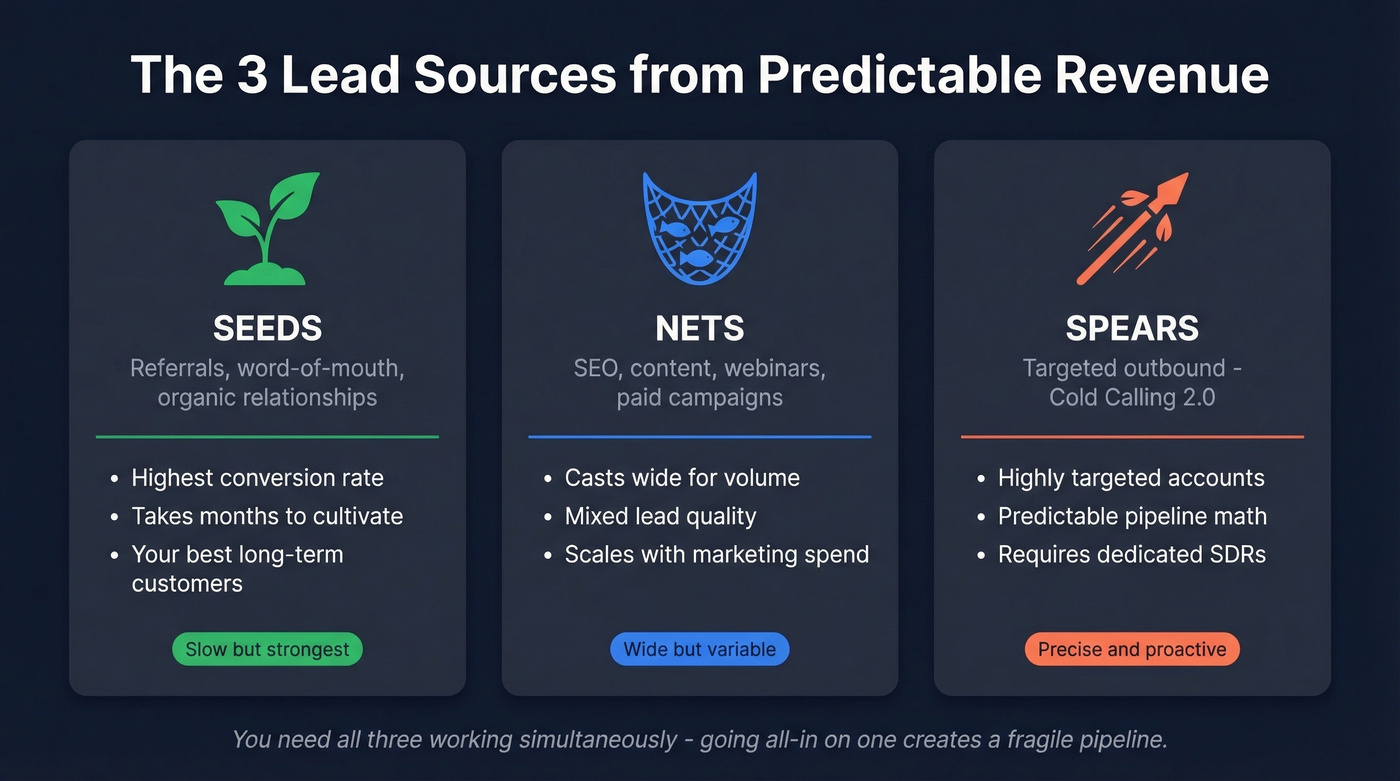
Seeds are referrals, word-of-mouth, and organic relationships. They convert at the highest rate because, as the book puts it, "when customers recommend your product or service to a peer, they're establishing that you're credible and trustworthy." Seeds take time to cultivate - you can't rush them - but they produce your best customers.
Nets are inbound marketing: SEO, content, webinars, paid campaigns. They cast wide and pull in mixed-quality leads at scale.
Spears are targeted outbound - the Cold Calling 2.0 methodology. Some summaries use "Harpoons" instead of "Spears."
The key insight: you need all three working simultaneously. Teams that go all-in on outbound without investing in seeds and nets build a fragile pipeline. We've seen this firsthand - companies that nail outbound but neglect content and referrals hit a ceiling within 18 months almost every time.
Cold Calling 2.0 - The Five Steps
This is the framework that made the book famous. Despite the name, there are no cold calls involved. That's the whole point.
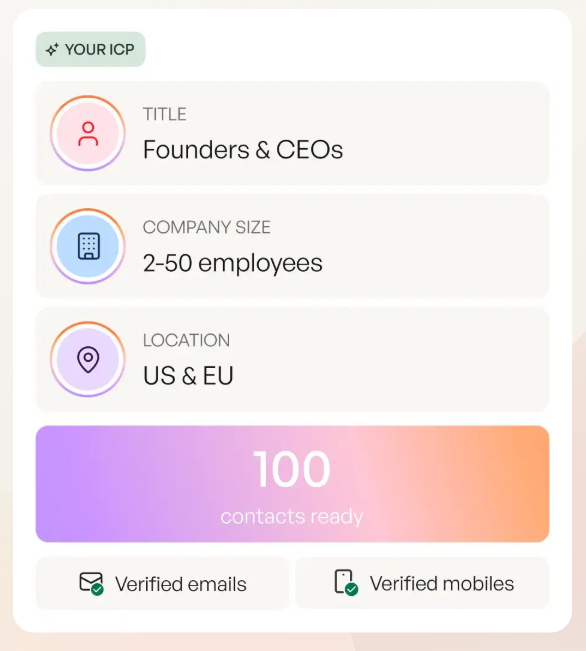
- Build your ICP. Define exactly who you're targeting - industry, company size, title, pain points. In 2026, you can layer in technographics, funding signals, headcount growth, and buyer intent data to build an ICP that's genuinely predictive, not just descriptive. If you need a starting point, use an Ideal Customer Profile template.
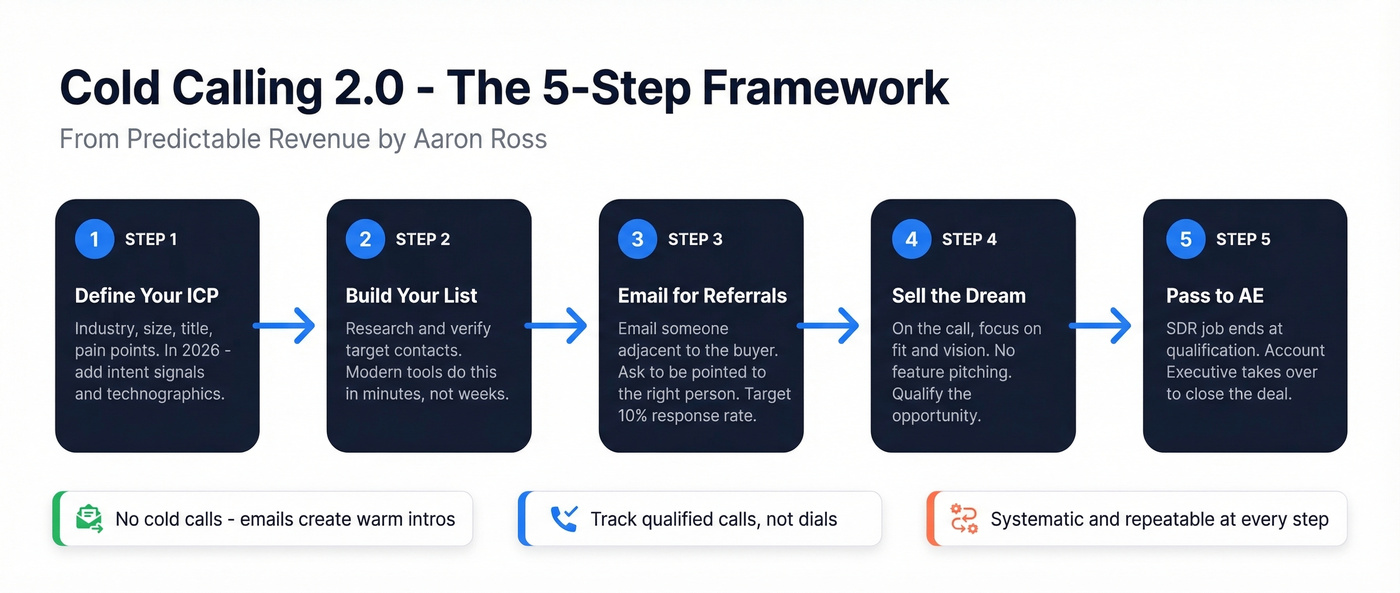
Build your list. The book assumed manual research and purchased lists. Today, B2B data platforms let you filter 300M+ profiles by 30+ criteria and export verified contacts in minutes. The principle hasn't changed - the speed has.
Run outbound emails to get internal referrals. This is the counterintuitive move. You're not emailing the decision-maker directly. You're emailing someone adjacent and asking to be pointed to the right person. Ross's benchmark: 50-100 prospecting emails per day, targeting roughly a 10% response rate.
Sell the dream on the call. Once you've got the referral and the call is booked, focus on fit and vision - not pitching features.
Pass the baton to an AE. The SDR's job ends at qualification. The Account Executive takes over to close. This handoff is non-negotiable in the Predictable Revenue model.
Three things differentiate this from traditional outbound: no cold calls (emails generate warm introductions), focus on results over activity (track qualification calls, not dials), and a systematic, repeatable process at every step.
The Role Specialization Model
Let's be honest: the role specialization model is the book's most lasting contribution, not Cold Calling 2.0. Ross argues that combining prospecting, qualifying, closing, and account management into one "sales" role is a productivity killer. He breaks it into four functions:
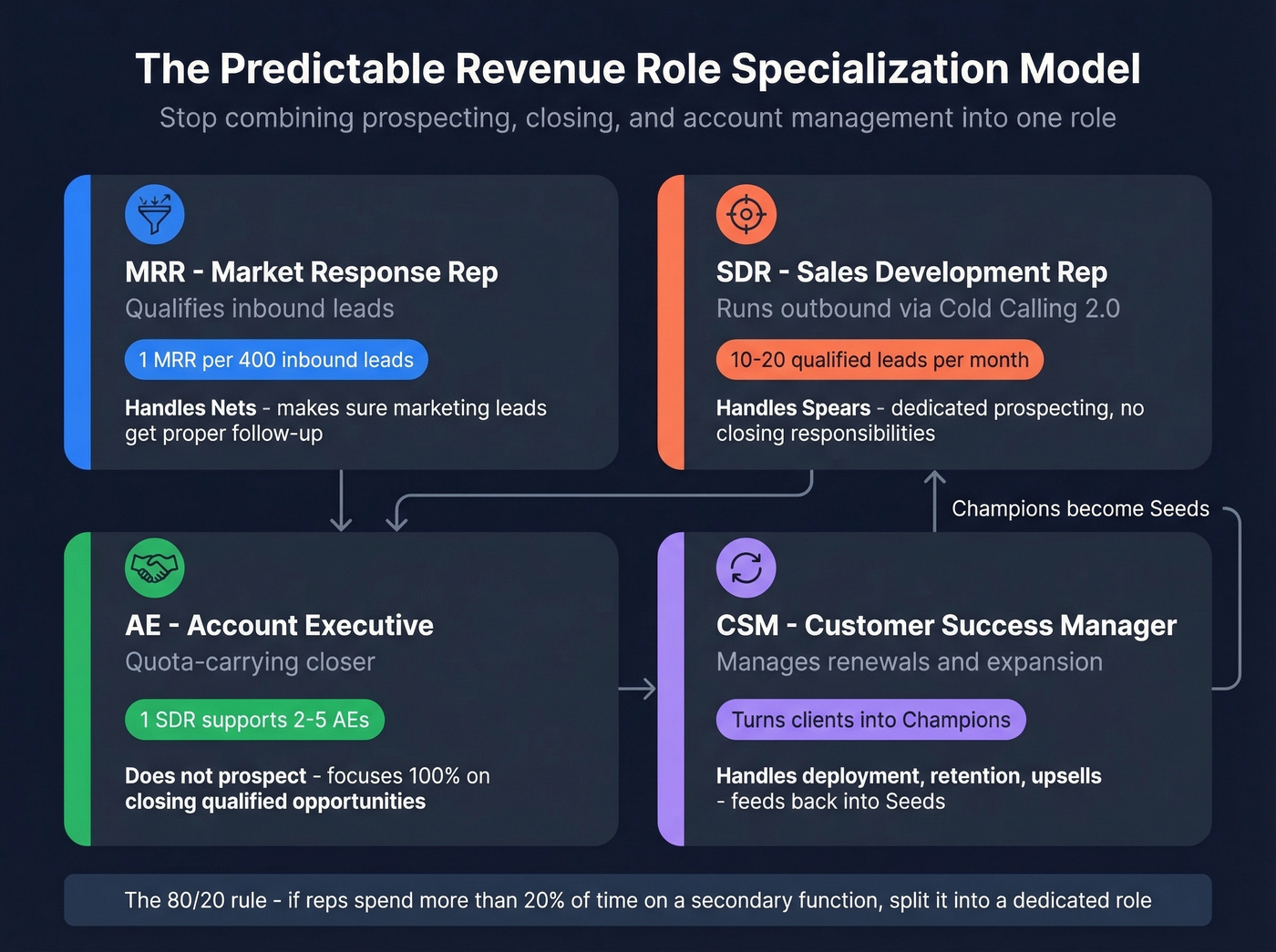
- MRR (Market Response Rep): Qualifies inbound leads. One MRR per 400 leads.
- SDR (Sales Development Rep): Runs outbound prospecting via Cold Calling 2.0. Generates 10-20 qualified leads per month once ramped. (If you're building your stack, start with these SDR tools.)
- AE (Account Executive): Quota-carrying closer. Doesn't prospect. One SDR typically supports 2-5 AEs depending on deal size.
- CSM (Customer Success Manager): Manages deployment, renewals, and expansion.
Ross gives three reasons closers shouldn't prospect: they don't like it, they aren't effective at it, and it's a poor use of expensive resources. The 80/20 rule provides a clean trigger - if reps spend more than 20% of their time on a secondary function, split it into a dedicated role. His timing advice is aggressive: specialize "sooner than you think."
Metrics and Benchmarks
Aaron Ross is specific about what to track, which is one of the book's genuine strengths. Here are the outbound benchmarks he provides:
| Outbound Benchmark | Range |
|---|---|
| Emails/week | 150-250 over 3-4 days |
| Response rate | 8-12% |
| Leads/month per SDR | 10-20 (once ramped) |
| SDR-to-AE ratio | 1 SDR per 2-5 AEs |
| MRR-to-leads ratio | 1 MRR per 400 inbound |
Beyond activity metrics, Ross tracks five stages: Prospect, Lead, Opportunity, Client, Champion. That last stage - Champion - is often ignored, but it feeds back into Seeds. Your best customers become your best lead source.
The five core numbers to watch: new leads per month by source, lead-to-opportunity conversion by channel, qualified opportunities per month and pipeline value, opportunity-to-close rate segmented by lead type, and booked revenue split across new, add-on, and renewal. (For a cleaner view of what to monitor, use these funnel metrics.)

Cold Calling 2.0 starts with a verified list. Prospeo gives you 300M+ profiles with 30+ filters - buyer intent, technographics, headcount growth, funding - so your SDRs spend time sending, not researching. 98% email accuracy means sub-4% bounce rates from day one.
Build the list Ross described - in minutes, not weeks.
Does It Still Hold Up in 2026?
Yes, but with significant caveats.
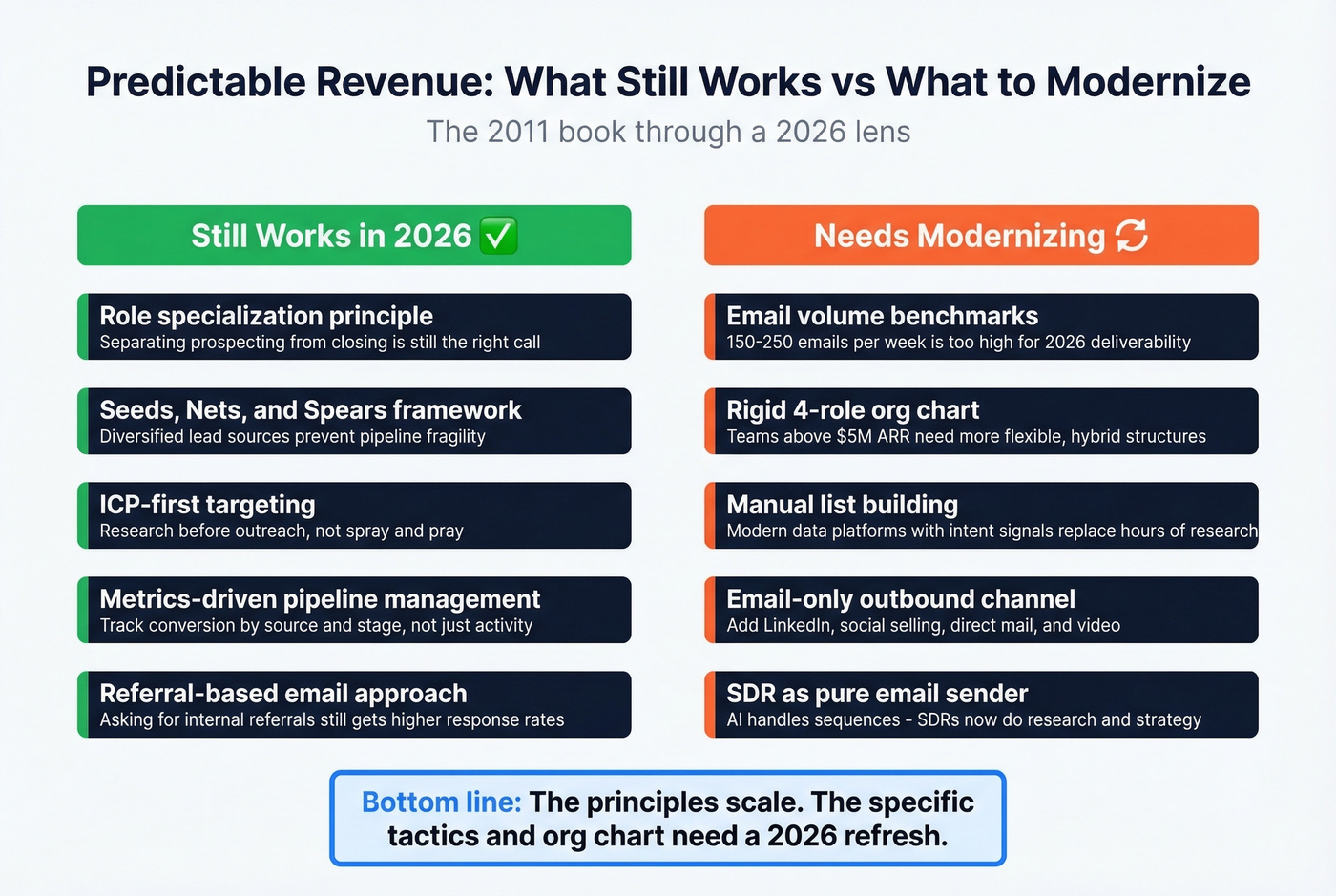
Collin Stewart, co-CEO of Predictable Revenue, put it well: "Consistent top of funnel activity + consistent process = predictable revenue." That formula hasn't changed. What's changed is everything around it.
Cold Calling 2.0 was designed as account-driven, researched, targeted outreach. The market misapplied it into volume-based generic emailing - blast 500 people a day and hope for responses. In our experience, teams that skip the ICP definition step and jump straight to email volume are the ones who blame the book when outbound fails. Buyers tuned out. Spam filters caught up. Deliverability tightened, and teams running high-volume, low-quality outbound saw inbox placement collapse. If you're seeing that, start with an email deliverability guide and tighten your email velocity.
Modern best practice has swung back toward the book's original intent: send fewer emails, be more targeted, and earn the right to someone's inbox. The difference is that in 2026, you have tools that didn't exist when Ross wrote the book. Prospeo, for instance, turns the "build your list" step from hours of manual research into minutes - 300M+ profiles with buyer intent signals across 15,000 topics and 98% email accuracy on a 7-day refresh cycle, so your Cold Calling 2.0 campaigns actually reach inboxes instead of tanking your domain reputation.
Stewart also recommends a newer role - the Sales Development Researcher - dedicated to account research so SDRs can focus on outreach rather than list-building. Modern teams layer in social selling and direct mail alongside email, channels the 2011 book barely touches. (If you're building a modern sequence, start with a B2B cold email sequence.)
Pavilion's "death of the Predictable Revenue era" framing captures a real shift. The assembly-line GTM model is evolving. AI is reshaping the SDR role into something more hybrid and strategic: supervising AI-driven outreach, doing deeper account research, and focusing on the human moments that actually move deals forward.
Our take: The Predictable Revenue framework is still the best starting point for any team building outbound from scratch. But most teams above $5M ARR have outgrown the rigid four-role model. The principles scale; the org chart doesn't always.
Limitations Worth Noting
The book's biggest weakness is that it has a relatively small set of core ideas stretched across 213 pages. A Medium reviewer gave it 3/5 and noted it "could be condensed into 3-4 blog posts." That's harsh but not wrong.
The tactical references are dated - 2011 tools, 2011 email volumes, 2011 assumptions about inbox deliverability. Skip it if you're an individual contributor looking for copy-paste email templates, or if your deal sizes are under $1K where role specialization doesn't make economic sense. For teams selling six-figure contracts into enterprise accounts, though, the architecture still holds. If you're troubleshooting performance, these sales pipeline challenges are usually the real culprit.
What to Read Next
If this predictable revenue book summary resonated, here's the reading path practitioners on r/sales recommend:
- Fanatical Prospecting (Jeb Blount) - daily prospecting discipline and pipeline management. Where Ross gives you the architecture, Blount gives you the work ethic.
- New Sales. Simplified. (Mike Weinberg) - messaging and positioning for outbound. How to craft the emails and calls that the Predictable Revenue framework requires. (Pair it with these sales prospecting techniques.)
- Predictable Prospecting (Marylou Tyler & Jeremy Donovan) - the direct sequel that modernizes the outbound workflow. If you only read one follow-up, make it this one.
Ross benchmarked 150-250 emails per week with an 8-12% response rate. That math only works if your emails actually land. Prospeo's 5-step verification and 7-day data refresh keep bounce rates under 4% - so every SDR hits those 10-20 qualified leads per month.
Predictable revenue requires predictable data. Get both at $0.01 per email.
FAQ
How long does it take to read Predictable Revenue?
About 4-6 hours. It runs 213 pages and reads quickly - most sales leaders extract the core frameworks (Seeds/Nets/Spears, Cold Calling 2.0, role specialization) in a single afternoon with a notebook handy for the metrics.
What's the difference between Predictable Revenue and Predictable Prospecting?
Predictable Revenue (2011) covers the full sales machine - role specialization, lead types, Cold Calling 2.0, and organizational design. Predictable Prospecting (2017) by Marylou Tyler and Jeremy Donovan zooms in on modernizing the outbound workflow with updated sequencing, technology, and multi-channel tactics.
What tools do you need for Cold Calling 2.0 in 2026?
Three essentials: a B2B data platform for building verified prospect lists with intent signals, a CRM like Salesforce or HubSpot for pipeline tracking, and a sequencing tool like Smartlead or Instantly for automated follow-ups. Data quality matters more than any specific vendor - 98%+ email accuracy prevents the deliverability damage that kills outbound programs.