

Professional Follow-Up Email After No Response (2026)
You sent the proposal three days ago. The prospect opened it - you saw the notification - and then nothing. The average office worker receives 120+ emails per day. Your message didn't get rejected. It got buried.
Emails without a follow-up average a 16% response rate. Add just one follow-up, and that jumps to 27%. Following up isn't desperate. It's the single highest-return habit you can build into your outreach.
The Short Version
- For sales, proposals, and outreach: wait 3 business days, then send a follow-up that adds new value - not "just checking in." (If you need a full cadence, see When Should You Follow Up on an Email?.)
- Your first two emails generate 69% of all replies. After that, diminishing returns hit hard. (For ready-to-send copy, use these sales follow-up templates.)
- Before you send more follow-ups, verify the email address is valid. A surprising number of "no responses" are bounced emails sitting in a void. (Here’s a deeper email deliverability guide if you want the full checklist.)
Why You're Not Getting a Response
Most follow-up misses fall into one of five buckets, and identifying yours changes what you write next.
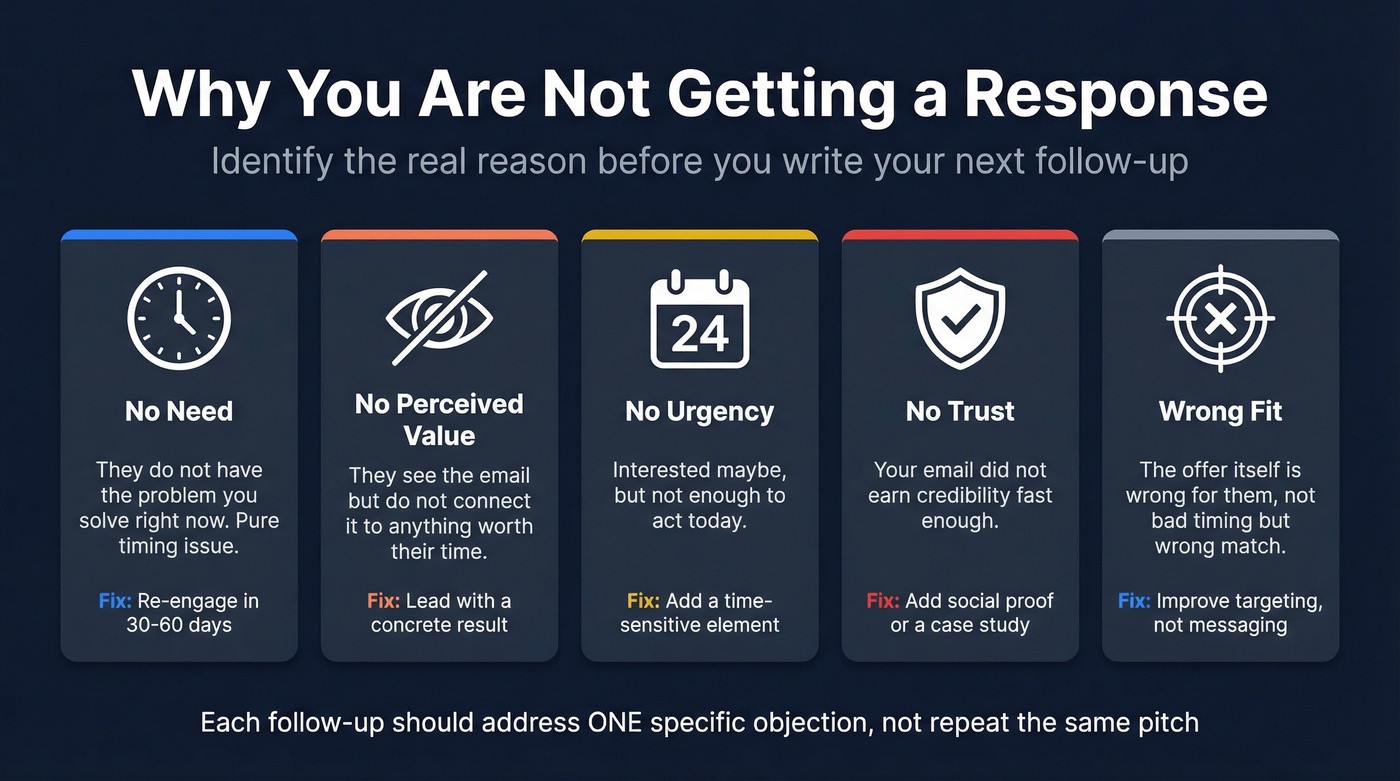
No need. They don't have the problem you're solving right now - pure timing. No perceived value. They see the email but don't connect it to something worth their time. No urgency. Interested, maybe, but not enough to act today. No trust. Your email didn't earn credibility fast enough. Fundamental mismatch. The offer itself is wrong for them - not bad timing, but wrong fit entirely.
Instead of rewriting the same "bumping this to the top of your inbox" message, address a specific objection. That's the difference between a good follow-up and one that gets deleted without a second thought. (If you want a framework for value-add touches, read how to add value in sales.)
What the Data Says
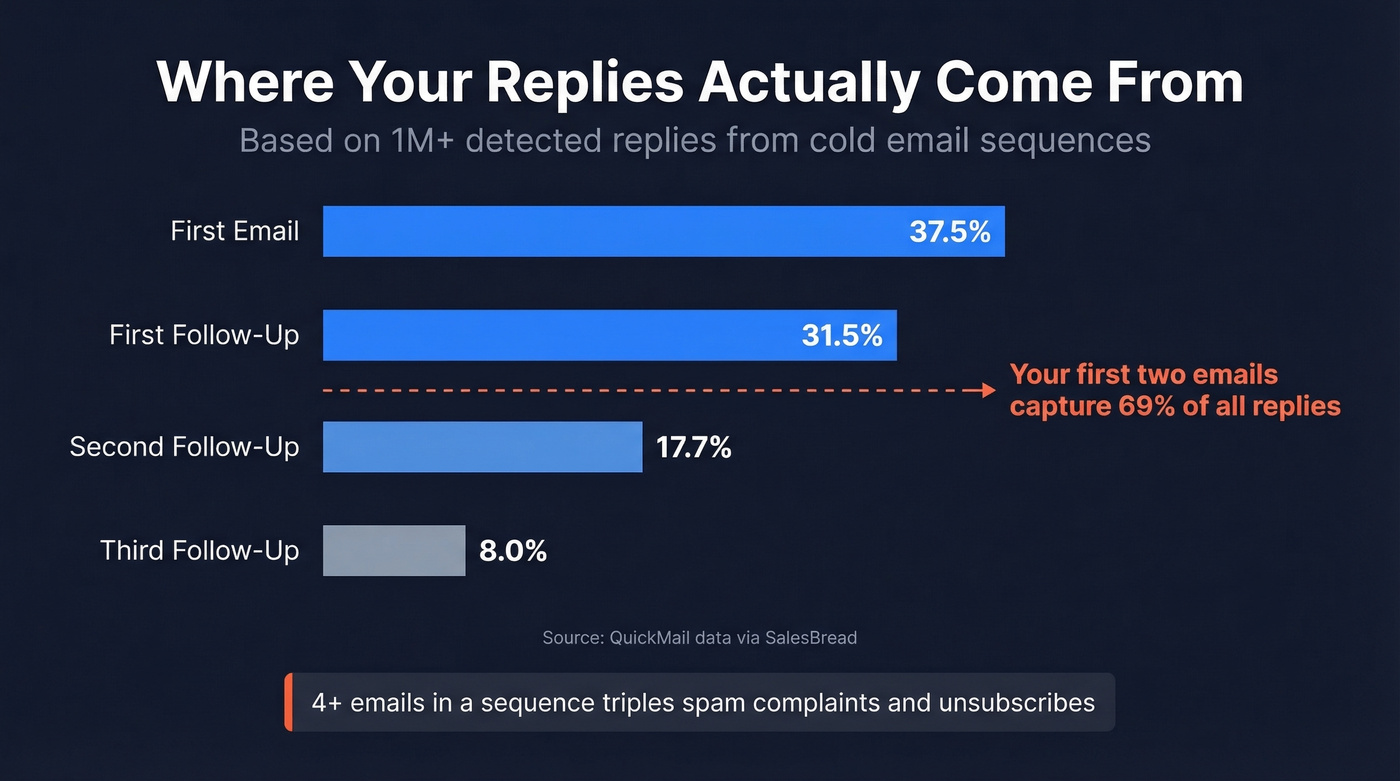
Based on QuickMail data covering one million detected replies, the pattern is clear:
| Email in Sequence | Share of Total Replies |
|---|---|
| First email | 37.5% |
| First follow-up | 31.5% |
| Second follow-up | 17.7% |
| Third follow-up | 8.0% |
Your first two emails capture nearly 70% of all replies you'll ever get. Each additional touch yields less, and Belkins' analysis of 16.5 million cold emails found that 4+ emails in a sequence more than triples spam complaints and unsubscribes. (More benchmarks here: follow-up email reply rate.)
One nuance worth knowing: founders actually see a slight reply rate increase on the second follow-up (6.94% vs. 6.64%) before it drops off. Persistence pays differently depending on who you're emailing. (If you’re building a full outbound motion, start with these sales prospecting techniques.)

Before you craft the perfect follow-up, make sure your first email actually landed. A surprising number of "no responses" are just bounced emails to outdated addresses. Prospeo verifies emails at 98% accuracy with a 7-day data refresh - so you're following up with real people, not dead inboxes.
Stop following up on emails that never arrived.
When to Send Your Follow-Up
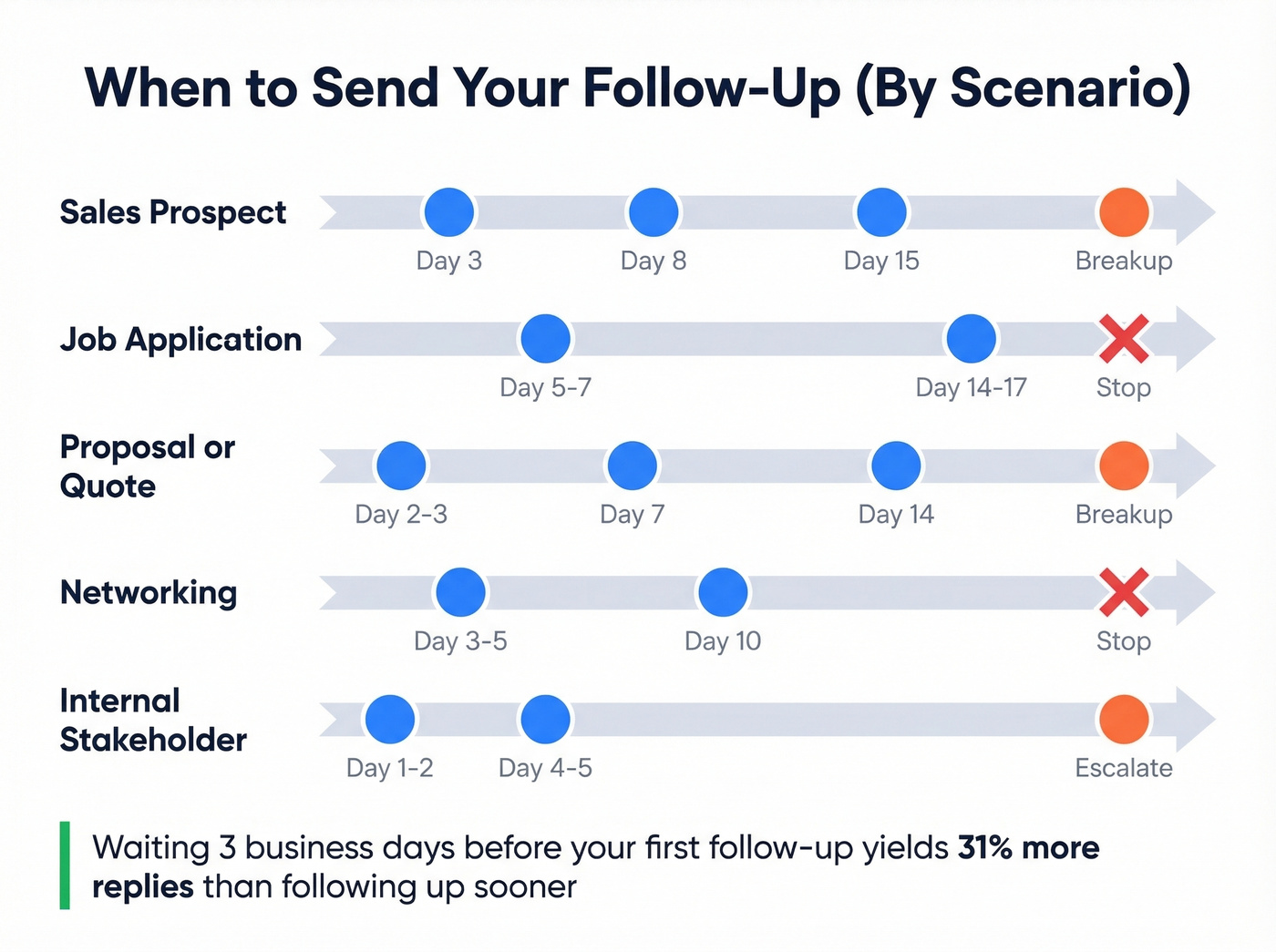
Waiting three business days before your first follow-up yields 31% more replies than following up sooner. Here's a practical cadence:
| Scenario | 1st Follow-Up | 2nd Follow-Up | 3rd Follow-Up |
|---|---|---|---|
| Sales prospect | 3 days | 5 days | 7 days |
| Job application | 5-7 days | 7-10 days | Stop |
| Proposal/quote | 2-3 days | 5 days | 7 days |
| Networking | 3-5 days | 7 days | Stop |
| Internal stakeholder | 24-48 hrs | 2-3 days | Escalate |
For job applications and networking, two follow-ups is usually the ceiling. For sales prospects, 2-3 value-add touches before a breakup email is the sweet spot.
When email stalls, switch channels. Belkins found that combining a direct message on a professional profile with a profile visit yields an 11.87% reply rate - often higher than a third or fourth email to the same inbox. Atlassian's data shows video follow-ups boost click-through rates by 65%. We've seen this firsthand: the teams that mix channels consistently outperform those who keep hammering the same inbox. (If you’re scaling this, consider follow up email software to manage sequences cleanly.)
What to Include in Every Follow-Up
Every template below follows one rule: each follow-up adds something new. No bumping. No "just circling back." What you put in a follow-up matters more than how many you send. (For more examples, see emails that get responses.)
Sales Prospect Follow-Up
Most reps default to something like: "Hi [Name], just bumping this to the top of your inbox. Let me know if you're interested!" That tells the reader nothing new.
Subject: Quick idea for [their specific goal]
Hi [Name],
I shared [specific resource] last week - wanted to add one thing. We helped [similar company] generate 10-15 warm leads per week using [approach]. Might be relevant given [their situation].
Worth a 15-minute look?
The rewrite addresses the "no perceived value" bucket by leading with a concrete result, not a reminder. That's what separates a strong follow-up from one that gets deleted.
Job Application / Post-Interview
Subject: Following up on [Role] - [Your Name]
Hi [Name],
Thanks again for the conversation about [role]. You mentioned [key attribute for success] and [biggest challenge] as priorities - I've been thinking about how my experience with [specific skill] maps to both.
Happy to share more detail if helpful. Looking forward to hearing about next steps.
A hiring manager on r/jobsearchhacks who's conducted 1,000+ interviews recommends mirroring the exact attributes, challenges, and team goals discussed in the interview. It proves you listened - and that's rarer than you'd think. Send within 24-48 hours of the interview, and reference specific conversation points, not generic enthusiasm.
Proposal or Quote Follow-Up
Subject: [Project name] - one thing I'd adjust
Hi [Name],
Wanted to flag something since we last spoke. [New insight, market shift, or updated timeline] could affect the scope we discussed. I've updated the proposal to reflect it.
Happy to walk through the changes - does Thursday work?
This directly tackles the "no urgency" objection by introducing a time-sensitive element.
Networking Follow-Up
The generic version everyone sends: "Great meeting you at [event]! Let's stay in touch."
The version that gets replies:
Subject: That point you made about [specific topic]
Hi [Name],
Your point about [specific topic] at [event] stuck with me - I found [article/resource] that builds on it. Thought you'd find it useful.
Coffee next week?
Referencing a specific moment separates you from the 30 other people who sent "Great meeting you!" that same evening. Personal and genuinely useful beats polished and forgettable every time.
The Breakup Email
Let's be honest: a lot of sales practitioners skip the breakup email entirely and pause outreach for a few months before re-engaging. Both approaches work. But the breakup email gives you one last shot at a reply before going quiet, and the graceful exit often triggers a response precisely because it removes pressure.
Subject: Should I close the loop?
Hi [Name],
I've reached out a few times and haven't heard back - totally understand if the timing isn't right. I'll assume this isn't a priority and won't follow up again.
If anything changes, I'm here.
At this stage, you're looking at about 8% of total replies landing on the third follow-up. Low, but not zero. And the replies you do get tend to be honest about timing or interest, which is valuable information either way.
Confirm the Email Actually Arrived
Here's the thing most follow-up advice misses entirely: a significant chunk of "no responses" aren't rejections. They're deliverability failures. The email bounced, hit a spam filter, or went to an address the person stopped using six months ago. (If you’re troubleshooting bounces, start with email bounce rate.)
Before you agonize over your wording, verify the address is real. We've seen teams rewrite follow-up sequences three times before realizing the original email never landed. Don't be that team. Tools like Prospeo handle this in real time with 98% email accuracy - paste a URL or upload a CSV and get results in minutes. The free tier covers 75 emails per month, so there's no reason to skip this step.

Mistakes That Get You Ignored
Bumping without value. "Just making sure you saw this" tells the reader nothing new. Treat every follow-up as a fresh touchpoint with a new insight, stat, or resource.
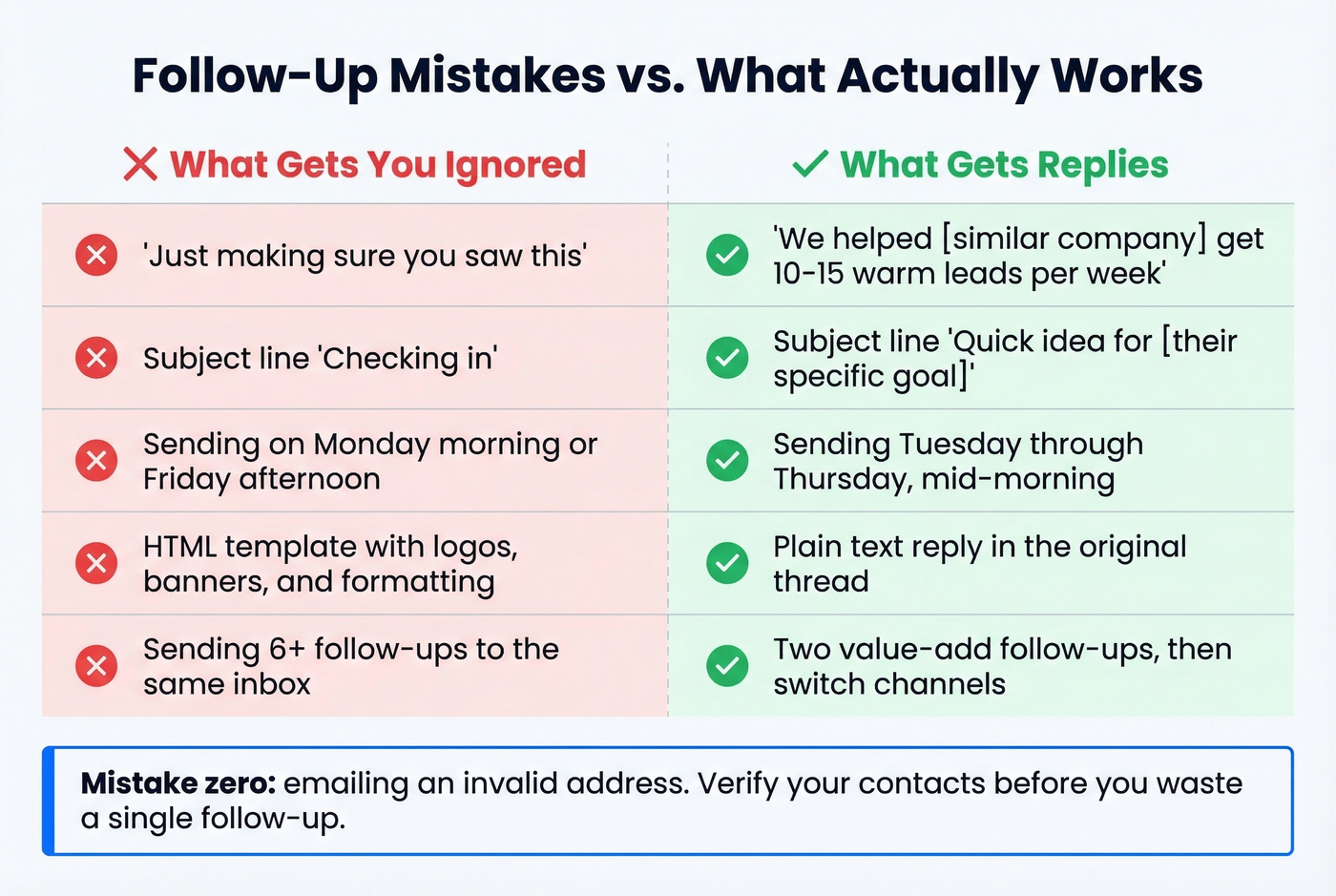
Using "checking in" as a subject line. It signals you have nothing to say. "Quick idea for [their goal]" consistently outperforms it. (If you want more options, browse these email subject line examples.)
Wrong timing. Monday morning and Friday afternoon are inbox graveyards. Tuesday through Thursday tends to perform best. (More detail: best time to send cold emails.)
Sounding like a bot. Formatted HTML templates with logos and banners scream automation. Plain text, short paragraphs, sent as a reply to your original thread - that's what gets read. I've personally watched open rates jump 20%+ just by stripping HTML and sending plain text replies.
Emailing an invalid address. This is mistake zero. Verify first before you waste a single follow-up. (If you need a quick method, use this guide to check if an email exists.)
Look, if your average deal size is under $8k, you don't need a 12-touch sequence with custom video and multi-channel orchestration. Two well-crafted follow-ups - each sent to a verified contact - will outperform a bloated cadence built on bad emails. Complexity isn't a strategy.
Your follow-up sequence is only as good as the contact data behind it. Prospeo gives you 143M+ verified emails and 125M+ direct dials - so when email stalls, you can switch to a phone call instantly. At $0.01 per email, bad data is no longer an excuse for silence.
Get verified emails and direct dials for every prospect in your pipeline.
FAQ
How many follow-ups should I send?
For sales, 2-3 value-add follow-ups is the sweet spot. Once you hit 4+ emails in a sequence, spam complaints and unsubscribes more than triple. Send a breakup email, then move on or switch channels entirely.
What should I say in a follow-up email after no response?
Lead with new value - a relevant case study, a fresh data point, or a specific question tied to their goals. The biggest mistake is rehashing your original pitch. Pick one objection (timing, value, urgency, or trust) and build your entire message around it.
What's the best subject line for a follow-up?
Skip "Checking in" and "Following up" - they're the easiest to ignore subject lines in professional email. "Quick idea for [their specific goal]" consistently outperforms generic subjects because it promises something new rather than repeating a request.
How do I know if my email went to spam?
Verify the address is valid first - tools like Prospeo check deliverability in seconds with 98% accuracy. If the address is correct but you still get silence, switch channels (phone or a direct message on a professional profile) rather than sending a fourth email to the same inbox.
What topics work best in follow-up emails?
Focus on one per follow-up: a relevant case study, a new industry data point, a specific easy-to-answer question, a revised proposal with an updated timeline, or a graceful exit that removes pressure. Each touch should give the recipient a reason to engage they didn't have before.