

Prospect Identification in 2026: A 5-Step Framework (Without Wasting Hours on Bad Data)
84% of reps missed quota last year. The problem isn't effort - it's targeting. Prospect identification separates the teams that crush pipeline from the ones burning hours on accounts that were never going to buy. Most teams blast 500 accounts when they should be working 50 deeply with verified data and real buying signals.
Here's the thing: if your reps are spending more time building lists than having conversations, your identification process is broken. We've watched teams triple pipeline just by tightening who they go after and verifying every contact before a single email goes out.
What Is Prospect Identification?
It's the process of finding and qualifying accounts and contacts that match your ideal customer profile. Different from lead generation - leads are contacts who haven't been vetted, while prospects have been qualified against your ICP and show signals of fit or interest.
The distinction determines how you spend your time. You're actively choosing who deserves personalized outreach based on organizational fit, opportunity potential, and stakeholder authority. A lead is a name in a spreadsheet. A prospect is someone worth your best pitch.
Why Targeting Is Broken
The old playbook - buy a list, blast emails, hope for replies - collapses when 91% of buyers research you before the first meeting. Buying committees now average 11-13 stakeholders, and buyers use around 10 interaction channels before engaging with sales. On top of that, 75% of B2B buyers prefer a rep-free experience.
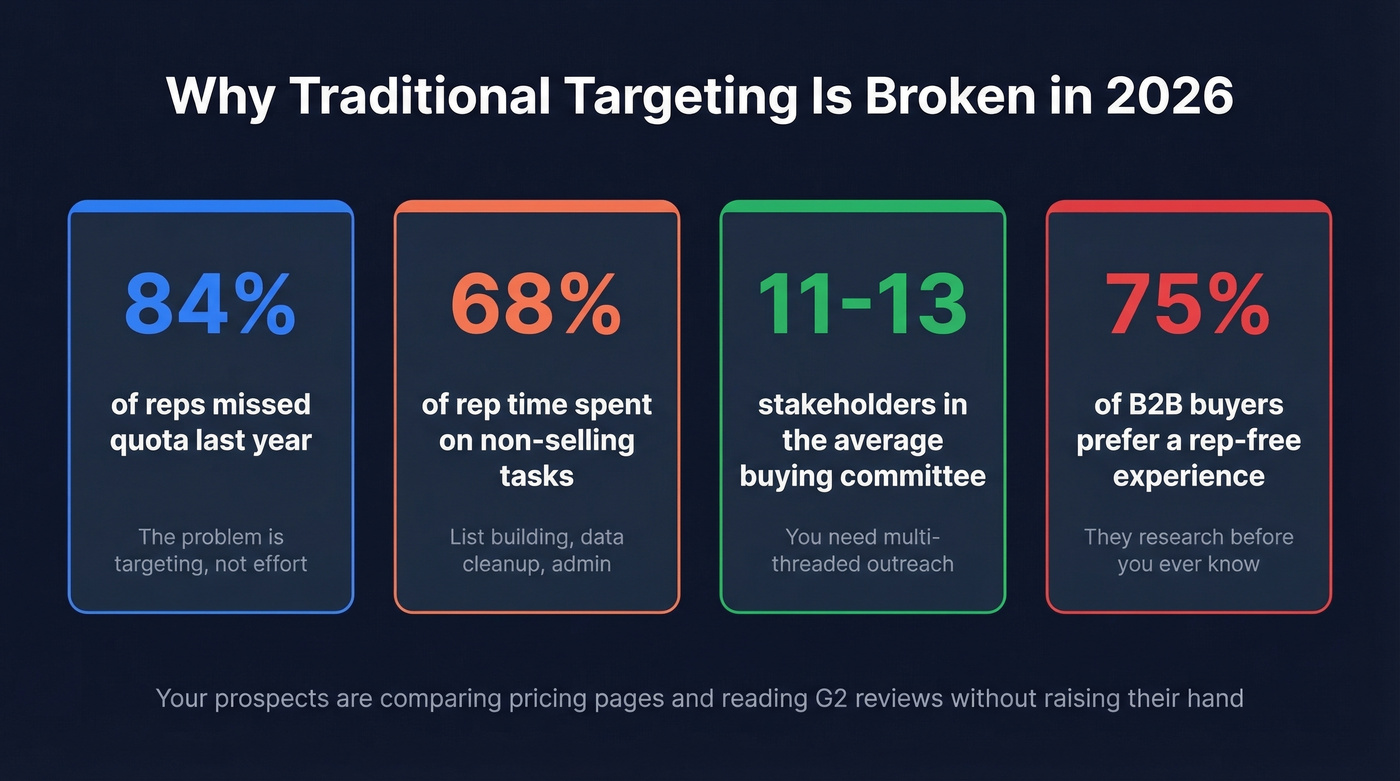
Your prospects are reading case studies, checking G2 reviews, and comparing pricing pages - all without raising their hand. Meanwhile, reps spend 68% of their time on non-selling activities. The problem isn't volume. It's targeting accounts that aren't in-market, with contact data that bounced three months ago.
The 5-Step Framework
1. Define your ICP. Analyze your last 50-100 closed-won deals. You'll find 70-80% share 3-5 traits - industry, company size, tech stack, buying trigger. Document them and revisit quarterly. If you need a starting point, use an ICP template.
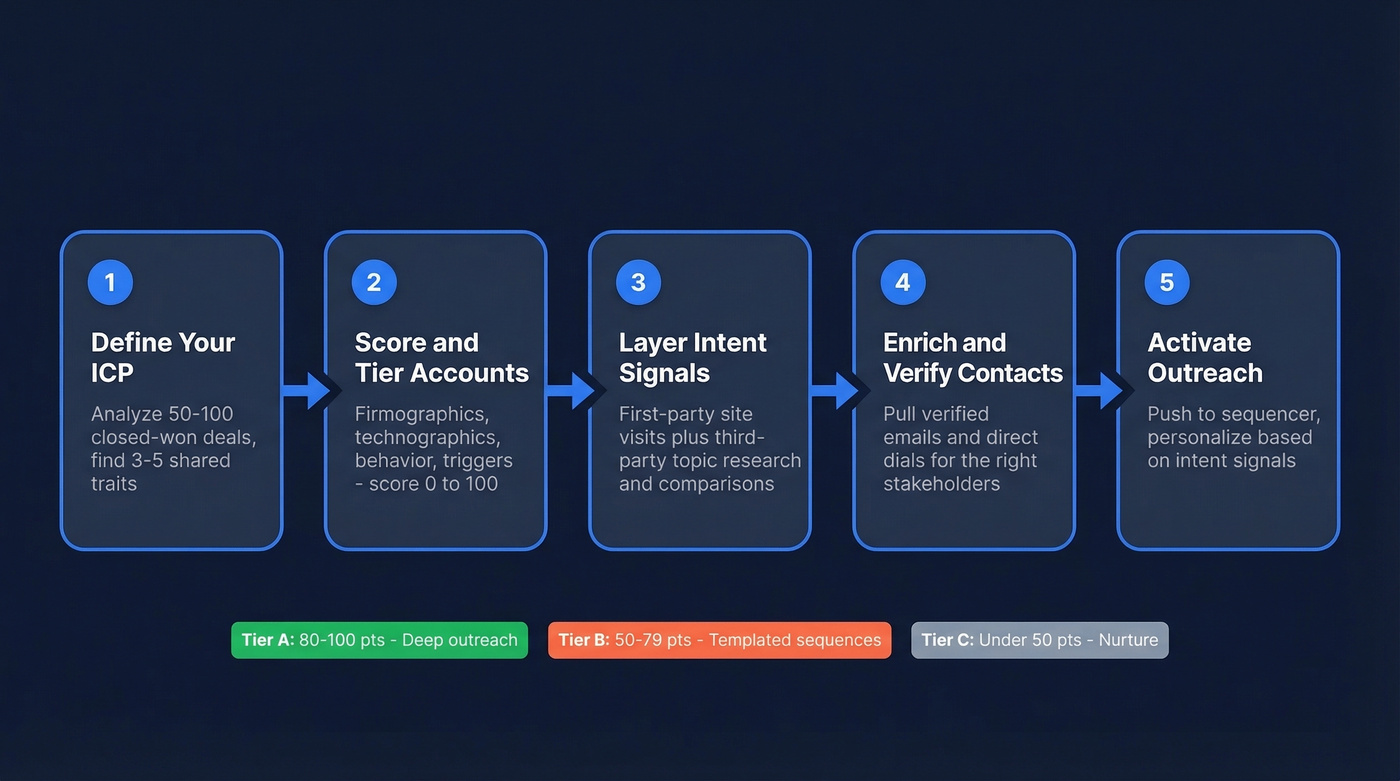
2. Score and tier accounts. Assign numeric scores across firmographics, technographics, behavioral signals, and trigger events. Tier A (80-100) gets deep, multi-threaded outreach. Tier B (50-79) gets lighter sequences. Tier C goes into nurture.
3. Layer intent signals. Stop asking "who are they?" and start asking "what are they doing?" First-party signals like site visits and trial signups are high-confidence. Third-party intent - topic research, vendor comparisons - catches accounts before they ever hit your site. If you want a tighter system, build an intent-based segmentation model.
4. Enrich and verify contacts. Once you've identified target accounts, pull verified emails and direct dials for the right stakeholders. Pay-per-result pricing means no budget burned on unverified records. (If you're comparing vendors, start with these data enrichment services.)
5. Activate outreach. Push verified contacts into your sequencer and personalize based on the intent signals from steps 2-3. The connected stack - discovery to enrichment to verification to activation - eliminates the manual tab-hopping that kills rep productivity. If you're standardizing your stack, use a dedicated sales engagement platform rollout plan.

Your 5-step framework needs a data layer that keeps up. Prospeo combines 300M+ profiles, 30+ search filters (intent, technographics, job changes, headcount growth), and 98% email accuracy on a 7-day refresh cycle - so every prospect you identify is verified and reachable.
Build your Tier A list in minutes, not hours.
How to Build an ICP Scoring Rubric
Pull 50-100 closed-won deals from the last 12 months and look for patterns across four categories. Assign point values based on how predictive each trait is.
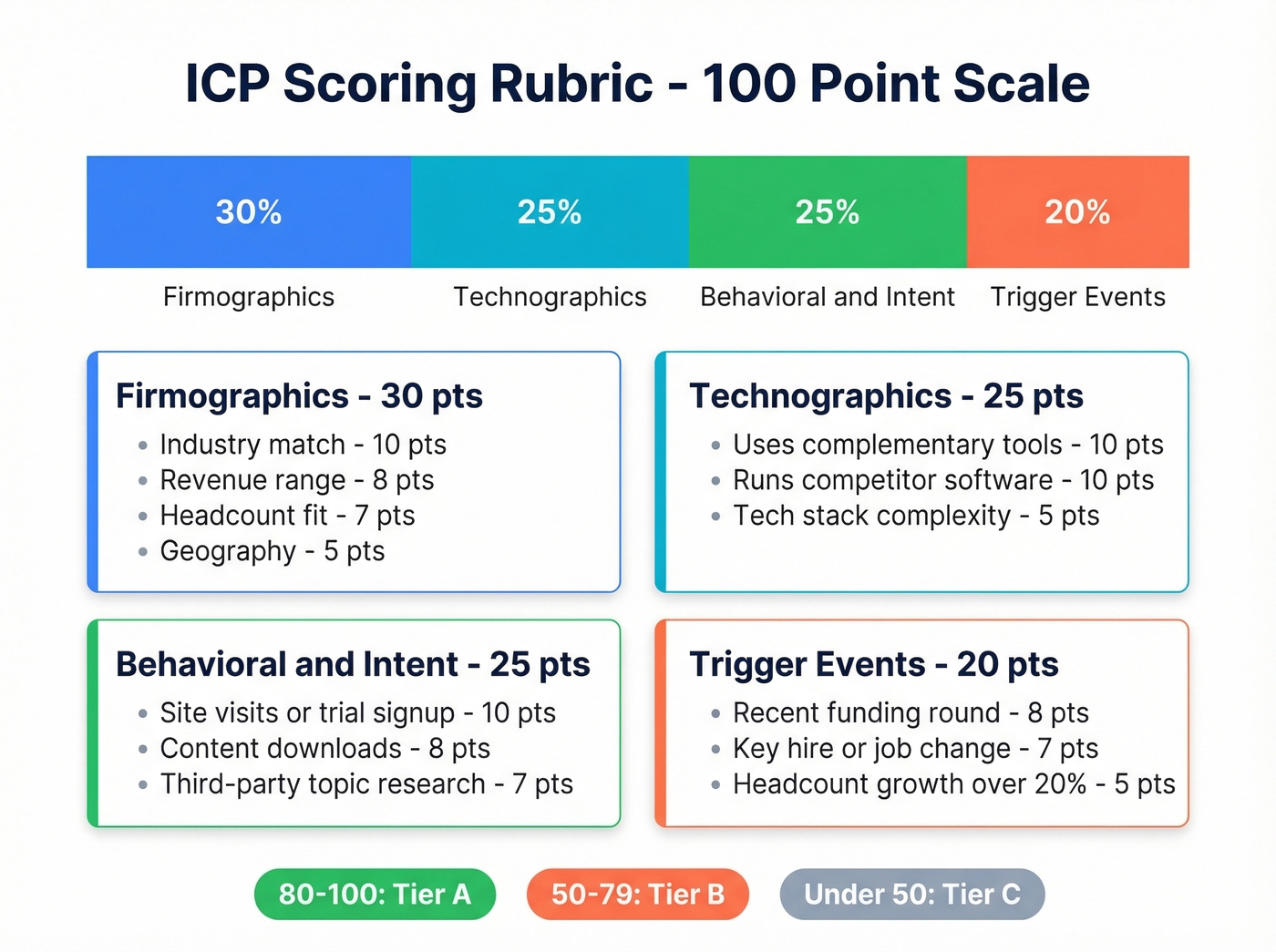
| Category | Example Criteria | Max Points |
|---|---|---|
| Firmographics | Industry, revenue, headcount, geo | 30 |
| Technographics | Tech stack fit, competitor tools | 25 |
| Behavioral/Intent | Site visits, content downloads, topic research | 25 |
| Trigger Events | Funding, job changes, headcount growth | 20 |
Accounts scoring 80+ are Tier A - multi-threaded outreach across email, phone, and social. Tier B (50-79) gets templated sequences. Tier C goes into marketing nurture until signals strengthen.
Don't stop at firmographics. Layer in opportunity qualification - can they implement and benefit? - and stakeholder qualification: does your contact have buying authority? A perfect-fit company with the wrong contact is still a dead end, and we've seen this mistake sink entire quarters for teams that should've known better.
If your average deal size is under $10K, you probably don't need a $40K intent platform. A tight ICP rubric and verified contact data will outperform expensive signal tools that your team never fully adopts.
Using Intent Data to Find In-Market Buyers
Two types of intent data are worth tracking. First-party intent - website visits, trial activity, pricing page views - is high confidence but limited to accounts that already know you. Third-party intent - topic research, vendor comparisons, G2 browsing - catches accounts before they discover your brand.
The platforms that aggregate third-party intent (Bombora, 6sense, Demandbase) are the standard. Track topic search surges, vendor comparison activity, and content consumption spikes. When an account lights up across multiple signals, that's your Tier A trigger, and that target account should move immediately into a personalized outreach sequence. For teams that don't want a separate intent platform, some prospecting databases now bundle intent data directly into their search filters - which saves both money and the headache of stitching tools together.
Tools for Identifying Prospects

Apollo is the fastest way to go from zero to a usable list. 275M+ contacts, a generous free tier, and built-in sequencing make it the default for speed over precision. Paid plans run $49-99/user/month. The consensus on r/sales is that it's a great starting point, but data quality gets shaky in smaller markets and non-US regions.
Clay is the power tool for hyper-specific lists through chained enrichment workflows. Reddit users love it for weirdly specific targeting ("SaaS companies using Snowflake that hired a VP of Sales in the last 90 days"). $149/month on credits. Setup-heavy, but nothing else matches it for custom logic. Skip this if your team doesn't have someone who enjoys building workflows - it'll collect dust. (If you want a step-by-step build, see Clay list building.)
| Tool | Best For | Database | Starting Price | Key Strength |
|---|---|---|---|---|
| Prospeo | Verified contacts + intent | 300M+ profiles | Free; ~$0.01/email | 98% accuracy, 7-day refresh |
| Apollo | Fast list building | 275M+ contacts | Free; $49/user/mo | Broad coverage, sequencing |
| ZoomInfo | Enterprise data needs | 600M+ profiles | ~$15K/year | Largest DB, deep firmographics |
| Clay | Custom enrichment | Multi-source | $149/month | Chained enrichment logic |
| Lusha | Quick phone lookups | Not disclosed | $49/user/mo | Fast contact lookup |
| 6sense | Intent-led ABM | N/A (intent platform) | ~$50K/year | Deep intent scoring |
ZoomInfo has the largest database at 600M+ profiles, but a 10-seat contract with intent data can exceed $40K/year. That's enterprise money. Lusha is solid for quick phone lookups but hit-or-miss by region. 6sense is a pure intent platform - powerful for ABM, but you're looking at $50K/year minimum and a long implementation cycle.
Mistakes That Kill Your Pipeline
Firmographic fit alone isn't enough. We've seen teams build beautiful account lists that go nowhere because they targeted the wrong persona. A perfect-fit company with the wrong contact is a wasted sequence. Layer in stakeholder qualification every time.
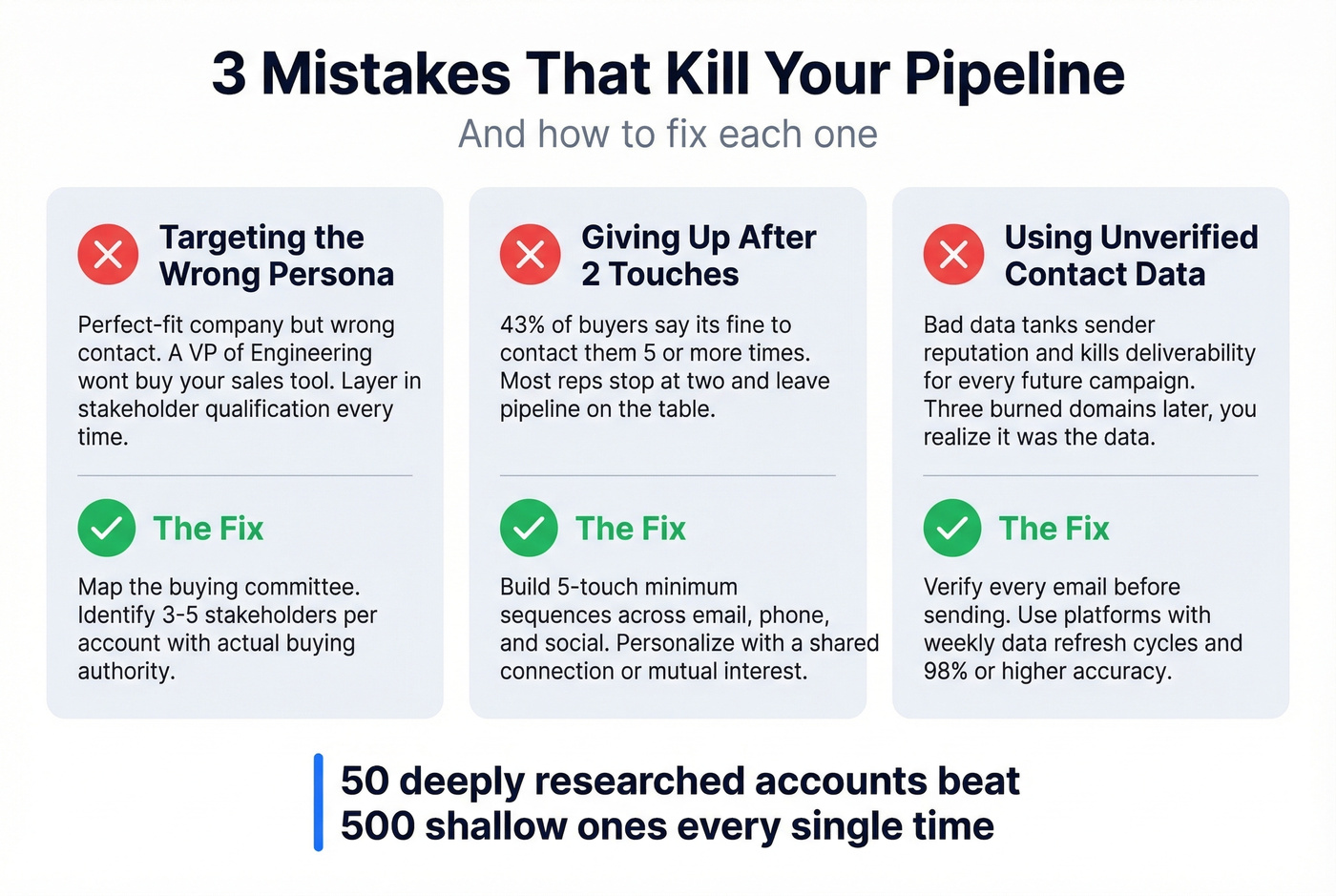
Most reps give up too early. 43% of buyers who accept meetings say it's fine for sellers to contact them 5+ times before getting through, yet most reps stop at two. And when they do reach out, generic templates get ignored - mentioning a single commonality like a shared connection or mutual interest lifts InMail acceptance by 46%. If you need a baseline cadence, start with these sales follow-up templates.
The silent killer is bad data. Unverified lists don't just miss - they damage your sender reputation and tank deliverability for every future campaign. I've talked to agency owners who burned through three domains before they realized the problem wasn't their copy, it was their data source. Fifty deeply researched accounts beat 500 shallow ones every time. If you're seeing issues, prioritize email deliverability and improve sender reputation before scaling volume.
Bad contact data turns perfect prospect identification into wasted outreach. Prospeo's 5-step verification delivers 98% email accuracy and 125M+ verified mobile numbers at ~$0.01/email - so your reps spend time selling to the right accounts, not chasing bounces.
Verify every contact before a single email goes out.
FAQ
What's the difference between a lead and a prospect?
A lead is a contact who hasn't been qualified - it's one-way communication. A prospect has been vetted against your ICP and shows fit or buying-intent signals. The distinction determines how much personalization and rep time they deserve.
How many accounts should an SDR work at once?
Most high-performing teams work 30-50 accounts deeply rather than hundreds superficially. Each Tier A account deserves 5+ personalized touches across email, phone, and social before moving on.
What's a good free tool for identifying prospects?
Prospeo's free tier (75 verified emails/month) is the strongest no-cost option for accurate contact data. Apollo also offers a generous free plan with broader but less precise coverage. Pair either with a CRM to track engagement.
How often should I refresh my prospect data?
Every 7 days is the gold standard - contact data decays fast as people change roles and companies. The industry average is 6 weeks, which means most teams are working stale records. Platforms with weekly refresh cycles cut bounce rates dramatically.