

How to Write a Reach Out Email That Actually Gets a Reply
You send 500 emails. Three replies - two are unsubscribes. The reach out email templates you copied from a blog post aren't broken, exactly. They're just 20% of the equation. The other 80% - data quality, deliverability, and timing - is what nobody wants to talk about because it's less fun than writing clever subject lines.
An analysis of 16.5 million cold emails puts the average reply rate at 5.8%, down roughly 15% from 6.8% the year prior. Outreach is getting harder. But the teams winning aren't writing better emails. They're sending fewer, cleaner ones to better-targeted lists.
If You Read Nothing Else
Do these four things:
- Verify your list first. Bounces above 2% tank your domain reputation. Run every list through a verification tool before hitting send.
- Set up SPF/DKIM/DMARC before sending a single email. Microsoft started enforcing this for bulk senders in May 2025, and if you're not authenticated, deliverability drops fast.
- Keep emails under 200 words with one CTA. The sweet spot is 6-8 sentences, which hit a 6.9% reply rate across 16.5 million emails analyzed.
- Personalize the subject line. Personalized subjects pull a 46% open rate vs 35% without - a 31% lift for five seconds of work.
2026 Outreach Email Benchmarks
Before you rewrite a single template, you need to know what "good" looks like right now:
| Metric | 2023 | 2024 | Takeaway |
|---|---|---|---|
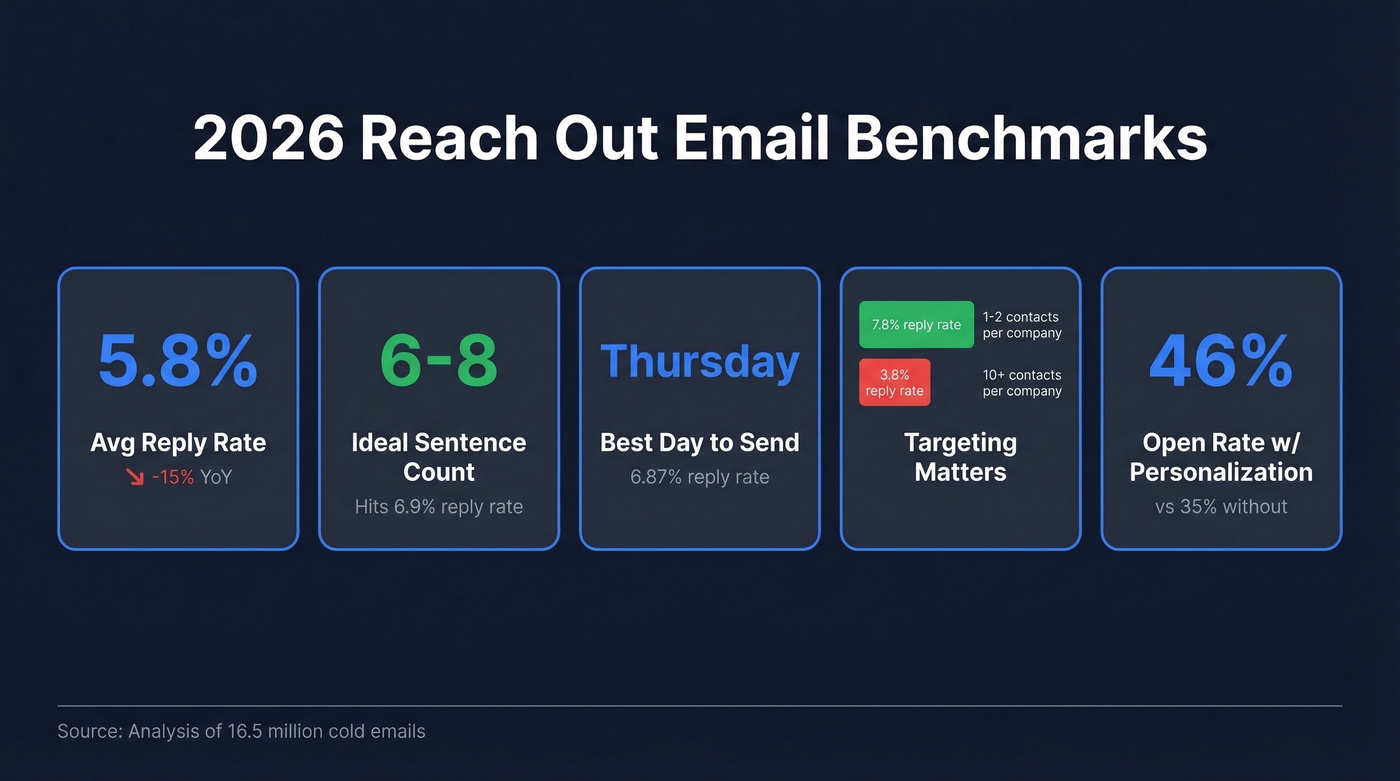
| Avg reply rate | 6.8% | 5.8% | Down 15% YoY |
| Best email length | 6-8 sentences | 6-8 sentences | Still the sweet spot |
| Best day to send | Thursday | Thursday (6.87%) | Thursday wins both years |
| Targeting (1-2/co.) | ~8% | 7.8% | Fewer contacts = more replies |
| Targeting (10+/co.) | ~4.5% | 3.8% | Spray-and-pray is dying |
The targeting breadth data is the most underrated finding here. Teams emailing 1-2 contacts per company pulled a 7.8% reply rate. Teams blasting 10+ contacts at the same company? 3.8%. That's half the performance for ten times the effort. The evening window of 8-11 PM also peaked at 6.52%, which is worth testing if your audience checks email after hours. Executives often need around 9 touches before responding; lower-level contacts tend to reply sooner.
Reply rates are declining industry-wide, but strong campaigns still clear 7-8% when targeting is tight and deliverability is clean. The gap between average and excellent is widening, and it's almost entirely a function of list quality and infrastructure - not copywriting. One operator shared their full stack cost: roughly $420/month generating 16 qualified leads from email alone. That's viable unit economics for most B2B teams.
Here's the thing: if your average deal size is under $5k, you probably don't need a $1,000/month outreach stack. A verified list, an authenticated domain, and three well-written emails will outperform a bloated tech setup with dirty data every time.
Before You Write - Deliverability Fundamentals
This is the section every "how to write a reach out email" article skips. It's also the section that matters most.
Authenticate Your Domain
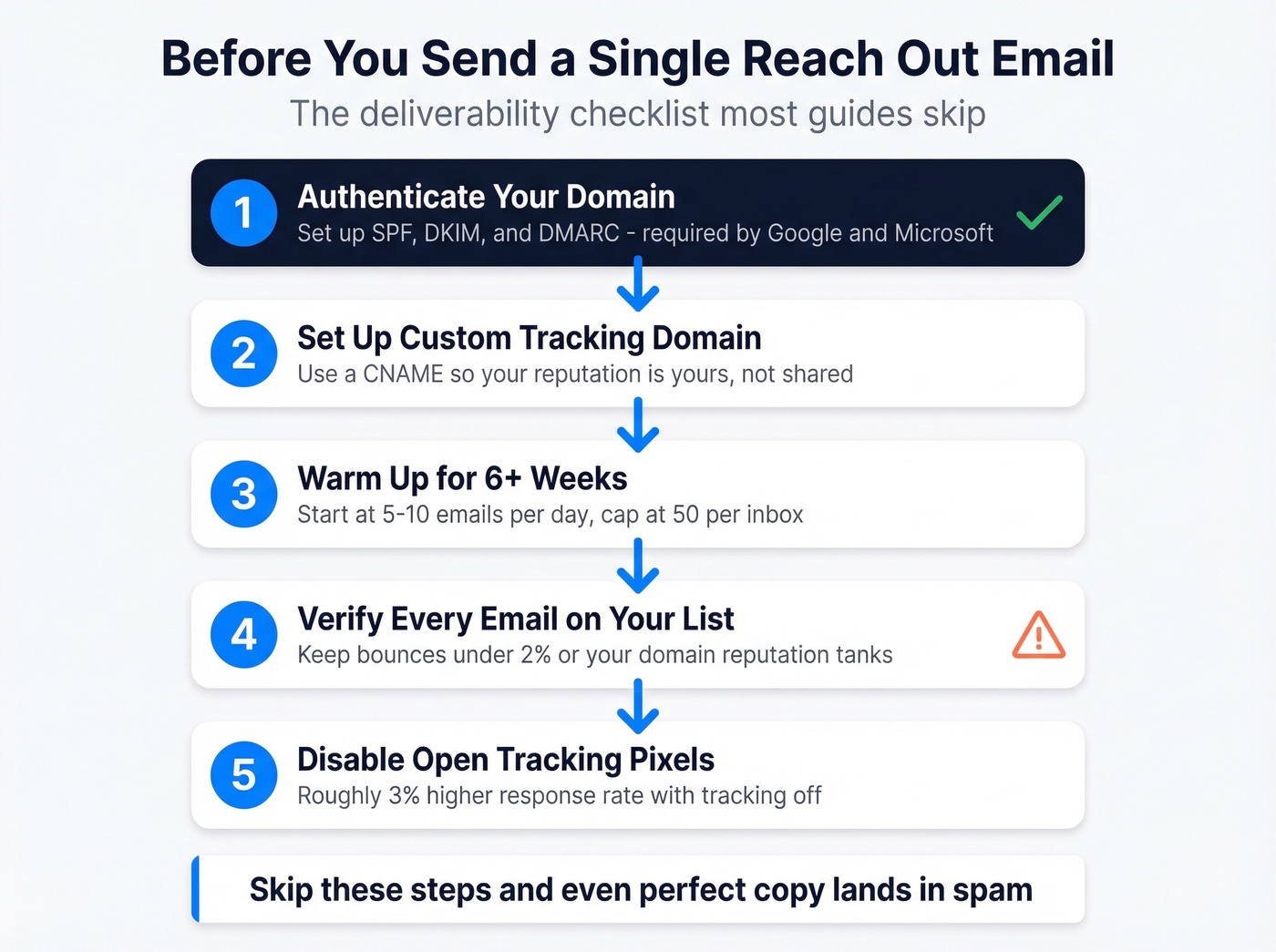
SPF, DKIM, and DMARC aren't optional anymore. Microsoft's been enforcing since early 2024. If your DNS records aren't set up, your emails simply aren't reaching inboxes consistently.
Publish DMARC so you can monitor authentication performance and protect your domain. Use a custom tracking domain (CNAME) so your reputation isn't tied to a shared one. Keep spam complaints under 0.3% and bounces under 2%.
Warm Up Properly
| Week | Daily volume | Notes |
|---|---|---|
| 1-2 | 5-10/day | Replies only to warmup emails |
| 3-4 | 15-20/day | Mix warmup + real sends |
| 5-6 | 30-40/day | Monitor bounce/complaint rates |
| 7+ | Cap at 50/day | Per inbox, not per domain |
Never exceed 50 emails per day from a single inbox. If you need more volume, rotate across multiple domains and inboxes. One operator on Reddit scaled from 3 domains to 7, each capped at 26 emails/day, and doubled their reply rate over 62 days. That kind of patience pays off.
Turn off open-tracking pixels. They hurt deliverability on cold email - the dataset showed roughly 3% higher response rates when open tracking was disabled.
Verify Your List
The Reddit operator who dropped bounces from 11% to under 2% doubled their reply rate. Every bounced email damages your sender reputation, and the damage compounds. Three bad campaigns in a row and you're digging out of a hole for months.
We've seen teams go from 3% reply rates to 6%+ just by cleaning their lists - no copy changes at all. In our experience, verification is the single highest-ROI step in any outreach workflow, and it's the one most people skip because it feels like busywork.
If you want a deeper breakdown of bounce thresholds and what they mean, see our bounce rate benchmarks.
Subject Lines That Get Opens
The patterns from 5.5 million analyzed emails are clear:
| Subject line type | Open rate | Verdict |
|---|---|---|
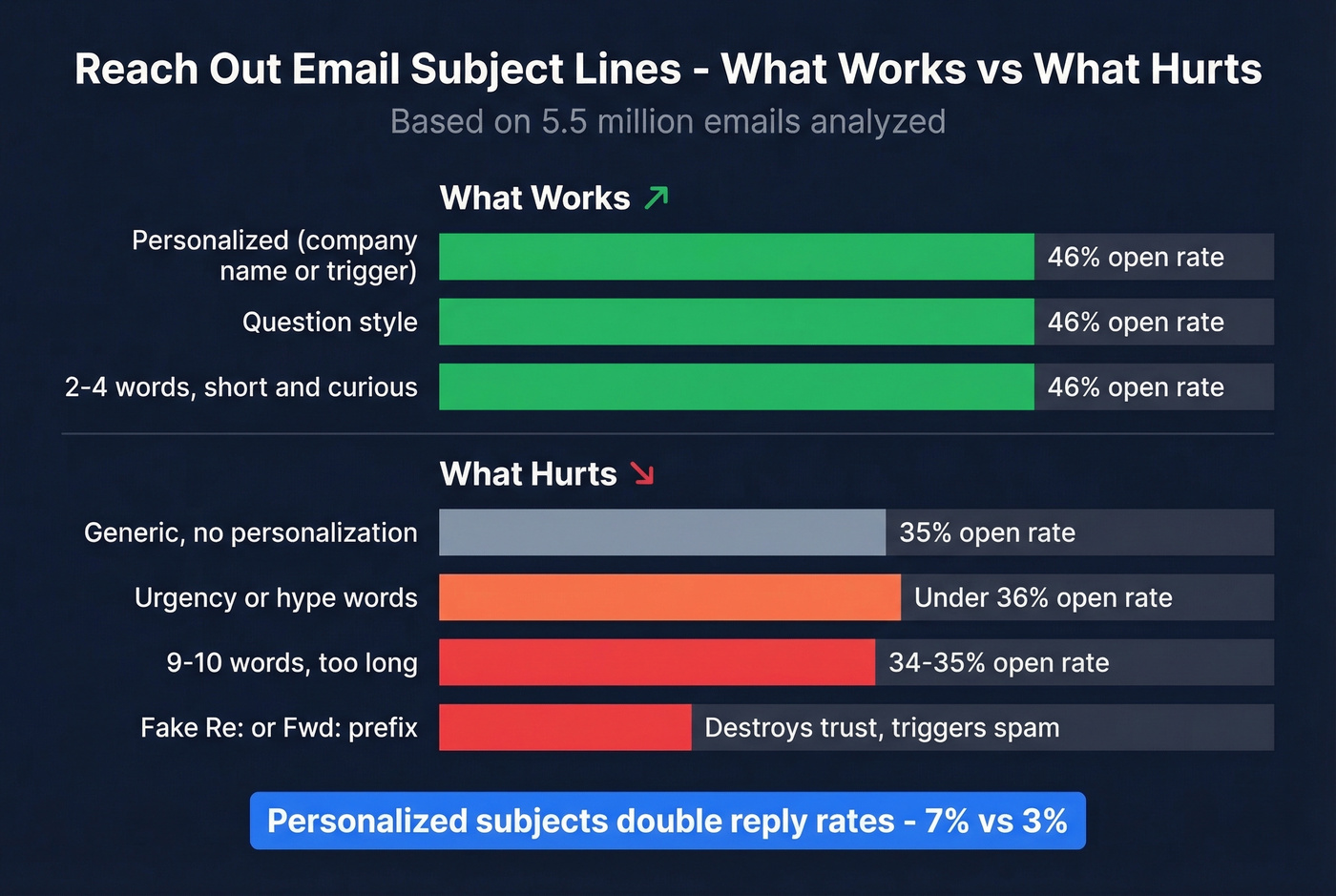
| Personalized | 46% | Always worth the effort |
| Question-style | 46% | Top performer |
| 2-4 words | 46% | Brevity wins |
| Generic/no personalization | 35% | Baseline |
| Urgency/hype terms | <36% | Actively hurts |
| 9-10 words | 34-35% | Too long |
Personalization doesn't just lift opens - it doubles replies. Personalized subject lines pulled a 7% reply rate vs 3% without. That's a 133% increase from something as simple as including the prospect's company name or a relevant trigger event.
One practitioner on Reddit tested "Quick question" as a subject line and hit 39% opens. "Partnership opportunity" dropped below 19%. Simple and curiosity-driven beats formal and descriptive every time. Skip numbers in subject lines too - they actually perform slightly worse.
If you need more ideas, pull from these subject line examples and compare against our cold email subject line examples dataset.
Words to cut from your subject lines: cheap, affordable, free, act now, limited time, guaranteed, ASAP. Anything that sounds like marketing hype pushes opens below 36%. And never use fake "Re:" or "Fwd:" prefixes - they get one open but destroy trust and trigger spam filters.
Let's be honest: stop A/B testing subject lines until your deliverability is solid. A perfect subject line means nothing if you're landing in spam.

You just read that dropping bounces from 11% to under 2% can double reply rates. Prospeo's 5-step email verification delivers 98% accuracy - and refreshes every 7 days so your list doesn't decay between campaigns. At $0.01 per email, cleaning your entire list costs less than one bounced send costs your domain reputation.
Stop rewriting subject lines. Fix the list underneath them.
How to Structure Your Reach Out Email
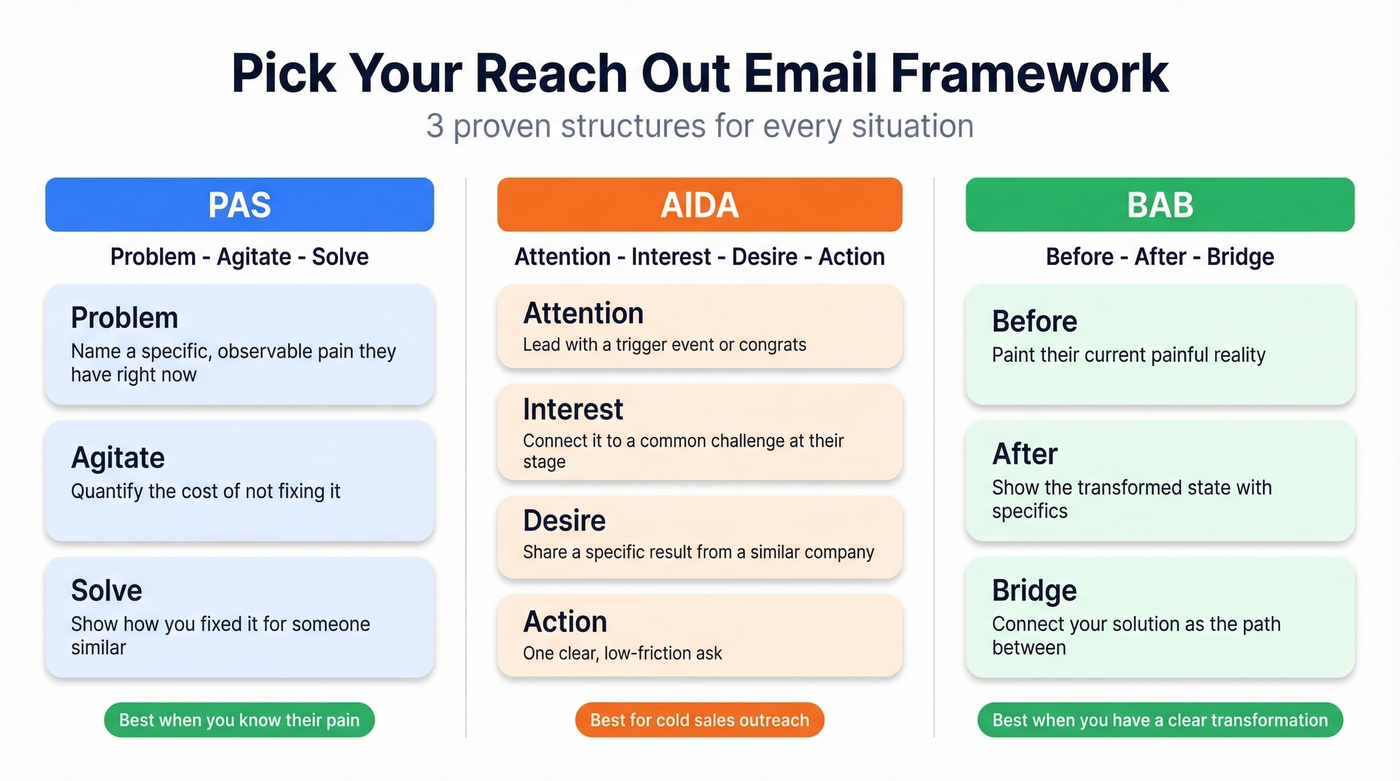
Three frameworks handle nearly every scenario. Pick the one that matches your situation, and always include an easy opt-out - something like "reply 'not interested' and I'll remove you" actually increases trust and reply rates.
PAS (Problem-Agitate-Solve)
Best when you know the prospect's specific pain. Here's what a bad version looks like versus a good one:
Weak PAS: Hi {{First name}}, I help companies with their email deliverability. We have great tools. Want to chat?
Strong PAS: {{First name}}, saw your team just opened 3 new AE roles - scaling outbound with bad data is brutal. Most teams we talk to are bouncing 8-12% of their lists, which torches sender reputation fast. We cut that to under 2% for {{similar company}} in two weeks - worth a quick look?
The difference? The strong version names a specific, observable problem and quantifies the pain before offering a fix.
AIDA (Attention-Interest-Desire-Action)
Best for cold sales outreach to unfamiliar prospects. Grab attention, build interest, create desire, close with one ask:
{{Company}} just raised Series B - congrats. Teams at your stage typically triple outbound volume but struggle to keep deliverability above 90%. We helped {{similar company}} scale from 500 to 2,000 emails/week without a single domain flag. Can I send a 2-min breakdown?
If you want to go deeper on the framework itself, see the AIDA breakdown.
BAB (Before-After-Bridge)
Best when you have a clear transformation to show:
- Before: Paint their current pain - {{similar company}}'s SDRs spent 4 hours/day building lists manually.
- After: Show the transformed state - Now they export verified contacts in minutes and spend that time selling.
- Bridge: Connect with your solution - Happy to show you the workflow in 10 minutes.
Templates by Use Case
Every template below follows the rules: under 200 words, single CTA, personalization placeholders. Adapt the framework to your audience and swap in your own data points.
Sales Prospecting
Cold intro:
{{First name}}, noticed {{company}} is hiring for {{role}} - usually means {{pain point}} is top of mind. We helped {{similar company}} solve that in {{timeframe}}. Worth 15 minutes this week?
Trigger-based:
Congrats on {{trigger event}}, {{first name}}. Teams in your position usually hit {{specific challenge}} within 60 days. We built a playbook for exactly this - can I send it over?
Referral-based:
{{Mutual connection}} suggested I reach out. They mentioned you're working on {{initiative}} and thought our approach to {{solution area}} might be relevant. Quick call this week?
For more tactics beyond templates, use these sales prospecting techniques.
Networking and Reconnection
Use these when you're building relationships, not closing deals. The tone shifts from ROI to genuine curiosity.
Warm reconnect:
{{First name}}, we met at {{event}} last {{month}}. Your point about {{topic}} stuck with me. Would love to continue that conversation over coffee or a quick call.
Cold networking:
{{First name}}, your {{specific piece/talk}} changed how I think about {{area}}. I'd love to ask you one specific question about {{subtopic}} - would a 10-minute call work?
If you’re writing a more relationship-first note, start with this connection email guide.
Job Seeking
Hiring manager outreach:
{{First name}}, I saw the {{role}} opening. I've spent {{X years}} doing exactly this - specifically {{relevant achievement}}. I'd love to share how I'd approach {{specific challenge in the role}}. Open to a quick chat?
Partnerships
Co-marketing pitch:
{{First name}}, your audience and ours overlap heavily - {{specific overlap}}. A joint {{webinar/guide}} on {{topic}} would drive leads for both of us. We'd handle production. Interested?
Wrong contact redirect:
{{First name}}, I may have the wrong person - I'm looking for whoever handles {{function}} at {{company}}. If that's not you, would you mind pointing me in the right direction? Appreciate it.
If partnerships are your main motion, this business partnership guide has more examples.
Follow-Ups
Value-add follow-up:
{{First name}}, since my last note I came across {{relevant resource}} that's directly related to {{their challenge}}. Thought it'd be useful regardless. Still open to a quick chat if the timing works.
Breakup email:
{{First name}}, I've reached out a couple times - totally understand if the timing's off. If {{pain point}} becomes a priority, I'm here. No hard feelings either way.
For more follow-up angles, see these follow-up templates.
The Follow-Up Sequence
The best framework we've tested for follow-ups comes from a practitioner on r/smallbusiness: awareness, then value, then ask.
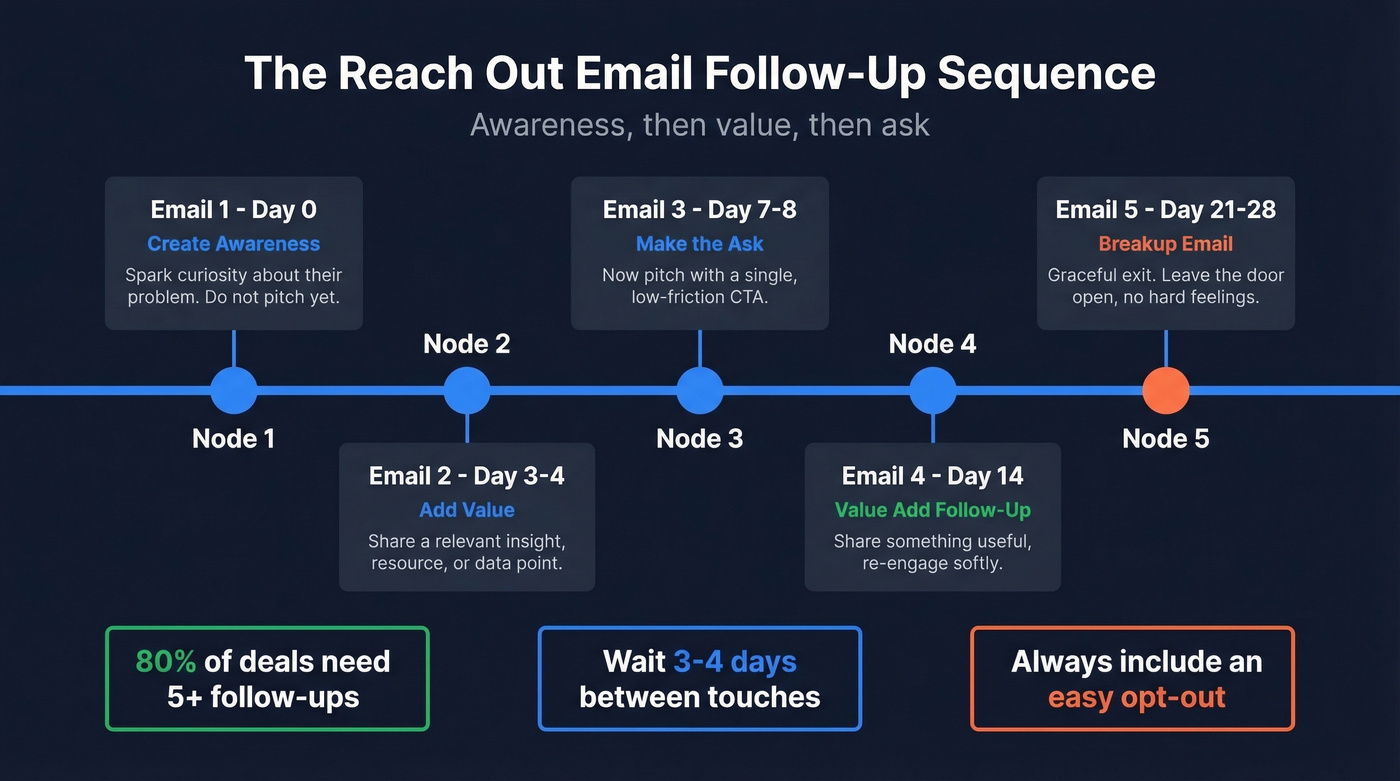
- Email 1 (Day 0): Create awareness. Spark curiosity about their problem. Don't pitch.
- Email 2 (Day 3-4): Add value. Share an insight, data point, or case study.
- Email 3 (Day 7-10): Clear CTA. You've earned the right to ask. Make it low-friction.
Single emails technically have the highest per-email reply rate at 8.4%, but a 3-email sequence maximizes total replies while keeping spam risk manageable. The first follow-up boosts replies by up to 49%. But by the fourth email, response rates drop roughly 55% while spam complaints triple from 0.5% to 1.6%.
If you want more sequencing options, this B2B cold email sequence guide goes deeper.
If they haven't replied after three well-crafted emails, move on. Your domain reputation isn't worth the marginal return.
Mistakes That Kill Your Reply Rate
Strategy mistakes:
- Opening with "Hope this email finds you well" or "Just reaching out" - instant delete for most recipients
- Wasting preview text with "My name is..." intros - the first line should hook, not introduce
- Writing 150+ word essays when 50-80 words land better
- Including multiple CTAs - emails with more than one ask perform worse across every dataset we've seen
- Using exclamation marks in subject lines - they signal desperation
- Skipping ICP research and segmentation entirely
Technical mistakes:
- Sending from your primary domain instead of a separate sending domain
- Missing SPF/DKIM/DMARC authentication
- No warmup period - going from 0 to 100 emails/day overnight
- Tracking opens on cold email, where those pixels actively hurt deliverability
- Not cleaning your list before every campaign
Skip the copy optimization entirely if your bounce rate is above 5%. Fix the data first. Everything else is rearranging deck chairs.
If you’re troubleshooting inboxing, use this email deliverability guide and these sender reputation fixes.
The data is clear: emailing 1-2 verified contacts per company pulls double the reply rate of blasting 10+. Prospeo's 30+ search filters - including buyer intent, job changes, and headcount growth - let you find the one right person instead of spraying an entire org chart. 300M+ profiles, 143M+ verified emails, all refreshed weekly.
Send fewer reach out emails to better targets. Get more replies.
FAQ
What's a good reply rate for a reach out email?
The current average across 16.5 million cold emails is 5.8%. Strong campaigns clear 7-8% when targeting is tight and deliverability is clean. If you're below 3%, fix your list quality and authentication before rewriting any templates.
How many follow-ups should I send?
Two to three. The first follow-up boosts replies by up to 49%, but by the fourth email, spam complaints triple to 1.6% and response rates drop roughly 55%. Three emails is the sweet spot for most sequences.
Should I track open rates on cold emails?
No. Open-tracking pixels hurt deliverability on cold outreach - disabling them produced roughly 3% higher response rates in controlled tests. Track replies instead. They're the only metric that matters.
How long should a reach out email be?
Under 200 words. The sweet spot is 6-8 sentences, which hit a 6.9% reply rate in the dataset. One Reddit operator cut emails from 141 words to under 56 and saw meaningful improvement in both opens and replies.
What's the best free tool for verifying emails before outreach?
Prospeo's free tier includes 75 email verifications per month at 98% accuracy - including catch-all handling and spam-trap removal. Hunter offers 25 free searches monthly but caps enrichment features. For small teams running real campaigns, the free plan at Prospeo covers more ground. Mailgun's verification API and ZeroBounce are also worth a look if you need bulk processing at scale.