

How to Write a Request for a Meeting Appointment Email That Gets a Reply
83% of meeting request emails never get a response. The problem isn't that people don't take meetings - it's that most meeting appointment requests are lazy, long, and give the recipient zero reason to care.
We've watched outbound teams iterate on meeting emails for years, and the failure patterns are always the same. Fix them, and you'll book more meetings this week than most reps book in a month.
Why Most Meeting Requests Get Ignored
Five mistakes kill meeting appointment emails over and over:
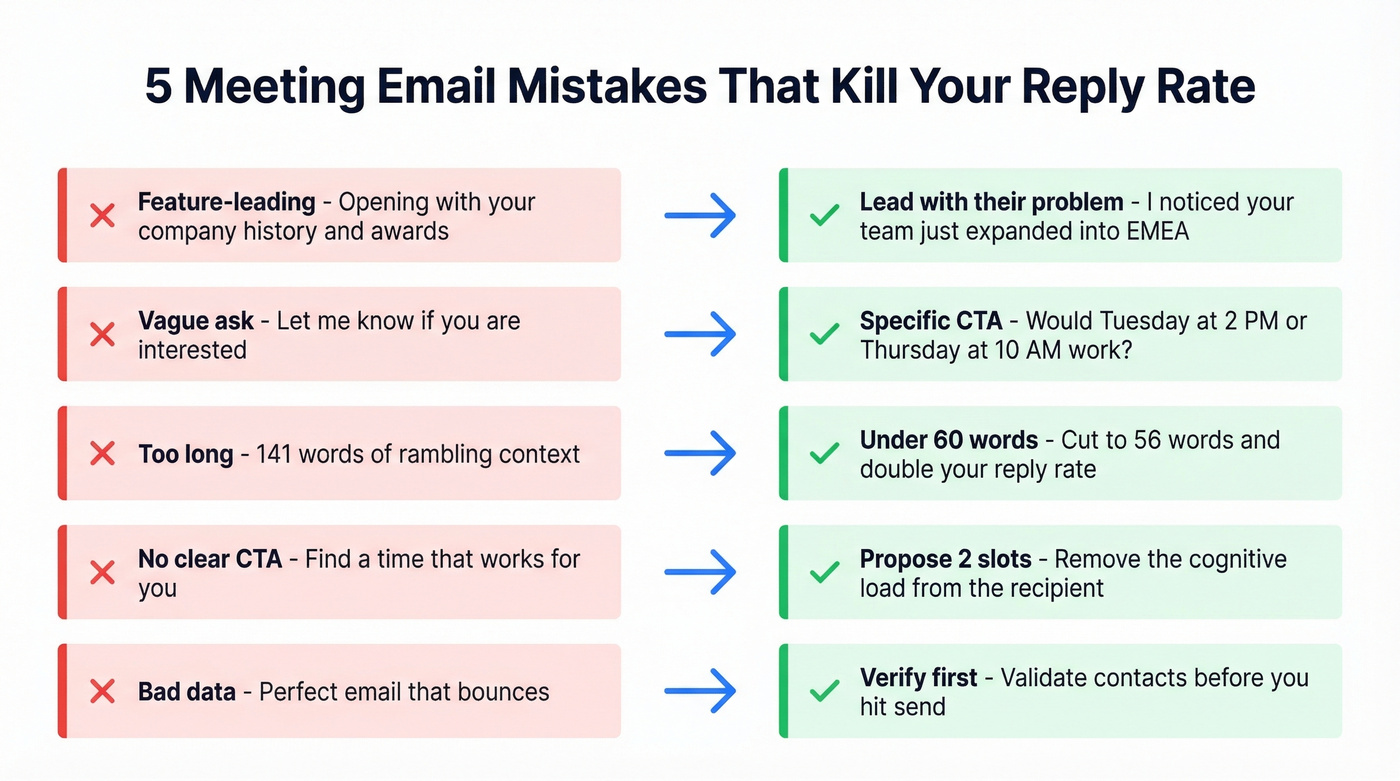
- Feature-leading. You open with your company's history, awards, or product specs. The recipient doesn't care about you yet. They care about their own problems.
- Vague ask. "Let me know if you're interested" isn't a call to action. It's a polite way of saying "I'll leave this entirely up to you," which means it dies in the inbox.
- Too long. One founder on r/Entrepreneur documented cutting emails from 141 words to under 56 and doubling reply rates. If your meeting request reads like a blog post, it's getting skimmed at best.
- No clear CTA. Asking someone to "find a time that works" puts the cognitive load on them. Propose two specific slots instead.
- Bad data. You crafted the perfect email. It bounced. Poor planning causes 35% of meetings to be seen as total time-wasters - and emails that never arrive waste 100% of your time.
What You Need Before Writing
Here's the checklist before you touch a single template:
- Short email. Under 60 words. Three short paragraphs max. (If you struggle with brevity, see how to write short emails.)
- Short subject line. 2-4 words. Longer subject lines reduce open rates. For more ideas, use these meeting subject line examples.
- Verified contact data. A bounced email wastes everything - verify before you send. Prospeo's free tier covers 75 verifications per month, enough to validate your highest-priority targets. (Compare options in our guide to email verification services.)
That's it. Everything below is the how. Jump to the templates if you already know the fundamentals, or skip to the follow-up cadence if your first emails are going unanswered.
Anatomy of an Effective Meeting Email
A reliable request for a meeting appointment email follows the same seven-part structure. Remember the founder who cut from 141 to 56 words and doubled replies? This structure is how you get there.
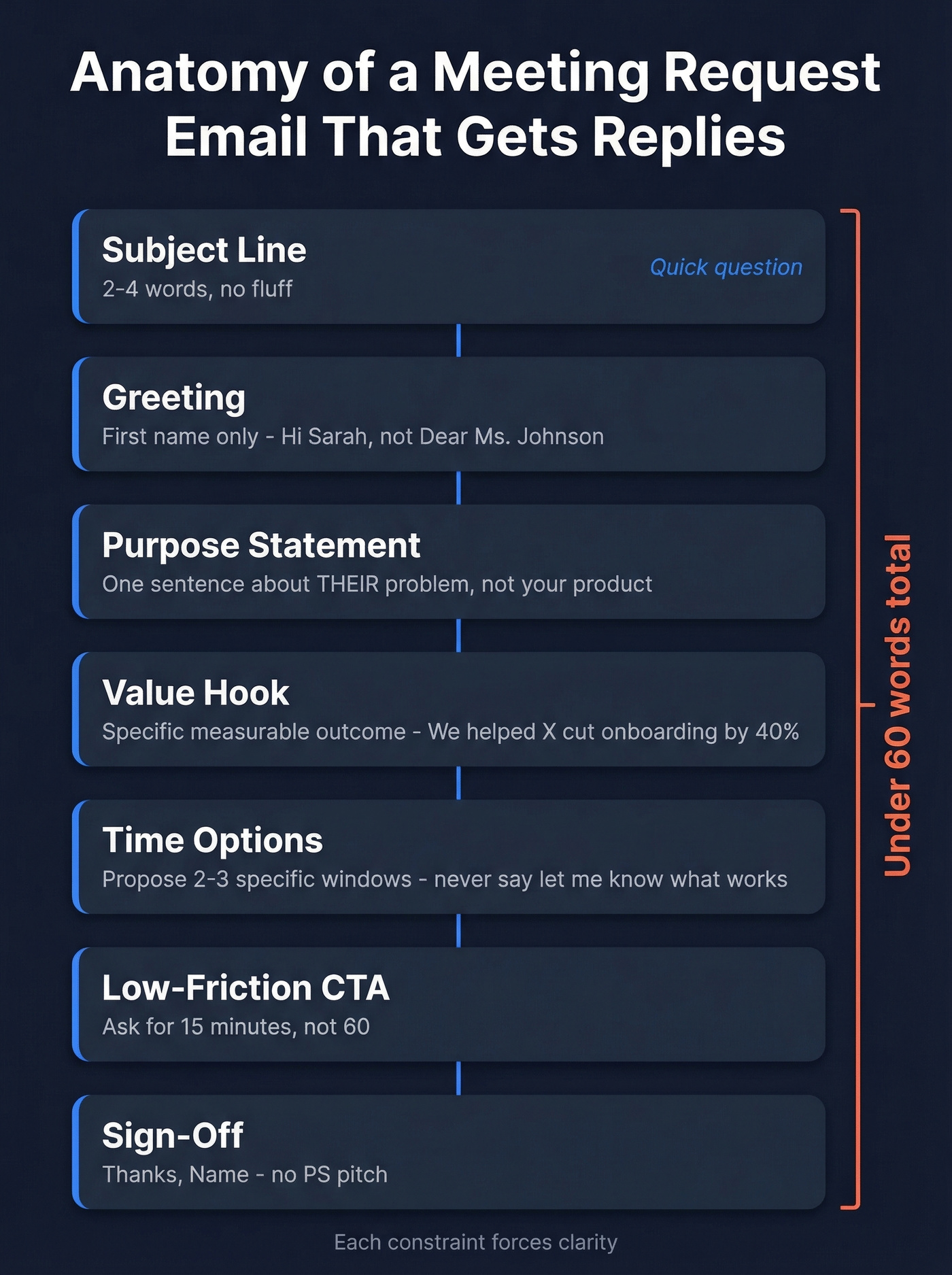
Subject line. 2-4 words. No fluff. In one founder's campaigns, "Quick question" pulled 39% opens while "Partnership opportunity" landed under 19%. If you want plug-and-play patterns, use these email subject line formulas.
Greeting. Use their first name. "Hi Sarah" beats "Dear Ms. Johnson" in almost every B2B context unless you're emailing in a culture that expects formality. (More options in our guide to business email salutations.)
Purpose statement. One sentence explaining why you're reaching out, framed around their problem, not your product. "I noticed your team just expanded into EMEA" beats "We're a leading provider of..." every single time.
Value hook. What's in it for them? A specific, measurable outcome works best. "We helped [similar company] cut onboarding time by 40%" gives them a reason to keep reading. If you need help tightening this, borrow from these unique selling proposition examples.
Time options. Propose two or three specific windows. "Would Tuesday at 2 PM ET or Thursday at 10 AM ET work?" removes friction. Never say "let me know what works." (More phrasing ideas: ask for meeting availability.)
Low-friction CTA. Ask for 15 minutes, not 60. A short meeting is easy to say yes to. A long one triggers calendar anxiety. If you want more CTA patterns, see our sales CTA guide.
Sign-off. Keep it simple. "Thanks, [Name]" is fine. Don't add a PS with another pitch - it undermines the brevity you just worked so hard to achieve. The whole thing should land under 60 words, and that constraint forces clarity.
Subject Lines That Actually Work
A Belkins study of 5.5M emails found that subject line length is the single biggest lever for open rates:
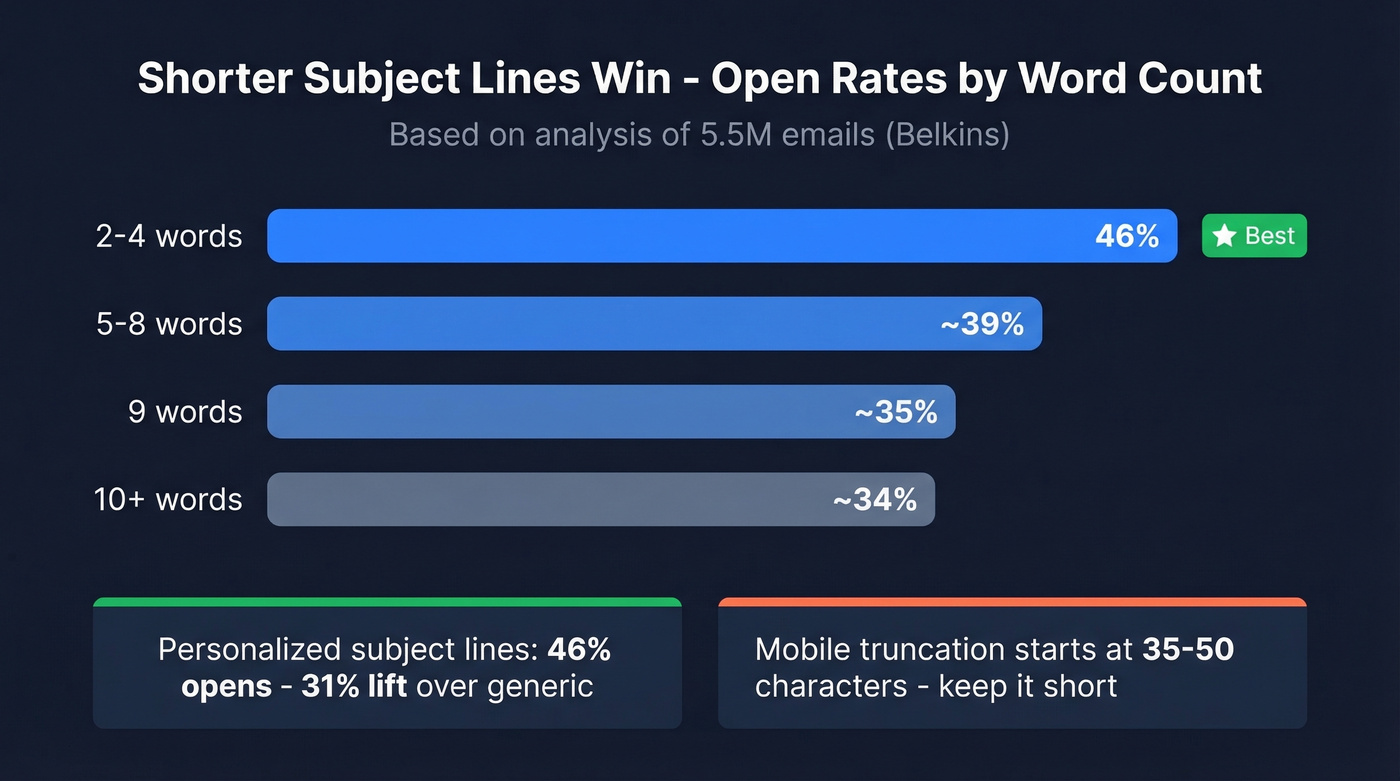
| Length | Open Rate |
|---|---|
| 2-4 words | 46% |
| 5-8 words | ~38-40% |
| 9 words | ~35% |
| 10+ words | ~34% |
Personalized subject lines hit 46% opens versus 35% without - a 31% lift. Question-style subject lines matched that 46% ceiling. Numbers in subject lines actually performed slightly worse (27% vs 28%), which surprised us.
Here's the thing: mobile truncation kicks in around 35-50 characters. If your subject line is "Following Up on Our Previous Conversation About Q3 Planning," most recipients see "Following Up on Our Prev..." and move on.
We've seen teams double their booking rate just by switching to 2-4 word subject lines. A Reddit founder separately confirmed that "Quick question" pulled 39% opens while "Partnership opportunity" landed under 19% in their own campaigns. The Belkins benchmarks and this practitioner data point in the same direction: shorter is almost always better.

You read it above: bad data wastes 100% of your effort. Prospeo verifies emails at 98% accuracy with a 7-day refresh cycle, so your meeting requests actually land. The free tier covers 75 verifications per month - enough to validate your top prospects before you hit send.
Stop crafting perfect emails that bounce into the void.
Meeting Appointment Email Templates
You don't need 25 mediocre templates. You need eight that cover every scenario you'll actually face - all under 60 words.
I've grouped these into external outreach, where you're earning attention, and internal or existing relationships, where you already have it. The dynamics are different, and your tone should reflect that.
Cold Outreach to a Prospect
When you've never spoken and need to earn the meeting.
Hi [Name],
I noticed [specific observation about their company]. We helped [similar company] [specific result] - I think there's a similar opportunity for [their company].
Would a 15-minute call on [Day] at [Time] or [Day] at [Time] work?
Thanks, [Your name]
Why this works: The observation hook proves you did your homework. The best triggers are a new role, a recent funding round, a product launch, or a hiring surge - anything that signals a problem you can solve. Generic flattery ("I love what your company is doing") gets deleted.
Common mistake: Leading with your company name or product. Nobody cares about your product in sentence one. They care about their own situation.
Warm Introduction / Mutual Connection
When someone referred you or you share a contact.
Hi [Name],
[Mutual contact] suggested I reach out - they mentioned you're working on [specific initiative]. We recently helped [similar company] with exactly that.
Could we grab 15 minutes on [Day] at [Time] or [Day] at [Time]?
Best, [Your name]
Warm intros typically see 2-5x higher reply rates than cold outbound. If you have a mutual connection, this template is your highest-ROI format - use it before anything else. (More options: mutual connection introduction email templates.)
Client Check-In or Upsell
For existing relationships where you want to expand the conversation.
Hi [Name],
It's been [timeframe] since we last connected. I've been thinking about [specific thing relevant to their account] and have a couple of ideas worth sharing.
Do you have 15 minutes on [Day] at [Time] or [Day] at [Time]?
Thanks, [Your name]
Internal Team Meeting
Hi team,
I'd like to sync on [specific topic] before [deadline/event]. I have a few updates and need input on [specific decision].
Does [Day] at [Time] work? If not, reply with your availability and I'll find a slot.
Thanks, [Your name]
Executive / C-Suite Request
When you're reaching up the org chart, every word matters more. Executives scan faster and tolerate less fluff than anyone else in the company - lead with a trend or challenge they're already thinking about, then connect it to a peer result. (More guidance: how to email C-level executives.)
Hi [Name],
[One sentence about a trend or challenge relevant to their role]. We've helped [peer company or competitor] address this - [specific metric].
Worth 15 minutes? I'm open [Day] at [Time] or [Day] at [Time].
Best, [Your name]
The peer company reference creates social proof and competitive tension simultaneously. Executives don't want to learn about your product. They want to know what their competitors are doing.
Partnership or Collaboration
When you're proposing a joint initiative, not selling.
Hi [Name],
I've been following [their company's] work on [specific initiative]. There's a natural overlap with what we're doing at [your company] around [shared area].
Would you be open to a 15-minute call on [Day] at [Time] to explore this?
Thanks, [Your name]
Rescheduling a Meeting
Hi [Name],
I need to reschedule our [Day] meeting - apologies for the shift. Could we move to [Day] at [Time] or [Day] at [Time] instead?
Same agenda, just a different slot. Let me know what works.
Thanks, [Your name]
Cross-Time-Zone Request
Hi [Name],
I'd like to discuss [topic] and want to find a time that works across our time zones. Would [Day] at [Time + timezone, e.g., 10:00 UTC] or [Day] at [Time + timezone] work for you?
Happy to adjust if neither fits.
Best, [Your name]
The Follow-Up That Books the Meeting
55% of cold email replies come from follow-ups, not the initial message. If you're sending one email and moving on, you're leaving more than half your meetings on the table.
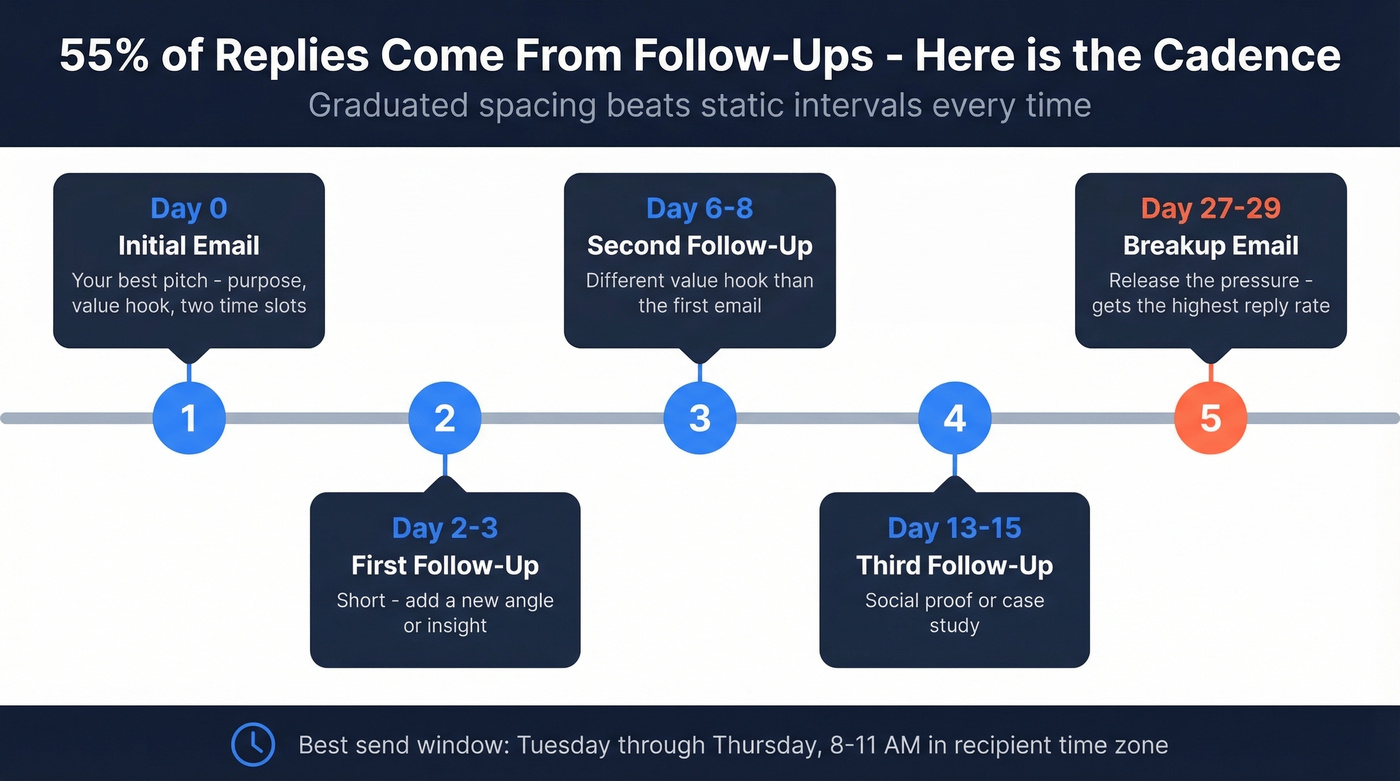
The key is graduated spacing. Static intervals - every 2 days, like clockwork - look automated and can hurt deliverability. Here's a cadence that works:
- Day 0 - Initial email
- Day 2-3 - First follow-up (short, adds a new angle)
- Day 6-8 - Second follow-up (different value hook)
- Day 13-15 - Third follow-up (social proof or case study)
- Day 27-29 - Final follow-up (breakup email)
Send Tuesday through Thursday, around 8-11 AM in the recipient's time zone. One practitioner reported a 16% lift in opens just from optimizing send times to that window. Avoid Mondays (inbox overload) and Fridays (weekend mode).
That same founder shared the infrastructure behind their results: 7 sending domains at 26 emails per day each, a total stack cost of roughly $420/month, generating 16 qualified leads per month from email alone. That's the kind of operational discipline that separates teams who "do cold email" from teams who actually book meetings with it.
First follow-up template:
Hi [Name], just circling back on my note from [Day]. [One new sentence - a relevant stat, article, or insight]. Still happy to do 15 minutes if [Day] at [Time] works.
Final follow-up (the breakup email):
Hi [Name], I've reached out a few times and don't want to be a nuisance. If [topic] isn't a priority right now, no worries at all. If it becomes one, I'm here - just reply to this thread.
In our experience, the breakup email gets the highest reply rate of the entire sequence. People respond to the release of pressure. (If you want more breakup options, see these sales breakup email templates.)
Verify Contacts Before You Hit Send
You just spent 20 minutes crafting the perfect meeting appointment request to a VP of Sales. You hit send. It bounces.
That's not just a wasted email - it's active damage. High bounce rates tank your domain reputation, which means your next hundred emails are more likely to land in spam. One founder documented dropping their bounce rate from 11% to under 2% after switching to manual verification for every contact.
Prospeo handles this at scale - checking emails against 300M+ professional profiles with 98% accuracy on a 7-day data refresh cycle versus the 6-week industry average. That freshness matters because people change jobs, companies rebrand domains, and stale data means bounced emails. (If you're troubleshooting deliverability, start with an email reputation check.)
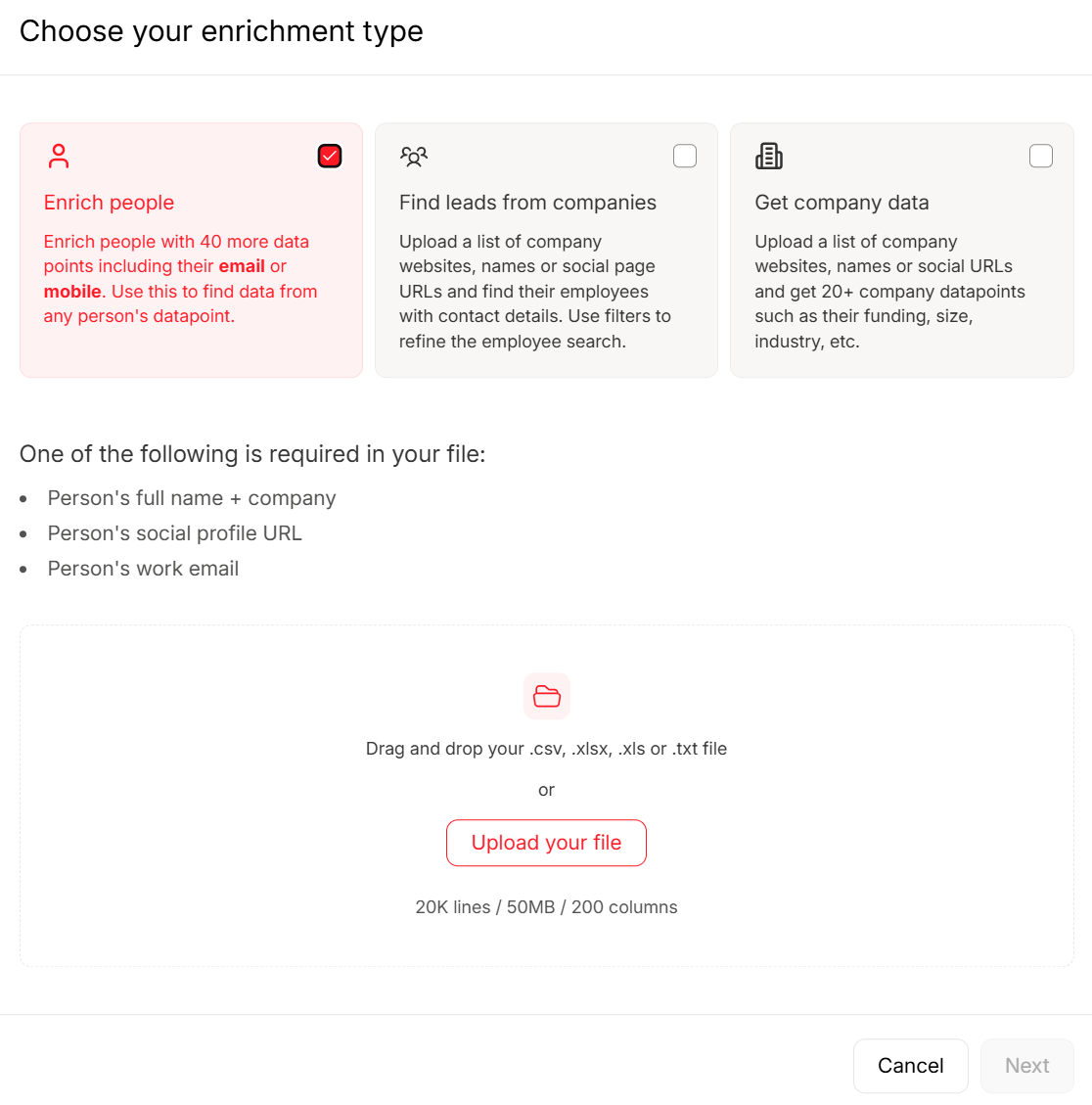
The best meeting request email in the world is worthless if it never arrives.
Great templates need great contact data. Prospeo gives you verified emails and direct dials for 300M+ professionals - at $0.01 per email. Teams using Prospeo book 35% more meetings than Apollo users because their emails actually reach real inboxes.
Find the right inbox, then send the right meeting request.
Kill the Scheduling Back-and-Forth
Once someone says yes, don't lose the meeting to a five-email thread about availability. A scheduling link in your signature or follow-up eliminates that friction entirely.
| Tool | Free Tier? | Paid From | Best For |
|---|---|---|---|
| Calendly | Yes | $12/user/mo | Widest integrations |
| Cal.com | Yes (individuals) | $15/user/mo | Open-source fans |
| SavvyCal | Yes | $12/user/mo | Most flexibility |
| zcal | Yes | $9.50/user/mo | Budget-conscious |
| Reclaim | Yes | $10/user/mo | AI scheduling |
| Sidekick | Yes | $5/user/mo | Cheapest paid option |
Per Zapier's 2026 roundup, all six offer free tiers. Our recommendation: Calendly or Cal.com if you want free, SavvyCal if you want the most flexibility at $12/user/month. Sidekick at $5/user/month is the cheapest paid option if you've outgrown a free plan.
Look - if your average deal is a few thousand dollars, you don't need a $200/month scheduling and sequencing stack. A free Calendly link, verified contact data, and the templates above will outperform most bloated sales tech setups. Spend money on data quality, not workflow tools.
Sending Across Time Zones and Cultures
68% of global virtual teams cite cultural differences as their biggest productivity hurdle, and 18% of companies have missed business opportunities entirely due to cultural misunderstandings. When your meeting request crosses borders, small details matter.
Specify the time zone explicitly. "Tuesday at 2 PM" means nothing without "ET" or "UTC+1." Never assume.
Use 24-hour format for international recipients. "14:00 CET" is unambiguous. "2 PM" requires the reader to do math.
Drop the idioms. "Let's touch base" or "circle back" can confuse non-native English speakers. Say what you mean plainly.
Research formality norms. Japanese business culture tends toward indirect, formal communication. American culture skews direct and casual. Getting this wrong doesn't just feel awkward - it can kill the meeting before it starts.
Rotate meeting times. If you always schedule at your convenient hours, your APAC colleagues are always taking the 10 PM call. Alternate. It's basic respect, and people notice when you don't.
Don't assume availability. Holidays, work weeks, and business hours vary globally. Friday is a weekend day in some countries. Check before you propose.
FAQ
How long should a meeting request email be?
Under 60 words. A founder documented cutting from 141 to 56 words and doubling reply rates. Three short paragraphs maximum - state your reason, propose specific times, and make it easy to say yes. Every word beyond 60 needs to earn its place.
What's the best subject line?
Keep it to 2-4 words. An analysis of 5.5M emails found short subject lines hit 46% open rates versus 34% for 10-word lines. "Quick question" outperforms "Partnership opportunity" by more than 2x. Shorter is almost always better.
How many follow-ups should I send?
Four follow-ups over roughly 30 days, with graduated spacing - 2, 4, 7, then 14 days between touches. Over 55% of cold email replies come from follow-ups, not the initial message. Don't give up after one send.
When's the best time to send?
Tuesday through Thursday, around 8-11 AM in the recipient's time zone. One practitioner reported a 16% lift in opens after switching to this window. Skip Mondays and Fridays.
How do I make sure my email doesn't bounce?
Verify the email address before sending. One founder cut their bounce rate from 11% to under 2% by verifying every contact first. Tools like Prospeo check against 300M+ professional profiles with 98% accuracy - the free tier covers 75 verifications per month, which is enough to validate your highest-priority targets.