

Retention in Sales: How to Keep Customers and Reps in 2026
A RevOps lead we know lost three senior AEs in one quarter last year. Within 60 days, two of their largest accounts churned - not because the product failed, but because nobody was left to manage the relationship. That's retention in sales distilled: two problems that look separate until they collide.
Half of U.S. companies are bracing for increased turnover in 2026, up from 39% in fall 2024. A Gartner survey of 243 CSOs found 73% are prioritizing growth from existing customers, and 57% rank account retention as a top-3 priority heading into the year. The average cost of replacing a single employee just hit $45,236 - up 23% from the prior year. Sales retention isn't optional. It's the thing that determines whether your revenue engine compounds or collapses.
The quick version: Retention has two sides - customers and reps - and they feed each other. Fix both or fix neither. Track NRR, not just CRR, because it reveals whether retained customers are growing or shrinking. And prioritize the four initiatives with the highest measured ROI: proactive CS outreach, usage-based pricing, QBRs, and onboarding optimization.
What Sales Retention Actually Means
When someone says "retention in sales," they're usually talking about one of two things: keeping customers buying, or keeping sales reps selling. The mistake is treating these as separate problems.
Customer retention is the percentage of existing customers who continue doing business with you over a given period. Rep retention is the percentage of your sales team that stays employed and productive. The connection between the people side and the customer side is tighter than most leaders admit - when a tenured AE leaves, their book of business enters a dead zone where handoffs get botched, renewal conversations stall, and accounts that were healthy six months ago start exploring alternatives. It hits reps personally, too. Commission claw-backs on churned accounts mean lost income, not just lost logos.
The critical window for both is the first 90 days. New customers who don't reach their first value milestone in that window churn at dramatically higher rates. New reps who don't feel supported, coached, and ramped in that same window start browsing job boards. That's where retention is won or lost on both sides.
The Real Cost of Poor Retention
Losing a Customer
Acquiring a new customer costs 5x more than retaining an existing one. That ratio alone should reorder your budget priorities, but most teams still over-invest in acquisition while starving retention.
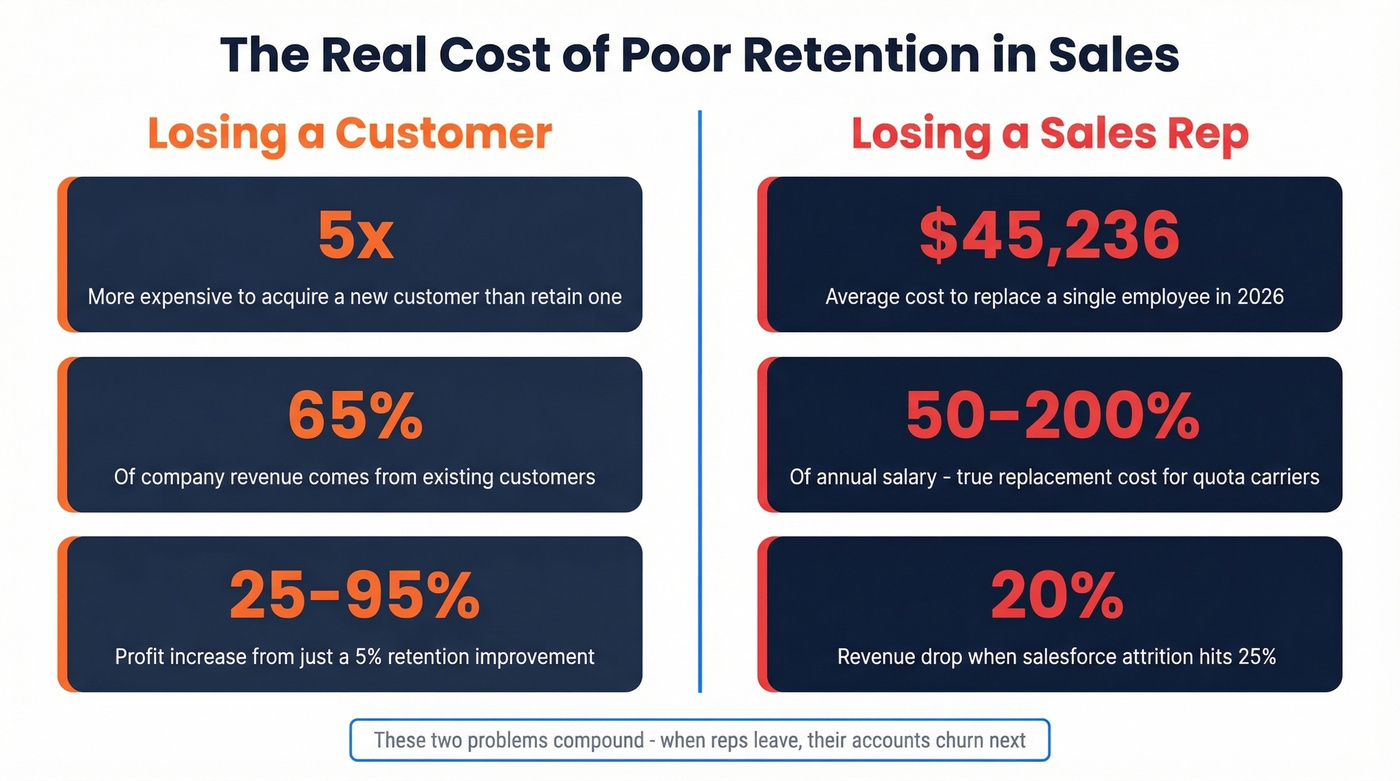
The math that matters: roughly 65% of a company's revenue comes from existing customers. A 5% improvement in customer retention can drive a 25-95% increase in profits - a range Bain & Company established and that's held up across industries for decades. The spread is wide because it depends on your margins and expansion revenue, but even the low end is significant. For a $10M ARR company with healthy margins, the conservative 25% profit lift translates to seven figures in additional profit over time.
Losing a Sales Rep
The $45,236 average turnover cost is a blended number across all roles. For quota-carrying sales reps, it's worse - the standard estimate is 50-200% of annual salary.
Take a rep earning $120K OTE. Direct replacement costs run $60K-$240K. But that's just the visible damage. Add the lost pipeline - deals that stall or die during the transition. Add months of ramp time before the new hire is fully productive. Add the institutional knowledge that walked out the door. Blue Ridge Partners modeled this at scale: an extra 5% in salesforce attrition increases selling costs by 4-6% and drops revenue 2-3%. Push attrition to 25% and selling costs spike 50% while revenue falls 20%.
This isn't a hypothetical problem. It's the math behind the panic.
How to Calculate Retention Rate
Customer Retention Rate (CRR)
E = customers at end of period, N = new customers acquired during the period, S = customers at start.
Example: You start Q1 with 200 customers, acquire 40 new ones, and end with 210. CRR = [(210 - 40) / 200] x 100 = 85%. Your churn rate is the inverse: 15%.
Employee Retention Rate
(Total headcount - Departures) / Total headcount x 100
Start the year with 50 reps and 8 leave? Your retention rate is 84%. Simple enough - but there's a trap. As ADP notes, annual-only calculations hide short-tenure attrition. If you hired 12 reps and 6 left within four months, your annual number looks fine while your onboarding pipeline is a revolving door. Track tenure distribution, not just the headline rate.
NRR and GRR
CRR tells you how many logos you kept. NRR tells you whether those logos are growing or shrinking - and that's the metric investors, boards, and operators actually care about.
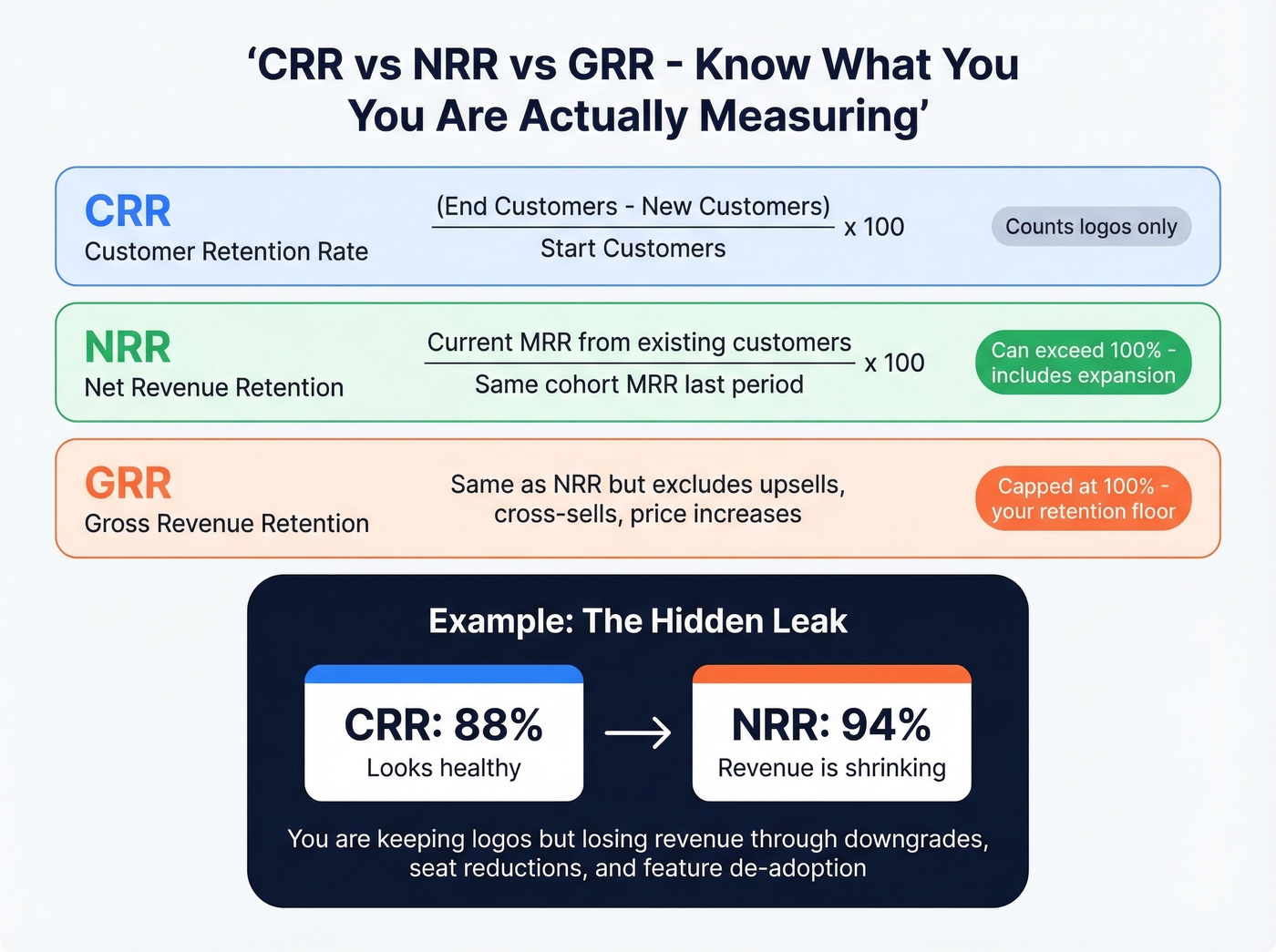
Net Revenue Retention is current-period MRR from existing customers divided by same-cohort MRR last period. NRR can exceed 100% because it includes upsells, cross-sells, and price increases. SaaS Capital's benchmarks for $25K-$50K ACV companies show a median NRR of 102%, top quartile at 111%, bottom quartile at 97%. Bootstrapped SaaS companies in the $3M-$20M ARR range run a median NRR of 104%.
Gross Revenue Retention uses the same calculation but excludes expansion revenue. GRR is capped at 100% and shows your pure retention floor - bootstrapped SaaS companies run a median GRR of 92%.
Here's the thing: any NRR below 100% means your existing customer base is shrinking in revenue terms, even if you're retaining most logos. Picture this - your CRR says 88%, your NRR says 94%. You're keeping logos but losing revenue. That gap is the hidden leak: downgrades, seat reductions, and feature de-adoptions that CRR alone will never surface. If you want a deeper breakdown, run a proper churn analysis instead of guessing.
Retention Benchmarks by Industry
Find your industry, then check your business model. The intersection is your target.
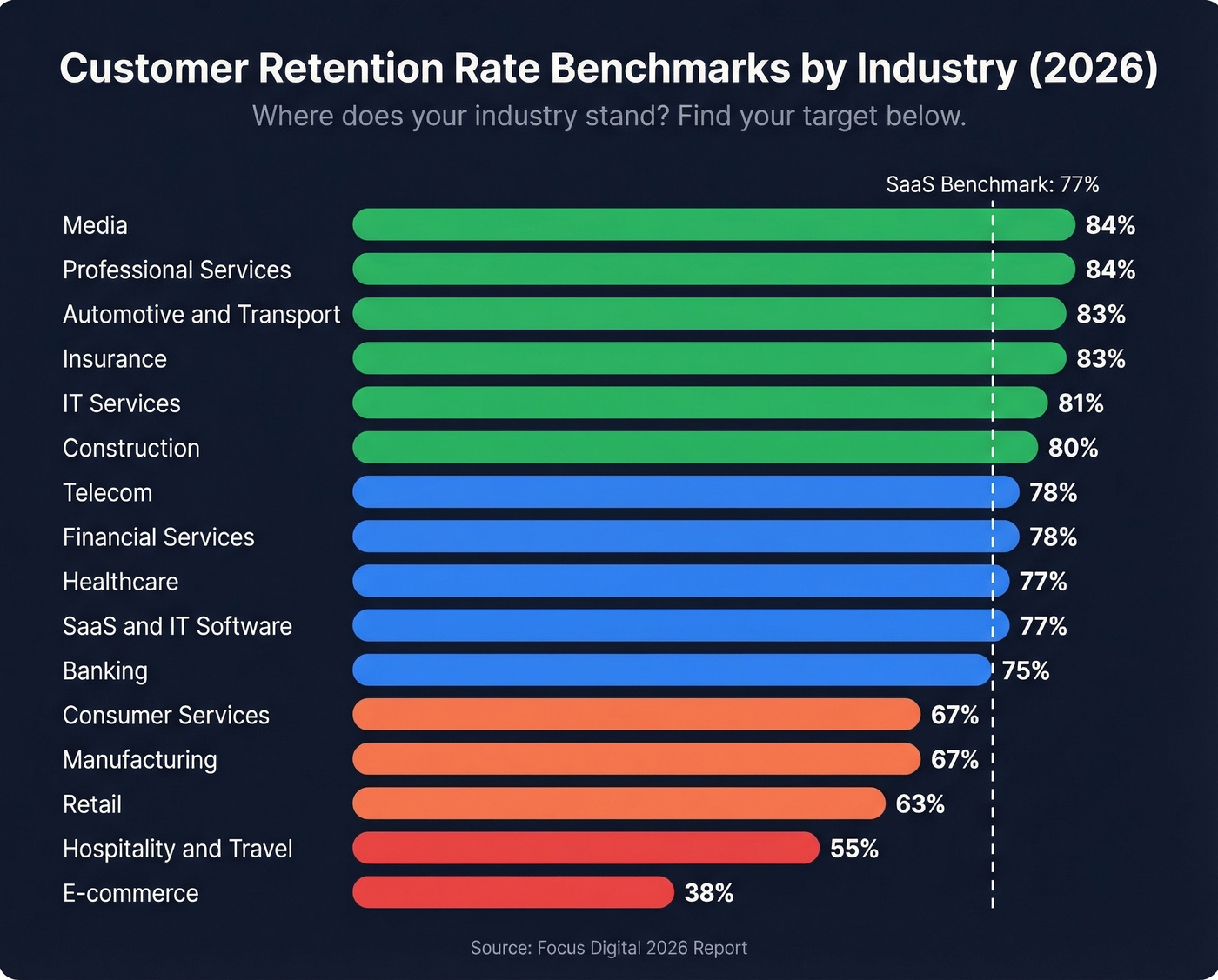
Customer Retention Rate by Industry (2026)
| Industry | CRR |
|---|---|
| Media | 84% |
| Professional Services | 84% |
| Automotive & Transport | 83% |
| Insurance | 83% |
| IT Services | 81% |
| Construction | 80% |
| Telecom | 78% |
| Financial Services | 78% |
| Healthcare | 77% |
| SaaS / IT & Software | 77% |
| Banking | 75% |
| Consumer Services | 67% |
| Manufacturing | 67% |
| Retail | 63% |
| Hospitality & Travel | 55% |
| E-commerce | 38% |
Source: Focus Digital 2026 report
Below 77% in SaaS? You're leaking revenue. Below 63% in retail? You're average - which in retail means you're losing to anyone who invests in post-purchase experience.
Retention by Business Model
| Model | Avg Retention | Median Lifetime |
|---|---|---|
| B2B SaaS Subscription | 90% | 5.2 years |
| Contractual Services | 86% | 4.1 years |
| Membership | 81% | 3.6 years |
| B2C Subscription | 72% | 2.8 years |
| Transactional E-commerce | 38% | 18 months |
| One-time Purchase | 24% | 11 months |
The business model matters more than the industry in many cases. A B2B SaaS company in healthcare has a fundamentally different retention profile than a healthcare staffing agency selling one-time placements.

When an AE leaves, their accounts enter a dead zone. The fastest way to recover is giving the next rep verified contact data for every stakeholder - instantly. Prospeo's 98% accurate emails and 125M+ verified mobiles mean new reps reach real buyers on day one, not week six.
Cut rep ramp time in half with data that connects on the first touch.
Why Sales Reps Actually Leave
Compensation gets blamed first, but it's rarely the full story. The real drivers are more structural - and more fixable. If you're trying to stabilize performance while reducing churn, treat this as a sales performance management problem, not a perks problem.
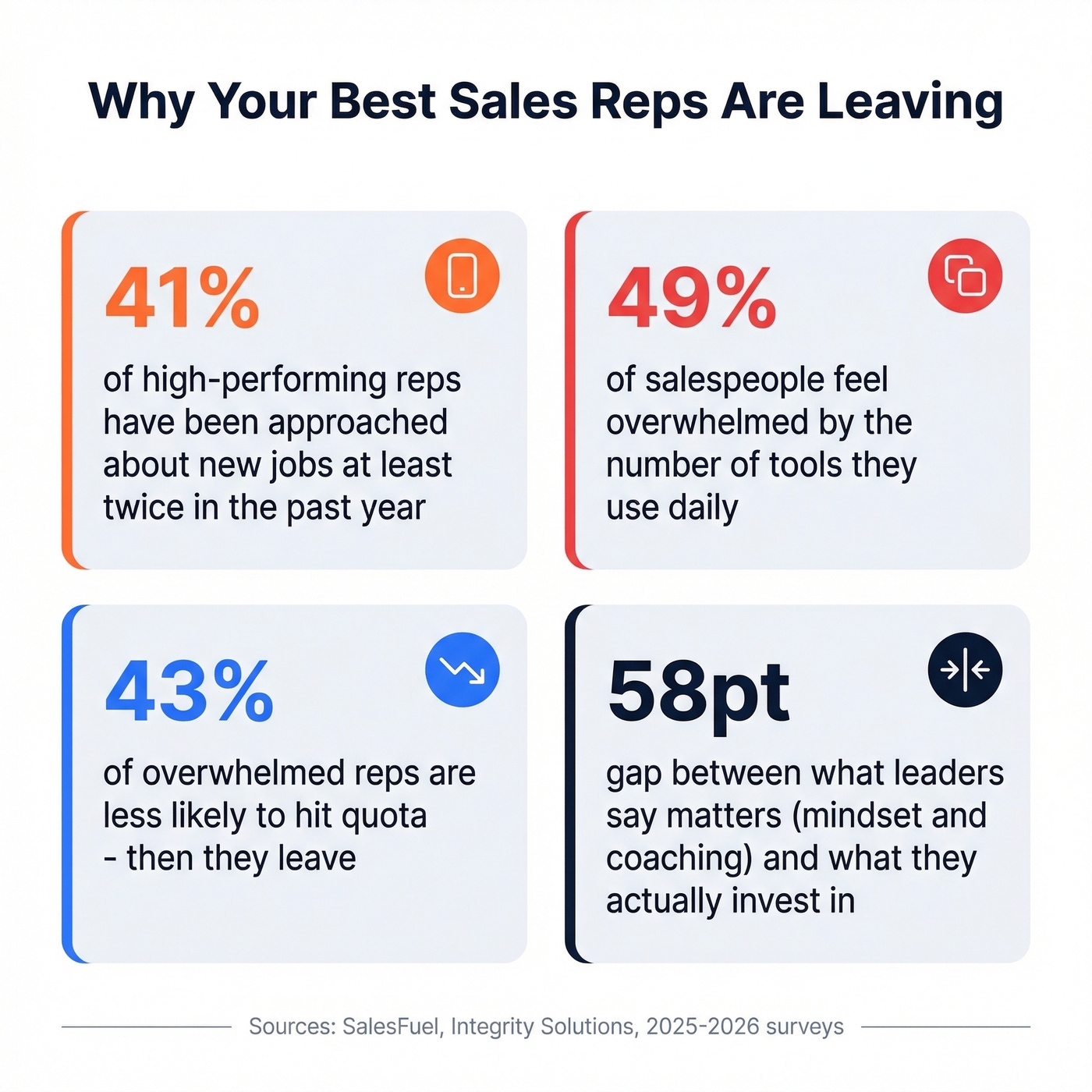
Poaching pressure is relentless. A SalesFuel survey found 41% of high-performing reps have been approached about changing jobs at least twice in the past year. All it takes is a 15% OTE bump to tempt them. Only 51% of top performers report having a clear path for advancement at their current company - a retention crisis hiding in plain sight.
Tech overload is crushing productivity. 49% of salespeople feel overwhelmed by the number of tools they're expected to use, and of those overwhelmed reps, 43% are less likely to meet quota. When reps miss quota, they leave. The tool stack you built to help them is actively pushing them out.
Recruiters hear the same story on repeat: quota increases 50%, territory gets redrawn, comp band changes after a leadership restructuring - all in the same quarter. Reps don't leave because the new plan is bad. They leave because they can't trust that the plan won't change again in six months. If you need a systems approach, start with sales leadership and rebuild trust from there.
The coaching gap compounds everything. 84% of sales leaders say mindset and values are at least as important as skills and product knowledge, yet only 26% rate their organization as effective at developing those factors. That's a 58-point gap between what leaders believe matters and what they actually invest in.
Retention Strategies Ranked by ROI
Not all retention initiatives are equal. We've ranked these seven by measured retention lift and time-to-impact, based on a 312-company cohort analysis.
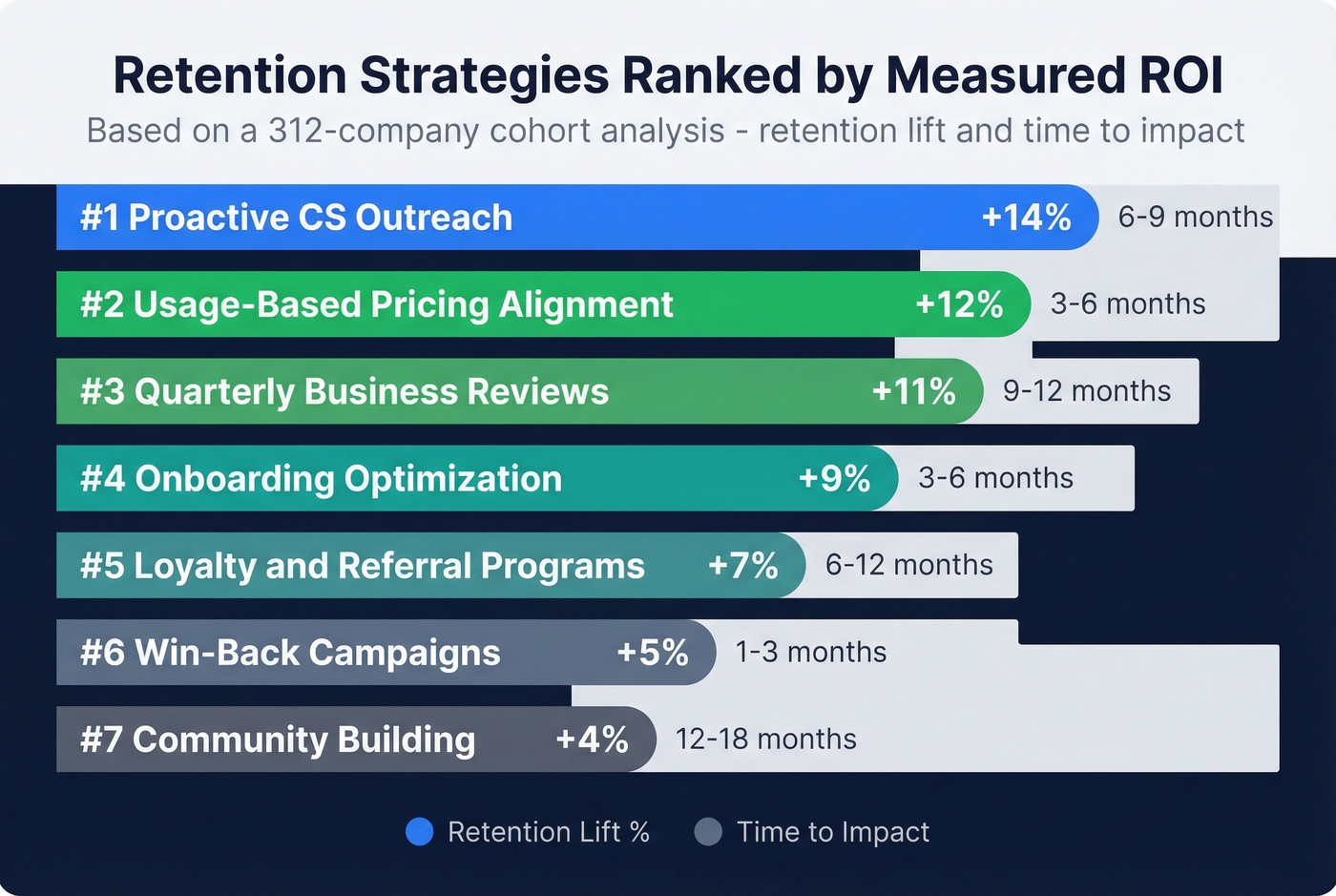
1. Proactive CS outreach (+14% lift, 6-9 months). This is the single highest-ROI lever available, and it's not close. Don't wait for the renewal conversation. Reach out when usage dips, when a champion changes roles, when a new stakeholder joins. The companies in the cohort that built systematic trigger-based outreach - not just "checking in" emails - saw the full 14% lift. The ones that did ad hoc outreach saw roughly half that. If you want to operationalize this, build it into your sequence management so it runs consistently.
2. Usage-based pricing alignment (+12%, 3-6 months). When customers pay for what they use, they don't resent the bill. Misaligned pricing is one of the fastest paths to churn because it creates resentment that compounds silently - the customer doesn't complain, they just don't renew. Aligning pricing to actual consumption eliminates that friction and often increases expansion revenue as a side effect.
3. Quarterly business reviews (+11%, 9-12 months). QBRs work because they force both sides to articulate value. The ROI takes longer to materialize, but the compounding effect is real. A QBR that surfaces a usage gap in month 3 prevents a churn conversation in month 11. The key is making them genuinely bilateral - not a slide deck your CSM reads aloud while the customer checks Slack. If your team needs structure, use a tighter agenda and QBR questions to ask.
4. Onboarding optimization (+10%, 3-6 months). A SaaS company that added a 3-day core-feature nudge sequence saw retention jump from 60% to 71%. First impressions aren't just for dating. For rep ramp, a formal 30-60-90 day plan for sales reps prevents early churn.
5. Loyalty programs (+8%, 6-12 months). More effective in B2C and transactional models. In B2B, the equivalent is preferential access - early features, dedicated support tiers, executive sponsorship.
| Strategy | Lift | Time to Impact | Best For |
|---|---|---|---|
| Multi-channel support | +7% | 3-6 months | High-touch accounts |
| Community building | +6% | 12-18 months | Product-led growth |
Multi-channel support and community building round out the list. Neither is flashy, but a media company that sent "new for you" alerts every 72 hours boosted monthly retention by 11%, proving that consistent, low-effort touchpoints add up.
Let's be honest: if your average deal size is under $15K, you probably don't need a dedicated CS platform. What you need is clean data and a disciplined outreach cadence. Most churn at the SMB level happens because nobody noticed the account was drifting - not because the product failed.
Build Churn-Risk Profiles
The strategies above work best when you know which accounts to target. Segment your customer base by industry, company size, contract value, and decision-maker tenure. Accounts where the original champion left, usage dropped below a threshold, or the company recently went through layoffs should trigger proactive outreach immediately - not at the next scheduled QBR. This is also where firmographic filters and consistent account scoring make the work repeatable.
None of these strategies work if your reps can't reach the right people. Contact data decays fast. Stakeholders change roles, get promoted, leave the company - and if your CRM doesn't reflect that, your proactive outreach bounces off stale records. Prospeo's 7-day data refresh cycle and 98% email accuracy keep reps connected to the right contacts in existing accounts, so when a new VP joins your customer's team, you know about it before the competitor does. If you're evaluating vendors, compare data enrichment services before you commit.
Common Retention Mistakes
Over-investing in acquisition while starving retention. If 65% of revenue comes from existing customers, the math doesn't work when retention is an afterthought. We've watched companies double their SDR headcount while their CS team stays at three people. The new pipeline looks great for two quarters, then the churn catches up.
Tracking vanity metrics instead of leading indicators. Email open rates and NPS scores feel good but are weak churn predictors on their own. Track NRR and 60-day repeat purchase rate instead - practitioners on r/ecommerce consistently flag the 60-day repeat rate as the metric that actually predicts long-term retention.
No ownership of the sales-to-CS handoff. The gap between "closed-won" and "first QBR" is where accounts go to die. Someone needs to own that transition explicitly - with a named owner, a defined timeline, and a checklist that both sides sign off on. If you need something copy-pasteable, start with a handoff email template.
Ignoring personalization. Customers are 90% more inclined to spend more with brands that personalize their experience. Generic renewal emails aren't a retention strategy. They're a churn accelerant. (If your team keeps defaulting to generic nudges, keep a set of sales follow-up templates on hand.)
Changing comp plans mid-year. Just as 63% of customers are likely to switch brands after a bad experience, reps respond similarly to broken trust. One mid-year comp plan change and they're fielding recruiter calls. The damage isn't the new plan itself - it's the signal that leadership doesn't have a stable strategy.
Tools That Support Retention
Retention isn't a single-tool problem, but the right stack makes the strategies above actually executable.
CRM: Salesforce or HubSpot for tracking customer health scores, rep activity, and renewal timelines. This is the foundation - everything else plugs into it. If you're standardizing your stack, it helps to align on examples of a CRM so teams stop talking past each other.
Data quality and enrichment: Stale CRM data is the silent killer of retention outreach. Prospeo keeps account data fresh with 300M+ profiles, 98% email accuracy, and CRM enrichment returning 50+ data points per contact. Free tier available, no contracts, integrates with Salesforce and HubSpot natively.
Compensation management: Stabilize comp plans with a dedicated platform. The category has matured - pick one that integrates with your CRM and finance stack.
Customer success platforms: For tracking health scores, usage analytics, and automated playbooks at scale. Skip this if you're managing fewer than 50 accounts - a well-maintained CRM and a shared spreadsheet will get you further than you'd expect.
Retention compounds when your team spends time selling, not hunting for valid contact info. At $0.01 per email with 92% match rates, Prospeo lets your reps focus on the relationships that drive NRR above 100% - not bounce-back cleanup from bad data providers.
Stop losing revenue to bad data. Fix your retention engine at the source.
FAQ
What's a good customer retention rate?
For B2B SaaS subscription models, 90%+ is the gold standard; the broader SaaS median sits at 77%. E-commerce averages just 38%, so benchmarks vary wildly by model. Track NRR alongside CRR - private SaaS companies run a median NRR of 102-104%, which reveals whether kept accounts are actually growing.
How do you calculate retention rate?
Customer retention rate: [(Customers at end - New customers) / Customers at start] x 100. Employee retention rate: (Headcount - Departures) / Headcount x 100. For revenue-level insight, use NRR: current-period MRR from existing customers divided by same-cohort MRR last period. NRR captures expansion and contraction, not just logo counts.
What's the fastest way to improve retention in sales?
Proactive customer success outreach delivers the highest measured lift - +14% within 6-9 months, per a 312-company cohort study. For rep retention, stabilize comp plans and invest in frontline manager coaching. Quick wins come from fixing broken basics: stale CRM data, missing handoff processes, and misaligned pricing.
Why do top sales reps leave?
41% of high-performing reps have been approached by recruiters at least twice in the past year, and only 51% see a clear advancement path at their current company. The top drivers are unstable comp plans, tech overload (49% feel overwhelmed by tools), and a coaching gap - 84% of leaders value mindset development, yet only 26% invest in it effectively.