

Revenue Team: What It Is, Why Most Fail, and How to Build One That Works
The CMO walks into the QBR with a deck showing 40% more MQLs than last quarter. The VP of Sales follows with a slide showing pipeline is actually down. Both are telling the truth. Both are using their own dashboards. And the CEO is wondering how two leaders sharing the same revenue number can't agree on what's happening.
This disconnect isn't a communication problem - it's a structural one. Misalignment between sales, marketing, and customer success costs businesses $1 trillion per year. The fix isn't another Slack channel or a monthly "alignment meeting." It's building a revenue team that actually operates as one unit.
The Short Version
- A revenue team is sales + marketing + CS aligned around shared KPIs, not just shared meetings.
- It's not the same as a RevOps team - RevOps is the operating layer underneath.
- Hire a RevOps Manager first, Data Analyst second.
- Fix compensation alignment before buying more tools.
- None of it works if your CRM data is garbage. Start with the data layer.
What Is a Revenue Team?
A revenue team is the cross-functional group - sales, marketing, and customer success - operating under shared metrics, shared accountability, and a shared view of the customer journey from first touch to renewal. It's not a weekly meeting where three department heads show their own dashboards and nod politely.
Most companies that claim they have one actually have three separate teams that occasionally sit in the same room. A real unified group is an operating system, not a calendar invite. It means shared KPIs that everyone's comp is tied to, a single source of truth in the CRM, and a handoff process where sales actually follows up with marketing-engaged prospects instead of letting them die in the gap.
If your marketing team can hit their number while sales misses theirs, you don't have alignment. You have three teams with a shared org chart.
Revenue Team vs. RevOps Team
These terms get used interchangeably, and that causes real confusion. They're different things that need each other.
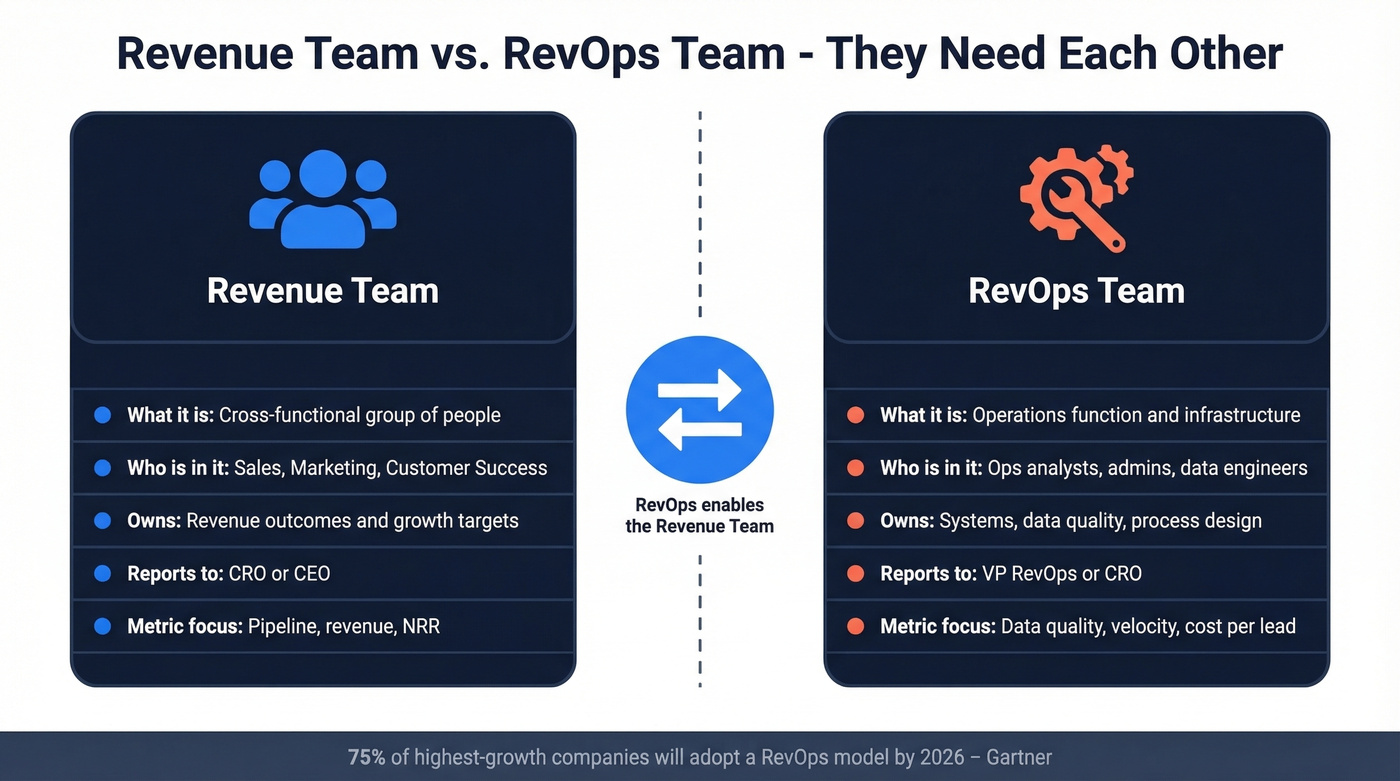
The revenue team is the alignment model - the cross-functional group of people working toward shared outcomes. RevOps is the operations function that enables it. Gartner defines RevOps as an end-to-end model unifying customer engagement across functions by integrating people, processes, and technology. RevOps builds the infrastructure. The team runs on it.
| Revenue Team | RevOps Team | |
|---|---|---|
| What it is | Cross-functional group | Operations function |
| Who's in it | Sales, Marketing, CS | Ops analysts, admins, data |
| Owns | Revenue outcomes | Systems, data, process |
| Reports to | CRO or CEO | VP RevOps or CRO |
| Metric focus | Pipeline, revenue, NRR | Data quality, velocity, cost |
Sales Ops teams now spend 68% of their time on non-sales functions - up from 39% in 2019 - which is exactly why the RevOps model emerged. By 2026, 75% of the highest-growth companies will have adopted a RevOps model. But adopting RevOps without building the cross-functional team around it is like installing a new engine in a car with no steering wheel.
Why Alignment Drives Growth
The business case isn't subtle. Forrester data shows aligned sales and marketing teams achieve 19% faster growth and 15% more profitability. Fullcast research puts aligned revenue operations at 12-15x faster growth, 34% more profitability, and up to 30% reduction in GTM expenses compared to siloed orgs.
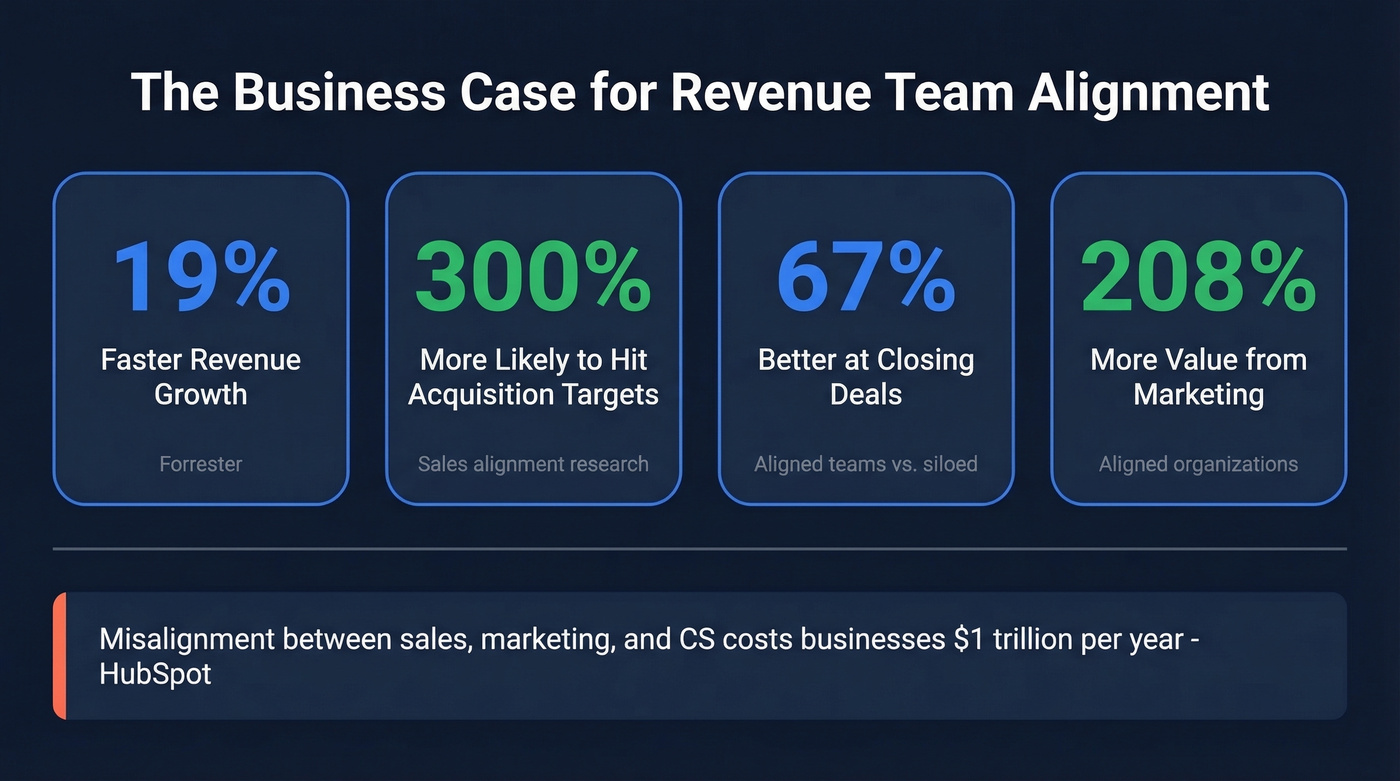
Sales organizations prioritizing alignment are roughly 300% more likely to exceed new customer acquisition targets. Aligned teams are 67% better at closing deals and generate 208% more value from marketing efforts.
Everyone knows alignment matters. The data has been clear for years. The reason most companies still don't have a functioning revenue team isn't ignorance - it's execution. They know what to build. They don't know how to build it without blowing up existing comp plans, reporting structures, and political territories.
You probably need to unify your GTM functions if: your sales and marketing teams argue about lead quality, your forecasts rely on spreadsheets, you're paying for redundant tools with no single source of truth, or customer handoffs feel like a game of telephone.
Key Roles and Structure
Core Roles
A revenue team isn't just the sales floor. Marketing and CS roles are equally core - they just get left off most org charts because the "revenue" label still feels like it belongs to sales alone.
| Role | Function | Primary KPI |
|---|---|---|
| BDR/SDR | Qualify inbound, create opps | SQLs generated |
| Sales Rep | Work deals to close | Closed-won revenue |
| Sales Engineer | Technical confidence | Win rate on deals involved |
| Account Manager | Expand existing accounts | Net revenue retention |
| CSM | Retention + adoption | Churn rate, NPS |
| Demand Gen | Drive qualified pipeline | MQL-to-SQL conversion |
| Marketing Ops | Attribution + tech stack | Data accuracy, speed to lead |
| Content/Brand | Awareness + education | Influenced pipeline |
Smaller orgs often combine the BDR and sales rep functions. CSMs own the post-sale relationship, and their metrics should feed directly into the shared dashboard - not live in a separate CS platform that nobody in sales ever checks.
Who to Hire First
If you're building RevOps from scratch, the sequence matters more than the titles.
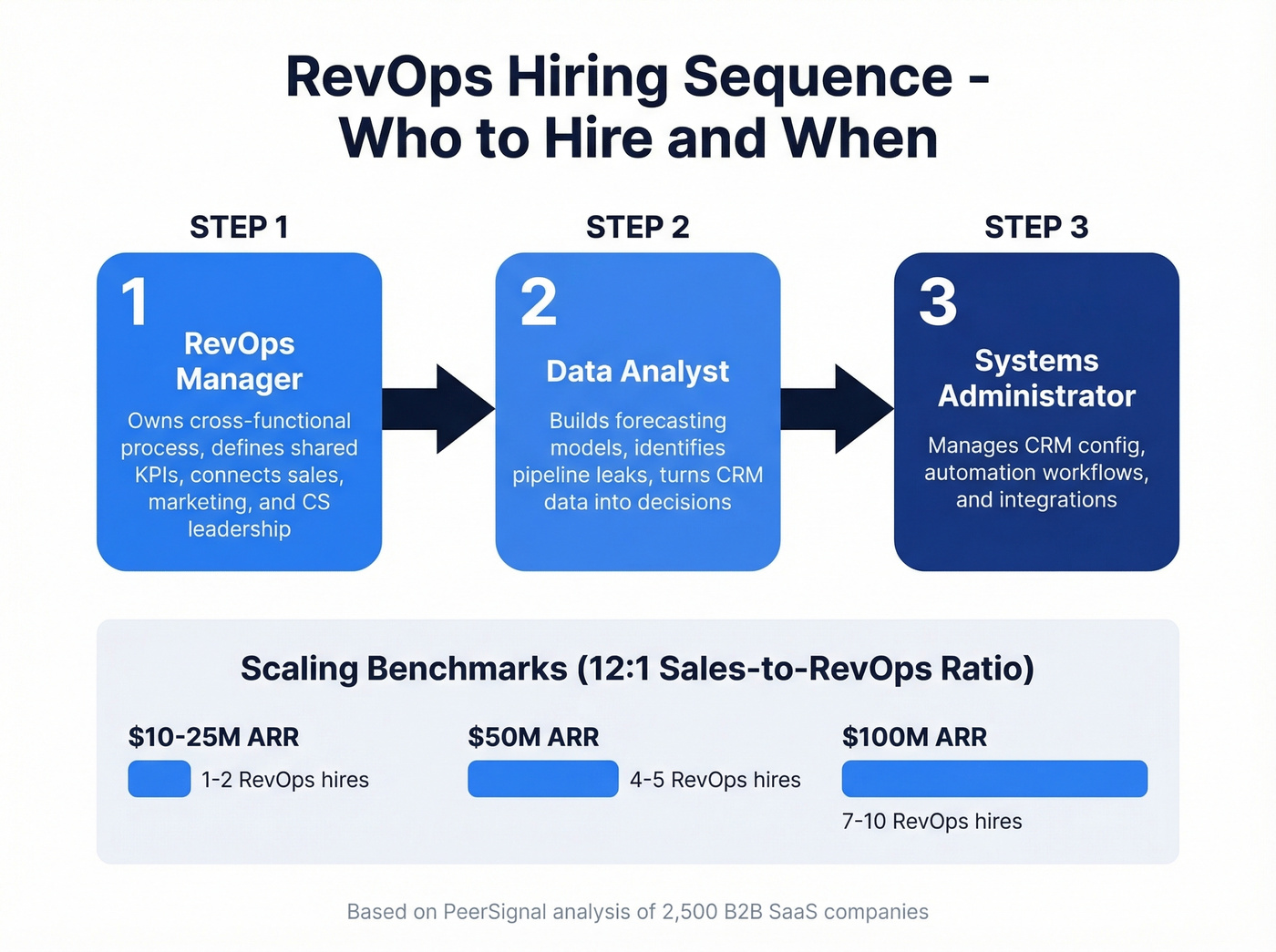
- RevOps Manager - owns the cross-functional process, defines shared KPIs, and serves as the connective tissue between sales, marketing, and CS leadership.
- Data Analyst - builds forecasting models, identifies pipeline leaks, and turns CRM data into decisions.
- Systems Administrator - manages CRM configuration, automation workflows, and integrations.
PeerSignal's analysis of 2,500 B2B SaaS companies shows a 12:1 sales-to-RevOps ratio. At $50M ARR with roughly 50 sales reps, plan for 4-5 RevOps hires. At $100M ARR, that scales to 7-10. Most early-stage companies can start with a single RevOps Manager working cross-functionally until budget supports a full department.

You just read that none of this works if your CRM data is garbage. Prospeo enriches your entire database with 98% verified emails, 125M+ mobile numbers, and 50+ data points per contact - refreshed every 7 days, not every 6 weeks. When sales, marketing, and CS share one source of truth, alignment stops being a slide deck and starts being a growth engine.
Give your revenue team the single source of truth it actually needs.
The Operating System
A revenue team without a shared measurement framework is just a reorg with a press release. The operating system lives in two layers: shared KPIs and a non-negotiable cadence.
Shared KPIs every aligned GTM org should track:
- Lead-to-Opportunity conversion rate
- Speed to Lead (time from form fill to first sales touch)
- Opportunity-to-Close rate
- Net Revenue Retention (expansion + churn)
- Attribution accuracy (can you trace revenue back to source?)
Every one of these metrics should live natively in your CRM. If it's not in the CRM, it didn't happen. The moment you start pulling attribution from a separate spreadsheet or a marketing-only dashboard, you've created two versions of reality - and that's exactly how the CMO and VP of Sales end up contradicting each other in the QBR.
High-performing teams also treat content production as a shared function. Sales contributes call insights and live customer objections directly into the content calendar, so marketing isn't guessing what resonates - they're working from real deal intelligence (and tightening sales execution at the same time).
Research from CRO interviews shows 53% of high-performing CROs emphasize a dual operating rhythm: weekly tactical reviews for pipeline health and handoff quality, plus quarterly strategic sessions for ICP refinement and comp adjustments. The weekly meeting isn't optional. It's where a coordinated group catches a broken handoff before it costs you a quarter.
The Compensation Problem
Here's the uncomfortable truth: if marketing is bonused on MQLs and sales is bonused on closed-won revenue, you don't have a unified GTM function. You have two teams optimizing for different numbers that happen to share a conference room.
Compensation alignment is the hardest part of building this model because it requires leaders to give up local optimization. The four golden rules from comp design research:
- Incentivize activities that match strategy
- Keep plans simple enough for reps to calculate their own payout
- Ensure alignment across teams - shared pipeline metrics, not siloed quotas
- Adapt comp when strategy shifts - don't wait for annual planning
Set quotas where 75-85% of reps hit target. Fewer than 75% hitting means your quotas are unrealistic; more than 85% means you're leaving money on the table. And watch the growing trend of spreading variable comp to SDRs, CSMs, and demand gen roles (including how you define OTE in Sales). If you want these functions to care about revenue, pay them like they belong at the table.
Let's be honest: most revenue team initiatives fail not because of tooling or org design, but because the CFO won't touch the comp plan. If your average deal size is under $30k and your marketing team is still bonused purely on MQLs, skip the rebrand and fix compensation first. Everything else is theater until the incentives align.
Why Most Revenue Teams Fail
We've seen teams invest six months in an alignment initiative and end up right where they started. The failure patterns are predictable.
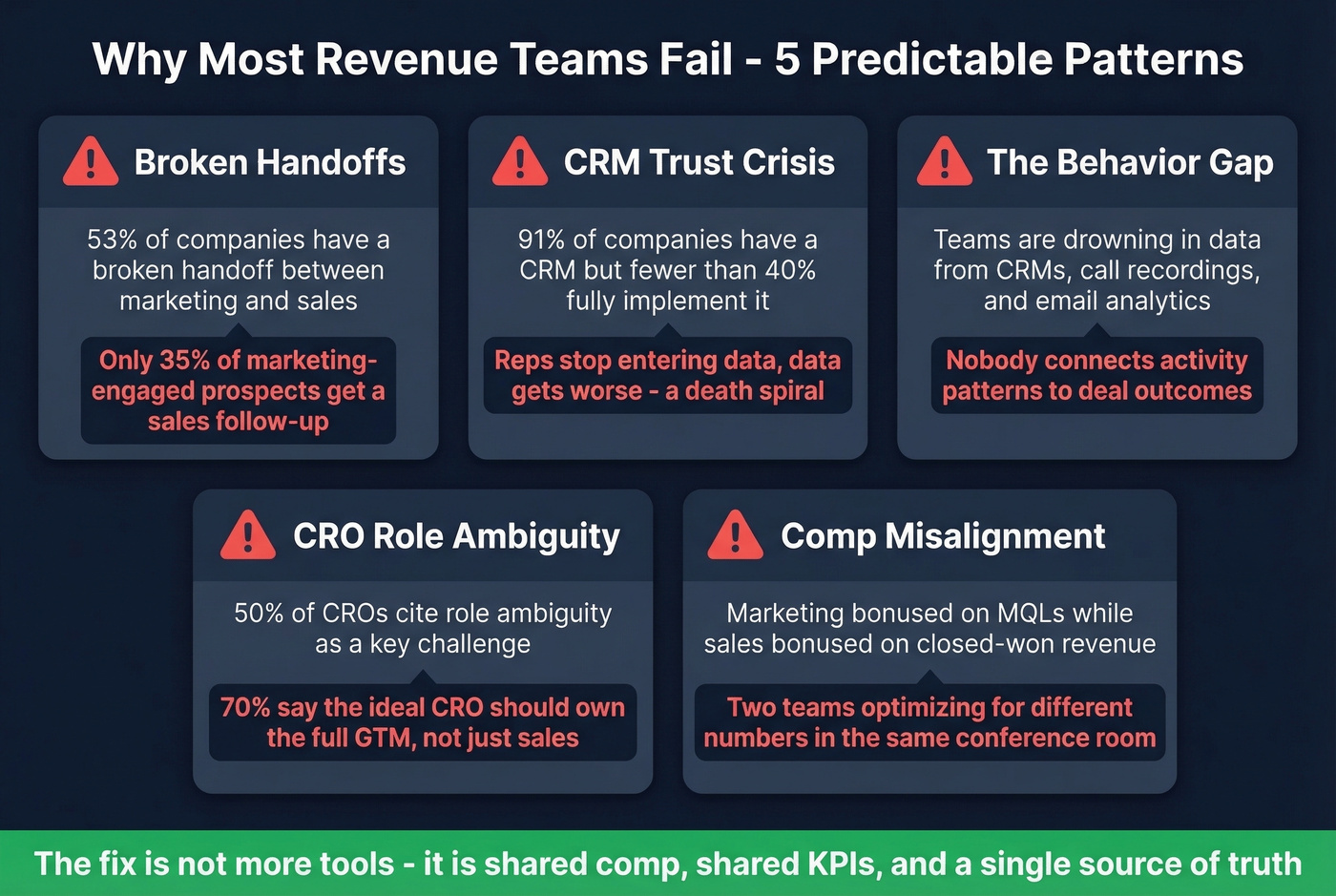
Broken handoffs. An Influ2 study of 105 companies found that 53% have a broken handoff - sales follows up with fewer than 35% of marketing-engaged prospects. Only 11% achieved both effective handoffs and high audience overlap. The other 89% are leaking pipeline at the seam (often because there’s no documented lead generation workflow).
CRM trust crisis. CRM adoption sits at roughly 91% for companies with 11+ employees, but fewer than 40% fully implement their CRM for reliable data flow. When reps don't trust the data, they stop entering it. When they stop entering it, the data gets worse. It's a death spiral, and we've watched it play out at companies of every size (especially when teams ignore basic sales operations metrics).
The behavior gap. As one r/b2bmarketing poster put it: "We keep adding tools and training but win rates aren't improving." The gap isn't knowledge - it's behavior. Orgs are drowning in data from CRMs, call recordings, and email analytics, but nobody's connecting the dots between activity patterns and deal outcomes (which is exactly what data-driven selling is supposed to solve).
CRO role ambiguity. Half of CROs surveyed by the Revenue Operations Alliance cite role ambiguity as a key challenge. They're hired as "Chief Revenue Officer" but scoped as a glorified VP of Sales. Meanwhile, 70% describe the ideal CRO as owning revenue across the full GTM. If your CRO only owns sales, the title change won't fix alignment.
Marketing-sales trust deficit. The r/techsales perspective is blunt: sales teams feel marketing focuses on brand and content without demonstrating near-term revenue impact. That trust gap doesn't close with a shared Slack channel. It closes with shared comp, shared KPIs, and a CRO who holds both sides accountable (and a clear pipeline health view everyone agrees on).
The Data Foundation
A revenue team without clean data is just a meeting with a fancy name. Every shared KPI, every handoff metric, every forecast - they all depend on the data underneath being accurate, fresh, and complete.
This is where most alignment initiatives quietly die. Marketing says the lead was qualified. Sales calls the number and it's disconnected. The AE marks it as "bad lead." Marketing disputes it. The cycle repeats until nobody trusts the system. In our experience, this single failure mode kills more alignment efforts than any org chart debate.
Prospeo keeps CRM records current with 98% email accuracy, a 7-day data refresh cycle, and 50+ data points per enrichment. Snyk's team of 50 AEs saw bounce rates drop from 35-40% to under 5%, and AE-sourced pipeline jumped 180% once reps could actually reach the contacts in their CRM (the same reason teams invest in lead enrichment and ongoing churn analysis).

Hiring a RevOps Manager and Data Analyst won't matter if they're working with stale contacts and bounced emails. Prospeo's 92% enrichment match rate and 30+ search filters - including buyer intent, technographics, and headcount growth - give your new revenue team the data foundation the article just told you to build. At $0.01 per email, it costs less than one misrouted lead.
Stop building your revenue team on a broken data layer.
Tools That Power Alignment
You don't need 15 tools. You need 3-4 that talk to each other and feed a single CRM.
| Category | Recommended Tool | Approx. Pricing |
|---|---|---|
| CRM | Salesforce / HubSpot | ~$25-$500+/user/mo depending on edition |
| Data Platform | Prospeo | ~$0.01/email, free tier available |
| Revenue Intelligence | Gong / Clari | ~$100-$200+/user/mo (annual contracts) |
| Outbound Sequencing | Outreach / Salesloft | ~$100-$200+/user/mo (annual contracts) |
The biggest mistake we see is teams buying a revenue intelligence tool before fixing their data layer. Gong can't tell you why deals stall if the contacts in those deals have wrong titles and disconnected phone numbers. Start with the data. Everything else builds on top.
Skip the revenue intelligence purchase if your CRM has fewer than 10,000 contacts or your team is under 10 reps - the ROI won't be there yet. Focus on CRM hygiene and a solid enrichment workflow first (or benchmark options in data enrichment services).
FAQ
What's the difference between a revenue team and a sales team?
A sales team focuses on closing deals. A revenue team aligns sales, marketing, and CS around shared KPIs for the full customer journey - from first touch to renewal - with shared comp and a single accountable leader like a CRO.
How big should a RevOps team be?
PeerSignal data shows a 12:1 sales-to-RevOps ratio in B2B SaaS. At $50M ARR, plan for 4-5 RevOps hires; at $100M ARR, scale to 7-10. Start with one RevOps Manager working cross-functionally.
What KPIs should a revenue team track?
Lead-to-Opportunity conversion, Speed to Lead, Opportunity-to-C-Close rate, Net Revenue Retention, and Attribution accuracy. Every metric should live natively in your CRM - not in a side spreadsheet.
Do I need a CRO to build a revenue team?
Not at early stages, but you need one leader accountable for the full GTM motion. 70% of CROs surveyed say the ideal scope includes sales, marketing, CS, RevOps, and partnerships - not just closing.
How do I fix bad CRM data before aligning my GTM teams?
Use a data enrichment platform with automatic refresh and email verification. A 7-day refresh cycle and 98% email accuracy eliminate the "bad lead" disputes that erode marketing-sales trust - the prerequisite for every shared KPI you'll track.