

SaaS Appointment Setting Playbook: Real Numbers, Templates, and Results
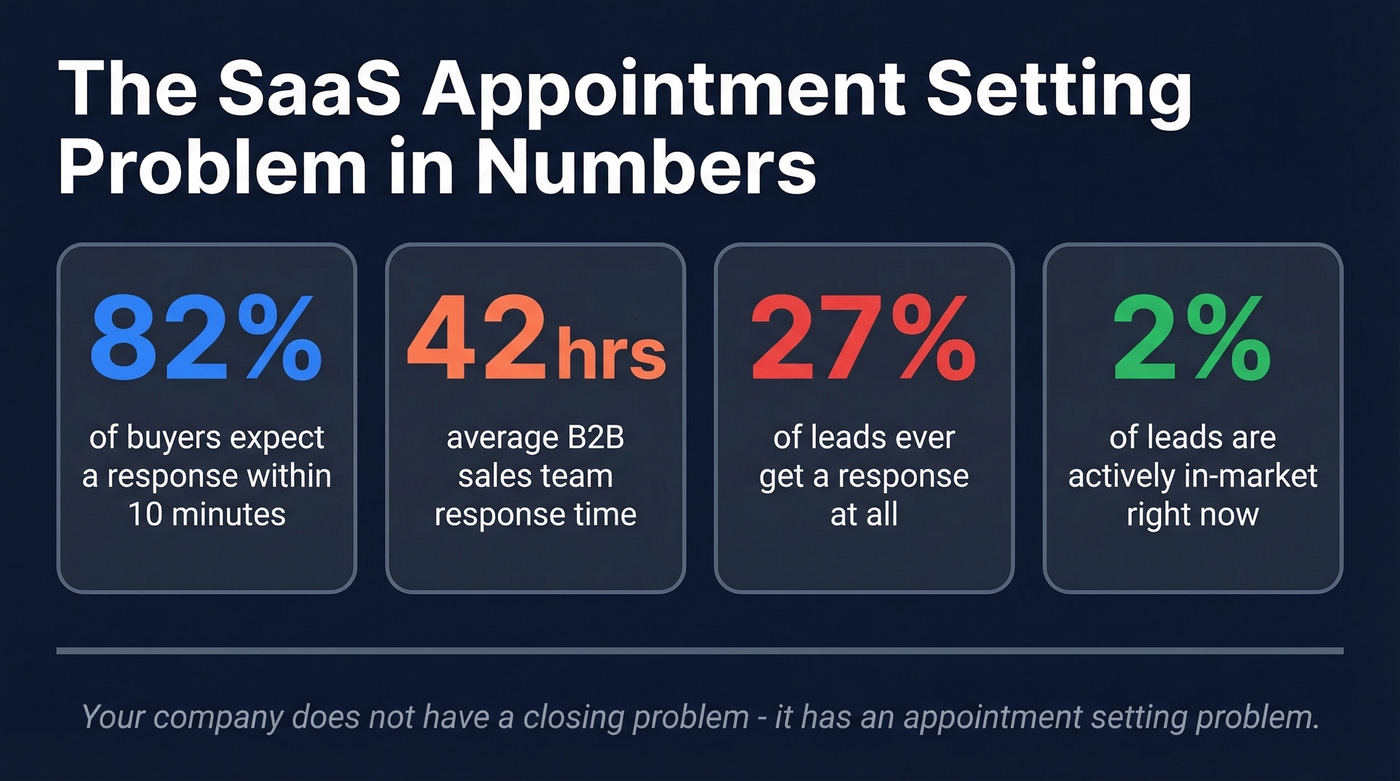
82% of buyers expect a response within 10 minutes. Most B2B sales teams take 42 hours to reply. Only 27% of leads ever hear back at all. Your SaaS company doesn't have a closing problem - it has an appointment setting problem. Everything downstream from that first booked demo depends on whether you can get the right person on a call before they've already ranked you behind two competitors.
We hear the same story from SaaS founders constantly: reps drowning in follow-ups while leads go cold after three days, budgets bleeding into tools that don't talk to each other, and bounce rates so high they're torching domain reputation. This playbook fixes all of it.
The Short Version
- Your meeting problem isn't messaging - it's targeting and data quality. The best cold email in the world bounces off a bad address.
- Build a micro-specific ICP using funding stage, tech stack signals, and hiring patterns. "Mid-market SaaS" isn't an ICP - it's a category. (If you need a starting point, use an ICP scoring rubric.)
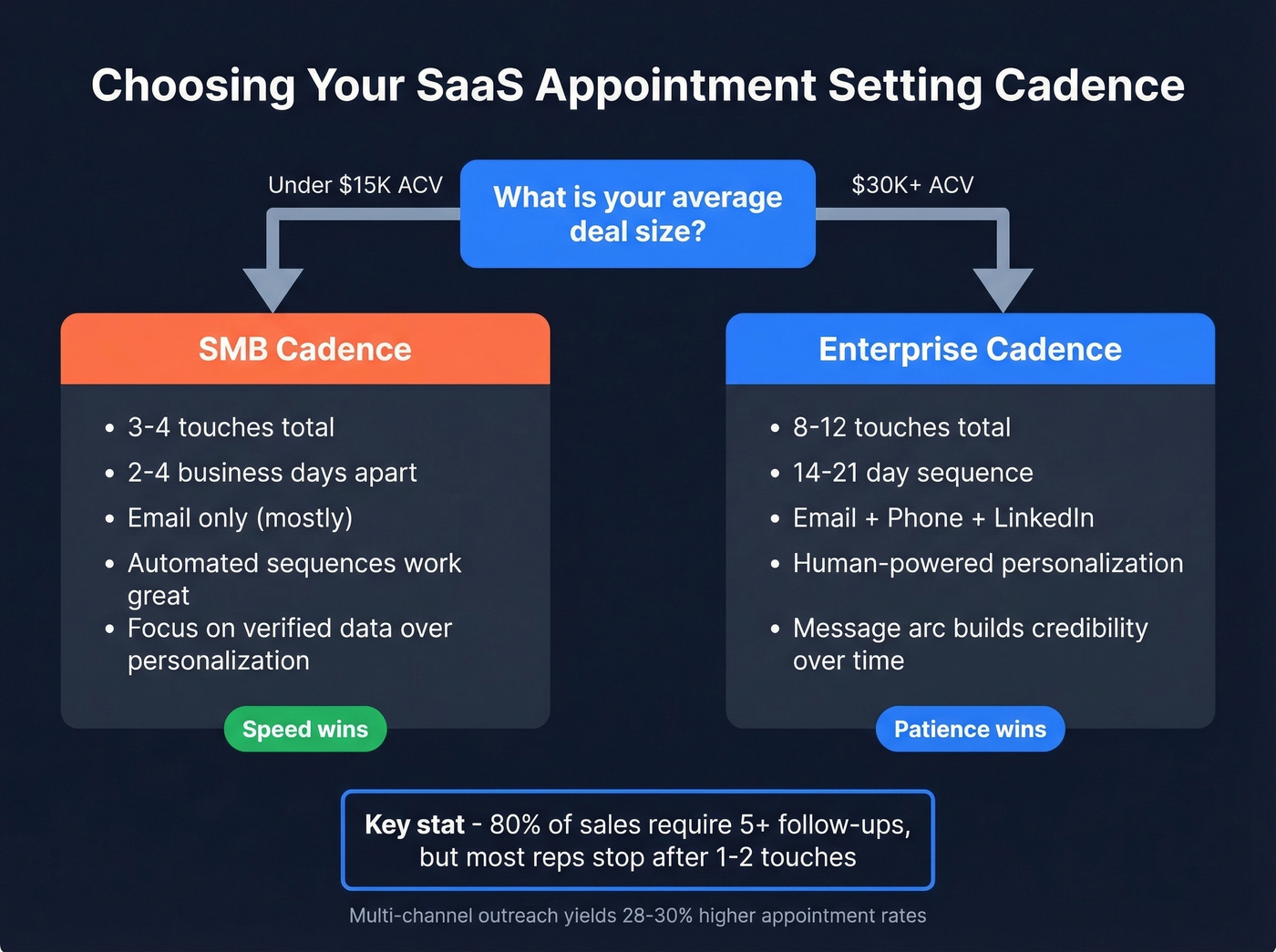
- Run 8-12 touches across email, phone, and social over 14-21 days for enterprise deals. For SMB, 3-4 touches spaced 2-4 business days apart.
- Fix your data first. If bounce rates exceed 5%, no cadence will save you. (Use email bounce rate benchmarks to diagnose the root cause.)
- Under $5M ARR? Outsource appointment setting at $150-400 per meeting. Above that, build in-house or run a hybrid model.
Why SaaS Demos Are Harder to Book
Buyers spend just 17% of the buying journey interacting with vendors. The rest is independent research - G2 reviews, pricing pages, peer conversations. 83% prefer to do their own homework before speaking to sales, and 94% of buying groups have already ranked their preferred vendors before they ever agree to a demo.
Your outreach isn't about getting a meeting. It's about getting into the consideration set before the meeting happens. The average buying group involves 6-10 stakeholders, each consuming 4-6 pieces of content before championing your product internally - and collectively, that group consumes 13 pieces of content before talking to sales.
Then layer on the SaaS-specific friction: intangible products that resist cold-email demos, highly technical buyers who see through generic pitches, and sales cycles stretching 12-18 months in regulated industries. This is what separates technology B2B appointment setting from simpler transactional outreach. The complexity of the buying committee and the length of the evaluation cycle demand a fundamentally different approach.
Just 2% of leads are actively in-market at any given time. Your job is to find those 2% and reach them with the right message at the right moment.
Define Your ICP With Micro-Specificity
Most SaaS teams define their ICP too broadly. "Series A to Series C companies with 50-500 employees in North America" covers tens of thousands of companies, most of which will never buy from you.
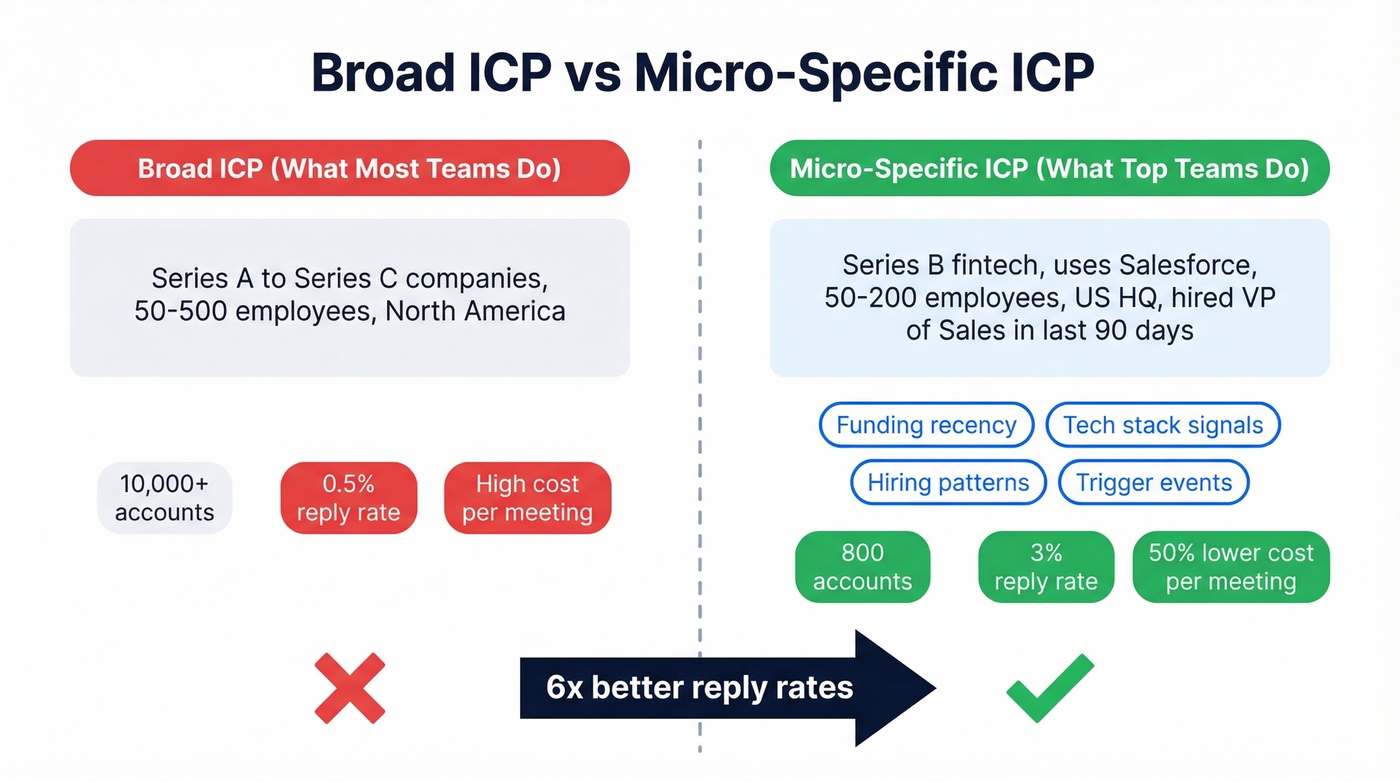
Micro-specific ICPs look like this: "Series B fintech companies using Salesforce, 50-200 employees, headquartered in the US, that hired a VP of Sales in the last 90 days." That's a company actively investing in revenue infrastructure - with budget, urgency, and a decision-maker who needs to prove ROI fast.
The signals that matter for micro-targeting:
- Funding stage and recency - a company that closed a Series B three months ago is spending money right now
- Tech stack indicators - Salesforce, HubSpot, Snowflake, or AWS usage reveals sophistication and budget (this is where firmographic and technographic data pays off)
- Hiring signals - new VP of Sales, Head of RevOps, or SDR Manager postings signal pipeline investment
- Trigger events - acquisitions, product launches, leadership changes, office expansions (build a system for identifying buying signals)
We've seen teams cut their cost-per-meeting in half by narrowing their target list from 10,000 accounts to 800. That's not a rounding error. It's the difference between 0.5% and 3% reply rates.
Layer Intent Data Into Targeting
Micro-ICP targeting tells you who to reach. Intent data tells you when. The B2B intent data market hit $4.49 billion in 2026, and 91% of B2B marketers now use some form of intent signal in their outreach.
Here's the uncomfortable truth: only 24% report exceptional ROI from intent data. The gap isn't the data itself - it's how teams use it. Buying a Bombora feed and dumping it into a spreadsheet doesn't move pipeline. Layering intent signals on top of micro-ICP targeting does. Teams that combine firmographic fit with active buying signals see 47% better conversion rates and 43% larger deal sizes.
The signals worth tracking: G2 category visits, competitor comparison searches, problem-related keyword spikes, content downloads on relevant topics, and job posting patterns that indicate technology evaluation. (If you want a practical framework, use intent based segmentation.)
Build Your Multi-Channel Cadence
Email alone rarely books enterprise demos. 80% of sales require 5+ follow-ups, yet most reps stop after one or two touches. Multi-channel outreach - email, phone, and social combined - yields roughly 28-30% higher appointment rates than single-channel sequences.
LinkedIn deserves special attention. It generates 4x more connections with Director+ decision-makers than other social channels, making it the highest-leverage social touch in any B2B cadence. Don't just connect - engage with their content before your first email lands.
Here's the thing: if your deal size sits below $10K, you probably don't need a 12-touch enterprise cadence. Three sharp emails with verified data will outperform a bloated sequence built on bad contact info every single time. (For more ideas, pull from proven sales prospecting techniques.)
High-ACV Cadence ($30K+)
Eight to twelve touches over 14-21 days. These buyers have committees, procurement processes, and competing priorities. Demo booking at this level demands patience, personalization, and a message arc that builds credibility with every touch.
| Day | Channel | Purpose |
|---|---|---|
| 1 | Intro value prop - pain-first, no pitch | |
| 2 | Social | Connect + engage with their content |
| 4 | Phone | Warm call referencing email |
| 6 | Educational insight or resource | |
| 9 | Phone | Follow-up, leave voicemail |
| 11 | Case study / social proof | |
| 14 | Social | Share relevant content directly |
| 16 | Direct meeting request | |
| 19 | Phone | Final attempt |
| 21 | Breakup - "closing the file" |
The message arc matters: intro value prop, then educational insight, then social proof, then direct ask, then breakup. Each touch adds value rather than just asking again.
Lower-ACV Cadence (Under $15K)
A 3-4 touch sequence spaced 2-4 business days apart. SMB buyers make faster decisions with fewer stakeholders.
| Day | Channel | Purpose |
|---|---|---|
| 1 | Value prop + specific pain | |
| 3 | Social proof or quick case study | |
| 6 | Direct ask with calendar link | |
| 10 | Breakup |
One stat worth memorizing: calling within 1 minute of a lead's engagement boosts conversions by 391%. Speed matters more than polish. For complex enterprise deals, human-powered outreach still beats full automation - but for high-volume SMB, automated sequences with verified data get you most of the way there at a fraction of the cost.

You just read that bounce rates above 5% will kill any cadence. Prospeo's 5-step email verification delivers 98% accuracy - and our 7-day data refresh means the contacts you pull today are still valid next week. Teams using Prospeo book 35% more meetings than Apollo users.
Stop burning sequences on bad data. Start booking demos that actually happen.
Email Templates That Book Demos
Templates are starting points, not scripts. Adapt these to your product, ICP, and the specific signal that triggered the outreach.
Template 1: Value-First (Cold)
Subject: {pain point} at {company}
Hi {first name},
{Company} is scaling {department/function} - which usually means {specific pain point}. We helped {similar company} cut {metric} by {result} in {timeframe}.
Worth a 15-minute call to see if we can do the same?
Template 2: Social Proof
Subject: How {similar company} solved {problem}
Hi {first name},
{Similar company} was dealing with {problem}. After switching to {your product}, they saw {specific result}. I think {company} could see similar results. Open to a quick demo this week?
Template 3: Trigger-Based
Subject: Congrats on the {Series X / new hire / launch}
Hi {first name},
Saw {company} just {raised Series B / hired a VP of Sales / expanded into EMEA}. Teams at that stage usually hit {specific challenge} fast. We built {product} for exactly that moment. Can I show you in 15 minutes?
Template 4: Breakup
Subject: Closing the loop
Hi {first name},
I've reached out a few times and haven't heard back - totally understand. I'll close this thread, but if {pain point} becomes a priority, here's my calendar: {link}.
The breakup email often outperforms other touches in the sequence. Something about "I'm going away" triggers a response. We've tested this across dozens of campaigns and it's remarkably consistent.
The Data Quality Problem Nobody Talks About
Let's be honest about what actually happens. Your rep sends 200 emails on Monday. A chunk bounces. A chunk lands in spam. A few people reply. One says "wrong person." That's how you end up with a tiny useful response rate - and a domain reputation hit that lingers for weeks.
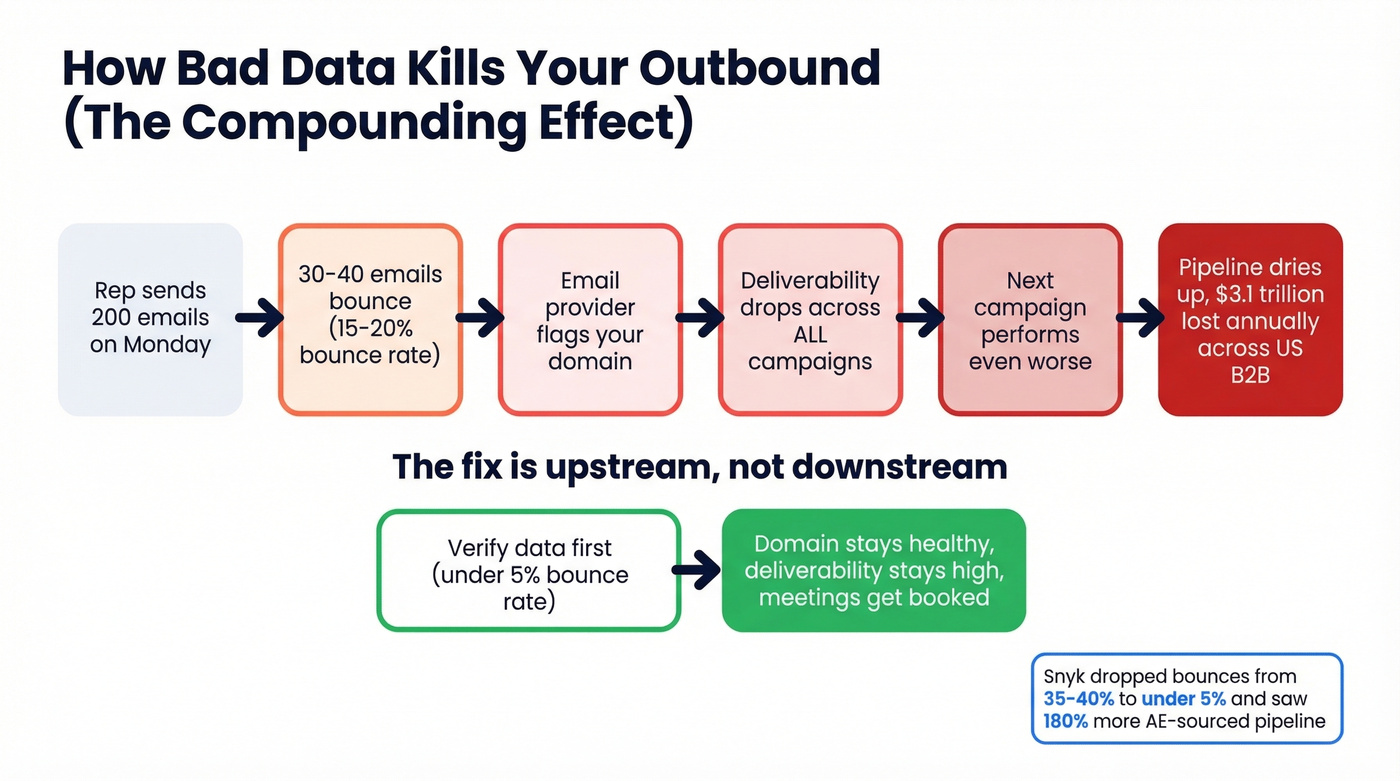
Invalid data costs U.S. B2B businesses $3.1 trillion annually. Bounce rates above 5% don't just waste rep time - they destroy domain reputation, tank deliverability across your entire org, and make every subsequent campaign worse. It's a compounding problem, and it's infuriating to watch teams pour money into sequencing tools while ignoring the garbage data feeding them. (If you need a remediation checklist, start with an email deliverability guide.)
Snyk's team of 50 AEs was running bounce rates of 35-40%. After switching their data provider, bounces dropped below 5%, AE-sourced pipeline jumped 180%, and the team now generates 200+ new opportunities per month. Across our customer base, teams using Prospeo book 26% more meetings than those on ZoomInfo and 35% more than Apollo users.
The Right Tech Stack
The average SDR team uses 12-15 tools, running $2,000-$5,000 per SDR per month in total stack cost. Here's what a modern stack looks like:
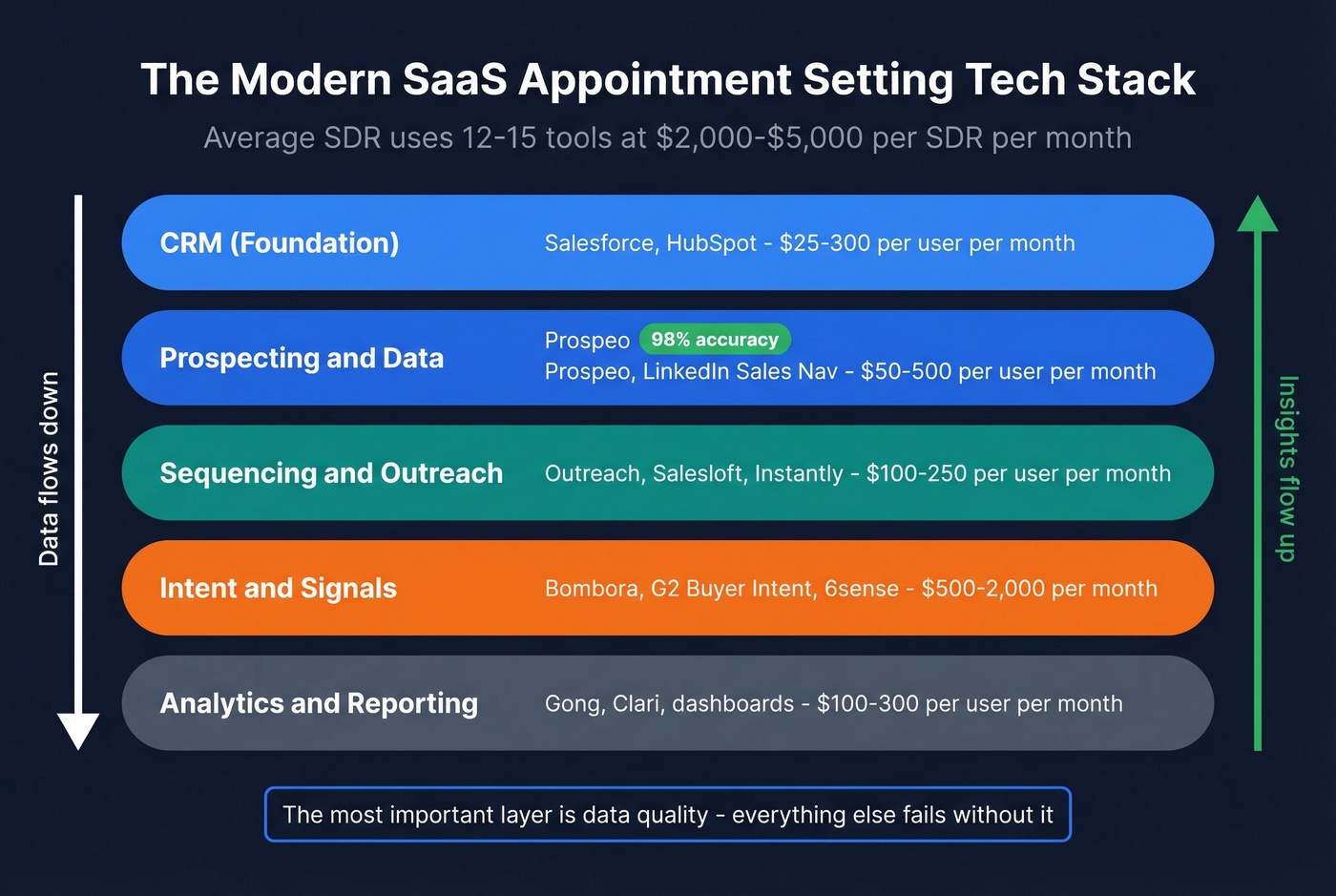
| Category | Tools | Cost Range |
|---|---|---|
| CRM | Salesforce, HubSpot | $25-300/user/mo |
| Prospecting/Data | Prospeo, Apollo, ZoomInfo | $0.01/email to $15K-50K/yr |
| Social Selling | LinkedIn Sales Navigator | $80-140/user/mo |
| Sales Engagement | Outreach, Instantly | $30-150/user/mo |
| Dialer | Orum, Nooks | $200-350/user/mo |
| Scheduling / Routing | Calendly, Chili Piper, LeadAngel | $10-2,042/mo |
| Intent/Signals | Bombora, 6sense | $500-5,000/mo |
| Conversation Intel | Gong, Chorus | $100-200/user/mo |
AI-assisted sequencing tools are gaining traction fast - platforms like Instantly and Outreach now offer AI-generated email variants, send-time optimization, and auto-prioritization of engaged leads. They won't replace human judgment on complex enterprise deals, but they can cut busywork on high-volume SMB campaigns dramatically. (If you're evaluating options, compare SDR tools by workflow fit.)
Skip the full eight-category stack on day one. Start with CRM, prospecting data, and a sequencer. Add dialer and intent data once your cadences are converting consistently.
In-House vs. Outsourced: Real Numbers
This is the decision that trips up most SaaS founders. The consensus on r/sales leans toward outsourcing early and building internally once you've validated your ICP and messaging - and the numbers back that up.
| Metric | In-House | Outsourced |
|---|---|---|
| Setup cost | ~$178,770 (4 reps + mgr) | ~$41,000 |
| Monthly cost | $20,000-30,000 | $6,000-15,000 |
| Cost per lead | $250-800 | $150-600 |
| 6-month total | ~$117,490 | ~$47,500 |
| Time to results | 4-6 months | 30-60 days |
| Long-term control | Full ownership | Limited |
| Institutional knowledge | Compounds over time | Stays with agency |
In-house SDR salaries run $90-110K/year plus roughly $31K in onboarding costs. Recruiting takes about 42 days, followed by 30-90 days of ramp. If someone leaves, replacing them costs up to 150% of their salary. (To structure ramp, use a 30-60-90 day plan.)
Outsourced appointment setting delivers results at roughly 60% lower cost with a 30-60 day time-to-results window. The tradeoff is less control over messaging and less institutional knowledge building. For startups that need pipeline now without the overhead of a full SDR team, outsourcing is often the fastest path.
The Hybrid Play
The smartest teams don't pick one or the other. Three hybrid models that work:
Launch outsourced, transition internal. Use an agency to validate messaging and ICP fit in the first 90 days, then hire reps who inherit a proven playbook.
Outsource top-of-funnel, internalize qualification. Let the agency generate raw meetings while your team handles discovery and complex qualification. This is our favorite model for teams between $3M and $8M ARR - it keeps your senior reps focused on deals that matter while maintaining steady pipeline flow.
Geographic split. Internal team covers your core market; outsourced team tests new regions or verticals.
Under $5M ARR with urgency to fill pipeline? Outsource. The per-meeting cost of $150-400 is predictable and manageable. Building a sales engine for the next 12+ months? Hire internally. The upfront investment is higher, but you'll own the process, the data, and the institutional knowledge.
KPIs and Benchmarks
Track these metrics weekly. If you're not measuring, you're guessing.
| Metric | Target | Average |
|---|---|---|
| Call-to-conversation | 10%+ | 5-10% |
| Response rate | 30%+ | Varies by channel |
| Appointment to SQL | 20%+ | 15-25% |
| Show rate | 70-90% | 60-75% without reminders |
| Meetings/SDR/month | 10-30 | Depends on ACV |
| Follow-up within 24hrs | 100% | Hard rule |
Enterprise-focused reps targeting $50K+ ACV will book fewer meetings - 10-15 per month - but each carries significantly more pipeline value. SMB-focused reps should aim for 20-30. The average successful cold call lasts 5 minutes and 50 seconds, so coach reps on keeping conversations substantive but efficient. One well-qualified enterprise demo is worth more than ten unqualified SMB calls. (To tighten measurement, align on funnel metrics definitions.)
Mistakes Killing Your Pipeline
After working with dozens of SaaS teams on their outbound motion, we see the same seven mistakes over and over.
Poor targeting wastes rep cycles. The fix is micro-ICP targeting with intent signals layered on top. Pitching features too early kills cold emails before they get read - lead with the pain you solve, not the product you sell. Stopping after 1-2 follow-ups ignores the reality that 80% of sales require 5+ touches. Build cadences with 8-12 touches and commit to running them fully. (If you need copy you can deploy fast, use sales follow-up templates.)
Slow lead response is the silent killer. Responding in hours instead of minutes craters conversion rates. Route inbound leads to reps in real time with alerts and auto-assignment.
Ignoring data quality compounds every other problem - bounce rates above 5% tank deliverability for your entire domain. Verify every email before it enters a sequence. No show-rate optimization creates false pipeline. Booked meetings that don't happen waste prep time and distort forecasting. Send calendar invites immediately, value-reinforcement emails 24 hours before, same-day reminders, and have a no-show recovery cadence ready.
One-size-fits-all cadences treat enterprise and SMB buyers identically when they need completely different touch patterns. If you're running the same 12-step sequence for a $5K deal and a $100K deal, stop. Segment by ACV and buying committee complexity.
Micro-ICP targeting with funding signals, tech stack filters, and hiring patterns isn't optional anymore - it's how you turn 10,000 accounts into 800 that convert. Prospeo gives you 30+ filters including intent data across 15,000 topics, so you find the 2% who are actually in-market right now.
Layer intent on top of your ICP and reach buyers before competitors do.
FAQ
What does SaaS appointment setting cost?
Outsourced runs $150-400 per booked demo or $3K-10K/month on retainer. In-house SDRs cost $90-110K/year each plus about $31K in onboarding. Add $2K-5K/month per SDR for tools. Total first-year in-house cost for a 4-rep team is roughly $178K before pipeline generates revenue.
How many meetings should an SDR book per month?
Enterprise reps targeting $50K+ ACV should book 10-15 qualified meetings monthly. SMB reps running shorter, more automated cadences should target 20-30. Below those thresholds, audit your ICP targeting and data quality before adding headcount.
Should I outsource or build in-house?
Under $5M ARR, outsource - you'll see results in 30-60 days at roughly 60% lower cost than hiring. Above $5M ARR, build internally for long-term control. Many teams run a hybrid during the transition, outsourcing top-of-funnel while internalizing qualification.
How do I improve email deliverability for cold outreach?
Start with verified contact data - bounce rates above 5% damage domain reputation. Beyond data quality, warm up new domains 2-3 weeks before sending and keep volume under 50 emails per day per inbox. Tools like Instantly and Lemlist have built-in warmup features that help.
Does appointment setting work for regulated industries?
Yes, but expect 12-18 month sales cycles, stricter compliance on messaging, and more stakeholders in the buying committee. The same micro-ICP and intent data principles apply - you just need tighter targeting, conservative touch frequency, and legal review on outbound copy.