

SaaS Go-to-Market Strategy Examples That Actually Include Numbers
Only [13% of SaaS companies reach $10M ARR](https://chartmogul.com/reports/saas-growth-report/) after 10 years. Since early 2022, new business ARR growth for companies under $1M ARR has dropped 34 percentage points. The margin for GTM error is razor-thin, and most SaaS go-to-market strategy examples you'll find respond with frameworks so abstract they could apply to a lemonade stand.
You don't need a 47-slide GTM deck. You need three decisions, a motion that matches your price point, and benchmarks to know whether it's working.
The quick version
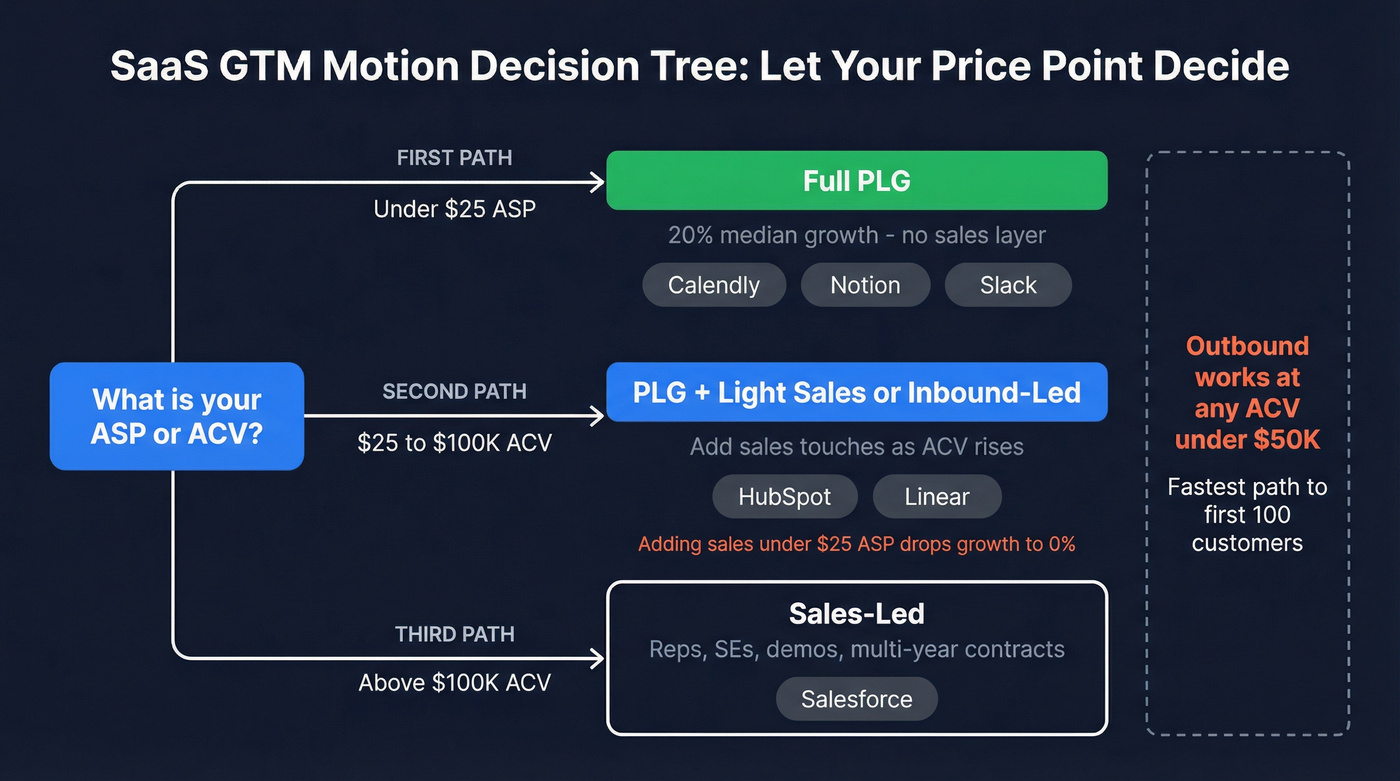
- Under $25 ASP: Full PLG. Sales adds friction at this price.
- $25-$100 ASP: PLG + light sales, or inbound-led.
- Above $100K ACV: Sales-led is usually the default motion.
These thresholds come from ChartMogul's analysis of 2,500+ SaaS companies. They're not opinions - they're the median outcomes.
Every GTM Strategy Starts With Three Decisions
Every SaaS GTM strategy boils down to three choices. Get these right and the rest is execution.
1. Who you're selling to (ICP). Job title, company size, industry, pain point. If you can't describe your buyer in one sentence, you're not ready to go to market. Use an ideal customer profile template if you need structure.
2. How they'll find you (motion). PLG, inbound, outbound, sales-led, or some hybrid. This isn't a philosophical choice - it's dictated by your price point.
3. What you'll charge (pricing model). Below $25 ASP, stay full PLG. ChartMogul's data shows 20% median growth for full PLG at that price, versus 0% when sales gets layered in too early. Around $100 ASP, start adding light sales touches. Above $100K ACV, you're typically sales-led.
Once you've locked these three decisions, execution follows a simple map:
Foundation (weeks 1-2): ICP definition, pricing model, competitive positioning (see B2B brand positioning). Choices (weeks 2-4): Pick your primary motion, select channels, build your data layer. Execution (months 2-3): Launch the motion, ship content or sequences (use a B2B cold email sequence if outbound is in the mix), run first campaigns. Measurement (month 3+): Instrument Day-7 activation, track CAC payback, iterate weekly.
One underrated move during the Choices phase: map your content and distribution to intent buckets. People searching "best [category] tool" have different needs than people searching "[competitor] pricing" or "[competitor] reviews." Build separate landing pages or sequences for each bucket. In our experience, founders over-index on channel selection before doing this intent work, and it costs them months.
Real GTM Motions by Company
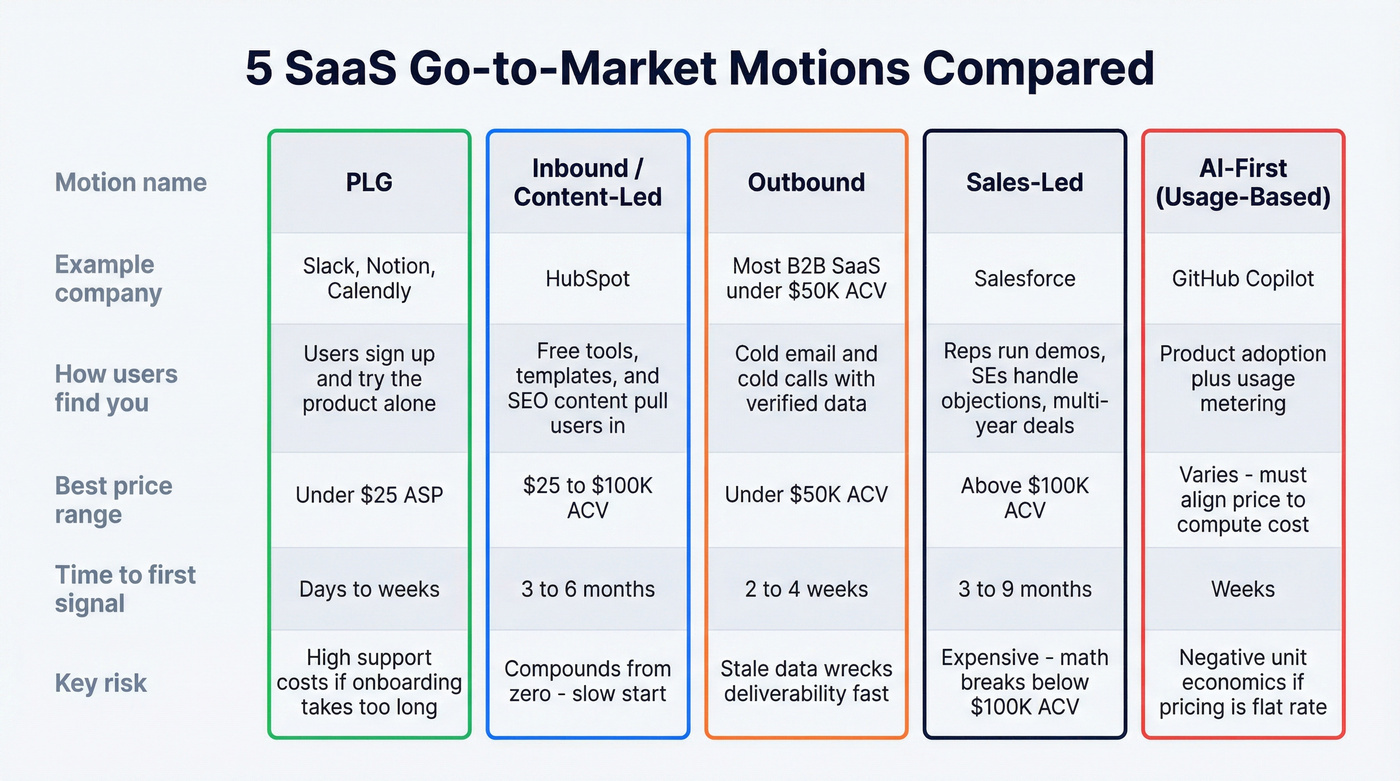
PLG - Slack, Notion, Calendly
Slack hit 8,000 signups on day one and scaled to millions of daily active users with bottom-up adoption. The product was the distribution. Notion took a different PLG path - community-built templates created viral loops that pulled new users in without paid acquisition. Calendly grew by embedding itself in every meeting invite its users sent, turning each scheduling link into a silent referral.
Here's the thing: PLG doesn't mean freemium. A study of 474 Series A startups found that 39% enable self-serve PLG, but only 25% offer a free tier. Stripe, Vercel, and Linear are all PLG - and they all charge from day one. PLG means users can start without talking to sales. That's it.
One operational signal that you're ready for PLG: time-to-value under 30 minutes for the core job-to-be-done. If your product takes a week of onboarding, PLG will bleed you dry on support costs before conversion kicks in.
Inbound / Content-Led - HubSpot
HubSpot's GTM playbook is the canonical inbound example. They launched a free CRM as a wedge product, built a content flywheel around free tools like Website Grader, and hit $100M ARR by 2012. Every free CRM user became a potential upsell into Marketing Hub, Sales Hub, or Service Hub.
The lesson isn't "write blog posts." It's that content-led GTM works when the content itself is a product - tools, templates, calculators - not just thought leadership. If your "content strategy" is a blog with 800-word SEO articles and no interactive utility, you're doing inbound wrong. (If you need a baseline, start with what is B2B content marketing.)
Sales-Led / Enterprise - Salesforce
Salesforce built its GTM on aggressive enterprise displacement and strategic acquisitions like Tableau and MuleSoft to expand its platform moat. The core playbook was straightforward: convince CIOs that on-premise CRM was dead, then lock in multi-year contracts. Their 77% gross margin is the traditional SaaS benchmark that AI-first companies are now struggling to match.
Sales-led works when deal sizes justify the cost of a human sales cycle. If your ACV is six figures, you need reps, SEs, and a demo environment - not a signup page. If your ACV is $5K and you're running a sales-led motion, the math is already broken. For six-figure deals, borrow from enterprise B2B sales playbooks.
Outbound-Led - The Motion Nobody Covers
Every GTM guide covers PLG and inbound. Almost none talk about outbound, despite it being how most B2B SaaS companies under $50K ACV land their first 100 customers. Cold email and cold calling aren't glamorous, but they're fast - you can get signal in weeks, not months.
The catch is that outbound lives or dies on data quality. Bounce rates above 5% can wreck deliverability, and once your sending domain is flagged, your entire outbound motion is dead. We've seen this kill early-stage pipelines repeatedly - a founder burns through their primary domain in the first month because they pulled contacts from a stale database, and suddenly they're rebuilding from scratch with a new domain and zero sender reputation. If you're seeing issues, start with email bounce rate and an email deliverability guide.
The industry average data refresh cycle is roughly six weeks, which means most providers are serving you contacts that have already changed jobs or emails by the time you hit send. Prospeo runs a 7-day refresh cycle with 98% email accuracy and 125M+ verified mobile numbers, so you're working with data that's actually current. Stack Optimize used it to build from $0 to $1M ARR - client deliverability stayed above 94%, bounce rates under 3%, zero domain flags across all clients.

Let's be honest: if your ACV is under $15K, outbound with verified data will outperform inbound content for the first 12 months. Inbound compounds, but it compounds from zero. Outbound gives you revenue and customer conversations while your content flywheel is still warming up. To tighten execution, use proven sales prospecting techniques and keep your sender reputation clean.
AI-First Pricing - GitHub Copilot
GitHub Copilot is the cautionary tale every AI-first SaaS founder should study. Estimates put Copilot's compute cost as high as $80/user/month for heavy users while charging $10/user/month - negative unit economics at scale. GitHub eventually introduced allowances plus usage fees ($0.04 per extra request) to align revenue with inference costs.
This is the new reality for AI-first GTM. Traditional SaaS gross margins run 70-90%, while AI-first companies often land at 50-60%, with some hyper-growth startups hitting 25% or worse early on. Unlimited pricing is dead. If you're building AI-first in 2026, your go-to-market strategy needs usage-based pricing baked in from the start - not bolted on after you realize you're subsidizing your heaviest users.

Outbound is the fastest GTM motion for SaaS under $50K ACV - but one bad data provider can torch your domain in weeks. Prospeo's 7-day refresh cycle and 98% email accuracy keep bounce rates under 3%, so your outbound motion actually scales.
Don't let stale data kill your GTM before it starts.
GTM Benchmarks Worth Bookmarking
These numbers come from ChartMogul's analysis of 2,500+ SaaS companies, PhoenixStrategy's 2026 KPI benchmarks, and widely used SaaS metric benchmark tables. Plan against them quarterly.
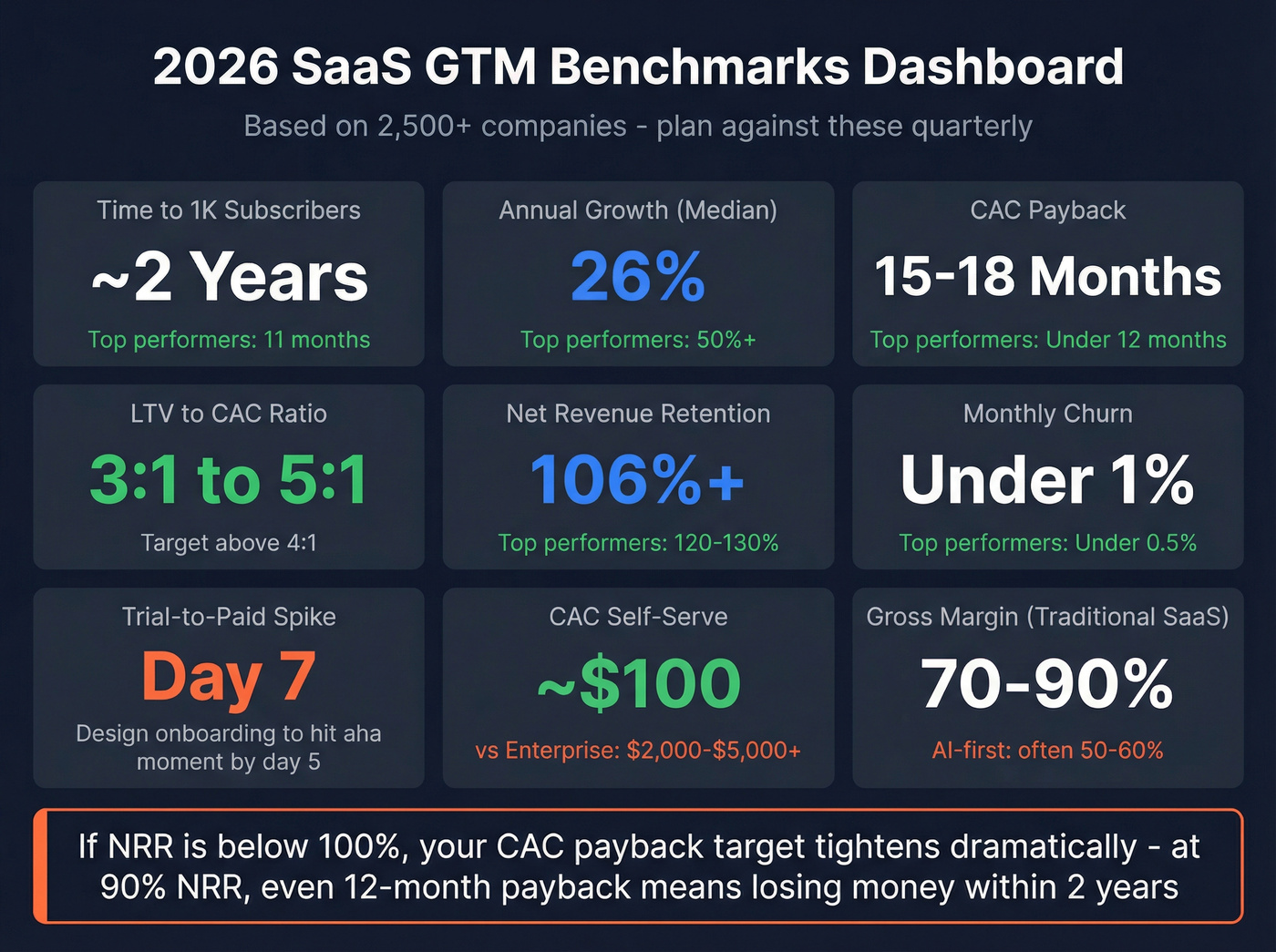
| Metric | Target | Top Performers |
|---|---|---|
| Time to 1K subs | ~2 years (median) | 11 months |
| Annual growth | 26% median | 50%+ |
| CAC (self-serve) | ~$100 | - |
| CAC (referral) | ~$150 | - |
| CAC (LinkedIn Ads) | $2,000+ | - |
| CAC (enterprise) | $2,000-$5,000+ | - |
| CAC payback | 15-18 months | <12 months |
| LTV:CAC | 3:1-5:1 | >4:1 |
| NRR | 106%+ | 120-130% |
| Monthly churn | <1% | <0.5% |
| Trial-to-paid spike | Day 7 | - |
The top decile hits 1,000 subscribers in under 3 months. That's not a typo - it's what happens when ICP, motion, and pricing are aligned before launch.
The CAC gap between self-serve ($100) and enterprise ($5,000+) is why your pricing model dictates your motion. If you're charging $50/month and acquiring customers through enterprise sales or LinkedIn Ads at $2,000+ per customer, the math never works. I've watched founders burn six months of runway before realizing this. If you want more targets to sanity-check, use sales pipeline benchmarks.
How to use the Day-7 spike. ChartMogul's data shows trial-to-paid conversion spikes around day 7. That means your onboarding needs to deliver the "aha moment" within the first week - not the first month. Design your activation flow backward from that deadline: what's the single action that makes a user say "I need this"? Push them there by day 5, follow up on day 6, and present the upgrade on day 7.
How to read CAC payback alongside NRR. If your net revenue retention is above 120%, you can tolerate longer payback periods because existing customers are expanding. But if NRR is below 100% - meaning you're shrinking within accounts - your CAC payback target tightens dramatically. At 90% NRR, even a 12-month payback means you're losing money on most cohorts within two years.
What Founders Actually Get Wrong
A practitioner who watched 28 SaaS startups fail at marketing identified the same pattern every time: build for 6-12 months, launch to no audience, no distribution, no relationships. Half the runway gone before a single customer conversation.
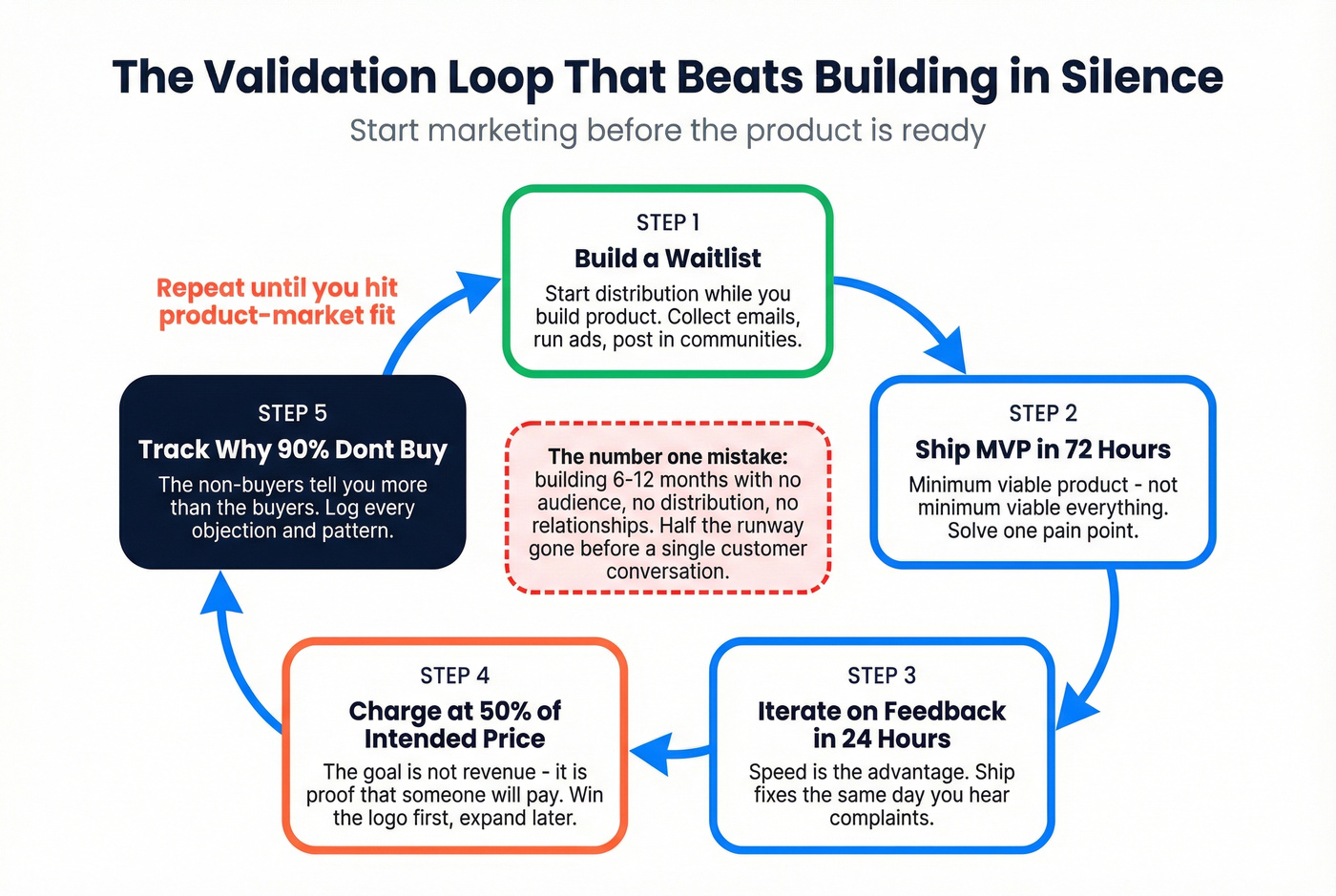
The fix is counterintuitive - start marketing before the product is ready. Build distribution while you build product.
A founder on r/SaaS who failed seven times before building something profitable shared a validation loop worth stealing: waitlist, MVP in 72 hours, ship feedback iteration in 24 hours, then charge at 50% of your intended price. The point isn't to maximize revenue early - it's to validate that someone will pay. The consensus on r/startups echoes this: track why the 90% don't buy, not just the 10% who do. Keep pricing wildly easy to understand. Don't get greedy early - win the logo, then expand.
The founders who survive aren't the ones with the best product. They're the ones who figured out distribution first.
Stack Optimize built $0 to $1M ARR running outbound on Prospeo data - 94%+ deliverability, zero domain flags. With 300M+ profiles, 30+ filters, and intent data across 15,000 topics, you can target your exact ICP from day one.
Start executing your GTM strategy with data that's actually current.
FAQ
What's the difference between a GTM strategy and a marketing strategy?
A go-to-market strategy is the full market-entry plan covering ICP definition, pricing, sales motion, channel selection, and competitive positioning. Marketing strategy is one component focused on awareness and demand generation. GTM is the blueprint for the entire launch; marketing is one room in the building.
How long does it take to see results from a SaaS GTM strategy?
Expect 60-90 days for first meaningful signal from outbound or paid channels, and 6-9 months for inbound to compound. Top-performing B2B SaaS companies hit 1,000 subscribers in 11 months; the top decile does it in under 3 months. Start building distribution while you're still building the product.
How do you build a prospect list for an outbound SaaS launch?
Define your ICP by job title, company size, and industry, then use a B2B data platform to pull verified contacts filtered by intent signals, technographics, or headcount growth. Verify every email before sending - bounce rates above 5% will tank deliverability. Tools like Prospeo offer a free tier (75 verified emails/month) that's enough to test your first outbound sequences before committing budget.
Which GTM motion works best for early-stage SaaS?
For companies with ACV under $15K, outbound typically generates revenue fastest - within weeks, not months. PLG works if time-to-value is under 30 minutes and the product sells itself. Inbound compounds long-term but starts from zero. Most successful early-stage teams run outbound for immediate pipeline while building an inbound flywheel in parallel.
Pick one motion. Instrument Day-7 activation. Don't mix enterprise CAC with SMB pricing. And if you're going outbound first - which you probably should be if your deal size is under $15K - get the data layer right before you write a single cold email. The best SaaS go-to-market strategy examples all share one trait: the founders locked their three decisions before touching execution. Everything else follows.