

How to Build a SaaS Sales Pitch That Doesn't Bomb
A founder on r/ycombinator shared a story that still makes us wince. He emailed a CTO from his personal Gmail - no company domain, no context, just a feature dump. The CTO's response? Called it "irritating" and said the founder was "hiding behind a mask." That SaaS sales pitch didn't fail because the product was bad. It failed because every signal surrounding it screamed amateur.
Here's what actually went wrong, and how to fix every channel of your pitch so you don't end up as a cautionary Reddit post.
Five Mistakes That Kill Your Pitch
1. Jumping straight into the demo. You haven't earned the right to show product yet. Do discovery first. Ask three questions before you share a single screen.
2. Not disqualifying bad-fit prospects. One founder on r/SaaS admitted sending 2,000 cold emails that generated six replies and zero customers. The problem wasn't cold email - it was spraying generic messages at unresearched contacts. Spend 5 minutes per prospect. Check their tech stack, recent funding, and open roles.
3. Slow follow-up on inbound leads. SaaStr's guidance is blunt: if you don't follow up on inbound requests in minutes, you lose. SDRs who gate-keep with Calendly links instead of booking directly add friction that kills conversion. Speed beats polish every time. Set a target of 150 outbound actions per day, and respond to every inbound lead in under 5 minutes.
4. Talking more than listening. Your prospect should do 80% of the talking in discovery. If you're monologuing, you're losing. Prepare questions, not talking points. (If you need a tighter question bank, start with these discovery questions.)
5. No defined next step. "I'll follow up next week" isn't a next step. It's a vague promise both sides will forget. End every interaction with a calendar invite or a specific deliverable. If you want plug-and-play options, use these sales follow-up templates.
The Core Framework Behind Winning Pitches
Every effective SaaS sales pitch follows the same arc: Research, Discovery, Pain Quantification, Solution Framing, Social Proof, Next Step.
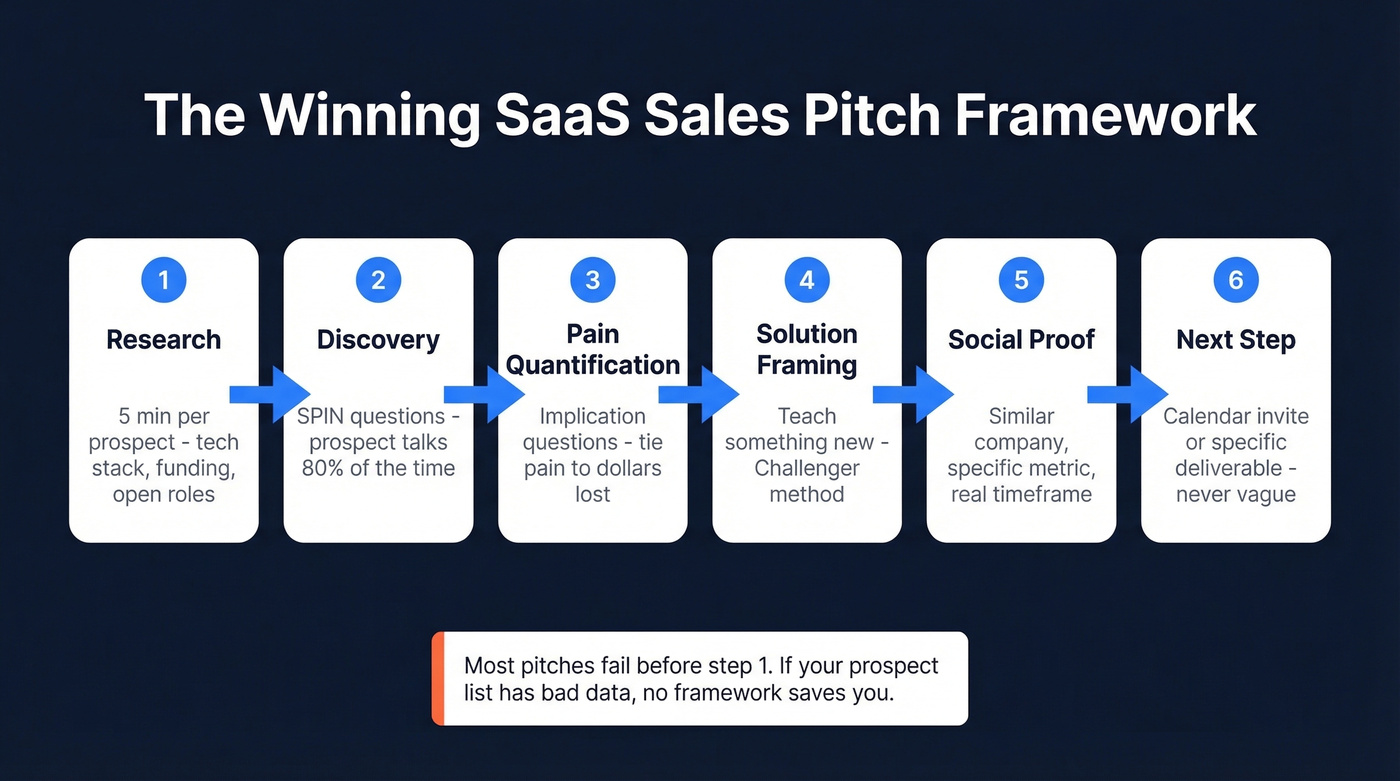
For discovery, SPIN selling remains the gold standard. Start with Situation questions ("What tools are you using for X today?"), then Problem questions ("Where does that break down?"). Move to Implication questions that quantify the cost - "How does this affect cash flow?" Finish with Need-payoff questions that let the buyer articulate the value themselves.
For enterprise deals with buying committees, layer in MEDDIC qualification to map the decision process and identify your champion. (If you want a ready-made set, steal these MEDDIC discovery questions.) For executive pitches, the Challenger framework - Teach, Tailor, Take Control - cuts through because B2B SaaS buyers get 20+ vendor pitches monthly. You need to teach them something new, not recite features they've already heard from five competitors.
Here's our honest take: most pitches fail before the rep opens their mouth. If your prospect list is built on stale data and unverified emails, the best framework in the world won't save you. Fix your data first, then worry about your talk track. (This is the core of data-driven selling.)

Your SaaS sales pitch framework is only as good as the data behind it. Teams using Prospeo's 300M+ verified profiles with 30+ filters - including buyer intent, tech stack, and funding signals - book 35% more meetings than Apollo users. That 5 minutes of prospect research? Prospeo does it for you.
Stop pitching unqualified contacts. Start with data that converts.
Channel-Specific Templates and Scripts
Cold Email
Template 1: Pain-Point Opener
Subject: {{specific problem}} at {{Company}}
Hi {{First Name}},
{{Company}} is scaling fast - which usually means {{specific pain point}} becomes a bottleneck around this stage.
We helped {{similar company}} cut {{metric}} by {{percentage}} in {{timeframe}}. Happy to share how in 15 minutes.
Open to a quick call {{day}}?
Template 2: Social Proof Opener
Subject: How {{similar company}} fixed {{problem}}
Hi {{First Name}},
{{Similar company}} was dealing with {{problem}} - {{specific detail}}. After switching to {{your product}}, they saw {{result}}.
Worth a 15-minute conversation to see if that applies to {{Company}}?
Keep both under 100 words. Best send times are early weekdays, 9-11 AM. (If you want the data and a schedule, see the best time to send cold emails.) Follow up in 3-5 days, two follow-ups max, then switch channels.
These templates only work if they reach a real inbox. High bounce rates kill your domain reputation and tank every future sequence. We've seen teams go from 35% bounce rates to under 4% just by running their lists through Prospeo's real-time verification before sending - that's the difference between a campaign that builds pipeline and one that gets your domain blacklisted. If you're troubleshooting this, start with email bounce rate benchmarks and fixes.
The article says it plainly: 2,000 cold emails, six replies, zero customers. That's what happens when you pitch the wrong people with bad data. Prospeo's 7-day refresh cycle and 5-step email verification keep bounce rates under 4% - so every pitch you craft actually reaches a real decision-maker.
Protect your domain and your pipeline. Verify before you send.
Cold Call Script
The average cold call lasts 83 seconds, and only 31% get past the pitch stage. Your structure needs to be tight. (If you're building a repeatable motion, use a cold calling system.)
Intro: "Hey {{Name}}, this is {{Your Name}} with {{Company}}. Got 30 seconds to talk about {{core benefit}}?"
Value prop: Lead with a stat or pain point, not features: "Most {{role}} teams spend X hours a week on {{problem}}."
Qualifying questions: "Who's your target audience - SMB or enterprise?" and "What solutions have you tried, and why didn't they work?" These come from Cognism's research logging 5,265 meaningful conversations out of 9,247 cold calls.
Next step: "I'd love to schedule a 15-minute demo. How's next Tuesday?" Always propose a specific time.
Look - 57% of C-level and VP buyers actually prefer phone contact. Cold calling isn't dead. Bad cold calling is. Join the call 5 minutes early, and if it's a no-show, stay 10-15 minutes. Marinate in the objection instead of moving on instantly. (For common patterns and fixes, see cold call rejection.)
Demo Pitch
Skip this if your prospect hasn't done a discovery call first - jumping straight to demo is the #1 mistake above. When you do demo, use 3-5 context-setting slides max, then go live in the product. One team rebuilt a 34-slide feature deck into a focused 12-slide version and went from 47 demos yielding 3 closes to 23 demos yielding 9 closes. If you want a tighter process, use a product demo checklist.
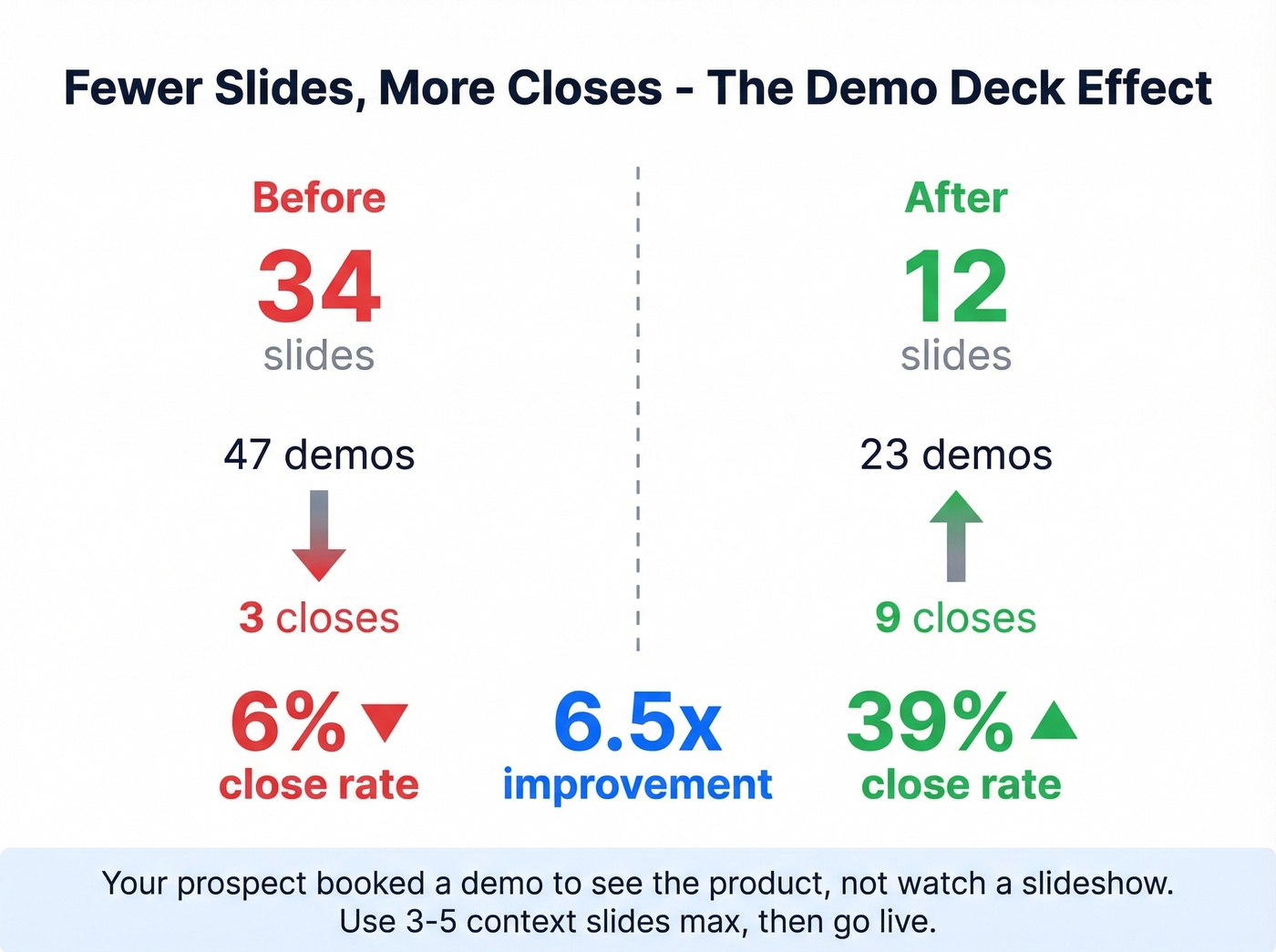
That's a jump from 6% to 39% close rate with fewer meetings. Less is more.
Sales Deck Structure
Your deck needs to work when you're not in the room - your internal champion will forward it to their CFO and procurement team. If it doesn't sell without your voiceover, it doesn't sell. A 34-slide deck is a confession you don't know your ICP. (If you need help tightening the narrative, use sales deck storytelling.)
Use a 12-slide structure: cover slide, market insight, the problem, the status quo, your solution, top 3 capabilities, live demo transition, key benefits, social proof, pricing, FAQs/objections, next steps with CTA. For CFO-heavy deals where the contract exceeds $50K, compress to an 8-slide ROI-first deck. For competitive displacement, lead with switching cost analysis in a 10-slide format.
Adapt Your Pitch by Go-to-Market Motion
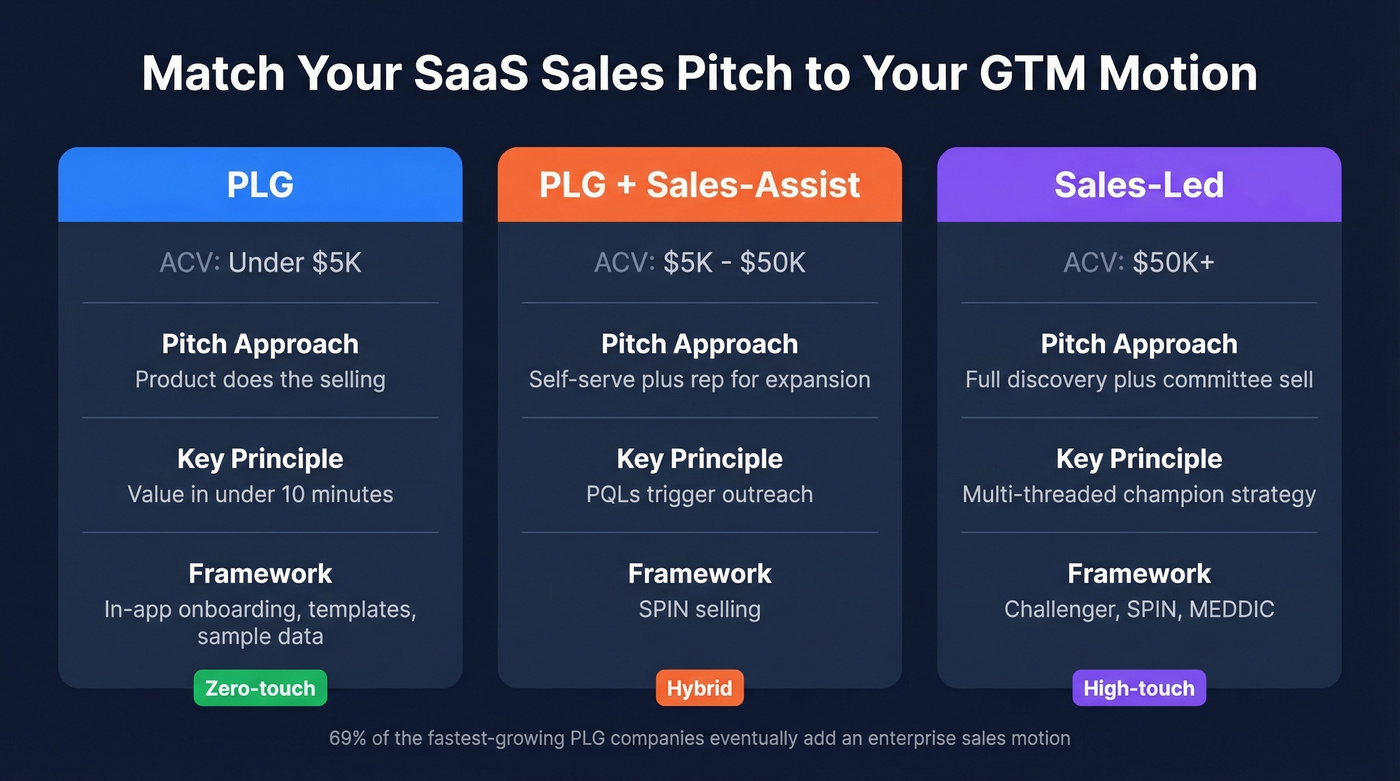
Not every SaaS product gets sold the same way. Your pitch format should match your go-to-market motion. (If you're mapping this end-to-end, start with B2B sales explained.)
| Motion | ACV Range | Pitch Approach | Key Principle |
|---|---|---|---|
| PLG | Under $5K | Product does the selling | Value in under 10 min |
| PLG + Sales-Assist | $5K-$50K | Self-serve + rep for expansion | PQLs trigger outreach |
| Sales-Led | $50K+ | Full discovery + committee sell | Challenger/SPIN/MEDDIC |
The PLG litmus test: can a user get core value in under 10 minutes with zero setup - through templates, imports, or sample data? If not, you need a sales-assist layer. And 69% of the fastest-growing PLG organizations have an enterprise offering, so even product-led companies eventually need a pitch deck for upmarket deals.
For PLG + Sales-Assist, define your PQA thresholds: 5+ weekly active users, 3 power features used by 2 distinct roles, or 1,000+ product events. When an account crosses those lines, that's when your rep reaches out with a tailored expansion pitch. Not before.
SaaS Sales Benchmarks for 2026
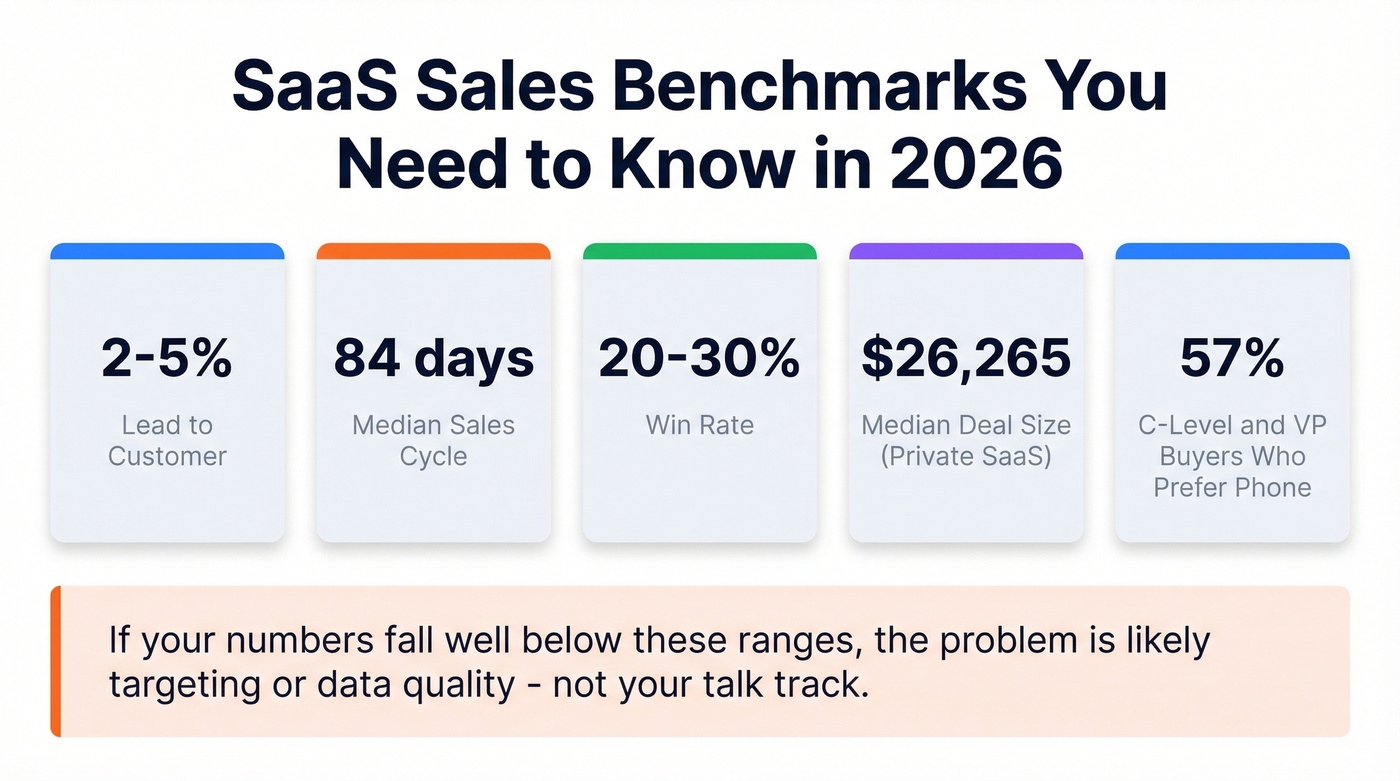
Know what "normal" looks like before you optimize. These benchmarks come from The Digital Bloom's pipeline analysis and Cognism's cold calling data:
| Metric | Benchmark |
|---|---|
| Lead-to-customer | 2-5% |
| Median sales cycle | 84 days |
| Win rate | 20-30% |
| Median deal size (private SaaS) | $26,265 |
| C-level/VP buyers who prefer phone | 57% |
If your numbers fall well below these ranges, the problem likely isn't your talk track - it's your targeting or qualification process. We've watched teams run outbound on stale contact data and routinely see bounce rates above 30%, which craters deliverability and poisons every sequence that follows. Fixing data quality is the single highest-ROI move most sales orgs can make, and it's the one they keep putting off. (A good starting point is an email deliverability guide.)
FAQ
How long should a SaaS sales pitch be?
Cold emails should stay under 100 words, cold calls average 83 seconds, demos run about 15 minutes, and sales decks should be 12 slides or fewer. Shorter pitches consistently outperform longer ones - one team cut slides from 34 to 12 and saw close rates jump from 6% to 39%.
What's the biggest reason SaaS pitches fail?
Bad targeting, not bad scripts. If you're pitching the wrong person at an unverified email, no framework saves you. Fix your data first - verify every address before you send.
Should I use slides in a SaaS demo?
Use 3-5 context-setting slides, then go live in the product. Your prospect booked a demo to see the product, not watch a slideshow. The fewer slides between "hello" and a live product walkthrough, the higher your conversion rate.
Which sales framework works best for B2B SaaS?
SPIN selling works best for mid-market discovery calls, MEDDIC for enterprise deals with buying committees, and Challenger for executive conversations. Match the framework to your deal complexity - most teams under $50K ACV get the best results from SPIN alone.