

SaaS Sales Techniques That Actually Move Pipeline
A rep on our team sent 5,000 emails last quarter and booked one meeting. One. The emails were personalized, the copy was decent, and the list was "ICP-matched." The problem wasn't effort - it was technique. He was spraying into a market where only a fraction of buyers were ready to talk, using a process that skipped discovery and single-threaded every deal.
You already know what SaaS sales is. You don't need a glossary. What you need are the SaaS sales techniques - with data behind them - that separate reps who hit quota from reps who churn out after 9 months.
The Three That Matter Most
You don't need 10 methodologies. You need three:
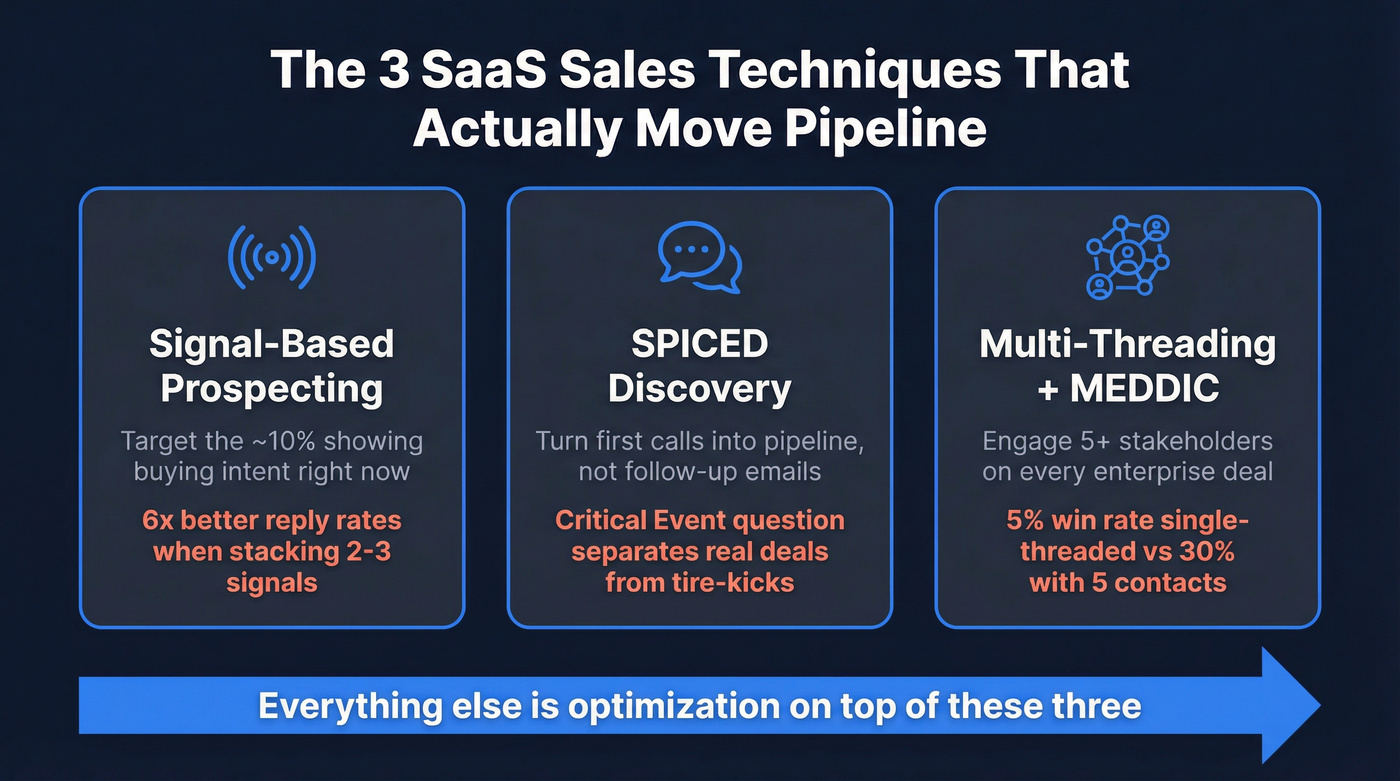
- Signal-based prospecting - stop blasting ICP lists and start targeting the ~10% showing buying intent right now. (If you want more plays, see prospecting.)
- SPICED discovery - the framework that turns first calls into pipeline instead of "let me send you some info." (Pair it with better discovery questions.)
- Multi-threading + MEDDIC - because single-threaded, unqualified enterprise deals die the moment your champion changes jobs. (Use a tighter MEDDIC qualification checklist.)
Everything else in this article is optimization on top of those three.
Signal-Based Prospecting
Only 3-5% of your market is buying right now. Another ~7% is open to a conversation. The rest will ignore you no matter how good your subject line is.
Signal-based prospecting means finding that ~10% before you write a single email. The signals worth watching: recent funding rounds, a new VP of Sales hire, job postings for roles your product supports, a competitor's tech getting ripped out, or a usage spike followed by a drop. The key is stacking. Don't act on one signal alone. When two or three converge on the same account, reply rates jump because you're reaching out at the exact moment the problem is top of mind. (If you need a system, start with identifying buying signals.)
One practitioner on r/startups described building a signal-routing system that turned 3,000 messy CRM accounts into 30,000+ mapped and scored companies - a one-person GTM engine that outperformed a five-rep team running unfiltered lists. That's the gap between volume and precision.
Signals are worthless if your contact data is stale by the time you act. Prospeo runs a 7-day data refresh cycle and combines 300M+ professional profiles with Bombora intent data tracking 15,000 topics, so you can stack intent signals with job-change and funding filters, then pull verified contacts in the same workflow. (If you’re evaluating vendors, compare data enrichment services.)
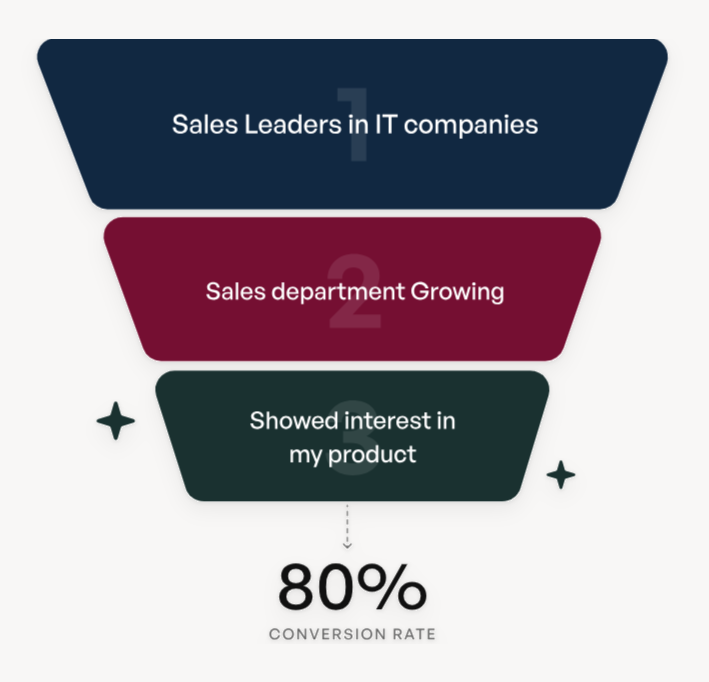
Discovery That Converts: SPICED
SPICED, from Winning by Design, gives discovery calls a repeatable structure that surfaces real buying urgency: Situation, Pain, Impact, Critical Event, Decision. Run the call in that order. Two questions per letter is enough. (You can also use a structured discovery call script.)
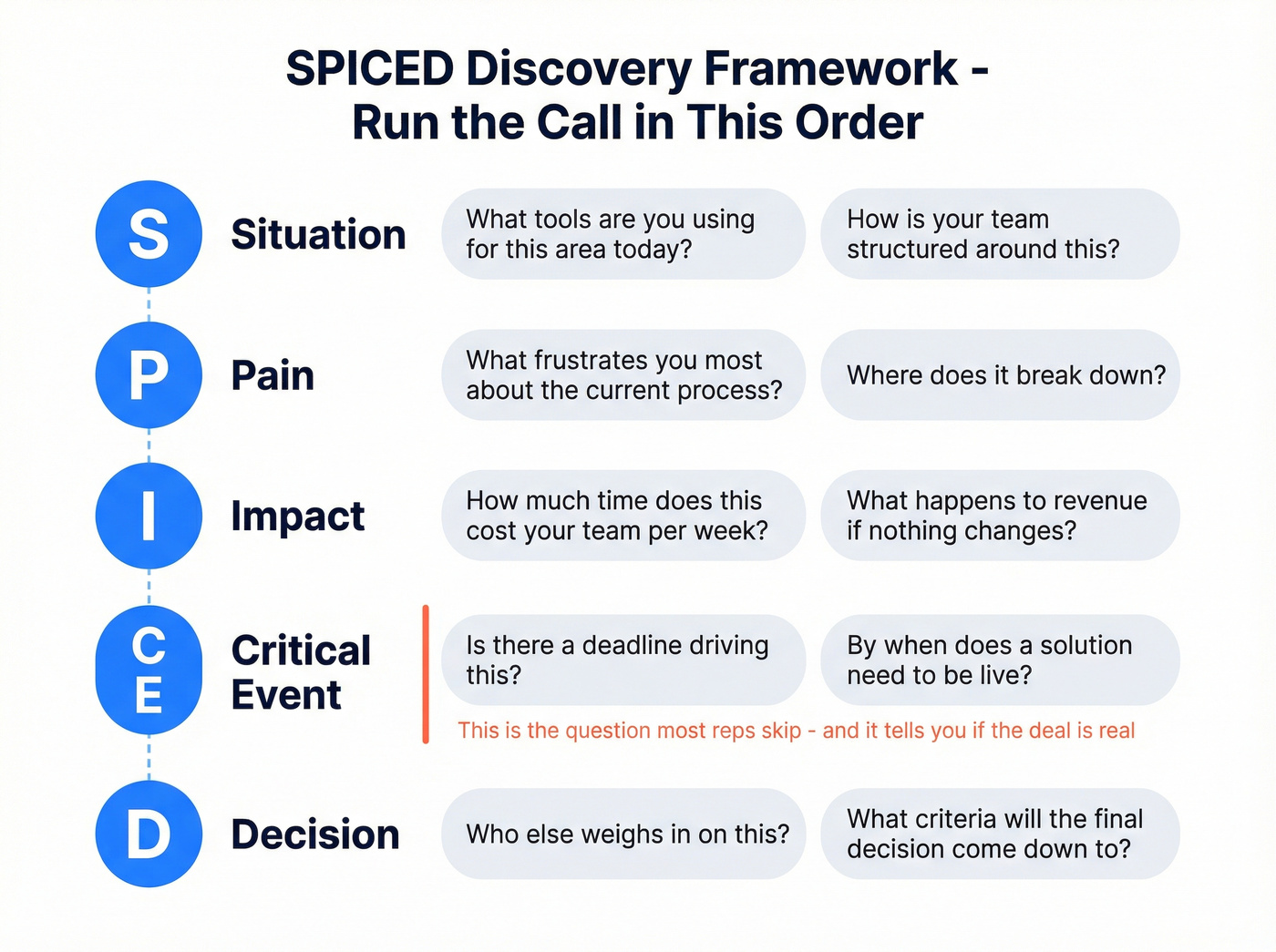
Situation: "What tools are you using for [area] today?" and "How's your team structured around this?"
Pain: "What frustrates you most about the current process?" and "Where does it break down?"
Impact: "How much time does this cost your team per week?" and "What happens to revenue if nothing changes?"
Critical Event: "Is there a deadline driving this?" and "By when does a solution need to be live?"
Decision: "Who else weighs in on this?" and "What criteria will the final decision come down to?"
The Critical Event question is the one most reps skip - and it's the one that tells you whether this deal is real or a tire-kick. Here's the thing: among all the SaaS selling techniques we've tested, anchoring every deal to a critical event is what separates real pipeline from wishful forecasting. No critical event, no urgency. No urgency, no close.
Multi-Threading Enterprise Deals
We watched a team lose a $60K deal last year because their single champion left the company mid-cycle. The deal didn't stall - it reset completely. New stakeholders, new priorities, new evaluation. Three months of work, gone.
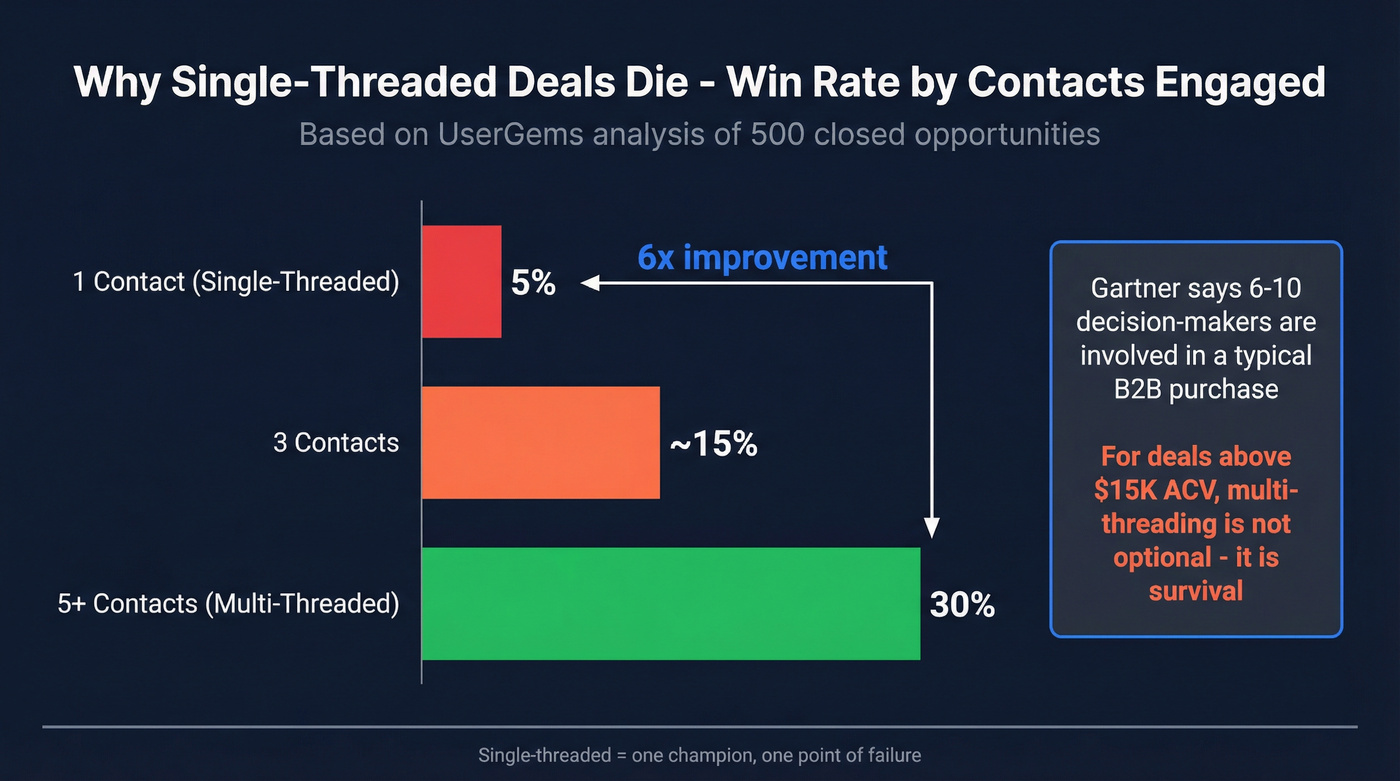
Gartner puts the typical B2B buying group at 6-10 decision-makers. A UserGems analysis of 500 closed opportunities found that single-threaded deals win just 5% of the time. Get five contacts engaged and that jumps to 30% - a 6x improvement. For deals above $15K ACV, multi-threading isn't optional. It's survival.

Multi-threading enterprise deals means reaching 5+ stakeholders with verified contact data. Prospeo gives you 300M+ profiles, 125M+ verified mobiles, and 98% email accuracy - so your outreach actually lands.
Stop losing deals because you couldn't reach the buying committee.
Product-Led Sales: The PLG Hybrid
Pure PLG sounds great in pitch decks. In practice, McKinsey's analysis of 107 public B2B SaaS providers found that adopting PLG alone doesn't guarantee outperformance. What works is the hybrid - product-led sales - where self-serve usage data feeds the sales motion.
The concept that makes this work is the product-qualified account. PQLs convert 5-10x faster than MQLs, and 97% of buyers prefer to try before they buy. PLG is a spectrum, not a binary. Your ACV and support capacity determine where you land - not what's trendy.
Let's be honest: if your deal size sits under $10K and you don't have a self-serve trial, you're leaving the easiest revenue on the table. At that price point, buyers want to click "buy," not sit through a 45-minute demo. (If your demos are dragging, use a tighter product demo checklist.)
Trial and Pricing Benchmarks
A FirstPageSage study of 86 SaaS companies gives us the clearest trial conversion data available:
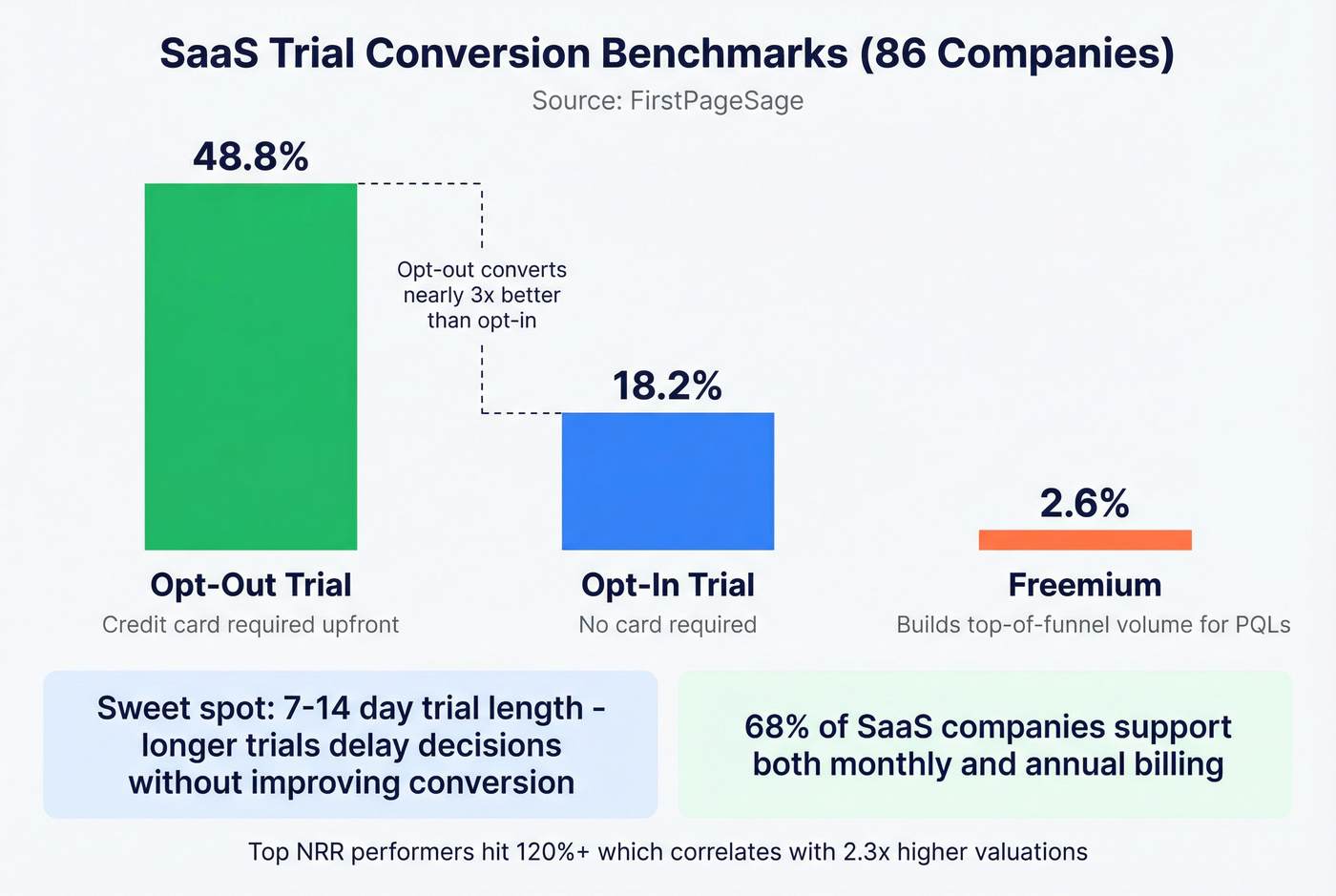
| Model | Trial-to-Paid Rate |
|---|---|
| Opt-in trial | ~18.2% |
| Opt-out trial | ~48.8% |
| Freemium | ~2.6% |
Opt-out trials convert nearly 3x better than opt-in. Freemium converts terribly on its own, but it builds top-of-funnel volume that feeds PQLs downstream. For most SaaS products, a 7-14 day trial hits the sweet spot; longer trials drag out the buying decision without improving conversion.
Most SaaS companies support both monthly and annual billing - one Recurly benchmark puts it at 68%. Every technique in this article ultimately serves one metric: net revenue retention. Top NRR performers hit 120%+, which correlates with 2.3x higher valuations. (If you’re diagnosing churn, start with churn analysis.)
Handling Objections
The framework: Validate the concern, Isolate it as the real blocker, then Reframe around value.
Price: "If budget's the main thing holding us back, let's walk through the ROI model - most teams see payback in under 90 days."
Competitor: "What gap in your current setup made you take this call?" Don't bash the competitor. Find the pain they aren't solving.
Timing: "Let's quantify what waiting another quarter costs - if the number's small, I'll tell you to wait."
Authority: "Let's co-create a one-pager you can bring to that meeting - I'll make you look good."
Never discount as your first move. Discounting before isolating the real objection trains buyers to negotiate harder next time. This is one of the most overlooked SaaS sales tips - holding price until you've confirmed the real blocker protects both your margins and your credibility. (If you want a deeper framework, use anchor in negotiation.)
Key SaaS Sales Benchmarks
Per Phoenix Strategy Group's 2026 data and Forecastio's win-rate analysis:
| Metric | SMB | Mid-Market | Enterprise |
|---|---|---|---|
| ACV range | < $15K | $15K-$100K | > $100K |
| Sales cycle | 1-4 weeks | 1-3 months | 3-12 months |
| Win rate (avg) | 30-40% | 25-35% | 20-25% |
| Win rate (top quartile) | 45%+ | 40%+ | 30%+ |
| CAC payback | 8-12 mo | 14-18 mo | 18-24 mo |
Healthy LTV:CAC sits at 3:1-5:1. Median CAC payback across all segments runs 15-18 months; elite teams get under 12. (To pressure-test your funnel, track pipeline health.)
Five Fastest Ways to Kill a Deal
A recurring theme on r/sales: reps rush to demo before discovery. They prescribe before diagnosing, and the prospect tunes out. Beyond that frustration, here are the five deal-killers we see most often:
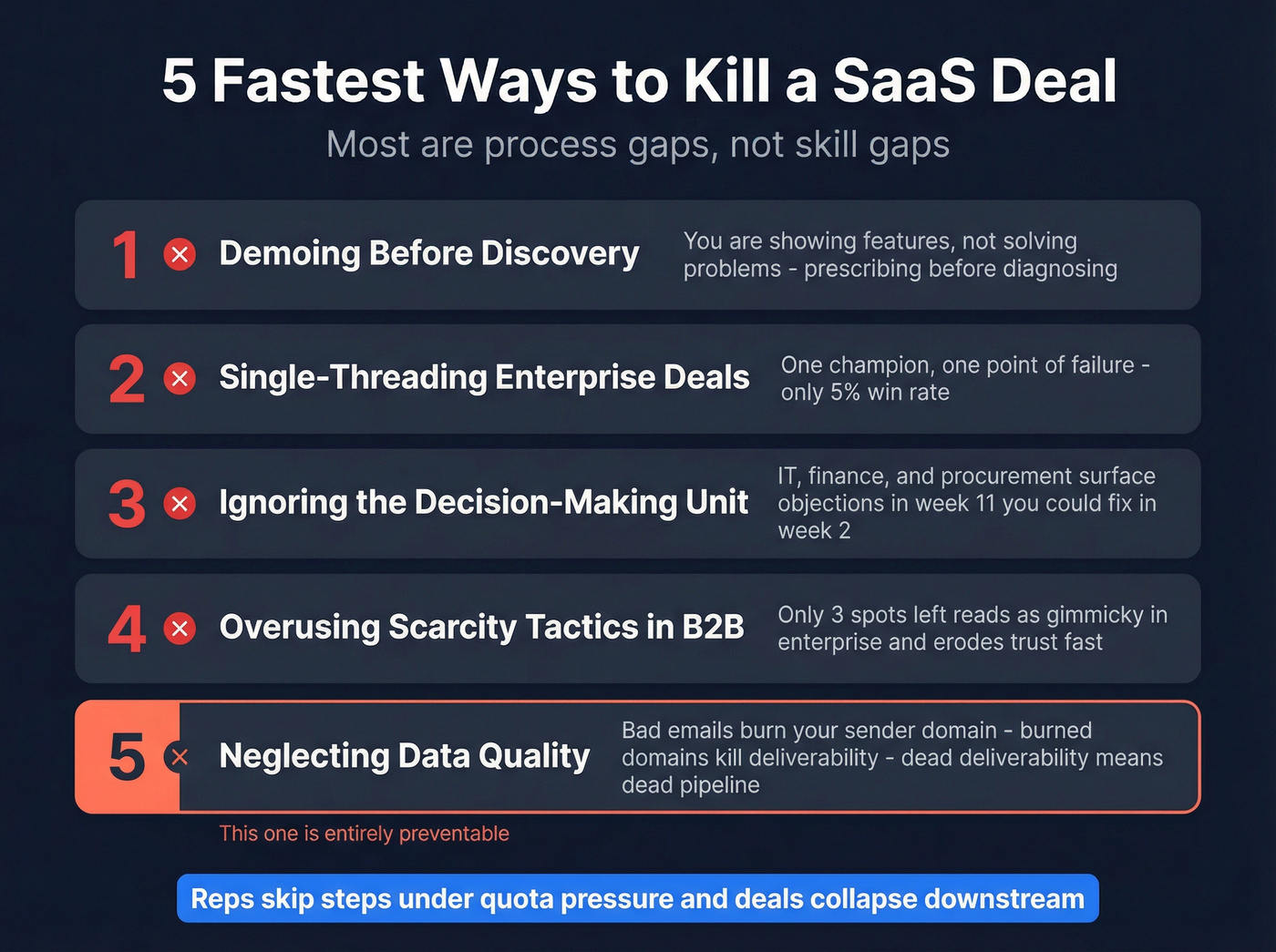
- Demoing before discovery. You're showing features, not solving problems. Skip this if you want to understand why your "great demo" didn't convert.
- Single-threading enterprise deals. One champion, one point of failure - 5% win rate. We covered the math above.
- Ignoring the decision-making unit. IT, finance, and procurement will surface objections in week 11 that you could've addressed in week 2.
- Overusing scarcity tactics in B2B. "Only 3 spots left" reads as gimmicky in enterprise and erodes trust fast.
- Neglecting data quality. Bad emails burn your sender domain. Burned domains kill deliverability. Dead deliverability means dead pipeline. This one's infuriating because it's entirely preventable. (If you’re seeing issues, start with an email deliverability guide.)
Most SaaS selling challenges boil down to process gaps, not skill gaps. Reps skip steps under quota pressure, and deals collapse downstream as a result.
Signal stacking is the technique. Fresh data is the fuel. Prospeo combines Bombora intent data across 15,000 topics with job-change, funding, and technographic filters - refreshed every 7 days at $0.01 per email.
Target the 10% ready to buy instead of blasting the 90% who aren't.
FAQ
What's the most effective SaaS sales technique in 2026?
Signal-based prospecting - targeting the ~10% of your market showing active buying signals - consistently outperforms volume-based outbound. Stack multiple signals like funding, job changes, and intent surges before reaching out, then use SPICED discovery to convert conversations into qualified pipeline.
How long should a SaaS free trial be?
Seven to fourteen days is the sweet spot. Opt-out trials convert at ~49% versus ~18% for opt-in, per FirstPageSage's 86-company dataset. Longer trials delay decisions without improving conversion.
What's a good win rate for SaaS sales?
Average win rates run 20-40% depending on segment. Top-quartile teams hit 30-45%+. The biggest lever isn't closing technique - it's qualifying harder so you only work deals you can actually win.
How do I multi-thread accounts without burning hours on research?
Use a B2B data platform with department and seniority filters to pull verified contacts for entire buying committees in one search. Prospeo's database covers 300M+ profiles with 30+ filters, so you can map a 6-10 person buying group in minutes. The free tier includes 75 verified emails per month - enough to multi-thread 10-15 accounts without a contract.