

7 Sales Campaign Examples You Can Steal and Launch This Week
Every "sales campaign examples" list reads the same - Coca-Cola polar bear ads, Nike retrospectives, and holiday coupon codes. None of that helps you book meetings. A rep on r/sales posted that they received zero MQLs this year after marketing budget cuts, and cold email feels "extremely oversaturated" even with heavy personalization. That's the reality most B2B teams are living in right now.
Below: seven actual outbound sales campaign structures with day-by-day cadences, copy templates, and benchmarks you can measure against. No brand awareness fluff.
Building your first outbound campaign? Start with the 7-touch multichannel structure (Example #1). Already have outbound running but pipeline is flat? Skip to the ABM and win-back examples - they're the highest-ROI plays most teams ignore. And before you launch anything, verify your list. About 28% of B2B emails decay every year, and 17% of cold emails never reach the inbox.
What Is a Sales Campaign (And What It Isn't)
A sales campaign is a coordinated sequence of touchpoints - emails, calls, social touches - designed to move a defined group of prospects toward a specific outcome (usually a booked meeting or a closed deal) within a set timeframe. [HubSpot defines a sales sequence](https://knowledge.hubspot.com/sequences/create-and-edit-sequences) as a planned, timed series of outreach steps that runs until a prospect replies, books, or exhausts the sequence. Most B2B campaigns execute over 2-6 weeks, though complex ABM plays can stretch longer.
People confuse three things constantly. A sales campaign isn't a sales promotion (that's a discount or incentive). It isn't a marketing campaign (that's broader awareness and lead gen). And there's a subtle but useful distinction between a sequence and a cadence: the sequence is the specific steps for a particular goal or segment, while the cadence is the broader timing philosophy that governs how all your sequences run.
| Sales Campaign | Sales Promotion | Marketing Campaign | |
|---|---|---|---|
| Goal | Book meetings, close deals | Drive short-term purchases | Build awareness, gen leads |
| Audience | Defined prospect list | Existing customers/leads | Broad market |
| Duration | 2-6 weeks | Days to weeks | Weeks to months |
| Channels | Email, phone, social | Email, in-app, ads | Ads, content, events |
Why Your Old Playbook Stopped Working
Three structural shifts have gutted the single-channel outbound playbook that worked in 2021.
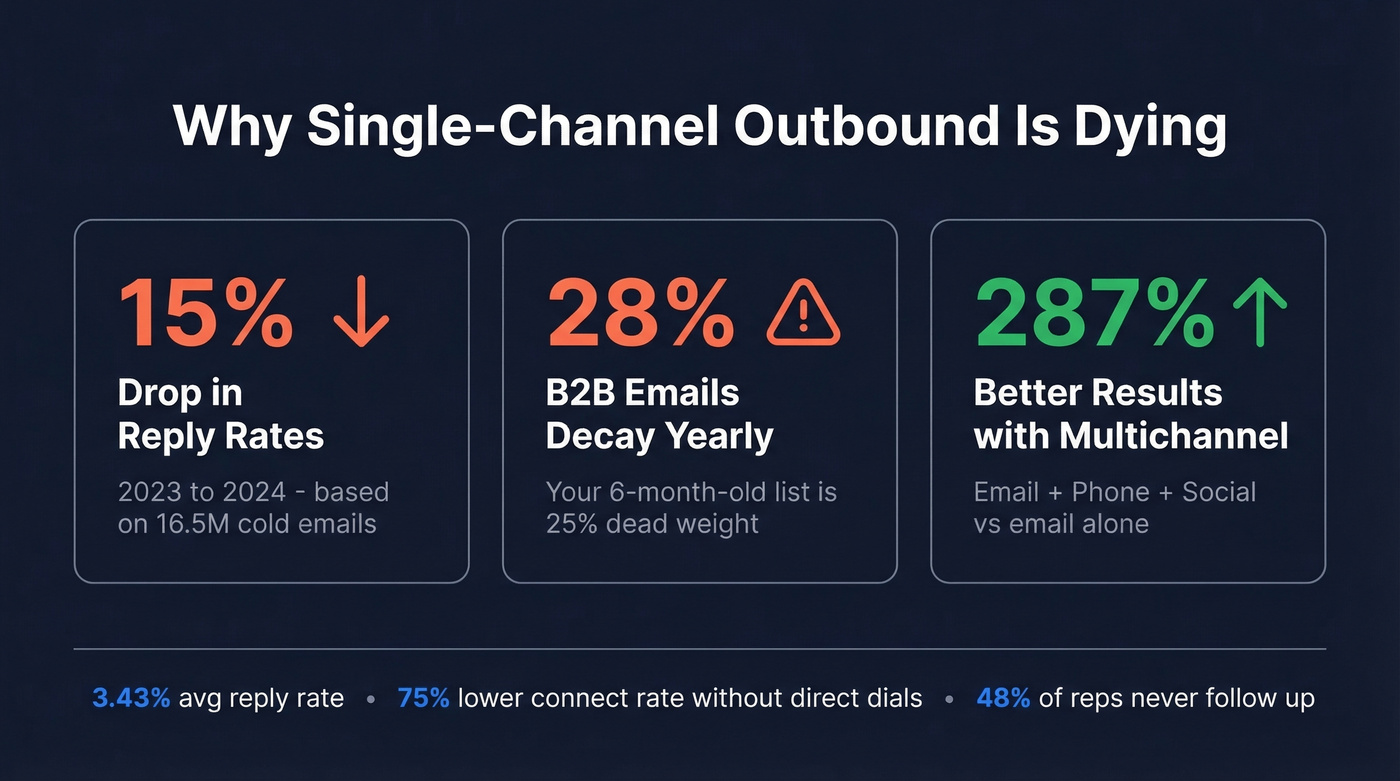
Reply rates are falling. Belkins' analysis across 16.5M cold emails, 20M+ social outreach attempts, and 5M cold calls found reply rates dropped 15% between 2023 and 2024. The inbox is noisier, spam filters are smarter, and prospects are more guarded. A 3.43% reply rate is now the platform-wide average, meaning 95%+ of your cold emails generate zero response.
Your data is rotting. About 28% of B2B email addresses become invalid every year due to job changes and role shifts. If you're running campaigns on a list you built six months ago, a quarter of it is dead weight - and those bounces are actively damaging your sender reputation. (If you want a deeper fix, start with an email deliverability audit.)
Single-channel is a losing bet. Using generic switchboard numbers instead of direct dials can reduce connect rates by 75%. Multichannel outreach (email + phone + social) produces 287% better results than email alone, with 20% higher close rates, 20% lower CAC, and 25% shorter sales cycles. The Reddit sentiment that "cold calling is dead" isn't wrong - cold calling alone is dead. Paired with email and social, it's still one of the highest-converting touches in the sequence.

How to Plan a Campaign in 6 Steps
Before you pick a campaign type, nail the planning. Adapted from Wrike's campaign planning framework, here's the sales-specific version:
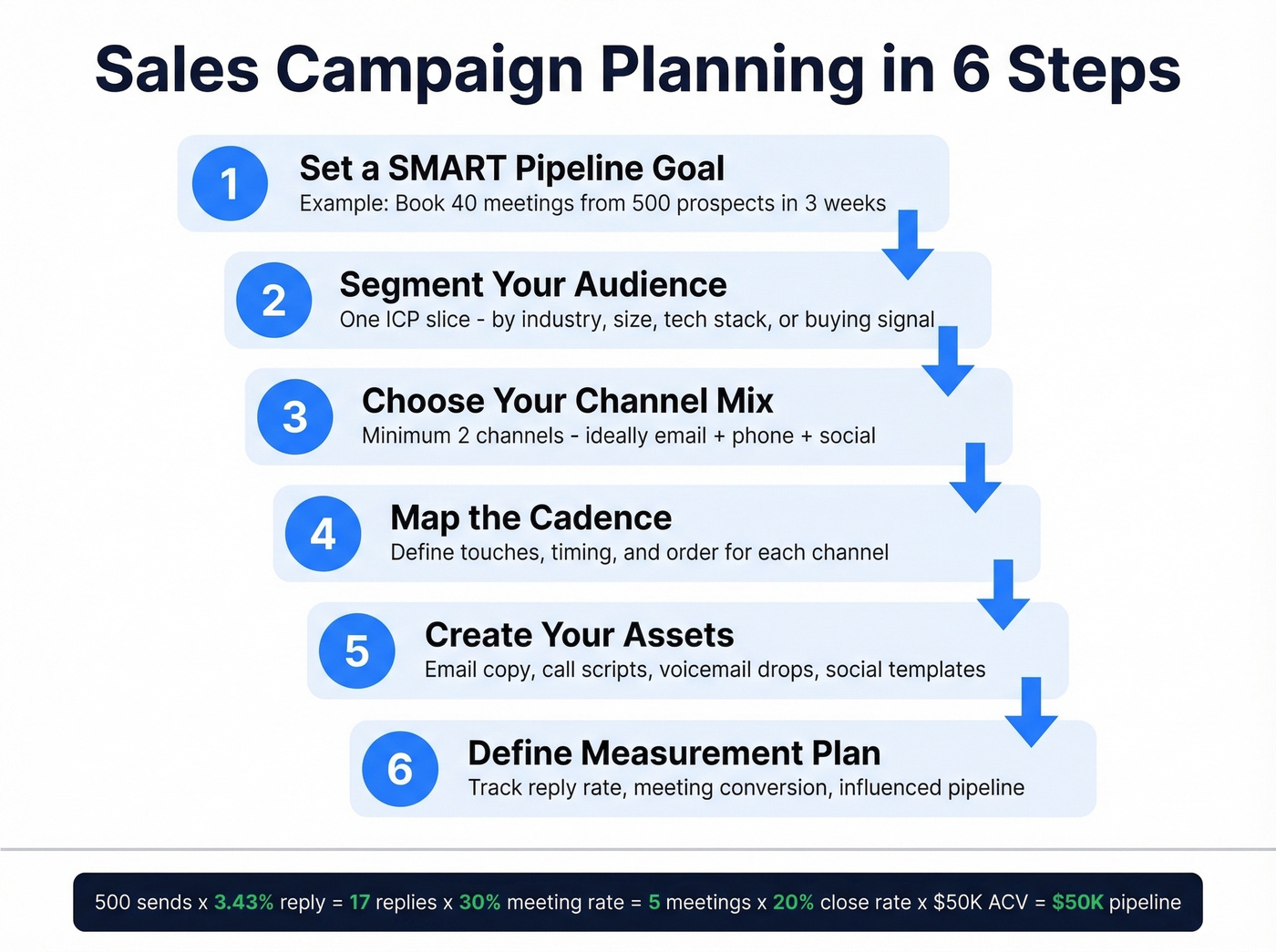
Set a SMART goal tied to pipeline. Not "generate awareness" - something like "book 40 meetings from 500 prospects in 3 weeks." Measurable, time-bound, connected to revenue. (If your pipeline is stalling, map it to pipeline health metrics first.)
Segment your audience. Don't blast your entire TAM. Pick one ICP slice - by industry, company size, tech stack, or buying signal. Tighter targeting means better personalization and higher reply rates. Use an ideal customer profile rubric so reps segment the same way.
Choose your channel mix. At minimum, use two channels. The data overwhelmingly favors three (email + phone + social). Decide which channel leads and which supports. If calling is part of your mix, build a repeatable cold calling system.
Map the cadence. How many touches, over how many days, in what order? The examples below give you templates. (For more, see sequence management.)
Create your assets. Email copy, call scripts, voicemail drops, social message templates. Personalize by role and pain point - buyers can tell instantly when outreach is automated versus intentional. If you need copy building blocks, pull from sales follow-up templates and prospecting email subject lines.
Define your measurement plan. Track reply rate, meeting conversion rate, and influenced pipeline - not just activity counts. Review and iterate at least quarterly; aggressive teams A/B test monthly.
Run the pipeline math before you launch. If you send 500 emails at a 3.43% reply rate, that's roughly 17 replies. If 30% of replies turn into meetings, that's 5 meetings. If your average deal size is $50K and close rate is 20%, that's $50K in expected closed-won from one campaign cycle. Knowing these numbers upfront tells you whether your list is big enough and your targeting is tight enough to hit your goal.

You just read that 28% of B2B emails decay every year and 17% of cold emails never reach the inbox. Every campaign example above assumes clean data - without it, your cadences are burning sends and killing your domain. Prospeo refreshes every record on a 7-day cycle and delivers 98% email accuracy, so your multichannel sequences actually land.
Stop launching campaigns on dead data. Verify your list first.
7 Outbound Campaign Structures
1. Multi-Touch Outbound Prospecting
If you only run one outbound campaign type, make it this one.
Goal: Book discovery calls with net-new prospects. Audience: ICP-matched contacts at target accounts. Channels: Email, phone, social.
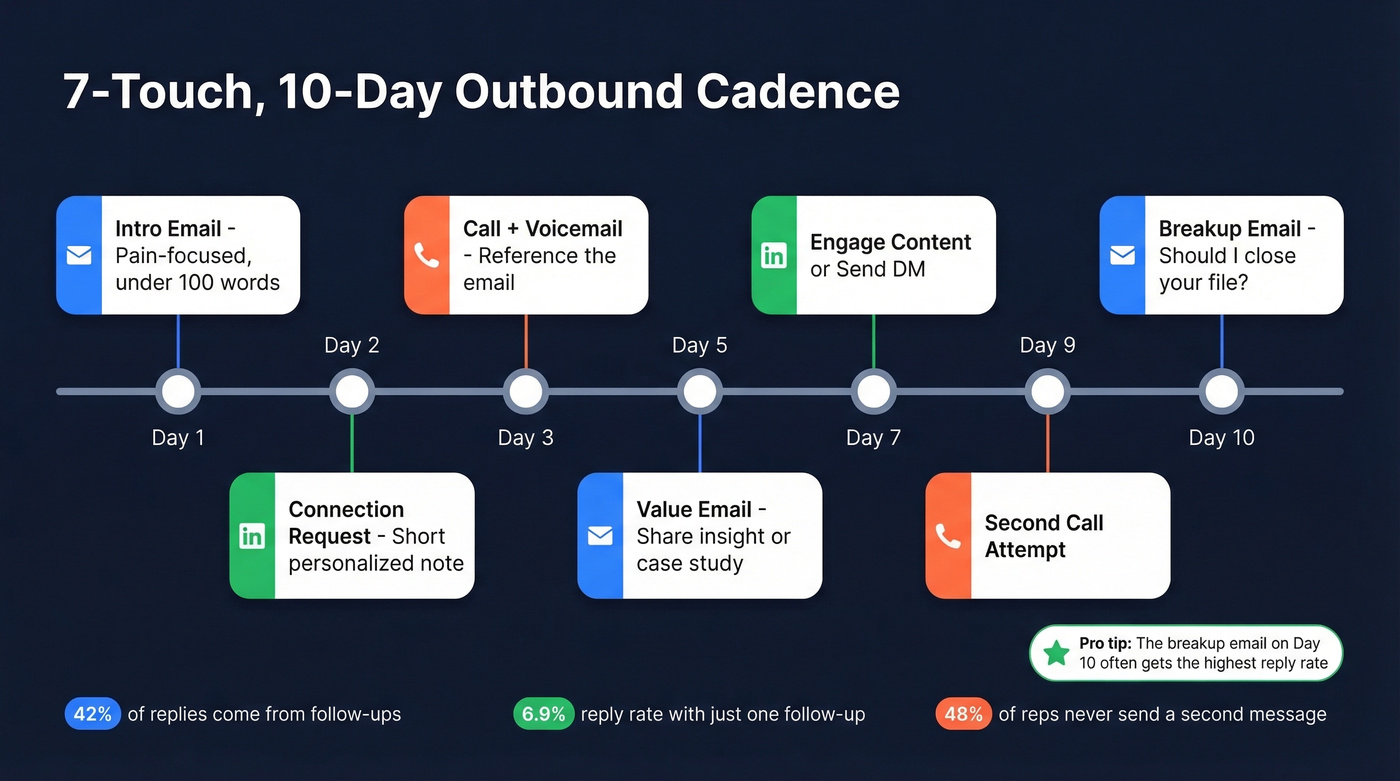
Here's a 7-touch, 10-day cadence structure you can adapt:
| Day | Channel | Action |
|---|---|---|
| 1 | Intro email - pain-focused, under 100 words | |
| 2 | Social | Connection request with a short note |
| 3 | Phone | Call + voicemail (reference the email) |
| 5 | Value email - share a relevant insight or case study | |
| 7 | Social | Engage with their content or send a DM |
| 9 | Phone | Second call attempt |
| 10 | Breakup email - "Should I close your file?" |
The first call should happen within 48 hours of the initial email - that timing matters because 42% of all replies come from follow-ups, yet 48% of reps never send a second message. A 2-email sequence with one follow-up generates the highest response rates at 6.9%, so even minimal follow-up dramatically outperforms a single touch. In our experience, the breakup email on Day 10 often generates the highest reply rate of the entire sequence.
Sample intro email:
Subject: Quick question about [specific pain point] at [Company]
Hi [First Name],
[Company] is scaling [specific initiative] - which usually means [specific pain point] starts eating into your team's time.
We helped [similar company] cut [metric] by [result] in [timeframe]. Took one call to scope it.
Worth 15 minutes this week?
Sample breakup email:
Subject: Closing your file
Hi [First Name],
I've reached out a few times and haven't heard back - totally fine. I'll assume the timing isn't right and close out your file.
If [pain point] becomes a priority later, my calendar's here: [link]
Benchmark: A 3.43% reply rate is average. Well-targeted multichannel campaigns hit 5-8%. Below 2%? The problem is usually data quality or targeting, not your copy.
The list is everything. We've seen teams double their reply rates just by switching from a stale CRM export to verified contacts with direct dials. Prospeo's 30+ search filters (intent data, technographics, job changes) help you target the right accounts, and 98% email accuracy keeps your domain clean from Day 1. (If you're rebuilding your outbound stack, compare outbound lead generation tools and SDR tools.)
2. Lead Nurturing Drip Sequence
Use this if: You have warm leads (webinar attendees, content downloaders, trial signups) who aren't ready to buy yet.
Skip this if: You're trying to generate net-new pipeline from cold prospects. Drip sequences nurture - they don't prospect. For cold pipeline, run an outbound lead generation campaign instead.
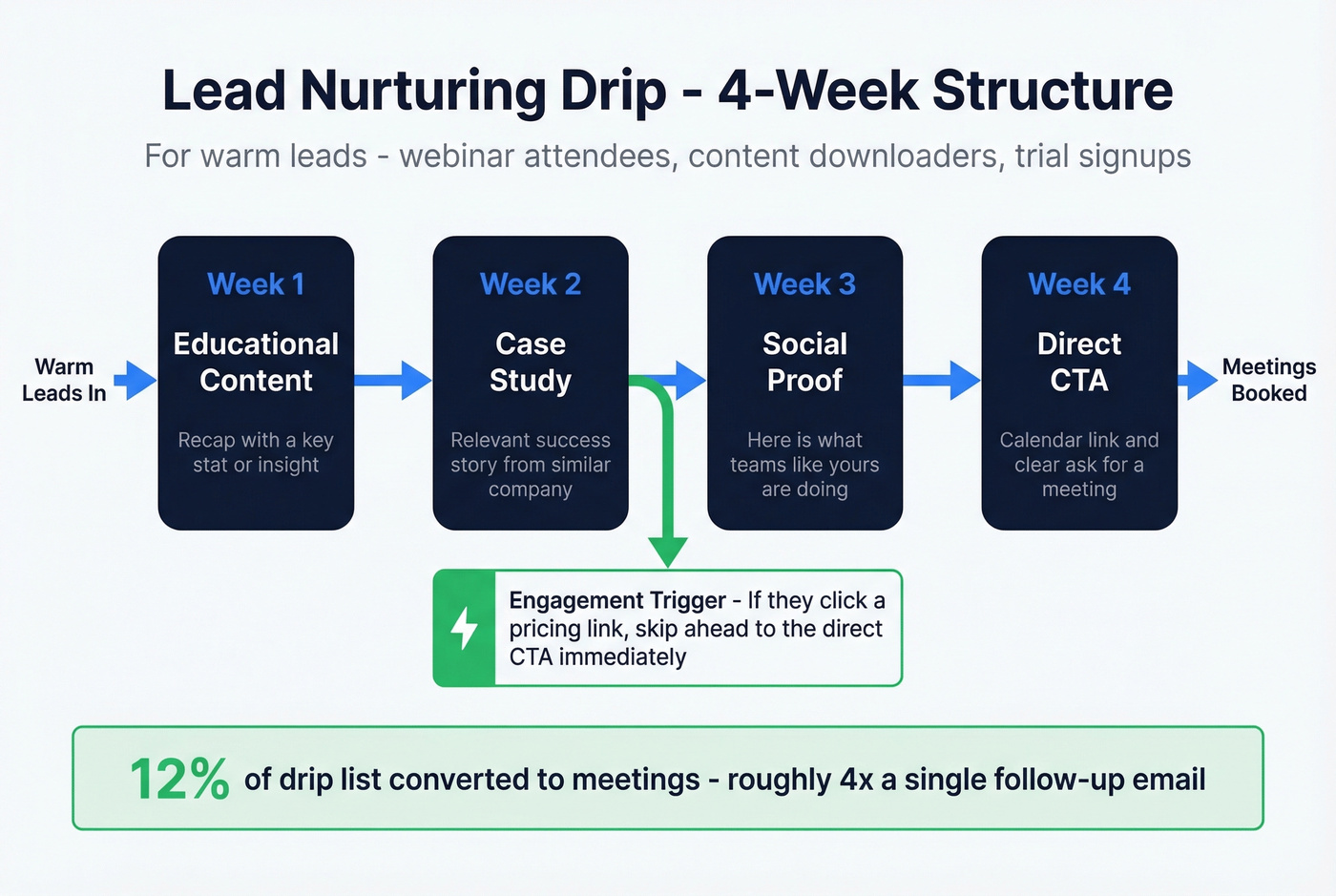
This is a longer timeline - 4-6 touches over 3-4 weeks, spaced further apart than outbound. Structure it as: educational content, then case study, then soft ask, then direct CTA. The key principle from Highspot's research: adapt to buyer behavior rather than running a rigid sequence. If someone clicks a pricing link in touch #2, don't wait until touch #4 to offer a demo. Trigger the next step based on engagement signals. (More on this approach in personalized drip campaigns.)
One scenario we've seen work well: a SaaS company ran a 4-week drip on webinar attendees who didn't book during the live session. Touch #1 was a recap with a key stat from the webinar. Touch #2 was a relevant case study. Touch #3 was a "here's what teams like yours are doing" email. Touch #4 was a direct ask with a calendar link. They converted 12% of the drip list to meetings - roughly 4x what a single follow-up email would've produced.
3. Account-Based Campaign
ABM campaigns target specific accounts with personalized, multi-threaded outreach. The Revenue Operations Alliance frames ABM by funnel stage - awareness, consideration, post-purchase - and the channel mix is broader than standard outbound (display ads, direct mail, events alongside email and phone).
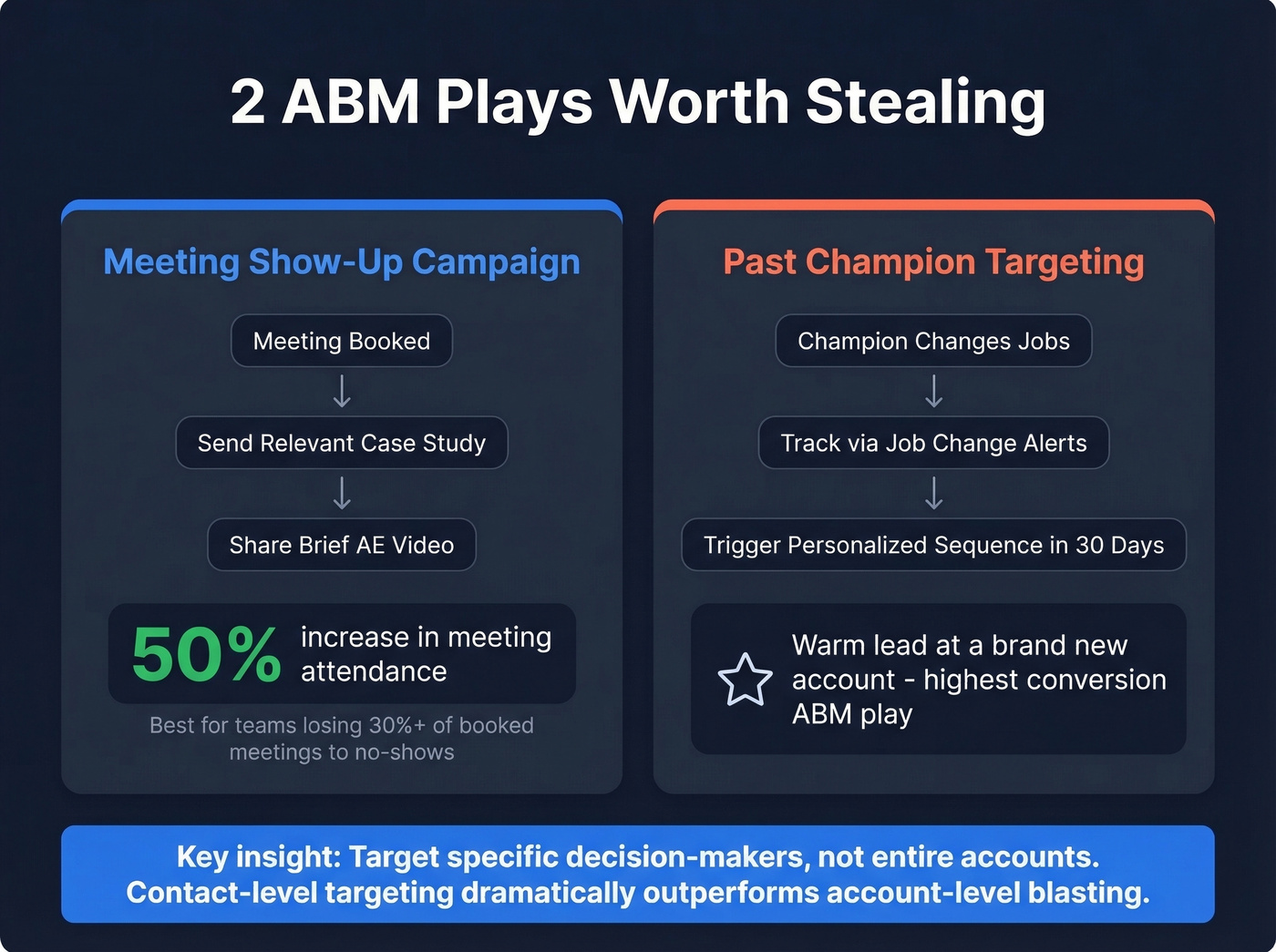
The critical distinction: contact-level targeting beats account-level blasting. Influ2's data shows that targeting specific decision-makers with personalized ads dramatically outperforms generic account-wide campaigns. (If you're operationalizing this, use account-based selling best practices to keep targeting tight.)
Two plays worth stealing:
Meeting show-up campaign. After booking a meeting, run a short sequence of personalized touchpoints - a relevant case study, a brief video from the AE - to keep the prospect engaged. Influ2 reports this increased meeting attendance by 50%. If you're losing 30%+ of booked meetings to no-shows, this is the highest-leverage fix available.
Past champion targeting. When a champion at a closed-won account changes jobs, they're a warm lead at a new company. Track job changes and trigger a personalized sequence within the first 30 days of their new role. Prospeo's job change filters surface these signals automatically, so you can build a targeted list the moment a champion moves.
4. Competitive Displacement Campaign
This is a sniper campaign, not a shotgun. You're targeting prospects who use a specific competitor and hitting them when they're most likely to switch.
Trigger events to watch for: Competitor price increases (especially annual renewal windows), product outages or negative press, leadership changes at the prospect company, or public complaints on review sites. (To systematize this, build a competitive intelligence strategy.)
Message angle: Don't trash the competitor. Lead with the specific pain their users experience and show how you solve it differently.
Sample subject line: "Noticed [Company] uses [Competitor] - quick question"
Sample opening: "I noticed [Company] uses [Competitor]. A lot of teams in [industry] tell us [specific frustration] - here's how [3 customers] solved it."
Specificity is what makes displacement campaigns work. Generic "we're better" messaging gets deleted.
5. Win-Back / Reactivation Campaign
Reactivating a former customer is 5x more cost-effective than acquiring a new one, and 45% of win-back email recipients go on to read subsequent messages from the brand. Even if the first touch doesn't convert, you're rebuilding the relationship.
Here's the thing: if your average deal is under $10K, win-back campaigns are probably a better use of your team's time than cold outbound. You already have context, usage data, and a relationship to reference. Most teams ignore churned accounts entirely and spend 5x more chasing strangers. That's backwards. (If you need a framework, start with churn analysis.)
Segment churned accounts by inactivity window:
- ~90 days: Light re-engagement - new feature announcement, relevant content
- 90-120 days: Direct outreach with a specific offer or use case
- 120+ days: Heavier lift, may need executive-level outreach or a new champion
Sample subject line: "Things have changed since you left, [First Name]"
Before you launch, diagnose why they left. Review usage trends, NPS scores, and termination reasons. Prioritize accounts that still match your current ICP and show positive signals like renewed website activity.
6. Trial-to-Paid Conversion
Three phases, timed around the trial window:
Activation (Days 1-3): Get the user to complete the core action that demonstrates value. If they haven't completed onboarding by Day 2, trigger a guided walkthrough email.
Value (Days 4-10): Share use cases and tips tied to what they've actually done in the product. Behavioral triggers beat calendar-based sends every time.
Urgency (Days 11-14): Trial expiration countdown. Send a "here's what you'll lose" email 48 hours before expiration, listing the specific features they used most. A phone call from an AE at this stage converts significantly better than email alone - we've seen it double conversion rates on deals over $5K.
7. Event / Webinar Follow-Up
Speed-to-lead is everything here.
Your follow-up sequence should start within 24 hours for high-intent attendees, 48 hours max for everyone else. Segment by engagement level: attendees who stayed for the full session and asked questions get a personalized email plus a phone call. Registrants who didn't attend get a recording link and a softer ask. Don't wait a week - by then, they've forgotten your session and three competitors have already reached out.
Sales Campaign Benchmarks for 2026
Here's what "good" looks like right now. Use these to calibrate expectations and diagnose underperformance.
| Metric | Benchmark | Context |
|---|---|---|
| Cold email open rate | 27.7% | 2026 benchmark |
| Cold email reply rate | 3.43% | Platform-wide average |
| Emails that never reach inbox | ~17% | Bounces + spam filtering |
| Replies from follow-ups | 42% | Why follow-ups aren't optional |
| 2-email sequence response rate | 6.9% | Optimal minimum follow-up |
| Multichannel vs email-only lift | 287% | Email + phone + social combined |
| Best day to launch | Monday | Highest initial open rates |
| Best day for follow-ups | Wednesday | Peak mid-week engagement |
| Optimal send window | 9:30-11:30 AM | Recipient's local time |
Sources: Martal cold email statistics, Snov.io 44M email analysis
If your reply rate is below 2%, fix the list first. Not the copy. Not the subject line. The list.
5 Mistakes That Kill Campaigns
1. Launching on dirty data. 28% of B2B emails decay every year. Launch a campaign on a stale list and you're burning your domain reputation - and 17% of cold emails never reach the inbox even under normal conditions. Meritt saw bounce rates drop from 35% to under 4% and pipeline triple from $100K to $300K/week after switching to verified data with a 7-day refresh cycle.
2. Running single-channel campaigns. Email-only outbound misses the 287% performance lift that multichannel delivers. If you're not combining email with phone and social, you're competing with one hand tied behind your back.
3. Giving up after one touch. 48% of reps never send a second email. 42% of all replies come from follow-ups. The math is brutal and obvious - yet most teams still under-invest in follow-up sequences.
4. Targeting the wrong stakeholders. NetSuite's research highlights a classic failure: speaking to people who can't actually make the buying decision. Qualify your list for decision-making authority before you launch, not after you've burned through your best messaging. (If you're tightening qualification, use MEDDIC sales qualification.)
5. Never iterating. The campaign you launch in January shouldn't be the same campaign you're running in June. Test subject lines, adjust timing, and refresh messaging based on what's actually converting. Teams that treat campaigns as living documents consistently outperform the ones running the same playbook all year.
The Open Tracking Trick Nobody Talks About
Something counterintuitive: a Snov.io analysis of 44M emails found that turning off open tracking more than doubled reply rates - 2.36% vs 1.08%. That's not a marginal difference. That's a 2x improvement from a single settings change.
The reason is straightforward. Open tracking pixels hurt deliverability and drag down performance. Most email platforms enable tracking by default, and most reps never think to turn it off. If you're optimizing subject lines and copy but haven't touched your tracking settings, you're leaving the easiest win on the table. Turn off open tracking. Measure replies instead.
That pipeline math only works if your contact data connects you to real people. Prospeo gives you 300M+ profiles with 30+ filters - buyer intent, tech stack, headcount growth - so you can segment tight ICPs and launch any of these 7 campaign structures with contacts that actually convert. At $0.01 per email, one campaign pays for itself with a single meeting booked.
Build the exact prospect list these campaigns need in minutes.
FAQ
How long should a B2B sales campaign run?
Most B2B campaigns run 2-6 weeks. Standard outbound typically uses 7-10 touchpoints over 10-14 days. ABM and win-back campaigns stretch to 4-8 weeks due to longer decision cycles and multi-threaded stakeholder engagement.
What's a good reply rate for cold email in 2026?
The current benchmark is 3.43% across all industries. Top multichannel campaigns hit 5-8%. Below 2% usually signals a data quality or targeting problem - verify your list before blaming your copy.
How many touchpoints should a campaign have?
Seven to ten across at least three channels. 42% of replies come from follow-ups, and 48% of reps never send a second message. More touches across more channels wins consistently.
What's the biggest reason outbound campaigns fail?
Bad data. If 28% of your list decays annually and you don't verify before launching, you'll burn your domain reputation and tank deliverability for every future campaign. Verify your list before every launch - Meritt cut bounces from 35% to under 4% by switching to a 7-day refresh cycle.
How is outbound prospecting different from a nurture sequence?
Outbound prospecting targets cold prospects who haven't engaged with your brand, using direct outreach to create pipeline from scratch. A nurture sequence warms up leads who already know you - webinar attendees, content downloaders, trial signups - with educational content over a longer timeline.