

The Complete Guide to Becoming a Sales Closer in 2026
You're an SDR who's been booking meetings for over a year, watching your AE collect the commission check while you get a $50 spiff and a "great job" Slack message. Or maybe you're an AE running full-cycle deals without the comp to match. Either way, you want to become a sales closer - and the internet keeps serving you job board listings and $5K course funnels instead of actual guidance.
The average B2B close rate sits around 29%. Deals now take 62 touches across three or more channels before they land. Closing is harder than it's ever been, and more valuable than it's ever been.
What You Need (Quick Version)
What the role is: The person who converts qualified pipeline into revenue. Bottom-of-funnel specialist, not a lead generator.
What it pays: $110K median OTE in the US, with a typical range of $86K-$143K. Base salary alone runs $53K-$81K depending on industry and geography. (If you want to sanity-check OTE math, see OTE.)
How to get there: SDR/BDR → AE or Inside Sales Rep → Closer. Expect 18-36 months before you're running closing calls solo. A structured ramp like a 30-60-90 day plan helps you move faster.
The one thing most people get wrong: Your close rate is a qualification problem before it's a skills problem. The best closers don't have a magic phrase - they qualify ruthlessly so they only pitch deals that are going to close. (Use an ideal customer profile to make this measurable.)
What Is a Sales Closer?
A sales closer takes a qualified prospect from "interested" to "signed." They sit at the bottom of the funnel, after marketing has generated the lead and an SDR has qualified the opportunity. Their job isn't to generate demand - it's to convert it.
That distinction matters. Order-takers process inbound requests. Closers navigate objections, build urgency, align stakeholders, and ask for the commitment when the moment is right. The title "closer" is most common in high-ticket environments where deals run $3K and up - coaching programs, consulting engagements, solar installations, real estate, and enterprise SaaS.
A typical day looks like two to four scheduled closing calls, each running 30-60 minutes. Between calls, you're reviewing CRM notes, prepping for objections specific to each prospect, following up on proposals, and coordinating with the SDR or marketing team on pipeline quality. The best closers spend more time preparing than talking. By the time they're on the call, the outcome is almost predetermined - because they've already done the work upstream.
Closer vs AE vs SDR
The titles blur across companies, but the functions don't:
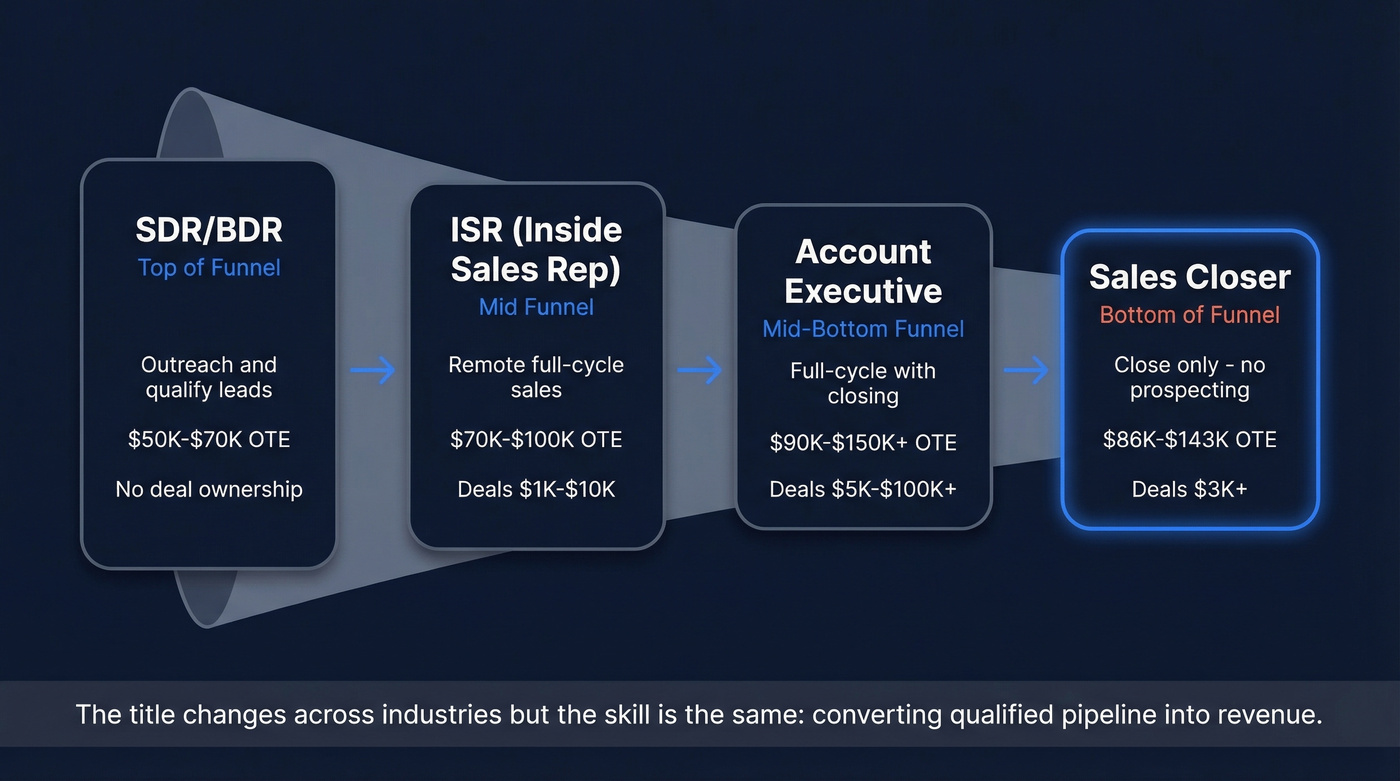
| Role | Funnel Stage | Primary Activity | Typical Comp | Deal Size |
|---|---|---|---|---|
| SDR/BDR | Top | Outreach, qualify | $50-70K OTE | N/A |
| ISR | Mid | Remote full-cycle | $70-100K OTE | $1K-$10K |
| AE | Mid-Bottom | Full-cycle, close | $90-$150K+ OTE | $5K-$100K+ |
| Closer | Bottom | Close only | $86-$143K OTE | $3K+ |
In SaaS, the person closing enterprise deals is called an AE. In coaching and consulting, the same skill set gets the "closer" label. The title matters less than the skill - can you take a qualified opportunity and turn it into revenue?
The $3K threshold is where the dedicated closing specialist becomes most common. Below that, the economics don't support a separate role. Above it, the conversation gets complex enough that someone who does nothing but close can dramatically improve conversion rates. (If you want the full funnel context, start with a B2B sales funnel template.)
Salary and Compensation in 2026
Base vs OTE
The gap between base salary and OTE tells you everything about how a company values closing. Glassdoor puts the median total pay at $110K/year, with a range of $86K-$143K. Base pay alone runs $53K-$81K, meaning $33K-$62K of your comp comes from variable pay.
The national average for the generic "Closer" title on Salary.com is $56,683 - but that includes non-sales roles, so it skews low. City-level data tells a clearer story:
| City | Avg. Salary |
|---|---|
| San Jose | $71K |
| San Francisco | $71K |
| New York | $66K |
| Washington, DC | $62.8K |
For high-ticket remote closing in coaching and consulting, location matters less - your comp is tied to deal flow and commission percentage, not a local salary band.
Commission Models
Three comp structures dominate the closer world: salary plus commission, commission-only, and base plus uncapped variable.
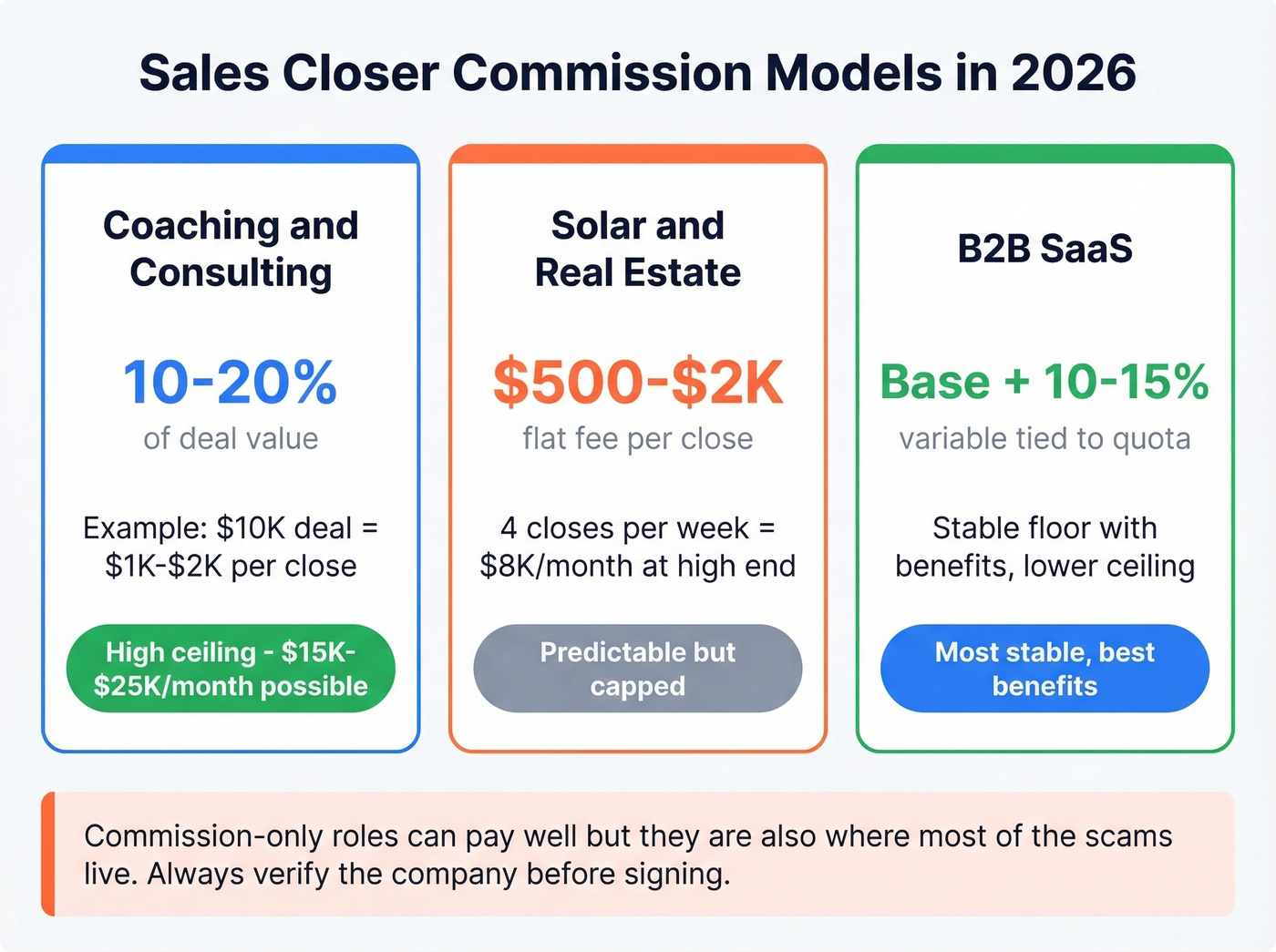
Coaching and consulting typically pays 10-20% of deal value. On a $10K coaching package, that's $1K-$2K per close. High-volume closers running four to five calls a day can clear $15K-$25K/month.
Solar and real estate pays flat fees of $500-$2K per close, sometimes with volume bonuses. Predictable but capped.
SaaS offers a salaried base plus 10-15% variable tied to quota attainment. More stable, lower ceiling, but you get benefits and a floor.
Commission-only roles can be lucrative, but they're also where most of the scams live. More on that below.
How to Become a Sales Closer
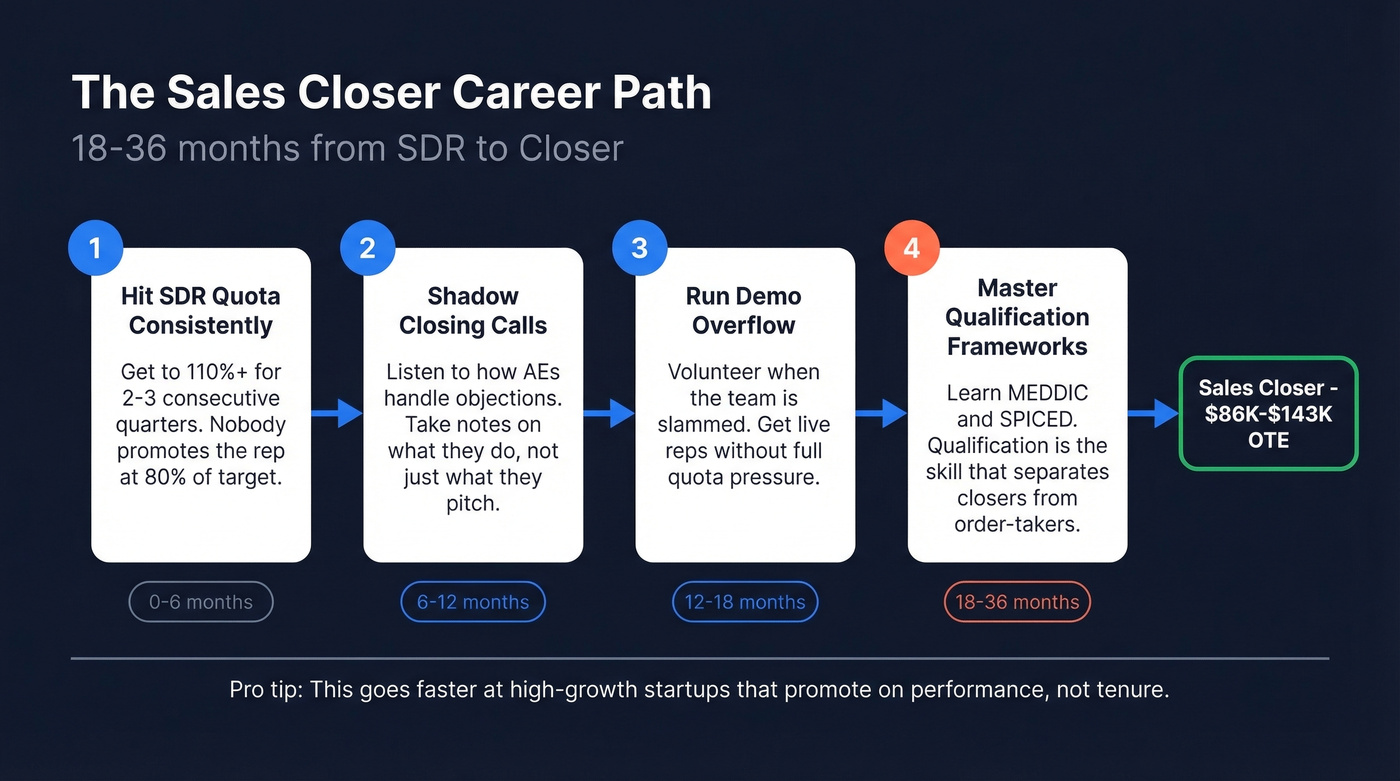
The standard path runs SDR/BDR → Inside Sales Rep or AE → Closer. Expect 18-36 months of progression, faster if you're at a high-growth startup where reps get promoted on performance rather than tenure.
A 24-year-old car salesman on Reddit closing at about 25% captures the exact gap most aspiring closers face: strong rapport, solid product knowledge, good needs assessment - but weak negotiation skills and an inability to close buyers who aren't already leaning yes. That's the gap. Closing the easy ones isn't closing. Closing the uncertain ones is. (If negotiation is your weak spot, learn how to use an anchor in negotiation without being manipulative.)
Here's the practical playbook:
Hit your SDR quota consistently. Nobody promotes the rep at 80% of target. Get to 110%+ for two or three consecutive quarters. If you need more top-of-funnel reps, use proven sales prospecting techniques.
Ask to shadow closing calls. Most AEs will let you listen in. Take notes on how they handle objections, not just what they pitch.
Volunteer for demo overflow. When the team is slammed, offer to run initial demos. This is how you get live reps without the full quota pressure. Use a product demo checklist so you don’t wing it.
Study qualification frameworks before technique. MEDDIC and SPICED will do more for your close rate than any "magic close" script. Qualification is the skill that separates closers from order-takers. (Start with MEDDIC sales qualification.)

You said it yourself: qualification is the skill that separates closers from order-takers. Prospeo's 30+ search filters - buyer intent, technographics, funding, headcount growth - let you qualify prospects before you ever pick up the phone. 98% email accuracy means your follow-ups actually land.
Stop closing blind. Qualify ruthlessly with data that's refreshed every 7 days.
Closing Techniques That Work
You just got off a 45-minute call that felt perfect. The prospect said "this sounds great." Then they asked for a follow-up email and ghosted. Sound familiar?
The problem usually isn't your close - it's everything that came before it. (Tighten your post-call process with sales follow-up templates.)
Three Closes Worth Mastering
The assumptive close frames next steps as already agreed. Instead of "Would you like to move forward?" you say "Let's get the $48K annual contract over to you this afternoon - does your legal team need anything specific?" It works because it removes the awkward decision moment and replaces it with logistics. In our experience, this is the single most effective close for deals where the prospect has already verbally confirmed fit.
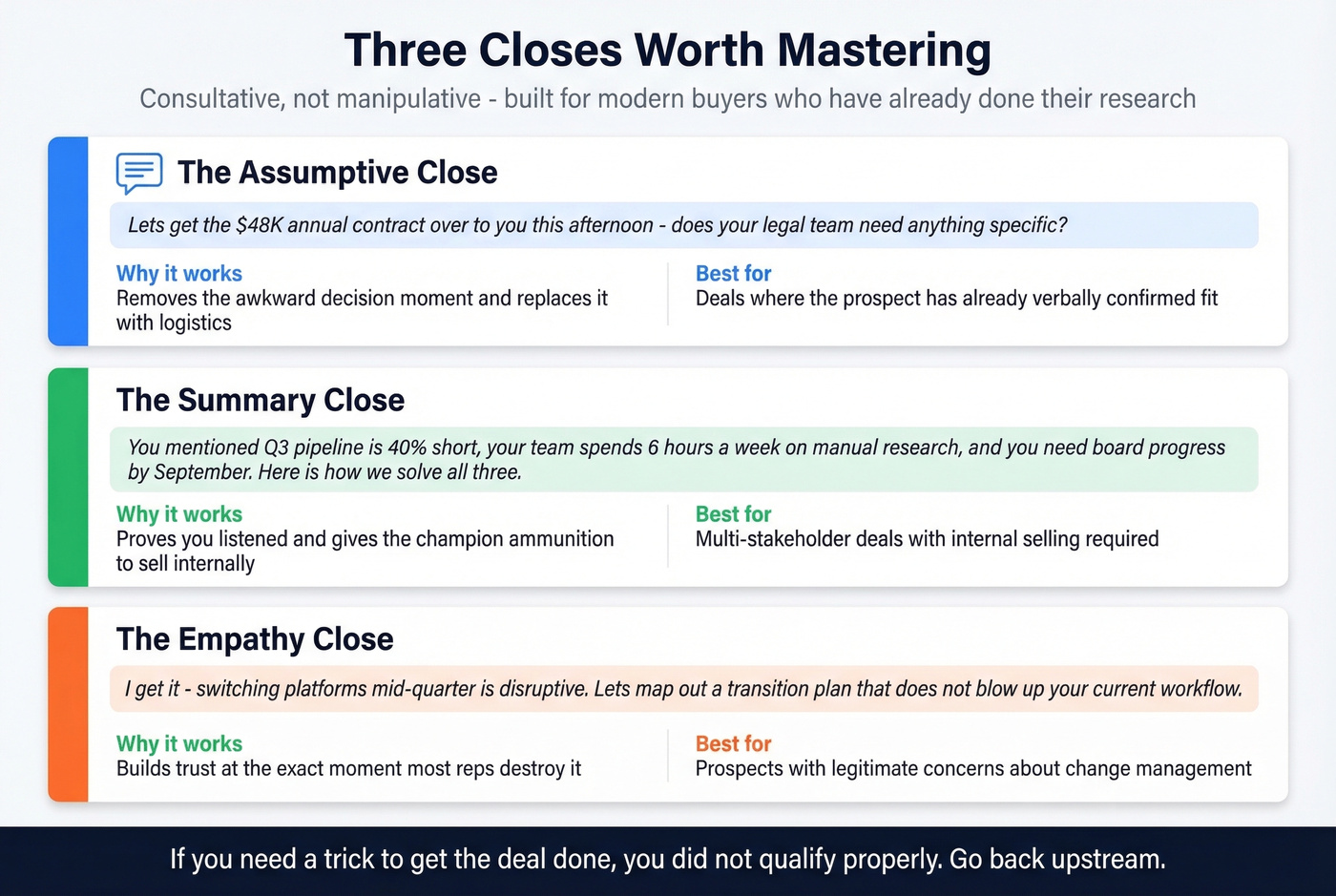
The summary close recaps the prospect's priorities, the risks of inaction, and how your solution maps to their business case. "You mentioned Q3 pipeline is 40% short, your team is spending 6 hours a week on manual research, and you need to show the board progress by September. Here's how we solve all three." This works because it proves you listened - and it gives the champion ammunition to sell internally.
The empathy close validates concerns instead of bulldozing them. "I get it - switching platforms mid-quarter is disruptive. Let's map out a transition plan that doesn't blow up your current workflow." It builds trust at the exact moment most reps destroy it.
All three are consultative, not manipulative. They work because modern buyers have already done their research before they talk to you.
Techniques to Retire
The deadline close ("this price is only good today"), the sharp-angle close, the Ben Franklin close - retire all of them. These tactics were built for an era when the buyer had less information than the seller. That era is over. If you need a trick to get the deal done, you didn't qualify properly - go back upstream and run MEDDIC or SPICED on the opportunity before your next call.
Mistakes That Kill Your Close Rate
With close rates hovering around 29% and deals requiring 62 touches before they convert, there's a massive gap between effort and results. We've watched reps make the same mistakes for years, and the list is depressingly consistent.
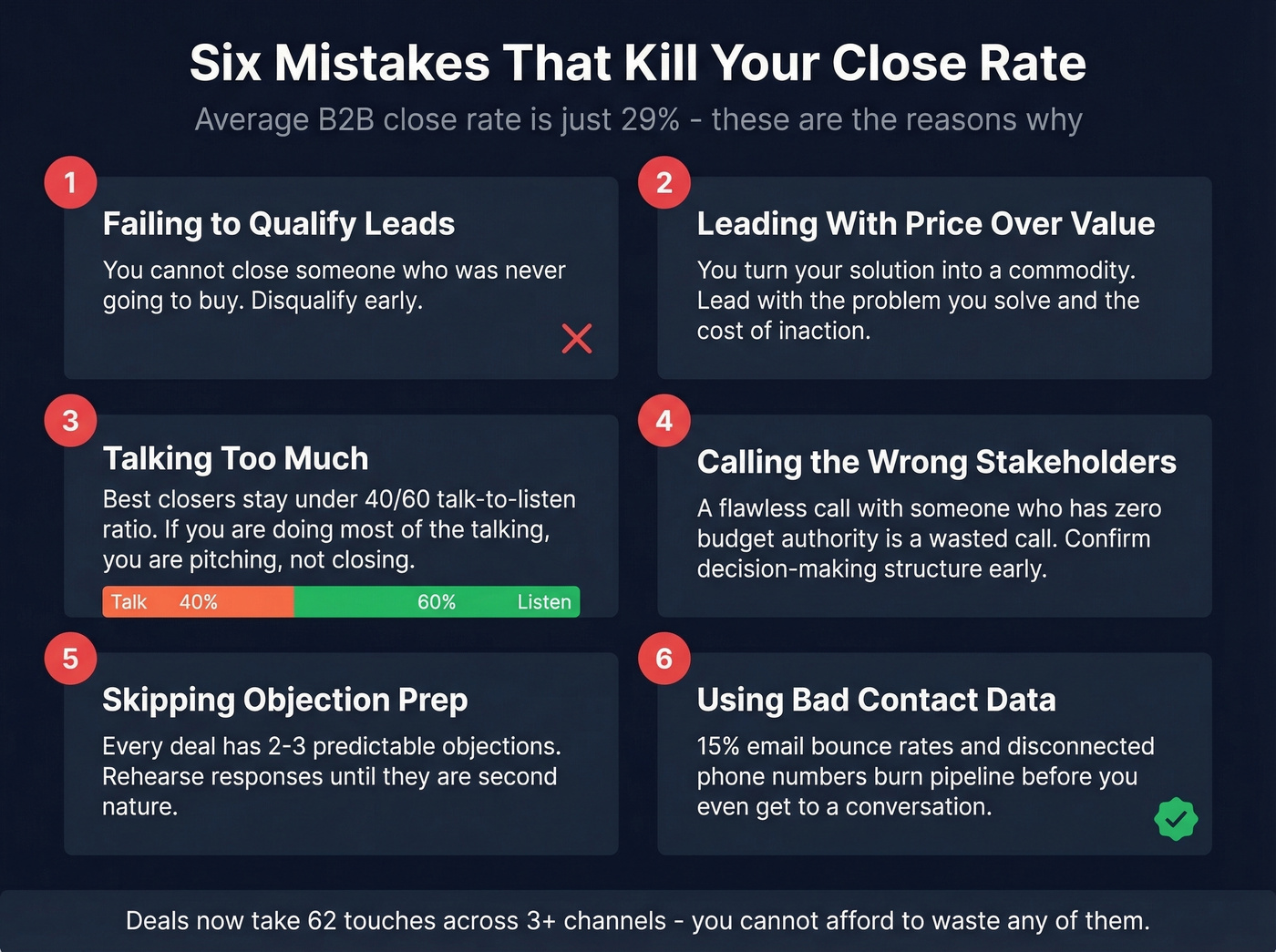
Failing to qualify leads is the number one killer. You can't close someone who was never going to buy. Spend more time disqualifying early and your close rate jumps overnight. (If you want a system, implement lead scoring.)
Emphasizing price over value turns your solution into a commodity. Lead with the problem you solve and the cost of inaction - not the line item on a proposal.
Talking too much is the silent deal-killer. The best closers maintain a talk-to-listen ratio under 40/60. If you're doing most of the talking, you're pitching, not closing.
Calling the wrong stakeholders wastes everyone's time. You can run a flawless call with a champion who has zero budget authority. Always confirm the decision-making structure early.
Skipping objection prep guarantees you'll fumble live. Every deal has two to three predictable objections. Rehearse responses until they're second nature.
Using bad contact data tanks your close rate before you even get to a conversation. If 15% of your emails bounce and a third of your phone numbers are disconnected, you're burning pipeline. Tools like Prospeo - with 98% email accuracy and a 7-day data refresh cycle - exist specifically so closers can actually reach the people they need to talk to.
Tools Every Closer Needs
Closing skill matters, but it sits on top of a tech stack. Without the right tools, even great closers waste hours on admin and miss opportunities.
CRM
Salesforce for enterprise teams, HubSpot for everyone else. Your CRM is where deal intelligence lives - stage progression, stakeholder mapping, activity history. If you're not logging religiously, you're flying blind on every call. (If you’re evaluating options, see examples of a CRM.)
Conversation Intelligence
Gong is the standard. It records your calls, surfaces coaching moments, and shows you exactly where deals stall. The pattern recognition alone - seeing that deals die when you skip the budget conversation - is worth the investment. Expect $100-$200/user/month for mid-market teams.
Verified Prospect Data
Before you can close anyone, you need to reach them. Prospeo gives you 300M+ professional profiles with 98% email accuracy, which means almost zero bounces. Their 125M+ verified mobile numbers hit a 30% pickup rate - roughly 2-3x what you'll get from most data providers. Data refreshes every seven days, so you're not calling disconnected numbers from a six-week-old export. The free tier gives you 75 verified emails per month, enough to test whether data quality is the bottleneck killing your connect rates. (If you’re comparing vendors, start with data enrichment services.)

The best closers spend more time preparing than talking. Prospeo gives you 50+ data points per contact - verified emails, direct dials, tech stack, intent signals - so you walk into every closing call knowing exactly who you're talking to and what they care about.
125M+ verified mobile numbers. 30% pickup rate. Reach the decision-maker directly.
Dialer and Sequencing
Aircall or Orum for parallel dialing, paired with Outreach or Salesloft for multi-channel cadences. The dialer gets you more at-bats per hour. The sequencer makes sure no follow-up falls through the cracks. Pair these with verified contact data and you're reaching the right people through coordinated touchpoints.
Finding Legitimate Closer Jobs
Here's the thing: the "high-ticket closer" job market is a minefield. The consensus on r/sales is blunt - many "closer" job postings on Indeed and in Facebook groups are funnels designed to sell you a $5K sales course, not actual employment. We've seen reps waste months in commission-only roles that turned out to be course funnels disguised as jobs.
Red flags that scream "walk away":
- The "interview" feels more like a sales pitch for a training program
- Commission-only with no named product, company website, or client references
- Vague company information and a heavy emphasis on "mindset" over process
- They want you to pay for onboarding, training, or "certification"
What a legitimate job description looks like: It names the company and product. It specifies the deal size and average sales cycle. It describes the comp structure with a realistic OTE range, not just "uncapped earnings." It mentions CRM tools and a defined sales process. If the posting reads like a motivational poster instead of a job description, keep scrolling.
Where to find real roles:
- Closers.io runs a legitimate placement service - they charge the employer a $5K+ recruitment fee, not you
- Direct outreach to coaching companies, consulting firms, and agencies selling $3K+ packages - many don't post publicly
- SaaS companies hiring AEs with a closing focus - search for "Account Executive" roles that emphasize bottom-of-funnel ownership
- Referrals from other closers - the legitimate high-ticket world is small and reputation-driven
AI and the Future of Closing
Sales professionals spend up to 40% of their time on administrative tasks - CRM updates, call summaries, proposal formatting, scheduling. AI is eating that 40% fast.
AI sales agents are already handling autonomous discovery calls, initial demos, and intelligent scheduling around the clock. They can qualify leads, navigate basic objections, and push data straight into Salesforce - all without a human touching it.
Here's my hot take: if your average deal size is under $10K, AI will handle most of your closing within two years. The human closer becomes essential - irreplaceable, really - above that threshold. Building trust in a six-figure deal, reading the emotional subtext when a CFO hesitates, navigating multi-stakeholder politics where three VPs have competing priorities - that's human territory for the foreseeable future. The closers who thrive in 2026 and beyond will let AI handle the admin so they can spend more time on the conversations that actually move revenue.
FAQ
What's the difference between a closer and an account executive?
The roles overlap significantly. "Closer" is most common in high-ticket environments selling packages above $3K - coaching, consulting, solar. "Account Executive" is the standard title in SaaS and enterprise sales. The core skill set is identical: converting qualified pipeline into revenue.
How long does it take to become one?
Most reps make the transition in 18-36 months, starting from an SDR or BDR role. High performers at fast-growing companies can move faster. The key milestones are consistent quota attainment, experience running demos, and demonstrated ability to handle objections independently.
Is "high-ticket closer" a real job?
Yes, but proceed with caution. Legitimate roles exist in coaching, consulting, and agency sales where closers earn 10-20% commission on $3K-$25K deals. Many job postings - especially on Indeed and in Facebook groups - are scams disguised as course funnels. If the interview feels like a sales pitch, walk away.
What's a good close rate?
The B2B average is roughly 29%. Top performers who qualify rigorously and focus on well-fitted opportunities consistently hit 40-50%+. If you're below 25%, the problem is almost certainly upstream in your qualification process, not in your closing technique.