

Sales Dev Rep: What the Role Actually Looks Like in 2026
It's your first Monday as a sales dev rep. You've got a list of 200 accounts, a Salesforce login, and a quota card that says 12 meetings this month. Nobody told you that the average cold call converts at 2.0-3.5%.
The sales development representative role is the fastest on-ramp into tech sales - and one of the most misunderstood. The headline numbers look great: $60K base, $85K OTE at median. But 57.3% of reps actually hit quota, average tenure sits at 14-18 months, and 67% of reps report burnout. That gap between the recruiting pitch and the daily reality is where most new SDRs get blindsided.
What You Need (Quick Version)
The SDR job is straightforward on paper: prospect, qualify, book meetings. The execution is brutal. You'll make 50-80 calls a day, send 30-50 emails, and hear "no" more than any other role in the company. The median rep books 8-10 qualified meetings per month. Top performers hit 18+.
If you're interviewing for SDR roles right now, learn three things before your first day: a CRM like Salesforce or HubSpot, a sequencing tool like Outreach or SalesLoft, and a data platform like Prospeo or Apollo for building prospect lists.
What Is a Sales Development Representative?
An SDR sits at the top of the sales funnel. The sales development meaning is simple at its core: find potential buyers, qualify whether they're worth a conversation, and book meetings for account executives to close. Sales development reps bridge marketing and sales, turning raw leads and cold prospects into pipeline.
The role is almost entirely about volume and precision. You're not closing deals. You're opening doors. That distinction shapes everything - your comp structure, your daily workflow, your KPIs, and your career trajectory.
Here's a stat that explains the entire role's existence: responding within 5 minutes makes teams 9x more likely to convert an inbound lead. That alone is why companies hire dedicated SDRs instead of asking AEs to prospect.
SDR vs BDR: Does It Matter?
At many companies, SDR and BDR are interchangeable titles. Where they differ - and this is the textbook version - SDRs handle inbound leads like form fills, webinar registrations, and content downloads, while BDRs do outbound prospecting through cold calls, cold emails, and social selling. In practice, read the job description, not the title. Plenty of "SDR" roles are 100% outbound, and plenty of "BDR" roles handle inbound queues.
What Does a Sales Dev Rep Do All Day?
The daily rhythm of an SDR is repetitive by design. You're running the same plays against different accounts, refining your messaging, and trying to squeeze more meetings out of the same number of touches.
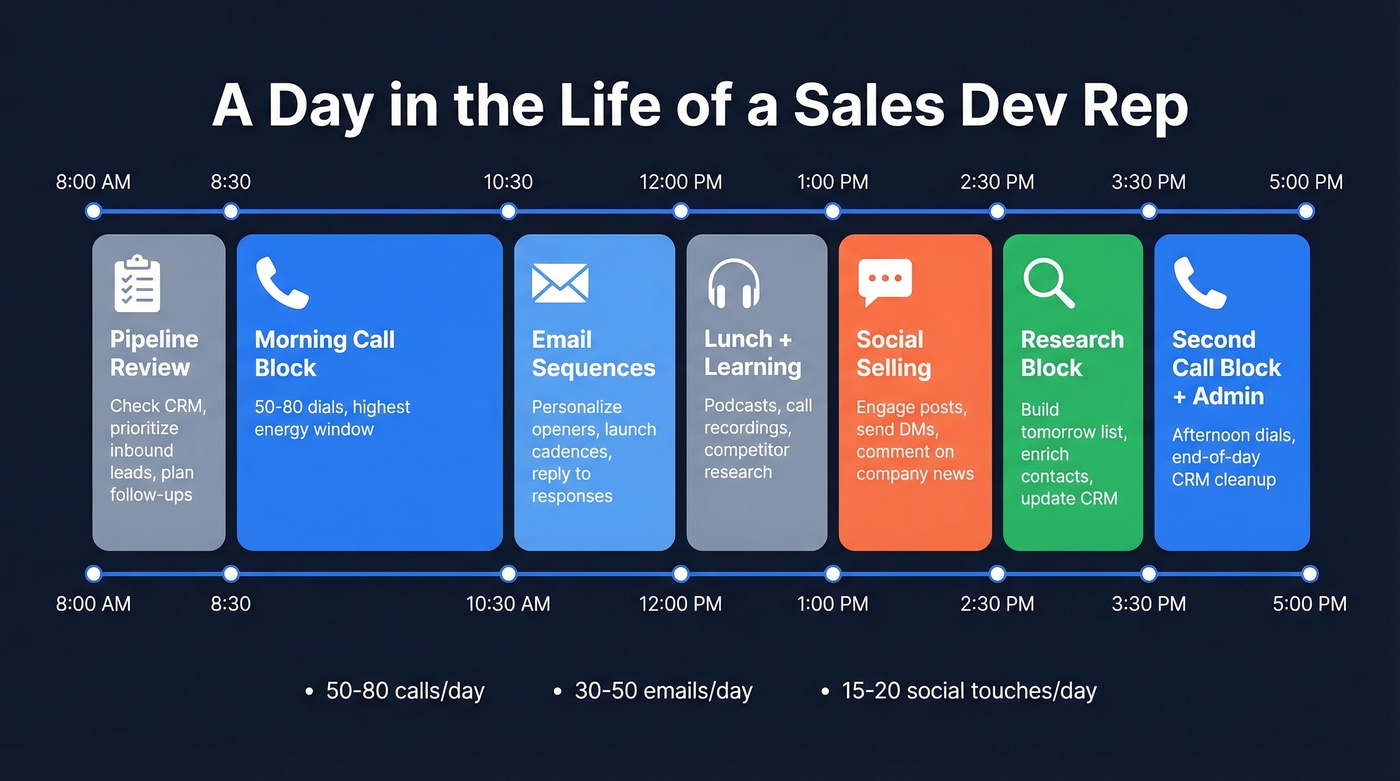
Here's what a typical day looks like, time-blocked:
- 8:00-8:30 - Review pipeline, check CRM for overnight inbound leads, prioritize follow-ups
- 8:30-10:30 - Morning call block. This is your highest-energy window - use it for dials.
- 10:30-12:00 - Email sequences: personalize openers, launch new cadences, reply to responses
- 12:00-1:00 - Lunch + learning via podcasts, call recordings, or competitor research
- 1:00-2:30 - Social touches: engage with prospects' posts, send direct messages, comment on company news
- 2:30-3:30 - Research block: build tomorrow's call list, enrich contacts, update CRM notes
- 3:30-5:00 - Second call block + end-of-day admin
The core responsibilities boil down to three things: prospecting (finding the right people), qualifying (confirming they fit your ICP), and booking (getting them on the AE's calendar). Everything else - the CRM hygiene, the research, the social selling - supports those three outcomes.
Cold calls convert at 2.0-3.5%. That means for every 100 dials, you're getting 2-3 conversations that might turn into meetings. The math is unforgiving, and it's why multi-channel sequences exist. If you want a tighter playbook, start with proven sales prospecting techniques.
SDR Activity Benchmarks and KPIs
Let's get specific. An Optifai study of 939 companies with data from Q1-Q3 2025 gives us the clearest picture of what SDR activity actually looks like across performance tiers.
Daily Activity
| Activity | Median | Top Quartile | Elite 10% |
|---|---|---|---|
| Outbound calls | 50-60 | 65-75 | 80+ |
| Cold emails | 30-40 | 40-50 | 50+ |
| Social touches | 15-20 | 20-25 | 25+ |
Meetings Per Month
| Performance Tier | Meetings/Month |
|---|---|
| Median | 8-10 |
| Top quartile | 12-15 |
| Elite 10% | 18+ |
Conversion Rates by Channel
| Channel | Conversion to Meeting |
|---|---|
| Cold call | 2.0-3.5% |
| Cold email | 0.8-2.0% |
| Social DM | 2.0-4.5% |
| Multi-touch sequence | 4.0-7.0% |
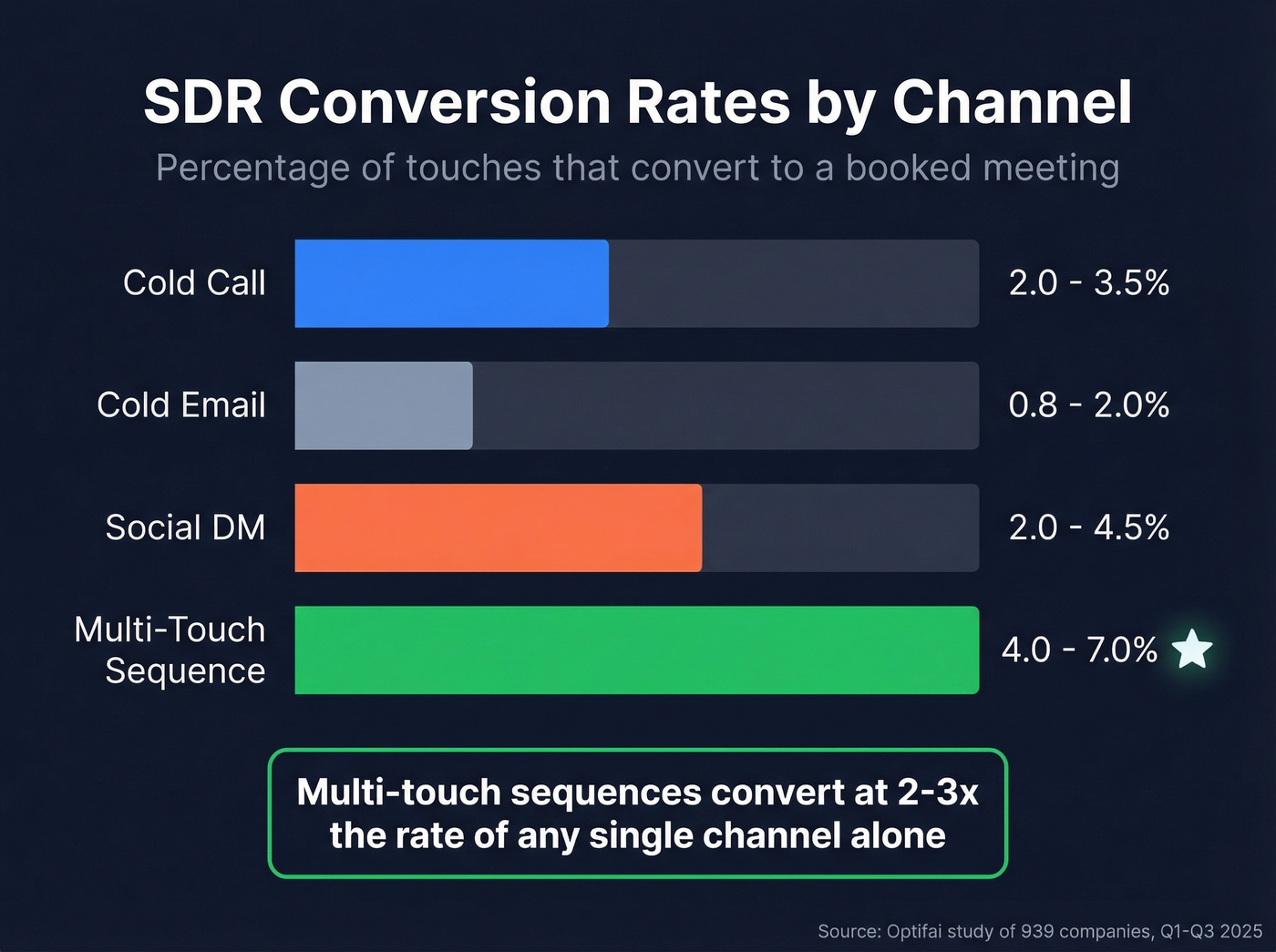
The multi-touch number is the one that matters most. Sequences combining calls, emails, and social touches convert at 2-3x the rate of any single channel alone. TOPO's research suggests 16 touches per account as a baseline, and Gartner data shows it takes 18+ dials just to connect with someone. One Keller Center study found that 1 in 59 cold calls ends in a meeting.
Stop obsessing over call volume. Multi-touch sequences at 4-7% crush single-channel cold calls at 2.0-3.5%. If you want more concrete examples, borrow from these sales activities that consistently move pipeline.
Ramp Time: What to Expect
Most SDRs take 3-4 months to reach full productivity. A typical ramp looks like this: 25% of quota in month one, 50% in month two, 75% in month three, and full quota by month four. If your manager expects 100% quota attainment in month two, that's a red flag about the company, not about you. Build your first-quarter plan like a real 30-60-90 day plan, not a vague checklist.

Cold calls convert at 2-3.5%. Bad emails bounce. The math only works when your data connects you to real buyers. Prospeo gives SDRs 300M+ profiles with 98% email accuracy and 125M+ verified mobile numbers - refreshed every 7 days, not every 6 weeks.
Stop burning dials on dead data. Build your list in minutes.
SDR Salary and Compensation in 2026
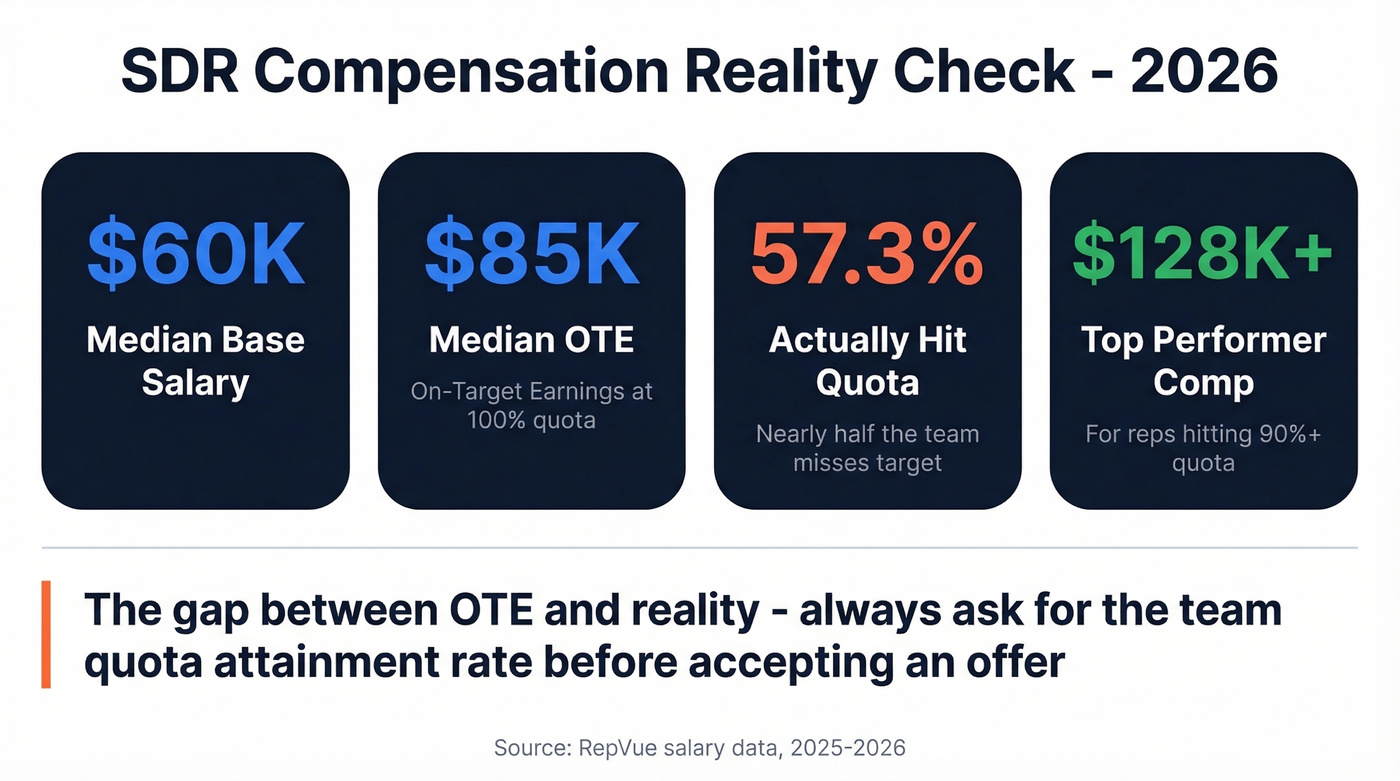
Let's talk money. RepVue-powered salary data gives us clean national benchmarks.
| Metric | National Median | Top Performer | Atlanta |
|---|---|---|---|
| Base salary | $60,000 | - | $60,000 |
| OTE | $85,000 | $128,000 | $85,000 |
| Top performer comp | - | $128,000+ | $134,809 |
| Quota attainment | 57.3% | 90%+ | 57.1% |
That $85K OTE is aspirational for nearly half the team - only 57.3% of SDRs hit quota. OTE stands for "on-target earnings," meaning base plus variable compensation if you hit 100% of your number. Miss quota, and you're taking home something closer to your base plus whatever variable you earn. (If you want the full breakdown, see OTE in sales.)
Glassdoor pegs the average SDR total pay at $99K, but that number skews high because it includes senior SDRs, high-cost-of-living markets, and companies with aggressive accelerators. For a first-year SDR at a mid-market company, $60K base / $80-85K OTE is realistic.
What Real Offers Look Like
To make this concrete: Rent posts $75K base / $125K OTE in Atlanta, Tractian offers $90K base / $122K OTE, and Manhattan Associates lists $80K base / $120K OTE. The spread is wide, and it proves that negotiation matters - especially on base salary.
The comp structure is typically 60/40 or 70/30 base-to-variable. Some companies offer monthly bonuses tied to meetings booked; others pay quarterly against pipeline generated. Ask about the comp plan structure in your interview - an OTE number with a 50/50 split and low quota attainment is worse than a lower OTE with a 70/30 split at a company where most reps hit target. If you want a framework for the conversation, use an anchor in negotiation instead of “hoping they go higher.”
Here's the frustrating part of SDR compensation: companies advertise OTE without disclosing quota attainment rates. A job posting that says "$85K OTE" without mentioning that 43% of the team misses quota is leaving out the most important number. Always ask for the team's quota attainment rate before you accept an offer.
Career Paths After the SDR Role
The sales dev rep role isn't a destination. It's a launchpad.
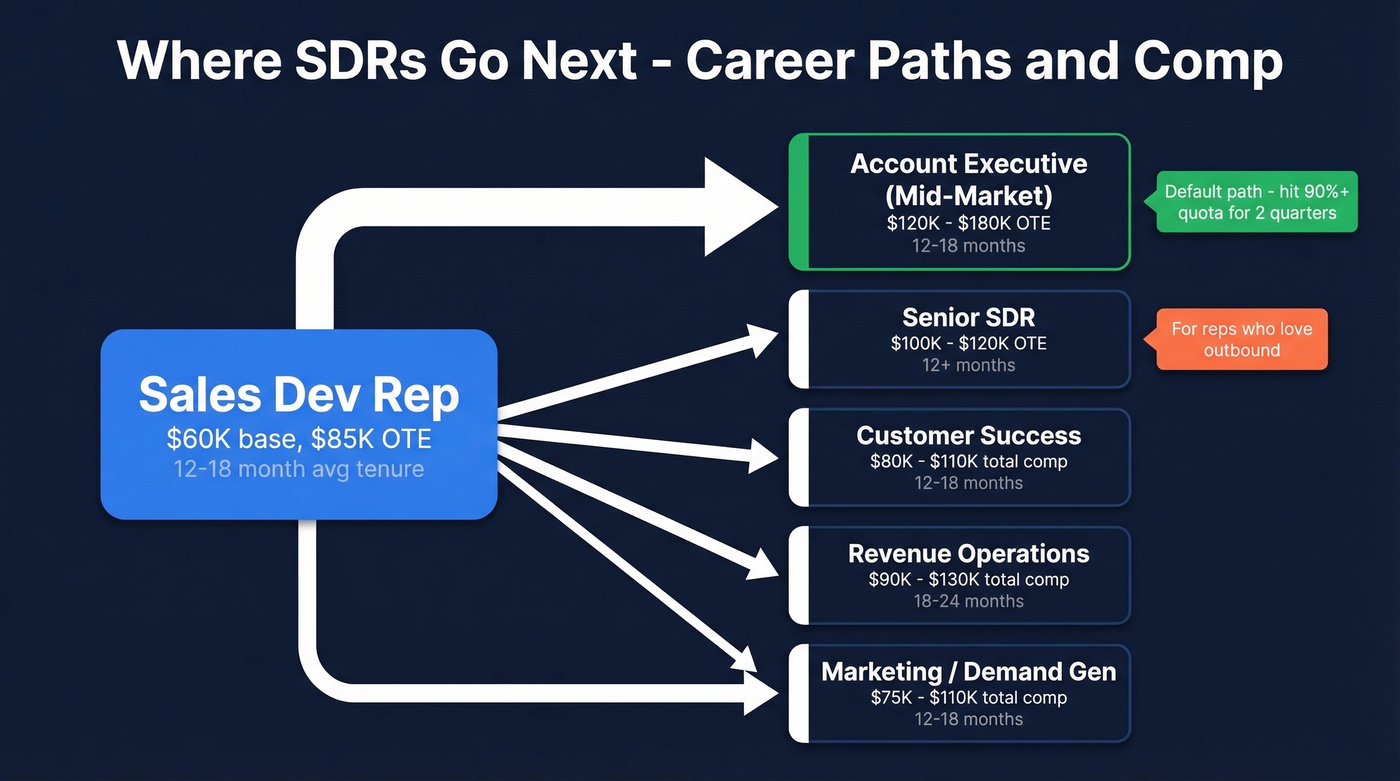
Most SDRs transition to an account executive role within 12-18 months, with high performers sometimes making the jump in 10-12 months.
The AE Path
This is the default trajectory. The promotion benchmark most managers use: hit 90%+ quota for two consecutive quarters, then make your case. Jason Lemkin argues that top SDRs expect the AE conversation within 4-6 months - and if you don't have it, they'll start interviewing elsewhere.
Smart managers test SDRs with mini-AE responsibilities before promoting: owning smaller deals, running discovery calls, or closing self-sourced opportunities. If your company won't discuss AE promotion within 12 months, start interviewing.
Alternative Paths
Not everyone wants to carry a quota forever. Four common alternatives:
| Role | Base | Total Comp/OTE | Typical Timeline |
|---|---|---|---|
| Mid-market AE | $60K-$80K | $120K-$180K | 12-18 months |
| Customer Success | $55K-$75K | $80K-$110K | 12-18 months |
| Revenue Operations | $65K-$85K | $90K-$130K | 18-24 months |
| Marketing / Demand Gen | $60K-$80K | $75K-$110K | 12-18 months |
| Senior SDR | $70K-$80K | $100K-$120K | 12+ months |
The Senior SDR track deserves special attention. Some reps genuinely love outbound and don't want to manage a full sales cycle. Companies that create a Senior SDR path - with comp that rivals junior AEs - retain their best prospectors instead of forcing them into roles they don't want.
Marketing and demand gen is another underrated exit. SDRs who understand buyer pain points and messaging make excellent demand gen marketers, and the work-life balance is dramatically better.
The Hard Truth About SDR Burnout
You're three months in. You've hit quota once, missed it twice. Your call block feels like pushing a boulder uphill. This is normal - and it's also why 67% of sales reps report burnout.
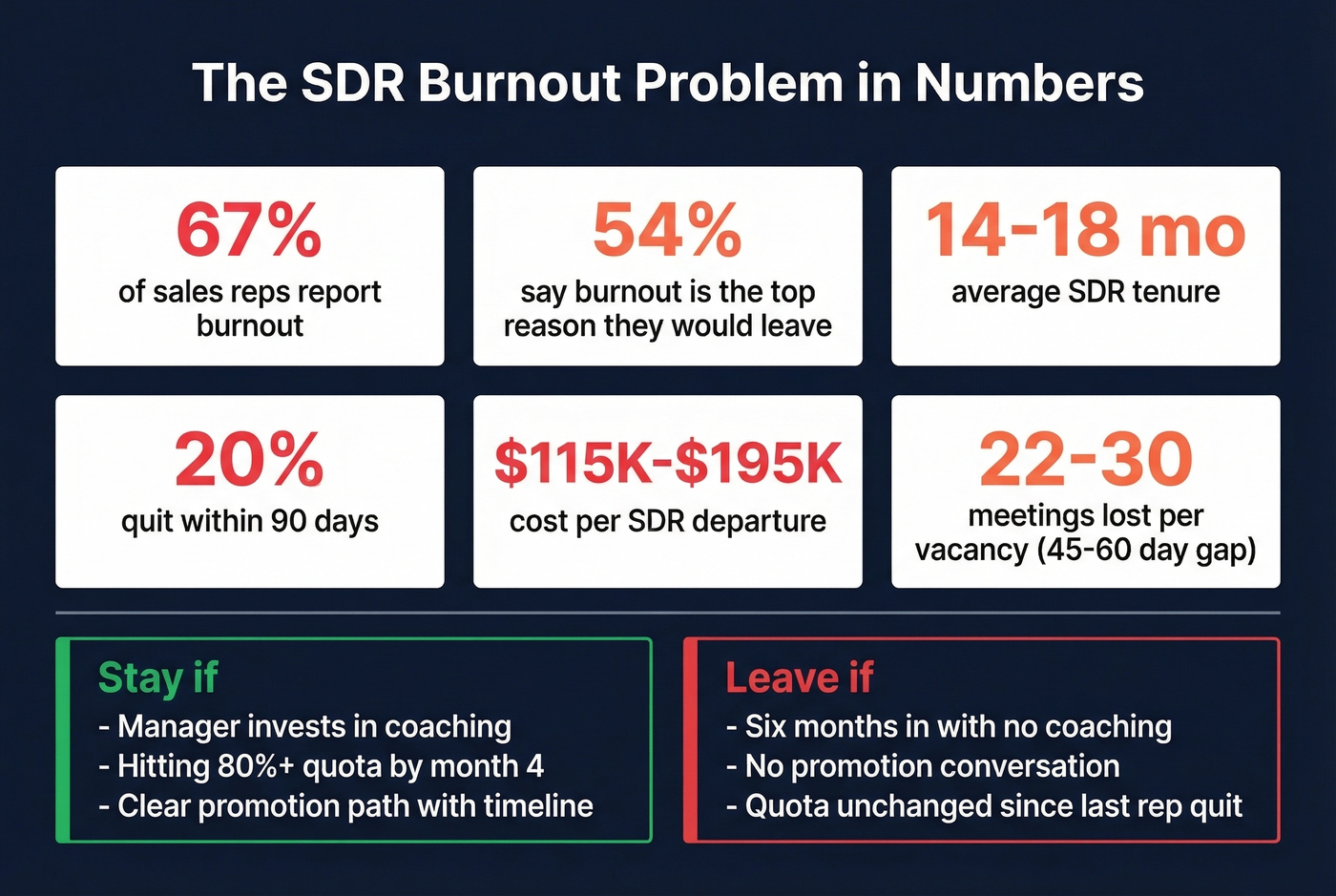
The numbers paint a stark picture: 54% of SDRs say burnout is the top reason they'd leave. Average tenure is 14-18 months. 20% quit within 90 days. Every departure costs the company $115K-$195K when you factor in recruiting, ramp time, and lost pipeline - and it leaves a 45-60 day vacancy gap, which means 22-30 meetings that never get booked.
Stay if your manager invests in coaching, you're hitting 80%+ of quota by month four, and there's a clear promotion path with a timeline. The grind is temporary if the trajectory is real.
Leave if you're six months in with no coaching, no promotion conversation, and a quota that hasn't been adjusted since the last SDR quit. Some companies use SDRs as disposable labor. Don't be disposable.
Survival tactics that actually work: strict time blocking (protect your call blocks like meetings), multi-channel sequences (they convert better and feel less monotonous than pure cold calling), and collaborative calling sessions. Some teams run "power hours" where 5-10 reps dial simultaneously on a shared video call - the energy is contagious and the isolation disappears. The consensus on r/sales is pretty clear: the isolation of solo dialing is what breaks most people, not the rejection itself. If rejection is the part that’s wearing you down, train it like a skill with a cold call rejection playbook.
Skills That Get You Hired
There are 80,000+ open SDR roles in the US right now. Getting hired isn't the hard part - getting hired at a good company is.
You need CRM proficiency in Salesforce or HubSpot, even at the free-tier level. You need familiarity with a sequencing tool like Outreach or SalesLoft. And you need to know how to build a prospect list, filter by ICP criteria, and export contacts from a data platform. On the soft-skills side, resilience matters most - you'll hear "no" 50+ times a day, and interviewers want to know you won't crumble. Curiosity, coachability, and time management round out the profile. (If you want to systematize that mindset, read this guide on resilience in sales.)
Here's the move most candidates miss: act like a salesperson to get the job. Don't just apply online. Find the hiring manager, send a personalized cold email, and follow up. You're literally auditioning for a role that requires cold outreach - show them you can do it before they hire you. Walk into your interview having already built a sample prospect list for the company's ICP, complete with verified contact data and a draft first-touch email. That's the kind of preparation that gets you hired over 50 other applicants. If you need copy you can adapt fast, start from these sales follow-up templates.
The SDR Tech Stack (With Real Costs)
The average SDR team uses 12-15 tools daily. Total cost runs $2,000-$5,000 per rep per month when you add everything up, which is why managers care about tool utilization. If you’re comparing options, this roundup of SDR tools is a good starting point.
| Category | Key Tools | Cost/User/Month |
|---|---|---|
| CRM | Salesforce, HubSpot | $25-$300 |
| Prospecting/Data | Prospeo, Apollo, ZoomInfo | $50-$500+ |
| Sales Engagement | Outreach, SalesLoft | $25-$150 |
| Dialer | Orum, Nooks, Aircall | $50-$200+ |
| Enrichment | Clearbit, Clay | $30-$200 |
| Scheduling | Calendly, Chili Piper | $10-$30 |
| Intent/Signals | Bombora, 6sense | $500-$5,000 |
| Conversation Intel | Gong, Chorus | $100-$200 |
CRM: Your System of Record
Salesforce dominates enterprise; HubSpot wins with startups and mid-market. If you're learning one before your first interview, pick HubSpot - the free tier is fully functional and you can build real pipeline management skills without spending a dollar. Salesforce proficiency matters more at companies with 100+ reps, but HubSpot fluency transfers. If you’re still getting oriented, here are more examples of a CRM and what they’re actually used for.
Sales Engagement: Your Daily Driver
Outreach at roughly $100-150/user/month and SalesLoft at roughly $75-125/user/month are the two platforms you'll live in. They manage your email sequences, call tasks, and social touches in one workflow. Neither publishes pricing openly - expect to negotiate, especially for teams under 10 seats. For a new SDR, knowing how to build a multi-step sequence in either platform is table stakes.
Prospecting Data: Where Pipeline Starts
This is where we've seen the most wasted budget on our team. A 10-seat ZoomInfo contract runs $20-50K/year, and most SDR teams use maybe 30% of the platform's capabilities. Apollo offers a generous free tier with 275M+ contacts, making it the default for bootstrapped teams.
Prospeo gives you 300M+ professional profiles with 98% email accuracy and a 7-day data refresh cycle. The free tier includes 75 verified emails per month - enough for a new SDR to start building pipeline without waiting for budget approval. The 30+ search filters cover job title, company size, tech stack, funding stage, and buyer intent signals, which are the criteria that define most ICPs. If you’re evaluating vendors, compare options in our guide to sales prospecting databases.

We've run bake-offs where the "best database" lost because it created thousands of duplicate contacts in Salesforce in the first week. Data accuracy and CRM hygiene matter more than database size. A 98% email accuracy rate means your sequences actually land, your domain reputation stays clean, and your conversion metrics reflect real outreach - not bounced messages. If you need to fill gaps in your records, look at dedicated data enrichment services.
Skip ZoomInfo if you're a team of five or fewer. The contract minimums don't make sense at that scale, and you'll get better per-lead economics from self-serve platforms.
Your ramp time shouldn't be wasted cleaning bad contact data. Prospeo's 30+ search filters let you build ICP-matched lists by job title, intent signals, tech stack, and headcount growth - then export verified emails at $0.01 each with a 98% accuracy rate.
Hit quota faster with data that actually connects you to decision-makers.
FAQ
Is being a sales dev rep a good career?
Yes - it's the fastest on-ramp into tech sales with median OTE of $85K and most reps promoting to AE within 12-18 months, where comp jumps to $120-180K. That said, 67% report burnout and average tenure is 14-18 months. Go in with open eyes and a clear exit timeline.
What's the difference between SDR and BDR?
At many companies, the titles are interchangeable. The textbook distinction is that SDRs handle inbound leads while BDRs do outbound prospecting. In practice, the job description matters more than the title - read the actual responsibilities before you apply.
How much do SDRs make in 2026?
Median compensation is $60K base / $85K OTE nationally, with top performers hitting $128K+. Only 57.3% of reps hit quota, so that OTE figure is aspirational for nearly half the team. Always ask about quota attainment rates during your interview.
What tools should I learn before my first SDR interview?
Start with a CRM (HubSpot's free tier), a sequencing platform like Outreach or SalesLoft, and a prospecting database with a free tier so you can practice building lists. Showing up with hands-on tool experience separates you from 90% of candidates.
How long should you stay in the SDR role?
Twelve to eighteen months is the sweet spot. Hit 90%+ quota for two consecutive quarters, then push for AE promotion. High performers sometimes make the jump in 10-12 months. If your company stalls the promotion conversation past 12 months, start interviewing elsewhere.