

How to Write a Sales Email That Actually Gets Replies
Your SDR team sent 2,000 emails last month and got 6 replies. The sequences were tight. The templates looked great. And yet, the pipeline didn't move.
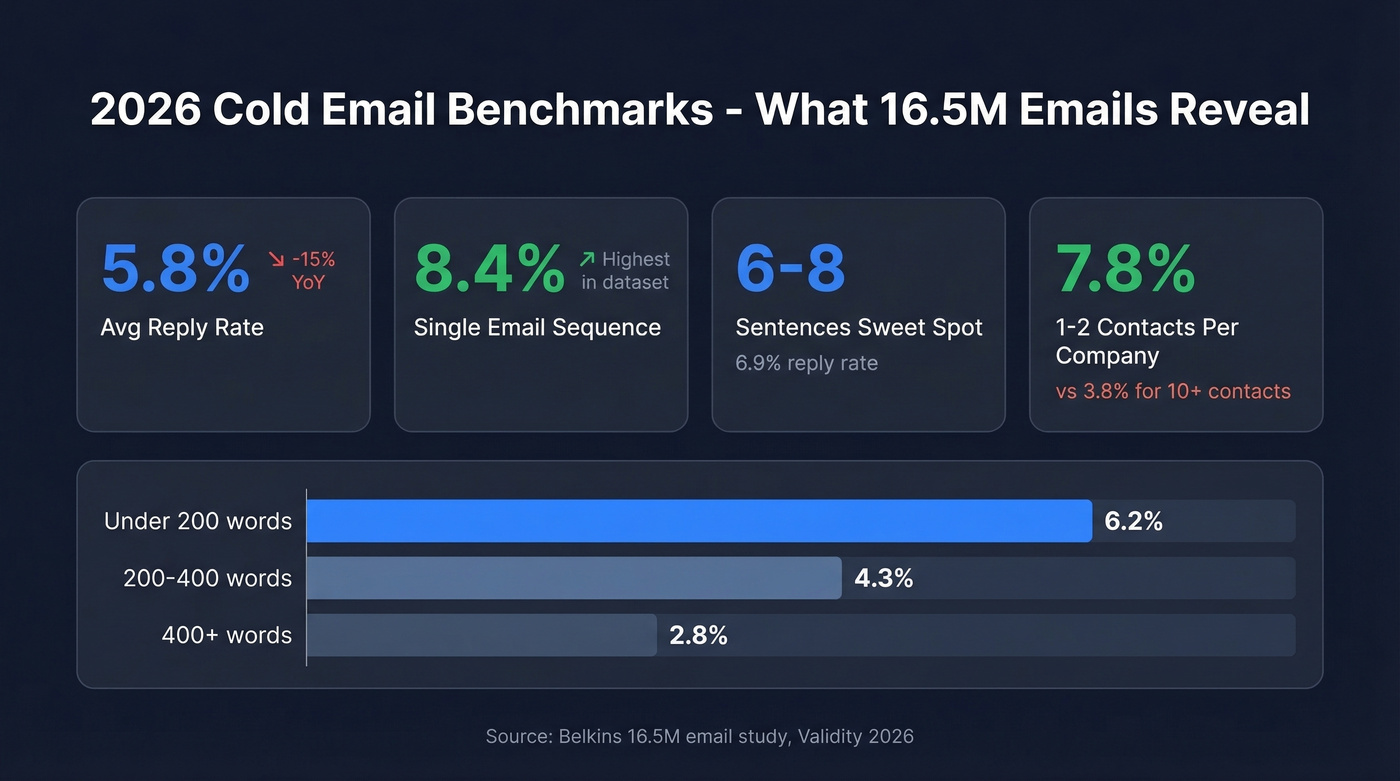
Here's the uncomfortable truth: across 16.5 million cold emails analyzed, the average reply rate was 5.8% - down from 6.8% the year before. That's a 15% year-over-year decline, and it isn't because your subject lines need work.
The problem isn't your templates. It never was. Every guide hands you 55 subject line formulas and calls it a day, while 17% of cold emails never even reach the inbox. Data quality, deliverability, and targeting determine 80% of your results before a single word of copy matters.
The Three Things to Fix First
Before you rewrite anything:
- Fix your data and deliverability before touching templates. 17% of cold emails never reach the inbox - Prospeo's 98% email accuracy and 7-day data refresh cycle keep your domain clean so your copy actually has a chance.
- Write 40-60 word emails with a specific offer and a soft CTA - not a meeting request.
- Track replies and meetings booked, not opens. Open tracking is unreliable and actively hurts your deliverability.
2026 Benchmarks Worth Knowing
Numbers first. The dataset - 16.5 million emails across 93 industries - gives us the clearest picture of what's actually working right now.
| Metric | Benchmark | Source |
|---|---|---|
| Avg reply rate | 5.8% | Belkins (16.5M emails) |
| Best email length | 6-8 sentences (6.9% reply) | Belkins |
| One-email sequence | 8.4% reply rate | Belkins |
| Inbox placement | 75-87% | Validity 2026 |
| Spam complaint cap | <0.3% | Google/Yahoo/Microsoft |
A few things jump out. One-email sequences outperformed multi-touch at 8.4% - the highest reply rate in the dataset. Teams emailing 1-2 contacts per company hit 7.8%, while those blasting 10+ contacts at the same account dropped to 3.8%. More isn't better. Precision is.
The length data is equally clear: emails in the 6-8 sentence range hit a 6.9% reply rate, and anything under 200 words outperformed longer emails across the board. If your outreach runs longer than a short paragraph, you're working against the data.
Here's a take that'll annoy your sales engagement vendor: if your deals typically close under $10K, you probably don't need a 7-step nurture sequence. A single, well-targeted message with a strong offer will outperform the elaborate drip campaign your platform is nudging you to build.
Why Your Outreach Isn't Working
Most failures come down to four mistakes that have nothing to do with copywriting.
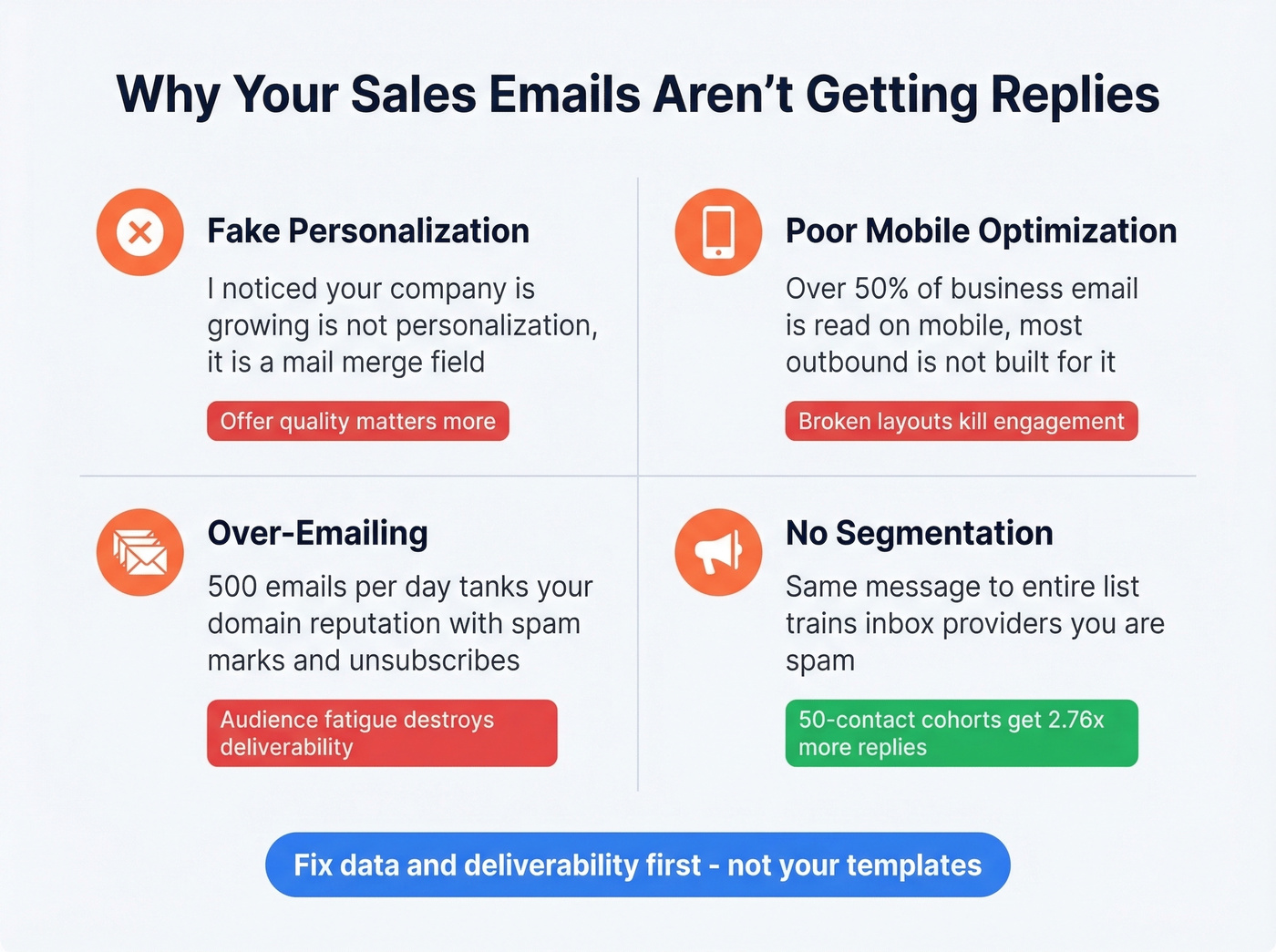
Fake personalization. "I noticed your company is growing" isn't personalization - it's a mail merge field with a generic observation. The consensus on r/copywriting is blunt: offer quality matters more than shallow personalization tricks.
Poor mobile optimization. Over half of business email gets read on mobile, and most outbound messages aren't built for it. Tiny text, broken layouts, CTAs you can't tap.
Over-emailing. Just because your tool can send 500 emails a day doesn't mean it should. Audience fatigue drives unsubscribes and spam marks - the exact signals that tank your domain reputation. (If you're pushing volume, learn your safe email velocity first.)
No segmentation. Blasting your entire list with the same message is the fastest way to train inbox providers that you're spam. Targeted sends to small cohorts of 50 or fewer contacts see 2.76x higher reply rates.
Some teams are pivoting to community outreach entirely because cold email results feel inconsistent. But the inconsistency is almost always a data and deliverability problem, not a channel problem. The r/SaaS sentiment that "no one cares about your 50% discount offer anymore" is right about the symptom, wrong about the diagnosis. Inboxes are flooded with generic messages that offer nothing specific. The teams still getting results run cleaner data, tighter targeting, and shorter sequences.
Deliverability Before the Send
Let's be honest: it's absurd that most guides skip deliverability entirely. They hand you 25 templates and never mention that your emails might not reach the inbox. (If you want the full checklist, start with an email deliverability guide.)
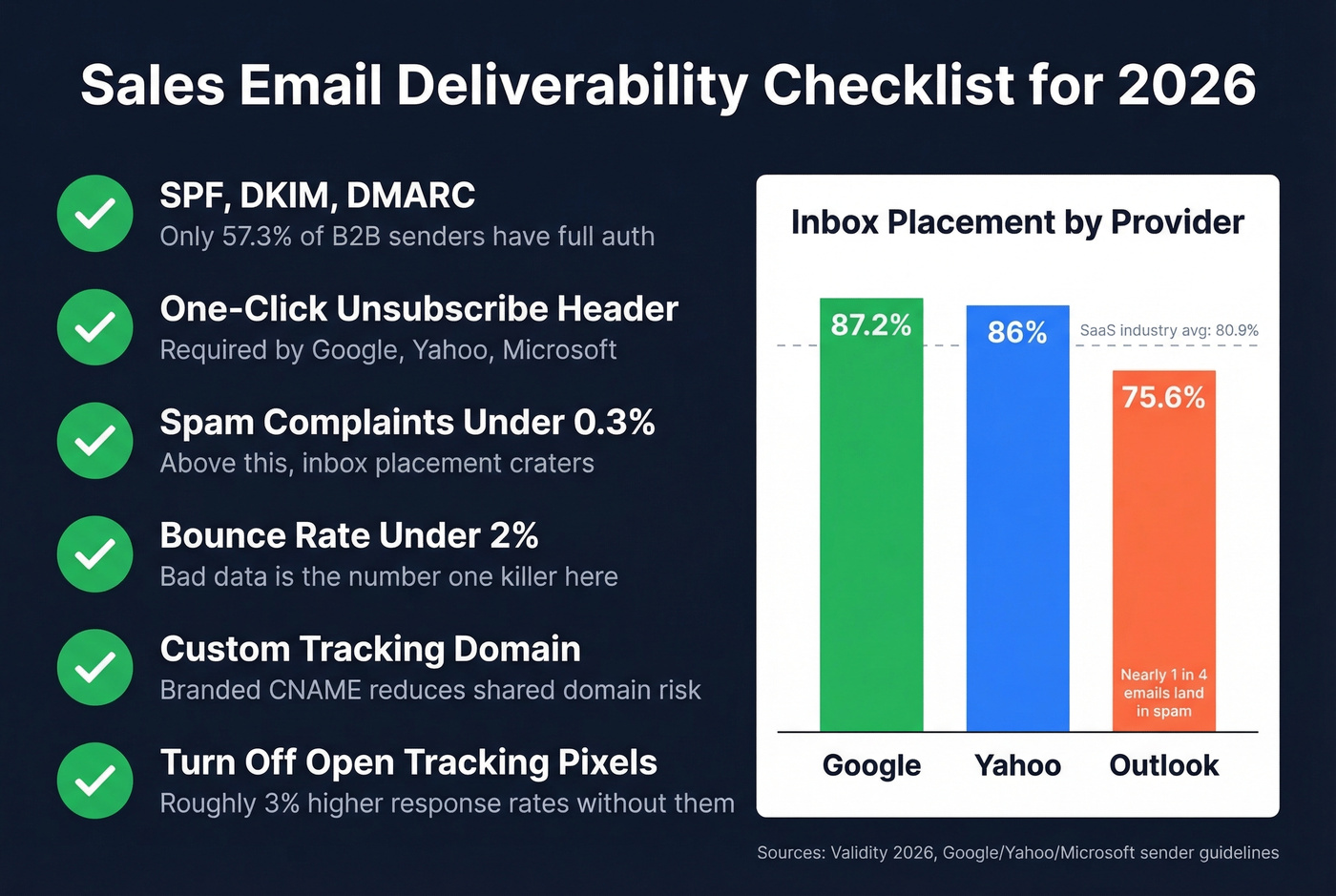
Every bulk sender needs these non-negotiables in 2026:
- SPF, DKIM, and DMARC authentication configured and passing. No exceptions. Only 57.3% of B2B senders have full authentication - if you're in the other 43%, fix this before anything else. (If you're troubleshooting, see how to verify DKIM is working.)
- RFC 8058 one-click unsubscribe (List-Unsubscribe + List-Unsubscribe-Post header). Google, Yahoo, and Microsoft all require it.
- Spam complaints under 0.3%. Go above this and inbox placement craters.
- Bounce rates under 2%. This is where bad data kills you. (Benchmarks and fixes: email bounce rate.)
- Custom tracking domain via branded CNAME - reduces shared-domain risk. (More on setup: tracking domain.)
- Warming schedule for new domains at 5-10 emails/day, ramping over 4-6 weeks. (Tooling options: unlimited email warmup.)
One detail most teams miss: turning off open-tracking pixels. Emails without tracking produced roughly 3% higher response rates in controlled tests. Tracking pixels are also a common deliverability risk factor, and the data they return is increasingly useless anyway. (Deep dive: email tracking pixels.)
Inbox placement varies by provider, and the gaps are significant:
| Provider | Inbox Placement |
|---|---|
| 87.2% | |
| Yahoo | 86% |
| Outlook | 75.6% |
If your prospect list skews toward Outlook/Microsoft 365 domains, nearly a quarter of your emails land in spam or promotions by default. Industry matters too: Software/SaaS senders see about 80.9% inbox placement, while Healthcare hits 94.7%. Know your audience's email environment before you optimize copy.
Verify Before You Send
Before you rewrite a single template, verify your list. Prospeo runs a 5-step verification process with catch-all domain handling, spam-trap removal, and honeypot filtering - all on a 7-day refresh cycle while the industry average sits at six weeks. Stack Optimize built from $0 to $1M ARR using that data, maintaining 94%+ deliverability, under 3% bounce rates, and zero domain flags across all their clients.
Your Outreach Stack
If you're building from scratch, get three things right: a verified prospect list, a sending tool with warming, and a CRM that tracks replies. Everything else is optimization. (If you're evaluating tooling, start with SDR tools.)
| Function | Tool | Starting Price |
|---|---|---|
| Email verification | Prospeo | Free (75 emails/mo) |
| Sending + warming | Instantly or Smartlead | ~$30-$100/mo |
| CRM | HubSpot or Salesforce | HubSpot free; Salesforce ~$25-$165/user/mo |
| Sales engagement | Outreach or Salesloft | ~$100-$200/user/mo |

Your sales emails can't get replies if they bounce. Prospeo's 5-step verification with catch-all handling, spam-trap removal, and 7-day data refresh keeps bounce rates under 2% - the threshold that separates inbox placement from spam folders. At ~$0.01/email, cleaning your list costs less than a single wasted send.
Verify your list before your next campaign goes out.
The data says precision beats volume: 50-contact cohorts get 2.76x higher reply rates. Prospeo's 30+ search filters - buyer intent, technographics, headcount growth, job changes - let you build those tight segments in minutes instead of hours. Meritt tripled their pipeline to $300K/week and cut bounce rates from 35% to under 4%.
Send fewer sales emails to better prospects and book 26% more meetings.
Compliance Essentials
Cold email is legal in most jurisdictions - with requirements. CAN-SPAM carries penalties up to $53,088 per email violation. GDPR goes up to EUR 20M or 4% of global annual turnover.
CAN-SPAM compliance comes down to seven requirements: no misleading "From" headers, no deceptive subject lines, identifying the message as an ad, including a physical postal address, providing a clear opt-out mechanism, honoring opt-outs within 10 business days, and taking responsibility for third parties sending on your behalf.
The critical distinction: the US uses an opt-out model (you can email until someone says stop), while GDPR and most international frameworks require opt-in or legitimate interest before you send. About 47% of global email traffic was spam in 2023 - regulators are paying attention.
How to Write a Sales Email
Subject Lines
Across 5.5 million emails analyzed, the data is clear: keep subject lines short and personal. Two to four word subject lines hit a 46% open rate. Beyond seven words, opens drop to 39%. By nine or ten words, you're down to 34%.
If you need a swipe file, pull from these email subject line examples and adapt them to your offer.
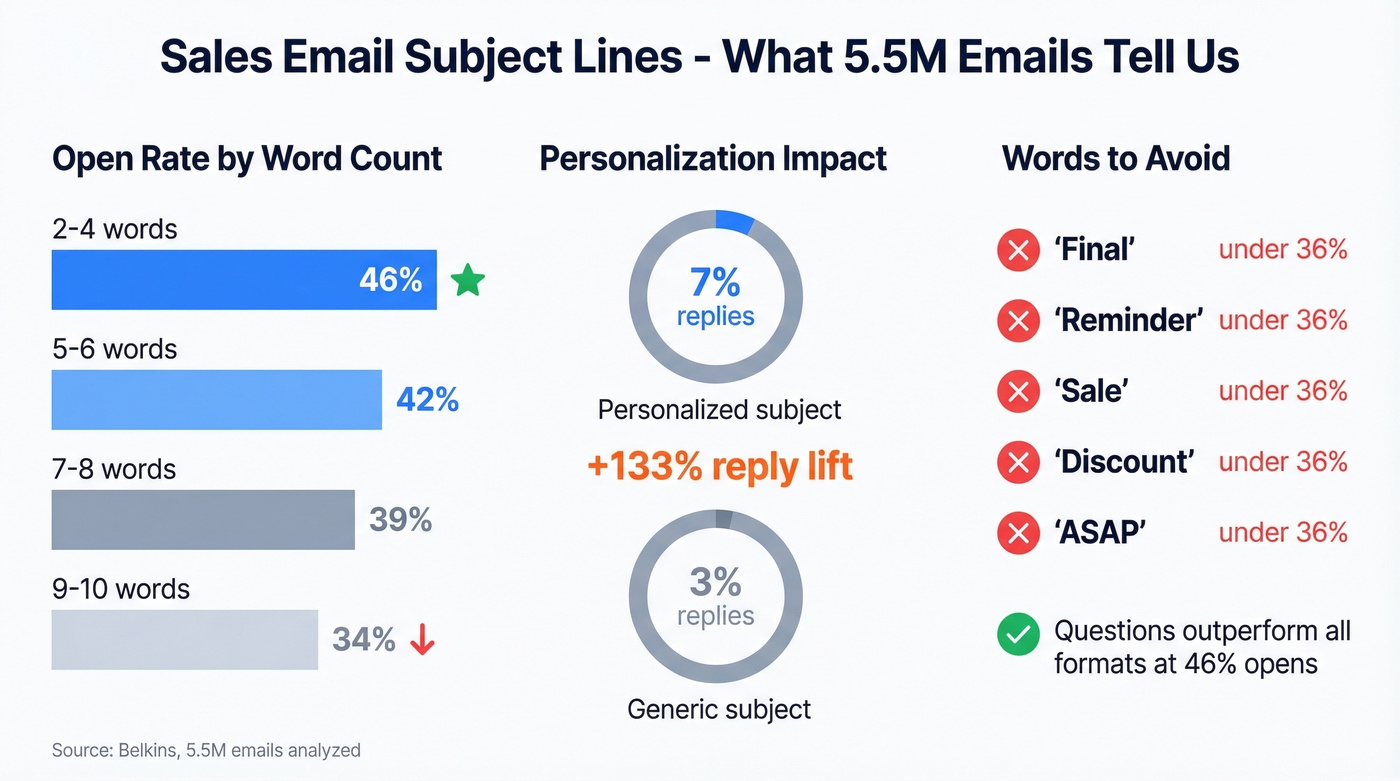
Personalized subject lines drove 46% opens versus 35% without - and more importantly, 7% reply rates versus 3%. That's a 133% reply lift. Questions outperformed every other format at 46% opens. Words to avoid entirely: "Final," "Reminder," "Sale," "Discount," and "ASAP" - all dragged opens below 36%.
The Body - Less Is More
You don't need 55 templates. You need five great ones, clean data, and a deliverability setup that actually lands your messages in the inbox. (For a deeper framework, see email copywriting.)
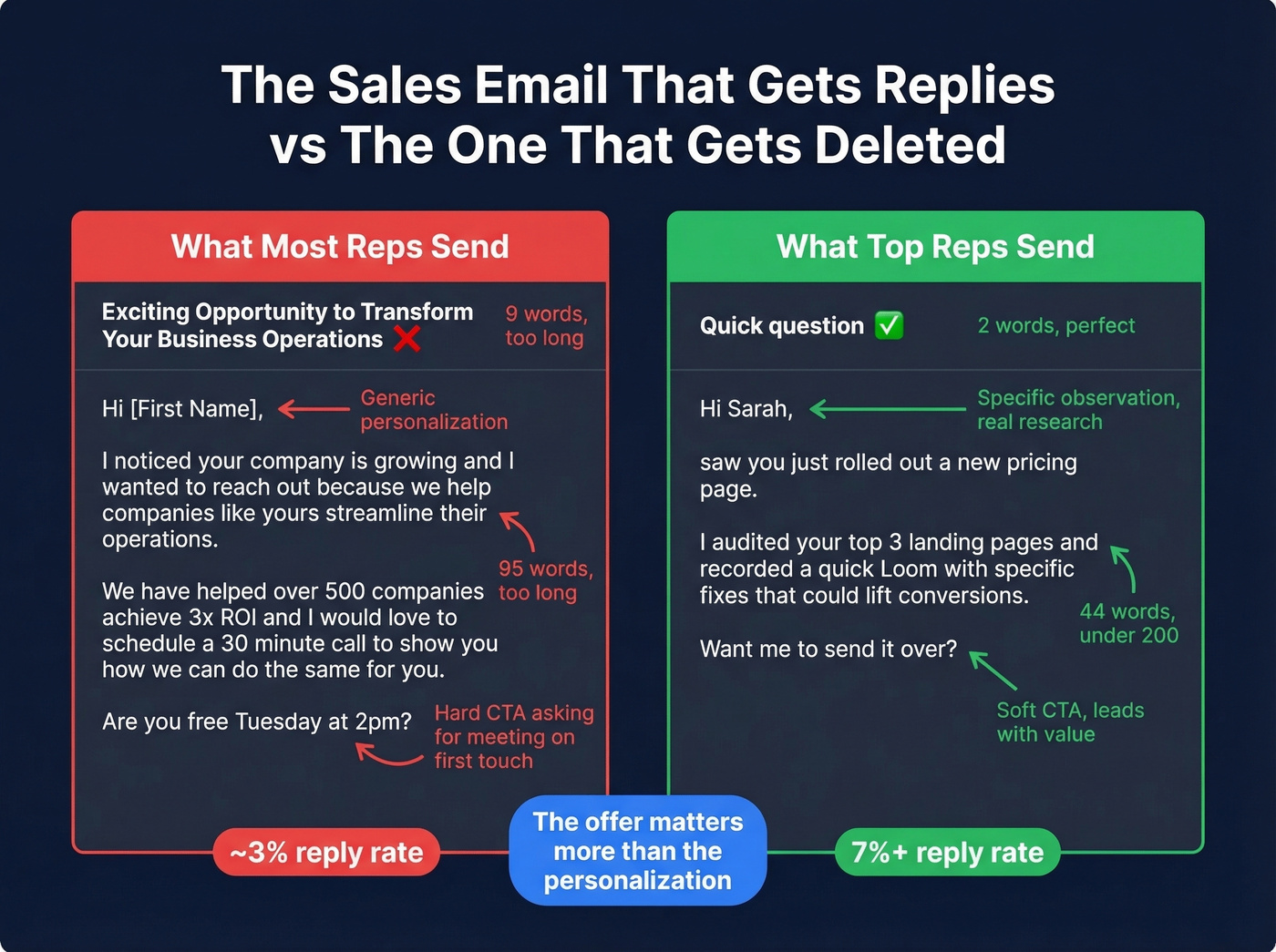
The practitioners on r/copywriting are emphatic: 40-60 words maximum. The data confirms it - 6-8 sentences is the sweet spot, and anything under 200 words outperforms longer messages. Write at an 8th-grade reading level. Keep your pronoun ratio at roughly 1:2 between "I/my" and "you/your" - the email should be about the prospect, not you.
The offer matters more than the personalization. A strong offer is specific, low-friction, and immediately valuable. "I'll audit your top 3 landing pages and send a Loom with fixes" beats "I'd love to show you how we help companies like yours" every single time. Lead with what you'll give, not what you want.
Types You Should Master
Not every outreach situation calls for the same approach. Cold prospecting, trigger-based outreach, follow-ups, re-engagement, and post-meeting recaps each serve a different purpose in the buyer's journey. Knowing when to deploy each one is what separates high-performing reps from everyone else. (More tactics here: sales prospecting techniques.)
A/B Testing
Test subject lines on 20% of your list and roll the winner to the remaining 80%. Minimum sample size: 50-100 per variant. Test one variable at a time - subject line, CTA phrasing, or email length - never all three at once. In our experience, teams that commit to weekly A/B tests on subject lines see measurable reply rate improvements within a month.
CTAs That Don't Kill Replies
Gong Labs data, cited by HubSpot, found that asking for interest ("Does this sound interesting?" or "Worth a conversation?") doubles success rates compared to a specific next-step CTA. Don't ask for a meeting in your first touch. Ask if the problem resonates. The meeting comes later. (More examples: email call to action.)
Soft CTAs that work: "Worth a look?" / "Interested?" / "Make sense to chat?" Hard meeting requests in a first touch feel presumptuous - and the data confirms they underperform.
Signature Basics
Name, title, phone number, one social link. That's it. Skip the inspirational quotes, banner images, and legal disclaimers that add visual noise and trigger spam filters.
Templates by Stage
Six templates. Each one earns its place. Think of these as a starting framework - sales email copy works best when you adapt the structure to your specific prospect and offer. (If you want more, use these sales follow-up templates as add-ons.)
Cold Prospecting vs. Trigger Event
The difference between these two is timing - and timing changes everything. Timeline-based hooks outperform generic problem hooks 2.3x.
Cold Prospecting (Value-First):
Hi [First Name], I noticed [specific trigger - e.g., you're hiring 3 SDRs]. We helped [similar company] [specific result] in [timeframe]. Happy to share how - worth a look?
Trigger Event (Job Change / Funding):
Congrats on [the new role / the Series B]. When [company] hit that stage, they ran into [specific problem]. We solved it in [timeframe]. Interested in a quick breakdown?
Use the cold template when there's no obvious trigger. Use the trigger template within 2 weeks of a job change, funding round, or product launch.
The Transparency Play
Most outbound messages oversell. This one does the opposite - and it works because it builds trust by acknowledging potential lack of fit.
Hi [First Name], not sure if [your specific solution] is the right fit for [their company]. We typically work with [profile] dealing with [problem]. If that's not you, no worries at all. But if it is - worth 10 minutes?
We've seen this template surprise teams who try it. The disqualification framing lowers defenses and makes the prospect feel like they're choosing to engage rather than being sold to.
Follow-Up and Re-Engagement
Follow-Up #1 (3-5 days after initial): Keep it to two sentences. Restate the value prop in one line and ask "Still relevant?" That's it. Short follow-ups respect the prospect's time and give them an easy out - which paradoxically makes them more likely to reply.
Re-Engagement (60-90 days after going cold):
Hi [First Name], we spoke [timeframe] ago about [topic]. Since then, we've [new proof point or product update]. Worth revisiting?
New information gives dormant prospects a reason to re-engage. Without it, you're just reminding them they already said no.
Post-Meeting Recap
Send the same day. Lock in next steps while the conversation is fresh.
Great speaking today, [First Name]. To recap: [2-3 bullet action items]. I'll [next step] by [date]. Let me know if I missed anything.
How to Improve Results Over Time
Three follow-ups is the ceiling, not the floor. Spam complaints jump from 0.5% on the first email to 1.6% by the fourth follow-up. Unsubscribes climb from 0.1% to 2%. Reply rates drop 55% by that fourth touch.
We've seen teams ruin sender domains by running 7-step sequences to unresponsive lists. It isn't persistence - it's self-sabotage.
Keep cohorts small. Segmenting into groups of 50 or fewer contacts drives 2.76x higher reply rates. Use timeline-based hooks ("Now that you've closed your Series B...") over generic problem hooks - they outperform at 10.01% versus 4.39%. Space your follow-ups at 3-5 day intervals, not daily.
Metrics That Matter
The only metrics worth tracking are reply rate, meetings booked, and pipeline generated. These are the numbers that connect to revenue.
Ignore open rates, click rates, and "engagement scores" built on open data. Open rates are a vanity metric in 2026. Your sales engagement platform shows 45% opens and you feel great - meanwhile, half those "opens" are Apple Mail Privacy Protection pings and corporate security scanners pre-fetching links. Open-tracking pixels actively hurt deliverability, and emails without them saw roughly 3% higher response rates in controlled tests.
In our experience, teams that stop tracking opens and focus exclusively on replies see clearer decision-making within two weeks. If your reporting dashboard leads with open rates, you're optimizing for the wrong thing.
FAQ
What's a good reply rate for a sales email?
The average is 5.8% across 16.5M cold emails analyzed in 2026. Above 8% is strong - teams targeting 1-2 contacts per company hit 7.8%. Below 3% consistently points to data quality or deliverability issues, not copywriting problems.
How long should a sales email be?
Under 200 words, ideally 40-60 words for cold outreach. The 6-8 sentence range produces a 6.9% reply rate in large-scale testing. Shorter messages respect the prospect's time and consistently outperform longer pitches.
How many follow-ups should I send?
Three maximum. Reply rates drop 55% by the fourth touch, and spam complaints triple from 0.5% to 1.6%. One-email sequences actually outperform multi-touch at 8.4% - more messages often means worse results.
How do I keep cold emails out of spam?
Set up SPF, DKIM, and DMARC authentication. Keep bounce rates under 2% by verifying your list before sending. Warm new domains at 5-10 emails/day and keep spam complaints below 0.3%.
Are cold sales emails legal?
Yes, with requirements. CAN-SPAM mandates a physical address, honest subject lines, and a working unsubscribe link - fines reach $53,088 per violation. GDPR requires legitimate interest or consent, with penalties up to EUR 20M or 4% of global turnover.