

Sales Enablement: What It Is, What Works, and What Every Vendor Guide Gets Wrong
Every sales enablement guide you've read was written by a company selling you an enablement platform. They define the category, list the pillars, drop a few stats, and funnel you toward a demo. The problem? 55% of organizations still can't effectively drive GTM initiatives - after a decade of these guides. Something's missing, and it isn't another content management platform.
We sell a data platform, not an enablement suite, so we've got no reason to sugarcoat what works and what doesn't.
The Short Version
- Enablement is a system, not a content library. If your "enablement strategy" is a shared drive of battle cards, you don't have one.
- Measure revenue KPIs first, not content adoption. 49% of enablement pros disagree with leadership on which metrics matter. Lead with win rate and deal size, not "how many reps opened the deck."
- Consolidate your tools. The market already is - Seismic and Highspot announced a definitive merger, and Showpad completed its merger with Bigtincan. Follow the signal.
- AI amplifies good process but doesn't replace it. Allego found 100% of enablement leaders use GenAI. A separate Dynata study found only 28% say AI is improving revenue-driving sales performance. That gap is the story.
- Fix your prospect data before investing in anything else. Every enablement investment compounds when reps reach real people. It collapses when 35% of emails bounce.
What Is It (And What Isn't It)?
Sales enablement is the ongoing system of content, training, tools, process, and data that equips revenue teams to close deals. Not a department. Not a software category. A system - one that connects what marketing produces to what reps actually need in live selling situations.
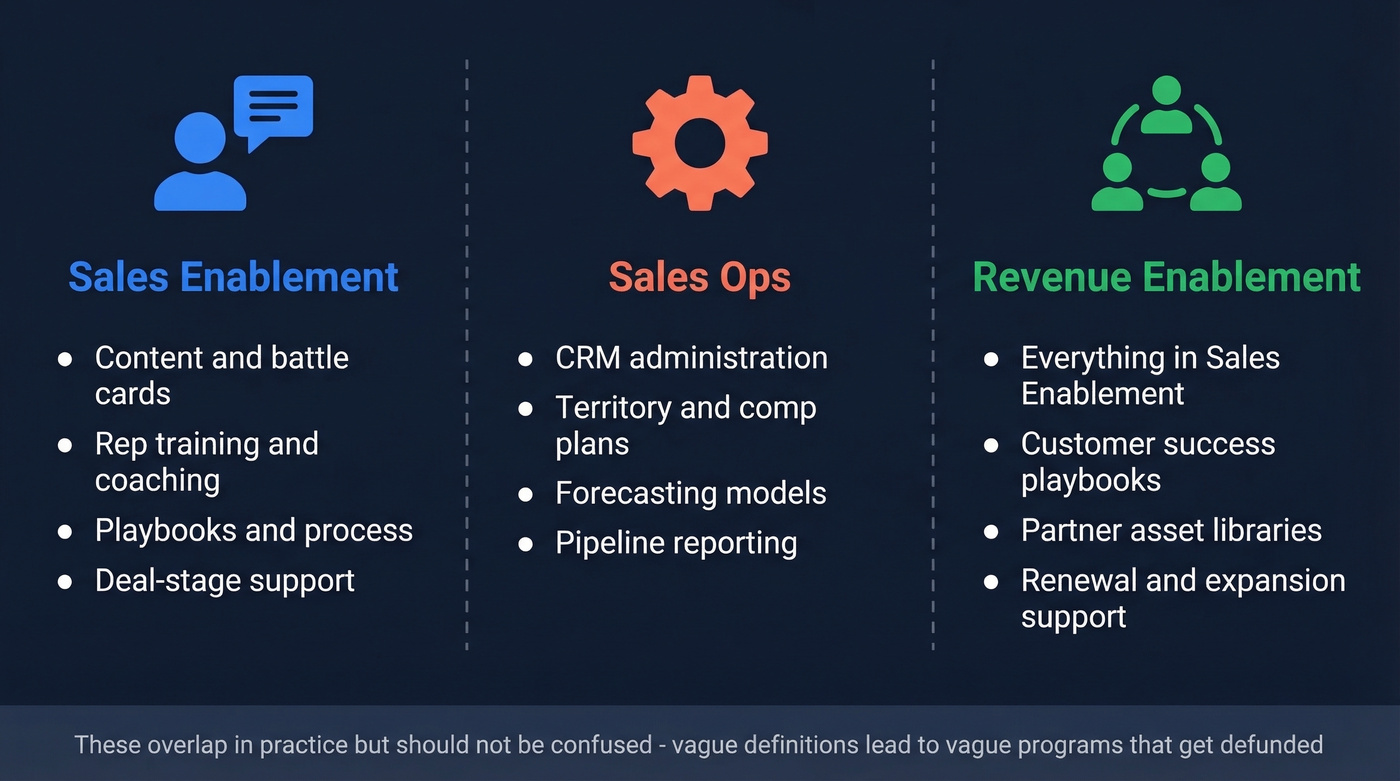
The confusion starts because three related functions overlap and people use the terms interchangeably. They shouldn't. A vague definition leads to a vague program, and vague programs get defunded.
Enablement vs. Sales Ops
Sales ops owns the infrastructure: CRM administration, territory design, compensation plans, forecasting models, pipeline reporting. Enablement owns the capability layer - making sure reps know what to say, have the right content, and follow a repeatable process. Ops builds the machine. Enablement teaches people how to drive it.
When enablement roles start absorbing tech stack management and tool implementation - which happens constantly in practice - that's scope creep, not a definition change.
If you're hiring for this function, the enablement roles and the sales ops remit should be distinct on paper.
Enablement vs. Revenue Enablement
Revenue enablement extends the same principles beyond the sales team to every revenue-facing function: customer success, partnerships, solution engineering, expansion. The sales-focused version builds deal rooms and microsites for prospects. Revenue enablement adds customer onboarding portals, partner asset libraries with role-based permissioning, and CS playbooks for renewal conversations. If your enablement program stops at "closed-won," you're leaving expansion revenue on the table.
If you're building deal rooms, it's worth understanding what a digital sales room is (and why many fail).
Where Should Enablement Report?
The Sales Enablement Landscape Report shows a clear shift in reporting structure heading into 2026:
| Reports To | % of Orgs |
|---|---|
| RevOps | 39.4% |
| Sales | 25.4% |
| C-Suite | 16.6% |
| Marketing | 5.2% |
| Product Marketing | 3.5% |
| HR | 2.6% |
| Other | 7.3% |
The RevOps reporting line is winning, and for good reason. It keeps enablement connected to pipeline data and revenue outcomes rather than siloed under marketing (where it becomes a content factory) or sales leadership (where it becomes ad-hoc training).
If you're formalizing RevOps ownership, a RevOps manager typically becomes the connective tissue here.
Why It Matters in 2026
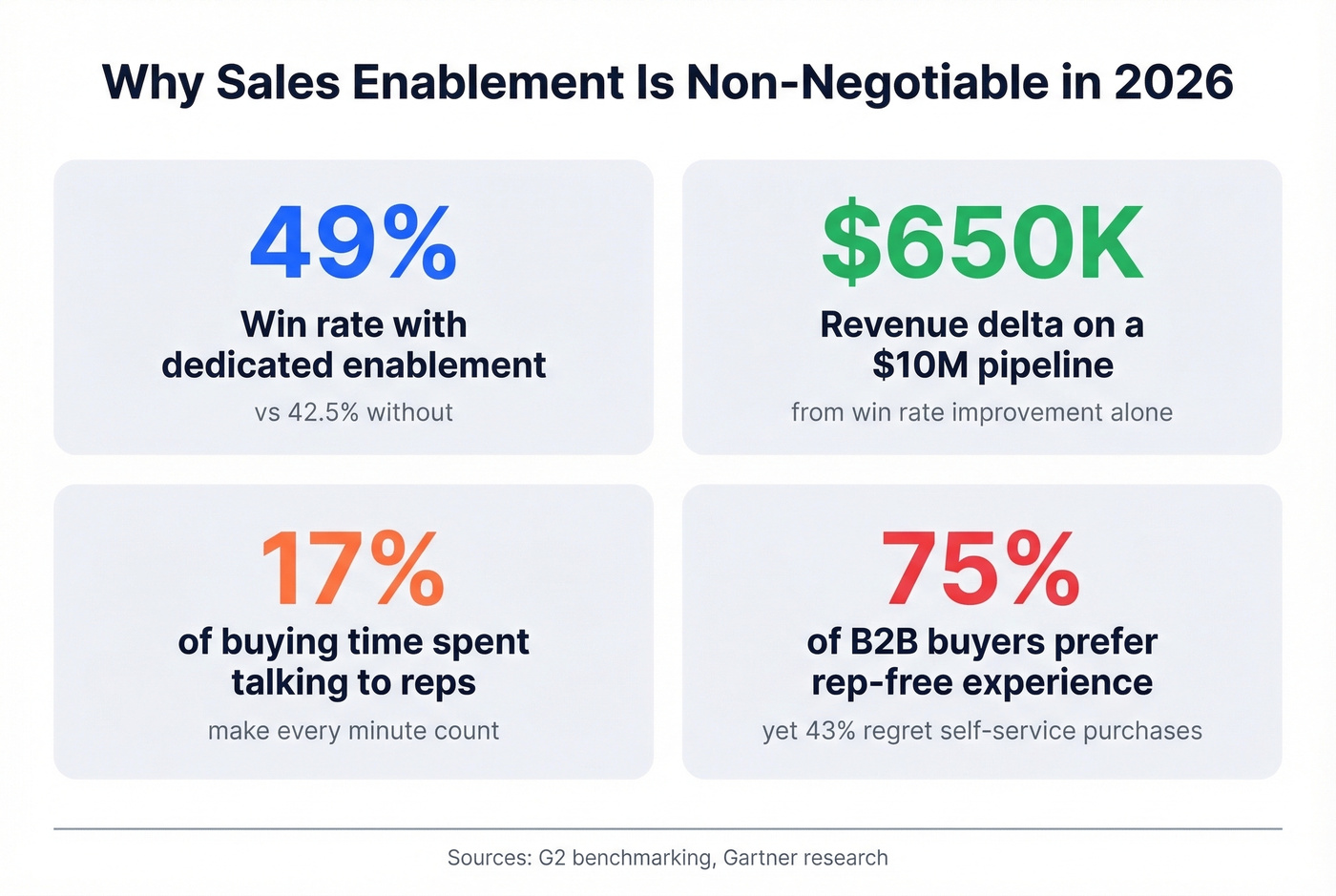
Organizations with a dedicated enablement function hit a 49% win rate versus 42.5% without one, according to G2 benchmarking data. Companies using a unified enablement platform are 42% more likely to improve win rates. On a $10M pipeline, that win rate delta is worth roughly $650K in closed revenue. These aren't marginal gains.
But the buyer side of the equation is what makes enablement existential, not optional.
Gartner's research shows 75% of B2B buyers prefer a rep-free experience - yet 43% of buyers who complete a self-service purchase regret it. They wanted autonomy during research but needed guidance during decision-making. Buyers spend just 17% of their time talking to sales reps. Enablement has to make that window count.
Your reps aren't competing with other reps. They're competing with the buyer's instinct to figure it out alone. The job is to make the rep so valuable during those critical decision moments that the buyer is glad they engaged.
47% of organizations struggle with customer experience and 41% can't effectively engage new buyers. The teams solving this aren't throwing more reps at the problem. They're enabling the reps they have.
Five Pillars That Drive Revenue
Most frameworks list four pillars: content, training, tools, and process. They're right but incomplete. There's a fifth pillar that every vendor guide ignores because none of them sell it.

Content That Gets Used
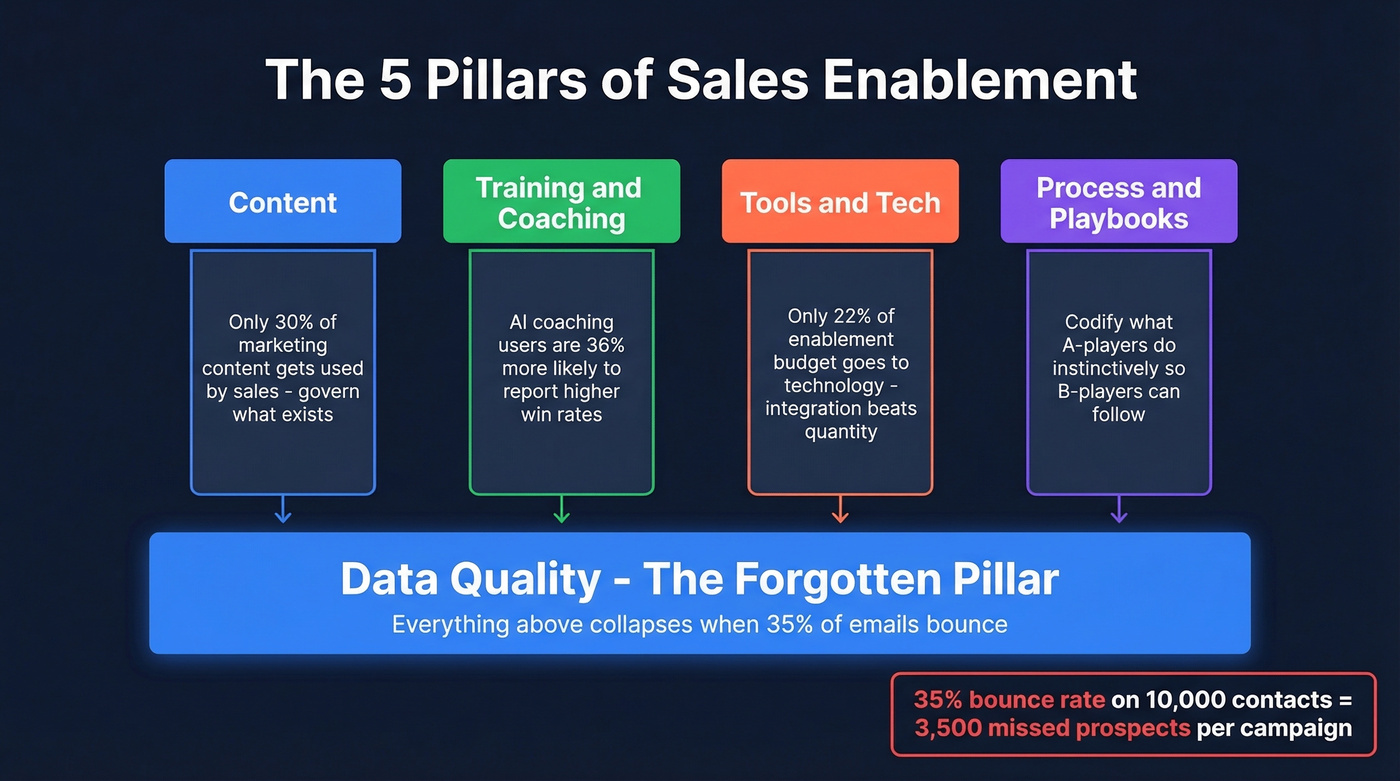
Only about 30% of marketing content actually gets used by sales. The rest sits in a shared drive collecting dust. The fix isn't producing more - it's governing what exists. Map content to deal stages, tag it by persona and objection, and track what reps actually pull into deals. If a battle card hasn't been opened in 90 days, kill it or rewrite it.
If you need a starting point, build a real sales battle cards system before you buy another platform.
Training and Coaching
Managers spend 13 hours per week coaching reps. That's a massive investment, and most of it happens informally - ride-alongs, Slack messages, pipeline reviews. Structured enablement turns that time into something measurable.
164% more companies now use AI in sales training programs compared to a year ago, and those using AI coaching are 36% more likely to report higher win rates - plus 35% more likely to report increased average deal size. But the coaching has to connect to real deals, not just certifications. We've seen teams run beautiful onboarding programs that produce reps who ace the quiz and bomb their first discovery call. The gap between "knows the material" and "can run a deal" is where coaching earns its keep.
If you're tightening coaching, start with a consistent discovery questions framework and a repeatable discovery call script.
Tools and Technology
29% of organizations still rely on multiple disconnected GTM tools. The market is consolidating fast - 27% more companies now use a few core, well-integrated tools, and the average org runs 2 fewer tools than last year. Only 22% of enablement budget goes to technology. The lesson: spend less on tools, spend more on making the tools you have actually work together.
If your stack is messy, prioritize sequence management and clean CRM hygiene before adding more point solutions.
Process and Playbooks
Enablement without process is just a content library with a training budget. Playbooks codify what your best reps do - the discovery questions they ask, the objections they handle, the follow-up cadence they run - and make it repeatable. The goal isn't to turn every rep into a robot. It's to give your B-players the framework your A-players use instinctively.
If your follow-up is inconsistent, standardize it with proven sales follow-up templates.
Data Quality - The Forgotten Pillar
Here's the thing: none of the other four pillars matter if your reps can't reach the right people. You can build perfect content, run world-class coaching, deploy the best tools, and document every process - and it all falls apart when a third of your emails bounce.
A quick way to quantify the damage: if 35% of emails bounce on a 10,000-contact campaign at $0.05/send, that's $175 wasted on sends alone, plus the opportunity cost of 3,500 prospects who never saw your message. Multiply that across a quarter and the number gets ugly fast.
If you want benchmarks and fixes, start with email bounce rate and then work backward into list hygiene.
How to Build a Strategy
Building an enablement strategy that survives its first budget review requires a specific sequence. Skip a step and you'll end up with a program that looks good in a deck but doesn't move revenue.
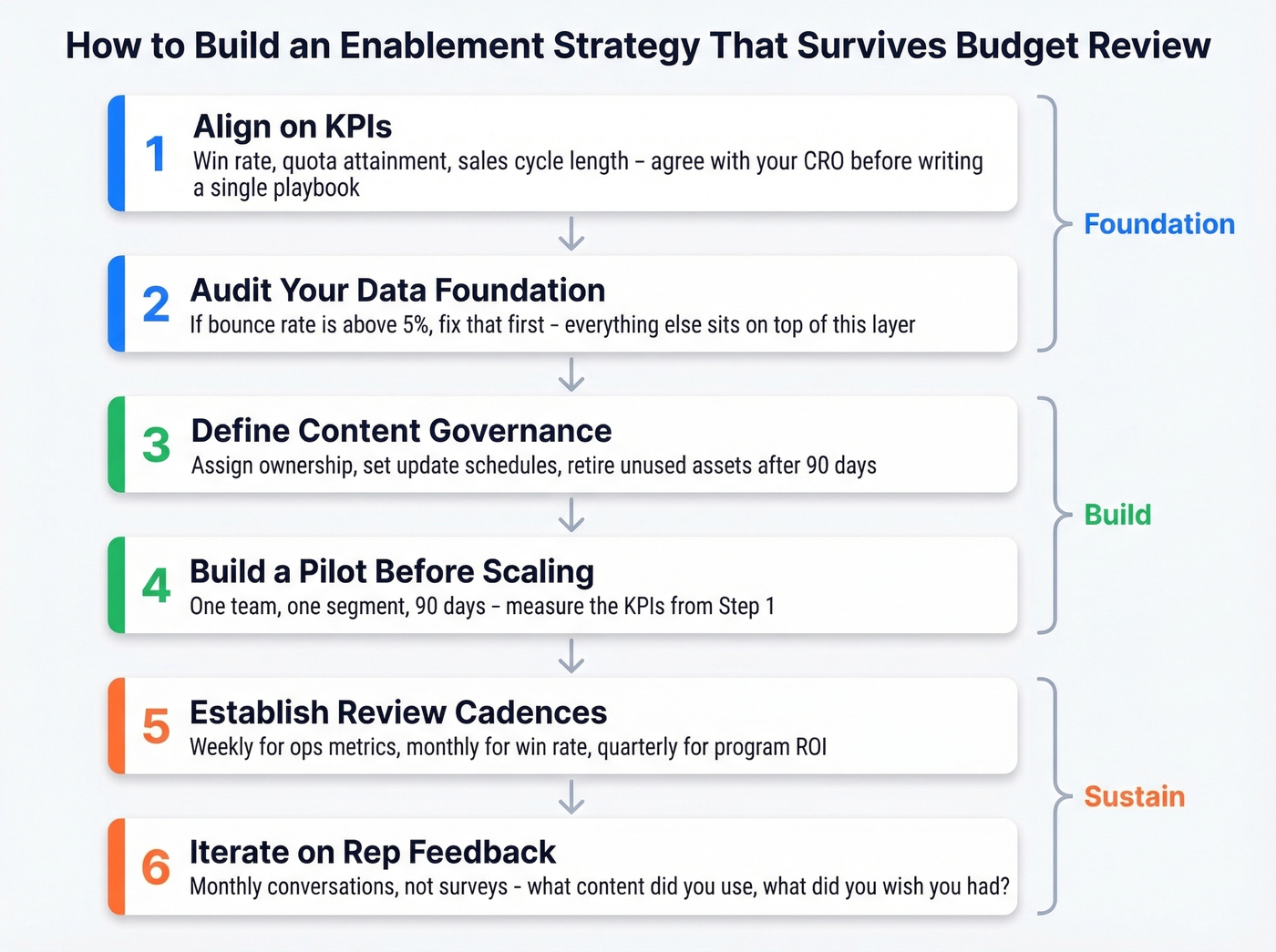
Step 1: Align on KPIs. 49% of enablement professionals disagree with their leadership on which metrics matter. That misalignment is the #1 reason programs get defunded. Sit down with your CRO or VP of Sales and agree on 3-4 metrics before you write a single playbook. Win rate, quota attainment, and sales cycle length are the safe starting trio.
If you need a KPI set that maps to pipeline, use a pipeline health view alongside win rate.
Step 2: Audit your data foundation. Before investing in content or training, verify that your reps can actually reach prospects. If your bounce rate is above 5%, fix that first - everything else you build sits on top of this layer.
Step 3: Define content governance. Assign ownership for every content type. Who creates battle cards? Who updates them? What's the retirement policy? Without governance, you'll have 47 versions of the same competitor one-pager and reps will trust none of them.
Step 4: Build a pilot before scaling. Pick one team, one segment, or one deal stage. Run the enablement program for 90 days. Measure the KPIs you agreed on in Step 1. If it works, expand. If it doesn't, you've learned cheaply.
Step 5: Establish review cadences. Weekly or bi-weekly for operational metrics like quota attainment and sales cycle length. Monthly or quarterly for win rate and average deal size. Quarterly or annually for program ROI and CLV impact. Without cadences, enablement becomes a launch-and-forget initiative.
Step 6: Iterate on rep feedback. The best enablement teams run monthly feedback loops with frontline reps. Not surveys - conversations. What content did you use this month? What did you wish you had? Where did a deal stall because you didn't have the right answer?

You just read it: every enablement pillar collapses when 35% of emails bounce. Prospeo's 5-step verification delivers 98% email accuracy on 300M+ profiles - refreshed every 7 days, not 6 weeks. That's the data quality foundation your enablement investment needs to compound.
Stop enabling reps to reach voicemail and bounce folders.
The AI Reality Check
The hype-to-reality gap in AI enablement is enormous.
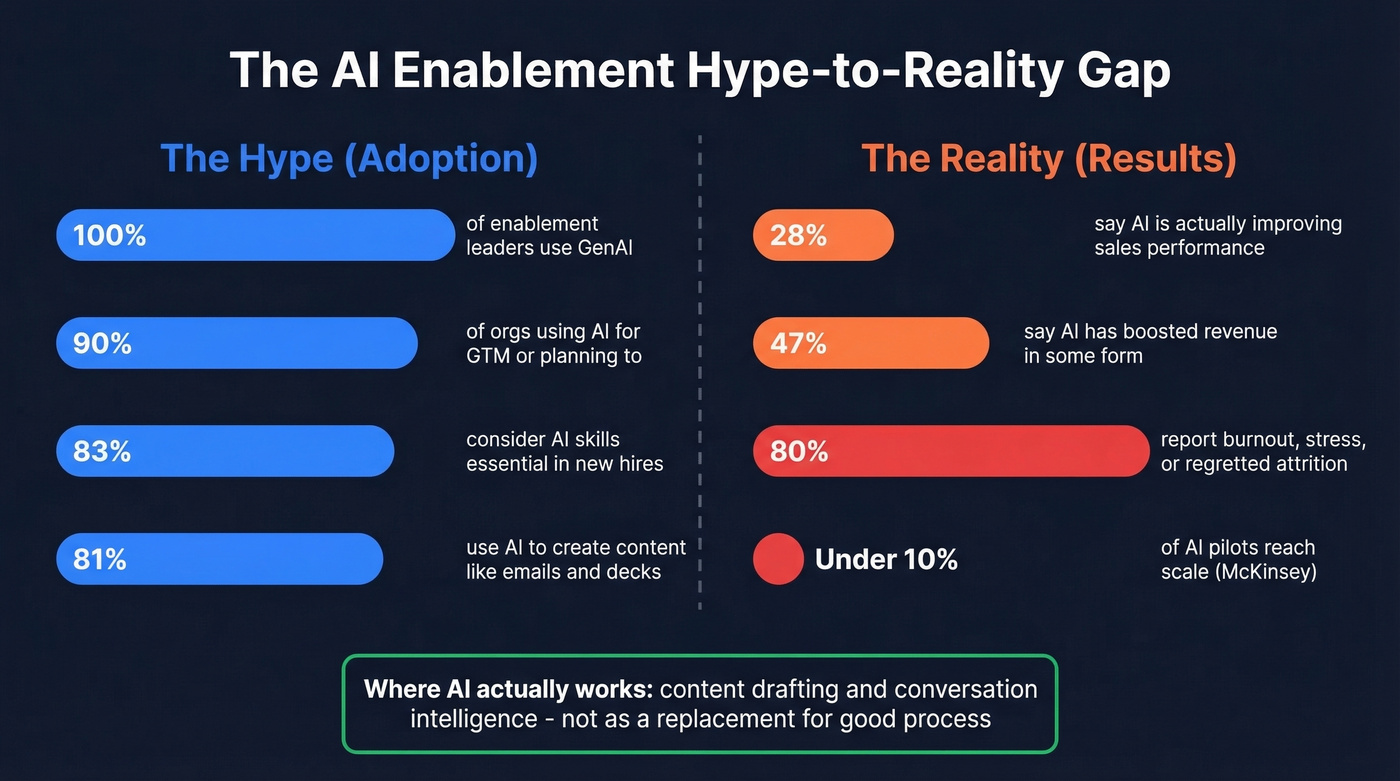
Adoption numbers are staggering: 100% of enablement leaders surveyed by Allego use GenAI, up from 62% in 2024. 81% use AI to create content like presentations and emails, up from just 28% a year earlier. 90% of organizations are either using AI for GTM or planning to start. And 83% of enablement leaders now consider AI skills essential in new hires.
Now the reality: only 28% say AI is actually improving revenue-driving sales performance, per a Dynata study of 463 senior sales and revenue leaders. 47% say AI has boosted revenue in some form, but the gap between adoption enthusiasm and measurable sales performance improvement remains wide. Meanwhile, 80% report burnout, stress, or regretted attrition. McKinsey notes that fewer than 10% of AI pilots reach scale.
So where does AI actually deliver? Two places consistently produce results:
- Content creation - drafting initial versions of emails, call scripts, and battle cards that humans then refine. 81% adoption for a reason.
- Call coaching - 60% use AI for real-time feedback during sales calls, and 63% say coaching quality improved. Teams using AI in training report 51% shorter sales cycles.
Where AI fails: when it's deployed as a strategy substitute rather than a process amplifier. If your enablement fundamentals are broken - no playbooks, no content governance, no KPI alignment - AI just accelerates the dysfunction. We've seen teams deploy AI coaching tools before they've even defined what a good discovery call looks like. The AI faithfully coaches reps toward... nothing in particular.
Let's be honest about the budget question, too. If your average deal size is under $15K and your team is under 20 reps, you probably don't need an AI enablement platform. You need a shared doc with your top 10 objection responses, a weekly pipeline review, and clean prospect data. The basics outperform the technology when the basics aren't in place.
For 2026, use AI for content generation and conversation intelligence. Don't use it to replace the strategic thinking that makes enablement work.
Measuring Enablement ROI
The 49% KPI disagreement stat deserves repeating because it's the single biggest threat to your enablement program's survival. If you're measuring content adoption and your CRO cares about quota attainment, you're speaking different languages - and you'll lose the budget fight.
Here's what enablement teams actually track:
| Metric | % of Teams Tracking |
|---|---|
| Content adoption | 50% |
| Quota attainment | 43.1% |
| Win rate | 42.2% |
| Revenue generated | 37.9% |
| Sales cycle length | 33.6% |
| eNPS | 30.1% |
The mistake most teams make is leading with content adoption when presenting to leadership. Content adoption is an internal health metric - it tells you whether reps are using what you built. Leadership doesn't care. They care about revenue generated, win rate, and quota attainment. Lead with those three in budget conversations. Use content adoption and eNPS internally to diagnose problems.
For eNPS, the formula is straightforward: eNPS = % Promoters - % Detractors. Promoters score 9-10, detractors score 0-6.
The distinction between leading and lagging indicators separates enablement teams that survive from those that get cut. Content adoption and training completion are leading indicators - they predict future performance. Win rate and revenue are lagging - they confirm past performance. You need both, but you present them differently to different audiences.
Tools You Actually Need
The 15-tool stack is dying. Seismic and Highspot announced their merger in early 2026. Showpad completed its merger with Bigtincan in late 2025. Gong expanded into full revenue enablement in early 2026. Consolidation is the signal - follow it.

A thread on r/sales captures what practitioners actually care about: tools that integrate cleanly with Salesforce and Marketo, and a lot of mindshare for Showpad in that discussion. The fact that most vendors don't publish pricing is a market problem that forces every buyer into a sales cycle just to get a ballpark.
| Tool | Category | Est. Pricing | Best For |
|---|---|---|---|
| Highspot | Content + enablement | ~$30-80K/yr | Enterprise content |
| Seismic | Content + analytics | ~$30-80K/yr | Enterprise analytics |
| Showpad | Content + coaching | ~$20-60K/yr | Mid-market integrations |
| Mindtickle | Readiness + coaching | ~$20-50K/yr | Rep certification |
| Allego | AI coaching | ~$25-60K/yr | Conversation intel |
| Gong | Revenue intelligence | ~$30-80K/yr | Call analytics |
| SalesHood | Content activation | ~$15-40K/yr | Mid-market activation |
| Salesloft | Sales engagement | ~$75-150/user/mo | Outbound cadences |
| HubSpot Sales Hub | CRM + enablement | Free tier available; paid from ~$20/user/mo | SMB, transparent pricing |
The enterprise platforms cluster around $30-80K/year - that's real budget for a mid-market company. HubSpot is the only vendor in this list with genuinely transparent pricing and a free tier. The Highspot-Seismic merger will create a dominant player, which could mean better integration or higher prices. Probably both.
Skip the enterprise platforms entirely if you're under 50 reps. In our experience, the mid-market tools cover 90% of what smaller teams need, and the implementation overhead of Highspot or Seismic will eat your first two quarters.
Remember that only 22% of enablement budget goes to technology. The other 78% is people, content, and process. Don't let tool selection consume more attention than it deserves.
Mistakes That Kill Programs
Five failure modes we see repeatedly:
- Treating enablement as a tactic instead of a system. A few decks and a quarterly training session isn't enablement - it's a content dump. Fix: define it as the ongoing system connecting content, training, tools, process, and data.
- Sales and marketing operating in silos. Misaligned goals produce wasted content and hard-to-track ROI. Fix: shared KPIs and a joint content calendar with monthly reviews.
- No quantitative KPIs. "Reps seem more confident" doesn't survive a budget review. Fix: tie every initiative to win rate, deal size, or sales cycle length from day one.
- Content disconnected from the brand story. When every rep tells a different story, buyer confidence erodes. Fix: build a messaging framework first, then create content that maps to it.
Where Enablement Is Headed
Revenue enablement is the trajectory. The best programs aren't stopping at closed-won - they're enabling CS teams for expansion, partners for co-selling, and SEs for technical validation.
The async and product-led motion is reshaping how enablement gets delivered, too. Practitioners on Reddit describe a shift toward value-first, async product immersion - Notion docs, Loom walkthroughs, sandbox links replacing heavy demos and discovery calls. Teams that only build content for live selling conversations are missing half the buyer journey.
Market consolidation will continue. The Seismic-Highspot and Showpad-Bigtincan mergers are just the beginning. Expect Gong and Salesloft to keep expanding their feature sets, blurring the line between engagement, intelligence, and enablement. For buyers, this means fewer vendors to evaluate but more pressure to pick the right ecosystem early.
AI will move from hype to targeted deployment. The teams that win won't be the ones using AI everywhere - they'll be the ones using it in the two or three places where it actually moves numbers: content drafting, call coaching, and onboarding acceleration.
And buyer enablement - giving prospects the tools and content to sell internally - is emerging as its own discipline. The 75% who prefer rep-free research still need to build a business case for their CFO. The enablement teams that arm buyers with ROI calculators, executive summaries, and internal pitch decks will close faster than those still optimizing their own sales decks.
Sales enablement in 2026 isn't about buying the right platform. It's about building a system where every pillar - content, training, tools, process, and data - reinforces the others. Get the foundation right and the rest compounds.
Reps get 17% of the buyer's time. Don't waste it dialing wrong numbers. Prospeo gives your team 125M+ verified mobiles with a 30% pickup rate and direct emails at $0.01 each - so every coaching hour, battle card, and playbook actually connects to a real conversation.
Make your enablement investment pay off with data that connects.
FAQ
What is sales enablement?
It's the ongoing system of content, training, tools, process, and data that equips revenue teams to close deals. Unlike narrower definitions focused on content management alone, the full scope covers everything that helps a rep move a deal forward - from battle cards to verified contact data.
How much does an enablement platform cost?
Enterprise platforms like Highspot, Seismic, and Gong run $30-80K/year. Mid-market options like SalesHood and Showpad start around $15-40K/year. HubSpot Sales Hub offers a free tier scaling to ~$150/user/month. Budget roughly 22% of total enablement spend on technology - the rest goes to people and process.
What KPIs should I track?
Win rate, quota attainment, sales cycle length, and average deal size. Lead with these revenue metrics when reporting to leadership - 49% of enablement pros disagree with their leaders on which metrics matter, and that misalignment is the top reason programs get defunded.
Is AI replacing enablement teams?
No. 100% of enablement leaders use GenAI, but only 28% say it's improving revenue performance. AI excels at content drafting and call coaching but fails without clear process fundamentals. Think of it as a force multiplier, not a replacement.
How do I fix bad prospect data before enabling reps?
Start by measuring your bounce rate - anything above 5% signals a data problem. Tools like Prospeo verify emails at 98% accuracy on a 7-day refresh cycle, compared to the six-week industry average. Snyk cut bounces from 35-40% to under 5% and grew AE-sourced pipeline 180% after switching.