

The Only Sales Funnel Templates You Actually Need
96% of visitors aren't ready to buy when they hit your page. That's not a design problem - it's a structure problem. A practitioner on r/SaaS nailed it: design is maybe 20% of conversion. If visitors can't answer "what is this, who is it for, what do I do next" within five seconds, no Canva template saves you.
The sales funnel templates that actually convert aren't the prettiest - they're the clearest. Here are the only three you need, the benchmarks that tell you if they're working, and the tools worth paying for.
What You Need (Quick Version)
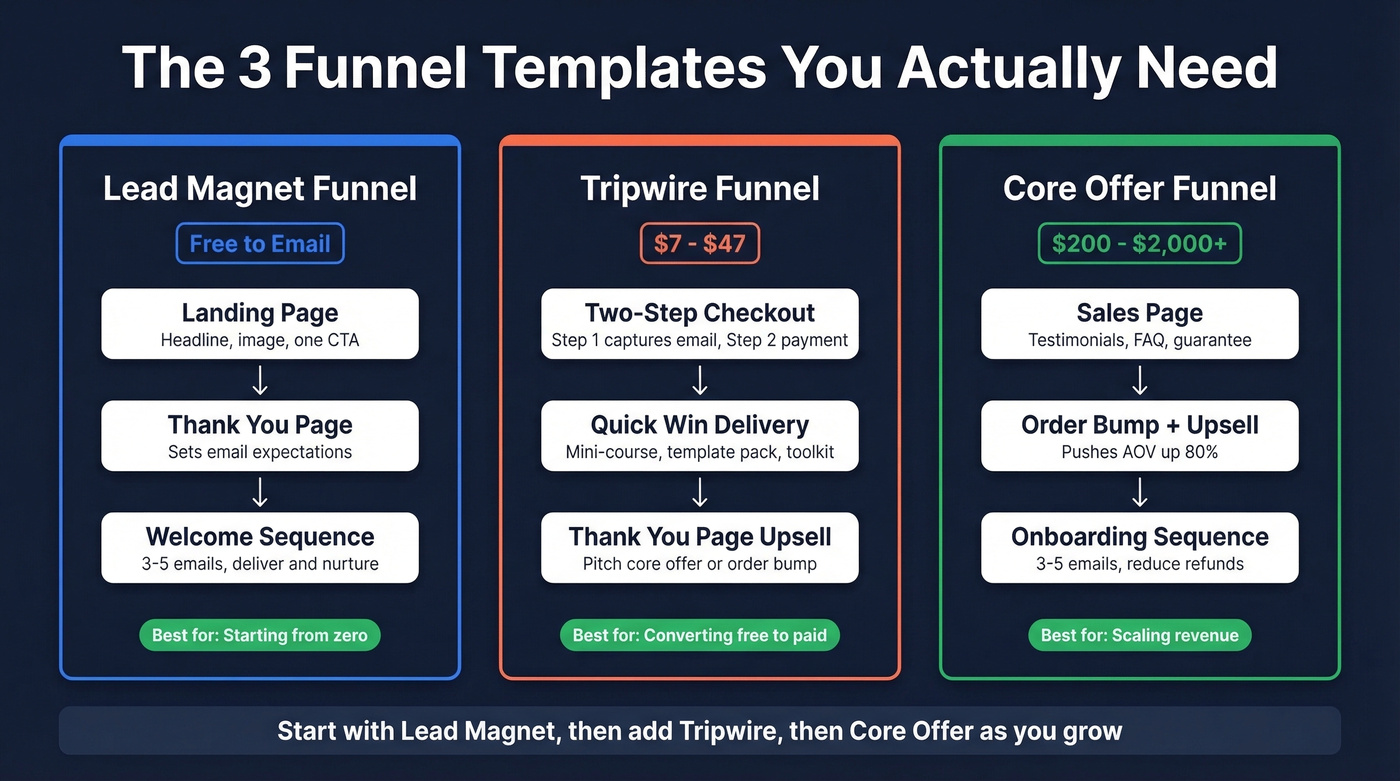
You need three funnel structures: lead magnet (free offer to email capture), tripwire ($7-$47 low-ticket offer), and core offer ($200-$2,000+). Every other funnel type - webinar funnels, challenge funnels, application funnels - is a variation of one of these three.
Start with a free template in Google Sheets before you spend a dollar on software.
| Business Stage | Template | Tool | Cost |
|---|---|---|---|
| Just starting | Lead magnet funnel | Google Sheets + Canva | Free |
| Under $10K/mo | Tripwire + core offer | Systeme.io or GetResponse | Free-$59/mo+ |
| Scaling | Full stack | GoHighLevel or ClickFunnels | $97/mo |
Funnel Stages in 60 Seconds
Every funnel maps to the same underlying psychology: AIDA - Attention, Interest, Desire, Action). The jargon changes depending on who's talking, but the mechanics don't.
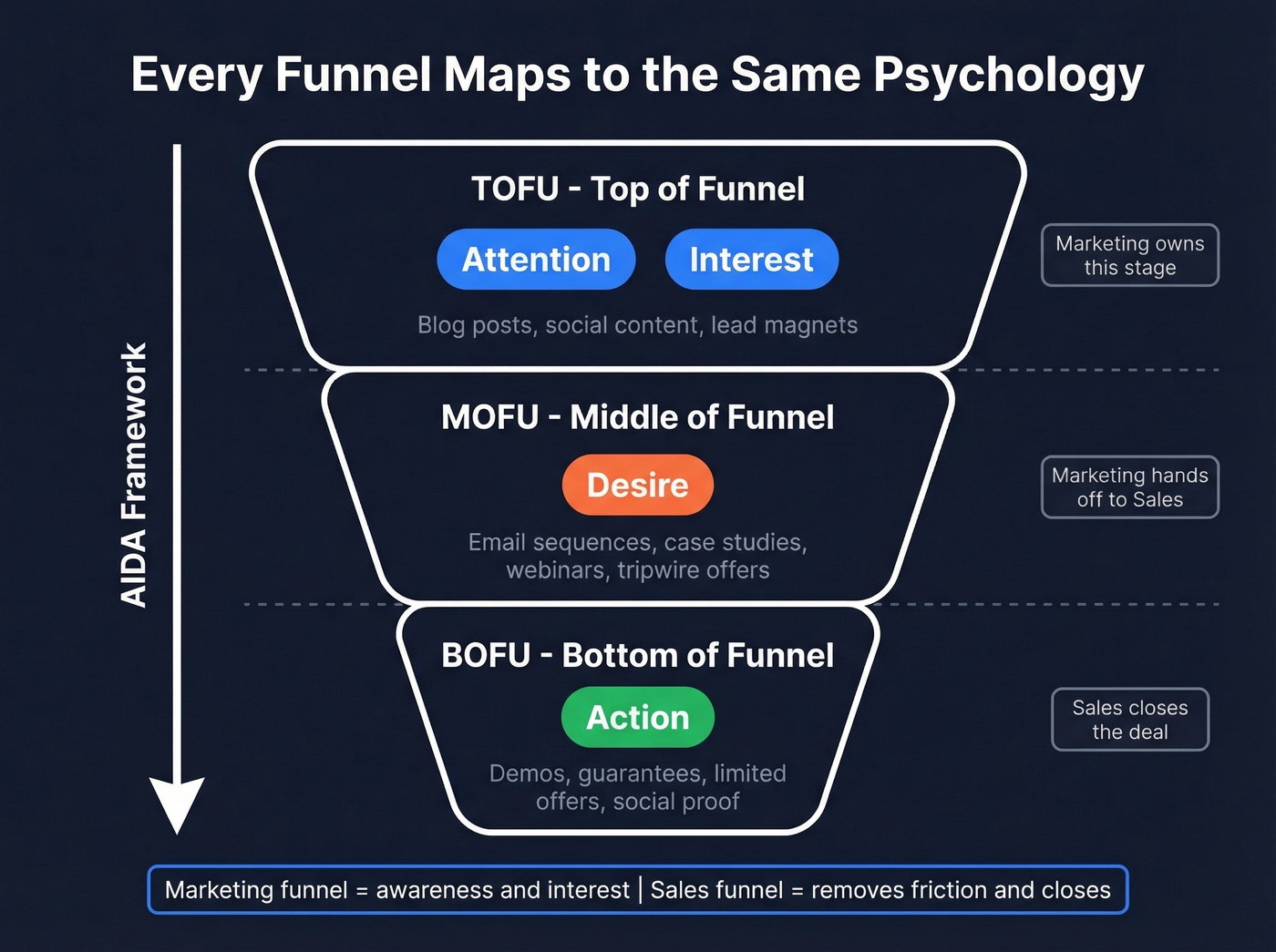
TOFU (Top of Funnel) covers Attention and Interest. Your audience knows they have a problem but isn't shopping yet. Blog posts, social content, lead magnets - anything that earns awareness lives here. Marketing owns this stage. (If you want the deeper breakdown, see top of funnel.)
MOFU (Middle of Funnel) maps to Desire. Visitors have hit your site, maybe downloaded something, and they're actively comparing options. Email sequences, case studies, webinars, and tripwire offers handle the conversion work. This is where marketing hands off to sales.
BOFU (Bottom of Funnel) is Action. These are buyers who need the right push - a demo, a guarantee, a limited offer, social proof. Your core offer funnel lives here.
Here's the distinction that actually matters: your marketing funnel generates awareness and interest, while your sales funnel removes friction and closes. Most template articles blur these together, which is why people build funnels that attract traffic but don't convert. Each template below maps to a specific stage so you know exactly where it fits.
The 3 Templates Every Business Needs
Lead Magnet Funnel (Free to Email)
Use this if you're starting from zero and need to build an email list before you sell anything.
Skip this if you already have a list of 1,000+ engaged subscribers - jump straight to the tripwire.
The structure is dead simple: a landing page (squeeze page), a thank-you page, and a 3-5 email welcome sequence. That's the entire funnel. The landing page has one job - headline, image, CTA, nothing else. The thank-you page sets the expectation that the lead magnet is coming via email, which trains your new subscriber to open your messages.
Your headline needs to promise a specific outcome ("Get the 5-step cold email framework that books 12 meetings/week"), not a vague benefit ("Improve your outreach"). The image should show the deliverable - a mockup of the PDF, the spreadsheet, the checklist. And the CTA button should say what happens next ("Send me the framework"), not something generic ("Submit").
Your welcome sequence does the real work. Email 1 delivers the lead magnet. Emails 2-3 build credibility with quick wins or case studies. Emails 4-5 introduce your paid offer. This is where most people drop the ball - they capture the email and then go silent for two weeks. (If you're building this out, a tight email cadence matters more than fancy design.)
Tripwire Funnel ($7-$47)
The entire point of a tripwire isn't revenue. It's the psychological shift from "free subscriber" to "paying customer." That shift changes everything about how someone engages with your brand.
The sweet spot for pricing is $7-$27. Low enough that it's an impulse buy, high enough that the buyer has committed real money. The mechanic that makes tripwires powerful is the two-step checkout: step one captures the lead's contact info, step two collects payment. If payment fails or they abandon, you still have their email for follow-up. Two-step checkout improves conversion 20-40% over single-step because you're separating the commitment from the payment friction.
The tripwire itself should be a quick win - a mini-course, a template pack, a toolkit. Something they can use in under an hour and get a result from. The thank-you page is where you pitch the core offer or an order bump. Never waste a thank-you page on "thanks for your purchase." If your average deal size is north of $5,000, skip the tripwire entirely and go straight to the core offer with a consultation-based approach.
Core Offer Funnel ($200-$2,000+)
Here's where the math gets interesting: a $197 core offer with a well-placed $47 order bump and a $109 upsell pushes your average order value to $353.90 - roughly an 80% revenue increase per customer. If you're running a core offer funnel without order bumps and upsells, you're leaving easy revenue on the table. (More ideas: upsell techniques.)
This funnel requires the most trust-building elements. You can't just slap up a sales page and expect conversions at this price point - the page needs testimonials (video if possible), a detailed FAQ section, a money-back guarantee, and clear onboarding expectations. Buyers at the $200+ level want to know exactly what happens after they click "buy." An onboarding email sequence of 3-5 emails over the first week reduces refund rates and increases lifetime value. We've seen refund rates drop by half just from adding a solid post-purchase sequence that makes buyers feel like they made the right call.
Templates by Business Type
B2B SaaS
Lead magnet: whitepaper, ROI calculator, or product demo video. Tripwire: free trial or freemium tier (your $0 tripwire - the commitment is time, not money). Core offer: annual subscription with onboarding.
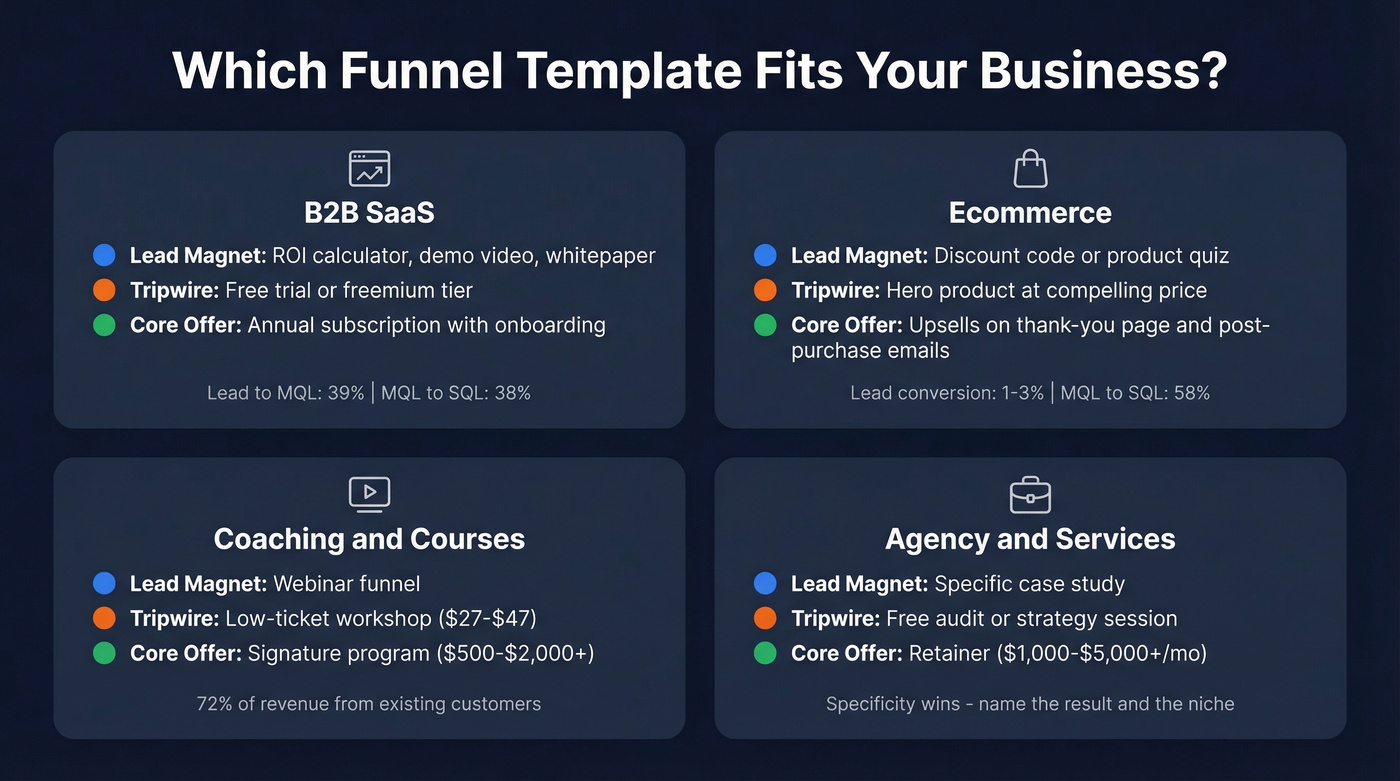
B2B SaaS benchmarks run Lead to MQL at 39% and MQL to SQL at 38%. Those are solid lead qualification rates, which means your lead magnet is doing its job if you're in that range. Where SaaS funnels leak is SQL to Closed Won at 37% - that's a sales execution problem, not a template problem. (To instrument this properly, track B2B sales funnel metrics.)
Ecommerce
Ecommerce sellers want plug-and-play funnels built around a hero product with 3-5 upsell/cross-sell items. Your lead magnet is a discount code or quiz ("Find your perfect [product]"). The tripwire is the hero product at a compelling price. Upsells happen on the thank-you page and in the post-purchase email sequence.
Ecommerce lead conversion sits at 1-3%, but MQL to SQL jumps to 58% - meaning once someone engages, they're much more likely to buy. Focus your energy on that first conversion.
Coaching & Courses
Webinar funnel as lead magnet, low-ticket workshop tripwire ($27-$47), signature program core offer ($500-$2,000+). The webinar does double duty: it builds authority and pre-sells the core offer. Your post-purchase retention sequence matters as much as the initial funnel - up to 72% of revenue comes from existing customers, so the real money is in what happens after the first sale.
Agency & Services
Case study funnel as lead magnet, free audit or strategy session as tripwire, retainer core offer ($1,000-$5,000+/mo). The audit serves as both a tripwire and a sales conversation. Keep the case study specific - "How we generated 47 SQLs in 30 days for a Series B fintech" beats "How we help companies grow." (If you need a tighter close plan, use these sales closing techniques.)

Your lead magnet funnel captured the email. Now what? 96% of visitors aren't ready to buy - but the ones who are need to hear from you at a verified address. Prospeo gives you 98% accurate emails and 125M+ direct dials so your BOFU sequences actually reach decision-makers.
Stop building funnels that leak at the contact data layer.
Funnel Conversion Benchmarks
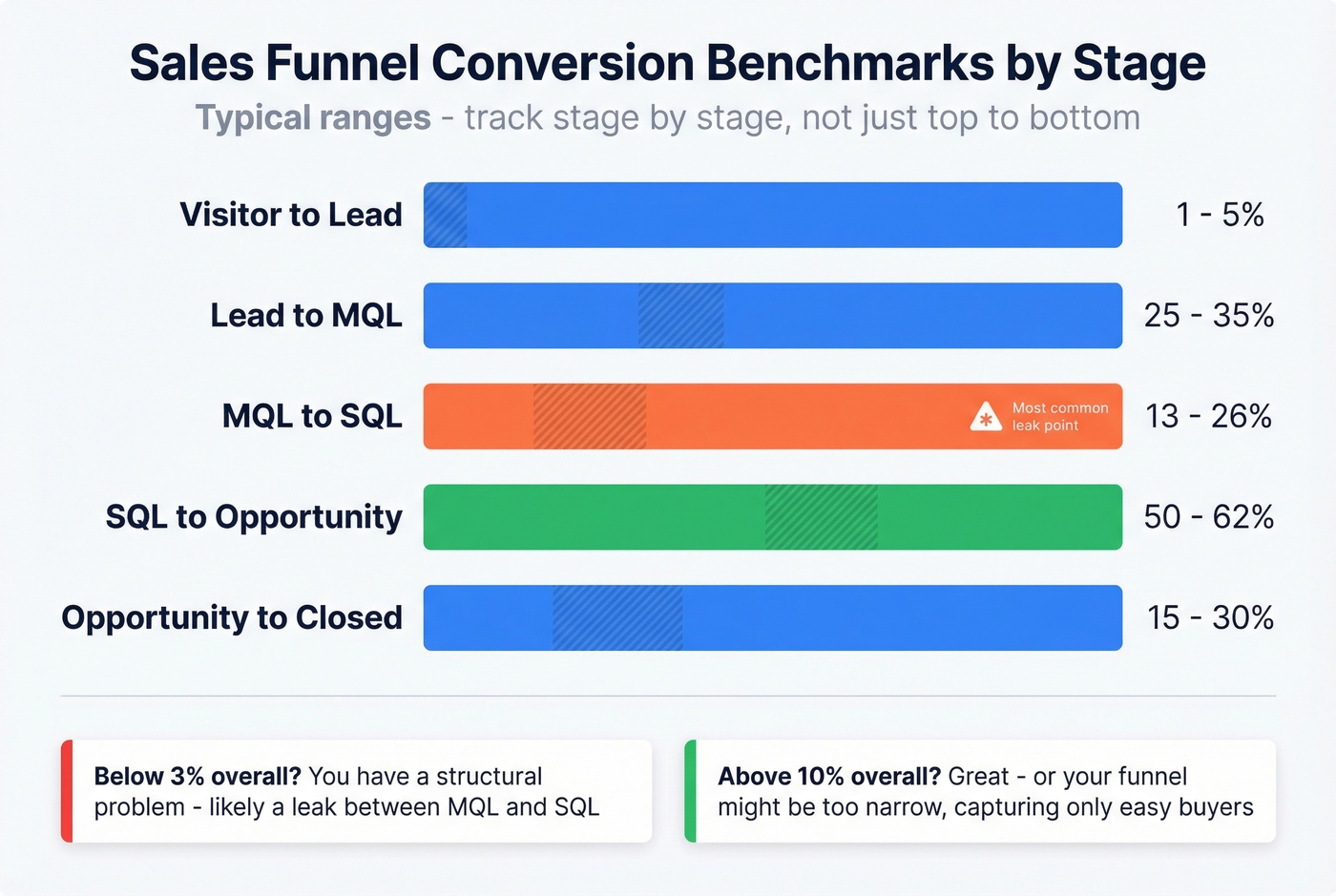
Benchmarks are useless without context. A 5% visitor-to-lead rate is excellent for a cold traffic landing page and terrible for a retargeting page.
Stage-by-Stage Benchmarks
| Stage | Typical Range |
|---|---|
| Visitor to Lead | 1-5% |
| Lead to MQL | 25-35% |
| MQL to SQL | 13-26% |
| SQL to Opportunity | 50-62% |
| Opportunity to Closed | 15-30% |
Industry Benchmarks
| Industry | Lead to MQL | MQL to SQL | SQL to Opp | SQL to Closed |
|---|---|---|---|---|
| B2B SaaS | 39% | 38% | 42% | 37% |
| Ecommerce | 23% | 58% | 66% | 60% |
Overall, most funnels convert 3-10% from first touch to closed deal. Below 3%, you've got a structural problem - likely a leak between MQL and SQL where leads go cold. Above 10%, you're either in a high-intent niche or your funnel is too narrow and you're only capturing the easiest buyers.
Track stage-by-stage, not just top-to-bottom. A funnel with a 2% overall conversion rate might have a fantastic lead magnet (5% visitor to lead) and a broken middle (8% MQL to SQL). You can't fix what you can't see. (If you suspect leakage, start with a leaky sales funnel audit.)
Free Downloads You Can Use Today
Before you pay for anything, grab these:
Salesflare's spreadsheet template - Free download in Excel and Google Sheets. Three tabs: Settings & Instructions, Sales Funnel, and Insights with auto-updated metrics. Customize stages, add team members, set targets, and configure follow-up reminders. Best starting point for tracking.
Canva funnel diagrams - Free templates for visualizing your funnel in team presentations or strategy docs. These aren't functional funnels - they're alignment tools.
Coupler.io Looker Studio dashboards - Free reporting templates that pull from Salesforce, HubSpot, Pipedrive, and GA4. Visual dashboards without building from scratch.
Typeform + Google Sheets via Zapier - Connect a form tool to your tracking sheet so new leads flow in without manual entry. Not a CRM, but for teams running fewer than 50 deals a month, it's more than enough.
Look, a Google Sheet beats a $97/month tool if you have fewer than 50 deals a month. We've seen teams spend months configuring ClickFunnels when a spreadsheet and a Mailchimp account would've gotten them to revenue faster. Don't buy software to avoid doing the work - the work is the funnel strategy, not the tool.
Best Funnel Builder Tools Compared
| Tool | Best For | Starting Price | Free Tier? | Key Strength |
|---|---|---|---|---|
| Systeme.io | Beginners | Free-$27/mo+ | Yes | Full builder at $0 |
| GetResponse | Email-first funnels | $59/mo (1,000 subscribers) | No | Email + funnels in one |
| FunnelKit | WordPress users | ~$99-$299/yr | No | Best value on WP |
| Swipe Pages | Mobile-first pages | ~$29/mo+ | No | AMP + A/B testing |
| GoHighLevel | Agencies | $97/mo | No | White-label + CRM |
| ClickFunnels | Template variety | $97/mo | No | 44+ templates |
| Kartra | All-in-one marketers | ~$99/mo | No | Email + memberships + helpdesks |
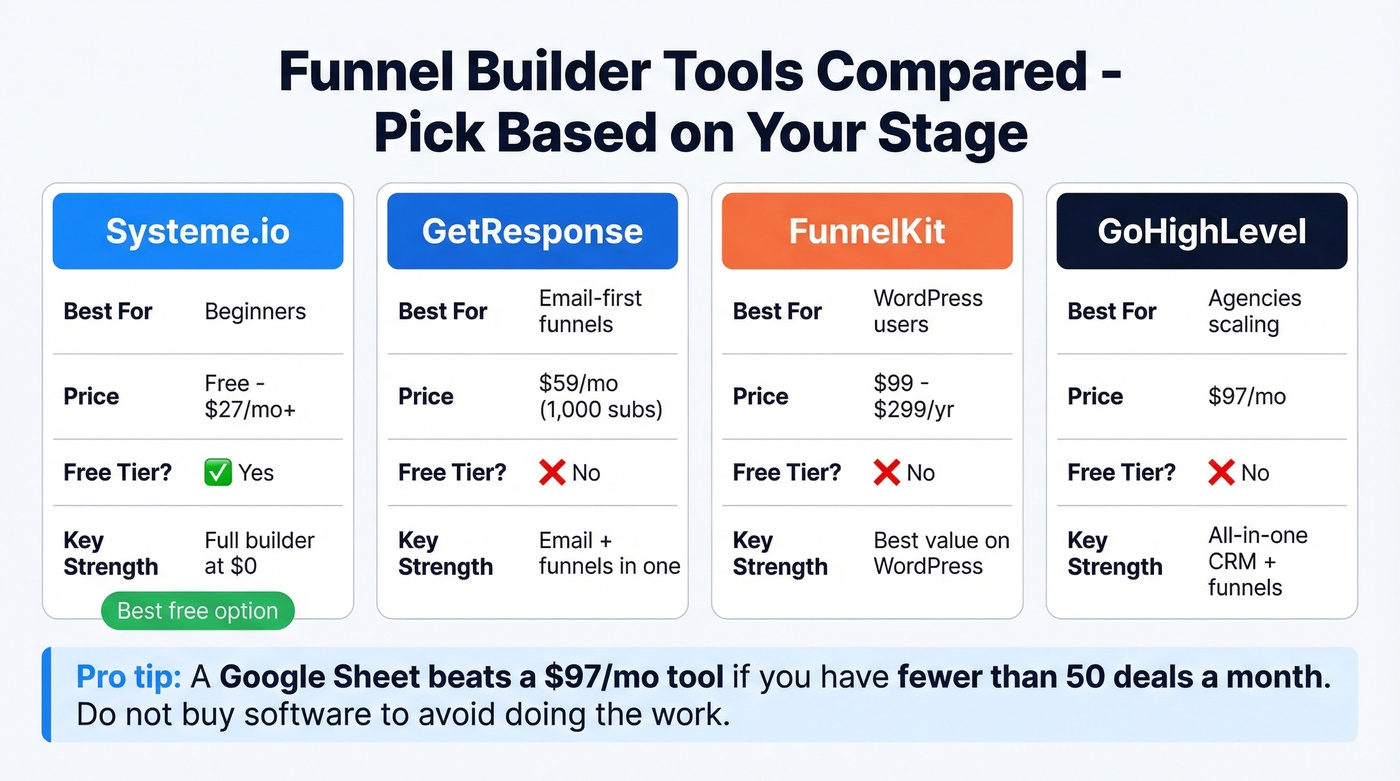
Free: Systeme.io. It's the only tool on this list with a genuinely usable free tier - funnel builder and email automation included. It's not pretty, but it works.
Under $100/mo: GetResponse if email is your primary channel. The $59/mo Marketing Automation plan covers 1,000 subscribers with funnels built in. For WordPress users, FunnelKit at ~$99-$299/year is the best value - it plugs into WooCommerce and gives you checkout optimization that standalone builders can't match. Kartra fits here too if you want email, memberships, and helpdesks in a single dashboard without stitching tools together.
Scaling: GoHighLevel at $97/mo if you're an agency - white-label everything and resell to clients. ClickFunnels at $97/mo if you want the largest template library and community. A common complaint about ClickFunnels is price relative to complexity - people pay $97/mo and spend weeks learning the interface. GoHighLevel has a different problem: the funnels look dated out of the box. Reddit threads are full of users asking how to make GoHighLevel pages look modern. The workaround is to design in Figma first, then build inside the tool.
5 Mistakes That Kill Conversions
Skipping the Clarity Test
Design is roughly 20% of what makes a funnel convert. The other 80% is structure and copy. If a visitor can't answer three questions in five seconds - what is this, who is it for, what do I do next - no template saves you. Run the clarity test from r/SaaS on every page before you worry about colors and fonts. Quizzes and assessments force clarity by design and collect zero-party data - information prospects give you directly, which is more reliable than any tracking pixel.
One-Step Checkout
If your checkout page asks for payment info on the first screen, you're losing 20-40% of potential conversions. Two-step checkout captures the lead's email first, then asks for payment. If they abandon at step two, you still have their contact for a recovery sequence. This is the single highest-impact change most funnels can make.
No Upsells or Order Bumps
We've audited funnels where the core offer was solid but there were zero upsells. That's a 20-50% AOV increase sitting there unclaimed. The math is straightforward: a $197 core offer with a $47 bump and a $109 upsell pushes average revenue to $353.90 per customer - an 80% increase from adding two elements to your funnel. (If you also sell add-ons, use these cross selling examples.)
Ignoring Cart Abandonment
70% of carts get abandoned. A recovery sequence at 1 hour, 2 hours, 24 hours, and 48 hours recaptures a meaningful chunk of those lost sales. Most funnel builders have this built in - if yours doesn't, connect your checkout to an email tool via Zapier.
Sending Unverified Contacts Into the Funnel
This one is frustrating because it's so preventable. If 35% of the emails in your outbound list bounce, your domain reputation tanks and every subsequent campaign suffers. It doesn't matter how good your funnel is if your emails never reach the inbox. Verify before the funnel, not after the damage is done. (If you need options, start with an email checker tool.) Meritt tripled their pipeline from $100K to $300K/week while cutting bounce rates from 35% to under 4% by switching to verified data with a 7-day refresh cycle.
How to Fill Your Funnel
Your funnel is built. Now the hard part: getting qualified people into it.
For B2B outbound, you need verified contacts that won't torch your sender reputation. Prospeo's B2B database covers 300M+ professional profiles with 30+ search filters - buyer intent, technographics, job change, headcount growth, funding, department size. Intent data tracks 15,000 topics via Bombora, so you can target prospects researching your category right now. The accuracy backs it up: 98% email accuracy, 125M+ verified mobile numbers, all on a 7-day data refresh cycle while the industry average sits at six weeks. Snyk generates 200+ new opportunities per month with 50 AEs using the platform.
The free tier gives you 75 verified emails per month - enough to test whether the data quality matches your needs before committing. No contracts, no sales calls, self-serve from day one. (If you're writing sequences to feed this, start with a proven B2B cold email template.)
B2B SaaS funnels lose 63% of SQLs before close. Bad contact data makes that worse. Prospeo's 300M+ profiles with 30+ filters - buyer intent, job changes, funding signals - let you feed your funnel with prospects already in-market. At $0.01 per email, your cost per opportunity drops fast.
Fill every funnel stage with contacts that actually convert.
FAQ
What's the best free sales funnel template?
Salesflare's Google Sheets template is the strongest free option for tracking - it includes three sheets with auto-updated metrics. For a live funnel builder, Systeme.io's free tier includes page building and email automation.
Do I need funnel builder software?
Not until you're running 50+ deals per month. A Google Sheet paired with an email tool handles most early-stage funnels. Software pays off when you need A/B testing, multi-step automation, and checkout optimization that spreadsheets can't replicate.
What's a good funnel conversion rate?
Most funnels convert 3-10% overall from first touch to closed deal. B2B SaaS converts leads to MQLs at roughly 39%, while ecommerce lead conversion sits at 1-3%. Track stage-by-stage - a healthy top-of-funnel with a broken middle looks identical to a bad funnel if you only measure end-to-end.
How many funnel templates do I need?
Three. A lead magnet funnel (free offer to email capture), a tripwire funnel ($7-$47 low-ticket offer), and a core offer funnel ($200-$2,000+). Webinar funnels, challenge funnels, and application funnels are all variations of these three core structures.
How do I get qualified leads into my funnel?
For B2B, use a data platform with verified contacts filtered by intent signals, industry, and job role. For B2C, drive traffic via content marketing, paid ads, or social media. The best template in the world can't fix an empty pipeline.