

7 Consultative Selling Examples - With the Dialogue, the Mistakes, and the Numbers
A rep on r/sales described using a "fancy discovery question" on a cold call - "What's keeping you up at night regarding your current solution?" - and the prospect fired back: "Are you reading from a script?" Then hung up. The company had paid a $15k consultant to teach that exact framework.
Most examples of consultative selling give you theory. This one gives you the dialogue and the moments where it actually breaks.
What Separates the Best
Three things separate top consultative sellers from everyone else. They research before the call - role, company signals, likely pain - so the conversation starts with context instead of a blank page. They talk less than 45% of the time (more on talk-to-listen ratio benchmarks later). And they're willing to say "we're not the right fit" and walk away, because that honesty builds more pipeline long-term than any closing technique ever will.
What Consultative Selling Actually Is
Consultative selling means understanding a buyer's goals, constraints, and priorities before you recommend anything. It's the opposite of transactional selling, where you lead with features and price and try to close fast. In B2B, 87% of buyers now expect a consultative experience.
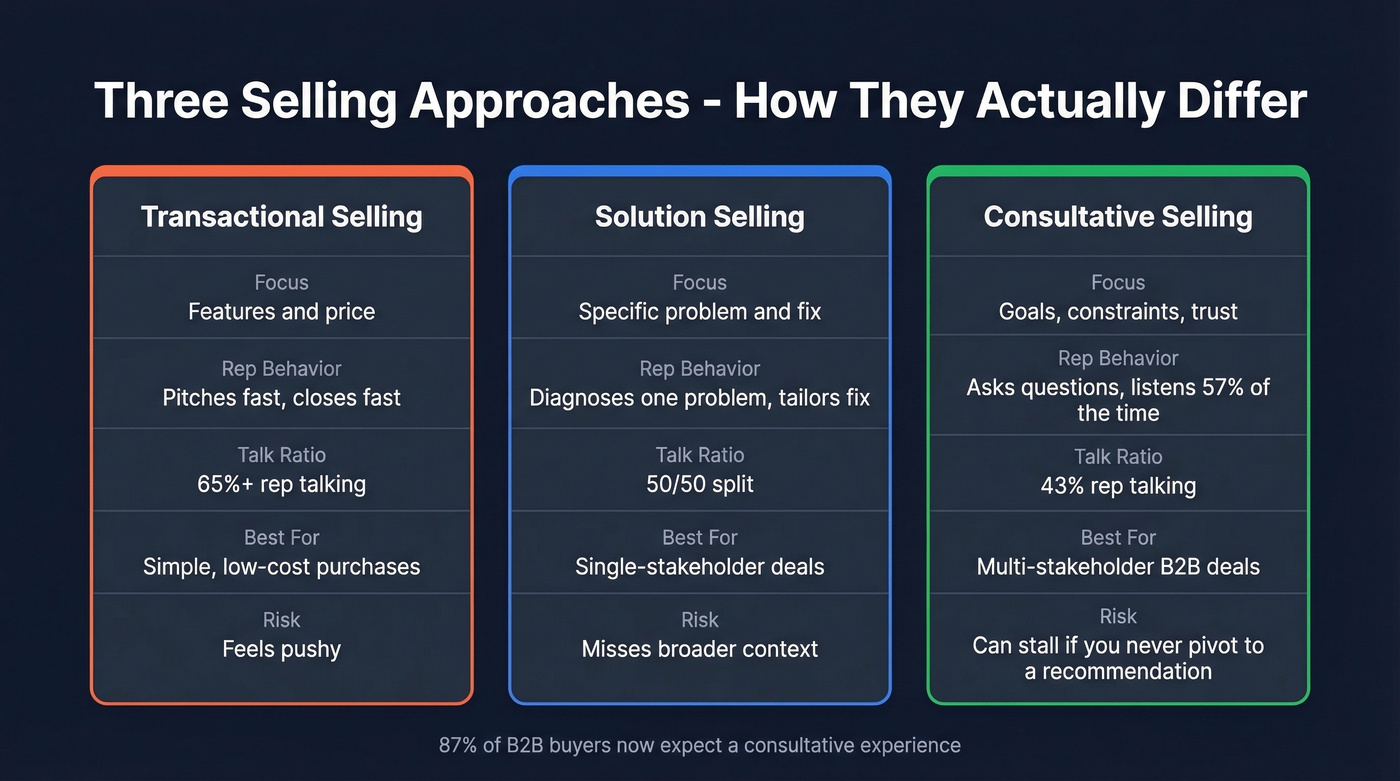
One distinction worth making: consultative selling isn't solution selling. Solution selling identifies a specific problem and tailors a fix. Consultative selling starts wider - it focuses on needs, goals, and trust before any recommendation happens. The difference matters in multi-stakeholder deals where the "problem" isn't even agreed upon yet (if you want the deeper breakdown, see consultative selling vs solution selling).
Why It Works - The Numbers
Wilson Learning trained roughly 600 sales and marketing reps in a consultative sales culture program and documented a 3.1:1 ROI - $3.10 returned for every $1 invested. That's one of the few quantified training ROI numbers in the industry.
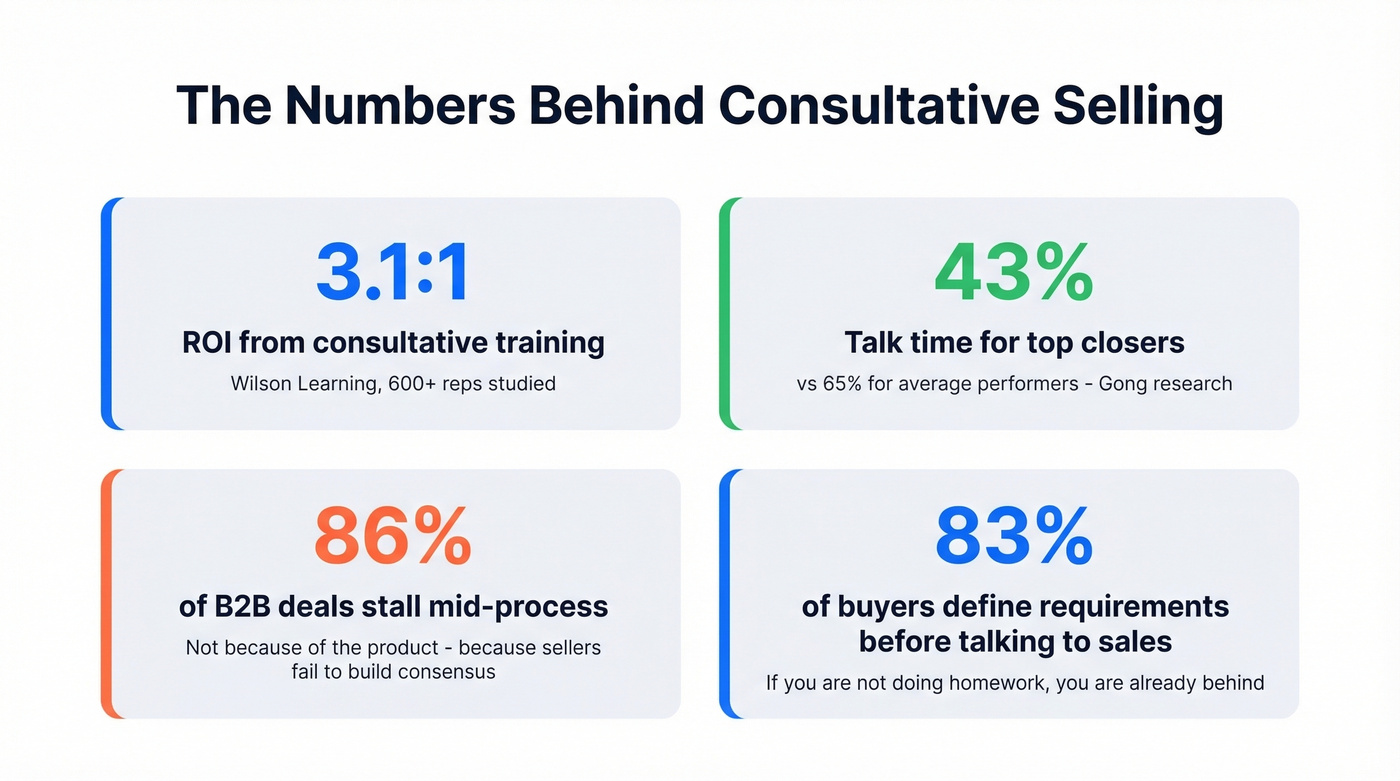
The behavioral data is just as clear. Gong's analysis shows top closers speak 43% of the call versus 65% for average performers. That gap isn't about being quiet - it's about asking better questions that get the prospect talking about what actually matters (use these sales questioning techniques to sharpen it).
Meanwhile, 86% of B2B purchases stall during the buying process. Not because the product was wrong, but because the seller failed to help the buyer build internal consensus. A consultative approach surfaces the real blockers early. And 83% of buyers mostly or fully define their purchase requirements before they ever speak to sales - so if you're not doing homework before the call, you're already behind.
Here's the thing: the best consultative sellers we've worked with have zero formal sales training. They just ask good questions naturally and shut up long enough to hear the answer. The frameworks below aren't magic. They're guardrails for people who haven't developed that instinct yet.


The best consultative sellers research before the call - role, company signals, likely pain. Prospeo gives you 30+ filters including buyer intent, technographics, job changes, and headcount growth on a 7-day refresh cycle. Turn every cold call into a warm one.
Stop asking "what keeps you up at night" - show up already knowing.
7 Real-World Consultative Selling Examples
1. SaaS Discovery - SPIN Implication Questions
Scenario: Mid-market SaaS AE on a first call with a VP of Operations who mentioned manual data entry as a pain point.
Rep: "You mentioned your team loses about 3 hours a day to manual entry. If that continues for a full quarter across 12 reps, what does that cost you in pipeline coverage?"
VP: "Honestly, I haven't done that math. But it's... a lot."
Rep: "Let's do it together. At your average deal size, that's easily six figures in opportunity cost per quarter. Does that feel right?"
This is a classic SPIN Implication question - it takes a stated problem and forces the prospect to quantify the downstream impact. SPIN methodology comes from research across 35,000 sales calls, and a solid questioning strategy can lift closure rates by around 20%. The rep never mentions their product. They let the math do the persuading.
2. The "Menu of Pain" Cold Call Opener
Scenario: SDR cold-calling a Director of Marketing at a 200-person company.
SDR: "Hey Sarah, quick question - when I talk to marketing directors at companies your size, the three things that come up most are attribution gaps, lead quality from paid channels, and campaign-to-pipeline lag. Which of those hits closest to home, or is it something else entirely?"
Instead of the dreaded "What keeps you up at night?" - which sounds canned and puts the prospect on the spot - the menu of pain approach gives multiple-choice options. It establishes credibility, gets to the root faster, and avoids the blank-page problem of open-ended questions (more examples: cold call questions). Cognism's research found that 57% of C-level and VP buyers prefer phone contact, but only when the caller has something relevant to say.
3. Multi-Stakeholder Discovery
Enterprise deals live or die on whether you ask the right person the right question. Here's what that looks like in practice - an AE navigating a 5-person buying committee at a Fortune 500, with both the VP of Sales and a Sales Ops Manager on the call.
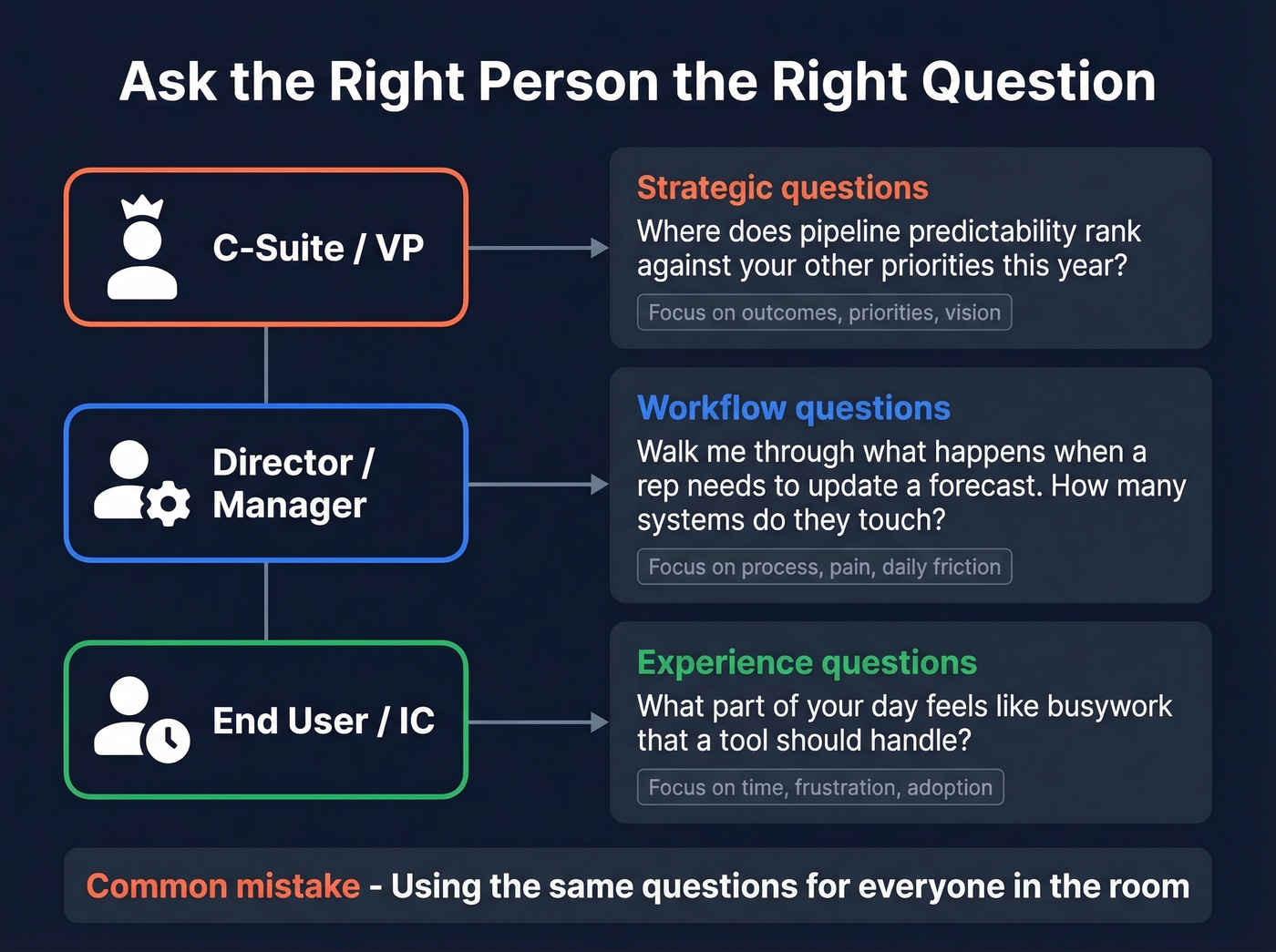
To the VP: "Where does pipeline predictability rank against your other priorities this year?"
VP: "It's top three. We missed forecast two quarters running."
To the Manager: "Walk me through what happens today when a rep needs to update a forecast. How many systems do they touch?"
Manager: "Three. And half the time they just guess."
The questions are tailored to each stakeholder's altitude. The VP cares about strategic outcomes. The Manager lives in the workflow. Asking the VP about system workflows wastes their time; asking the Manager about strategic priorities gets you a shrug. This is where most reps blow it - they default to one set of questions for everyone in the room (for a full structure, use an enterprise sales stages map).
4. Qualifying Out - "We're Not the Right Fit"
Most reps can't bring themselves to say this. That's exactly why it works.
Rep: "Based on what you're describing, you need an agency that can handle end-to-end creative production in-house. That's not us - we'd slow you down. But I know two shops that do this well. Want me to make an intro?"
Prospect: "...Yeah, actually. That'd be great. And honestly, we might need media buying help next quarter."
Honest disqualification builds trust that pays compound interest. That prospect will come back, and they'll refer others. Consultative selling sometimes means not selling (this is also where strong objection handling in B2B sales helps you stay direct without getting defensive).
5. Research-First Cold Outreach
Two approaches, same prospect:
Without research: "Hi, is this Mark? I'm calling from Acme - we help companies like yours with sales acceleration..."
With research: "Mark, congrats on the Series B - saw you closed $18M last month. With 15 new sales hires on the plan, I'm guessing ramping those reps fast is top of mind. That's exactly what we help with."
The second opener gets a conversation. The first gets a dial tone. Consultative selling starts before the call - with buyer intent signals, technographics, and headcount growth data that turn a cold call into a warm one. We use Prospeo's 30+ search filters and 7-day data refresh to do this prep in minutes, pulling intent data and company growth signals so every conversation starts with context (more ideas: pipeline generation).

6. Renewal and Upsell Discovery
Scenario: CSM running a quarterly business review with a customer who's been on the platform for 14 months.
CSM: "Last quarter you hit 92% of your activation target. Where do you want that number to be by Q3?"
Customer: "110% would be the stretch goal. But we'd need better onboarding automation to get there."
CSM: "We launched an onboarding module last month. Want me to walk you through how two similar customers are using it?"
Goal-oriented questions on existing accounts surface expansion opportunities naturally. The CSM isn't pushing a product - they're connecting a stated goal to a capability the customer didn't know existed. In our experience, this is where some of the highest-ROI conversations happen, and most teams under-invest in it badly. Every example in this article applies to new business, but the renewal conversation is where the consultative approach truly compounds (see a full account management upsell strategy).
7. Retail - The Non-B2B Example
Salesperson: "Before I show you anything - tell me about the room. Open floor plan? Kids? Pets?"
Customer: "Two dogs, a toddler, and a husband who falls asleep watching football."
Salesperson: "Performance fabric, deep seat, machine-washable covers. Let me show you three options."
Consultative selling isn't a B2B invention. The salesperson who leads with "this Italian leather is on sale" loses to the one who asks about the dogs first. Same principle, different context.
When Consultative Selling Backfires
Sounding Scripted
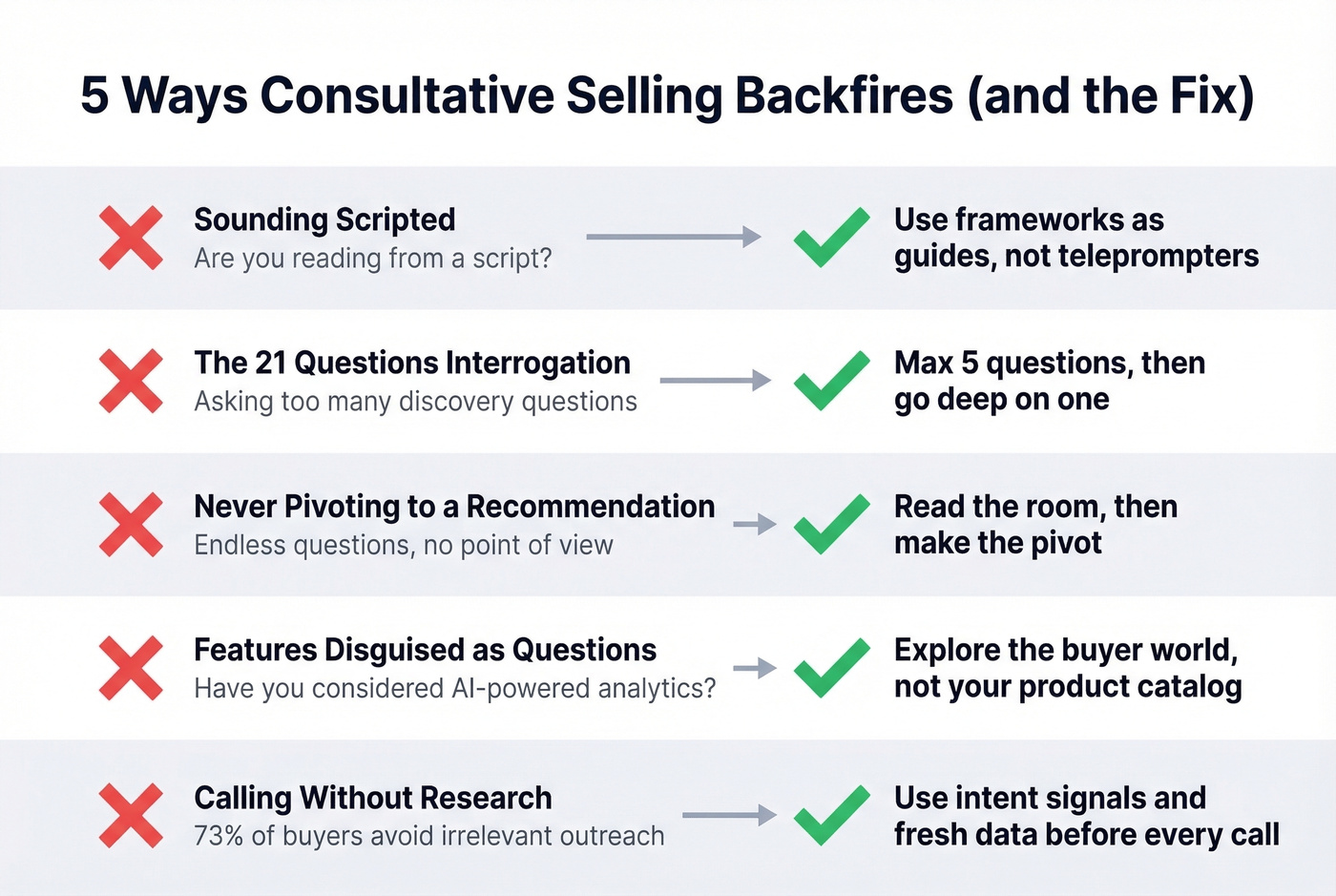
The r/sales thread says it all: "Are you reading from a script?" If your discovery questions sound rehearsed, you've already lost. The framework is a guide, not a teleprompter. Reps making 40 calls a day need scripts that flex, not scripts they recite word-for-word (a good starting point: phone scripts).
The "21 Questions" Interrogation
One AE on Reddit described consultative discovery as feeling like he was "grilling a customer... 21 questions." If you're asking more than five well-chosen questions in a discovery call, you're interrogating, not consulting. Use the menu of pain to get to the root in two or three questions, then go deep on one.
Never Pivoting to a Recommendation
At some point, being "too consultative" becomes disingenuous. The buyer knows you're selling something. If you keep asking questions and never offer a point of view, you look like you're stalling - or worse, like you don't have a solution. Read the room and make the pivot.
Leading With Features Disguised as Questions
"Have you considered how a platform with AI-powered analytics could transform your workflow?" That's not a consultative question. That's a pitch wearing a question mark. Consultative questions explore the buyer's world. Feature-leading questions explore your product catalog. Skip this approach entirely - it fools nobody (this is basically feature dumping with extra steps).
Calling Without Research
73% of B2B buyers avoid sellers who send irrelevant outreach. And contact data decays fast - the industry average refresh cycle is six weeks. If your contact data is stale, consultative selling dies before it starts. This is the most fixable mistake on the list, and the one teams ignore the longest.
Discovery Framework That Prevents Interrogation
Three steps. Internalize them - don't read them off a card.
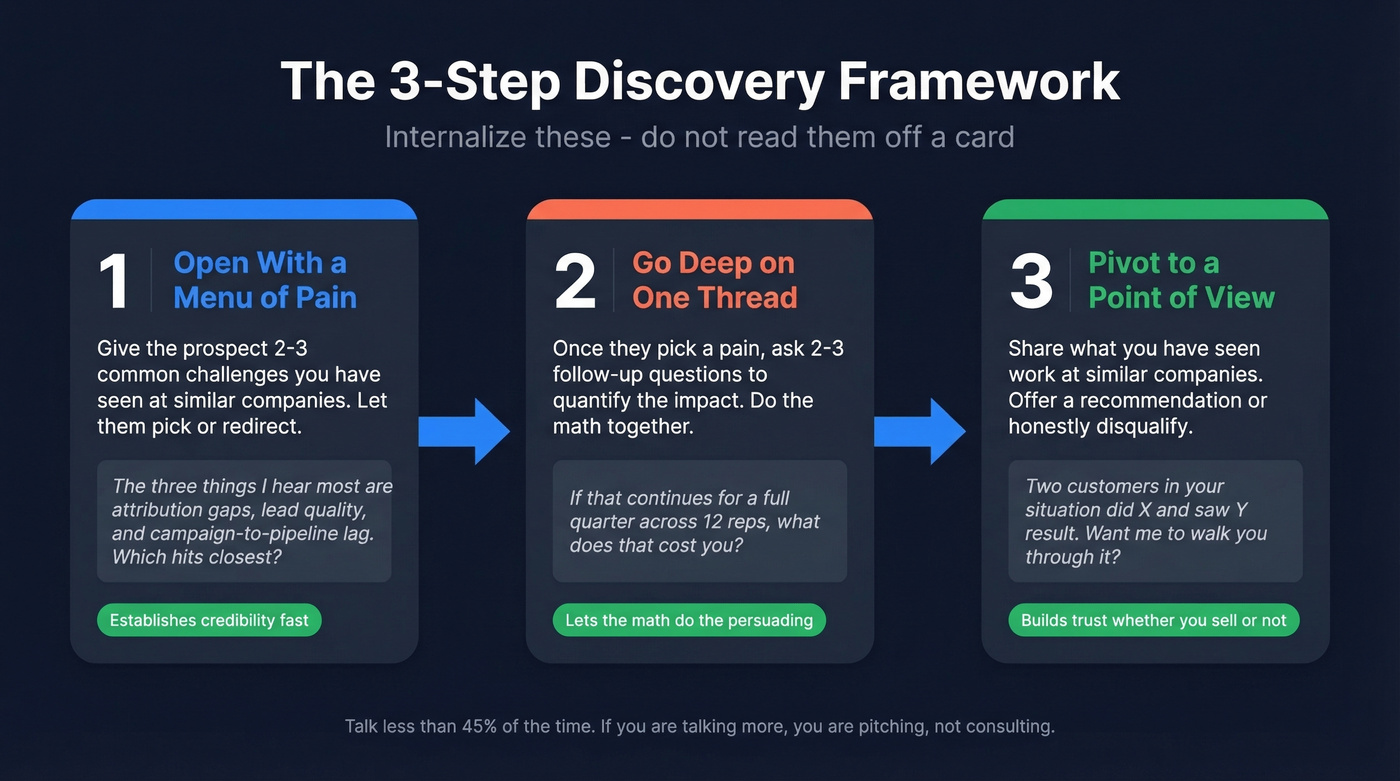
Step 1 - Open with a menu of pain. Give the prospect two or three common challenges you've seen at similar companies. Let them pick or redirect. This establishes credibility and avoids the blank-page problem.
Step 2 - Go deep with SPIN questions. Once you've identified the pain, use Situation questions to understand context, Problem questions to clarify scope, Implication questions to quantify impact, and Need-payoff questions to let the buyer articulate the value of solving it. You shouldn't need more than four or five total (a swipe file: SPIN questions).
Step 3 - Close with a transparency prompt. "What made you take this meeting today?" or "What would need to be true for this to be worth your time?" Multiple-choice options work here too - they encourage honesty and help you qualify faster.
The target: talk 40% of the time, listen 60%. If you're above 50%, you're pitching, not consulting.
Consultative vs. Solution vs. Transactional
| Dimension | Consultative | Solution | Transactional |
|---|---|---|---|
| Focus | Buyer's goals and needs | Specific problem to solve | Features and price |
| Relationship | Long-term advisor | Problem-solver for this deal | One-time transaction |
| Best for | Complex, multi-stakeholder | Technical or niche needs | Commodity purchases |
| Cycle length | Longer (higher LTV) | Medium | Short |
| Key skill | Asking the right questions | Diagnosing the right problem | Efficient pitch and close |
Most B2B teams need a blend. Transactional works well for low-ticket, low-complexity purchases. Solution selling fits when the buyer already knows their problem. Consultative selling wins when the buyer doesn't fully understand their own situation - which, in complex B2B, is most of the time.
Let's be honest: the frameworks are the easy part. Reading the room - knowing when to ask one more question and when to shut up and recommend - that's the skill that separates consultative sellers from people who've read about it (if you need the next step after discovery, use these sales closing techniques).
83% of buyers define requirements before talking to sales. If you're not doing pre-call research, you've already lost. Prospeo tracks 15,000 intent topics and surfaces company growth signals so your discovery questions land with context, not guesswork.
Research-first outreach starts at $0.01 per verified contact.
FAQ
What's the difference between consultative selling and solution selling?
Consultative selling builds trust and explores goals before recommending anything; solution selling diagnoses a specific problem and tailors a fix. In practice, start consultative to uncover the full picture, then narrow to solution selling as the deal progresses and the problem crystallizes.
How many discovery questions should I ask?
Three to five maximum. Use the menu of pain approach - offer two or three common challenges and let the prospect pick - to reach the root issue in two questions instead of ten. Going beyond five signals interrogation, not consultation.
Does consultative selling work for cold outreach?
Yes, but only with pre-call research. Knowing the prospect's role, company signals, and likely pain turns a cold call into a warm conversation. Intent data, technographics, and headcount growth signals let you personalize in seconds, not hours.
What talk-to-listen ratio should I aim for?
Top closers talk about 43% of the time according to Gong's data. If you're above 50%, you're pitching, not consulting. Aim for a 40/60 split as your benchmark on every discovery call.
Is consultative selling training worth the investment?
Wilson Learning documented a 3.1:1 ROI across roughly 600 reps - $3.10 back for every $1 spent. The risk isn't the methodology; it's robotic execution. Training that makes reps sound scripted is worse than no training at all.