

Sales Pipeline Generation: Math, Strategies, and the Numbers Nobody Gives You
It's the last week of the quarter. Your CRM shows 3.5x pipeline coverage. Your VP of Sales is confident. Then someone runs the probability-weighted numbers and coverage drops to 1.4x. Suddenly the team is scrambling, and nobody can explain where the pipeline went.
That's the phantom pipeline problem - and it's why most sales pipeline generation guides are useless. They give you 12 strategies and zero math.
What You Need (Quick Version)
Pipeline generation is a math problem. Three numbers matter: your raw coverage ratio, which should be at least 3.4x; your weighted coverage ratio, which should hit 2.1x or higher; and your pipeline velocity. If you don't know these, skip to the Pipeline Math section below. If your outreach data is bad with bounce rates above 10%, fix that first - bad data will sabotage every strategy on this page. Then build the engine below.
What Pipeline Generation Actually Is
Pipeline generation isn't lead gen, and it isn't demand gen. Lead gen finds interested people. Demand gen creates awareness. Sales pipeline generation is the repeatable engine that qualifies, engages, and progresses those people into realistic opportunities with estimated close dates and deal values. It's the middle and bottom of the funnel, where revenue actually gets built.
If your pipeline generation process is broken, no amount of top-of-funnel activity will save your quarter.
Why Building Pipeline Is Harder in 2026
Buyers are doing more of the journey without you. 61% of B2B buyers, per Gartner's research. 73% actively avoid suppliers who send irrelevant outreach. And 69% report inconsistencies between what they read on a vendor's website and what sellers actually tell them - which means trust erodes before the first call even happens. Buyers define requirements 83% of the time before they ever talk to sales.
That means your pipeline engine has to reach people earlier, with sharper relevance, or you simply don't exist in their evaluation. The numbers keep getting worse: 86% of B2B purchases stall somewhere in the process, and only 16% of reps hit quota. The average sales cycle compressed from 11.3 months to 10.1 months according to 6sense's buyer data - which sounds like good news until you realize buyers are cutting sellers out of more stages, not moving faster through yours.
Here's the thing: talk to any experienced AE and you'll hear the same frustration. Buyers ghost earlier, committees are bigger, and pipeline evaporates faster than it did two years ago. If your team is still running the same outbound playbook from 2023, you're fighting a fundamentally different buyer with outdated weapons. Without a deliberate pipeline development strategy, you're reacting to these shifts instead of getting ahead of them.
Pipeline Math: The Numbers You Need
This is where most pipeline generation content falls apart. They'll tell you to "build more pipeline" without defining how much is enough.
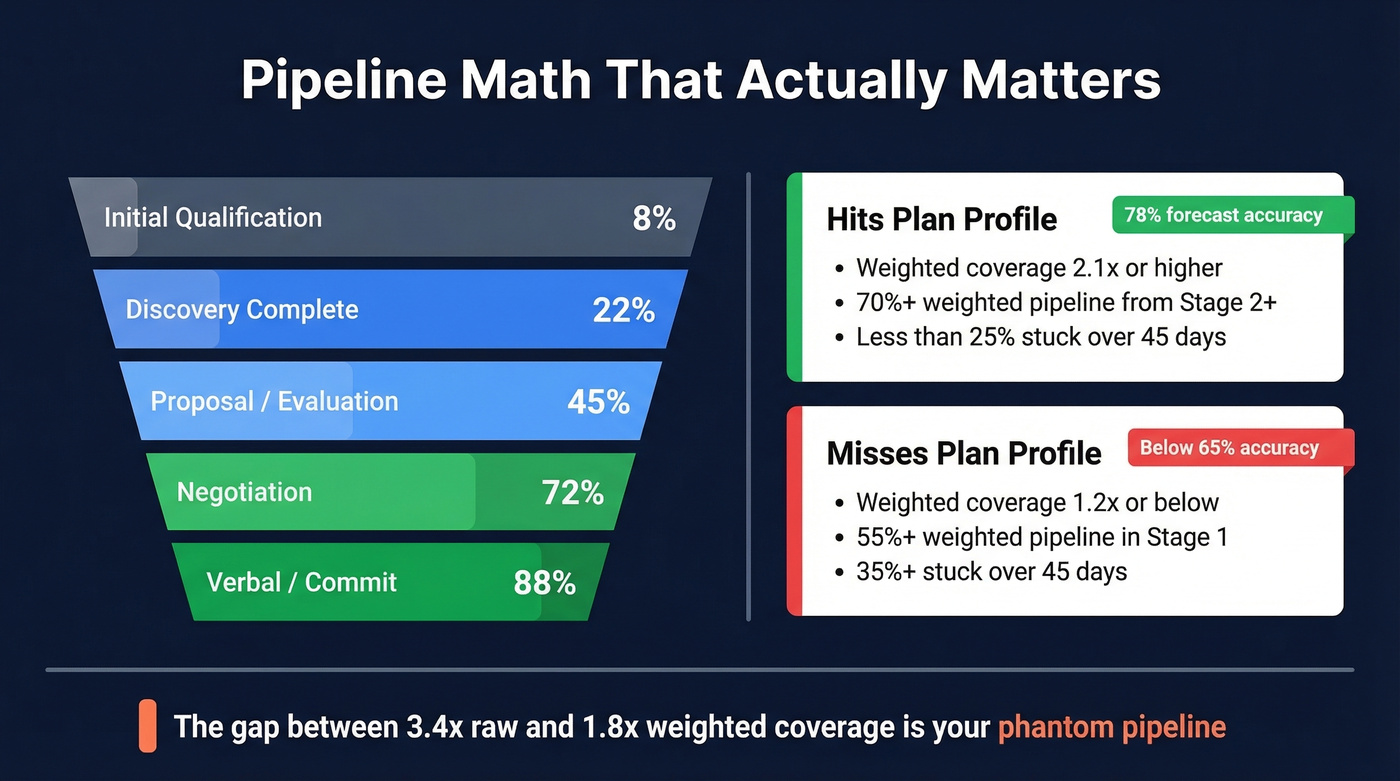
For B2B tech companies in the $5M-$50M ARR range, the median raw pipeline coverage is 3.4x and the median probability-weighted coverage is 1.8x. That 1.6x gap is your phantom pipeline - deals sitting in Stage 1 that look like coverage but have an 8% close probability.
Here's how stage probabilities break down:
| Stage | Close Probability |
|---|---|
| Initial Qualification | 8% |
| Discovery Complete | 22% |
| Proposal/Evaluation | 45% |
| Negotiation | 72% |
| Verbal/Commit | 88% |
The "hits plan" profile looks like this: weighted coverage of 2.1x or higher, 70%+ of weighted pipeline from Stage 2 or later, and less than 25% of pipeline value stuck in the same stage for over 45 days. Teams matching all three criteria hit plan with 78% accuracy.
The "misses plan" profile is the mirror: weighted coverage at or below 1.2x, 55%+ of weighted pipeline sitting in Stage 1, and 35%+ of value stuck for over 45 days. Forecast accuracy for these teams drops below 65%.
Pipeline shape matters too. If your pipeline is top-heavy with 60%+ in Stage 1, your problem is progression - you need better discovery and qualification. Bottom-heavy? Your problem is volume.
Let's run a worked example. You've got a $1M quarterly target and a 25% win rate. You need $4M in raw pipeline. But at a 1.8x weighted-to-raw ratio, you actually need $7.2M in raw pipeline to generate $4M in weighted coverage. If your team is celebrating $4M in raw pipeline, they're celebrating a miss.

Phantom pipeline starts with phantom contacts. If your bounce rate is above 10%, your 3.4x coverage is fiction. Prospeo's 5-step verification delivers 98% email accuracy on 300M+ profiles - refreshed every 7 days, not 6 weeks. Layer Bombora intent data across 15,000 topics to target accounts actually in-market. Real pipeline starts with real data.
Stop building pipeline on contacts that don't exist.
Strategies That Actually Fill Your Funnel
Multi-channel sequences beat single-channel every time. Email alone doesn't cut it. The teams we've seen consistently generate pipeline combine email, phone, and social touches in coordinated sequences. Single-channel outreach gets ignored - this isn't theory, it's what the data shows across every segment we've tracked. (If you need a starting point, use these sales prospecting techniques to structure activity.)
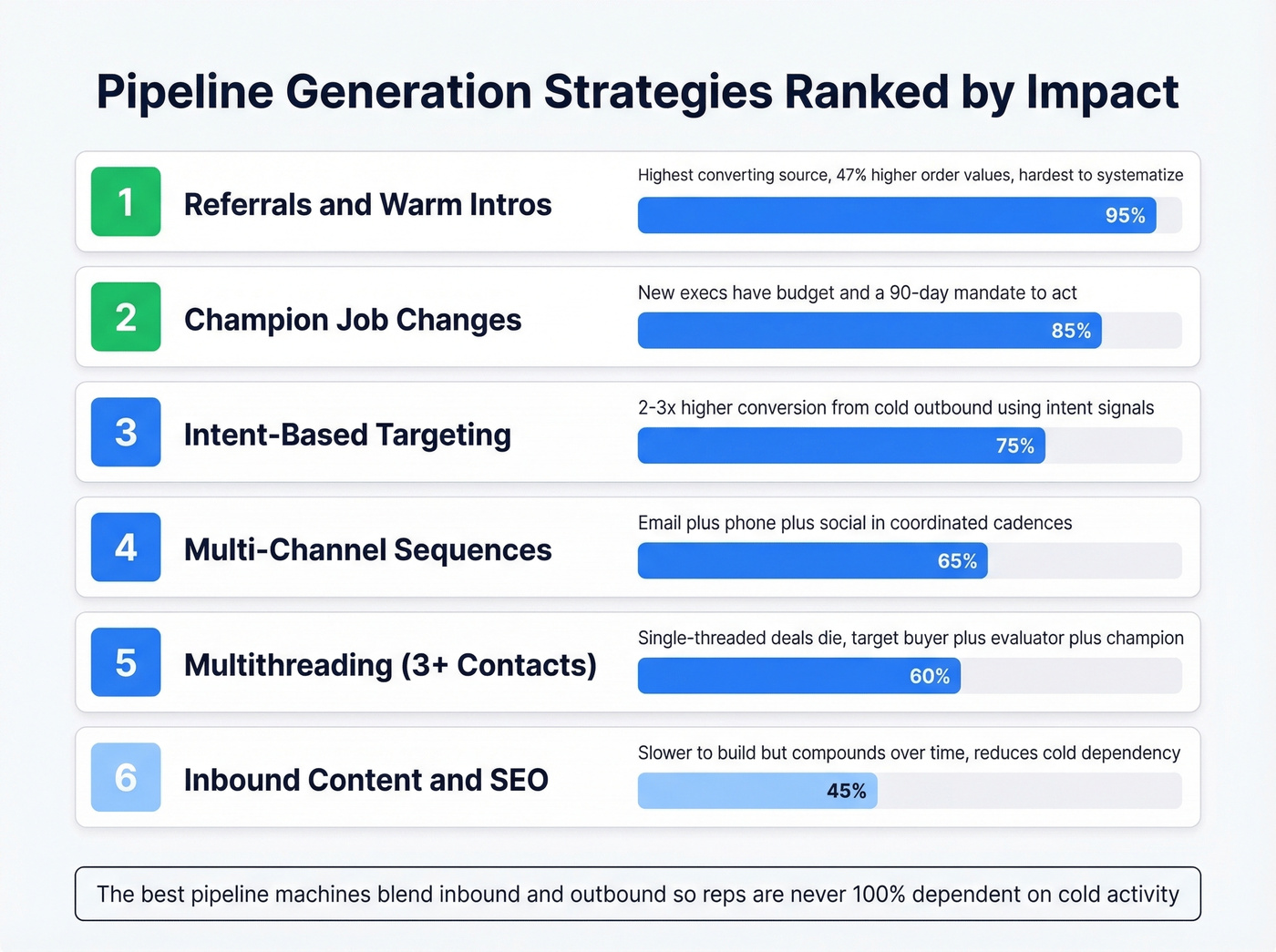
Intent-based targeting flips the outbound model. Instead of spraying your TAM, focus on accounts actively researching your category. Layer intent signals - like Bombora-powered intent across 15,000 topics - with job role and company growth filters to zero in on accounts that are actually in-market. Teams using intent signals consistently see 2-3x higher conversion rates from cold outbound. (For a deeper framework, see account-based selling.)
When a champion moves to a new company, that's one of the warmest outbound triggers you'll find. New executives have budget, mandate, and a 90-day window to make moves. Conversion rates are dramatically higher than any cold list. If you want to operationalize this, build a system for tracking sales triggers.
Multithreading is non-negotiable. Single-threaded deals die. Target 3+ contacts per account - the economic buyer, the technical evaluator, and the internal champion at minimum. (If you need a refresher, this breakdown of the technical evaluator helps.)
Referral and warm intro programs are the highest-converting pipeline source in practice, yet most teams underinvest here because it's harder to systematize than outbound. Nurtured leads produce 47% higher order values, which means the effort compounds over time. If you're not running a formal referral program, you're leaving your best pipeline source to chance.
Content and SEO work as inbound pipeline generators - slower to build, but they compound. The best pipeline generation machines blend inbound and outbound so reps aren't 100% dependent on cold activity. Treating pipeline creation as a dual-channel discipline is what separates teams that hit plan from those that scramble every quarter. (If you're building this motion, start with B2B content marketing.)
One case study that sticks with us: a team built a multi-industry demand gen infrastructure using HubSpot and ZoomInfo, scaling to 38,000+ enriched prospects with 98.2% deliverability and 39.4% company engagement across 1,010 target accounts. The key wasn't any single tactic - it was architecture that didn't require rebuilding every time they entered a new vertical. That's the difference between a campaign and a machine.
One decision most guides skip: build or outsource? For teams with fewer than 3 SDRs, outsourcing the first 6 months while you build infrastructure often makes more sense than hiring into chaos. Once you have repeatable sequences and proven messaging, bring it in-house. (If you're onboarding new reps into the system, use a 30-60-90 day plan.)
The Pipeline Generation Tech Stack
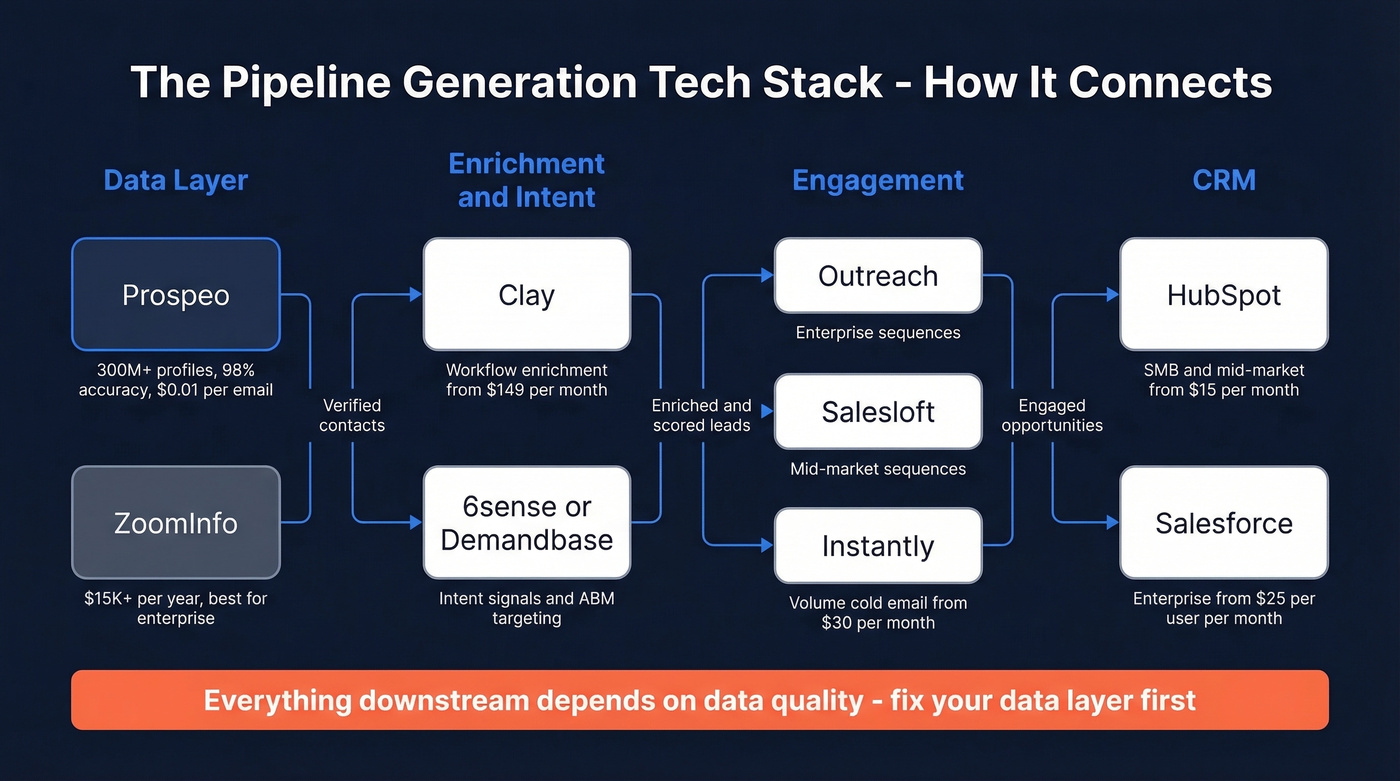
You need 3-4 tools that talk to each other, not 10 that create data silos. Here's what a functional stack looks like:
| Category | Tool | Starting Price | Best For |
|---|---|---|---|
| CRM | HubSpot | From $15/month/user | SMB/mid-market |
| CRM | Salesforce | $25/user/mo | Enterprise |
| Prospecting + Verification | Prospeo | Free; ~$0.01/email | Accuracy + cost |
| Prospecting | Apollo.io | Free-$99/user/mo | Free-tier experimentation |
| Prospecting (Enterprise) | ZoomInfo | $15K+/yr | Large teams |
| Engagement | Outreach | Custom pricing | Enterprise sequences |
| Engagement | Salesloft | Custom pricing | Mid-market sequences |
| Enrichment | Clay | From $149/mo | Workflow enrichment |
| Cold Email | Instantly | From $30/mo | Volume outbound |
| Intent / ABM | 6sense | $60K+/yr | Enterprise ABM |
| Intent / ABM | Demandbase | $24K+/yr | Enterprise ABM |

Everything downstream depends on data quality. Prospeo covers 300M+ professional profiles with 98% email accuracy and a 7-day data refresh cycle - the industry average is six weeks. At roughly $0.01 per email, it's 90% cheaper than ZoomInfo with higher verified accuracy. Meritt tripled weekly pipeline from $100K to $300K after switching their data layer, with bounce rates dropping from 35% to under 4%. The free tier gives you 75 emails plus 100 Chrome extension credits per month to test before committing anything. (If you're comparing providers, start with data enrichment services.)
Our honest take: ZoomInfo is still the most comprehensive all-in-one platform. But most teams don't need all-in-one - they need accurate data and a few tools that integrate well. If your average deal size is under $15K, you almost certainly don't need a $15K+/year data contract. Skip it and put that budget toward engagement tooling instead.
Multithreading 3+ contacts per account means you need verified emails and direct dials that actually connect. Prospeo gives you 125M+ verified mobiles with a 30% pickup rate and 143M+ verified emails - 90% cheaper than ZoomInfo. Teams using Prospeo book 26% more meetings. That's the volume and progression your coverage ratio demands.
Multithread every deal with data that picks up the phone.
Mistakes That Kill Pipeline
Five anti-patterns that destroy pipeline generation before it starts:
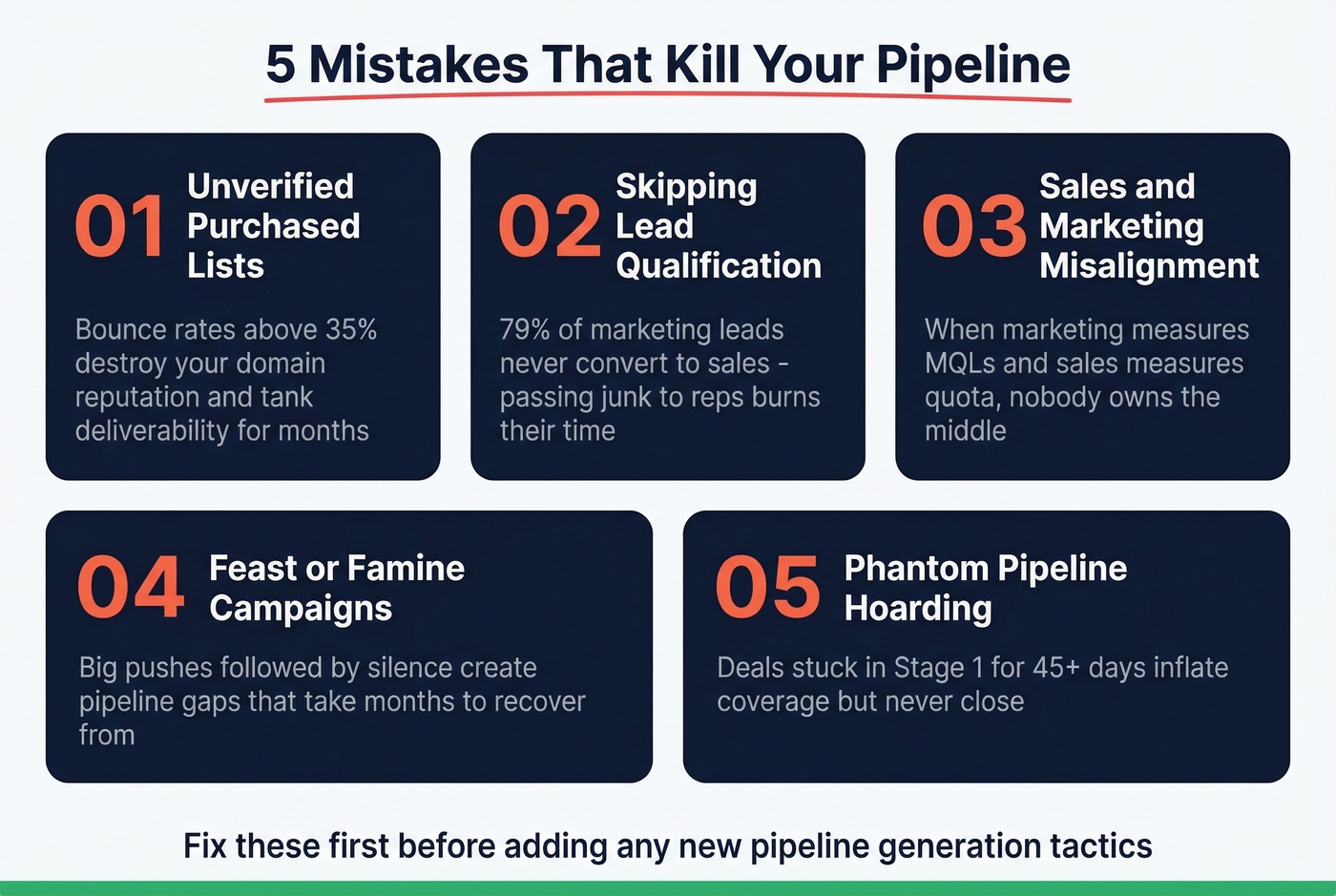
Unverified purchased lists. Bounce rates above 35% don't just waste sends - they destroy your domain reputation. Real-time email verification with catch-all handling, spam-trap removal, and honeypot filtering fixes the upstream problem before it tanks your deliverability. We've seen teams recover domain sender scores within weeks of switching to verified data. (If you're troubleshooting, start with email bounce rate and then tighten your email deliverability.)
Skipping lead qualification. 79% of marketing leads never convert into sales. If you're passing unqualified names to reps, you're burning their time and inflating phantom pipeline. (A structured lead scoring model fixes this fast.)
Sales/marketing misalignment. When marketing measures MQLs and sales measures quota, nobody owns the middle. Agree on what a qualified opportunity actually means - and track cost per qualified opportunity, not just cost per lead. The consensus on r/sales is that this misalignment kills more pipeline than any competitor ever will.
Feast-or-famine campaigns are the fourth killer. A big push in January, nothing in February, panic in March. Consistent pipeline development requires a steady process, not a quarterly sprint.
Over-automation with zero personalization rounds out the list. 73% of buyers avoid irrelevant outreach. Sending 10,000 identical emails isn't pipeline generation - it's noise generation.
Measuring Pipeline Health
The core formula is pipeline velocity: (Opportunities x Avg Deal Value x Win Rate) / Sales Cycle Length. Every lever in that formula is something you can improve independently. The median sales cycle runs about 84 days, with the optimal range falling between 46 and 75 days.
We think about pipeline health across three dimensions: coverage (do you have enough), quality (is it real), and convertibility (will it close in the forecast window). 79% of B2B companies miss quarterly forecast by more than 10% - usually because they're measuring coverage without weighting for quality. (If you want a full dashboard, use these pipeline health metrics.)
Here's how funnel conversion benchmarks differ by segment:
| Stage | SMB/Mid-Market | Enterprise |
|---|---|---|
| Visitor to Lead | 1.4% | 0.7% |
| MQL to SQL | 39% | 31% |
| SQL to Opportunity | 42% | 36% |
| Opportunity to Close | 39% | 31% |
If your numbers are significantly below these benchmarks at any stage, that's where your pipeline is leaking. Fix the worst stage first - don't try to optimize everything at once.
FAQ
What's the difference between pipeline generation and lead generation?
Lead generation finds interested people; pipeline generation qualifies, engages, and progresses them into realistic opportunities with estimated close dates and deal values. Lead gen feeds the top of the funnel, while pipeline gen builds the middle and bottom where revenue actually materializes.
What's a good pipeline coverage ratio?
For B2B tech companies in the $5M-$50M ARR range, target 3.4x raw coverage and 2.1x+ probability-weighted coverage. If your weighted number drops below 1.5x, you're likely missing your number - regardless of what the raw pipeline says.
How do I fix high bounce rates killing my pipeline?
Verify every email before sending - bounce rates above 10% mean your pipeline problem is actually a data quality problem. A 5-step verification process with catch-all handling, spam-trap removal, and honeypot filtering keeps bounce rates under 4% for teams like Meritt and Snyk.
How much pipeline should each rep generate?
Divide your per-rep quota by your win rate for the raw target, then multiply by 1.8x to account for the phantom pipeline gap. A rep carrying $500K in quarterly quota with a 25% win rate needs roughly $3.6M in raw pipeline per quarter.