

How to Set Sales Goals and Objectives That Reps Actually Hit
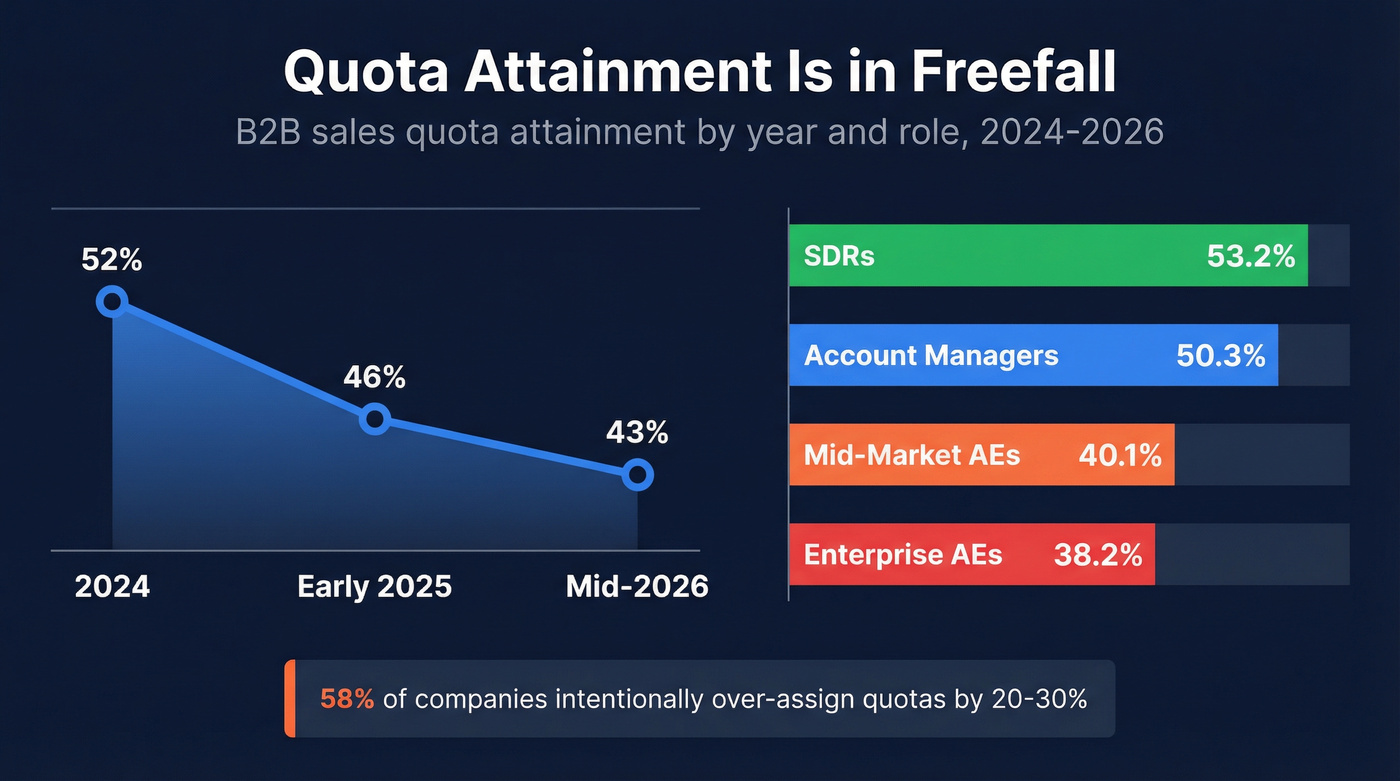
Quota attainment has fallen from 52% to 43% in just two years. Around 57% of reps are missing their number right now - and the problem isn't effort. It's how the goals got set in the first place. 87% of sales leaders admit they have no real method for setting quotas. They're guessing, then wondering why reps burn out.
The Quick Version
Goals set direction, objectives define the path - you need both. Decompose revenue into growth levers (new business, expansion, retention) instead of dividing a number by headcount and calling it a plan. Then cascade company targets into role-specific activity objectives and track them weekly.
Why Most Sales Goals Fail
The numbers are ugly. Quota attainment across B2B sales dropped from 52% in 2024 to 46% in early 2025 to 43% by mid-2026. Enterprise AEs are getting hit hardest, with attainment in that cohort sitting around 38.2%. And yet 58% of companies intentionally over-assign quotas by 20-30%, hoping the stretch motivates performance.
It doesn't. In a QuotaPath study, 91% of organizations missed quota expectations, and 35% attributed the failure directly to misaligned sales activities. One Reddit thread on r/sales captured it perfectly: an SDR reported that only 2 out of 10 reps hit quota per quarter, and the company's solution was offering unpaid swing shifts. Another thread described reps saying quota anxiety followed them home, affecting sleep and relationships. That's not a goal-setting strategy. That's a retention crisis.
The root cause isn't lazy reps or soft markets. Most organizations treat goal-setting as arithmetic - last year's revenue plus 10%, divided by headcount - instead of as a strategic exercise grounded in data, capacity, and market reality.
Sales Objectives vs. Sales Goals
These terms get used interchangeably, but they aren't the same thing. A sales goal is a broad, long-term outcome: "Grow revenue 20% this year." A sales objective is a specific, measurable action that supports that goal: "Each AE closes $125K in new business per quarter" or "SDRs book 15 qualified meetings per month."
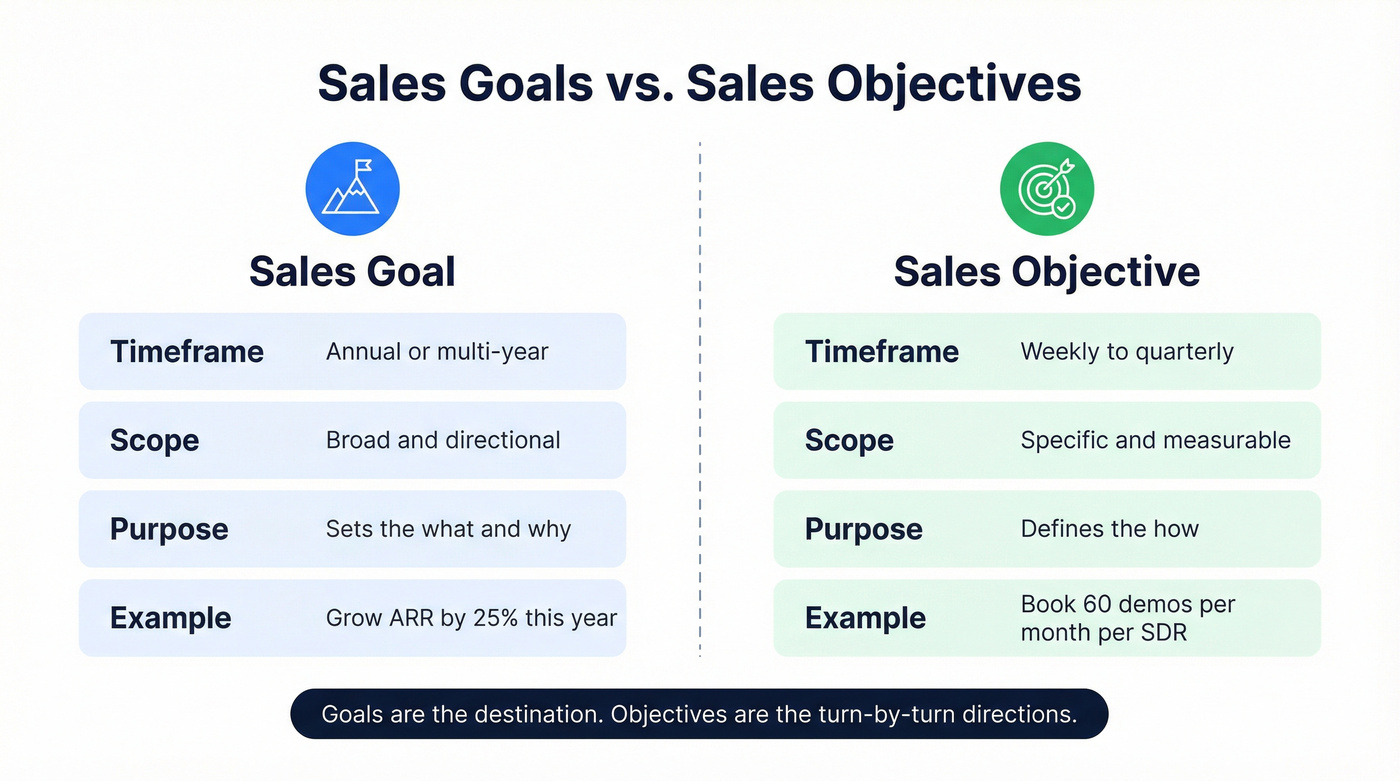
Goals are the destination. Objectives are the turn-by-turn directions.
A goal without objectives is a wish. Objectives without a goal are busywork.
| Dimension | Sales Goal | Sales Objective |
|---|---|---|
| Timeframe | Annual or multi-year | Weekly to quarterly |
| Scope | Broad, directional | Specific, measurable |
| Purpose | Sets the "what" and "why" | Defines the "how" |
| Example | Grow ARR by 25% | Book 60 demos/month per SDR |
The Dear Lucy framework lays this out well: goals cascade from the board to the VP of Sales to managers to individual reps. Each layer translates the same company ambition into progressively more specific, actionable targets. Some teams use OKRs for team-level alignment, which works well for cross-functional goals - but for individual sales targets, SMART objectives still give you more precision.
Why Goals Work - The Science in 60 Seconds
Locke and Latham's goal-setting theory has over 50 years of research behind it, and the core findings haven't changed. Goals improve performance when they meet five conditions: they're specific ("do your best" doesn't cut it), challenging enough to stretch performance but achievable enough that reps believe in them, backed by genuine commitment rather than mere compliance, supported by regular feedback through weekly tracking rather than quarterly surprises, and matched to task complexity so a new hire doesn't get the same target as a five-year veteran.
This isn't motivational theory. It's one of the most replicated findings in organizational psychology. If your goals fail any of these five tests, performance drops - regardless of how good your comp plan is.
How to Set Targets Reps Actually Hit
Start With Revenue Decomposition
Here's the thing: the most common mistake in sales goal-setting is dividing the company revenue target by the number of reps and calling it done. Outreach's team calls this out explicitly, and they're right - it ignores ramp time, territory differences, deal complexity, and where growth is actually supposed to come from.
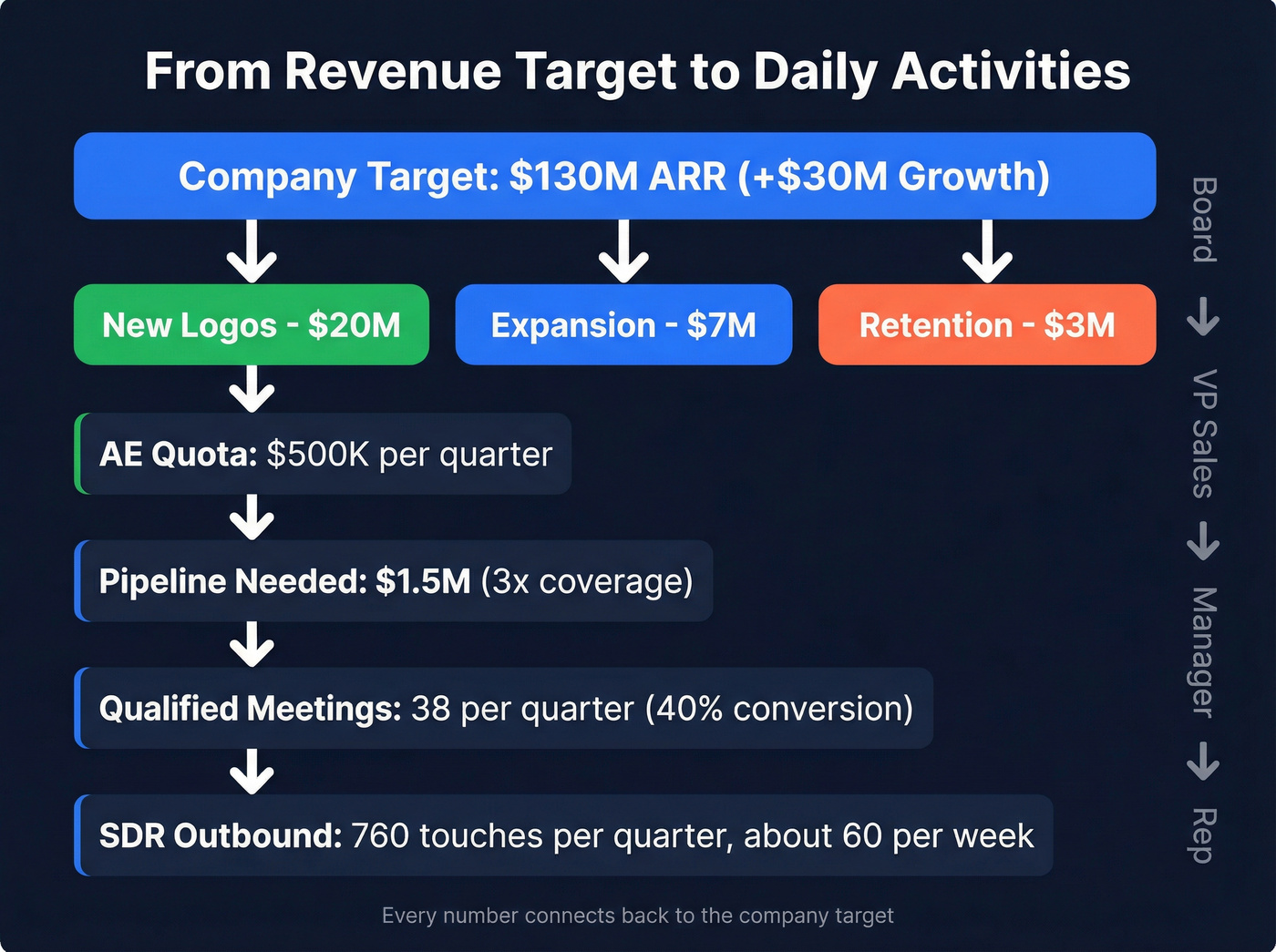
Instead, decompose your revenue target into growth levers. If you're going from $100M to $130M, that $30M gap isn't one number. It's $20M from new logo acquisition, $7M from expansion within existing accounts, and $3M from improved retention. Each lever maps to different roles, different activities, and different quotas.
Cascade From Company to Rep
Once you've decomposed revenue into levers, cascade targets down the org chart. The board sets the revenue goal. The VP of Sales translates it into team-level targets. Managers break those into individual quotas. SDRs get pipeline creation objectives that feed AE revenue targets.
Here's a practical example we've walked through with several teams: if an AE needs to close $500K per quarter and your historical win rate is 33%, that AE needs $1.5M in qualified pipeline - a 3x coverage ratio. The SDR feeding that AE needs to generate enough qualified meetings to build that pipeline. Every number connects back to the company target.
If you want a more detailed walkthrough of quota math, a sales quota calculator can help you sanity-check assumptions.
Convert Revenue Into Activity Objectives
Revenue goals tell reps what to achieve. Activity objectives tell them what to do today. Reverse-engineer the math: if an AE needs 15 qualified opportunities per quarter and the meeting-to-opportunity conversion rate is 40%, they need roughly 38 meetings. If SDRs book those meetings at a 5% cold outreach conversion rate, that's 760 outbound touches per quarter - about 60 per week.
Revenue.io's KPI framework breaks this into daily metrics: dials per day, emails per day, conversations per day, and contact attempts per account. These are the leading indicators that predict whether revenue targets will be met weeks before the quarter closes.
If you’re building your own KPI stack, start with the core B2B sales KPIs and then tailor by role.
Activity goals only work if the contact data behind them is accurate. Fifty outbound emails a day means nothing if 15% bounce. That's where data quality becomes infrastructure - a platform like Prospeo with 98% email accuracy and a 7-day data refresh cycle ensures that when a rep hits their daily email target, those messages actually land in inboxes.
If bounce is a recurring issue, it’s worth understanding why emails bounce before you raise activity targets.
Validate With Data
Before you finalize targets, stress-test them against reality. Pull historical conversion rates at every stage of your funnel. Check pipeline coverage ratios - if you're setting quotas that require 4x coverage but your team has never built more than 2.5x, something has to change. And account for actual selling days: once you subtract holidays, PTO, company meetings, and ramp periods, a "quarter" often shrinks to far fewer true selling days.
Anaplan's framework recommends incorporating intent data to assess account-level potential, plus rolling forecasts instead of fixed annual targets. Rolling forecasts let you adjust quarterly without turning every forecast call into a performance review.
If you’re doing capacity planning alongside targets, use a sales headcount planning model so quotas reflect ramp and coverage.

Activity objectives only drive revenue when reps reach real people. If 15% of your emails bounce, your SDRs need 20% more touches just to hit the same pipeline number. Prospeo delivers 98% email accuracy on a 7-day refresh cycle - so every outbound touch your team makes actually counts toward quota.
Stop inflating activity targets to compensate for bad data.
A Quick Scorecard Before You Build Targets
Answer these five questions honestly:
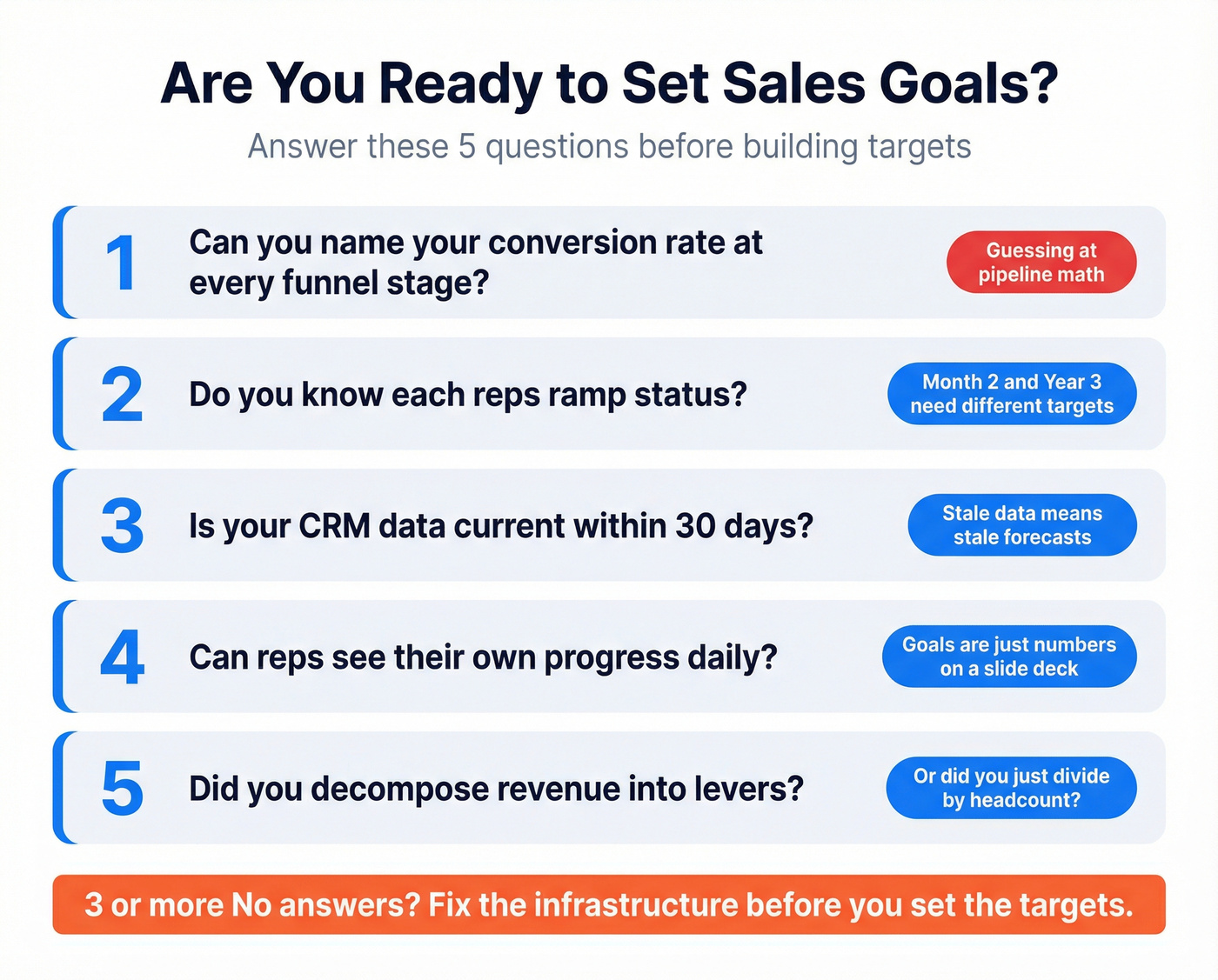
- Can you name your conversion rate at every funnel stage? If not, you're guessing at pipeline math.
- Do you know each rep's ramp status? A rep in month two and a rep in year three need different targets.
- Is your CRM data current within 30 days? Stale data means stale forecasts.
- Can reps see their own progress daily? If not, goals are just numbers on a slide deck.
- Did you decompose revenue into levers? Or did you divide by headcount?
If you answered "no" to three or more, fix the infrastructure before you set the targets. Goals built on bad foundations just create sophisticated-looking failure.
Examples by Role
SDR Goals
SDRs own pipeline creation. Their objectives should focus on output quality and volume:
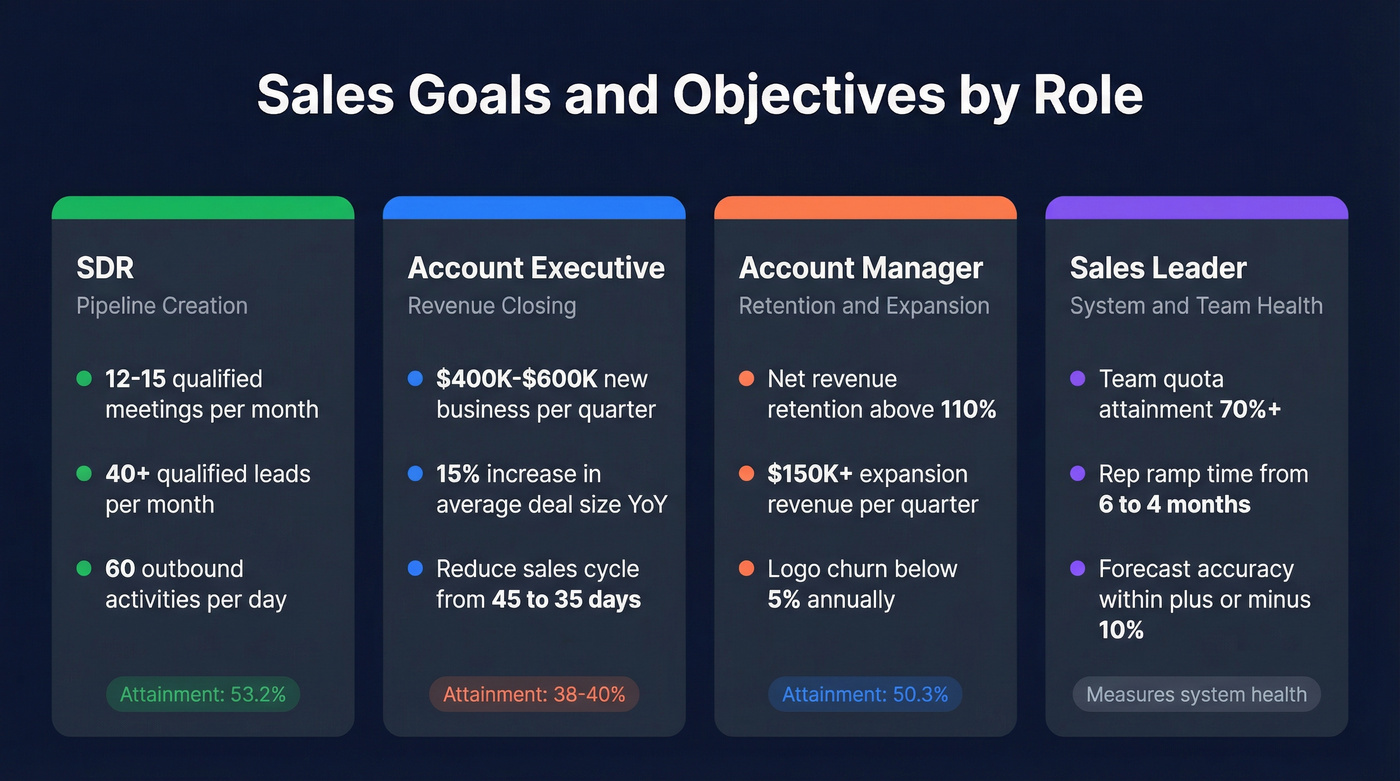
- Book 12-15 qualified meetings per month - qualified meaning AEs accept them, not just "meetings"
- Generate 40+ qualified leads per month through outbound sequences
- Maintain ~60 outbound activities per day across calls, emails, and social touches
If you need a tighter set of benchmarks, use these BDR KPIs and a simple SDR metrics template to track weekly.
SDR attainment sits at 53.2% in 2026 - the highest of any role. That makes sense: activity-based goals are more controllable than revenue outcomes. If your SDR attainment is significantly below that benchmark, your targets are miscalibrated or your data quality is dragging down connect rates.
Account Executive Goals
AEs own revenue. Their objectives blend outcome targets with efficiency metrics:
- Close $400K-$600K in new business per quarter, adjusted for market segment
- Increase average deal size by 15% year-over-year through better discovery and multi-threading
- Reduce average sales cycle from 45 days to 35 days by qualifying harder upfront
To pressure-test AE targets, compare against common Account Executive KPIs (win rate, cycle length, pipeline coverage, and more).
Mid-market AE attainment is at 40.1%, and enterprise AEs are at 38.2%. If fewer than 4 in 10 reps are hitting quota industry-wide, your targets need to reflect that reality - not pretend it doesn't exist.
Account Manager Goals
Picture this: your largest account just churned, taking $200K in ARR with it. Nobody saw it coming because the AM's goals were all about new upsells, not retention signals.
That's the failure mode AM goals should prevent. Effective AM targets balance defense and offense: net revenue retention above 110% means the book is growing, not just surviving. Expansion revenue of $150K+ per quarter keeps AMs proactive rather than reactive. And logo churn below 5% annually forces early intervention when health scores dip. AM attainment runs about 50.3% - better than AEs but still below where most leaders want it. The biggest lever is usually proactive expansion rather than reactive retention.
If you want a clean set of AM benchmarks, track account management KPIs alongside revenue.
Sales Leadership Goals
Leaders own the system, not individual deals. The right leadership goals measure team health and predictability: strong team quota attainment around 70%+ (not 100%, because that likely means targets were too low), reduced new rep ramp time from 6 months to 4 months, forecast accuracy within ±10% of actual results, and voluntary rep turnover below 20% annually. Every one of these metrics tells you whether the goal-setting system itself is working.
If you’re formalizing leadership expectations, map them to sales manager KPIs so coaching and forecasting don’t get hand-wavy.
Types of Objectives That Drive Results
Not all objectives are created equal. The most effective teams mix several types to cover both short-term execution and long-term growth:
Revenue objectives - closed-won targets, expansion revenue, ARR growth. Activity objectives - daily dials, emails sent, meetings booked. Efficiency objectives - win rate improvement, cycle time reduction, cost per acquisition. Retention objectives - churn rate, net revenue retention, customer health scores. Development objectives - ramp time, certification completion, new product attach rate.
The right mix depends on your team's maturity and your go-to-market motion. Outbound-heavy teams lean on activity objectives. PLG-assisted teams weight efficiency and conversion. The key is ensuring every rep has a blend that connects their daily work to the company's revenue target.
Five Goal-Setting Mistakes That Kill Quota
1. Dividing revenue by headcount. A $10M target split across 10 reps ignores that 3 are ramping, 2 have weak territories, and 1 is on a PIP. Decompose first, then allocate.
2. Over-assigning quotas by 20-30%. 58% of companies do this, thinking it creates healthy stretch. What it actually creates is a team where missing quota is the norm, which kills motivation and makes your comp plan a fiction.
3. Setting goals without tracking infrastructure. 69% of teams use Salesforce for setting and monitoring quotas, but plenty still rely on spreadsheets updated once a month. That's not tracking - that's archaeology.
4. Ignoring role-level differences. An SDR and an enterprise AE operate in completely different worlds. The attainment data proves it: SDRs hit 53%, enterprise AEs hit 38%. Same company, wildly different realities.
5. "Last year + 10%" without market context. If your market contracted 5% and you added 10% to quotas, you didn't set an ambitious goal - you set an impossible one.
Let's be honest: if your average deal size is under $10K, you probably don't need enterprise-grade goal-setting infrastructure. A spreadsheet, honest conversion data, and weekly check-ins will outperform a $200K planning tool paired with bad assumptions every single time.
How to Track Sales Goals
Setting goals is half the battle. The other half is building a tracking cadence that catches problems before they become missed quarters.
| Dashboard Type | Cadence | What It Shows |
|---|---|---|
| Leaderboard | Daily | Activity volume, calls, emails |
| Rep Performance | Weekly | Pipeline created, conversion rates |
| Forecast | Monthly | Coverage ratios, pipeline health |
| Strategic Review | Quarterly | Attainment, territory balance |
Daily leaderboards keep activity visible without micromanaging. Weekly pipeline reviews are where managers catch slippage early - if a rep's pipeline coverage drops below ~2.5x mid-quarter, that's a coaching conversation, not a quarter-end surprise. 59% of teams track pipeline health as their primary gauge of quota performance, which tells you where the smart money focuses attention. We've watched teams transform their forecast accuracy just by moving from monthly to weekly pipeline reviews.
If you want a repeatable cadence, use a pipeline review template and standardize the fields reps must update.
For outbound-heavy teams, pair your CRM with a verified data source so activity metrics reflect real conversations, not bounced emails and disconnected numbers. When your CRM says a rep made 50 outbound touches, you want confidence those touches actually reached humans.
Track both leading indicators (dials, emails sent, meetings booked) and lagging indicators (revenue closed, deal size, cycle length). Leading indicators are your early warning system. If activity drops in week 2, you don't have to wait until week 12 to find out the quarter is blown.
Skip the fancy BI dashboards if your team is under 10 reps. A shared Google Sheet with weekly updates and a 15-minute Monday standup will get you 80% of the value at 0% of the cost.
You just reverse-engineered quota into 60 weekly touches per rep. Now ask: how many of those reach a valid inbox? Teams using Prospeo cut bounce rates from 35% to under 4% and book 26% more meetings than ZoomInfo users - turning the same activity goals into more pipeline.
Make every rep's activity target actually achievable with verified contacts.
FAQ
What's the difference between a sales goal and a sales objective?
A sales goal is a broad, long-term outcome like growing revenue 20% this year, while a sales objective is a specific, measurable action supporting that goal - booking 15 demos per rep per month, for instance. Goals set direction; objectives define the steps. You need both working together for targets to mean anything.
What are good sales objectives examples for SDRs?
Strong SDR objectives include booking 12-15 qualified meetings per month, maintaining 60 daily outbound activities, and generating 40+ qualified leads monthly. SDR attainment sits at 53.2% in 2026 - the highest of any sales role - because activity-based targets are more controllable than revenue outcomes.
How often should you review sales goals?
Use a tiered cadence: daily leaderboards for activity metrics, weekly pipeline reviews per rep, monthly forecast check-ins with leadership, and quarterly strategic reviews to adjust targets. The weekly review is the most important - it catches pipeline gaps early enough to course-correct before the quarter closes.
What tools help track sales goals effectively?
A CRM like Salesforce or HubSpot is the foundation - 69% of teams already use Salesforce for quota monitoring. Layer in dashboarding for real-time visibility, and make sure your outbound data source delivers verified contacts so your activity metrics reflect actual outreach, not bounced messages.