

How to Write a Sales Introduction Email to a Client That Gets Replies
You spent an hour personalizing 20 introduction emails. You hit send. Three bounced, two went to spam, and the rest got zero replies. The problem wasn't your copy - it was everything that happened before you started writing.
Stop collecting templates. What you actually need is a system: verified contact data, a framework that forces personalization, and a deliverability setup that keeps you out of spam. Templates are the last 10%. Practitioners on r/copywriting are blunt about this - most of what worked two years ago is dead.
Here's the thing: if your bounce rate is above 2%, no amount of copywriting will save you. Fix your data first, write emails second. (If you need a deeper breakdown, start with bounce rate benchmarks and fixes.)
What "Good" Actually Looks Like
The average cold email reply rate is 3.43%. Top-quartile campaigns hit 5.5%+, and elite performers reach 10.7%+. Marketing email open rates hover around 35%, but that metric is inflated by Apple Mail Privacy Protection pre-fetching tracking pixels - it's basically noise now. Reply rate is the metric that matters for any sales introduction email to a client. If you're below 3%, the problem is infrastructure or data quality, not your writing. (More on the root causes in our email deliverability guide.)
The sweet spot for follow-up sequences is 4-7 touchpoints. Beyond that, diminishing returns kick in unless each touch adds genuinely new value. If you want examples that match this cadence, see these sales follow-up templates.
Cold vs. Warm Introductions
A cold introduction email goes to someone who doesn't know you exist. You're earning attention from scratch with relevance and a specific offer - the entire burden is on you to prove the message is worth reading.
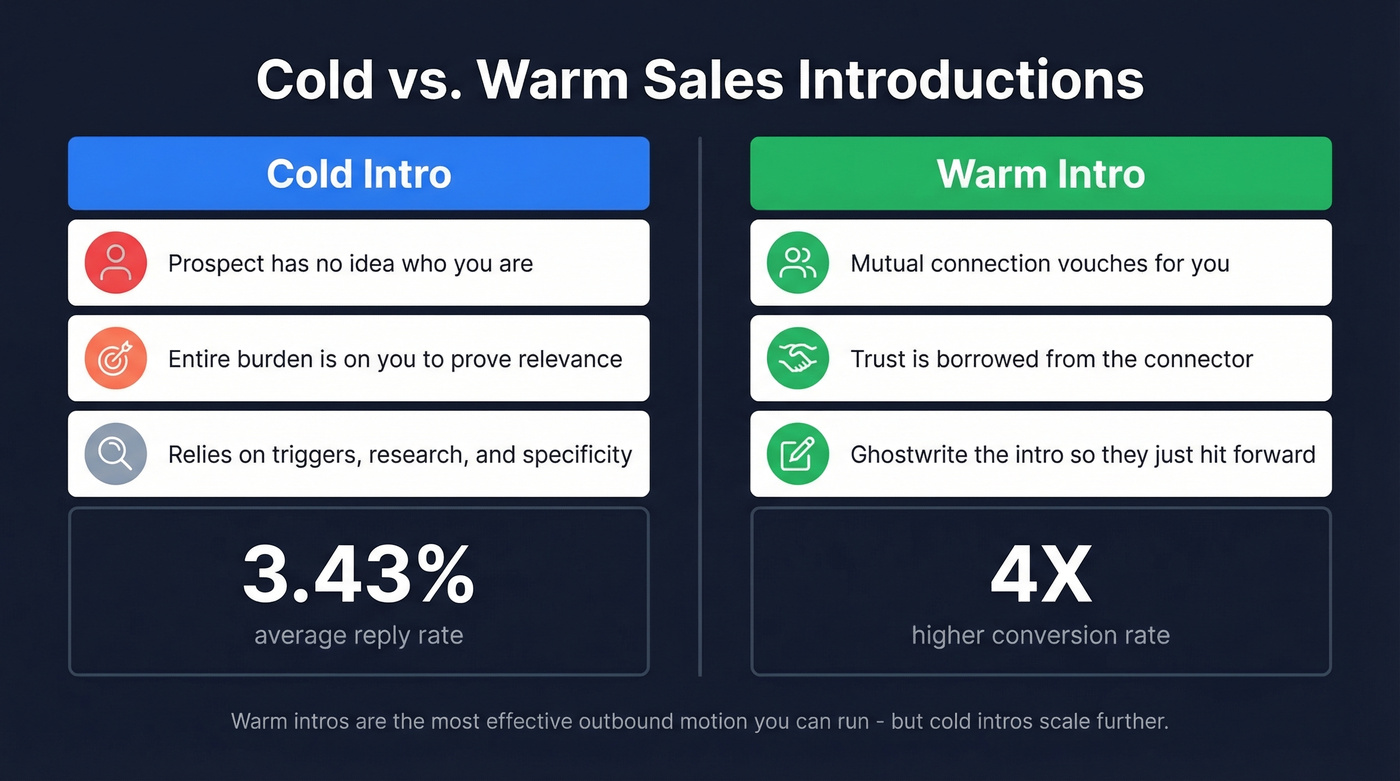
A warm introduction email comes through a mutual connection. Warm intros convert at 4X the rate of cold emails, making them the most effective outbound motion you can run. The best approach is ghostwriting: you draft the intro for your connector so all they have to do is hit forward. Less friction for them, better positioning for you. We'll cover exactly how to do this in the templates below.
How to Structure Your Intro Email
Frameworks beat templates because they force you to think about the prospect instead of filling in blanks. Here's the 5-part structure that practitioners on r/b2bmarketing consistently recommend:
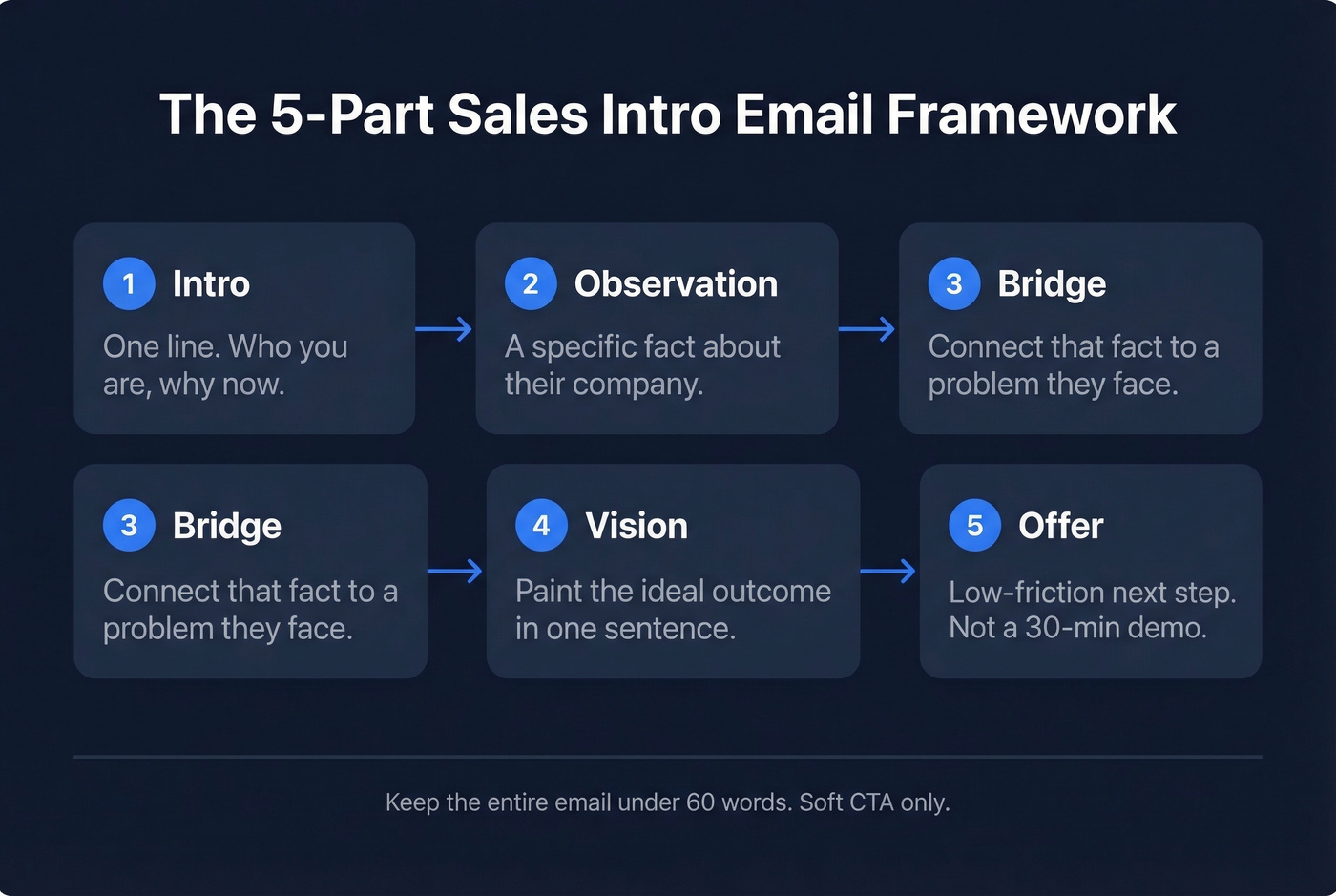
- Intro - One line. Who you are, why you're reaching out.
- Observation - A specific fact about their company that proves you did research.
- Bridge - Connect that observation to a problem they face.
- Vision - Paint the ideal outcome in one sentence.
- Offer - A low-friction next step. Not "book a 30-minute demo." More like "Worth a quick look?"
The alternative is PAS (Problem, Agitate, Solve), which works well when you can name a specific, quantifiable pain point. Instead of "struggling with lead gen?", try: "Your site pulled 99.7k visits last month per SimilarWeb, but your demo page has no social proof. That's leaving pipeline on the table." Concrete beats generic every time. One Reddit poster shared a cold email using exactly this kind of specificity and said it converted a client on the first send.
Let's be honest about something most guides gloss over: the offer matters more than the copy. A perfectly written email with a weak offer loses to a mediocre email with a specific, valuable offer. Keep the body to 40-60 words and use a soft CTA. (If you want to tighten the language further, use these email copywriting rules.)
Subject lines: Keep them under 7 words. Include the company name or a specific trigger. Skip "Quick question" - it's been burned into oblivion. In our experience, subject lines that reference a concrete event ("Congrats on the Series B") outperform clever wordplay every time. For more options, pull from these cold email subject line examples.

You read it above: if your bounce rate is over 2%, no amount of copywriting saves you. Prospeo's 5-step email verification delivers 98% accuracy - teams using it cut bounce rates from 35% to under 4% and tripled their pipeline.
Stop perfecting templates on bad data. Fix the foundation first.
Annotated Templates
Template 1: Cold Intro (Trigger-Based)
Subject: [Company] + [specific trigger]
Hi [Name], saw [Company] just [trigger - new funding round, product launch, job posting]. When teams hit that stage, [specific problem] usually follows. We helped [similar company] [specific result]. Worth a quick conversation?
The trigger proves timing. The result proves relevance. Under 50 words. This one works especially well for SaaS teams selling into mid-market companies going through visible growth events. (To operationalize this, build a repeatable sales prospecting workflow around triggers.)
Template 2: Cold Intro (PAS Framework)
Here's why this one works before you even read it: it opens with a compliment, agitates a real gap, and offers without pushing. Most reps do the opposite - they lead with their product and wonder why nobody responds.
Subject: Quick thought on [specific metric]
Hi [Name], [Company]'s [specific metric] looks strong, but [agitate - gap between metric and outcome]. [One sentence about how you solve it]. Happy to share how - interested?
Template 3: Warm Intro (Ghostwritten)
Most people ask for warm intros and then make their connector do all the work. Don't be that person. Write the email for them.
Before: "Hey, could you introduce me to Sarah at Acme? I think we could help them."
After:
Subject: Intro - [Your Name] / [Prospect Name]
Hi [Prospect], wanted to connect you with [Your Name] at [Company]. They helped [result for me/someone I know] and I think there's a fit given [specific reason]. Looping them in - I'll let you two take it from here.
One forward, done. Your connector does zero thinking.
Template 4: Referral Request
Subject: Quick favor
Hi [Connector], I'm trying to reach [Prospect Name] at [Company] about [specific topic]. Would you be comfortable making an intro? I've drafted a short note you can forward - happy to send it over.
Offering the ghostwritten draft upfront reduces friction to near zero.
Template 5: Re-engagement Follow-Up
58% of replies come from the first email, but the other 42% come from follow-ups that add new value - not "just bumping this." (If you need more variations, use these cold email follow-up templates.)
The mistake most reps make with follow-ups is restating the original pitch. Bring something new instead.
Subject: Re: [original subject]
Hi [Name], [One new piece of value - a relevant case study, a new data point, a specific insight about their company]. Still relevant? If timing's off, no worries.
These five cover the core outbound motions. For post-sale renewal or gatekeeper-specific emails, the same frameworks apply - swap the observation for an account-specific insight.
What Moves Reply Rates
A Mailshake case study showed what a single A/B test can do: a team emailing 206 prospects lifted reply rates from 9.8% to 18% by addressing prospect skepticism directly instead of leading with vague partnership language. That one change generated 30+ meetings from a list most teams would've written off.
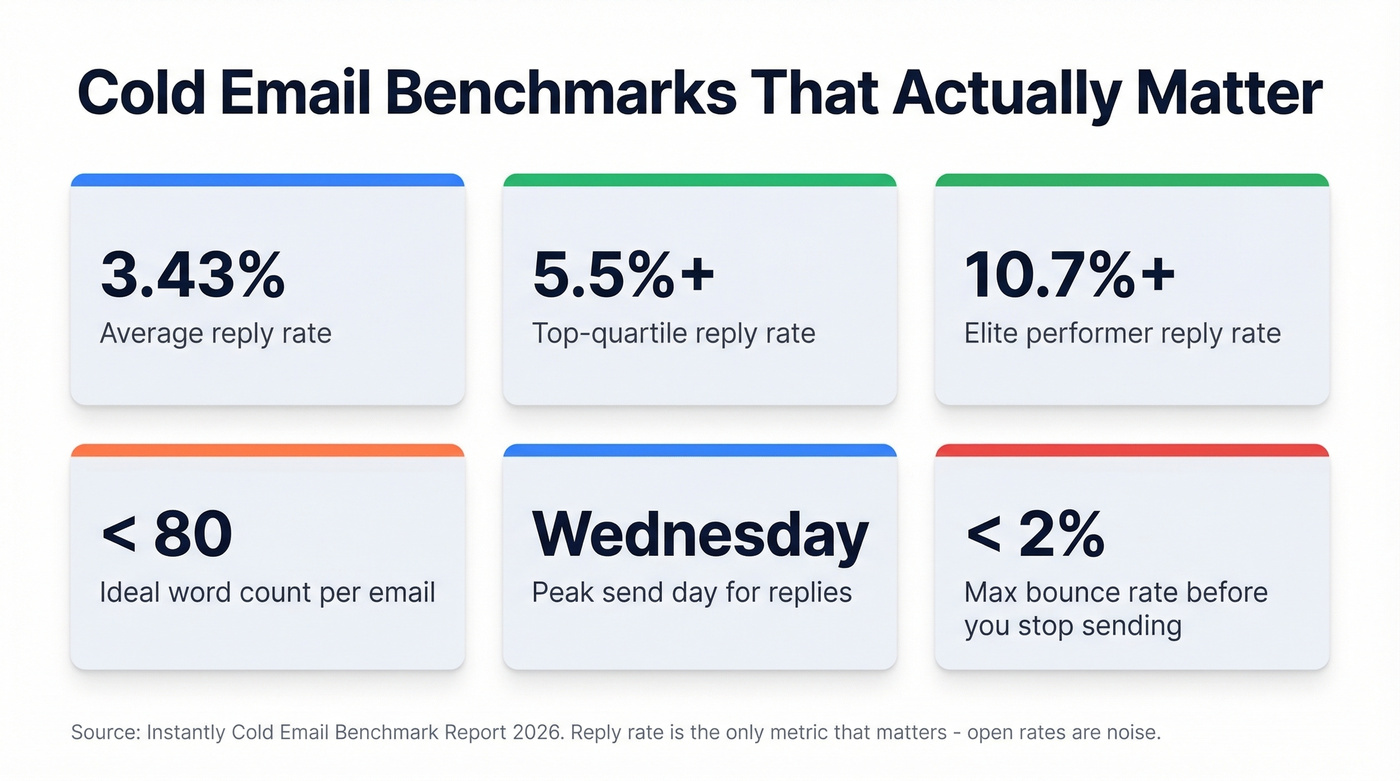
The takeaway isn't "copy this email." It's that small, targeted changes compound. We've seen teams fix nothing but their bounce rate and double their reply rate overnight - no copy changes at all. Test one variable at a time. Wednesday is the peak send day for replies. And keep emails under 80 words. (For a deeper breakdown, see the best time to send cold emails data.)
Before You Hit Send
Technical Setup
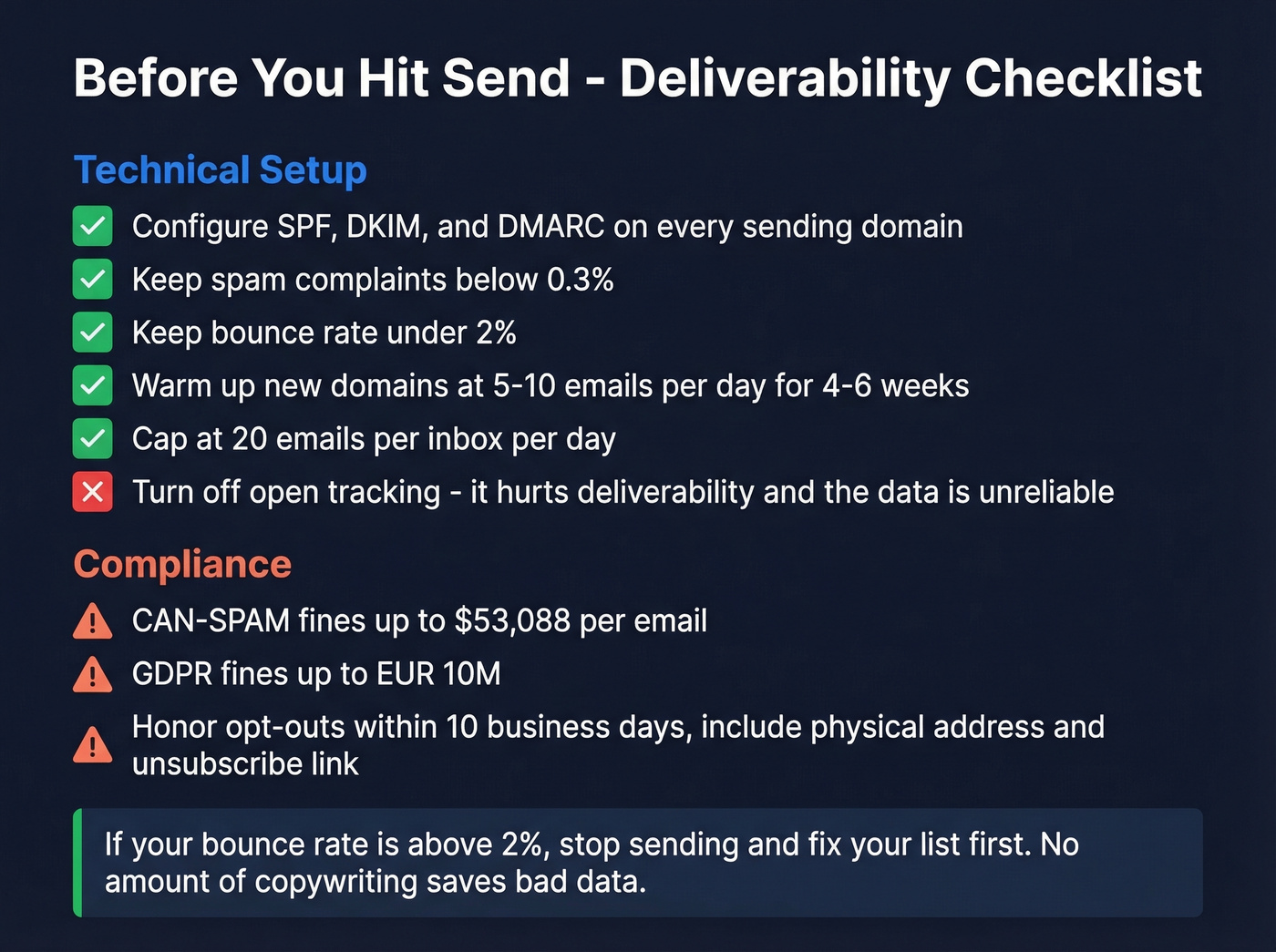
- Configure SPF, DKIM, and DMARC authentication on every sending domain (use this SPF record example if you’re unsure)
- Keep spam complaints below 0.3% and bounce rates under 2%
- Warm up new domains at 5-10 emails per day over 4-6 weeks
- Cap at 20 emails per inbox per day (more on safe email velocity limits)
- Turn off open tracking - it hurts deliverability and the data's unreliable anyway
Compliance
CAN-SPAM fines reach $53,088 per email. CASL hits $10M for businesses. GDPR goes up to EUR 10M. Honor opt-out requests within 10 business days and include a physical address and unsubscribe option in every message. (If you’re unsure where the line is, read Is it illegal to buy email lists?.)

Fix Your Data First
If your bounce rate is above 2%, stop sending and fix your list. Meritt, an outbound agency, saw bounce rates drop from 35% to under 4% after switching to Prospeo's verified data, and their pipeline tripled from $100K to $300K per week. That's not a copywriting win - it's a data quality win. Prospeo's free tier covers 75 email verifications per month, enough to run a small pilot on a sample list before committing. (If you’re comparing options, start with data enrichment services.)
Trigger-based intro emails only work when you reach the right person at the right moment. Prospeo tracks 15,000 intent topics and flags job changes, funding rounds, and headcount growth - so your observation line writes itself.
Find the trigger, find the email, send the intro that gets a reply.
FAQ
How long should an introduction email be?
Under 80 words. The 40-60 word range performs best - enough for a personalized hook, one value proposition, and a soft CTA. Emails over 100 words see measurably lower reply rates across every benchmark study we've reviewed.
What's a good reply rate for cold outreach?
Average is 3.43%. Below 3% means your deliverability or data needs work before you touch the copy. Top-quartile teams hit 5.5%+ by combining verified contact data with trigger-based personalization.
Can I use the same template for new business and renewals?
No. A new-business introduction earns attention from scratch - you're proving relevance to a stranger. Renewal emails lean on shared history and account-specific results. The underlying framework (observation to bridge to offer) stays the same, but the observation changes completely.
How do I keep sales emails out of spam?
Set up SPF, DKIM, and DMARC on your sending domain. Verify every address before sending to catch invalid addresses, spam traps, and honeypots before they damage your reputation. Warm up new domains over 4-6 weeks and keep spam complaints below 0.3%.